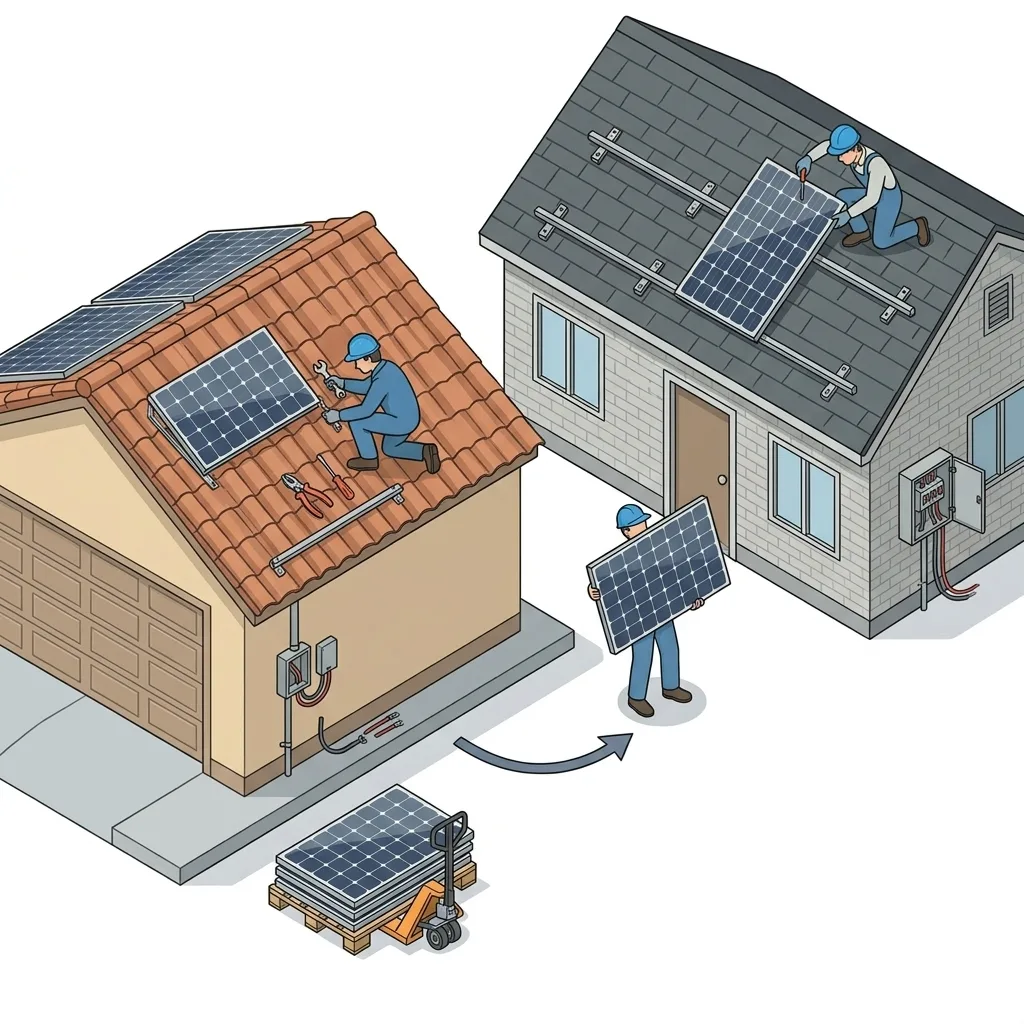
Moving to a new home raises a question that surprises a lot of solar owners: what do you do with the panels on your roof?
The instinct is to take them with you, you paid for them, they work, and leaving them behind feels like abandoning a major investment. But the economics of solar panel relocation are rarely as straightforward as they seem. In most cases, the combined costs of removing, transporting, and reinstalling an existing system approach or exceed the cost of installing a new one.
What relocation actually costs
Solar panel removal runs $200–$500 per panel, depending on roof type and system complexity. For a typical 20-panel residential system, removal alone costs $4,000–$10,000. Add transport ($500–$2,000 depending on distance), reinstallation at the new site ($3,000–$8,000), new permits and inspections ($150–$1,000), and potential roof repairs at the old home ($150–$1,000+), and the total lands in the range of $5,000–$15,000 or more.
By comparison, the average residential solar installation runs roughly $20,000 before state or local incentives. Panel module prices have dropped to historic lows: residential systems averaged $2.50 per watt in 2024, down more than 30% year-over-year, meaning new systems deliver more watts per dollar than anything installed even a few years ago.
Hidden costs
The sticker price of relocation understates the true cost in several ways.
Code compliance. An existing rooftop system is grandfathered under the electrical code in effect when it was installed. Once removed and reinstalled, local building departments treat it as a new installation subject to current NEC standards. That can mean adding rapid shutdown equipment, upgrading wiring, or replacing inverter components.
Warranty risk. Most panel manufacturers require their own certified installers to handle removal. If a different contractor does the work, the equipment warranty, typically 25 years, may be voided. Relocating panels without warranty protection creates an unquantified future liability.
Efficiency loss. Solar panels degrade at a median rate of roughly 0.75% per year, according to NREL's analysis of nearly 8 GW of U.S. solar assets. A 10-year-old system still generates power, but at roughly 93% of its original output, while a new system starts at 100% with panels that are meaningfully more efficient per square foot than what was available a decade ago.
Double permitting. Relocation requires a full permit cycle at both the removal site and the reinstallation site: structural engineering review, building permits, electrical permits, and inspections at each location.
The home-value offset
Homes with owned solar systems sell for a premium. Research from Lawrence Berkeley National Laboratory found that solar adds roughly $4 per watt to a home's sale price, approximately $15,000 for a typical residential system. Solar-equipped homes also tend to sell faster.
Leaving the panels on the old home captures that premium. In many cases, the sale price increase alone covers most or all of the cost of a new system at the next address.
When relocation might make sense
Relocation is not always the wrong call. The math can work when:
- The system is relatively new (under 3–5 years old), retaining most of its value and warranty.
- The move is local, keeping transport costs minimal.
- The original installer handles both removal and reinstallation, preserving warranties.
- Existing mounting hardware is compatible with the new roof.
For newer, smaller systems moved short distances by the original installer, relocation costs can stay in the $3,000–$5,000 range, well below the cost of a new installation.
Bottom line
For most homeowners moving, the practical path is to leave the panels on the old home, capturing the resale premium, and install a new system at the next address. New panels cost less per watt, produce more energy per square foot, come with full warranties, and are designed for the specific roof they sit on.
Relocation makes financial sense only in a narrow set of circumstances: new equipment, short move, original installer involved. For everyone else, the numbers favor starting fresh.