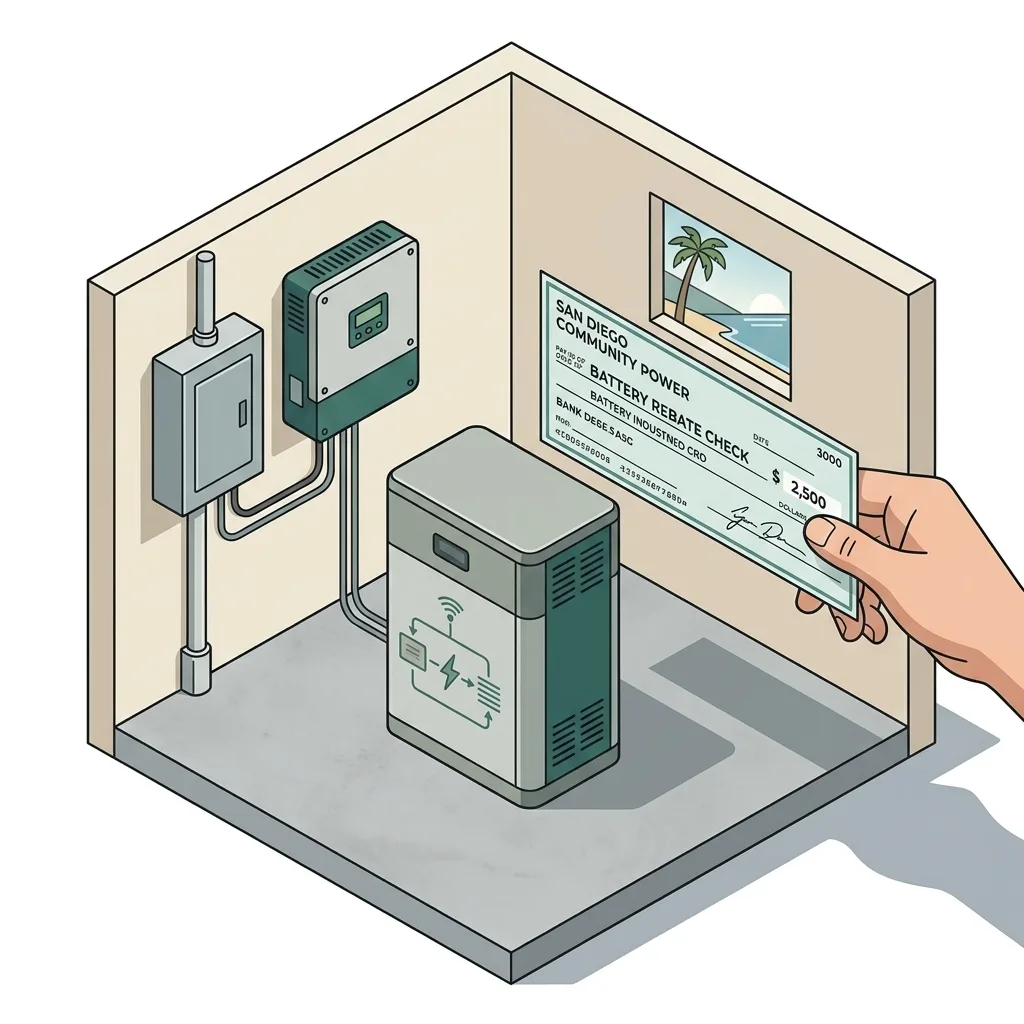
San Diego Community Power runs a program called Solar Battery Savings that pays homeowners upfront rebates and ongoing performance incentives for installing battery storage paired with solar panels. If you live in SDCP's service territory and have been considering battery storage, here is what the program requires and what it pays.
Who qualifies
The program is open to residential SDCP customers in single-family homes across the cities of San Diego, Chula Vista, Encinitas, Imperial Beach, La Mesa, National City, and unincorporated San Diego County.
There are two eligible installation paths:
- New solar-plus-battery installation. You install solar panels and a battery system at the same time.
- Adding a battery to existing solar. If you already have solar panels under a Net Energy Metering or Solar Billing Plan agreement, you can add a battery and still qualify.
Battery-only installations at homes with no solar panels are not eligible. The program requires batteries to be charged exclusively from on-site solar energy; grid charging is prohibited.
How much the rebate pays
Upfront rebates are calculated per kilowatt-hour of usable battery capacity:
| Scenario | Market rate | CARE/FERA/Communities of Concern |
|---|---|---|
| New solar + battery | $350/kWh | $500/kWh |
| Battery added to existing solar | $250/kWh | $350/kWh |
The maximum upfront rebate is $10,000 per system. For a Tesla Powerwall 3 with 13.5 kWh of usable capacity, the new-solar-plus-battery rebate at market rate comes to approximately $4,725. A 20 kWh sonnen system would receive approximately $7,000 at market rate or up to $10,000 for income-qualified households.
Beyond the upfront payment, the program pays $0.10 per kWh for battery discharge during the weekday dispatch window of 4:00 PM to 9:00 PM, when grid demand peaks. To earn the performance incentive, the battery must discharge at least 50% of its usable capacity during the window. Performance payments are issued annually in the first quarter of the following year.
The five-year commitment
Participants must remain enrolled for at least five years. Leaving early triggers prorated repayment of the upfront rebate: 100% in year one, declining to 20% by year four. Future performance incentives are also forfeited.
The program cannot be combined with other demand-response programs such as the Emergency Load Relief Program (ELRP) or Demand Side Grid Support (DSGS).
What the payback looks like
Battery storage in San Diego currently runs roughly $1,000–$1,100 per kWh installed, based on EnergySage marketplace data from early 2026. A typical 13.5 kWh system costs $12,000–$15,000 before incentives.
With SDG&E residential rates at roughly 42–46 cents per kWh and NEM 3.0 export credits averaging only 5–8 cents per kWh, the spread for time-of-use arbitrage is wider in San Diego than in most U.S. markets. Shifting solar energy from midday export to evening self-consumption can save an estimated $600–$900 per year depending on household load and battery size.
Stacking the SDCP upfront rebate, TOU savings, and the performance incentive, multiple installer analyses and at least one documented project show payback periods in the range of 5–7 years for solar-plus-battery installations. Without incentives, standalone battery payback stretches to 8–20 years.
One important change for 2026: the 30% federal Residential Clean Energy Credit under Section 25D expired on December 31, 2025. Homeowners installing battery storage this year no longer have that credit available, which makes programs like SDCP's comparatively more significant for project economics.
Practical considerations
The solar-only charging requirement creates a seasonal tension. In winter months with shorter days, generating enough solar energy to both power the home and charge the battery to meet the 50% discharge threshold can be difficult. The program requires at least 90% of enrolled capacity discharged monthly to qualify for the performance incentive.
Discharging half the battery every weekday evening also limits backup capacity for outages. Homeowners who value emergency resilience over grid-export savings should weigh this trade-off.
The program operates on a first-come, first-served basis within an annual budget cycle running July 1 through June 30. The current fiscal year is funded at $18.8 million, part of a nearly $55 million five-year commitment. When the budget is exhausted, new applications go on a waitlist; at least one installer has reported the program temporarily closing to new applications during a previous funding cycle.
Only batteries from the SDCP-approved product list are eligible. Current approved manufacturers include Tesla, Enphase, FranklinWH, sonnen, Qcells, and Fortress Power, among others. Using an unapproved battery or contractor can disqualify the application entirely.
How to apply
Applications are submitted by the installer, not the homeowner. The typical process:
- Choose an SDCP-approved installer and a battery from the qualified product list.
- The installer submits an application to reserve the rebate before installation begins.
- SDCP reviews the application within 10 business days.
- After approval, the installation proceeds.
- The installer submits a project installation package upon completion.
- The rebate check is issued within 30 business days of package approval.
SDCP can be reached at SolarBatterySavings@SDCommunityPower.org for program questions.