The American roof is changing. What was once merely a protective layer against rain and snow has evolved into a dynamic asset, a mini-power plant capable of harvesting sunlight and running a modern household. For homeowners across the United States, the decision to go solar is driven by a mix of rising utility bills, a desire for environmental stewardship, and—increasingly—a need for security against a fragile electrical grid. In this bustling marketplace of panels, wires, and batteries, one name often rises to the top of the conversation: Enphase Energy.
Navigating the solar industry can feel like learning a new language. You encounter terms like "kilowatt-hours," "clipping," "net metering," and "time-of-use rates." It can be overwhelming. This report is designed to cut through that noise. We aren't just looking at spec sheets; we are going to explore the Enphase ecosystem from the ground up (or rather, the roof down). We will look at how the technology works, why it is different from the old-school methods, how it stands up to harsh weather and grid failures, and what real homeowners—your neighbors—are saying about it after the installation trucks drive away.
Whether you are just starting to gather quotes or are ready to sign a contract, this guide will provide the exhaustive detail necessary to make an informed decision. We will explore the "microinverter" revolution that Enphase pioneered, the nuances of their battery storage, the reality of their "sunlight backup" technology, and the hard numbers behind the costs and warranties.
The Problem with "Old School" Solar
To understand why Enphase exists, we have to look at how solar used to be done. For decades, the standard method for wiring solar panels was the "string inverter" system. Imagine a string of old Christmas lights. You connect one panel to the next, creating a long chain or "string" of high-voltage direct current (DC) electricity. 1 This string runs across your roof, down the side of your house, and into a single, large box on the wall called a central inverter.
This system is simple and relatively cheap, but it has a massive flaw: the "Christmas light effect." In a series circuit, electricity has to flow through every single component. If one panel gets covered by leaves, shaded by a chimney, or covered in bird droppings, it creates a blockage. The electrical flow for the entire string drops to the level of that one weak panel. 1 If one panel is working at 50% capacity, the other ten panels in that string might be forced down to 50% capacity, even if they are in full sun.
Furthermore, string inverters involve running dangerous high-voltage DC power (often up to 600 or 1,000 volts) across your roof. 3 This creates safety concerns regarding arc faults—high-power electrical sparks that can start fires—and makes the system dangerous for firefighters to be around during an emergency.
The Enphase Solution: The Microinverter
Enphase took a different approach. Instead of one big inverter on the wall, they shrunk the technology down to the size of a paperback book. They placed one of these "microinverters" underneath each individual solar panel on the roof. 4
This was a paradigm shift. By converting the DC electricity from the sun into household-ready Alternating Current (AC) electricity right there on the roof, Enphase solved the "Christmas light" problem. Each panel operates independently. If a tree shades the bottom left corner of your array, those panels produce less power, but the panels five feet away in full sunlight keep humming along at 100% capacity. 1
This decentralized approach is the heart of the Enphase value proposition. It offers higher energy production in real-world conditions (where shade and dirt are inevitable), greater safety (no high-voltage DC on the roof), and granular monitoring that lets you see the heartbeat of every single panel. But as we will see, this premium technology comes with a premium price tag. Is it worth it? Let's dive in.
---
Chapter 2: The Heart of the System – Microinverter Technology
At the core of an Enphase system is the microinverter. While it might look like a simple black box bolted to the racking under your panels, it is a sophisticated piece of power electronics designed to survive in a brutal environment.
Surviving the Roof: Reliability and Heat
One of the first questions skeptical homeowners ask is, "Why would I put complex electronics on my roof, where it gets incredibly hot?" It is a valid concern. Electronics generally hate heat. A central string inverter sits in your cool garage or on a shaded wall. A microinverter bakes in the sun all day. 5
However, the engineering reality is nuanced. A central string inverter is processing thousands of watts of power—the entire output of your roof. This generates a massive amount of internal heat that must be managed with fans and large heatsinks. A microinverter, by contrast, only handles the power of one panel (typically 300 to 500 watts). Because the power load is so much smaller, the internal heat generation is lower. 5
Enphase has tackled the reliability challenge through rigorous testing. They claim a Mean Time Between Failures (MTBF) of over 300 years. 1 Now, this doesn't mean your specific inverter will last until the year 2325. MTBF is a statistical measure of reliability across a large population. In practical terms, field data suggests a failure rate of about 0.05% annually—roughly one in every 2,000 units. 2
Compare this to string inverters. Central inverters typically have a lifespan of 10 to 15 years. It is widely accepted in the industry that if you buy a string inverter system, you will replace that central box at least once during the 25-year life of your solar panels. 1 That replacement can cost $2,000 to $3,000. 4 With Enphase, while individual units might fail, the system as a whole keeps running. If one microinverter dies, you lose the production of one panel (perhaps $0.15 of electricity per day) until it is fixed. If a string inverter dies, your entire system produces zero power until the repair is made. 2
The IQ Series Evolution
Enphase technology has evolved through several "generations." The current standard for most installations is the IQ8 Series, though the previous IQ7 Series is still widely deployed and supported.
IQ7 vs. IQ8: The "Grid-Forming" Leap
The IQ7 was a fantastic grid-tied inverter. It converted power efficiently and reliably. But it had the same limitation as almost every other solar inverter in history: it was "grid-following." This means it relied on the utility grid to provide a steady frequency signal to operate. If the grid went down (during a blackout), the IQ7 had to shut down immediately for safety. 6
The IQ8 Series introduced a revolutionary capability: it is "grid-forming." Using proprietary, high-speed chips, the IQ8 can generate its own AC waveform. 7 This allows it to create a "microgrid" in your home. We will discuss the specific feature of "Sunlight Backup" in the next chapter, but the key takeaway is that the IQ8 is smarter and faster than its predecessors, capable of reacting to changes in electrical load in milliseconds.
Clipping: Why is My Inverter Smaller than My Panel?
If you look closely at your solar quote, you might notice something that looks like a mistake. You might be buying 400-watt solar panels, but the installer is pairing them with Enphase IQ8+ microinverters that have a maximum output of only 290 watts. 8
You might think, "Am I paying for 400 watts but only getting 290? That's a rip-off!"
This phenomenon is called clipping, and it is actually a deliberate design choice. Here is why:
- Lab vs. Real World: That "400-watt" rating on the panel is determined in a laboratory with a flash of light at a perfect temperature (Standard Test Conditions or STC). In the real world, panels get hot, and heat reduces efficiency. On a typical sunny day, a 400W panel might only produce 320W or 330W.
- The Bell Curve: Solar production follows a bell curve. It is low in the morning, peaks at noon, and drops in the evening. The panel only hits its maximum output for a very short window in the middle of the day.
- Efficiency Zones: Inverters are like car engines; they run most efficiently at a certain "RPM." A smaller inverter runs more efficiently at low power levels (morning, evening, cloudy days), which is where your system spends most of its time.
- The Trade-Off: By using a slightly smaller inverter, you capture more energy in the mornings and evenings. You might "clip" or lose a tiny bit of energy at high noon on perfect spring days, but you gain more energy throughout the rest of the year. Studies show the loss from clipping is often less than 1% of total annual production, while the cost savings of using the smaller inverter makes the system cheaper. 8
So, if your DC-to-AC ratio is around 1.2 or 1.3 (panel wattage divided by inverter wattage), your installer has likely designed the system correctly.
Table 1: Technical Comparison of Inverter Architectures
| Feature | Enphase Microinverters (IQ8) | Traditional String Inverter (e.g., SMA) | Optimized String (e.g., SolarEdge) |
|---|---|---|---|
| Point of Conversion | At every panel (DC to AC) | One central wall unit (DC to AC) | At central unit (Optimizers condition DC) |
| Shade Tolerance | Excellent: Only shaded panel drops output | Poor: Entire string drops to weakest link | Good: Optimizers mitigate most shade issues |
| System Reliability | High: Distributed failure points. One failure = one panel down. | Moderate: Central point of failure. One failure = system down. | Moderate: Central inverter can still fail, taking system down. |
| Safety | Best: Low voltage AC on roof. No arc fault risk. | Riskier: High voltage DC (600V+) on roof. | Better: "SafeDC" drops voltage when off, but still DC on roof. |
| Expandability | Easy: Add panels one by one. Modular. | Difficult: Limited by central inverter capacity. | Difficult: Limited by central inverter capacity. |
| Warranty | 25 Years (Standard) | 10-12 Years (Standard) | 12 Years Inverter / 25 Years Optimizers |
1
---
Chapter 3: The "Sunlight Backup" Feature – Promise vs. Reality
One of the most heavily marketed features of the new IQ8 microinverters is "Sunlight Backup." It sounds like magic: if the grid goes down during the day, your solar panels keep working, powering your home even if you don't have a battery.
How It Works
Traditional solar inverters shut off during a blackout to prevent electrocuting utility workers (a requirement called "anti-islanding"). The IQ8, however, when paired with an IQ System Controller, can physically disconnect your house from the grid and form its own microgrid. 7 It adjusts its power output thousands of times a second to match exactly what your house is using.
The Limitations: What They Don't Always Tell You
While technologically impressive, the user experience of Sunlight Backup without a battery can be rocky.
- Clouds are Kryptonite: If a cloud passes over your house, solar production drops instantly. If your house is using more power than the panels can generate at that exact second, the microgrid collapses. The lights go out. 11
- Motor Loads Struggle: Appliances with motors (like a refrigerator compressor or a well pump) require a huge surge of power to start up. Without a battery to provide that instant "kick," the solar panels alone often cannot handle the surge, causing the system to trip. 12
- Essential Loads Only: You cannot power your whole house. You must install a "load controller" to physically turn off heavy appliances like your A/C or dryer during an outage. You are limited to backing up perhaps four 240V circuits or eight 120V circuits (lights, fridge, router). 7
Real-World Feedback: Homeowners on forums like Reddit often describe Sunlight Backup as a "nice to have" but not a primary reliability strategy. One user noted, "One cloud and the whole thing fails." Another pointed out that the cost of the extra hardware (System Controller + Load Controllers) is significant, and that money might be better spent on a small battery. 11
The Verdict: Sunlight Backup is a bridge, not a destination. It provides a layer of resilience that other inverters don't have, but for a true blackout solution, you really need to pair it with a battery.
---
Chapter 4: Energy Storage – The IQ Battery Ecosystem
If you want power at night, or stable power during a blackout, you need batteries. Enphase offers the IQ Battery line (formerly known as Encharge).
Safety First: The LFP Advantage
A critical distinction in the battery market is chemistry. Many early home batteries (and many electric cars) use NMC (Nickel Manganese Cobalt) chemistry. While powerful, NMC batteries have a lower thermal runaway threshold—meaning they are more prone to catching fire if damaged or overheated.
Enphase uses LFP (Lithium Iron Phosphate) chemistry. 14 LFP is widely regarded as the safer option for home storage. It is extremely difficult to force an LFP battery into thermal runaway. It also lasts longer, typically enduring 6,000+ charge cycles compared to the ~3,000 cycles of NMC batteries. This is why Enphase offers a 15-year warranty on their batteries, significantly longer than the industry-standard 10 years offered by Tesla or LG. 14
The Lineup: 5P vs. 10T
Enphase currently supports two main generations of batteries, and the difference matters.
1. The Legacy Models (IQ Battery 3T / 10T)
These are the second-generation units. They are reliable but have a weakness: Power Output.
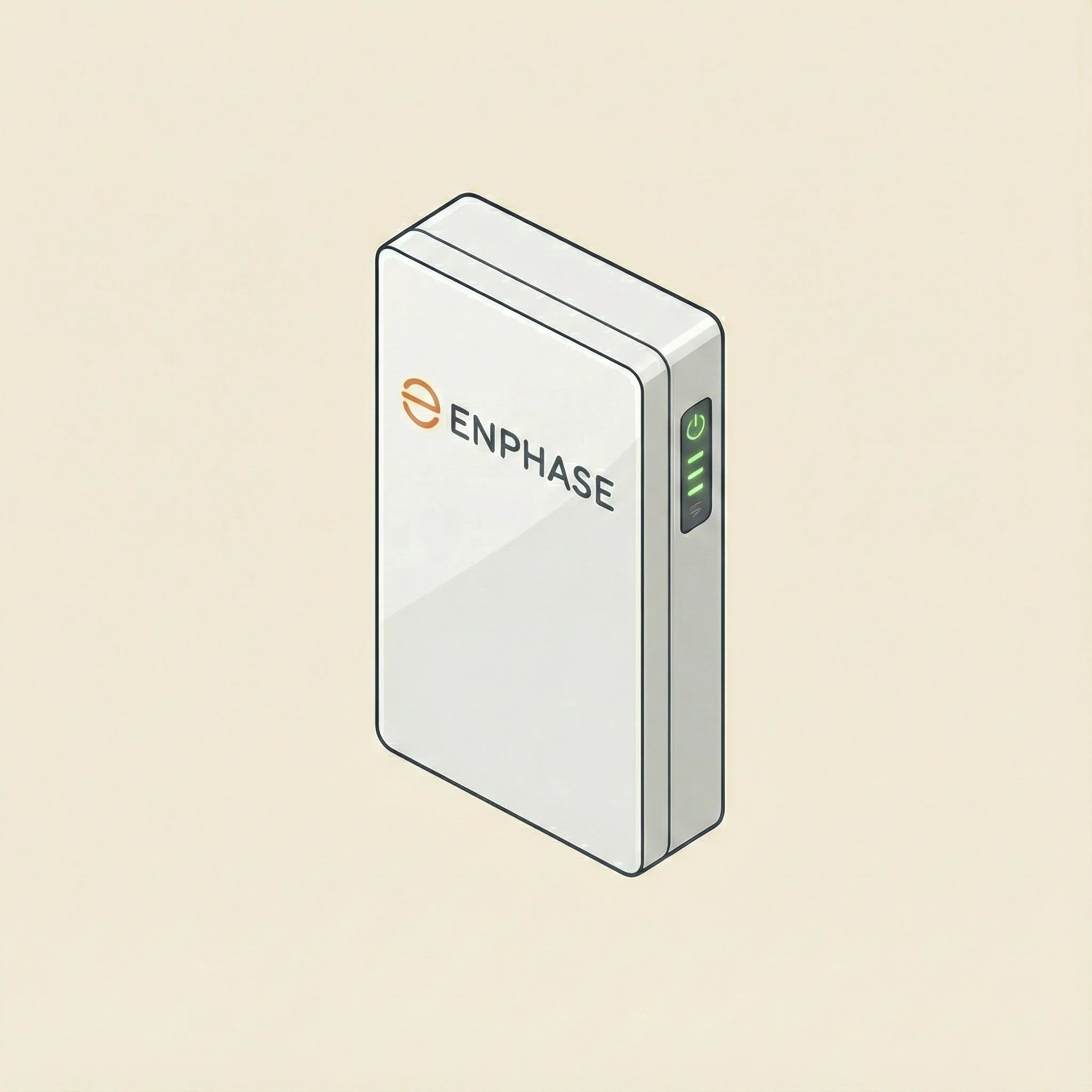
- The IQ Battery 10T holds a lot of energy (10 kWh), but it releases it slowly. It has a continuous power output of only 3.84 kW. 16
- Why this matters: A central Air Conditioner might need 5 kW or 6 kW to run. A single 10T battery cannot run it. You would need to buy two 10T batteries just to turn on your A/C, even if you didn't need that much storage capacity.
2. The New Standard (IQ Battery 5P)
Released recently, the IQ Battery 5P is a game-changer. It is smaller (5 kWh capacity), but it is much more powerful.
- High Power: A single 5P unit delivers the same continuous power (3.84 kW) as the massive 10T. 15
- Surge Capability: It can surge up to 7.68 kW for 3 seconds. This allows it to start heavy motors (like A/C units or pumps) that the older batteries couldn't handle. 14
- Cost Effective: Because of this high power density, you don't need to over-buy storage just to start your appliances.
Table 2: IQ Battery 5P vs. Tesla Powerwall 3
| Feature | Enphase IQ Battery 5P | Tesla Powerwall 3 |
|---|---|---|
| Usable Capacity | 5.0 kWh | 13.5 kWh |
| Continuous Power | 3.84 kW | 11.5 kW |
| Surge Power | 7.68 kW (3 sec) | ~30 kW (claimed) |
| Chemistry | LFP (Safer, longer life) | LFP (Powerwall 3 switched to LFP) |
| Warranty | 15 Years / 6,000 Cycles | 10 Years / Unlimited Cycles |
| Inverter Type | AC Coupled (Works with any solar) | Integrated Hybrid Inverter |
| System Expansion | Highly Modular (Stack 5 kWh at a time) | Less Modular (Stack 13.5 kWh units) |
| Typical Cost | ~$4,000 - $5,000 (Hardware Only) | ~$8,000+ (Hardware Only) |
18
The Comparison: The Tesla Powerwall 3 is a brute. It offers massive power and capacity in a single box, often at a better price-per-kWh. However, the Enphase 5P offers modularity. If you only need a little backup, you can buy one 5P. You can't buy "half a Powerwall." Enphase also wins on warranty length (15 years vs 10 years).
Storm Guard: A Smart Feature with Growing Pains
The Enphase battery system includes a software feature called Storm Guard. It monitors National Weather Service alerts for your zip code. If a hurricane, heat wave, or blizzard warning is issued, the system automatically stops discharging the battery and charges it to 100% from the grid to prepare for a potential outage. 14
User Experience: While brilliant in theory, user reviews on Reddit highlight frustration with the execution. Users complain that it is overly sensitive, triggering "Full Backup" mode for minor wind advisories or distant storms. This forces the battery to charge from the grid (potentially at expensive peak rates) for outages that never happen. Users have repeatedly asked for more granular control to "opt-out" of specific alert types. 21
---
Chapter 5: The Digital Experience – Enlighten App & Gateway
The solar panels are the muscle, but the IQ Gateway (formerly known as the Envoy) is the brain. This small device, usually installed in a combiner box on the side of your house, collects all the data and sends it to the cloud.
The "Game" of Monitoring
The Enphase App (Enlighten) is widely considered the gold standard for solar monitoring. Unlike some competitors that only show you a total system number, Enphase gives you Panel-Level Visibility. 24
- The Array Tab: You see a virtual map of your roof. You can tap on every single panel to see exactly how many watt-hours it produced today.
- Why this is cool: It gamifies energy. You can see exactly when the shadow from your neighbor's oak tree hits your roof. You can see if a panel is dirty.
- Why this is useful: If a panel fails, you know instantly. With string inverters, you might not know a panel is down for months because the total system output only drops slightly.
Consumption Monitoring: The Missing Link
Crucial Advice: When you get a quote, ensure it includes Consumption CTs (Current Transformers). These are small sensors installed in your main electrical panel. 16
- Without them, the app only shows what you made (Production).
- With them, the app shows what you used (Consumption).
This allows you to see your "Net Energy" status. Are you importing from the grid? Exporting? Without this data, you are flying blind regarding your actual utility bill savings. Many installers skip this because it takes extra time to install. Insist on it. 24
Connectivity Headaches
The most common complaint from Enphase owners isn't about power—it's about Wi-Fi. The Gateway connects to your home router to send data. If you change your Wi-Fi password or get a new router, the Gateway disconnects.
- The Frustration: The app will say "Gateway Not Reporting." Your solar is still working! The microinverters are still making power. But you can't see it on your phone.
- The Fix: Reconnecting the Gateway can be tricky for non-tech-savvy users, often requiring you to go outside, press buttons on the box, and use a special mode on your phone. Reviews often cite this as a major annoyance. 26
---
Chapter 6: The Economics – Costs, ROI, and Value
Let's talk money. Enphase is a premium product, and that is reflected in the price.
The "Enphase Premium"
In general, an Enphase system will cost 20% to 30% more upfront than a comparable string inverter system (like a basic SMA or Fronius setup). 4
- SolarEdge Comparison: A SolarEdge system (string inverter + optimizers) is usually the direct competitor. Enphase systems typically cost roughly $2,000 to $4,000 more than SolarEdge for a standard residential size (6kW - 10kW). 28
Cost Estimates (2025 Data)
For a standard 12 kW residential system in the US, the average cost before incentives is around $29,650 (approx. $2.50 - $3.00 per watt). 29
- Microinverter Cost: An individual IQ8 microinverter costs roughly $150 - $200 per unit at retail pricing (though installers buy in bulk). 30
- Battery Cost: An IQ Battery 5P retails for approximately $4,000 - $5,000 for the hardware alone. Installation adds significantly. 19
The Long-Term ROI Calculation
If Enphase costs more upfront, why do people buy it? The argument lies in the 25-Year Horizon.
- Replacement Costs: A string inverter has a 10-12 year warranty. You will likely pay $2,500+ to replace it in Year 12. Enphase microinverters have a 25-year warranty. When you factor in the cost of that mid-life replacement for the string system, the price gap narrows or disappears. 4
- Production Yield: Because of the shade tolerance and early wake-up (Burst Mode), Enphase systems often produce 5-20% more energy over the life of the system. 1 More energy = more savings on your bill.
- Expansion: If you decide to add 5 more panels in Year 5 because you bought an EV, Enphase makes this easy. You just add 5 panels and 5 micros. With a string inverter, your central unit might be maxed out, requiring you to buy a whole new, larger inverter. 10
The Verdict on Value: If you are flipping a house in 5 years, buy the cheaper string inverter system. If you plan to live in the home for 15-20 years, Enphase offers a better Total Cost of Ownership (TCO).
---
Chapter 7: Installation, Expansion, and Scalability
One of the hidden benefits of the Enphase architecture is how flexible it makes the installation process.
The "Plug and Play" Expansion
Adding panels to an existing Enphase system is remarkably straightforward compared to other technologies.
- Scenario: You have 20 panels. You buy a Rivian and need more power.
- Enphase Process: The installer mounts new panels, plugs in new microinverters, and wires them into the combiner box. As long as your main service panel has room for another breaker (or the existing combiner has spare slots), it is a simple day's work. 31
- Combiner Limits: The IQ Combiner box typically has 4 slots for solar circuits. Each circuit can handle a certain number of microinverters (e.g., 13 IQ8+ units per 20A breaker). 31 As long as you don't exceed these limits, expansion is easy.
- Mixing Models: You can even mix older IQ7 panels with new IQ8 panels on the same roof (though they usually need separate branches). This backward compatibility is a huge asset. 33
The Labor Warranty: A Critical Detail
Warranties have fine print. A "25-year warranty" usually covers the part, not the labor to climb onto the roof and swap it. This can lead to a nasty surprise where you get a free replacement inverter but a $300 bill from the electrician.
Enphase addresses this with a Labor Reimbursement Program.
- The Deal: If a unit fails, Enphase pays the installer a fixed fee (e.g., $200 per truck roll + $25 per microinverter) to perform the swap. 34
- The Catch: This coverage typically lasts for 2 years to 10 years depending on the specific product and whether your installer is part of the "Enphase Installer Network" (Silver/Gold/Platinum tiers). 36
- Advice: Ask your installer explicitly: "Are you an Enphase Network installer? Does my warranty include labor reimbursement, and for how many years?" 36
---
Chapter 8: Reliability and Customer Sentiment
What is it actually like to live with this system? We scoured consumer reports, BBB complaints, and forums to find the truth.
The Good
- "Set It and Forget It": The vast majority of reviews are boring—in a good way. The system works, the bill goes down, and the app shows the data. Reliability is generally very high. 37
- Customer Support: Unlike some tech giants that are impossible to reach, Enphase support receives praise for being responsive. Users report that Enphase support agents can remote-in to their systems, diagnose issues, and even push firmware updates to fix problems while on the phone. 26
The Bad
- Gateway Failures: The Envoy/Gateway is the weak link. If it dies (and it has a shorter 5-year warranty), you lose monitoring. While the solar keeps working, flying blind is stressful. 38
- Communication Noise: Since the system talks over your home's power lines, "noise" from cheap electronics (like bad LED light dimmers or old refrigerator motors) can sometimes jam the signal, causing data gaps in the app. This can be frustrating to diagnose. 39
- Storm Guard Anxiety: As noted in the battery section, the lack of control over Storm Guard is a major pain point for battery owners who feel the system is wasting their money by charging from the grid too often. 22
The Safety Advantage: Rapid Shutdown
We cannot overstate the safety benefit. In 2017 and 2020, the National Electrical Code (NEC) updated "Rapid Shutdown" rules to protect firefighters. Solar systems must be able to de-energize the roof conductors instantly in an emergency.
Because Enphase microinverters are right next to the panel, when the power is cut, the only live electricity is inside the panel itself. The wires running across your attic and roof go dead instantly. String inverters often require extra "shutdown boxes" to meet this code, adding complexity and cost. 40 For a homeowner concerned about fire safety, Enphase is the gold standard.
---
Conclusion: Is Enphase Right for You?
Enphase Energy has effectively positioned itself as the "Apple" of the residential solar world. Their products are integrated, user-friendly, high-tech, and come with a premium price tag. They prioritize safety, granular data, and modularity over raw cheapness.
You should choose Enphase if:
- You have a complex roof: If you have dormers, chimneys, or panels facing multiple directions (East/West/South), the independent control of microinverters is non-negotiable.
- You have shading: Trees, neighbors, or power lines casting shadows make string inverters a bad choice.
- You plan to expand: If you see an EV or heat pump in your future, the modularity of Enphase will save you thousands later.
- You value safety: The low-voltage AC architecture and LFP battery chemistry offer the highest safety profile in the industry.
- You are a data geek: If you want to see exactly what every single panel is doing, Enphase is the only game in town.
You might consider alternatives (like Tesla or SolarEdge) if:
- Budget is #1: If you have a perfect, unshaded, south-facing roof and just want the fastest ROI, a string inverter will be cheaper and perform almost as well.
- You need massive backup: If you want to back up a large mansion for days, the sheer density and cost-per-kWh of the Tesla Powerwall 3 might be a better fit than stacking multiple Enphase 5P batteries.
Ultimately, going solar is a 25-year commitment. The "Enphase Premium" is essentially an insurance policy—a payment for reliability, safety, and flexibility over those two-and-a-half decades. For most American homeowners, that is a price worth paying.
Works cited
- Microinverter vs String Inverter: Choosing the Best Option – 1KOMMA5, accessed December 9, 2025, https://1komma5.com/au/solar/enphase-micro-inverters-vs-string-inverter-even-unshaded-roof/
- Types of solar inverters: microinverters vs string inverters – Enphase, accessed December 9, 2025, https://enphase.com/learn/home-energy/solar-basics/types-solar-inverter-microinverter-string-inverters
- SolarEdge string inverters+optimizers, vs. Enphase microinverters : r/solar – Reddit, accessed December 9, 2025, https://www.reddit.com/r/solar/comments/1jlyshl/solaredge_string_invertersoptimizers_vs_enphase/
- Enphase Micro Inverter Complete Guide 2025: Models & Performance – SolarTech, accessed December 9, 2025, https://solartechonline.com/blog/enphase-microinverter-complete-guide/
- Microinverters vs String Inverters (A data-driven approach) – Solar Insure, accessed December 9, 2025, https://www.solarinsure.com/microinverters-vs-string-inverters
- Debunking myths about solar energy performance | Enphase, accessed December 9, 2025, https://enphase.com/blog/homeowners/debunking-myths-about-solar-energy-performance
- Understanding Sunlight Backup system for homeowners | Enphase, accessed December 9, 2025, https://enphase.com/download/understanding-sunlight-backup-system-homeowners
- Microinverter vs Optimizer ? : r/solar – Reddit, accessed December 9, 2025, https://www.reddit.com/r/solar/comments/1aelb60/microinverter_vs_optimizer/
- Enphase vs SolarEdge: Which Is Better? – SolarThoughts, accessed December 9, 2025, https://solarthoughts.com.au/enphase-vs-solaredge/
- Enphase vs. SolarEdge: Which One Should You Buy? – Solar Optimum, accessed December 9, 2025, https://solaroptimum.com/enphase-vs-solaredge-which-one-should-you-buy/
- Do Sunlight Backup [iQ8] without a battery? : r/solar – Reddit, accessed December 9, 2025, https://www.reddit.com/r/solar/comments/11mxf8c/do_sunlight_backup_iq8_without_a_battery/
- Is Enphase Sunlight Backup Worth It Without Batteries? – YouTube, accessed December 9, 2025, https://www.youtube.com/watch?v=AFLveJabNFU
- Understanding Sunlight Backup system for homeowners – Enphase, accessed December 9, 2025, https://enphase.com/homeowners/sunlight-backup-user-guide
- Enphase IQ Battery Complete Guide 2025: Models, Pricing & Performance – SolarTech, accessed December 9, 2025, https://solartechonline.com/blog/enphase-iq-battery-complete-guide/
- IQ Battery 5P – Enphase, accessed December 9, 2025, https://enphase.com/store/storage/gen3/iq-battery-5p
- Enphase IQ Batteries: Features, Installation, and Cost | Solar.com, accessed December 9, 2025, https://www.solar.com/learn/enphase-batteries/
- Enphase IQ Battery 5P – ShopSolar: Complete Solar Kits + Lifetime Customer Support, accessed December 9, 2025, https://shopsolarkits.com/products/enphase-iq-battery-5p
- Enphase 5P Vs. Tesla Powerwall 3: What's the best battery for solar?, accessed December 9, 2025, https://www.virtuesolar.com/2024/09/05/enphase-5p-vs-tesla-powerwall-3/
- Tesla Powerwall 3 vs. Enphase IQ Battery 5P: A Comparison | Solar Discovery, accessed December 9, 2025, https://solarpricediscovery.com/tesla-powerwall-3-vs-enphase-iq-battery-5p-a-comparison/
- Enphase IQ 5P vs. Tesla Powerwall 3 – Energy Matters, accessed December 9, 2025, https://www.energymatters.com.au/renewable-news/enphase-iq-5p-vs-tesla-powerwall-3/
- Storm Guard unusable? – r/enphase, accessed December 9, 2025, https://www.reddit.com/r/enphase/comments/1ooofsb/storm_guard_unusable/
- Commissioned my batteries last night. 12 hours later I already hate Storm Guard and will be disabling it. – r/enphase, accessed December 9, 2025, https://www.reddit.com/r/enphase/comments/1nwvv3v/commissioned_my_batteries_last_night_12_hours/
- Enphase Overriding My Storm Guard Setting – Reddit, accessed December 9, 2025, https://www.reddit.com/r/enphase/comments/1htq2f3/enphase_overriding_my_storm_guard_setting/
- Get to know the Enphase app, accessed December 9, 2025, https://enphase.com/learn/home-energy/using-your-system/get-know-enphase-app
- IQ Envoy™, a communications gateway for an intelligent energy system communication – Enphase, accessed December 9, 2025, https://enphase.com/en-ph/installers/communication/iq-envoy
- Enphase Energy – Profile & Reviews – 2025 – EnergySage, accessed December 9, 2025, https://www.energysage.com/supplier/150/enphase-energy/
- Enphase Enlighten – Apps on Google Play, accessed December 9, 2025, https://play.google.com/store/apps/details?id=com.enphaseenergy.myenlighten
- Enphase vs SolarEdge vs A Standard String Inverter – 1KOMMA5, accessed December 9, 2025, https://1komma5.com/au/solar/enphase-price-vs-solaredge-a-standard-system/
- Solar Panel Cost In 2025: It May Be Lower Than You Think | EnergySage, accessed December 9, 2025, https://www.energysage.com/local-data/solar-panel-cost/
- 2025 Solar Panel Costs: Ultimate Guide to Pricing and Savings Strategies, accessed December 9, 2025, https://www.solar.com/learn/solar-panel-cost/
- Adding panels to existing system : r/enphase – Reddit, accessed December 9, 2025, https://www.reddit.com/r/enphase/comments/1akqxb2/adding_panels_to_existing_system/
- How do I add panels to my system? Installers don't seem interested in doing this., accessed December 9, 2025, https://support.enphase.com/s/question/0D5Ps00000jTr0kKAC/how-do-i-add-panels-to-my-system-installers-dont-seem-interested-in-doing-this
- Why it may be worth it to add solar panels to your existing system – Enphase, accessed December 9, 2025, https://enphase.com/blog/homeowners/add-solar-panels-existing-system
- Labor Reimbursement for Warranty Service | Enphase, accessed December 9, 2025, https://enphase.com/download/labor-reimbursement-warranty-service-2022-06-14-v3
- Labor reimbursement for warranty service – Enphase, accessed December 9, 2025, https://enphase.com/en-au/download/labor-reimbursement-anz
- Labor Protection Program | Enphase, accessed December 9, 2025, https://enphase.com/legal/labor-protection-program
- Enphase Energy Reviews 397 – Trustpilot, accessed December 9, 2025, https://www.trustpilot.com/review/enphase.com
- Enphase Energy, Inc. | BBB Complaints | Better Business Bureau, accessed December 9, 2025, https://www.bbb.org/us/ca/petaluma/profile/solar-energy-equipment-dealers/enphase-energy-inc-1116-360280/complaints
- Enphase IQ Gateway (Envoy) Metered + DRM – AC Solar Warehouse, accessed December 9, 2025, https://www.acsolarwarehouse.com/shop/enphase-envoy-s-metered-19726
- Understanding Rapid Shutdown for solar – Enphase, accessed December 9, 2025, https://enphase.com/blog/homeowners/understanding-rapid-shutdown-solar
- How Important is Rapid Shutdown in a Solar Panel Energy System?, accessed December 9, 2025, https://www.pscenergy.com.au/blog/how-important-is-rapid-shutdown-in-a-high-voltage-dc-solar-system/