Plug-in balcony solar — small, portable solar panels that connect to a standard wall outlet — is experiencing a regulatory breakthrough in the United States after years of legal limbo. Over 30 states have introduced legislation to legalize these systems in 2025–2026, 1 2 with Utah becoming the first state to pass a dedicated law in March 2025 3 and Virginia following in March 2026. 4 5 Yet the US remains far behind Europe, where Germany alone has more than one million registered balcony solar systems. The convergence of new safety standards (UL 3700, launched January 2026), 4 an expanding product ecosystem, and the expiration of the federal residential solar tax credit is reshaping the calculus for millions of American renters and homeowners looking for an affordable entry point into solar energy.
What balcony solar actually is and how it works
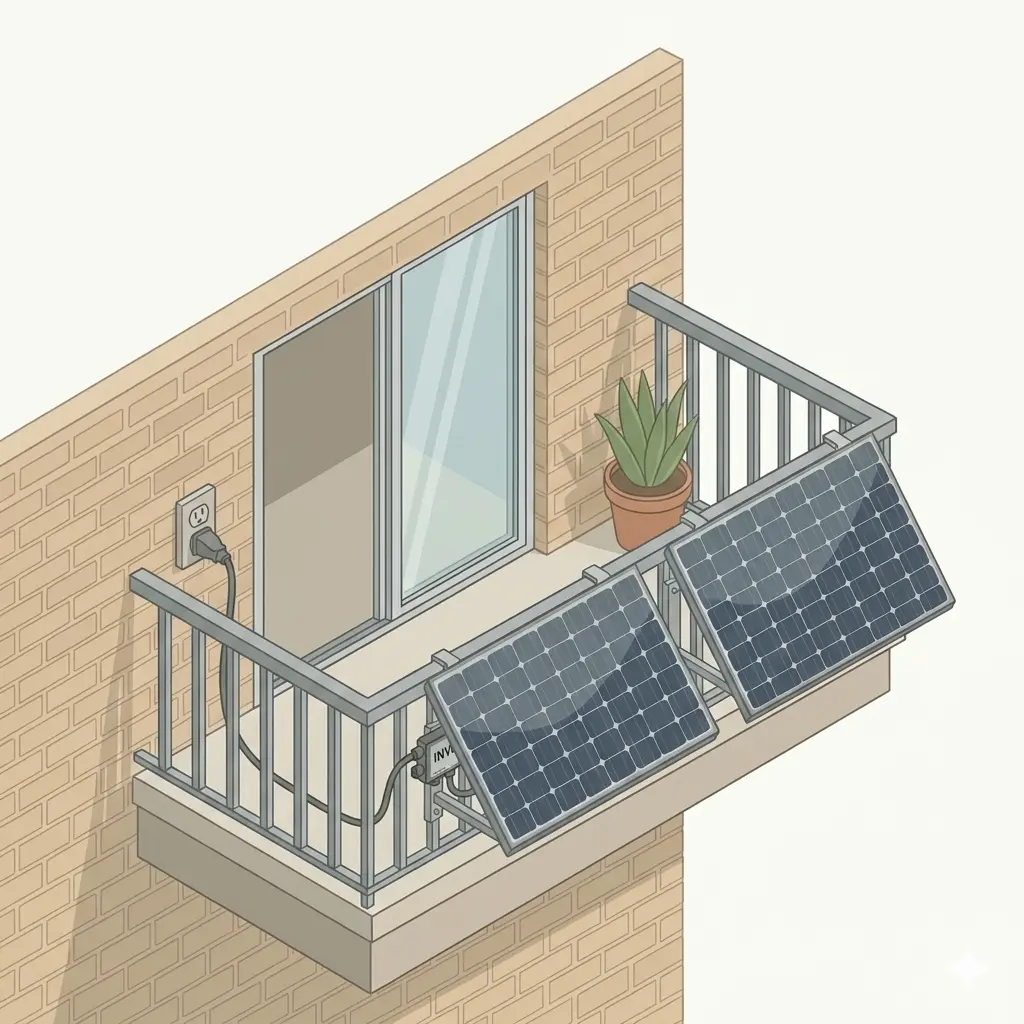
Balcony solar — also called plug-in solar, micro solar, or plug-in photovoltaics (PIPV) — refers to compact solar panel systems of one to four panels (200W–1,200W total) 6 paired with a microinverter that converts DC power to AC 7 and plugs directly into a standard 120V household outlet. 4 Unlike traditional rooftop solar, these systems require no professional installation, no roof access, and no utility interconnection agreement in states that have legalized them. 8 A typical setup involves mounting panels on a balcony railing, patio, fence, or ground stand, then running a cord to the nearest outdoor outlet. 9
The microinverter synchronizes with the home's grid power and feeds electricity into the building's wiring, 10 11 effectively reducing how much power the home draws from the utility. 11 Think of it as a load reducer rather than a generator — the system offsets consumption of always-on appliances like refrigerators, routers, and LED lighting. 4 More advanced setups include a smart power meter installed at the breaker box that throttles the inverter to prevent any excess power from flowing back to the grid (zero-export design), 12 and optional LiFePO₄ battery storage (1–2+ kWh) that captures surplus daytime generation for evening use.
The critical distinction from rooftop solar is accessibility. Balcony solar is fully portable — a renter can take it when they move. 4 Installation takes 90 minutes with no tools for railing-mount systems. There are no permits required in enabling states, no utility approval, and no electrician needed. The tradeoff is scale: an 800W balcony system offsets 10–30% of a typical apartment's electricity, 4 compared to 80–120% for a professionally installed rooftop array.
Products available in the US market today
The US balcony solar product ecosystem is still nascent compared to Europe, where systems are sold at IKEA and supermarkets. However, several brands now serve American consumers, with significant variation in availability, certification, and pricing.
EcoFlow STREAM Series is the highest-profile US market entry. 13 14 Launched in July 2025, 15 the STREAM Microinverter supports up to 1,200W AC output 13 from two solar panel inputs and plugs into a standard NEMA 5-15 or 5-20 outlet. 16 It lists at $599 (promotional price $299). 17 The premium STREAM Ultra combines a 1.92 kWh LiFePO₄ battery with a built-in microinverter 13 for $2,399 (early-bird $1,459), 17 expandable to 11.52 kWh by stacking six units. 18 19 EcoFlow claims a fully configured system (Ultra + Microinverter + panels) can generate up to 6,424 kWh annually and save up to $1,027 per year. 18 14 However, EcoFlow's plug-and-play products are currently only sold for use in Utah under that state's HB 340 law, 20 18 with expansion planned as other states pass legislation. 19
CraftStrom, based in Texas, is arguably the most established US plug-in solar manufacturer, having sold approximately 2,000 systems since 2021, primarily in California, Texas, and Florida. 21 Their 800W kit includes four 200W bifacial semi-flexible panels, two 350W ETL/UL-certified smart inverters, a smart power meter, and all cabling for $2,031. The system's zero-export design — the power meter adjusts output every 0.1 seconds — means no utility interconnection agreement is needed. 22 CraftStrom estimates annual generation of up to 1,872 kWh 23 and offers a 10-year warranty.
Bright Saver, a California-based nonprofit, 24 sells a compact Flex 200 balcony panel at ~$399 (220W with integrated microinverter, mounts with zip ties) 2 and a larger backyard kit at ~$1,849 or $34.90/month for six years. Their systems include licensed electrician installation 24 in the Bay Area and Los Angeles. Bright Saver estimates savings of $35–$55 per month and a payback period of 4–5 years 25 at California electricity rates.
PluggedSolar offers an 800W kit on Amazon (four 200W panels, micro grid-tie inverter, WiFi monitor, 50-foot cord) 26 for ~$900–$1,100 and a larger 1,800W kit for more ambitious setups. Their UL 1741-certified microinverter 27 and straightforward Amazon distribution make them one of the most accessible options for DIY buyers.
Several major brands remain Europe-only for their balcony products. 28 Anker SOLIX's Solarbank series and dedicated balcony kits are not UL-certified for the US market. Hoymiles' new HiFlow balcony-specific microinverter line launched in Europe in early 2026 29 but has not yet reached the US, though their HMS-800-2T microinverter ($150–$250) is available through US distributors. Enphase launched a balcony system in Germany in May 2025 with no US version announced. 28
The regulatory landscape is transforming fast
The legal status of plug-in solar in the United States has shifted more in the past 18 months than in the prior decade. The core regulatory problem has always been straightforward: US electrical codes and utility rules were not designed for consumers plugging power-generating devices into wall outlets. 8
Utah's HB 340, signed unanimously in March 2025, created the first legal framework 1 21 by defining a new category for portable solar generation devices up to 1,200 watts. 30 The law exempts these systems from utility interconnection agreements, 31 prohibits utilities from requiring approval or charging fees, 11 and mandates UL or equivalent certification. 4 Virginia's HB 395, approved in March 2026, 4 follows a similar model and adds a provision prohibiting landlords with four or more rental units from banning balcony solar. 32 Colorado's HB26-1007 passed the state House 48–16 33 in April 2026. 34 Maine's LD 1730 was approved on April 2, 2026, though it requires licensed electrician installation. 35
California's SB 868, the "Plug Into the Sun Act," 8 passed its Senate committee 12–0 in March 2026 and would reclassify plug-in solar as a household appliance 36 — a pivotal framing that could set a national template. 9 New York's SUNNY Act (S.6840/A.7147) would exempt systems from interconnection and net metering requirements. 37 In total, more than 30 states and Washington, D.C. have introduced plug-in solar bills, 1 spanning the political spectrum 3 2 from deep-blue California to conservative Wyoming. 3
Most bills share a common framework: they define plug-in solar as a distinct category (typically ≤1,200W), exempt it from utility interconnection, 38 require UL 3700 or equivalent safety certification, and classify systems as appliances rather than power generation facilities. 39 This "appliance" designation is the critical legal innovation — it sidesteps the entire existing solar regulatory apparatus. 9 4
The NEC (National Electrical Code) remains a complication outside enabling states. 40 Article 690 governs all solar PV systems 41 and requires dedicated branch circuits for power production sources — plugging into a shared outlet technically violates this. 42 Article 705's "120% rule" limits how much back-fed current a panel busbar can handle, 43 though small plug-in systems (10A at 120V) typically fall well within this limit. The fundamental issue is backfeeding: US residential wiring assumes one-way power flow, and circuit breakers cannot detect additional current injected from a solar device at an outlet, creating a theoretical overload risk. 8 10
Safety standards caught up in January 2026
The launch of UL 3700 on January 8, 2026 4 — "Outline of Investigation for Interactive Plug-In Photovoltaic Equipment and Systems" 44 — marked a watershed moment for US balcony solar safety. 45 4 This is the first dedicated American safety standard for plug-in solar and addresses the core risks that have kept regulators cautious.
UL 3700 requires 45 automatic power cut-off (plug prongs go dead in less than one second when disconnected, preventing shock from an energized plug in sunlight), anti-islanding protection (automatic shutoff during grid outages to protect utility workers), 4 overload and reverse-current prevention, ground-fault protection, and weatherproofing standards. 4 The standard builds on UL 1741 SB, which certifies grid-interactive inverters for smart functions like voltage-frequency ride-through. 42
The primary safety concerns with plug-in solar center on three issues. Backfeeding is the most discussed: when solar power flows backward through an outlet, the upstream circuit breaker cannot detect the additional current, potentially creating hidden overloads that exceed wire ratings without tripping protection. 8 This risk increases if multiple plug-in units share a circuit 8 (explicitly prohibited in Colorado's bill). 46 Shock hazard from exposed plug prongs 32 is addressed by UL 3700's rapid de-energization requirement. 4 Utility worker safety during outages is mitigated by anti-islanding, 32 now mandatory under both UL 1741 SB and UL 3700. 45 4
As of early 2026, no products have completed UL 3700 certification — the standard was released only in mid-December 2025. 47 48 Several manufacturers sell components that are individually UL-listed (e.g., microinverters certified to UL 1741), but full system-level UL 3700 certification is still working through the pipeline. 49 50 Consumers should look for UL 1741 SB-certified microinverters at minimum, and should check insurance implications before installing, since non-code-compliant systems could void coverage if they cause damage.
The federal tax credit is gone, but state incentives persist
The financial landscape for all residential solar shifted dramatically when the 30% federal Residential Clean Energy Credit (Section 25D) expired on December 31, 2025. The One Big Beautiful Bill Act, signed July 4, 2025, terminated the credit nearly a decade ahead of its scheduled 2034 sunset under the Inflation Reduction Act. 51 52 This means no federal tax credit exists for homeowner-purchased solar systems installed after 2025 53 — balcony or rooftop. 54
Before its expiration, the ITC had no minimum system size, meaning plug-in solar likely qualified, though the IRS never issued specific guidance on balcony systems. 55 Renters who owned their equipment could also claim it. This is now moot for new installations, though unused credits from pre-2026 systems can still carry forward. 55
State-level incentives remain significant. New York offers a 25% state tax credit up to $5,000. Massachusetts provides a 15% credit up to $1,000 56 plus its SMART program (~$0.03/kWh production incentive for 20 years). 53 New Jersey's SuSI program awards SRECs worth $85 per MWh for 15 years — among the most valuable incentives nationally. 57 Pennsylvania's PECO offers a $500 rebate. 56 Multiple states provide sales and property tax exemptions on solar equipment regardless of system size. 58
However, most SREC programs require grid-interconnected, registered systems of at least 1 kW, making them impractical for small balcony setups. The most reliable financial benefit of balcony solar remains direct electricity bill reduction through self-consumption, particularly in high-rate states like California ($0.30–$0.44/kWh) and the Northeast.
How balcony solar stacks up against rooftop systems
The comparison between balcony and rooftop solar is not a contest — they serve fundamentally different markets and needs. An 800W balcony system generates 650–1,400 kWh per year depending on location and orientation, 59 while an 8kW rooftop array produces 9,000–16,800 kWh. The average US household consumes roughly 10,500 kWh annually.
On cost, an 800W balcony kit runs $600–$2,500 with zero installation expense, 10 while a professionally installed 8kW rooftop system costs $18,400–$28,800 in 2026 without the federal credit. Cost per watt is surprisingly comparable ($1.50–$3.00/W for balcony vs. $2.30–$3.60/W for rooftop), but rooftop's figure includes professional labor, permitting, and soft costs that comprise over half the total. 10
Payback periods tell an interesting story. In high-electricity-rate markets, balcony solar can pay for itself faster than rooftop. An 800W system in Los Angeles at $0.28/kWh electricity pays back in roughly 2.8 years on a $700 investment. 60 The same household's $22,000 rooftop system (without federal credit) takes 8–12 years. But lifetime savings diverge enormously: $3,500–$9,000 for balcony versus $37,000–$154,000 for rooftop over 25 years. 61 Rooftop solar also increases home value by 4–10% (averaging ~$29,000 on a median US home), while portable balcony systems have no property value impact.
The key financial variable for balcony solar is self-consumption rate. Without net metering (unavailable for most plug-in systems), any excess generation is effectively wasted. 24 60 Someone working from home with 80–95% self-consumption extracts far more value than someone away all day at 20–40%. Adding battery storage ($800–$1,500 for ~1 kWh) increases self-consumption to 90%+ but extends the payback period. 62
Germany has millions of systems; the US has thousands
The contrast with Europe underscores how far the US market has to go. Germany's "Balkonkraftwerk" (balcony power plant) phenomenon has produced over one million registered systems 32 9 by mid-2025, with experts estimating the true total at 1.5–4 million including unregistered installations. 63 Germany added roughly 430,000 new plug-in systems in 2025 alone, 28 contributing about 500 MW of capacity. Spain has approximately 1.5 million systems. The European market overall hosts an estimated 4–5 million plug-and-play solar installations and is projected to grow from $500 million in 2025 to $1.8 billion by 2033.
Three factors explain Germany's lead. First, regulatory head start: Germany created a legal framework for plug-in solar 64 in 2019 12 and further simplified it in 2024 by raising the inverter limit from 600W to 800W, establishing renters' legal right to install, and reducing registration to five data fields. Second, electricity prices: German households pay approximately €0.37–0.40/kWh (~$0.40–$0.43), roughly 2.5 times the US average of ~$0.16/kWh, 65 making every kilowatt-hour of self-generated solar far more valuable. A €600 system in Germany pays for itself in 2.5–3 years; 66 the same math doesn't work as cleanly at US rates. Third, housing patterns and culture: over 50% of Germans rent (vs. ~36% in the US), creating enormous demand for portable, renter-friendly solar. 12 Germany's post-Ukraine-invasion energy independence movement further accelerated adoption. 28
In the US, the installed base remains in the low thousands — mostly in Utah, 3 California, Texas, and Florida. 34 2 The products cost more ($1,000–$2,500 vs. €400–$800 in Germany), 67 retail distribution barely exists (online-only vs. IKEA and supermarkets in Europe), 11 and no products have yet completed UL 3700 certification. 47 48 But the legislative momentum is unmistakable: the number of states with active bills jumped from roughly a dozen in mid-2025 to over 30 by April 2026. 34
HOA restrictions and renter challenges remain real
Approximately 25–30 states have solar access laws limiting HOA restrictions on solar installations, 68 but most were written for rooftop systems on single-family homes. 66 California's Solar Rights Act voids HOA rules that increase solar costs by more than $1,000 or reduce efficiency by more than 10%. 69 Texas, Arizona, Colorado, Oregon, and New York have similar protections. 68 However, balcony solar on condominiums presents unique challenges because balconies may be classified as limited common elements subject to association rules about aesthetics, weight loads, and safety.
The new wave of plug-in solar legislation is beginning to address this directly. Virginia's HB 395 prohibits landlords with four or more rental units from banning balcony solar. 70 South Carolina's HB 4579 would prohibit both HOAs and the state from restricting balcony solar installations. 71 Colorado's bill allows landlords to impose only "reasonable, content-neutral safety restrictions" that do not effectively prohibit compliant devices. 72
For renters without legal protection, practical strategies include using non-penetrating mounting (railing hooks, freestanding ground stands), getting written landlord approval, and checking lease clauses about exterior modifications. 73 DC-only configurations — solar panel connected to a portable battery powering devices directly — avoid grid-tie regulatory complexity entirely 40 and face essentially no legal restrictions. 40 Community solar programs, available in 41 states, offer renters an alternative path to solar savings 74 (typically 10–15% bill reduction) without any physical installation. 75
What to expect through the rest of 2026
The balcony solar landscape in the US is evolving on multiple fronts simultaneously. The most consequential near-term development will be UL 3700 product certifications — once major manufacturers achieve system-level certification, the regulatory pathway clears significantly, and states referencing UL 3700 in their legislation will effectively have a complete framework for legal, certified plug-in solar.
California's SB 868 passage would be transformative. 76 36 With roughly 14 million rental units and the nation's second-highest electricity prices, California represents the single largest addressable market for balcony solar in the US. 9 Bright Saver estimates that if five more states pass laws similar to Utah's, manufacturing scale will drive prices down enough for systems to pay for themselves in four years or less. 32
Paradoxically, the expiration of the federal residential solar tax credit may accelerate balcony solar adoption. With rooftop solar's effective cost jumping 30% 77 24 (a $22,000 system that would have cost ~$15,400 after the credit), the $600–$2,000 entry point for balcony solar becomes comparatively more attractive for budget-conscious households seeking partial bill relief. The industry describes balcony solar as a "gateway drug" — users start small, experience the satisfaction of generating their own electricity, and often pursue larger systems later. 34 With 53 million US renter households largely locked out of traditional rooftop solar, 78 balcony solar's moment in American energy policy appears to have arrived. 14
Conclusion
Balcony solar in the US sits at an inflection point defined by regulatory momentum, safety standardization, and market development all occurring simultaneously. The technology is proven — Germany's millions of installations demonstrate that. The economics work best in high-electricity-rate states where an 800W system costing $1,000–$2,000 can pay for itself in 3–5 years 4 and deliver $5,000+ in lifetime savings. The core barriers are legal and institutional, not technical, 74 and those barriers are falling state by state 67 at a pace few predicted even two years ago. For US renters and apartment dwellers, this represents the first realistic opportunity to participate directly in solar energy 74 79 — a market segment that traditional rooftop solar has never been able to serve. 34 14
References
- Solar United Neighbors
- Reasons to be Cheerful
- Canary Media
- solar
- WHRO
- Solarpermitsolutions
- Interfaithpower
- Solar Power World
- Solarrights
- SolarReviews
- World Resources Institute
- pv magazine
- Solar Builder
- CleanTechnica
- PR Newswire
- Homecrux
- BigGo
- EcoFlow
- Solar Power World
- EcoFlow
- The Energy Mix
- craftstrom
- Ondemandinstantsolar
- CleanTechnica
- Bright Saver
- Amazon
- Amazon
- CleanTechnica
- Hoymiles
- Balconysolar
- Balconysolar
- NPR
- Ark Valley Voice
- Rocky Mountain PBS
- CleanTechnica
- Solar Power World
- New York State Senate
- Ncelenviro
- PlugSolarHub
- LinkSolar
- Mayfield
- WattBuild
- Psu
- Solar Builder
- UL Solutions
- Citizen Portal
- pv magazine
- pv magazine USA
- Solar Builder
- High Country News
- GreenLancer
- Powerlutions
- SolarReviews
- Solar.com
- Internal Revenue Service
- Finray Solar
- Solar.com
- Solar Topps
- One5c
- howtogosolar
- EnergySage
- SolarCurrents
- Honlenergy
- Cybernews
- Busuu
- CleanTechnica
- Renewable Energy World
- HOA Management
- LS Carlson Law
- Virginia Mercury
- South Carolina Legislature
- pv magazine
- WATTROI
- Nuwattenergy
- Community Solar Farm
- Bright Saver
- All Energy Solar
- Managecasa
- The Washington Post