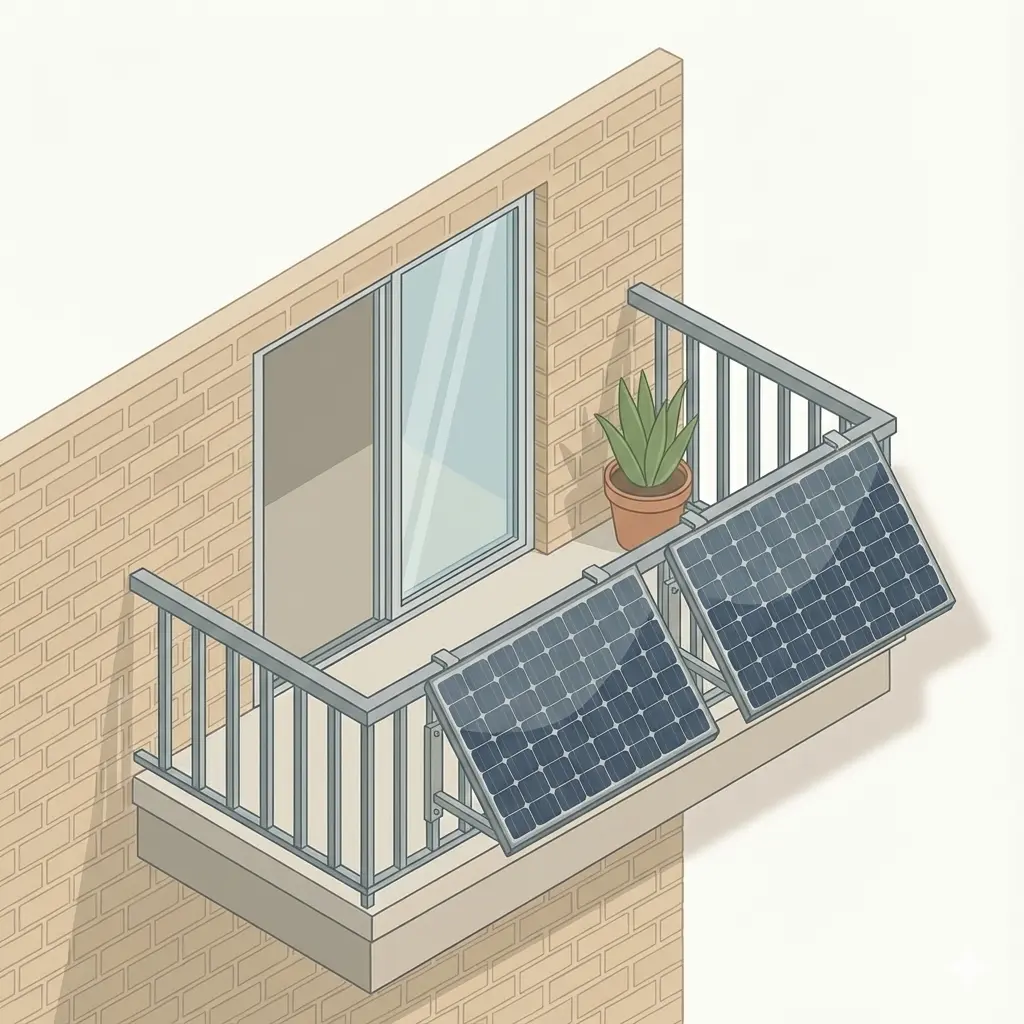
The United States residential energy sector is currently navigating a period of profound structural disruption, characterized by the collision of advanced distributed generation technology with legacy regulatory frameworks. In 2025, this tension has crystallized around the emergence of "balcony solar"—plug-in photovoltaic (PV) systems designed for immediate deployment by renters, apartment dwellers, and homeowners lacking suitable rooftops for traditional arrays. Long a staple of the European energy transition, particularly in Germany, the balcony solar segment is now forcing a re-evaluation of the American relationship with the electric grid.
This report offers an exhaustive examination of the balcony solar landscape as of late 2025. It analyzes the divergent regulatory trajectories emerging across the nation: while the federal government, under the newly enacted "One Big Beautiful Bill Act" (OBBBA), is rapidly retracting fiscal support for residential renewables, state legislatures in Utah, New York, California, and Maryland are aggressively carving out legal exemptions to democratize energy access. 1 The analysis delves into the technical complexities of adapting plug‑and‑play solar for the U.S. split‑phase 120V/240V electrical standard, the rigorous safety mandates of the National Electrical Code (NEC) and UL 1741 SB certification, and the emerging hardware ecosystem led by innovators like Raya Power and EcoFlow. 4
Furthermore, this report provides a critical financial assessment for U.S. households facing the impending expiration of the 30% Residential Clean Energy Credit on December 31, 2025. With the market poised on a precipice between a subsidized "gold rush" and a post‑incentive correction, the strategic implications for homeowners and renters are severe. The findings suggest that while 2025 is a year of regulatory friction and fiscal urgency, it marks the irreversible transition of solar power from a construction project to a consumer appliance, fundamentally altering the economics of household energy resilience.
1. The Paradigm Shift: From Infrastructure to Appliance
The traditional model of residential solar in the United States has historically been defined by permanence and exclusivity. It has been treated as a capital improvement—akin to a home addition—requiring homeownership, significant creditworthiness, favorable roof geometry, and a tolerance for protracted permitting processes. This model has systematically excluded a vast demographic: the approximately 53 million American households who rent their homes or live in multi‑family dwellings without roof access. [1] In 2025, the "appliance solar" model is dismantling these barriers, driven by the convergence of hardware miniaturization, energy storage integration, and a socio‑political demand for energy equity.
1.1 The Definition and Mechanism of Balcony Solar
"Balcony solar," also known as plug‑in solar or "solar garten" in its German origin, refers to small‑scale photovoltaic systems—typically ranging from 400 watts (W) to 1.2 kilowatts (kW)—that connect directly to a home's existing electrical circuitry via a standard wall outlet. Unlike rooftop systems that require a dedicated circuit breaker and hardwired interconnection, balcony systems operate behind the meter as a load‑offsetting device.
The mechanism is deceptively simple: the solar panels generate Direct Current (DC) electricity, which is converted by a microinverter into Alternating Current (AC) synchronized with the grid's frequency and voltage. When plugged into a standard NEMA 5‑15 outlet, the power flows into the home's local circuit. Because electricity follows the path of least resistance, appliances on that circuit (and connected circuits) consume the solar‑generated power first, slowing or stopping the draw from the utility meter. [1]
1.2 The "Solar Divide" and the Equity Imperative
The rise of balcony solar in 2025 is not merely a technological trend but a response to the "solar divide." Traditional net metering policies and tax incentives have disproportionately benefited single‑family homeowners with high credit scores, effectively subsidizing the wealthy at the expense of the broader ratepayer base. This disparity has become a central theme in state‑level legislative debates. In New York, for instance, the push for the "SUNNY Act" is explicitly framed as a measure of economic justice. State Senator Liz Krueger has argued that plug‑in solar is a necessary tool to extend the benefits of the "solar economy" to low‑income renters who have been structurally shut out of the market. 3
The demographic imperative is clear. With urbanization increasing and housing affordability declining, a growing percentage of the U.S. population resides in high‑density housing where rooftop solar is physically impossible or legally complex due to split incentives between landlords and tenants. The balcony solar model circumvents these structural issues by attaching the asset to the resident rather than the building. If a renter moves, they simply unplug the system and take it with them, transforming solar energy into a portable personal asset similar to a refrigerator or window air conditioning unit. 7
1.3 The European Precedent and American Adaptation
The U.S. market in 2025 is heavily influenced by the maturity of the European market, particularly Germany, where regulatory reforms in 2022 and 2023 catalyzed the installation of over one million balcony systems. The "German Model" demonstrated that small‑scale generation (capped at 600W‑800W) poses negligible risk to grid stability and can be safely exempted from bureaucratic interconnection processes. 3
However, translating this model to the United States has required overcoming significant technical and cultural inertia. The U.S. utility sector operates with a higher degree of caution regarding "uncontrolled" generation. While German regulations codified a "right to plug," American utilities have historically viewed any unauthorized backfeed as a safety violation and a theft of service (if the meter spins backward without a contract). The narrative of 2025 is defined by the struggle to align these two worldviews: the European proof of concept versus the American regulatory conservatism. 10
2. The Federal Landscape: The "One Big Beautiful Bill Act" (OBBBA)
While the technological logic of balcony solar is expanding, the federal fiscal environment is contracting. The defining policy event of 2025 is the enactment of the "One Big Beautiful Bill Act" (OBBBA), signed into law by President Trump on July 4, 2025. 11 This legislation represents a stark pivot from the Biden‑era Inflation Reduction Act (IRA), prioritizing fossil fuel deregulation and dismantling renewable energy subsidies.
2.1 The Sunset of the Section 25D Tax Credit
For U.S. homeowners and balcony solar adopters, the most critical provision of the OBBBA is the accelerated termination of the Section 25D Residential Clean Energy Credit. Previously scheduled to remain at 30% through 2032, the credit is now set to expire fully and abruptly on December 31, 2025. 12
This creates a "hard cliff" for the industry. Unlike previous incentive structures that phased down gradually (e.g., 30% to 26% to 22%), the OBBBA mandates a drop from 30% to 0% overnight.
- The Deadline: To qualify for the credit, the system must be "placed in service" by December 31, 2025. "Placed in service" is defined by the IRS as the point at which the property is installed and ready for use. 15
- Implications for Balcony Solar: This deadline favors the balcony solar form factor. Traditional rooftop installations often face permitting and interconnection backlogs of 3‑6 months. A homeowner initiating a rooftop project in September 2025 risks missing the deadline if the utility delays permission to operate (PTO) until January 2026. Conversely, a balcony system can be purchased, delivered, and plugged in within a week, ensuring the "placed in service" requirement is met before the tax credit vanishes. This effectively creates a Q4 2025 "rush" where balcony solar becomes the only viable option for late‑market entrants seeking the 30% subsidy. 17
2.2 Eligibility of Portable Systems
A recurring question in 2025 is whether portable, plug‑in systems qualify for the Section 25D credit. The OBBBA did not alter the fundamental definition of "qualified solar electric property" in the tax code. According to IRS instructions (Form 5695), qualified property includes equipment that uses solar energy to generate electricity for use in a dwelling unit located in the United States and used as a residence by the taxpayer. 18
The key criteria for balcony solar eligibility are:
- Ownership: The taxpayer must own the system (no leases or PPAs).
- Residence: The system must be used at the taxpayer's residence (primary or secondary).
- New Equipment: The equipment must be original installation (not used).
Crucially, the IRS guidance explicitly states that the home need not be the taxpayer's main home (unless claiming fuel cell credits), and there is no requirement for the panels to be permanently attached to the structure, provided they generate electricity for use in the home. 19 This interpretation suggests that a balcony system, even if movable, qualifies if it is powering the residence. However, the OBBBA's strict "Foreign Entity of Concern" (FEOC) restrictions, which kick in for commercial credits, have cast a shadow over supply chains, though residential credits are generally shielded from domestic content requirements until the expiration. 21
2.3 Political Context and Market Sentiment
The OBBBA reflects a broader "pro‑fossil fuel" shift in the federal administration, which has actively sought to "squash" certain renewable projects. [3] This hostile federal climate has paradoxically accelerated state‑level action. As the federal safety net retracts, states are stepping in to deregulate the market to maintain momentum. The expiration of the tax credit is viewed by industry analysts not just as a financial loss, but as a signal that the era of federal support is over, necessitating a shift to unsubsidized, market‑based viability—a test that balcony solar, with its lower soft costs, is uniquely positioned to pass. 13
3. The State‑Level Regulatory Mosaic
In the absence of federal leadership, a fragmented regulatory landscape has emerged. 2025 has been a watershed year for state legislation, with Utah leading a coalition of states in legalizing plug‑in solar, while others like California focus on automation and permitting reform.
3.1 Utah's House Bill 340: The Legislative Breakthrough
The passage of House Bill 340 in Utah marks the first time a U.S. state has explicitly codified the legality of balcony solar. Sponsored by Representative Raymond Ward, the bill passed with unanimous bipartisan support, creating a statutory exemption from utility interconnection agreements for portable solar devices. 1
3.1.1 The Mechanism of Exemption
Prior to HB 340, Utah law required any device feeding power to the grid to have a contract with the utility. HB 340 carves out an exemption for systems that:
- Generate 1.2 kW or less.
- Are "portable" plug‑and‑play devices.
- Are certified to National Electrical Code (NEC) standards and UL listings (once established). 24
3.1.2 The "Conditional" Legalization
While hailed as a victory, HB 340 is a "conditional" legalization. The text ties the legality of retail sales to the existence of an "explicit standard" in the NEC and UL certification. Representative Vork, the bill's sponsor, admitted in committee hearings that manufacturers had not yet produced certified models for the U.S. market because the standards were not in place. 24 This creates a "chicken and egg" scenario in late 2025: the law allows the devices, but the safety standards body (UL/NEC) is still finalizing the specific testing protocols for plug‑in interconnects, delaying widespread retail availability of compliant units.
3.2 New York and the "SUNNY Act"
In New York, the legislative focus is on property rights. The "SUNNY Act," introduced in 2025, addresses the power imbalance between tenants and landlords. Modeled after the FCC's "Over‑the‑Air Reception Devices" (OTARD) rule—which prevents landlords from banning satellite dishes—the SUNNY Act proposes to prohibit landlords and HOAs from unreasonably restricting the installation of balcony solar systems. 8
The bill defines an "unreasonable restriction" as one that:
- Increases the cost of the system significantly.
- Decreases the efficiency of the system significantly.
- Prevents the system from functioning.
This legislation is critical for New York City, where the vast majority of residents are renters. By removing the landlord's veto power (provided safety conditions are met), New York aims to unlock millions of square feet of vertical real estate for energy generation. 3
3.3 California: SB 379 and Automated Permitting
California's approach in 2025 focuses on reducing "soft costs" through automation. Senate Bill 379 (The Solar Access Act) mandates that cities and counties implement online, automated permitting platforms like SolarAPP+ or Symbium. While originally targeted at rooftop solar, the infrastructure established by SB 379 is being adapted for balcony solar permitting. 26
The requirement for instant, automated permitting is crucial for the balcony segment. The economic value proposition of a $1,000 balcony system is destroyed if the permit costs $300 and takes four weeks to process. By forcing jurisdictions to adopt "instant" permitting, California is effectively lowering the barrier to entry for small‑scale systems. Additionally, the implementation of NEM 3.0 (Net Billing Tariff) in California—which slashed export compensation—has inadvertently boosted the case for balcony solar. Since balcony systems are designed for self‑consumption rather than export, they are less affected by the poor export rates of NEM 3.0 compared to oversized rooftop systems. 28
3.4 Maryland: Defining "Reasonable" Restrictions
Maryland's 2025 legislative session produced Senate Bills 516 and 1022, which introduce precise mathematical definitions for "unreasonable limitations" on solar. Under the new law, a restriction is deemed unreasonable if it increases installation costs by more than 5% or reduces energy generation by more than 10%. 30
This quantitative standard is a powerful tool for balcony solar advocates. Because balcony systems are highly sensitive to orientation (hanging vertically vs. tilted), a landlord's requirement to move a panel to a less visible (and less sunny) location can now be legally challenged using solar irradiance data. If the move reduces output by 11%, the restriction is void.
3.5 Comparative State Legislative Matrix (2025)
| State | Legislation | Core Provision | Status (Late 2025) |
|---|---|---|---|
| Utah | HB 340 | Exempts <1.2 kW plug‑in systems from interconnection agreements. | Passed (Effective upon UL/NEC standard) 24 |
| New York | SUNNY Act | Prohibits landlord/HOA bans on balcony solar; Renters' Rights focus. | Introduced/Pending 8 |
| California | SB 379 | Mandates automated, instant online permitting (SolarAPP+). | Implementation Phase (Deadlines for cities active) 26 |
| Maryland | SB 516 | Defines "unreasonable restriction" as >5% cost increase or >10% efficiency loss. | Passed 30 |
4. Technical Architecture: The Engineering Challenge
While the legislative path is clearing, the engineering reality of integrating plug‑in solar into the U.S. grid remains the most significant friction point. The U.S. electrical infrastructure differs fundamentally from the European systems where balcony solar matured, necessitating specific hardware adaptations.
4.1 The Split‑Phase 120V/240V Impediment
The standard U.S. residential service is "split‑phase" power. The grid delivers power via two 120V "hot" legs (Line 1 and Line 2) and a neutral wire.
- 120V Loads: Standard outlets connect one hot leg to the neutral.
- 240V Loads: Heavy appliances (dryers, AC) connect Line 1 to Line 2.
European balcony systems are designed for 230V single‑phase grids. A European inverter cannot simply be plugged into a U.S. outlet. Consequently, manufacturers in 2025 have had to develop U.S.-specific microinverters that output 120V AC. 31
The Phase Imbalance Risk: Plugging a solar generator into a 120V outlet injects power into only one of the two phases. If a home is consuming 2,000 W on Line 1 and 500 W on Line 2, and a balcony system injects 800 W into Line 2, the imbalance increases. While the grid neutral wire is sized to handle the difference, excessive imbalance across millions of homes could strain utility distribution transformers. Advanced U.S. microinverters in 2025 are addressing this by either limiting output to 600 W (reducing the imbalance magnitude) or communicating wirelessly with a main panel meter to monitor phase loads. 32
4.2 The "Suicide Cord" and Connector Safety
A persistent safety concern is the physical connection. A plug‑in solar inverter has a male plug. If the inverter were to energize the plug while it was not plugged into the wall, the exposed prongs would be live, posing a lethal shock hazard (often called a "suicide cord").
To combat this, UL 1741 compliant inverters use anti‑islanding and loss‑of‑grid detection. The inverter effectively "listens" for the grid's 60 Hz frequency. It will not energize the prongs unless it detects that it is connected to a live grid. This safety interlock is the primary technical requirement for UL certification and the basis for the Utah legislation's safety mandate. 24
4.3 NEC 705.12: The "120% Rule"
The National Electrical Code (NEC) Article 705.12(B)(2), commonly known as the "120% Rule," is the governing constraint for backfeeding power through a breaker panel. It ensures that the busbar (the metal strip conducting electricity in the panel) does not overheat from the combined current of the utility feed and the solar feed. 34
The Calculation:
$$\text{Max Solar Amps} = \frac{(\text{Busbar Rating} \times 1.2) - \text{Main Breaker Rating}}{1.25}$$
Scenario A: Modern Panel (200 A Busbar / 200 A Main Breaker)
$$ \text{Max Solar} = \frac{(200 \times 1.2) - 200}{1.25} = \frac{240 - 200}{1.25} = \frac{40}{1.25} = 32A $$
Result: 32 A is ample capacity for a balcony system (which typically draws <10 A).
Scenario B: Older Apartment Panel (100 A Busbar / 100 A Main Breaker)
$$\text{Max Solar} = \frac{(100 \times 1.2) - 100}{1.25} = \frac{120 - 100}{1.25} = 16A$$
Result: 16 A allows for approximately 1.9 kW of solar. Still sufficient for balcony solar.
Scenario C: "Maxed Out" Panel (100 A Busbar / 125 A Main Breaker – Rare but exists)
$$\text{Max Solar} = \frac{(100 \times 1.2) - 125}{1.25} = \text{Negative Value}$$
Result: No solar allowed without a panel upgrade.
For most balcony solar adopters, the 120% rule is legally satisfied. However, the method of connection matters. NEC code generally requires a "dedicated branch circuit" for power production sources. Plugging into a shared circuit with other appliances technically violates this requirement in many jurisdictions, which is why the "appliance" classification sought by manufacturers like Raya Power is so critical—they argue the device is a load reducer, not a generator. 35
4.4 UL 1741 SB: The "Smart" Inverter Standard
In 2025, the gold standard for interconnection is UL 1741 SB (Supplement SB). This certification verifies compliance with IEEE 1547‑2018, which mandates "smart inverter" functions. Unlike older inverters that simply disconnected during grid volatility, UL 1741 SB inverters can:
- Ride Through: Stay connected during minor voltage/frequency disturbances.
- Volt‑Var Support: Inject reactive power to help stabilize grid voltage.
- Frequency‑Watt: Throttle power output if grid frequency rises (signaling over‑generation).
Utilities in California (Pacific Power) and elsewhere now mandate UL 1741 SB equipment for all new interconnections. 29 For the balcony solar market, this is a barrier to entry for cheap, generic imports. Only major players like EcoFlow and Enphase‑based systems have the resources to achieve this certification, effectively bifurcating the market into "legal/premium" and "grey market/unsafe" tiers. 33
5. The Hardware Ecosystem of 2025
The hardware enabling balcony solar in 2025 has evolved rapidly, moving away from repurposed rooftop components toward purpose‑built consumer electronics.
5.1 Vendor Landscape
- EcoFlow: A dominant player in 2025, leveraging its "PowerStream" microinverter. EcoFlow's strategy focuses on an ecosystem approach, integrating the balcony solar input with their "Delta" series portable power stations. This allows users to store excess solar during the day and discharge it into the home grid at night, maximizing self‑consumption. Their marketing emphasizes the "dual use" of the battery for both bill savings and emergency backup. 38
- Raya Power: A high‑profile startup emerging from Stanford, Raya Power is targeting the "appliance" niche. Their system uses a patent‑pending architecture that claims to avoid backfeeding entirely, positioning it as a "no permit required" device. By functioning strictly as a load‑offsetting appliance (likely using current transformers to match solar output to household load exactly), Raya aims to bypass the utility interconnection bottleneck. Their pilot programs in Puerto Rico and California focus on rental communities and low‑income households. 4
- Jackery: Focusing on the rugged/DIY segment, Jackery's "HomePower 2000" integrates balcony mounting with extreme weather resistance (IP65). Their systems emphasize "plug‑and‑play" simplicity with bifacial panels that capture reflected light from balcony floors, a critical feature for vertical installations. 5
5.2 Storage Integration: The Battery Necessity
Because net metering is unavailable or unfavorable for most plug‑in systems, batteries have become an essential component rather than an optional add‑on. Without a battery, any solar energy generated while the user is away (and household load is low) is effectively donated to the grid for free.
- Self‑Consumption Strategy: A typical 800W system might generate 4‑5 kWh on a sunny day. If the apartment's baseline load (fridge, router) is only 200 W, much of that generation is lost. A 2‑3 kWh battery captures this peak generation and shifts it to the evening peak (4 PM – 9 PM) when electricity rates are often highest. 5
- Resilience: The "appliance" model also sells peace of mind. In 2025, with grid instability rising due to climate events, the ability of a balcony system to act as an islanded backup generator for a fridge or medical device during a blackout is a primary sales driver, distinct from the financial ROI. 38
6. Financial Economics and ROI Analysis
The economic case for balcony solar in 2025 is driven by the interplay of high utility rates, hardware costs, and the expiring tax credit.
6.1 Cost vs. Savings
A typical 2025 balcony solar setup falls into two tiers:
-
Tier 1: Basic Solar (400W‑800W, No Battery)
- Hardware Cost: $600 – $1,000.
- Annual Generation: ~400 – 800 kWh.
- Savings (at $0.20/kWh): $80 – $160/year.
- Payback Period: 5 – 7 years.
-
Tier 2: Solar + Storage (800W + 2kWh Battery)
- Hardware Cost: $1,500 – $2,500.
- Annual Savings (high self‑consumption): $250 – $400/year (leveraging Time‑of‑Use arbitrage).
- Payback Period: 6 – 8 years. 7
6.2 The "Placed in Service" Urgency
The OBBBA deadline creates a massive financial swing.
- Purchase in Oct 2025: A $2,000 system is eligible for a $600 tax credit. Net Cost: $1,400.
- Purchase in Jan 2026: The same system costs $2,000.
This 30% price differential is the single largest economic factor in the 2025 market. For a renter, the $600 credit effectively covers the cost of the mounting hardware and cables, significantly accelerating the ROI. 13
6.3 Renters' Economics: The Portability Premium
For renters, traditional ROI calculations (which often include property value appreciation) do not apply. Instead, the value lies in asset portability.
- Scenario: A renter buys a system for $1,400 (after credit). They save $200/year on bills. After 5 years, they move.
- Outcome: They unplug the system and take it to the new apartment. The asset retains its utility. Unlike a painted wall or a garden, the investment is not lost to the landlord. Over a 25‑year lifespan, the system yields $5,000 in savings for a $1,400 investment—a 250% return, independent of homeownership status. 7
7. Insurance, Liability, and Property Rights
As balcony solar proliferates, it introduces new liabilities that the insurance industry is scrambling to address in 2025.
7.1 Insurance: Dwelling vs. Personal Property
The classification of balcony solar determines coverage:
- Homeowners Policy: If the panels are mechanically fastened to the railing, they may be considered "part of the dwelling" (Coverage A). However, insurers are increasingly excluding "wind and hail" damage for exterior solar equipment unless specifically endorsed. 41
- Renters Policy: For tenants, the system is "personal property" (Coverage C). Standard renters insurance covers theft and fire. The gray area is liability. If a DIY‑installed panel falls from a 4th‑story balcony and damages a parked car or injures a pedestrian, the renter is liable. In 2025, many major carriers are requiring tenants to add a specific "liability rider" for exterior attached equipment, or to increase their liability limits to $300,000 or more. 42
7.2 The "Right to Light" and Legal Precedent
The conflict between tenants and landlords invokes the ancient legal concept of the "Right to Light." While English Common Law recognized a prescriptive right to sunlight after 20 years of unobstructed access, U.S. law generally rejected this (Prior Appropriation doctrine). However, the new wave of state laws (NY, MD, UT) is effectively re‑establishing a statutory "Right to Light." By defining solar restrictions as "unreasonable" if they reduce efficiency, states are codifying that a tenant's access to the sun is a protected property interest that supersedes the landlord's aesthetic preferences. 44
8. Conclusion: The Year of Transition
2025 stands as the definitive turning point for residential solar in the United States. It is the year the monopoly of the rooftop array was broken by the agility of the appliance.
The convergence of the OBBBA tax credit expiration, the legalization of plug‑in systems in pioneering states like Utah, and the arrival of UL‑certified hardware has created a perfect storm for adoption. While significant friction remains—particularly in the technical harmonization of split‑phase connections and the resistance of conservative HOAs—the trajectory is unmistakable.
For the American consumer, the balcony solar system represents more than just a way to save $20 a month. It represents a shift in agency. It transforms the electric grid from a unilateral delivery system into a participatory marketplace, where even a renter in a fourth‑floor walk‑up can become a producer of clean energy. As the federal subsidies fade into history at midnight on December 31, 2025, the balcony solar market will likely stand on its own feet, driven not by tax breaks, but by the fundamental utility of affordable, portable, and resilient power.
Works cited
- Intro to Plug‑In, “Balcony” Solar – Washington – Third Act, accessed December 2, 2025, https://thirdact.org/washington/2025/10/29/intro-to-plug-in-balcony-solar/
- A Complete Guide to the Federal Solar Tax Credit December 2025 Deadline, accessed December 2, 2025, https://www.mpowersolar.com/post/your-complete-guide-to-the-federal-solar-tax-credit-2025-new-york
- Power surge: law changes could soon bring balcony solar to millions across US, accessed December 2, 2025, https://www.theguardian.com/us-news/2025/nov/30/balcony-solar-power-states-laws
- Startup Raya Power poised to offer its plug‑in solar and storage solution in Puerto Rico and California – pv magazine USA, accessed December 2, 2025, https://pv-magazine-usa.com/2025/12/02/startup-raya-power-poised-to-offer-its-plug-in-solar-and-storage-solution-in-puerto-rico-and-california/
- Battery Storage for Balcony Solar Systems – Our Top Picks and Recommendations, accessed December 2, 2025, https://eu.jackery.com/blogs/balcony-solar-system/balcony-solar-battery-storage-guide
- Raya Power, accessed December 2, 2025, https://rayapower.com/
- Solar Panels For Apartment Balconies: Complete 2025 Installation Guide – SolarTech, accessed December 2, 2025, https://solartechonline.com/blog/solar-panels-apartment-balcony-guide/
- Krueger, Gallagher Introduce SUNNY Act To Support Balcony Solar | NYSenate.gov, accessed December 2, 2025, https://www.nysenate.gov/newsroom/press-releases/2025/liz-krueger/krueger-gallagher-introduce-sunny-act-support-balcony
- Plug‑In Solar Power Could Be Coming to a Balcony Near You | Sierra Club, accessed December 2, 2025, https://www.sierraclub.org/sierra/plug-solar-power-could-be-coming-balcony-near-you
- Power surge: law changes could soon bring balcony solar to millions across US – Reddit, accessed December 2, 2025, https://www.reddit.com/r/solar/comments/1pbhn5m/power_surge_law_changes_could_soon_bring_balcony/
- One Big Beautiful Bill Act – Wikipedia, accessed December 2, 2025, https://en.wikipedia.org/wiki/One_Big_Beautiful_Bill_Act
- Federal Solar Tax Credit In 2025: How Does it Work? – EnergySage, accessed December 2, 2025, https://www.energysage.com/solar/solar-tax-credit-explained/
- The History & Future of the Solar Tax Credit in 2025 – GreenLancer, accessed December 2, 2025, https://www.greenlancer.com/post/solar-energy-tax-credit-2025
- The Implementation Timeline of the One Big Beautiful Bill Act, accessed December 2, 2025, https://www.americanprogress.org/article/the-implementation-timeline-of-the-one-big-beautiful-bill-act/
- Residential Solar Tax Credit Going Away In US After 2025 – GreenLancer, accessed December 2, 2025, https://www.greenlancer.com/post/solar-tax-credit-ending
- FAQs for modification of sections 25C, 25D, 25E, 30C, 30D, 45L, 45W, AND 179D under Public Law 119‑21, 139 Stat. 72 (July 4, 2025), commonly known as the One, Big, Beautiful Bill (OBBB) | Internal Revenue Service, accessed December 2, 2025, https://www.irs.gov/newsroom/faqs-for-modification-of-sections-25c-25d-25e-30c-30d-45l-45w-and-179d-under-public-law-119-21-139-stat-72-july-4-2025-commonly-known-as-the-one-big-beautiful-bill-obbb
- Solar Tax Credit 2025: Homeowners Need to Know Before It - EcoFlow, accessed December 2, 2025, https://www.ecoflow.com/us/blog/solar-tax-credit-2025-claim
- 2025 Instructions for Form 5695, accessed December 2, 2025, https://www.irs.gov/pub/irs-dft/i5695--dft.pdf
- Instructions for Form 5695 (2024) | Internal Revenue Service, accessed December 2, 2025, https://www.irs.gov/instructions/i5695
- How Does the IRS Verify Solar Credit Eligibility? – EcoFlow, accessed December 2, 2025, https://www.ecoflow.com/us/blog/how-does-irs-verify-solar-credit-eligibility
- How the Federal Solar Tax Credit Works In 2025 – Paradise Energy Solutions, accessed December 2, 2025, https://www.paradisesolarenergy.com/blog/how-does-the-solar-tax-credit-work/
- The “One Big Beautiful Bill” Act – Navigating the New Energy Landscape – Sidley Austin LLP, accessed December 2, 2025, https://www.sidley.com/en/insights/newsupdates/2025/07/the-one-big-beautiful-bill-act-navigating-the-new-energy-landscape
- How the One Big Beautiful Bill Changes Green Energy Tax Credits, accessed December 2, 2025, https://taxfoundation.org/blog/big-beautiful-bill-green-energy-tax-credit-changes/
- Committee clears bill to allow small plug‑in "balcony" solar panels once national safety standards exist, accessed December 2, 2025, https://citizenportal.ai/articles/6353135/Committee-clears-bill-to-allow-small-plugin-balcony-solar-panels-once-national-safety-standards-exist
- Krueger, Gallagher Introduce SUNNY Act To Support Balcony Solar : r/nyc, accessed December 2, 2025, https://www.reddit.com/r/nyc/comments/1p836qh/krueger_gallagher_introduce_sunny_act_to_support/
- SB 379 – Senate Bill Policy Committee Analysis, accessed December 2, 2025, https://trackbill.com/s3/bills/CA/2021/SB/379/analyses/assembly-local-government.pdf
- Streamlined Residential Solar and Energy Storage System Permits | National City, CA, accessed December 2, 2025, https://www.nationalcityca.gov/government/community-development/building/streamlined-residential-solar-and-energy-storage-system-permits
- U.S. Solar Market Trends 2025 – Record Growth & Risks – Sunhub, accessed December 2, 2025, https://www.sunhub.com/blog/us-solar-market-trends-2025/
- Customer Generation – Pacific Power, accessed December 2, 2025, https://www.pacificpower.net/savings-energy-choices/customer-generation.html
- 2025 Regular Session – Senate Bill 120 Chapter, accessed December 2, 2025, https://mgaleg.maryland.gov/2025rs/Chapters_noln/CH_516_sb0120t.pdf
- Understanding Split Phase Power – Solar System, accessed December 2, 2025, https://www.solarchargingbattery.com/blogs/solar-blog/understanding-split-phase-power
- What are my options in the US with split‑phase 120/240 | DIY Solar Power Forum, accessed December 2, 2025, https://diysolarforum.com/threads/what-are-my-options-in-the-us-with-split-phase-120-240.97538/
- PV Inverter and BESS Converters Certification – UL Solutions, accessed December 2, 2025, https://www.ul.com/services/pv-inverter-certification
- What Is the 120% Rule in Solar? A Phoenix Homeowner's Guide, accessed December 2, 2025, https://www.solartopps.com/blog/what-is-120-rule-solar/
- The 120% Rule Explained: How This Solar Regulation Affects Your Installation, accessed December 2, 2025, https://couleenergy.com/the-120-rule-explained-how-this-solar-regulation-affects-your-installation/
- Solar Interconnection Methods (Full Guide) – Ecuip Engineering, accessed December 2, 2025, https://www.ecuip.com/solar-interconnection-guide/
- Myth vs Reality: UL 1741 SB Equals Grid Code Compliance? – Anern Store, accessed December 2, 2025, https://www.anernstore.com/blogs/diy-solar-guides/ul1741sb-grid-code-compliance-myths
- Why Get a Portable Solar Panel in Summer 2025 – EcoFlow, accessed December 2, 2025, https://www.ecoflow.com/us/blog/portable-solar-panels-and-save-bills
- EcoFlow Newsroom | Product Info, Updates & More, accessed December 2, 2025, https://www.ecoflow.com/us/news
- Balcony Solar and Storage: Smart Power for Small Spaces – MANLY Battery, accessed December 2, 2025, https://manlybattery.com/balcony-solar-and-storage-battery/
- Does Home Insurance Cover Solar Panels? – Progressive, accessed December 2, 2025, https://www.progressive.com/answers/does-home-insurance-cover-solar-panels/
- Renting solar for your home? Here's how to insure it, accessed December 2, 2025, https://www.naked.insure/blog/renting-solar-for-your-home-heres-how-to-insure-it
- Solar Panels and Insurance Coverage: Is It Covered? – Webbins Group, accessed December 2, 2025, https://www.webbinsgroup.com/insurance/solar-panels-and-insurance-coverage-is-it-covered/
- Land‑Use Planning to Ensure Solar Access – NREL, accessed December 2, 2025, https://docs.nrel.gov/docs/legosti/old/163.pdf
- Model Solar Energy Access Legislation, accessed December 2, 2025, https://aglaw.psu.edu/wp-content/uploads/2022/10/Fullbright-Model-Solar-Energy-Access-Legislation.pdf