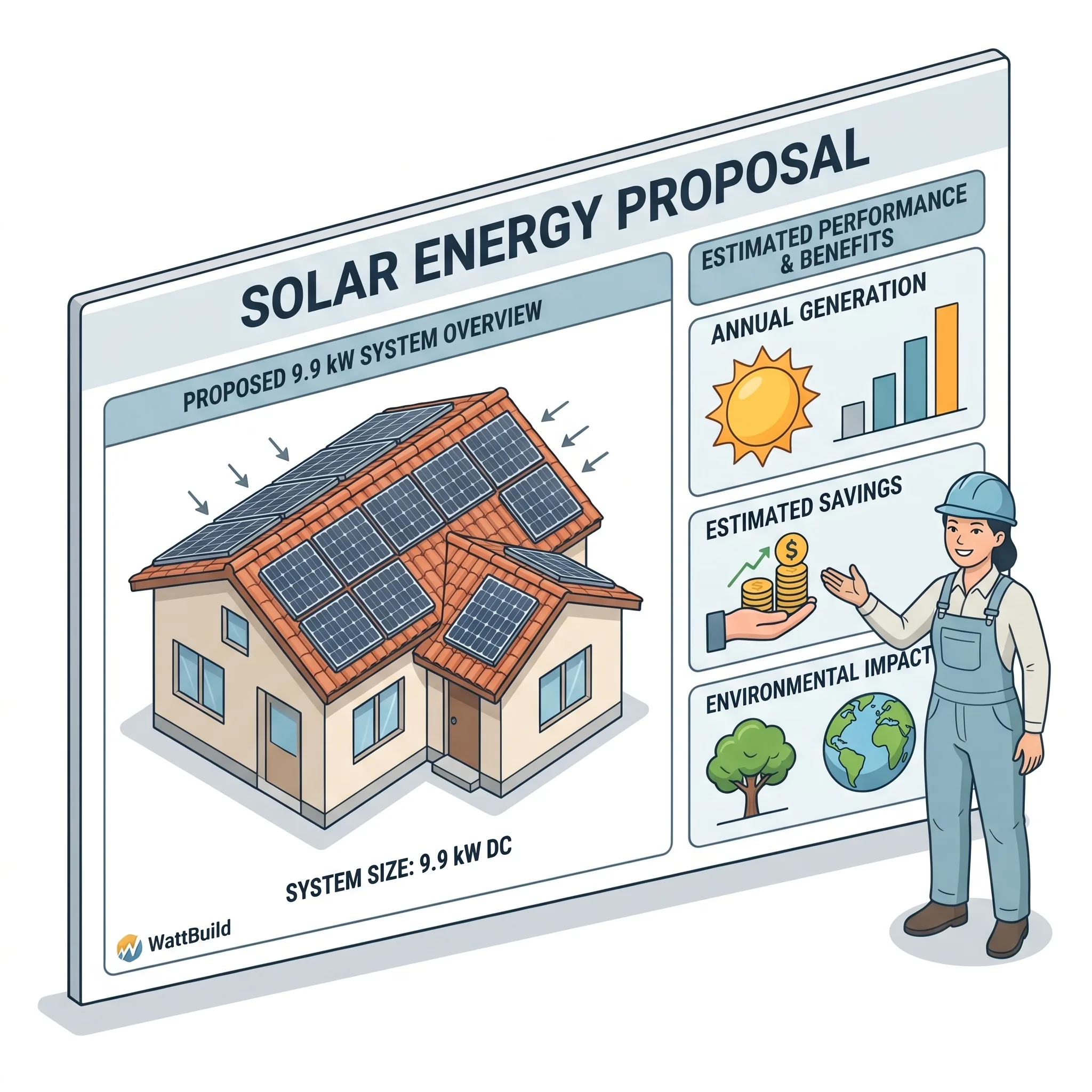
If your solar installer quoted you a 9.9 kW system and you wondered why they didn't just round up to 10, the answer has nothing to do with your roof or your panels. It is a regulatory line that determines how much paperwork, cost, and delay your interconnection requires.
The 10 kW threshold
In the United States, the 10 kW mark is a critical boundary in the solar interconnection process. It originates from FERC Order 2006, which established a three-tier system for connecting small generators to the grid:
- Under 10 kW (Level 1): Simplified application, minimal or no fees, no engineering study, and approval typically within days.
- 10 kW to 2 MW (Level 2): More extensive application, technical screening, potential engineering studies, and approval timelines of 30 to 90 days or longer.
- Over 2 MW (Level 3): Full interconnection study required.
Most states have adopted variations of this framework. The practical result: a 9.9 kW system qualifies for the simplest, cheapest, and fastest approval pathway. A 10.1 kW system may not.
What changes above 10 kW
Crossing the threshold can trigger several additional requirements depending on your utility and state:
- Engineering studies: the utility may require a formal analysis of how your system affects the local grid.
- Liability insurance: many utilities require $1 million in personal injury and property damage coverage for systems above 10 kW.
- PE-stamped plans: some jurisdictions require a Professional Engineer to review and stamp the system design.
- Longer timelines: Level 1 applications are typically processed in days; Level 2 applications can take 30 to 90 days or longer.
- Higher fees: application and study fees increase substantially.
For a residential system where the difference between 9.9 kW and 10.1 kW amounts to one or two panels, the added cost and delay of crossing the threshold rarely makes sense.
Three ways inverters limit output
The 9.9 kW number is primarily a system-sizing decision, but inverters themselves also limit output through three distinct mechanisms:
Inverter clipping. When the DC panel array is sized larger than the inverter's AC rating, a common and intentional design choice, the inverter caps its output at its nameplate rating during peak sun hours. A 9.9 kW panel array paired with a 7.6 kW inverter will clip at 7.6 kW during midday but produce more total energy across the day because the inverter runs closer to full output during morning, evening, and cloudy periods. Industry-standard DC-to-AC ratios range from 1.15 to 1.30, and the clipping loss at a 1.25 ratio is typically under 1% of annual production.
Software export limiting. All major inverter manufacturers, Enphase, SolarEdge, SMA, and Fronius, support configurable export limits that an installer sets during commissioning. These limits dynamically restrict how much power the system sends to the grid based on real-time meter readings. A system with a 9.9 kW export limit can still produce more than 9.9 kW if your household is consuming the excess. This is the mechanism that most directly implements a utility-required power cap.
Thermal derating. When internal components approach temperature limits, inverters automatically reduce output to protect themselves. Derating typically begins around 45 to 50 degrees Celsius ambient temperature and can reduce output by 20 to 30 percent in extreme heat. This is involuntary and environmental, not something your installer configures.
What changes with microinverters
Everything above assumes a single central inverter, but microinverters — one small unit per panel — behave differently in ways that matter at the 10 kW line. The most important difference is granularity: a string inverter comes in discrete sizes like 7.6 or 11.4 kW, while a microinverter system's AC rating is simply the sum of its units, each around 300 to 480 VA. An installer can land within a few hundred watts of any target, which is part of why microinverter proposals so often show oddly precise numbers.
Clipping also works per panel rather than per array. Each module has its own DC-to-AC ratio and its own pairing range published by the manufacturer, so a shaded or soiled panel clips on its own instead of pulling a whole string down with it. Export limiting, meanwhile, requires extra hardware: individual microinverters can't see the service point, so curtailment runs through a gateway with current transformers that throttles the fleet collectively. Thermal derating looks worse on paper too, since microinverters sit under the modules in rooftop ambient rather than on a shaded garage wall — though they're passively cooled and specified for those conditions.
The one thing to confirm with your installer is which number your utility actually screens on. Some jurisdictions count AC inverter output, others count DC nameplate at STC. A 12 kW DC array on 9.9 kW of microinverters clears Level 1 in the first case and gets bumped to Level 2 in the second. And because there's no inverter headroom in a microinverter system, adding even one panel later adds roughly 0.4 kW of AC capacity — enough to push a 9.9 kW system over the threshold and trigger a fresh interconnection application. String systems usually have slack; microinverter systems don't.
Why undersizing the inverter usually makes sense
It may seem counterintuitive to pair a 9.9 kW panel array with a smaller inverter, but the math works in the homeowner's favor. Panels rarely produce their rated output; temperature, angle, shading, wiring losses, and weather all reduce actual production below nameplate capacity. By oversizing the array relative to the inverter (a higher DC-to-AC ratio), the system produces more energy during the majority of daylight hours when conditions are not perfect.
Modeling data shows that at a 1.3 DC-to-AC ratio, only about 0.9% of total energy is lost to clipping, while the system gains 5 to 15 percent in total annual production compared to a 1:1 ratio. And as panels degrade over their 25-year lifespan (typically 0.5% per year), the clipping window shrinks naturally; by year 15, a system that once clipped moderately may not clip at all.
The bottom line
If your solar proposal shows a 9.9 kW system, your installer is almost certainly making a deliberate choice to keep you under the 10 kW interconnection threshold. That single-digit difference avoids engineering studies, insurance requirements, and months of additional permitting delay, without meaningfully reducing your energy production.
The 10 kW boundary is a regulatory artifact, not a technical limitation. Your system will produce the energy your roof and sun exposure allow; the 9.9 kW label is about how much red tape comes with connecting it to the grid.