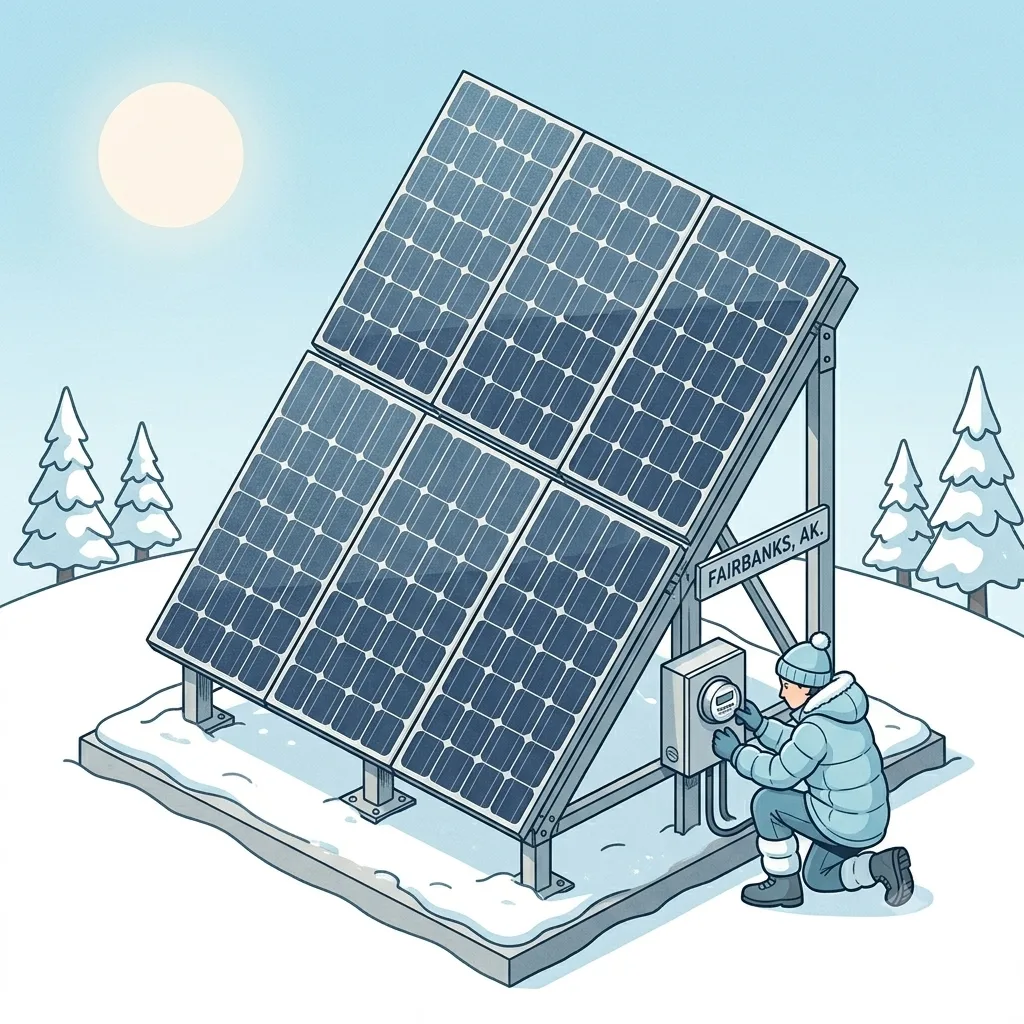
Solar panels in Fairbanks might sound impractical. Winter days are short, temperatures drop to -40, and snow covers everything for months. But Fairbanks has a counterintuitive advantage: its solar resource is roughly on par with Germany's, one of the world's largest solar markets. The key is getting the tilt angle right.
A common claim in Alaska solar discussions is that panels should be mounted vertically or nearly vertically, facing south, to maximize winter efficiency. The reality is more nuanced. Research from the University of Alaska Fairbanks shows that while steep tilt angles are important here, truly vertical mounting reduces annual production by roughly 30% compared to a properly angled system, and that winter is the wrong season to design around anyway.
Fairbanks sits at 64.8 degrees north
At this latitude, the sun behaves very differently than in the lower 48. On the winter solstice, the solar elevation angle peaks at just 2.6 degrees above the horizon. By the summer solstice, it climbs to 49.5 degrees and stays up for over 20 hours.
This extreme seasonal swing is why tilt angle matters more in Fairbanks than almost anywhere else in the United States. A panel optimized for summer will barely see the winter sun. A panel optimized for winter will underperform during the long summer days that produce most of the annual energy.
The optimal tilt is steep but not vertical
The Alaska Center for Energy and Power (ACEP) at UAF studied three residential configurations in Fairbanks over 21 months: flush-mounted panels at an 18-degree roof pitch, a mid-tilt around 50 degrees, and a steep tilt around 70 degrees.
The steeper arrays consistently outperformed flush mounts on an annual basis, primarily because of superior snow shedding in spring. Flush-mounted panels stayed covered with snow well into the season, costing one homeowner an estimated $90-$115 in lost production from a single snowed-in array. The 70-degree arrays shed snow under gravity and captured meaningful production during the critical March-April window.
The mathematically optimal angles depend on what you are optimizing for:
| Goal | Recommended tilt |
|---|---|
| Maximum annual production (fixed mount) | 59.5 degrees south-facing |
| Two-season adjustment | 39.3 degrees summer, 75.9 degrees winter |
| Four-season adjustment | 35.3 degrees summer, 61.2 degrees spring-fall, 81.7 degrees winter |
| Common Fairbanks residential installation | Approximately 70 degrees |
The winter-only optimal angle of roughly 82 degrees is close to vertical, which is likely where the "nearly vertical" advice originates. But most installations use a compromise tilt, typically around 70 degrees, that balances year-round production rather than maximizing a season when the sun barely rises.
Truly vertical (90-degree) wall-mounted panels do exist in Alaska. Arctic Solar Ventures in Anchorage has installed vertical arrays specifically to capture low-angle winter sun and eliminate snow accumulation. But these systems produce roughly 70% of the annual output of a properly tilted array. Vertical mounting makes sense for supplementary panels or space-constrained sites, but it is not the standard residential approach.
The spring bump
The most productive season for Fairbanks solar is not summer: it is spring. April and May combine three factors that create a production spike:
Increasing daylight. By late March, Fairbanks gets over 12 hours of daylight, climbing toward the 20-plus hours of midsummer.
Cold temperatures. Solar panels are more efficient in cold air. Most panels gain roughly 0.3-0.5% efficiency per degree Celsius below 25 degrees C. At -10 degrees C in early spring, a panel can produce 10-15% more than its rated output under the same irradiance.
Snow albedo. Fresh snow reflects 80-90% of incident sunlight. Ground-reflected light adds meaningfully to the irradiance reaching a steeply tilted panel face, and even more so for bifacial panels that capture light from both sides.
This combination is why ACEP found that tilted arrays generate roughly a quarter of their annual energy in spring alone. Flush-mounted arrays, by contrast, produce about two-thirds of their annual energy during summer because spring snow accumulation blocks them.
One documented Fairbanks system, two 5 kW arrays, produced peak monthly output of nearly 1,200 kWh in the best spring month. The same system produced only 19 kWh total across December through February combined.
Bifacial panels and snow reflection
Bifacial solar panels generate electricity from both their front and back surfaces. In snow-covered environments, the rear side captures reflected ground light that monofacial panels waste.
At UAF's test site (65 degrees N), bifacial panels showed a 21% annual energy gain over equivalent monofacial panels in side-by-side testing. At a test site in Kotzebue (67 degrees N), the gain was 15%. The IEA Photovoltaic Power Systems Programme Task 13 report on Arctic solar recommends bifacial modules as the default technology for Arctic deployments, citing longer-lasting snow cover, increased diffuse light, and low solar elevation angles as factors that amplify the bifacial advantage at high latitudes.
One finding from ACEP's research is worth highlighting: vertically mounted east-west-facing bifacial panels produced nearly the same annual energy as south-facing latitude-tilt bifacial panels, but with different seasonal profiles. This configuration, vertical panels facing east and west rather than south, is an emerging alternative for high-latitude sites, though it requires bifacial technology and departs from conventional south-facing orientation.
For homeowners considering ground-mounted systems in Fairbanks, bifacial panels on steep-tilt racking over snow-covered ground offer a well-documented production advantage that is specific to this latitude and climate.
Winter production is minimal regardless of tilt
No panel angle solves the fundamental problem: Fairbanks gets very little usable solar energy from mid-November through the end of January. The sun rises for fewer than 4 hours on the winter solstice, and the solar elevation is so low that even a perfectly aimed panel receives minimal energy.
For off-grid systems, a backup generator is a practical necessity during the winter months. Forum discussions among off-grid Alaskans describe running generators every few days in December and January to keep batteries charged. For grid-tied systems, the winter shortfall is covered by utility power: effectively using the grid as seasonal storage.
System sizing and economics in Fairbanks should be based on spring-through-fall output, not winter expectations.
Battery storage in extreme cold
Battery storage adds complexity in interior Alaska, where winter temperatures regularly drop below -30 degrees C.
Lithium iron phosphate (LFP) batteries, the standard choice for residential solar storage, cannot safely charge below 0 degrees C. Attempting to charge a cold LFP cell causes lithium plating on the anode, which permanently damages the cell. This damage is often not immediately apparent, showing up months later as reduced capacity. Even for discharge alone, LFP capacity drops to roughly 50-60% at -30 degrees C.
For installations with heated battery enclosures, LFP remains a strong choice: 4,000-8,000 cycle life, roughly 96% round-trip efficiency, and mature commercial availability. Insulated battery boxes with heater pads, consuming only 2-5% of system capacity while recovering 15-20% of otherwise lost cold-weather capacity, are a standard mitigation for Fairbanks installations. But in unheated outbuildings or outdoor enclosures, the charging restriction is a serious constraint that LFP's advantages do not overcome.
Sodium-ion batteries are emerging as a cold-climate alternative. Sodium-ion cells can charge at temperatures as low as -20 degrees C and retain approximately 90% capacity at that temperature, compared to 50-60% for LFP. Laboratory cells have demonstrated operation at -40 degrees C and below. The chemistry avoids the lithium plating risk entirely.
The trade-offs are real: sodium-ion currently offers lower cycle life (typically 2,000-3,500 cycles vs. 4,000-8,000 for LFP), lower energy density (100-175 Wh/kg vs. 160-210 Wh/kg), slightly lower round-trip efficiency (approximately 92% vs. 96%), and higher self-discharge (3-5% per month vs. 1-2%). Commercial production has been ramping up, with CATL and other manufacturers bringing volume products to market, though residential availability remains limited compared to LFP.
For Fairbanks specifically, the practical choice depends on the installation: grid-tied homes with heated garage or utility room storage are well-served by LFP. Off-grid or minimally heated installations may benefit from sodium-ion once residential products are more widely available. Until then, LFP with active heating is the standard approach.
Grid-tied solar in Fairbanks
Most residential solar installations in Fairbanks are grid-tied rather than off-grid. Golden Valley Electric Association (GVEA), the utility serving interior Alaska, offers the SNAP net metering program. Electricity produced by a solar system offsets consumption, and overproduction earns credits.
Grid-tied systems avoid the battery storage challenge entirely — the grid acts as seasonal storage. Spring and summer overproduction offsets winter grid consumption. At Fairbanks electricity rates, which are notably higher than the national average, a typical residential system has a payback period in the range of 9-12 years. Community purchasing programs like Solarize Fairbanks have helped drive installed costs below $3 per watt, making the economics increasingly practical.
Key takeaways
| Factor | What the research shows |
|---|---|
| Optimal fixed tilt | 60-70 degrees south-facing for annual production |
| Winter-specific tilt | 76-82 degrees, but winter output is minimal regardless |
| Vertical mounting | Produces roughly 70% of optimally tilted array; useful as supplementary |
| Bifacial panels | 15-21% annual gain from snow albedo at high latitudes |
| Peak production season | Spring (April-May), not summer |
| LFP batteries | Cannot charge below 0 degrees C; needs heated enclosure in Fairbanks |
| Sodium-ion batteries | Tolerates cold to -20 degrees C or below; limited residential availability |
| Grid-tied payback | Roughly 9-12 years at current Fairbanks electricity rates |
The advice to tilt panels steeply in Fairbanks is sound. The advice to go fully vertical overstates what the data supports. A 60-70 degree south-facing mount with bifacial panels is the configuration backed by the most research for this latitude, steep enough to shed snow and capture the low winter sun, but not so steep that it sacrifices the spring and summer production that drives the annual economics.