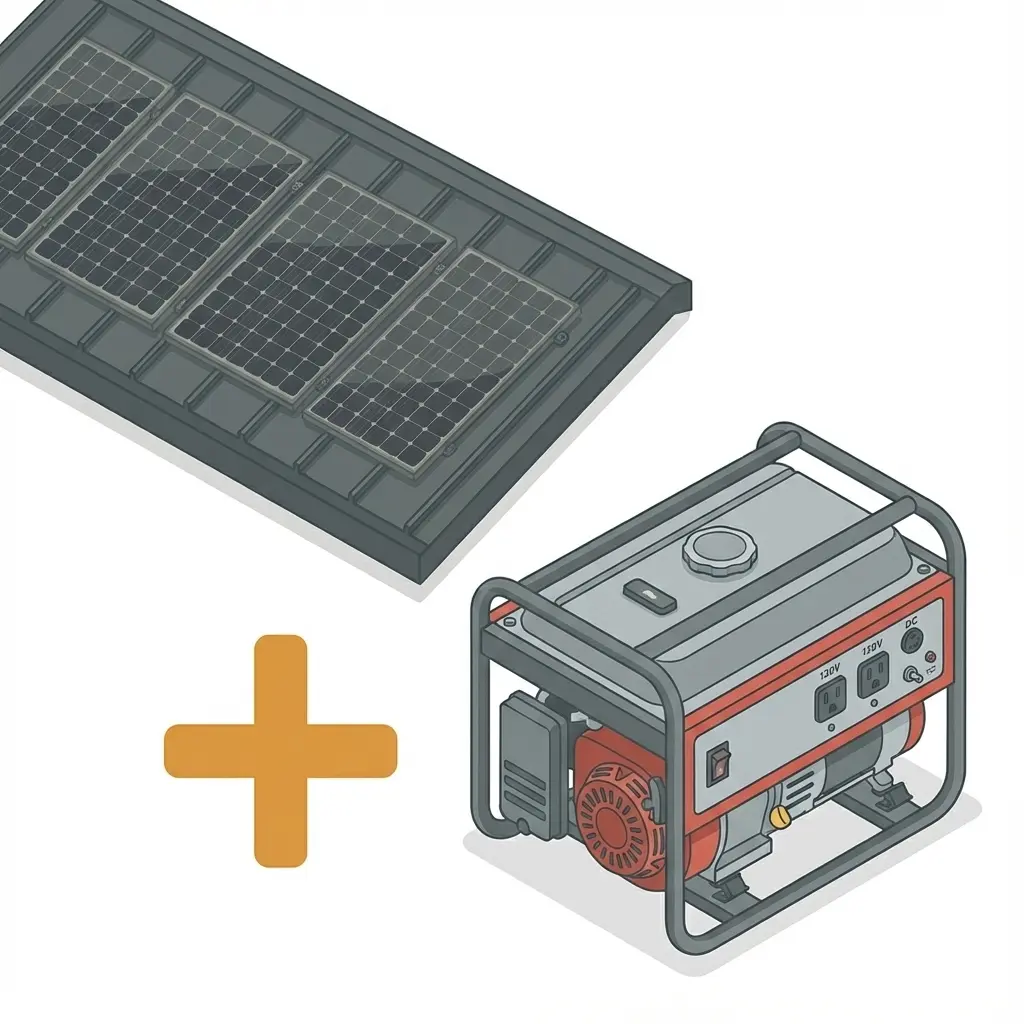
The widespread adoption of residential solar photovoltaic (PV) systems in the United States has been driven by the dual imperatives of environmental sustainability and long-term financial operational expenditure (OpEx) reduction. However, a significant misalignment exists between homeowner expectations of energy independence and the engineering realities of grid‑tied solar topologies. The prevailing assumption—that a solar array will automatically continue to energize a residence during a utility outage—is technically unfounded for the vast majority of standard installations due to mandatory anti‑islanding safety protocols codified in IEEE 1547 and UL 1741 standards.1 Consequently, the "need" for a generator or alternative backup mechanism is not merely a matter of convenience but a fundamental requirement for maintaining power continuity during grid failures.
This report provides an exhaustive technical and economic evaluation of the backup power landscape for solar‑equipped homes. It scrutinizes the operational mechanics of anti‑islanding, the viability of emerging "sunlight backup" technologies, and the comparative efficacy of traditional standby generators versus modern Battery Energy Storage Systems (BESS). Furthermore, it analyzes the integration challenges of hybrid architectures, the role of soft starters in HVAC management, and the financial implications of the Inflation Reduction Act (IRA) of 2022. By synthesizing data on total cost of ownership (TCO), insurance premium incentives, and fuel supply chain resilience, this document aims to equip stakeholders with the granular insights necessary to design robust, future‑proof residential energy systems.
1. The Operational Constraints of Standard Grid‑Tied Solar
1.1 The Anti‑Islanding Safety Protocol
The immediate cessation of power production by a grid‑tied solar system during a blackout is a deliberate engineering function designed to protect utility infrastructure and personnel. This function, known as "anti‑islanding," addresses the hazardous condition where a distributed energy resource continues to energize a portion of the electrical grid (an "island") after the main utility source has been disconnected.1
In a standard grid‑tied configuration, the solar inverter acts as a "grid‑following" device. It relies on the utility's 60 Hz AC waveform as a reference signal to synchronize its own output voltage and frequency. When the grid fails, this reference signal vanishes. If the inverter were to continue pushing current onto the distribution lines, it would create a lethal hazard for line workers attempting to repair the outage, as they operate under the assumption that isolated lines are de‑energized.3
To mitigate this risk, standards such as UL 1741 and IEEE 1547 mandate that all grid‑tied inverters must detect grid anomalies—such as voltage deviations or frequency shifts—and physically or electronically disconnect from the grid within a fraction of a second, typically 0.1 seconds. 1 This disconnection renders the PV array inert, regardless of the available solar irradiance. The system remains in this dormant state until the inverter detects stable grid parameters for a sustained period, typically five minutes, at which point it executes a controlled reconnection protocol.1
1.2 Grid Synchronization and Frequency Dependence
The dependency of standard inverters on a grid reference signal highlights the fundamental difference between "grid‑following" and "grid‑forming" architectures. A grid‑following inverter strictly matches the phase angle and frequency of the utility power. It lacks the internal control logic to establish a stable 60 Hz waveform independently. Without a grid‑forming source—such as a battery inverter or a specialized generator—to act as the "conductor" of the electrical orchestra, the grid‑following solar inverters cannot operate.3 This technological constraint is the primary driver for the integration of secondary power sources in solar residences.
1.3 "Sunlight Backup" Technologies: Capabilities and Limitations
Recent advancements, most notably by Enphase Energy with their IQ8 series microinverters, have introduced "grid‑forming" capabilities directly into the solar microinverter, enabling a feature marketed as "Sunlight Backup".7 This technology allows the PV system to form a microgrid during the day without a battery, adjusting energy production in real‑time to match home consumption.
However, the viability of Sunlight Backup as a standalone resilience strategy is severely limited by environmental variables. Because the system lacks an energy buffer (battery), the power output is strictly defined by instantaneous solar irradiance. If a cloud passes overhead, production drops instantly. If the home's electrical load exceeds this reduced production, the microgrid collapses.4 To prevent constant tripping, these systems require the installation of essential load controllers to rigorously shed non‑critical circuits. Furthermore, they generally cannot support high‑inrush loads such as central air conditioners or well pumps, and they provide zero utility during nighttime outages.4 User feedback and technical reviews suggest that while Sunlight Backup eliminates the "blackout during a sunny day" frustration, it falls short of providing the reliability required for true home resilience.10
2. The Standby Generator: Mechanical Resilience and Fuel Dependency
2.1 Engineering Mechanics of Standby Power
The traditional solution for whole‑home backup is the automatic standby generator. These units, typically fueled by natural gas (NG) or liquid propane (LP), are permanently installed assets ranging from 10 kW to 24 kW in residential applications.13 The core component of this system is the Automatic Transfer Switch (ATS).
Upon detecting a loss of utility voltage, the ATS signals the generator to start. Once the generator reaches its operating speed (typically 3600 RPM) and stabilizes its voltage, the ATS mechanically disconnects the home's main service panel from the utility meter and connects it to the generator. 15 This "break‑before‑make" transition physically isolates the home from the grid, thereby satisfying anti‑islanding requirements and allowing the home to be energized without back‑feeding the utility lines.16
2.2 Reliability Profiles of Fuel Sources
The resilience of a generator is intrinsically linked to the reliability of its fuel supply chain.
- Natural Gas (NG): NG infrastructure is predominantly underground, shielding it from wind, ice, and falling vegetation that plague overhead electric lines. Historical data indicates that NG distribution systems are significantly more reliable than electric distribution systems, with some studies citing an outage ratio of 1 in 650 customers for gas versus 1 in 1 for electricity annually.17 This makes NG generators a robust choice for storm‑prone areas. However, reliability is not absolute; extreme cold events can freeze wellheads or force electric‑dependent compressor stations offline, leading to supply curtailment, as witnessed during the 2021 Texas winter storm.19
- Liquid Propane (LP): Propane offers true off‑grid independence through on‑site storage. However, it relies on truck delivery for replenishment. During severe regional disasters such as hurricanes or blizzards, road infrastructure may be compromised, rendering refills impossible.20 A 22 kW generator running at full load can consume approximately 2‑3 gallons of propane per hour. A standard 500‑gallon residential tank (filled to 80 %) holds 400 gallons, providing roughly 5‑7 days of continuous runtime before depletion. Homeowners are advised to maintain tank levels above 30 % during winter months to ensure buffer capacity.21
3. Battery Energy Storage Systems (BESS): The Modern Microgrid
3.1 Technological Evolution: LFP vs. NMC Chemistry
The residential storage market has undergone a decisive shift from Nickel Manganese Cobalt (NMC) chemistry—common in early Tesla Powerwalls and EVs—to Lithium Iron Phosphate (LFP) chemistry. LFP is favored for stationary storage due to its superior thermal stability, which significantly reduces the risk of thermal runaway and fire.26 Furthermore, LFP batteries demonstrate a longer cycle life, often maintaining 80 % capacity after 3,000 to 6,000 cycles, compared to the 800‑1,000 cycles typical of NMC or lead‑acid chemistries.27 This longevity is critical for calculating the long‑term return on investment (ROI).
3.2 The Solar‑Storage Synergy and Grid‑Forming Physics
A battery system transforms a passive solar array into an active asset during outages through "grid‑forming" technology. When the grid fails, the battery's inverter instantly disconnects from the utility and establishes a local 60 Hz voltage reference.3 This reference signal "tricks" the solar microinverters into perceiving a live grid, enabling them to wake up and produce power.
To manage the energy balance, the battery employs "Frequency Shift Power Control." If the battery reaches 100 % state‑of‑charge (SoC) and solar production exceeds household demand, the battery inverter slightly increases the microgrid frequency (e.g., to 60.5 Hz). The solar inverters detect this shift and curtail production or shut down, preventing battery overcharge.29 As the battery discharges, the frequency returns to 60 Hz, prompting solar production to resume. This automated dance allows for indefinite operation, theoretically limited only by the availability of sunlight.30
3.3 The Impact of the Inflation Reduction Act (IRA)
The Inflation Reduction Act of 2022 fundamentally altered the economics of home storage. The legislation extended and modified the Investment Tax Credit (ITC), now referred to as the Residential Clean Energy Credit.
- 30 % Tax Credit: Homeowners can claim a credit equal to 30 % of the total installed cost of battery storage technology. This credit is available through 2032, stepping down to 26 % in 2033.31
- Standalone Eligibility: Crucially, the IRA removed the requirement that batteries must be charged 100 % by solar to qualify. Standalone storage batteries with a capacity of at least 3 kWh are now eligible, regardless of whether they charge from solar or the grid.33
- Exclusion of Generators: Fossil‑fuel standby generators generally do not qualify for this 30 % federal credit, nor are they considered "renewable" energy property under the tax code.35 This creates a significant net‑cost advantage for battery systems.
4. Economic Analysis: Total Cost of Ownership (TCO)
While standby generators often have a lower upfront "sticker price," a comprehensive 20‑year TCO analysis reveals that battery systems are often the more financially prudent choice due to operational costs and incentives.
4.1 Comparative Cost Structure
The following table synthesizes data from multiple industry sources to project the long‑term costs of a whole‑home solution.
| Cost Category | Whole‑Home Solar + Battery (10‑15 kWh) | Whole‑Home Nat. Gas Generator (20‑22 kW) |
|---|---|---|
| Upfront Equipment & Installation | $25,000 – $30,000 | $7,000 – $15,000 |
| Federal Tax Credit (IRA) | –$7,500 – $9,000 (30 %) | $0 (Ineligible) |
| Net Initial Investment | ≈$17,500 – $21,000 | ≈$7,000 – $15,000 |
| Annual Maintenance (20 Years) | ≈$500 (Software/Fan checks) | ≈$8,000 (Oil, filters, service calls) |
| Fuel Costs (20 Years) | $0 (Solar charged) | ≈$7,500 (Based on 120 hrs/yr usage) |
| Asset Replacement | ≈$9,500 (Battery module @ Year 15) | ≈$7,000 (Full unit replacement @ Year 15) |
| Total 20‑Year Cost of Ownership | ≈$27,500 – $31,000 | ≈$29,500 – $37,500+ |
| Potential Daily Savings | High (TOU Arbitrage / VPP) | None (Idle Asset) |
Table Data Sources: 14
Analysis: The crossover point where batteries become cheaper than generators typically occurs between years 5 and 10, driven by the absence of fuel costs and minimal maintenance requirements. Furthermore, batteries can participate in "Virtual Power Plants" (VPP) or Time‑of‑Use (TOU) arbitrage, generating daily bill savings that generators cannot.39 Generators are strictly liabilities (insurance policies), while batteries are assets with potential ROI.
4.2 Home Resale Value
Market data suggests that homes equipped with solar and battery storage command a higher resale value, often recovering a significant portion of the installation cost. This is attributed to the "future‑proof" appeal of energy independence and low utility bills.41 Conversely, while generators add value, the perception of required maintenance and fuel costs can dampen the premium compared to passive solar assets.14
5. Hybrid Integration: The "Holy Grail" of Resilience
For homeowners unwilling to compromise between the "infinite" duration of a generator and the silent efficiency of a battery, hybrid integration offers the ultimate solution. However, combining these technologies requires navigating complex compatibility issues.
5.1 The Charging Dilemma
A critical distinction in hybrid systems is whether the generator can charge the battery.
- Tesla Powerwall Limitations: In standard Tesla Powerwall architectures, the generator is integrated via an external transfer switch. When the generator runs, the Powerwall isolates itself. It cannot charge from the generator. The generator powers the home, and the battery waits for solar or grid return.43 This protects the battery from "dirty" generator power but limits the system's efficiency—fuel must be burned continuously to power loads, even if demand is low.
- Enphase and FranklinWH Advantages: Competitors like Enphase (with the IQ System Controller 2) and FranklinWH (with the aGate X) have developed sophisticated management units that allow for generator buffering. In these systems, the generator can charge the batteries. 46 This allows for "cycle charging": the generator runs at optimal load to charge the batteries, then shuts down, allowing the home to run silently on battery power for hours. This significantly extends fuel supplies during prolonged outages and reduces noise pollution.47
5.2 Soft Starters for HVAC Integration
Central air conditioners present a massive hurdle for backup power due to "Locked Rotor Amps" (LRA)—the surge of current required to start the compressor, which can be 5‑7 times the running current. 49 A 4‑ton unit might draw 4,000 watts to run but demand 100+ amps to start, potentially tripping a battery inverter or stalling a generator.
The Soft Start Solution: Devices like the Micro‑Air EasyStart or Hyper Engineering SureStart regulate the voltage application to the compressor motor, reducing LRA by up to 70 %. 49
- Cost: The hardware typically costs $300‑$400, with professional installation adding $150‑$500.52
- Impact: Installing a soft starter can allow a single Powerwall or a smaller (e.g., 10‑12 kW) generator to successfully start a 4‑ or 5‑ton AC unit, avoiding the need for expensive system oversizing.50
6. Portable Power and Budget Alternatives
For homeowners where a $15,000+ investment is unfeasible, portable solutions combined with manual transfer mechanisms offer a high‑value alternative.
6.1 Interlock Kits vs. Transfer Switches
- Generator Interlock Kit: This is a mechanical sliding plate installed on the main electrical panel. It physically prevents the main utility breaker and the generator back‑feed breaker from being in the "ON" position simultaneously. It is the most cost‑effective compliant solution, costing $400‑$850 installed.55 It allows the user to select any circuit in the house to power, up to the generator's limit.
- Manual Transfer Switch: This involves a separate sub‑panel where specific circuits are hardwired. While effective, it is less flexible and typically more expensive ($1,200‑$1,600 installed) than an interlock.57
6.2 Portable Solar Generators
"Solar Generators" (portable power stations from brands like EcoFlow, Bluetti, Jackery) provide a fuel‑free portable option.
- Runtime Expectations:
- Furnace: A modern gas furnace requires electricity for the blower and control board. A standard portable unit (e.g., EcoFlow Delta 2) can run a furnace for 4‑10 hours, depending on capacity and furnace efficiency.58 Note: This often requires a "neutral‑ground bonding plug" to trick the furnace's flame sensor into operating correctly.59
- Refrigerator: A unit with ≈2000 Wh capacity (e.g., Bluetti AC200MAX) can run a standard efficient fridge for 30‑45 hours.61
- Limitations: These units cannot typically be integrated into the main panel to back‑feed the whole house legally or safely without specific inlet boxes and interlocks. They are best used as standalone power sources for specific appliances via extension cords.
7. Insurance Implications and Discounts
Homeowners insurance carriers increasingly recognize backup power as a risk mitigation tool, particularly for preventing frozen pipes or sump pump failures. However, discounts vary by carrier and state.
| Insurance Carrier | Discount Type | Potential Savings | Notes |
|---|---|---|---|
| State Farm | Protective Device / Home Monitoring | Varies (often ≈5 %) | Discounts for "home monitoring systems" which can include generators; partnered with Generac for rebates.63 |
| Allstate | Protective Device | Up to 5 % | Discounts for devices that prevent theft, fire, or water damage (sump pumps powered by generators).65 |
| USAA | Connected Home | Up to 8 % | Focuses on "connected" water leak detectors; generators indirectly support this by keeping Wi‑Fi/sensors active.66 |
| Chubb | Superior Protection | Up to 15 % | Explicit credit for "permanently installed backup generator" under "Superior Protection" credits.67 |
| Liberty Mutual | Protective Device | Varies | Offers discounts for new/renovated homes and protective devices; precise generator % varies by state.68 |
| Amica | Bundling/Loyalty | Varies | Primary discounts are for bundling and loyalty; specific generator discounts are less advertised.69 |
Note: Homeowners should contact their agents directly, as discounts are often categorized under "Loss Mitigation" credits rather than explicitly labeled "Generator Discounts."
8. Strategic Recommendations and Conclusion
The "need" for a generator when owning solar panels is defined by the homeowner's tolerance for downtime and their geographic risk profile. Solar alone is not a backup solution.
8.1 Usage Scenarios
- Scenario A: The Urban Commuter (Grid Stability).
- Risk: Rare, short outages (2‑4 hours).
- Solution: Solar + Battery (10‑15 kWh).
- Rationale: Provides seamless power for essential loads. Maximizes financial return via TOU savings. Eliminates maintenance.
- Scenario B: The Coastal Resident (Hurricane Zone).
- Risk: Potential for 5+ day outages with cloud cover.
- Solution: Hybrid (Solar + Battery + Generator).
- Rationale: Solar/Battery handles the first 24 hours and nights. The generator provides the "range extension" required when solar production fails due to storm clouds, ensuring AC and refrigeration persist for weeks if necessary.
- Scenario C: The Budget‑Conscious Retrofit.
- Risk: Occasional outages, limited capital.
- Solution: Solar (Grid‑Tied) + Portable Generator w/ Interlock.
- Rationale: Preserves the savings of solar while providing a low‑cost ($1,000) insurance policy for long outages, requiring manual intervention but saving tens of thousands in upfront costs.
8.2 Conclusion
The modern residential energy landscape has moved beyond the binary choice of "grid vs. generator." The integration of Lithium‑Iron Phosphate batteries, incentivized by the IRA, has established a third pillar of resilience that offers superior economics and convenience for most daily outage scenarios. However, for total immunity from extended grid collapse and weather events, the mechanical reliability of a generator—specifically when integrated into a smart microgrid—remains the ultimate insurance policy. Homeowners must therefore view their solar installation not as a standalone solution, but as the foundational generation source for a broader, modular energy ecosystem.
Works cited
- What Is Anti‑Islanding in Solar Inverters? – Aforenergy, accessed November 27, 2025, https://www.aforenergy.com/what-is-anti-islanding-in-solar-inverters/
- The Ultimate Guide to Anti‑Islanding: Codes, Inverters, and Safety – Anern Store, accessed November 27, 2025, https://www.anernstore.com/blogs/diy-solar-guides/ultimate-guide-anti-islanding-codes-inverters-safety
- Why Do Grid‑Tie Solar Systems Shut Down During Power Outages?, accessed November 27, 2025, https://www.solar-electric.com/learning-center/why-do-grid-tie-solar-systems-shut-down-during-power-outages/
- Sunlight Backup: Exact Solar's IQ8 Microinverter Case Study, accessed November 27, 2025, https://exactsolar.com/sunlight-backup-iq8-microinverter-case-study/
- Anti‑Islanding Protection: Solar Safety for Grid‑Tied Systems – Circuit Breaker, accessed November 27, 2025, https://www.weishoelec.com/Blog/how-does-anti-islanding-work/
- Solar Anti‑Islanding Protection: A Comprehensive Guide, accessed November 27, 2025, https://suntegritysolar.com/uncategorized/solar-anti-islanding-protection-a-comprehensive-guide/
- Sunlight Backup installation support – Enphase, accessed November 27, 2025, https://enphase.com/installers/microinverters/iq8/sunlight-backup
- Is Enphase Sunlight Backup Worth It Without Batteries? – YouTube, accessed November 27, 2025, https://www.youtube.com/watch?v=AFLveJabNFU
- Enphase IQ8 Sunlight Backup Microinverters vs Battery Backup – Florida Power Services, accessed November 27, 2025, https://www.floridapowerservices.com/enphase-iq8-sunlight-backup-microinverters-vs-battery-backup/
- Is Anybody Using Enphase Sunlight Backup? : r/solar – Reddit, accessed November 27, 2025, https://www.reddit.com/r/solar/comments/16f0nzw/is_anybody_using_enphase_sunlight_backup/
- Thoughts on the Enphase Sunlight Backup? : r/solar – Reddit, accessed November 27, 2025, https://www.reddit.com/r/solar/comments/vry0is/thoughts_on_the_enphase_sunlight_backup/
- Enphase Sunlight Backup rant : r/solar – Reddit, accessed November 27, 2025, https://www.reddit.com/r/solar/comments/1imelzc/enphase_sunlight_backup_rant/
- How Much Does a Whole‑House Generator Cost? [2025 Data] – Angie's List, accessed November 27, 2025, https://www.angi.com/articles/how-much-does-it-cost-install-generator.htm
- Solar Battery Vs. Generator Debate for Backup Power – GreenLancer, accessed November 27, 2025, https://www.greenlancer.com/post/solar-battery-backup-vs-generator
- Can You Combine Solar Power with a Backup Generator? Here's How It Works, accessed November 27, 2025, https://www.cainelectricstl.com/st-louis-electrician-blog/solar-backup-generator-integration-12/
- Generator Interlock Information – DuroMax Power Equipment, accessed November 27, 2025, https://www.duromaxpower.com/pages/generator-interlock-information
- accessed November 27, 2025, https://www.aga.org/natural-gas-is-fueling-american-emergency-and-disaster-response/#:~:text=Natural gas systems are often,outage per year per customer.
- Natural Gas is Fueling American Emergency and Disaster Response, accessed November 27, 2025, https://www.aga.org/natural-gas-is-fueling-american-emergency-and-disaster-response/
- Research Identifies Percentage of U.S. Natural Gas Pipelines Vulnerable to Electric Outages, Recommends Steps to Avert Potential Hazards – Tepper School of Business, accessed November 27, 2025, https://www.cmu.edu/tepper-news/news/stories/2023/april/gas-pipelines-electric-outages.html
- Propane Safety During Winter Storms – Superior Energy, LLC, accessed November 27, 2025, https://propanect.com/blog/2017/2/8/propanesafety-during-winter-storms
- Winter Weather Propane Delivery FAQs, accessed November 27, 2025, https://www.superiorpluspropane.com/blog/propane-delivery-winter-faqs/
- Batteries vs generators: Choosing the right one for your home power backup – Hoymiles, accessed November 27, 2025, https://www.hoymiles.com/us/solar-insider/batteries-vs-generators-choosing-the-right-one-for-your-home-power-backup.html
- Whole House Battery Backup vs Generator: Which Power Solution Is Right for You?, accessed November 27, 2025, https://www.franklinwh.com/blog/whole-house-battery-backup-vs-generator-which-power-solution-is-right-for-you
- 5 Reasons Why Backup Battery Storage is Better Than a Generator – ES SOLAR, accessed November 27, 2025, https://essolar.com/blogs/es-solar/5-reasons-why-backup-battery-storage-is-better-than-a-generator/
- Solar Panels vs Generator Backup: Cost Comparison Guide, accessed November 27, 2025, https://optiononesolar.com/blog/solar-panels-vs-generator-backup-cost-comparison-guide
- Live in Houston: considering adding batteries versus a standby generator. Pros/cons? – r/solar – Reddit, accessed November 27, 2025, https://www.reddit.com/r/solar/comments/1ef2ivp/live_in_houston_considering_adding_batteries/
- How Long Can a Battery‑Powered Solar Generator Last? – EcoFlow, accessed November 27, 2025, https://www.ecoflow.com/ca/blog/how-long-can-battery-powered-generator-last/
- Solar Battery vs Standby Generator 2025 | BatteryEVO, accessed November 27, 2025, https://www.batteryevo.com/blogs/news/solar-battery-vs-standby-generator-2025-batteryevo
- No solar during extended outage? | DIY Solar Power Forum, accessed November 27, 2025, https://diysolarforum.com/threads/no-solar-during-extended-outage.82661/
- How Long Can Solar Battery Power a House During an Outage?, accessed November 27, 2025, https://www.solar.com/learn/how-long-can-a-battery-provide-power-during-an-outage/
- Residential Clean Energy Credit | Internal Revenue Service, accessed November 27, 2025, https://www.irs.gov/credits-deductions/residential-clean-energy-credit
- Battery Storage Technology Tax Credit | ENERGY STAR, accessed November 27, 2025, https://www.energystar.gov/about/federal-tax-credits/battery-storage-technology
- What is IRA battery storage tax credit and how to get it? – eco-worthy, accessed November 27, 2025, https://www.eco-worthy.com/blogs/lithium-battery/what-is-ira-battery-storage-tax-credit-and-how-to-get-it
- Home energy tax credits | Internal Revenue Service, accessed November 27, 2025, https://www.irs.gov/credits-deductions/home-energy-tax-credits
- Do Whole‑House Generators Qualify for Rebates or Tax Credits in 2025?, accessed November 27, 2025, https://thefurnaceoutlet.com/blogs/videos/do-whole-house-generators-qualify-for-rebates-or-tax-credits-in-2025
- Battery vs Generator: Which Keeps Your Home Running in 2025?, accessed November 27, 2025, https://martins-electrical.com/battery-vs-generator-which-keeps-your-home-running-in-2025/
- Home Battery Backup Power Vs. Generators (2025) – EnergySage, accessed November 27, 2025, https://www.energysage.com/energy-storage/battery-backup-power-vs-generators-which-is-right-for-you/
- The Ultimate Guide to Battery Backup vs Standby Generators – Anern Store, accessed November 27, 2025, https://www.anernstore.com/blogs/off-grid-solar-solutions/ultimate-battery-backup-vs-standby-generators
- Do Grid‑Tied Solar Panel Systems Work In a Blackout? – EcoFlow, accessed November 27, 2025, https://www.ecoflow.com/us/blog/do-gridtied-solar-panel-systems-work-in-blackout/
- Home Battery vs Portable Power Station: UPS Backup Compared – EcoFlow, accessed November 27, 2025, https://www.ecoflow.com/us/blog/home-battery-vs-portable-power-station/
- Are Solar Panels / backup batteries adding value. – r/RealEstate – Reddit, accessed November 27, 2025, https://www.reddit.com/r/RealEstate/comments/157l6uc/are_solar_panels_backup_batteries_adding_value/
- Home Battery Storage: Is It a Better Investment Than Generators?, accessed November 27, 2025, https://www.uncommonsolar.com.au/home-battery-storage-is-it-a-better-investment-than-generators/
- Combining Systems with Powerwall | Tesla Support Canada, accessed November 27, 2025, https://www.tesla.com/en_ca/support/energy/powerwall/learn/combining-systems
- Combining Systems with Powerwall | Tesla Support, accessed November 27, 2025, https://www.tesla.com/support/energy/powerwall/learn/combining-systems
- What if I have a backup generator already? Can my generator charge the Powerwall?, accessed November 27, 2025, https://greenmountainpower.com/help/backup-generator-already-can-generator-charge-powerwall/
- aGate Intelligent Energy Management Controller – FranklinWH, accessed November 27, 2025, https://www.franklinwh.com/au/products/agate-home-energy-management-controller/
- Generator support | Enphase, accessed November 27, 2025, https://enphase.com/installers/storage/gen2/generator
- DATASHEET – Franklin Home Power – FranklinWH, accessed November 27, 2025, https://e-uploads.franklinwh.com/website/news/7554cc31b8e25064c6d20654b49f37d5.pdf
- Using A Soft Starter with A Solar Energy System – BriskHeat, accessed November 27, 2025, https://www.briskheat.com/news-events/soft-starter-solar-energy/
- Will Power Walls Run a 5 Ton AC Unit? Know Everything – BettSun, accessed November 27, 2025, https://bettsun.com/will-power-walls-run-a-5-ton-ac-unit/
- The Best A/C Soft Starter For Residential Central Air Conditioners and Heat Pumps – SoftStart Home, accessed November 27, 2025, https://softstarthome.com/ac-soft-start/
- Going rate in Houston to install a soft starter to my Trane XR13 A/C unit? – Reddit, accessed November 27, 2025, https://www.reddit.com/r/Generator/comments/1ksbw8m/going_rate_in_houston_to_install_a_soft_starter/
- Could an electrician install a soft start kit? – r/hvacadvice – Reddit, accessed November 27, 2025, https://www.reddit.com/r/hvacadvice/comments/1lwis3k/could_an_electrician_install_a_soft_start_kit/
- Can a Tesla Powerwall Run an Air Conditioner – Element Electric, accessed November 27, 2025, https://elementelectric.com/blog/can-a-tesla-powerwall-run-an-air-conditioner/
- 2025 Generator Transfer Switch Installation Cost – HomeGuide, accessed November 27, 2025, https://homeguide.com/costs/generator-transfer-switch-installation-cost/
- 30 amp inlet/interlock: How much did your electrician quote you? – Reddit, accessed November 27, 2025, https://www.reddit.com/r/Generator/comments/1iihlkf/30_amp_inletinterlock_how_much_did_your/
- Cost To Install Generator Transfer Switch [2025 Data] | Angi, accessed November 27, 2025, https://www.angi.com/articles/cost-install-generator-transfer-switch.htm
- How Long Will The EcoFlow Power Station Run My Furnace? – YouTube, accessed November 27, 2025, https://www.youtube.com/watch?v=u40993FM0TQ
- Can my EcoFlow Delta Mini run my gas furnace? – r/SolarDIY – Reddit, accessed November 27, 2025, https://www.reddit.com/r/SolarDIY/comments/z09b58/can_my_ecoflow_delta_mini_run_my_gas_furnace/
- Help me understand: Could I plug my whole‑home natural gas furnace into my Delta Max? – r/Ecoflow_community – Reddit, accessed November 27, 2025, https://www.reddit.com/r/Ecoflow_community/comments/12bs0d2/help_me_understand_could_i_plug_my_wholehome/
- Can Bluetti Power a Refrigerator? – True Gear, accessed November 27, 2025, https://truegear.com.au/blogs/news/can-bluetti-power-a-refrigerator/
- Battery Meter / AC200Max – BLUETTI Apex & AC Series, accessed November 27, 2025, http://community.bluettipower.com/t/battery-meter-ac200max/7240
- Have the Power and Technology to Weather Any Power Outage – State Farm Newsroom, accessed November 27, 2025, https://newsroom.statefarm.com/have-the-power-and-technology-to-weather-any-power-outage/
- Homeowner Insurance Discounts to Help You Save – State Farm®, accessed November 27, 2025, https://www.statefarm.com/insurance/homeowners/discounts
- How to Get Home Insurance Discounts – Allstate, accessed November 27, 2025, https://www.allstate.com/resources/home-insurance/homeowners-insurance-discounts/
- Connected Home Program: Smart Home Discounts – USAA, accessed November 27, 2025, https://www.usaa.com/support/insurance/homeowners/connected-home/
- New York Masterpiece® Discounts – Chubb, accessed November 27, 2025, https://www.chubb.com/cpiebcontent/cpihomepage/pdf/resourceCenter/discounts/ny_cpi27933.pdf
- Home Insurance Discounts – Get a Quote – Liberty Mutual, accessed November 27, 2025, https://www.libertymutual.com/property/homeowners-insurance/discounts
- 6 Ways to Save Money on Homeowners Insurance – accessed November 27, 2025, https://www.amica.com/en/resources/home/coverage/6-ways-to-save-money-on-homeowners-insurance.html