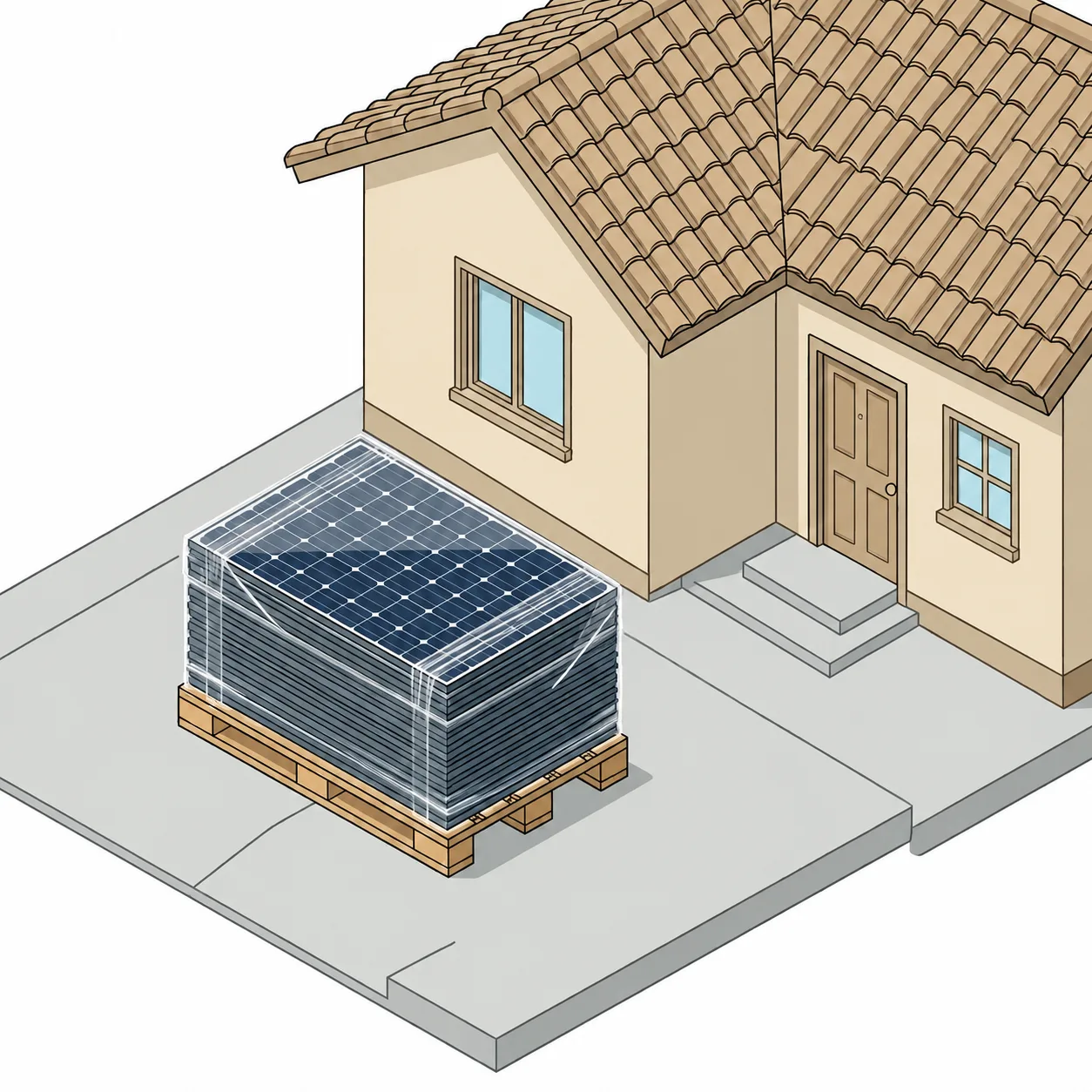
If you only need four or five solar panels, for a shed, a garage, or a small off-grid project, you will quickly discover that the solar panel market is not set up for you. Most suppliers price their panels around pallet-quantity orders, and a pallet typically holds 27 to 36 panels. Buy fewer, and you pay significantly more per watt.
Why minimum orders exist
Solar panels are large, fragile, and expensive to ship. A standard residential panel is over six feet long, cannot be stacked on top of other freight, and must travel on a wooden pallet via LTL (less-than-truckload) freight. The base freight charge for LTL shipping runs $287–$300 regardless of whether the pallet holds one panel or twenty. Add residential delivery fees ($40–$100), liftgate service ($75–$150), and appointment scheduling, and a single shipment can cost $300–$600 before you have bought a single panel.
That cost structure explains why many suppliers set minimums. Signature Solar, one of the largest online solar retailers for DIY buyers, requires a minimum purchase of ten panels for shipped pallet orders. Other distributors sell only in full pallets, commonly 31 to 36 panels, with no option to buy fewer at the pallet price. The savings at pallet quantities are real: online distributor pricing typically runs $0.25–$0.45 per watt at pallet volume, compared to $0.50–$1.20 per watt for individual panels through retail channels.
The price ladder
The markup chain from factory to your roof follows a consistent pattern across the industry:
- Factory production cost: approximately $0.18 per watt for a 400W monocrystalline panel
- Distributor wholesale (pallet quantities): $0.25–$0.45 per watt
- Online retail (individual panels): $0.50–$0.85 per watt
- Big-box retail (Home Depot, Lowe's): $0.80–$1.40 per watt
A homeowner buying four 400W panels at big-box retail prices might pay $320–$560 per panel. The same panels at pallet-quantity distributor pricing might cost $100–$180 each: a difference of 50–75%. The catch is that a full pallet contains 30-plus panels, which is far more than a small project needs.
Options for small-quantity buyers
Several channels serve buyers who need fewer than a pallet:
Local distributor pickup. Greentech Renewables operates over 100 locations across the United States. Many locations sell panels individually to walk-in buyers without requiring a contractor license, though policies vary by branch. Local pickup eliminates freight costs entirely and avoids the shipping damage that affects an estimated one in five shipped panel orders.
Online retailers with low or no minimums. Solar Electric Supply offers split-pallet orders and does not enforce a minimum project size. A1 SolarStore and GoGreenSolar also sell individual panels, though freight charges apply. Expect to pay $0.35–$0.50 per watt before shipping.
Amazon and marketplace sellers. Amazon carries solar panels in small quantities — two-packs, four-packs — which is convenient for small projects. The selection tends toward lower-wattage panels, and pricing runs at or above retail levels.
Secondary and surplus markets. The solar panel resale market handled approximately 1.7 million modules in 2024, with 95% being excess new panels still under manufacturer warranty. Facebook Marketplace and dedicated platforms like EnergyBin can surface deals on surplus inventory for buyers willing to verify warranty status.
When the math favors a full pallet
For a typical residential rooftop system, 20 to 30 panels producing 8–12 kW, pallet pricing is the natural fit. A pallet of 31 panels at mid-range distributor pricing ($0.30–$0.45 per watt for a 400W–550W module) typically costs $4,000–$7,000, compared to $6,000–$12,000 or more at individual retail pricing. The per-watt savings of 40–60% can amount to $2,000–$5,000 on a full system's worth of panels.
For projects that need fewer than ten panels, the economics shift. The fixed shipping cost of $300–$600 erases much of the per-watt discount when spread across just four or five panels. In that range, local pickup from a distributor branch, or paying retail from an online seller, often makes more financial sense than chasing wholesale pricing.
What to watch for
Shipping damage. LTL freight involves multiple warehouse transfers, and panels cannot withstand stacking or rough handling. Community forums document breakage in 1–5% of shipments. Purchase shipping insurance (typically $30–$50 per order) and inspect every panel on delivery before signing.
Tariff volatility. U.S. solar panel prices sit well above global spot prices due to trade restrictions. Anti-dumping and countervailing duties on panels from China, Vietnam, Thailand, and Malaysia add 24–46% to the base import price. These tariffs shift frequently: one documented case showed a pallet of 30 Tier-1 panels jumping from $6,600 to $8,700 between March and April 2025.
The installed-cost picture. Panels represent only about 25–30% of a professionally installed system's total cost. Soft costs — permitting, interconnection, installation labor, and overhead — account for roughly 64% of the final price. For homeowners hiring an installer, the panel procurement channel matters less than the installer's overall system price, since installers buy at wholesale volume regardless.