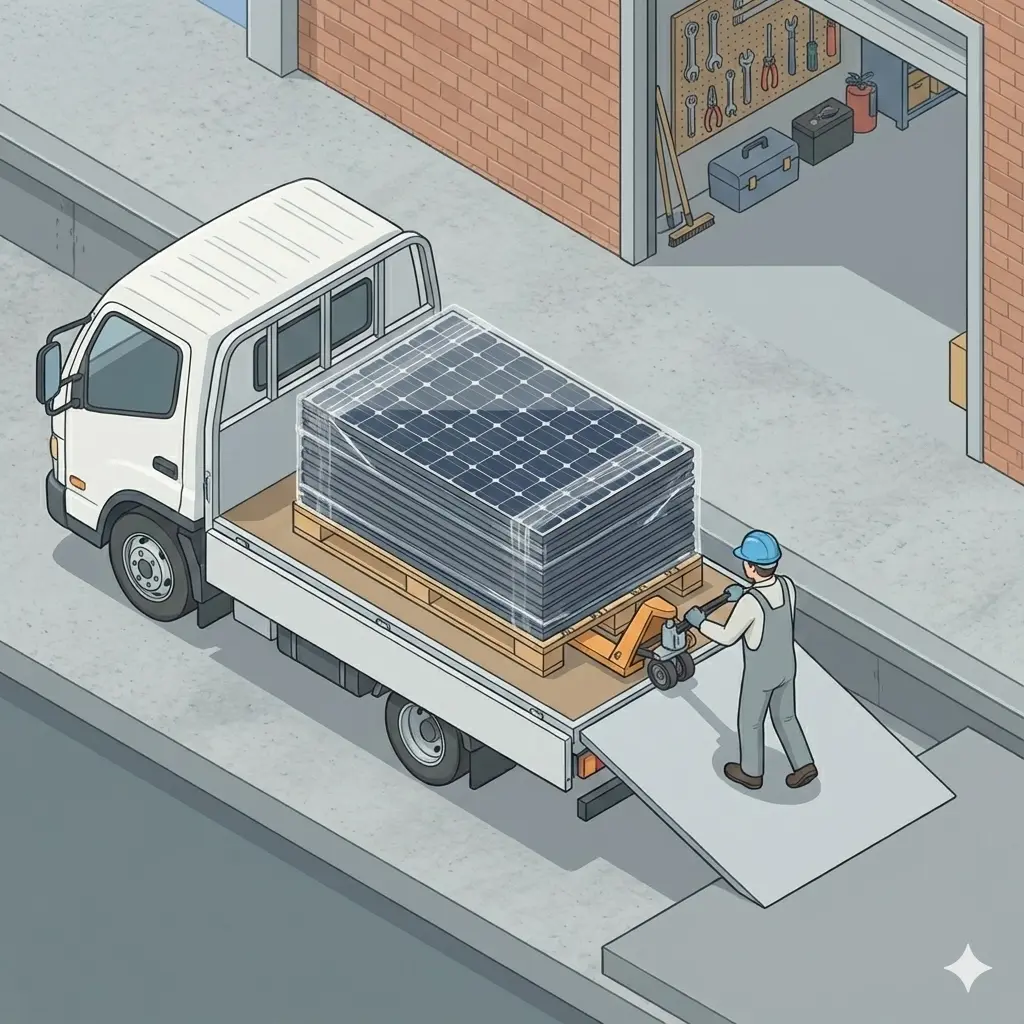
The landscape of residential renewable energy in the United States has undergone a radical transformation over the past decade. As photovoltaic (PV) technology has matured, the localized cost of energy generation has plummeted, democratizing access to solar power. This economic shift has given rise to a burgeoning demographic of "prosumers"—homeowners who not only consume energy but actively participate in the procurement, design, and often the installation of their own energy systems. However, while the financial and electrical barriers to entry have lowered, a formidable logistical barrier remains: the physical movement of industrial-grade equipment through a residential infrastructure not designed to accommodate it.
Buying solar panels is fundamentally different from purchasing standard consumer goods. Unlike a refrigerator or a television, which are packaged and shipped through robust networks designed for residential delivery, solar panels are industrial commodities. They are large, heavy, fragile, and sensitive to micro-vibrations. The supply chain that moves them—from the manufacturing hubs in Southeast Asia or domestic plants to the distributor's warehouse—is built on the backbone of Less-Than-Truckload (LTL) freight. This system relies on loading docks, forklifts, and commercial zoning, elements rarely found in a suburban driveway.
For the US homeowner, the "final mile" of solar logistics represents a significant intersection of risk and responsibility. Whether choosing to receive a freight shipment at the curb or electing to pick up materials via "Will Call" at a distribution center, the consumer effectively assumes the role of a logistics manager. They must navigate the legal intricacies of the Bill of Lading, understand the physics of load securement, and bridge the gap between industrial transport protocols and residential realities.
This report provides an exhaustive analysis of these logistical challenges. It dissects the operational mechanics of LTL shipping versus parcel services, explores the engineering constraints of residential liftgates, details the liability frameworks governing freight damage, and offers a technical guide to the self-transport of PV modules. By synthesizing data from carrier tariffs, retailer policies, Department of Transportation regulations, and industry best practices, this document serves as a definitive guide for navigating the complex supply chain of residential solar energy.
---
2. The Freight Ecosystem: Why Solar Cannot Be Mailed
To comprehend the logistical hurdles of solar procurement, one must first understand the structural divergence between parcel networks and freight networks. The modern consumer is conditioned by the "Amazon effect" to expect rapid, doorstep delivery of nearly any item. However, the physical characteristics of solar panels render them incompatible with the automated sortation systems that power the parcel economy.
2.1 The Structural Limitations of Parcel Logistics
Parcel carriers such as UPS, FedEx Ground, and the United States Postal Service operate networks optimized for high-velocity, low-weight packages. These systems utilize extensive conveyor belts, automated diverters, and spiral chutes to sort millions of packages daily. The "drop" is a standard feature of this process; packages are expected to withstand drops of several feet as they move from chutes to cages.
Solar panels, specifically standard 60-cell or 72-cell modules, possess dimensions and fragility profiles that violate the constraints of parcel networks. A typical 72-cell module measures approximately 80 inches by 40 inches and weighs roughly 50 to 60 pounds. While the weight is technically within the 150-pound limit of many parcel carriers, the dimensions often exceed the "length plus girth" restrictions (typically 165 inches)1. More critically, the fragility of the tempered glass and the silicon cells within makes them wholly unsuited for the tumble-and-sort environment of a parcel hub. Data indicates that a parcel shipment undergoes an average of 17 distinct touchpoints, each representing a risk of shock or impact that could shatter the glass or induce invisible microcracks2.
Consequently, single panels are almost never shipped via parcel service unless they are small, sub-100-watt units designed for portable applications. For residential arrays, which typically involve 10 to 40 modules, the only viable transport method is Less-Than-Truckload (LTL) freight.
2.2 The Mechanics of Less-Than-Truckload (LTL) Shipping
LTL shipping is the bridge between parcel service and Full Truckload (FTL) shipping. In this model, a carrier consolidates shipments from multiple customers into a single 53-foot trailer. The freight is palletized, shrink-wrapped, and banded to ensure stability. This method is cost-effective for shipments weighing between 150 and 15,000 pounds, a range that perfectly encapsulates the typical residential solar order1.
However, the LTL model introduces complexities that do not exist in parcel shipping. The network operates on a hub-and-spoke system. A pallet of solar panels originating in California may travel to a local terminal, be unloaded via forklift, reloaded onto a line-haul truck, travel to a regional hub in Denver, be unloaded and reloaded again, and finally arrive at a destination terminal in Ohio before being loaded onto a smaller delivery truck. Every transfer—known as "cross-docking"—is a critical risk point where forklift tines can puncture packaging or pallets can be dropped1.
The pricing structure of LTL is also distinct. It is governed by the National Motor Freight Classification (NMFC) system, which assigns a "class" to commodities based on density, stowability, handling, and liability. Solar panels typically fall into a high freight class (often Class 250 or higher) because they are high-value, fragile, and have poor stowability—you cannot stack heavy items on top of a pallet of glass2. This classification results in higher shipping rates per pound compared to dense, durable goods like bricks or paper.
2.3 Economic Implications for the Homeowner
For the consumer, the LTL cost structure creates a non-linear relationship between quantity and price. LTL carriers impose a "minimum charge" for any shipment, often starting around $287.50 to $3005. This serves as a floor for shipping costs. Whether a homeowner orders two panels or twenty, the base shipping cost may remain virtually identical. This creates a powerful economic incentive for bulk purchasing and efficient project planning. Ordering a single replacement panel for a damaged system is economically punitive, often costing more in freight than the hardware itself.
Furthermore, residential delivery introduces a suite of "accessorial fees." These are surcharges for services that deviate from the standard dock-to-dock contract of commercial freight.
- Residential Delivery Fee: Carriers charge a premium, typically between $40 and $100, to enter residential neighborhoods. This covers the additional time required to navigate narrow streets and the lack of a commercial loading dock3.
- Liftgate Service: This is the most critical accessorial for homeowners. Since residential driveways lack loading docks, a hydraulic liftgate is required to lower the freight from the truck bed to the ground. This service typically adds $75 to $150 to the shipping bill6.
- Appointment Fees: Unlike parcel carriers that may leave a package on the porch, LTL carriers require a signature and will often charge a fee to schedule a specific delivery window8.
2.4 The Geometrical Conflict: Long Pallets vs. Final Mile Equipment
The most acute logistical friction point in modern solar shipping is the mismatch between the product's evolving geometry and the legacy infrastructure of delivery trucks. As solar technology has advanced, panels have grown larger to capture more energy. The shift from 60-cell to 72-cell and even 144-cell split-cell modules has pushed panel lengths from 65 inches to over 85 or 90 inches.
When palletized, these modules create a footprint that can exceed 7.5 feet in length. However, the standard liftgates installed on residential delivery trucks (straight trucks or box trucks) typically feature platforms that are only 48 to 60 inches deep9. This geometric incompatibility creates a dangerous scenario where the pallet significantly overhangs the liftgate platform. If the center of gravity of the pallet extends beyond the edge of the liftgate, the load becomes unstable and can tip, risking catastrophic damage to the product and severe injury to the driver or homeowner.
This limitation leads to a high rate of refused deliveries. A driver may arrive at the residence, assess the pallet length against their liftgate capacity, and deem the delivery unsafe. The freight is then returned to the terminal, leaving the homeowner to navigate a complex resolution process that often involves renting a trailer to pick up the goods personally9.
| Feature | Parcel Shipping | LTL Freight Shipping | Solar Implications |
|---|---|---|---|
| Weight Limit | ~150 lbs per package | 150 - 10,000+ lbs | Solar pallets (1,500+ lbs) mandate LTL. |
| Handling | Automated conveyors, drops | Forklifts, Pallet Jacks | LTL minimizes shock but risks forklift puncture. |
| Delivery Point | Doorstep / Porch | Curbside / End of Driveway | Homeowner must move goods from the street. |
| Signature | Often waived | Mandatory (with inspection) | Presence required; liability transfers on sign-off. |
| Transit Time | 1-5 Days (Guaranteed) | 3-14 Days (Estimated) | Timelines must be flexible; installation delays common. |
---
3. The "Will Call" Option: Consumer Self-Fulfillment
Given the costs and complexities associated with freight delivery—ranging from $200 to over $600 per shipment—many homeowners consider the "Will Call" option. This involves purchasing the equipment online and driving to a warehouse or distribution center to pick it up personally. While this eliminates shipping fees and reduces the risk of transit damage caused by third-party carriers, it transfers the entire logistical burden and liability to the homeowner.
3.1 Retailer Policies and Warehousing Networks
The feasibility of Will Call depends entirely on the geographical footprint of the solar retailer. The market is fragmented, with major players operating centralized hubs rather than distributed networks.
Signature Solar (Sulphur Springs, Texas):
Signature Solar, a prominent retailer for DIY enthusiasts, operates a massive facility in Sulphur Springs, Texas. Their Will Call policy is rigorous, reflecting the high volume of traffic they manage.
- Scheduling: Customers must schedule a pickup appointment within 24 hours of order confirmation.
- Timeframes: The window for pickup is tight—orders must be collected within 8 business days.
- Process: The policy enforces strict adherence to appointment times; arriving more than 15 minutes late necessitates rescheduling. This discipline is required to manage the flow of heavy trucks and consumer vehicles in a busy industrial yard.
- Documentation: A valid driver's license and order confirmation are mandatory. The transfer of liability is explicit: once the customer signs for the goods and they are loaded, Signature Solar absolves itself of responsibility for any subsequent damage12.
Unbound Solar (Mount Shasta, California):
Located in Northern California, Unbound Solar facilitates pickups from their warehouses. Their approach emphasizes preparation, requiring customers to have appropriate vehicles and creating a distinct handover process where the customer inspects the freight before loading14.
CED Greentech (Nationwide):
CED Greentech represents a different model. As a massive B2B distributor with hundreds of local branches, they are deeply embedded in the professional installer ecosystem. Their relationship with the DIY market is complex and varies by branch.
- Accessibility: While some branches operate "pro counters" that may sell to walk-in customers paying cash or credit, others strictly enforce "trade only" policies, requiring a contractor's license or a corporate credit account.
- Liability Concerns: Branches that refuse DIYers often cite liability. They are wary of selling high-voltage DC equipment to untrained individuals due to fire risks and the potential for improper installation claims16.
- Inventory: Unlike online retailers who cater to the "budget" DIY market with specific brands, local branches stock what their professional installers buy. This may mean higher-priced, premium modules that don't align with a DIYer's ROI calculations17.
3.2 Vehicle Requirements and Load Engineering
The most common point of failure in the Will Call process is the vehicle. Homeowners often underestimate the physical dimensions and density of solar panels. A standard 72-cell panel is roughly 80 inches long and 40 inches wide. A pallet of 25-30 panels creates a block of glass and aluminum that is wider than the wheel wells of many pickup trucks and weighs nearly a ton.
Pickup Trucks:
A standard half-ton pickup (e.g., Ford F-150, Chevy Silverado 1500) has a payload capacity ranging from 1,500 to 2,000 pounds, depending on the trim and engine. A full pallet of solar panels can weigh between 1,600 and 2,000 pounds.
- Payload Risk: Loading a full pallet into the bed of a half-ton truck often pushes the vehicle to its Gross Vehicle Weight Rating (GVWR) limit. This affects braking distance, suspension travel, and steering control.
- Dimensional Fit: A 6.5-foot truck bed is 78 inches long. An 80+ inch pallet will require the tailgate to be down. Since pallets are typically 40-45 inches wide, they may fit between the wheel wells, but the overhang requires robust securement18.
Trailers:
Utility trailers are generally the superior option for DIY transport. A single-axle or tandem-axle utility trailer with a flat deck allows for easier forklift loading (often from the side or rear) and keeps the center of gravity low.
- Deck Width: The trailer deck must be wide enough to accommodate the pallet. If the trailer has side rails, they must be wider than the 45-inch pallet width, or the pallet will have to be broken down and hand-loaded, significantly increasing the time and risk of the operation.
3.3 The Physics of Transport: Vertical vs. Horizontal
Once the vehicle is selected, the method of securing the panels is a matter of physics and material science. There is a debate within the DIY community regarding horizontal (flat) vs. vertical (edge) transport, but industry best practices lean heavily toward maintaining the factory palletization whenever possible.
Horizontal Transport (Flat Stacking):
This is how panels are shipped from the factory. They are stacked glass-to-backsheet, separated by plastic corner clips and cardboard spacers.
- The Risk of Breaking the Pallet: If a homeowner picks up loose panels and stacks them flat in a truck bed without the original factory spacers, disaster is likely. The aluminum frame of the top panel will rest directly on the glass of the bottom panel. Road vibration will act as a hammer, shattering the glass or causing deep scratches19.
- Microcracking: Even with padding, a stack of 20 panels creates immense pressure on the bottom units. This static load, combined with the dynamic load of hitting a pothole, can cause the silicon cells in the bottom panels to fracture. These microcracks are invisible to the naked eye but will manifest years later as "snail trails" and hot spots that severely degrade performance21.
Vertical Transport (On Edge):
For transporting loose panels (i.e., less than a full pallet), vertical transport is often safer if executed correctly. This mimics the transport racks used by glass glaziers.
- The A-Frame Technique: Constructing a simple wooden A-frame or bulkhead in the trailer allows the panels to lean at a 10-15 degree angle. This directs the weight of the panels into the floor and the support structure, rather than onto the glass of adjacent panels.
- Securement: Panels must be strapped tightly together to act as a monolithic block. If they are loose, they will "slap" against each other, shattering the glass. Cardboard or foam separators are mandatory between every single panel to prevent frame-to-glass contact22.
Conclusion on Will Call:
Will Call offers cost savings and control but demands a level of preparation that rivals a professional logistics operation. The homeowner must arrive with the right vehicle, the right securement gear (ratchet straps, edge protectors, tarps), and a pre-engineered plan for how the load will sit.
---
4. Residential Delivery Protocols: The "Final Mile"
For the majority of homeowners, the convenience of delivery outweighs the effort of pickup. However, accepting a freight delivery is not a passive event. It is an active handover of legal custody that requires preparation and vigilance.
4.1 Curbside Delivery and the "Driveway" Misconception
Almost all residential freight contracts for solar panels specify "Curbside Delivery." It is vital to understand the legal definition of this term. "Curbside" means the carrier's responsibility terminates at the public street adjacent to the address.
- Limits of Liability: The driver is not required to move the pallet up the driveway, into the garage, or under a carport. They are certainly not required to unstack the pallet or dispose of packaging materials3.
- Driver Discretion: While some drivers may be accommodating and use their pallet jack to pull the freight up a paved, level driveway, they are often prohibited by company policy from operating on steep grades or unpaved surfaces (gravel, dirt) due to the risk of the heavy load dragging the pallet jack—and the driver—down the hill9.
4.2 The Physics of Liftgate Operations
The liftgate is the mechanical bridge between the industrial supply chain and the residential world. It is a hydraulic platform that folds out from the back of the truck.
- Weight Capacity: Standard residential liftgates are rated for 1,500 to 2,500 pounds7. A full pallet of 30+ large-format modules can weigh 1,800 pounds. This is near the operational limit of lighter-duty gates, causing the hydraulic system to struggle or move jerkily, which increases the risk of the load tipping.
- Dimensional Constraints: As previously noted, the depth of the liftgate platform (typically 48 to 60 inches) is often shorter than the solar pallet (80+ inches). This requires the driver to balance the load with significant overhang.
- The "Teeter-Totter" Effect: If the pallet's center of gravity is not perfectly centered on the liftgate platform, the pallet can tip backward off the gate or fall forward into the truck. This is why carriers like R+L Carriers and FedEx Freight have strict rules regarding maximum freight dimensions for liftgate services25.
4.3 Mitigation Strategies for Inaccessible Deliveries
If a carrier refuses delivery because the pallet is too large for the liftgate or the street is too narrow for a 53-foot semi-truck, the homeowner faces a dilemma.
- Terminal Pickup: The most common solution is for the homeowner to drive to the carrier's local terminal to pick up the freight. This effectively turns a delivery order into a Will Call order, but often without a refund of the shipping costs. The advantage is that the terminal has large forklifts and docks, making the loading process onto a consumer trailer much safer than a liftgate drop11.
- Hand Unloading: In rural areas, some drivers may allow the homeowner to break the bands on the truck and offload panels individually by hand. This is a "grey area" practice. It technically violates many safety protocols and detention time limits (drivers are usually allotted only 15-30 minutes for delivery). However, for a homeowner with a crew of helpers, passing 50-pound panels down "bucket brigade" style can bypass the liftgate limitation9. This requires heavy-duty gloves and extreme caution.
---
5. Inspection and Liability: The Bill of Lading
The moment the delivery driver hands over the electronic scanner or paper clipboard to the homeowner is the single most critical financial moment in the logistics process. This signature is not merely an acknowledgement of receipt; it is a binding legal statement regarding the condition of the goods.
5.1 The Bill of Lading (BOL) as a Contract
The Bill of Lading serves as the title of ownership and the contract of carriage. When a consignee signs the BOL, they are typically affirming a statement in fine print that reads: "Received the property described above in apparent good order and condition, except as noted."
- The "Clean Receipt" Trap: If a homeowner signs the BOL without making any notations, they have issued a "clean receipt." This legally shifts the burden of proof for any damage entirely to the homeowner. If they open the box an hour later and find shattered glass, the carrier can (and likely will) deny the claim, arguing that the damage occurred after delivery27.
5.2 The "Subject to Inspection" Myth
A pervasive myth among consumers is that writing "Subject to Inspection" on the BOL preserves their right to claim damage later. Legal precedent and carrier tariffs generally reject this. "Subject to Inspection" is viewed as too vague to constitute a valid exception.
- Actionable Advice: The notation must be specific. Examples of valid exceptions include: "Shrink wrap torn on bottom corner," "Pallet crushed," "Tip-N-Tell indicator activated," "Rattling sound heard when moving pallet." These specific notes create a factual record that the damage existed at the time of delivery27.
5.3 Concealed Damage Protocols
Concealed damage refers to breakage that is not visible from the exterior packaging (e.g., the inner panels of a stack are shattered while the outer box looks fine).
- Reporting Windows: The National Motor Freight Traffic Association (NMFTA) rules typically allow for a 5-day window to report concealed damage. However, retailers often impose tighter deadlines (e.g., 48 hours) to ensure they can file the claim on the customer's behalf.
- Immediate Action: If damage is discovered, the homeowner must stop unpacking immediately. They should photograph the packaging in its current state, document the damage, and retain all packing materials. Discarding the box or pallet often voids the claim, as the carrier has the right to inspect the packaging to determine if it was insufficient30.
5.4 The Right of Refusal
If a shipment arrives in obviously catastrophic condition—for example, if the pallet is toppled over, or glass shards are spilling out of the box—the homeowner has the legal right to refuse the shipment.
- Mechanism: The homeowner refuses to sign for the goods, and the driver must put them back on the truck (or leave them on the truck).
- Advantage: Refusal is often the safest path for the consumer. It forces the retailer and carrier to resolve the issue between themselves. The homeowner is not left holding broken goods while waiting for a claim check. However, one must be certain the damage is severe; refusing a shipment for a minor scratch on a box can result in the homeowner being charged for return shipping and restocking fees if the product inside is found to be undamaged32.
---
6. Safety and Site Logistics: Handling Heavy Glass
Once the logistical hurdle of delivery is cleared, the homeowner is left with a physical challenge: managing a large volume of heavy, fragile equipment on the job site.
6.1 Unpacking Protocols and Tipping Risks
Unpacking a pallet of solar panels is a high-risk activity. Panels are typically stacked vertically (on their long edge) or horizontally. Vertical stacking, while efficient for shipping, creates a "domino" risk during unpacking.
- The Danger: If the banding straps are cut without supporting the stack, the compressed panels can spring forward and topple. A 50-pound panel falling from a vertical position carries enough force to break bones or shatter instantly.
- Safety Procedure:
- Ensure the pallet is on a completely level surface.
- Utilize a two-person team.
- Cut straps one at a time, with one person physically leaning against the stack to support it.
- Peel panels off one by one, maintaining pressure on the remaining stack.
- Wind Awareness: A solar panel acts as a remarkably efficient sail. Even a moderate gust of wind can rip a panel from a worker's grip or blow over a vertical stack. Panels should never be unpacked or moved during high winds34.
6.2 Preventing Microcracks
The integrity of a solar panel is defined by its silicon cells, which are thinner than a human hair. While the tempered glass face is strong, the silicon is brittle.
- Handling Techniques: Panels should never be lifted by the junction box or cables, as this can tear the electrical connections. They should be gripped by the aluminum frame.
- Carrying Orientation: Carrying a panel flat (horizontal) allows gravity to bow the glass in the center. This flexing can induce microcracks. Panels should always be carried vertically (portrait orientation) to utilize the structural rigidity of the frame22.
- The "No-Walk" Rule: Despite marketing videos showing trucks driving over panels, walking on a standard residential module causes point-loading that fractures cells. This damage is often invisible initially but leads to significant power loss over time19.
6.3 Environmental Storage Requirements
If installation is not immediate, storage becomes a factor. Solar panels are weather-resistant, but their packaging is not.
- Cardboard Integrity: The cardboard boxes used for shipping will disintegrate if they get wet. A collapsed box can lead to a toppled stack. Pallets should be stored indoors (garage/barn) or under a heavy-duty, secured tarp.
- Connector Corrosion: While MC4 connectors are waterproof when mated, they are vulnerable to corrosion when open. Keeping connectors dry and free of dirt prior to installation is essential for long-term system reliability37.
---
7. Insurance and Risk Management for the Homeowner
A frequently overlooked aspect of the DIY solar logistics chain is insurance. Homeowners often operate under the assumption that their existing insurance policies provide a safety net for materials in transit or storage. This is a dangerous misconception.
7.1 The "In-Transit" Insurance Gap
When a homeowner transports solar panels in their own vehicle (Will Call), they expose themselves to a specific coverage gap.
- Auto Insurance Limitations: Standard personal auto insurance covers the vehicle and liability for damage caused to others. Coverage for "personal property" inside the vehicle is often minimal (e.g., capped at $200–$500) or nonexistent under standard collision policies39.
- Commercial Exclusion: If an insurance adjuster determines that the solar panels are for a "business purpose" (e.g., a farm or a home office deduction), they may deny the claim entirely if the vehicle is not insured under a commercial policy40.
7.2 Homeowners Insurance Nuances
Homeowners insurance generally covers materials stored on the property, but deductibles can be high (often $1,000 or 1% of the home value). Furthermore, many policies have exclusions for "goods in transit" or "construction materials" that are not yet installed.
- Inland Marine Coverage: For large, high-value projects (e.g., $20,000+), the only way to guarantee coverage during transport is to purchase a temporary "Inland Marine" policy (also known as Cargo or Trip Transit insurance). This provides specific coverage for property while it is being moved over land42.
7.3 Credit Card Purchase Protection
A viable secondary layer of protection comes from premium credit cards. Cards such as Visa Signature, Chase Sapphire, or American Express Platinum often offer "Purchase Protection" or "Purchase Security."
- Coverage: These benefits typically cover new purchases against theft or accidental damage for 90 to 120 days. If a homeowner drops a panel while unloading it, this insurance may reimburse the cost.
- Limitations: Coverage limits are often capped at $500 or $1,000 per claim, and $50,000 per account. This might cover the loss of a few panels but would not cover a catastrophic loss of an entire pallet. Documentation requirements are strict, necessitating original receipts and often a police report in the case of theft44.
---
8. Strategic Recommendations and Conclusion
The logistics of residential solar acquisition represent a convergence of industrial scale and consumer infrastructure. The system is not designed for the convenience of the homeowner; rather, the homeowner must adapt to the rigid requirements of the industrial supply chain.
8.1 Summary of Options
| Fulfillment Method | Cost Impact | Risk Profile | Best For |
|---|---|---|---|
| Direct Freight Delivery | High ($300-$600) | Moderate (Transfer of liability at curb) | Large orders (10+ panels), paved driveways, those without heavy trucks. |
| Will Call (Pickup) | Low (Fuel/Time) | High (Owner assumes all transit risk) | Owners with trailers, close proximity to hubs, DIY capability. |
| Local Distributor | Variable | Low (Immediate possession) | Projects requiring specific parts immediately; those with "Pro" negotiation skills. |
8.2 The Golden Rules of Solar Logistics
To successfully navigate this process, the homeowner must adopt a professional mindset:
- Engineer the Logistics: Do not assume a delivery truck can reach your house. Measure your driveway, check for low-hanging branches, and verify your liftgate requirements. If your order includes 72-cell panels, anticipate a liftgate refusal and have a backup plan (terminal pickup or manual offload crew).
- Inspect with Rigor: The driver's impatience is not your liability. Perform a forensic inspection of the exterior packaging. Look for the "Tip-N-Tell" sensors. Record specific exceptions on the BOL. Never sign a clean receipt for a questionable shipment.
- Respect the Physics: A pallet of solar panels is a ton of glass held together by plastic straps. It carries immense potential energy. Whether driving it home or unpacking it in the driveway, treat it with the caution due to hazardous industrial materials.
- Secure the Load: If transporting materials yourself, over-engineer the securement. Use A-frames for vertical transport, use more straps than you think necessary, and protect the glass from the aluminum frames at all costs.
By treating the logistics phase with the same rigor and detailed planning as the electrical design, US homeowners can ensure that their path to energy independence does not end in a pile of broken glass at the curb, but in a successful, generating array on the roof.
Works cited
- Parcel vs. LTL Shipping: What's the Difference? - NMFTA, accessed December 4, 2025, https://nmfta.org/parcel-vs-ltl-shipping/
- Parcel vs LTL vs FTL Shipping: Understanding the Differences - ShipBots, accessed December 4, 2025, https://www.shipbots.com/post/parcel-vs-ltl-vs-ftl-shipping-understanding-the-differences
- Differences Between LTL And A Parcel 11/28/2025 - FreightCenter, accessed December 4, 2025, https://www.freightcenter.com/differences-between-ltl-and-a-parcel/
- What is a normal LTL rate here? : r/FreightBrokers - Reddit, accessed December 4, 2025, https://www.reddit.com/r/FreightBrokers/comments/1l2b60l/what_is_a_normal_ltl_rate_here/
- FAQ - Solarflexion, accessed December 4, 2025, https://www.solarflexion.com/Articles.asp?id=259
- How Much Does Freight Delivery Cost? 2025 Pricing Guide - Red Stag Fulfillment, accessed December 4, 2025, https://redstagfulfillment.com/how-much-does-freight-delivery-cost/
- What Is Liftgate Delivery? Complete Guide for Shippers - Red Stag Fulfillment, accessed December 4, 2025, https://redstagfulfillment.com/what-is-liftgate-delivery/
- FedEx Freight surcharge quicksheet, accessed December 4, 2025, https://www.fedex.com/content/dam/fedex/us-united-states/services/FXF_Quicksheet_2023.pdf
- How did you take delivery of your panels? : r/SolarDIY - Reddit, accessed December 4, 2025, https://www.reddit.com/r/SolarDIY/comments/1mmjc4m/how_did_you_take_delivery_of_your_panels/
- What is a Liftgate Shipping Service? - Ark Transportation, accessed December 4, 2025, https://arktransportation.com/what-is-a-liftgate/
- Tailgate/Liftgate - What It Is & How to Use It - Freightera, accessed December 4, 2025, https://www.freightera.com/help/what-is-a-tailgate-liftgate-and-how-is-it-used
- Shipping & Returns - Signature Solar, accessed December 4, 2025, https://signaturesolar.com/shipping-returns/
- FAQs - Signature Solar, accessed December 4, 2025, https://signaturesolar.com/faq/
- Unbound Solar Freight Delivery Information, accessed December 4, 2025, https://unboundsolar.com/solar-information/freight
- Meet Big Red: Unbound Solar's new warehouse addition., accessed December 4, 2025, https://unboundsolar.com/blog/warehouse-distribution-center
- Company refuses to do business with DIY'ERS : r/solar - Reddit, accessed December 4, 2025, https://www.reddit.com/r/solar/comments/1hnjn71/company_refuses_to_do_business_with_diyers/
- Greentech Renewables no longer DIY friendly | Page 2, accessed December 4, 2025, https://diysolarforum.com/threads/greentech-renewables-no-longer-diy-friendly.61102/page-2
- Using 26' truck to transport used solar panels : r/SolarDIY - Reddit, accessed December 4, 2025, https://www.reddit.com/r/SolarDIY/comments/1nc7k3e/using_26_truck_to_transport_used_solar_panels/
- Transporting PV Module: How Can You Do It Without Risking Damage? | PVPro Solar – Dein Photovoltaikanbieter vor Ort in Hannover, accessed December 4, 2025, https://pvprosolar.de/en/transporting-pv-module/
- How to Protect Solar Panels from Damage Transporting - A1 SolarStore, accessed December 4, 2025, https://a1solarstore.com/blog/how-to-transport-ship-carry-and-move-solar-panels-around.html
- How to Transport & Ship Solar Panels - Crown LSP Group, accessed December 4, 2025, https://crownlspgroup.com/transporting-and-warehousing-solar-panels/
- Transporting Solar Panels Safely: Best Practices for Solar Module Transportation - hbowa, accessed December 4, 2025, https://www.pretapower.com/transporting-solar-panels-safely-best-practices-for-solar-module-transportation/
- What's the best way to transport ~20 solar panels, accessed December 4, 2025, https://diysolarforum.com/threads/whats-the-best-way-to-transport-20-solar-panels.64788/
- Transporting panels | DIY Solar Power Forum, accessed December 4, 2025, https://diysolarforum.com/threads/transporting-panels.38674/
- General Packaging Guidelines - FedEx, accessed December 4, 2025, https://www.fedex.com/content/dam/fedex/us-united-states/services/GrlPkgGuidelines_fxcom.pdf
- Final Mile and Liftgate Services - R-L Carriers, accessed December 4, 2025, https://rl-cdn.com/docs/rlc/media-kit/download/rl-liftgate-final-mile-service-flyer.pdf
- Damage Policy - SolarTown, accessed December 4, 2025, https://solartown.com/damage-policy/
- How do you Handle Concealed Damage Freight Claims? - Redwood Logistics, accessed December 4, 2025, https://www.redwoodlogistics.com/insights/how-do-you-handle-concealed-damage-freight-claims
- How to Notate Damages and Shortages on the Bill of Lading and Proof of Delivery, accessed December 4, 2025, https://www.echo.com/resources/blog/how-notate-damages-and-shortages-bill-lading-and-proof-delivery/
- Freight Inspection Before Signing Proof of Delivery, accessed December 4, 2025, https://www.flockfreight.com/blog/how-to-inspect-your-freight-before-signing-your-proof-of-delivery
- concealed damage or loss - 3868 - DGS.ca.gov, accessed December 4, 2025, https://www.dgs.ca.gov/Resources/SAM/TOC/3800/3868
- Damaged Freight Warning - Micro Matic, accessed December 4, 2025, https://www.micromatic.com/en-us/damaged-freight-warning
- How to Handle Freight Damaged Items the Right Way: A Guide - CSA Transportation, accessed December 4, 2025, https://www.csatransportation.com/blog/freight-damaged-items
- Unloading & Unpacking of Solar Modules, accessed December 4, 2025, https://www.solar-fabrik.de/wp-content/downloads/solarfabrik/anleitungen/Unloading_%26_Unpacking.pdf
- Unloading & Unpacking of Solar Modules - WINAICO, accessed December 4, 2025, https://winaico.com/wp-content/uploads/2024/10/WINAICO_Unloading_Unpacking_NFX_Series-1.pdf
- PV Module Unpacking, Handling and Storing Guide - Longi, accessed December 4, 2025, https://static.longi.com/LON_Gi_PV_Module_Unpacking_Handling_and_Storing_Guide_v16_de1d7accd2.pdf
- storage and unpacking instruction of photovoltaic modules, accessed December 4, 2025, https://jinkosolarcdn.shwebspace.com/uploads/STORAGE%20AND%20UNPACKING%20INSTRUCTION%20Of%20PV%20Module-1.pdf
- UNLOAD/TRANSPROTATION/STORAGE OF SOLAR PANELS - Knowledge - SUNPRO, accessed December 4, 2025, https://www.sunpropoweronline.com/info/unload-transprotation-storage-of-solar-panels-102717148.html
- Do I need to register and get insurance on my truck camper? - Good Sam Community, accessed December 4, 2025, https://community.goodsam.com/discussions/traveltrailerforum-board/do-i-need-to-register-and-get-insurance-on-my-truck-camper/2532832
- Construction/Excavators Insurance, accessed December 4, 2025, https://www.cnsinsures.com/commercial-auto-insurance/trucking-insurance/construction-excavators-insurance/
- Get a customized commercial auto insurance quote for your business today. - GEICO, accessed December 4, 2025, https://www.geico.com/commercial-auto-insurance/
- What Is Property in Transit Insurance Coverage? - Insureon, accessed December 4, 2025, https://www.insureon.com/blog/property-in-transit-coverage
- Cargo Coverage for Commercial Auto Insurance Explained - Fuller Insurance Agency, accessed December 4, 2025, https://www.fullerins.com/blog/cargo-coverage-for-commercial-auto-insurance
- Purchase Protection - Visa Benefits Portal, accessed December 4, 2025, https://visabenefitslac.axa-assistance.us/benefits/I_C_BR/Purchase_Protection
- Purchase Security - Visa, accessed December 4, 2025, https://usa.visa.com/dam/VCOM/download/personal/cards/prepaid/purchase-security-for-reloadable-visa-prepaid-card.pdf
- Purchase Protection | Credit Cards | Chase.com, accessed December 4, 2025, https://www.chase.com/personal/credit-cards/slate/purchase-protection