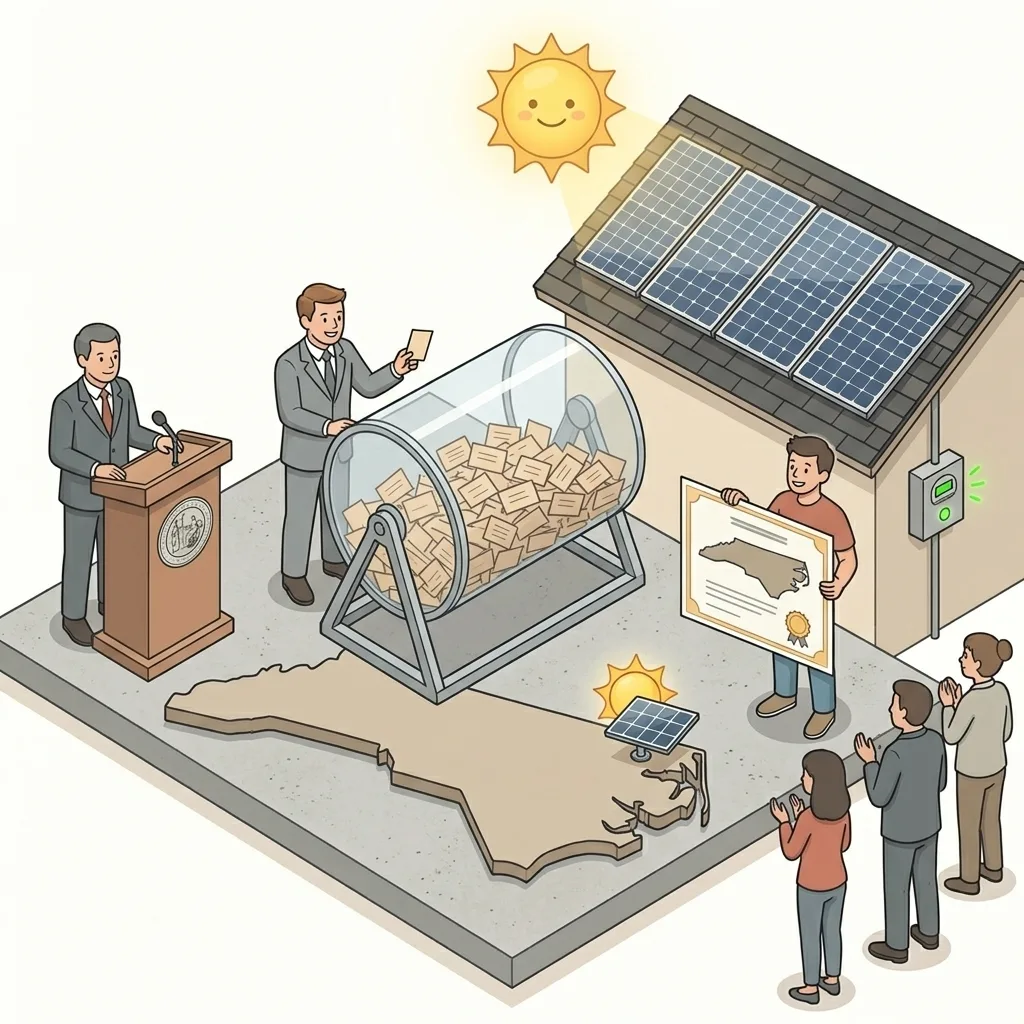
If you applied for a solar rebate in North Carolina between 2018 and 2023, you may have discovered something unexpected: getting the rebate was not a matter of filling out paperwork and waiting. It was a lottery.
Duke Energy's NC Solar Rebate Program, a $62 million initiative created by state law, was so oversubscribed that the North Carolina Utilities Commission replaced its first-come, first-served system with a random lottery in 2021. By the time the program ended in early 2023, roughly 2,900 applicants were still on a waiting list with little chance of receiving anything.
Here is how a program designed to accelerate rooftop solar adoption turned into one of the most competitive incentive lotteries in U.S. residential energy.
A $62 Million Program That Could Not Keep Up
House Bill 589, signed in 2017, required Duke Energy to create a solar rebate program covering 20 megawatts of new rooftop installations per year for five years. The program launched in mid-2018 with rebates of 60 cents per watt for residential customers (up to $6,000), 50 cents per watt for commercial installations (up to $50,000), and 75 cents per watt for nonprofits (up to $75,000).
Demand was immediate and overwhelming. In 2018, the entire annual allocation was exhausted within two weeks. By 2019, slots were gone in 90 minutes. In 2020, all available rebates were claimed in just 21 minutes.
Why the Program Switched to a Lottery
The first-come, first-served approach created problems beyond frustration. Duke Energy's application systems struggled under the crush of simultaneous submissions. Homeowners who had planned and budgeted for months could lose out because their application loaded a few seconds slower.
In 2021, the North Carolina Utilities Commission ordered a restructuring. The key changes: biannual application windows (January and July) replaced the single annual rush, rebate amounts were reduced to $4,000 for residential customers and $30,000 for businesses, and allocation shifted to a random lottery. Every application submitted during a one-week window had an equal chance, regardless of when it was filed.
The lottery was more equitable, no advantage for the fastest clickers, but it did not solve the fundamental problem. In July 2021, Duke received 3,718 applications for 800 available residential rebates, nearly five times more demand than supply.
How the Program Ended
The program was originally slated to close in summer 2022. When approximately $1.3 million remained from uncompleted projects, Duke held a final lottery in January 2023. That round awarded rebates to 356 customers statewide. The remaining 2,900 applicants on the waiting list were told that few, if any, would receive funding.
Over five years, the program paid out roughly $45 million of its $62 million authorization. The shortfall was not from lack of interest, residential and commercial demand always exceeded supply, but from fewer nonprofit applications than projected.
What Replaced the Lottery Program
Duke Energy launched the PowerPair pilot program in May 2024, approved by the NC Utilities Commission in January of that year. PowerPair differs from the original rebate in one important way: it requires homeowners to install both solar panels and battery storage together.
The incentive is up to $9,000 total: $3,600 for solar ($0.36 per watt, up to 10 kW) and $5,400 for battery storage ($400 per kWh, up to 13.5 kWh). In exchange, participants commit to a 10-year enrollment and allow Duke Energy to dispatch their battery during grid peaks up to 36 times per year.
PowerPair's initial application window in May 2024 used a random selection process similar to the old lottery. After that window, remaining capacity has been allocated first-come, first-served. As of mid-2026, Duke Energy Progress territory is fully allocated with its waitlist closed, and Duke Energy Carolinas capacity is nearly exhausted.
The Current NC Solar Incentive Landscape
Beyond PowerPair, homeowners navigating North Carolina solar incentives in 2026 face a significantly different landscape than the one that existed when the rebate lottery was active:
Federal residential tax credit eliminated. The 30% residential clean energy tax credit (Section 25D) expired for systems installed after December 31, 2025. Homeowners who installed in 2025 can still claim the credit on their tax returns, but new installations in 2026 and beyond do not qualify. Third-party-owned systems (leases and power purchase agreements) may still benefit from the commercial ITC (Section 48E) through 2027.
Net metering is transitioning. Duke Energy customers who applied for interconnection before July 1, 2023 can remain on full retail-rate net metering through December 31, 2026. New customers receive time-of-use export rates that value daytime solar generation at a fraction of the retail rate. Dominion Energy customers in northeastern NC still receive full retail net metering.
Property and sales tax exemptions remain. Solar installations in NC are exempt from both increased property taxes (100% exemption on added home value) and state sales tax on equipment.
NC ranks fifth nationally in installed solar capacity, with over 10,000 megawatts and enough capacity to power roughly 1.2 million homes, according to the Solar Energy Industries Association.
What This Means for Homeowners Considering Solar
The disappearance of the federal residential tax credit and the near-exhaustion of PowerPair capacity make 2026 a transitional year for NC solar economics. Without the federal credit, the average residential installation costs roughly $21,000–$27,000, and payback periods stretch to 14–17 years compared to 10–13 years when the credit was available.
Homeowners still in Duke Energy Carolinas territory should check PowerPair availability before it closes. For everyone else, the economic case now rests primarily on long-term electricity savings, the property and sales tax exemptions, and, for those who lease rather than buy, whatever portion of the commercial ITC their provider passes through.
The lottery is over. But so is the era of stackable incentives that made it worth entering.