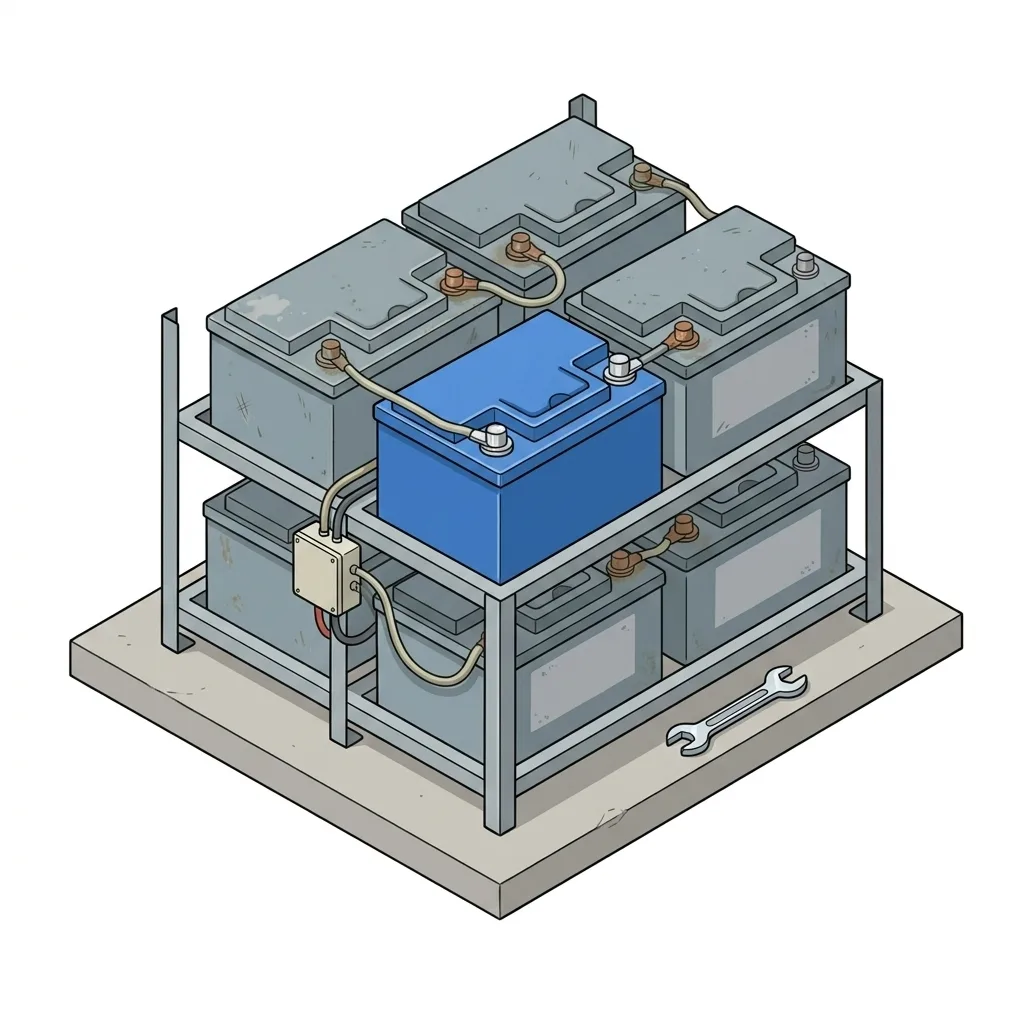
If you have ever tried to expand a solar battery bank by adding new batteries alongside old ones, you have probably been told not to. The advice is everywhere, from battery manufacturers to installer forums, and it turns out to be well-founded.
Connecting older and newer batteries in parallel creates a mismatch in internal resistance and capacity that causes both sets to degrade faster than they would on their own. The new batteries end up doing most of the work, wearing out prematurely, while the old batteries get pushed beyond their diminished capabilities. The result is a bank that performs worse than either set would independently, and that fails sooner than either set should.
This article explains the technical reasons behind this guidance, where the risks are greatest, and what your options are when you need more battery capacity.
Why internal resistance matters
Every battery has internal resistance: the opposition to current flow within the cell itself. In a new battery, internal resistance is low and consistent. As a battery ages, internal resistance increases due to chemical changes in the electrodes and electrolyte.
In a parallel bank, all batteries share the same voltage across their terminals. Current distributes inversely with resistance: batteries with lower internal resistance absorb more current during charging and deliver more current during discharge. This is how parallel circuits work.
When you connect a new battery (low resistance) alongside an old battery (high resistance) in parallel, the new battery handles a disproportionate share of the charge and discharge current. Researchers at MIT found that a 20% difference in internal resistance between two parallel-connected lithium-ion cells leads to approximately a 40% reduction in cycle life compared to well-matched cells. The mismatch generates excess heat in both cells, triggering a temperature-dependent degradation feedback loop that accelerates capacity fade.
The old battery, meanwhile, contributes less useful energy and charges at a different rate. Since the charge controller sees the parallel bank as a single unit and applies one voltage setpoint, the old battery may be undercharged while the new battery is pushed harder than necessary.
The "weakest link" effect
Battery University, an industry resource maintained by Cadex Electronics, describes the core principle: "A battery is only as strong as the weakest link in the chain."
In a parallel bank with mixed ages, the old battery's limited capacity constrains how deeply the bank can be discharged without risking damage. During charging, the old battery, with its reduced capacity, reaches full charge before the new battery does, but the charge controller cannot distinguish between them. The result is that one battery is consistently over- or undercharged relative to its needs.
Research from Imperial College London demonstrated that these performance gaps between parallel-connected batteries tend to widen over time rather than converge. Batteries with higher impedance develop a growing state-of-charge deficit that restricts accessible energy even before measurable capacity loss becomes severe. Initial small mismatches amplify with each cycle.
Lead-acid batteries](https://www.wattbuild.com/learn/about/125/agm-gel-battery)-battery-vs-lead-acid): the worst case
Lead-acid batteries, including flooded, AGM, and gel types, are the most sensitive to age mixing in parallel configurations.
As lead-acid batteries age, lead sulfate crystals build up on the plates (sulfation). This sulfation increases internal resistance unpredictably and reduces the plate surface area available for chemical reactions. An old lead-acid battery does not just have less capacity: it has fundamentally different electrical characteristics than when it was new.
AltE Store, a major solar equipment retailer, describes the practical consequence: new batteries added to an existing lead-acid bank "inherit the capacity of the used ones since they must all charge and discharge in unison." They recommend that any expansion of a lead-acid bank happen within six months of the original installation. Beyond that window, full replacement is the more practical option.
Rolls Battery (formerly Surrette), a manufacturer of deep-cycle batteries used in off-grid systems, states that replacement of individual batteries in an existing bank after 1.5–2 years of use is "generally not recommended." If a failed cell must be replaced, all existing batteries must first be desulfated, equalized, and tested before connecting the new unit, a process that adds significant labor and still does not guarantee matched performance.
Off-grid solar users on community forums report that mixed-age lead-acid banks typically show problems within months. Common reports include charging voltage dropping progressively, individual batteries showing divergent voltages, and the entire bank reaching end-of-life years before the new batteries should have worn out.
LiFePO4 batteries: more tolerant, but not immune
Lithium iron phosphate (LiFePO4) batteries are significantly more forgiving of age mixing than lead-acid, for several reasons:
- Flat voltage curve. LiFePO4 cells maintain a nearly flat voltage across most of their discharge range (roughly 3.2–3.3V from 20% to 80% state of charge). This means voltage differences between old and new cells are smaller during normal operation, reducing the equalization currents that cause problems in lead-acid banks.
- Slower capacity fade. LiFePO4 batteries typically lose only 1–2% of capacity per year under conservative use. A three-year-old LiFePO4 battery is much closer in performance to a new one than a three-year-old lead-acid battery would be.
- Stable internal resistance. Internal resistance in LiFePO4 cells increases more gradually and predictably than in lead-acid.
Community experience from off-grid solar forums generally supports mixing LiFePO4 batteries of different ages in parallel, provided that all batteries are fully charged and at similar voltages before connecting, and that the age gap is not extreme, roughly within three to five years.
However, LiFePO4 batteries have a complication that lead-acid does not: each battery typically has its own Battery Management System (BMS). When two batteries with separate BMS units are connected in parallel, the BMS on one battery may disconnect it (for low-voltage protection, for instance) while the other battery's BMS continues operating. This causes a sudden load shift that can trip the remaining battery's BMS as well, taking the entire bank offline.
Epoch Batteries, a LiFePO4 manufacturer, warns against mixing different capacities, ages, or internal resistance characteristics in parallel, stating it "introduces imbalance, which reduces overall efficiency and can shorten system lifespan."
What manufacturers say
The manufacturer consensus is clear and nearly unanimous: do not mix batteries of different ages, capacities, or brands in a parallel bank.
- Battle Born Batteries states that connecting batteries of different amp-hour capacities voids the warranty and warns that voltage discrepancies cause "the highest voltage battery to charge the lowest voltage battery," increasing the probability of battery failure.
- Renogy recommends that all paralleled batteries be the same brand, model, voltage, and capacity, warning that mixing "can result in potential damage to batteries and connected devices."
- Discover Battery explicitly warns against mixing old and new batteries, noting that a new battery connected alongside an old one will "reduce the life of the new one."
- BatteryStuff.com states batteries should "only be connected if they are of the same voltage, capacity rating, and are of the same batch."
These warranty restrictions reflect the same physics described above. A manufacturer cannot predict how their battery will perform or how long it will last when it shares a circuit with an unknown battery of unknown condition.
When mixing might be acceptable
Despite the general recommendation, there are narrow cases where mixing battery ages in parallel can work:
- LiFePO4 batteries within a few years of each other, with all batteries fully charged and at similar voltages before connecting, and current sharing monitored afterward. Community members suggest that more than a 25% difference in current draw between parallel batteries indicates problematic mismatch.
- Temporary bridging to get through a season while planning a full bank replacement. If you accept that the mixed bank will not perform optimally and that you are shortening the life of the new batteries, a short-term expansion can buy time.
- Separate charge controllers for each battery set, with an automatic transfer switch or manual disconnect. This avoids the parallel charging mismatch entirely but adds complexity and cost.
What to do instead
If you need more capacity from your battery bank, the better options are:
Plan ahead. Size your initial battery bank for future needs rather than planning to expand later. Adding one extra battery at the beginning costs far less than replacing an entire bank early because the expansion degraded everything.
Replace the entire bank. When the original batteries reach end-of-life, replace them all at once with matched batteries. The new bank will perform to spec and reach its full rated lifespan.
Upgrade to LiFePO4. If you are currently running lead-acid and need more capacity, a full switch to lithium iron phosphate provides more usable capacity per dollar (LiFePO4 can safely discharge to 80% depth of discharge versus roughly 50% for lead-acid), longer cycle life (typically 2,000–5,000 cycles versus 300–800 for lead-acid), and better expandability in the future.
Run separate banks. If you must keep old batteries in service while adding new ones, run them as independent banks with separate charge controllers rather than paralleling them. This avoids the mismatch problem entirely.
Summary
| Factor | Lead-acid | LiFePO4 |
|---|---|---|
| Tolerance for age mixing | Very low | Moderate |
| Internal resistance change with age | Large and unpredictable | Gradual and predictable |
| Capacity fade rate | Typically 5–10% per year | Typically 1–2% per year |
| BMS coordination risk | N/A | BMS disconnect cascades possible |
| Manufacturer guidance | Do not mix | Generally do not mix; some tolerance within 3–5 years |
| Expansion window | Within 6 months of original install | Within 3–5 years, with precautions |
Mixing old and new batteries in parallel is not recommended for well-documented reasons: the internal resistance mismatch causes uneven current sharing, accelerates degradation of the new batteries, and shortens the life of the entire bank. The concern is strongest for lead-acid batteries and moderated, but not eliminated, for LiFePO4. When you need more capacity, plan for it upfront, replace the full bank, or run separate systems rather than paralleling mismatched batteries.