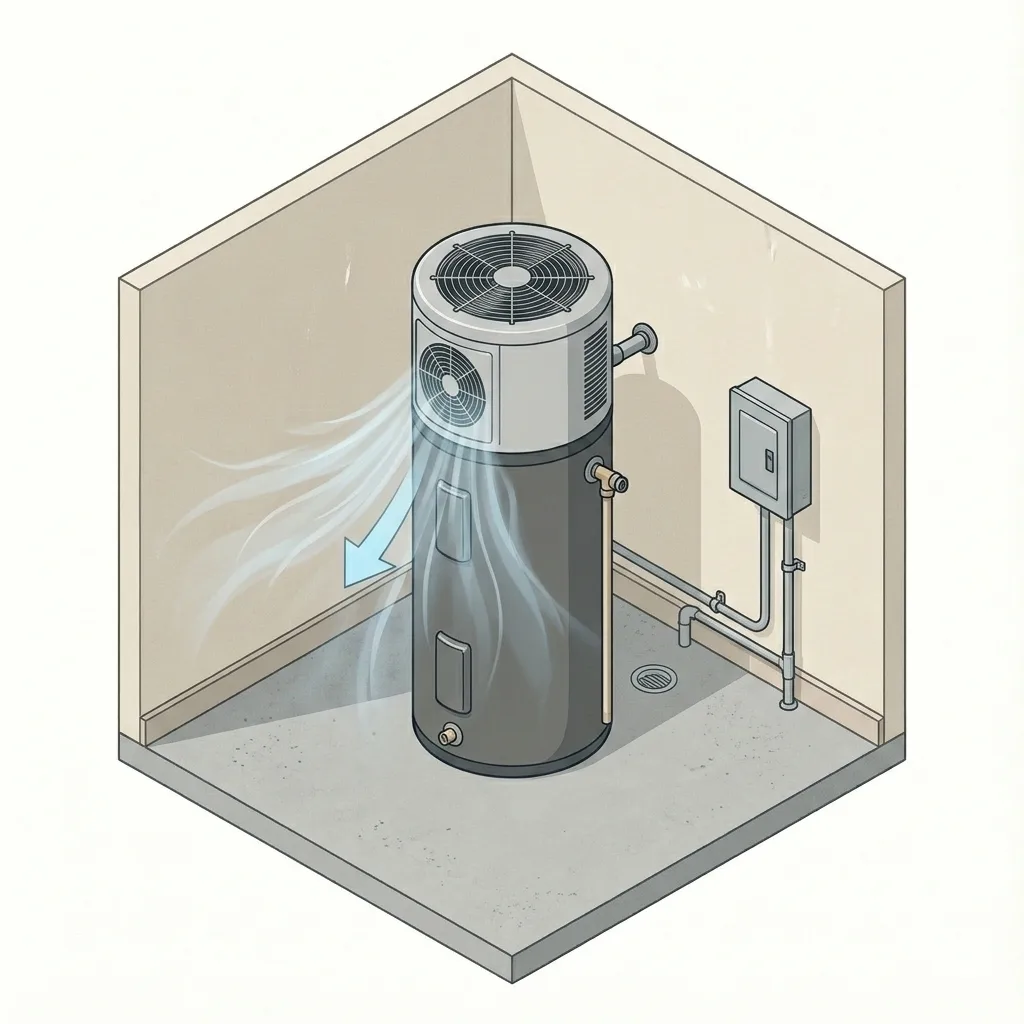
Heat pump water heaters have an unusual selling point that shows up in almost every product review: they cool the air around them while heating water. It sounds like a two-for-one deal: efficient hot water plus free air conditioning. The cooling effect is real, but the numbers tell a more nuanced story.
How the Cooling Works
A heat pump water heater operates like a refrigerator in reverse. It uses a compressor and evaporator coil to extract heat from surrounding air, then transfers that heat into the water tank. The exhaust air comes out cooler and drier than it went in.
This is the same thermodynamic cycle that powers an air conditioner. The difference is that a heat pump water heater's primary job is heating water. The cooled air is a byproduct, not the design goal, and the capacity reflects that.
What the Cooling Numbers Look Like
ENERGY STAR's design guide puts the cooling output at 2,500 to 5,000 BTU per hour while the compressor is running. That sounds meaningful: a small window AC unit delivers about 5,000 to 8,000 BTU per hour. But there is a catch.
The compressor only runs when the tank needs heating. For a typical household, that is roughly one to three hours per day. The rest of the time, the unit sits idle and provides zero cooling.
Energy analyst Allison Bailes calculated the effective cooling for his 80-gallon Rheem unit. The math: roughly 375,000 BTU of cooling per month, which averages to about 520 BTU per hour across a full day. His home's main floor cooling load runs around 21,000 BTU per hour, roughly 40 times what the water heater provides.
Field data reinforces this. A study of nine homes in Michigan found that room temperatures dropped an average of 2.3 degrees Fahrenheit during a heating cycle, with drops of about 4 degrees at floor level. Temperatures returned to within 0.1 degrees of baseline within four hours. A University of Central Florida study of eight occupied homes measured cooling energy savings of about 8 percent, roughly 1.1 kWh per day, when HPWH exhaust air interacted with conditioned space.
Dehumidification: The Quieter Benefit
The cooling may be modest, but the dehumidification byproduct gets less attention than it deserves. As air passes over the cold evaporator coil, moisture condenses out. For homeowners with damp basements or humid utility rooms, this can make a noticeable difference.
How noticeable depends on conditions. Testing by Fine Homebuilding measured 0.17 pints per day of condensate at 57 percent relative humidity, rising to 1.3 pints per day above 70 percent. A Florida Solar Energy Center study measured up to 3.2 pints per day under ideal warm, humid conditions. Compare that to a dedicated dehumidifier's 35-plus pints per day, and the HPWH is clearly a supplement, not a replacement.
Still, homeowners in online forums regularly report eliminating a standalone basement dehumidifier after installing a HPWH, particularly in moderately humid climates where a few hours of daily runtime combined with good air sealing keeps humidity manageable.
The Winter Tradeoff
The same cooling effect that helps slightly in summer works against you in winter. When the heat pump extracts warmth from indoor air, your heating system must replace it.
The University of Central Florida field study found that space heating energy increased by 24 percent when a HPWH drew air from conditioned space. A Massachusetts impact study estimated the heating penalty cut total HPWH savings by roughly one-third.
However, the penalty may be smaller than many expect. A Slipstream study monitoring nine homes in the upper Midwest could not detect any measurable increase in space heating from basement HPWH installations. The likely explanation: basements are semi-conditioned spaces where the heat extracted by the HPWH was not heat the furnace was directly supplying. A Canadian study cited by ENERGY STAR found that heating load increases were fully offset by HPWH efficiency gains, resulting in no net impact on whole-home heating costs.
Most HPWHs offer multiple operating modes: heat pump only, hybrid, and electric resistance. Switching to resistance mode in the coldest months eliminates the cooling byproduct entirely, though at the cost of reduced efficiency.
Where You Put It Matters
Placement has an outsized effect on how the cooling byproduct plays out.
Basements are the most common installation location and often the best fit. Ground-coupled temperatures stay around 50 degrees Fahrenheit year-round, preventing the unit from running out of heat to extract. The cooling and dehumidification are welcome in summer and largely inconsequential in winter.
Garages in warm climates get a noticeable benefit. Where ambient temperatures can exceed 110 degrees Fahrenheit, the HPWH keeps the space more tolerable while the warm air actually boosts the unit's efficiency.
Utility or laundry rooms offer an interesting synergy. A heat pump dryer raises room temperature by 10 degrees or more; the HPWH pulls that temperature back down while the warm air pushes the water heater's coefficient of performance toward 4 or 5.
Closets and tight spaces require caution. Most manufacturers specify a minimum of 450 to 1,000 cubic feet of free air space. Inadequate airflow degrades efficiency and can cause the unit to default to resistance heating.
One placement note from manufacturer guides: avoid positioning the unit's exhaust near a thermostat. The cool exhaust air can give false readings to your HVAC system.
Ducting the Cool Air
Some homeowners consider ducting the HPWH's cool exhaust into living spaces to boost the cooling effect. This approach can work, but the details matter.
A Pacific Northwest National Laboratory study found that fully ducting both intake and exhaust reduced whole-house energy use by 4.2 percent. But exhaust-only ducting, sending cool air into the home while pulling replacement air from outside, increased energy use by 2.9 percent. The negative pressure pulled in hot, humid outdoor air that the HVAC system then had to condition, more than canceling any cooling benefit.
If you duct the exhaust, make sure the intake draws from a comparable source. Balanced ducting avoids pressure problems; unbalanced ducting creates them.
The Real Value Proposition
The cooling byproduct is a genuine side benefit, but it is not the reason heat pump water heaters make financial sense. The main draw is efficiency.
HPWHs use roughly 60 percent less electricity than standard electric resistance water heaters. ENERGY STAR data shows annual savings of $270 for a two-person household and $550 for a four-person household compared to conventional electric units. A University of Maine five-year field study documented savings of 2,072 kWh per year for a family of four, a $311 annual reduction that delivered payback in about 17 months after rebates.
New DOE efficiency standards finalized in 2024 will require heat pump technology for electric storage water heaters larger than 35 gallons by 2029, making HPWHs increasingly the default for electric water heating. Available rebates, the federal HEAR program offers up to $1,750 for qualifying households through September 2031, help offset the higher upfront cost.
What to Expect
A heat pump water heater will noticeably cool and dehumidify the room where it is installed during the one to three hours per day it actively heats water. In a basement or garage, that is a welcome bonus. At the whole-home level, the effect is barely perceptible.
If you are considering a HPWH specifically for its cooling effect, recalibrate expectations. The cooling output averages roughly 500 BTU per hour across a day, about 2 to 3 percent of a typical home's cooling load. It will not replace air conditioning. It will save you a meaningful amount on water heating costs, and the summer cooling and dehumidification are legitimate perks of a technology that earns its keep on efficiency alone.