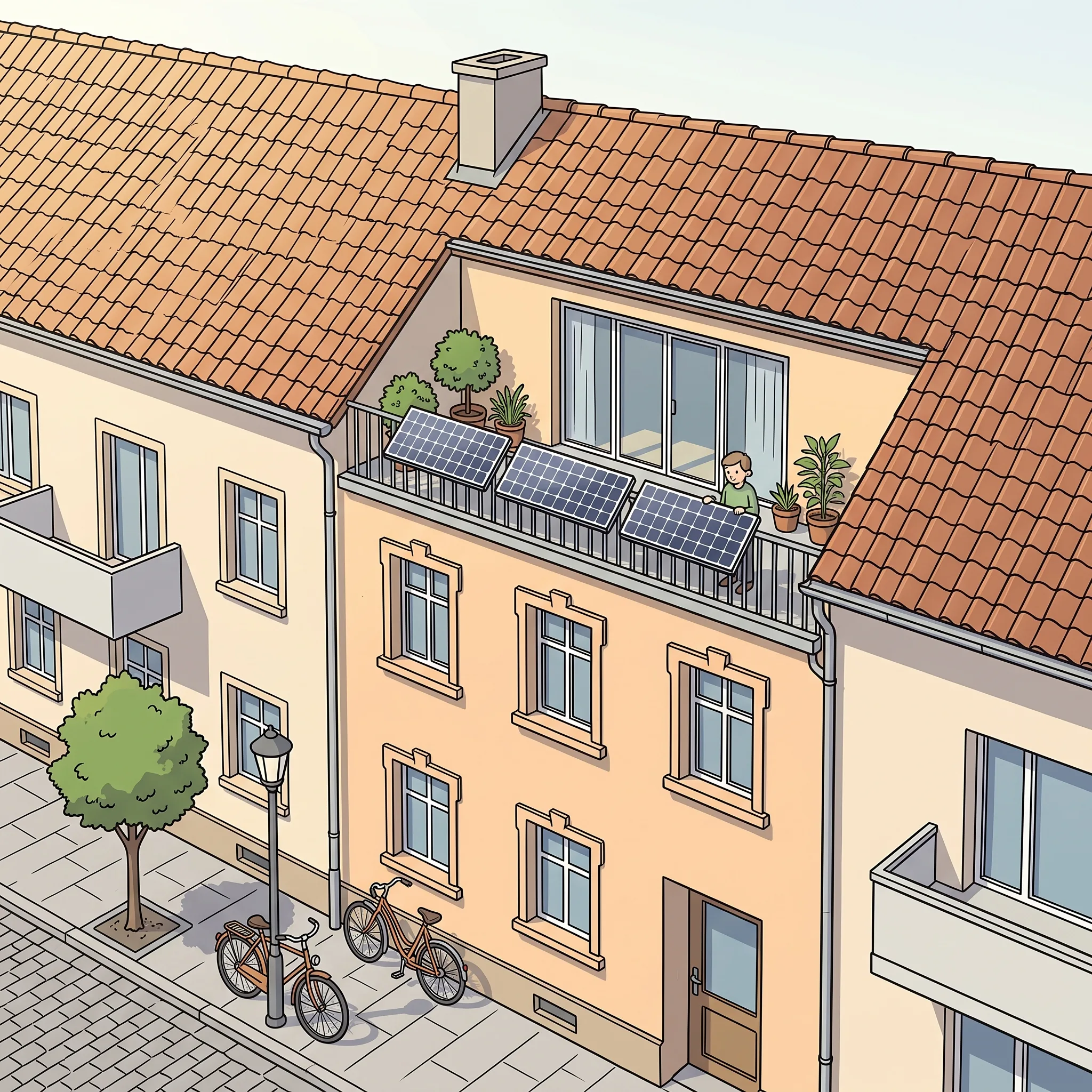
Germany's Marktstammdatenregister, the federal registry for energy generation systems, recorded its one millionth balcony solar installation on June 11, 2025. The milestone caps roughly two and a half years of explosive growth: at the end of 2022, fewer than 140,000 systems were registered. Registrations doubled from 500,000 to over one million in just the twelve months between June 2024 and June 2025.
The actual number of installed systems is almost certainly higher. Because registration is not enforced, industry estimates suggest 1.5 to 4 million plug-and-play solar systems may be operating across Germany.
How balcony solar works
A Balkonkraftwerk, literally "balcony power plant", consists of one or two solar panels, a micro-inverter, and a cable that plugs into a standard household wall outlet. The inverter converts DC power from the panels into 230-volt AC that feeds directly into the home's electrical circuit. Active appliances use the solar power first, and the grid fills in the rest.
Anti-islanding protection built into the micro-inverter ensures the system shuts down within milliseconds if the grid loses power, preventing electricity from back-feeding into de-energized utility lines.
German regulations cap the inverter's AC output at 800 watts, though the panels themselves can be rated up to 2,000 watts peak on the DC side. The oversizing is intentional: larger panels maintain closer to maximum output during cloudy weather, early morning, and late afternoon.
A typical two-panel system generates 600–900 kWh per year depending on location and orientation. At current German electricity prices of roughly EUR 0.35 per kWh, that translates to EUR 210–315 in annual savings on a system that costs EUR 400–700 without storage, a payback period of roughly two to four years.
The policy that made it happen
Germany's balcony solar boom was not organic market growth alone. A sequence of regulatory changes between 2023 and 2025 systematically removed the barriers that had kept adoption low for years.
January 2023: The government eliminated value-added tax on solar panels and inverters, saving buyers roughly EUR 100–150 per system.
May 2024: Solarpaket I raised the inverter feed-in limit from 600 watts to 800 watts and eliminated the requirement for a separate grid operator notification.
July 2024: The Bundestag amended Germany's rental law (BGB §554) and condominium law (WEG §20) to create an explicit legal right for tenants and apartment owners to install balcony solar. Landlords cannot refuse based on aesthetic concerns alone, and the burden of proof for any denial falls on the landlord.
April 2024: The Bundesnetzagentur simplified the Marktstammdatenregister, reducing the required registration data from roughly twenty fields to five. Registration is free, takes under thirty minutes online, and is the only step required: no permits, no inspections, no electrician.
December 2025: The VDE published DIN VDE V 0126-95, the world's first product standard for plug-in solar devices, officially permitting standard Schuko household plugs for qualifying systems and eliminating the need for a EUR 150–200 Wieland connector with professional installation.
The 2022 energy crisis played a role as well. Electricity prices spiked following the Russian invasion of Ukraine, and roughly half of all registrations at that point occurred in 2023 alone. But growth has continued well past the crisis, suggesting that policy simplification, not just price anxiety, is sustaining adoption.
What this means for US renters
The appeal of balcony solar is that it makes renewable energy accessible to people who cannot install a rooftop system, which in Germany means more than half the population, since over 55% of German households rent.
The US faces a similar structural gap. Roughly one-third of US households are renters, and that share is disproportionately made up of minority and lower-income households. Rooftop solar requires homeownership, roof access, and typically $15,000–$25,000 upfront. Balcony solar sidesteps all three.
US adoption has been limited by regulatory barriers, not technology. The National Electrical Code does not currently accommodate plug-in energy systems, and until January 2026 there was no US safety certification framework for complete plug-in solar kits. UL Solutions launched UL 3700 in January 2026, but no systems have completed certification yet.
State legislatures are moving faster than the national code. Utah became the first state to legalize plug-in solar in March 2025, passing House Bill 340 unanimously: 72–0 in the House, 27–0 in the Senate. The law exempts portable solar devices up to 1,200 watts from interconnection and permitting requirements. Virginia, Maine, Colorado, and California have followed with their own legislation, and legislators in nearly 30 additional states have introduced or are considering bills.
The economics are comparable to Germany's. An 800-watt system in the US costs $500–$1,500 and generates 840–1,320 kWh per year in favorable locations, with annual savings of $300–$600 depending on utility rates. Payback periods of two to five years are realistic.
Germany's experience suggests that the technology is not the bottleneck; the policy is. When Germany simplified registration, protected tenant rights, and set safety thresholds proportionate to the actual risk of an 800-watt system, adoption followed at a pace that surprised even proponents. Whether the US follows the same trajectory depends on how quickly state legislatures and the NEC process catch up.