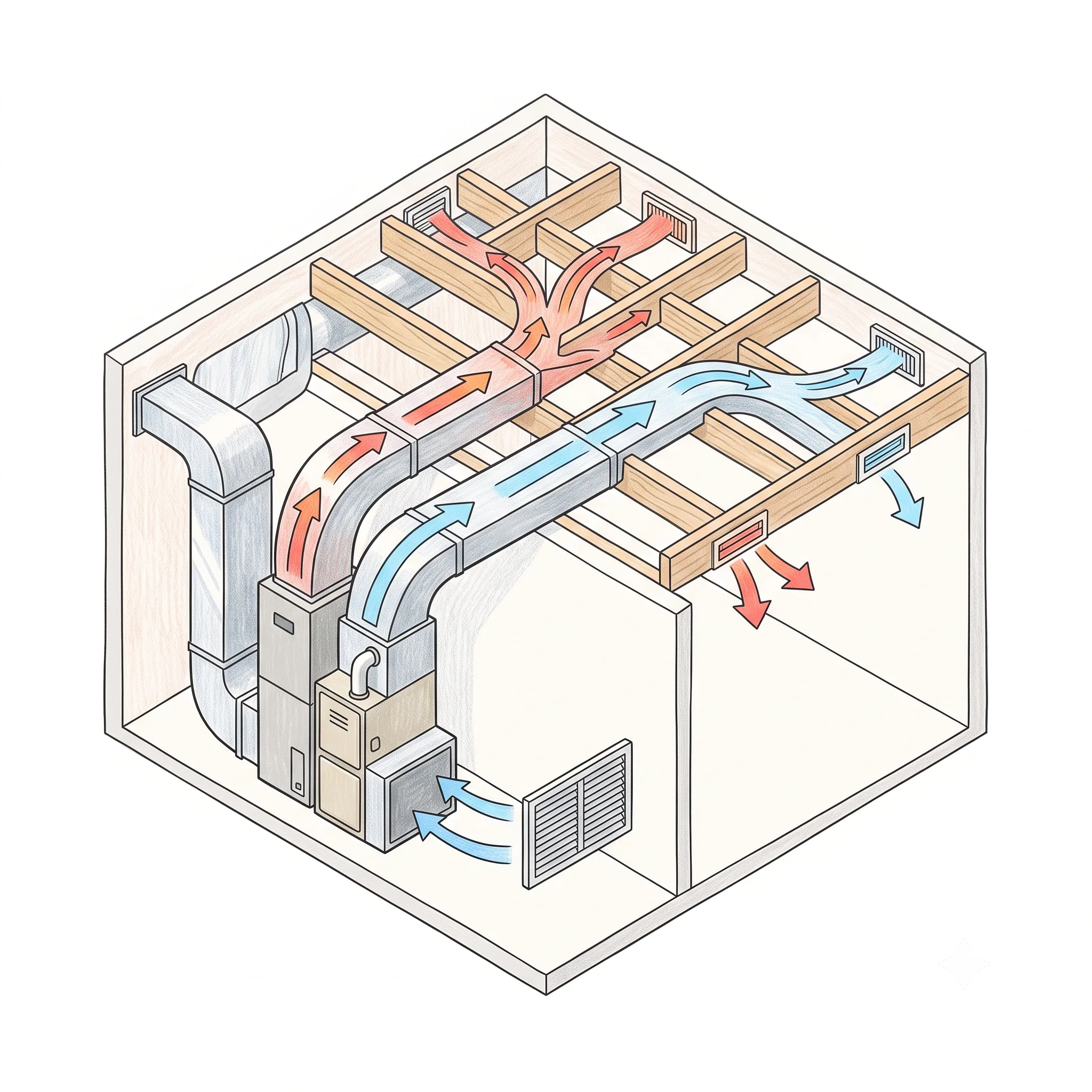
If you are planning to add air conditioning or convert from a gas or oil furnace to a heat pump, your existing ductwork may not be ready for the job, even if it has worked perfectly for heating.
The problem comes down to airflow. Heat pumps and air conditioners need to move significantly more air than a furnace to deliver the same amount of heating or cooling to your home. The U.S. Department of Energy specifies a minimum of 400 cubic feet per minute (CFM) per ton of cooling capacity for heat pump systems, with performance degrading noticeably below 350 CFM per ton. Heating systems, by contrast, typically operate at 300–350 CFM per ton equivalent: roughly 65% of what cooling requires.
The reason is temperature differential. A gas furnace delivers supply air at 105–140°F, so each cubic foot of air carries a large amount of heat energy. A heat pump in heating mode delivers supply air at approximately 95°F. To move the same number of BTUs into your living space at that lower temperature, the system must push a larger volume of air. Industry sources quantify this as 1.5 to 3 times more airflow for a heat pump compared to a furnace of the same rated heating capacity.
This means ductwork designed strictly for the lower heating airflow figure, common in homes built with only a furnace and no air conditioning, may be undersized when a heat pump or central air system is added. The ducts physically cannot carry enough air at acceptable velocity and pressure.
The consequences of undersized ductwork include elevated static pressure inside the system, increased blower motor strain, higher energy consumption (typically 20–30% above expected), excessive noise, uneven temperatures between rooms, and in severe cases, compressor damage from insufficient airflow across the evaporator coil. DOE Building America research specifically identifies low indoor airflow due to undersized ductwork as having the most potential for significant performance degradation in heat pump retrofits.
The return side is usually the bottleneck
In most retrofit situations, the return ductwork is the weakest link. Older heating-only systems often have fewer return air paths, sometimes a single central return, because furnace airflow requirements allowed it. Adding cooling or a heat pump demands return capacity that matches the higher supply airflow, and undersized returns create pressure imbalances that starve the system.
Enlarging the main return drop and switching from a restrictive 1-inch filter to a low-resistance 4-inch media filter are often the most cost-effective first steps. Adding return grilles to upper-floor rooms, which many heating-only homes lack entirely, can resolve comfort problems without replacing the entire duct system.
Existing ductwork is not automatically disqualified
An important qualification: the problem is not universal. Research from the building science community shows that most existing residential furnaces are significantly oversized relative to actual heating loads: sometimes by a factor of 2 to 3. This means their ductwork was also oversized relative to what the home actually needs.
When a properly sized heat pump (matched to a Manual J load calculation rather than to the old oversized furnace nameplate) replaces that equipment, the ducts may be adequate without modification. A home with a 100,000 BTU/hr furnace serving a 40,000 BTU/hr actual heating load likely has ductwork far larger than the heating load demanded; and a right-sized 3-ton heat pump may fit within that existing capacity.
The critical step is a professional assessment: static pressure testing at the air handler and CFM measurement at supply registers under cooling-mode airflow. This tells you whether your specific ducts can handle the specific equipment being installed.
Uninsulated ducts add a condensation risk
Beyond sizing, ductwork insulation becomes critical when cooling enters the picture. A furnace-only system pushes warm air through the ducts: no condensation risk. But when the same ductwork carries cold conditioned air for cooling, uninsulated metal duct surfaces drop below the dew point of the surrounding air, especially in unconditioned spaces like attics, basements, and crawlspaces.
The result is condensation forming on the outside of the ducts: the same physics as a cold glass sweating on a humid day. Left unaddressed, this leads to mold growth, corrosion of duct material, water damage to surrounding building materials, and degraded indoor air quality.
Insulating exposed ductwork keeps the surface temperature above the dew point and eliminates the problem. This is a standard requirement for ducts in unconditioned spaces carrying cooled air, but it is often absent in homes that have only ever had heating.
When ductless is the practical answer
For homes where existing ductwork is severely undersized, damaged, or inaccessible for modification, ductless mini-split heat pumps bypass the problem entirely. They deliver heating and cooling directly to individual rooms without relying on a central duct system.
The DOE identifies ductless systems as the recommended retrofit path when existing ductwork cannot be adequately upgraded. Full duct replacement costs range from several hundred to over $10,000 depending on the home, which often makes ductless installations the more economical path.
What to check before installing a heat pump
If you are considering a heat pump or central air conditioning for a home that currently has only ducted heating, these are the key evaluations:
- Load calculation — A Manual J calculation determines what size equipment your home actually needs, which may be substantially smaller than your current furnace.
- Static pressure test — Measures resistance in the existing duct system under cooling-mode airflow. High static pressure indicates undersized ducts or restrictions.
- Return air capacity — Verify that return pathways can handle 400 CFM per ton. Missing bedroom returns are a common gap.
- Duct insulation — Any ductwork running through unconditioned spaces needs insulation if it will carry cooled air.
- Physical condition — Crushed sections, disconnected joints, and deteriorated seals that were tolerable at lower heating airflow become critical restrictions at higher cooling airflow.
A qualified HVAC contractor performing a duct assessment before equipment selection, not after, avoids the most common retrofit failure mode: installing a heat pump onto ductwork that cannot support it.