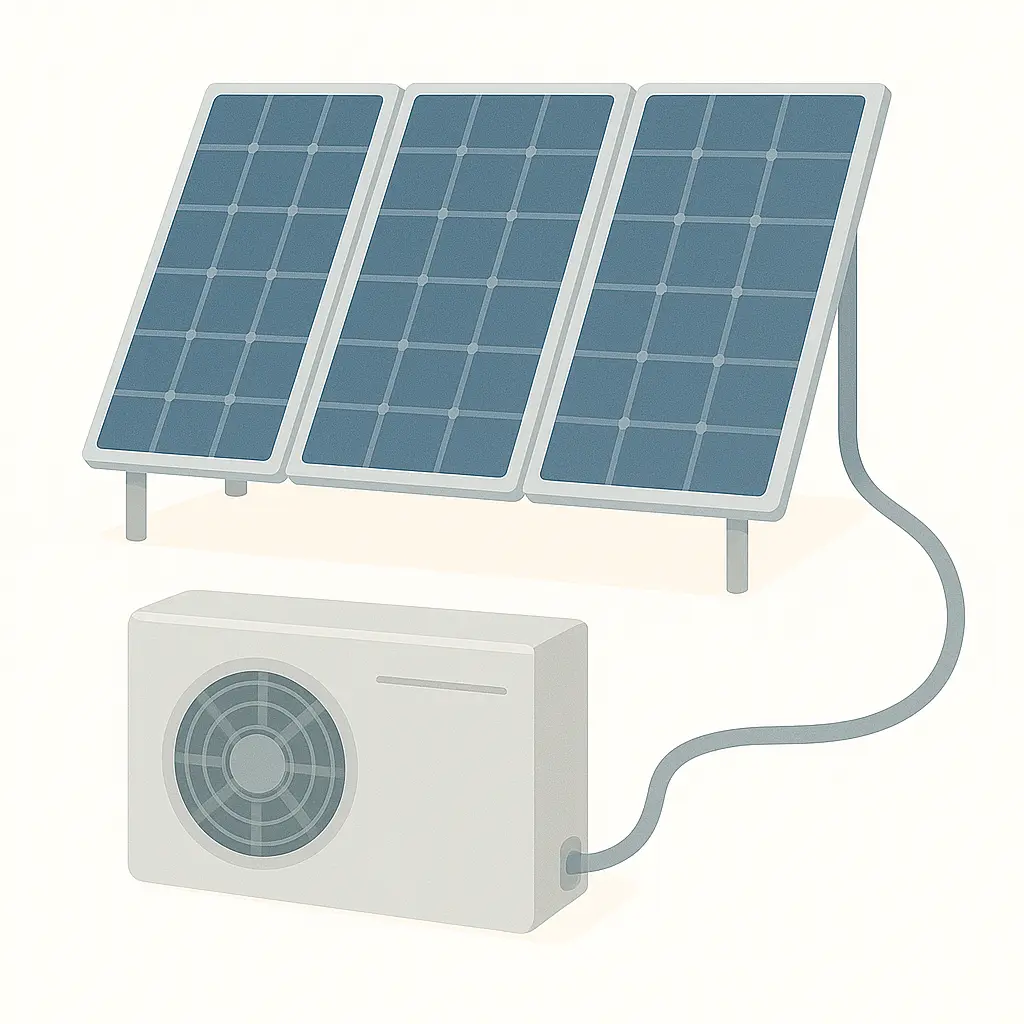
The desire to power home air conditioning with solar power stems from two distinct motivations: the financial goal of offsetting or eliminating high summer utility bills 1, and the independence goal of maintaining comfort during a grid power outage.3
These two goals are often treated as one, but they require fundamentally different and often mutually exclusive system architectures. This guide serves as a technical roadmap for achieving either—or both.
Air conditioning is, for most households, the single most power-hungry appliance.5 Successfully pairing it with solar power is not merely a question of how many panels can fit on a roof; it is a complex systems design challenge. The architecture of the solar system is far more important than the panel count alone.
This report will analyze the unique power demands of different air conditioning units, from light-duty window units to heavy-duty central systems. It will then detail the two primary pathways for solar integration: the grid-tied "financial offset" strategy and the off-grid "energy independence" strategy. Finally, it will explore advanced solutions for taming heavy-duty AC loads and the new "direct solar" hybrid technologies that are changing the market.
Section 1: Understanding the Load: Why Air Conditioners Are Solar's Toughest Challenge
Before a solar solution can be designed, the precise nature of the electrical load—the air conditioner itself—must be understood. The power demand of an AC is not one number, but two, and this distinction is the primary source of failure for undersized systems.
1.1 The Two Numbers That Matter: Running Watts vs. Starting (Surge) Watts
Every motor-driven appliance is defined by two power metrics:
- Running Watts (Rated Watts): This is the continuous power, measured in watts (W), that an appliance consumes while in normal operation.7 For an air conditioner, this is the power required to keep the compressor and fans running after they have started.8 This figure is used to calculate energy consumption over time, measured in watt-hours (Wh) or kilowatt-hours (kWh).9
- Starting Watts (Surge/Peak Watts): This is the momentary, massive spike in power required to overcome inertia and start the appliance's motor.7 This surge, which can be three to eight times higher than the running wattage, lasts for only a fraction of a second to a few seconds.8
These two numbers create a two-part sizing problem. A system's battery bank (measured in kWh) must be sized to meet the Running Watts for a desired number of hours. However, the system's inverter (measured in W) must be sized to meet the Starting Watts instantaneously.
This distinction is the most common and critical point of failure in backup power systems. Many homeowners install a battery backup system expecting it to run their air conditioning. On paper, the numbers may seem adequate: an AC unit rated for 2,000 running watts and an inverter rated for 3,000 continuous watts. When a power outage occurs and the system attempts to start the AC, nothing happens.10 The system fails because the momentary surge wattage of the AC (which was ignored) exceeded the inverter's surge capacity, triggering its protective-shutdown mechanism.
A real-world test demonstrates this: a small window AC unit with a running load of 400-500 watts was observed to produce a startup surge "well above 2,500 watts." This surge was high enough to instantly trip a 4,000-watt inverter when a second appliance was running simultaneously.11 Ignoring surge is the primary reason improperly designed battery backup systems fail to power AC units.
1.2 The Power Profile of Your AC: A Comparative Analysis
The three primary types of air conditioners have vastly different power profiles, making them more or less suitable for solar applications.
A) Window Units (Light-Duty, High-Surge)
- Running Watts: These units are highly variable. A small 5,000 BTU unit may consume 500W, while larger 10,000-12,000 BTU units can draw 1,000W to 1,500W.9 The fan-only mode is negligible, typically 50-200W.12
- Starting Watts: This is the hidden challenge. A 10,000 BTU window unit running at 1,000W can easily spike to 1,800W or more upon startup.12
- Solar Suitability: Window units represent the "worst of both worlds" for off-grid battery power. They are notoriously inefficient, with a low Energy Efficiency Ratio (EER) 9, meaning they drain a battery bank faster than other options. They also have a high surge-to-run ratio, requiring an expensive, oversized inverter to handle the startup load.11 They are the least solar-friendly option.
B) Ductless Mini Splits (Light-Duty, No-Surge)
- Running Watts: These systems are defined by their high efficiency. A 9,000 BTU unit typically runs between 500-750W, and a 12,000 BTU unit between 800-1,200W.14 They are often 30-40% more efficient than central AC or window units of the same capacity.15
- Starting Watts: This is the game-changing feature. Mini splits use "inverter technology," which means they have a variable-speed compressor.17 Instead of the violent "on/off" cycle of a window unit, the mini split's compressor "slowly accelerate[s] and decelerate[s]" to meet the cooling demand.11
- Solar Suitability: This variable-speed technology functions as a built-in soft starter. It has "almost zero surge".18 A 1,200W mini split will not surge to 2,500W; it will gently ramp up to its 1,200W operating load.19 This means it can be paired with a much smaller, less expensive inverter (e.g., a 1,500W inverter) that a window unit would instantly trip. This characteristic makes mini splits the ideal choice for solar and off-grid applications.
C) Central Air Conditioners (Heavy-Duty, The "Inverter Killer")
- Running Watts: Central AC units are heavy-duty loads. A typical 3-ton (36,000 BTU) unit consumes 3,000-3,500W while running.1 This load does not include the indoor furnace blower (fan), which is required to circulate the air and can add another 700-900W to the total load.20
- Starting Watts: This is where the term "surge" is insufficient. The metric for central AC startup is Locked Rotor Amps (LRA), which is listed on the unit's data plate.10 The surge wattage is calculated from this value. A 3-ton unit, for example, may have an LRA of 90 amps.21 At a standard 240 volts, this creates a momentary surge demand of $90A \times 240V = 21,600$ watts (21.6kW).22
- Solar Suitability: This massive surge "will bring an inverter to its knees".21 It is far beyond the surge capacity of any standard residential battery inverter. This makes a standard central AC unit fundamentally incompatible with standard battery backup systems. A homeowner with a 79A LRA unit, for instance, cannot run it on a 50A (12kW) inverter without modification.23 This fact is a critical, multi-thousand-dollar warning: a new $15,000 battery system will, by default, not be able to start a central AC unit during an outage. Solutions for this problem are discussed in Section 4.
Table 1: Comparative Air Conditioner Power Demands
| AC Type (BTU / Ton) | Est. Running Watts (W) | Est. Starting / Surge Watts (W) | Primary Off-Grid Challenge |
|---|---|---|---|
| Window Unit (10,000 BTU) | 1,000 - 1,400W 12 | 1,800 - 2,500W+ 11 | High Surge & Poor Efficiency |
| Mini Split (12,000 BTU / 1-Ton) | 800 - 1,200W 14 | ~1,200W (negligible surge) 18 | None (Ideal for Solar) |
| Central AC (3-Ton) | 3,000 - 3,500W (+ 700-900W blower) 15 | 18,000 - 21,600W+ (LRA) 10 | Extreme "Inverter Killer" Surge |
Section 2: Path 1: The "Financial Offset" (Grid-Tied Solar) Strategy
This is the most common solar installation in the United States. It should be understood as a financial tool designed to reduce utility bills, not as an independence tool for power outages.
2.1 How It Works: The Grid as Your "Virtual Battery"
The system is simple, consisting of solar panels and a grid-tied inverter.3 No expensive batteries are required.3
The power flow is straightforward:
- Solar panels generate Direct Current (DC) electricity.
- The grid-tied inverter converts this DC power to Alternating Current (AC) electricity, which is the type used by the home.26
- This solar-generated AC power is used first by any appliances running in the home, such as the air conditioner.24
- Any excess power not immediately consumed is automatically exported to the utility grid for credits.27
This creates a natural, powerful synergy. The main benefit of this pairing is that peak air conditioning demand (during the hottest part of the day, typically 1 PM to 5 PM) aligns perfectly with peak solar production.6 This means that on a sunny day, the AC is effectively running on solar power in real-time, zeroing out grid consumption and utility costs during those expensive peak hours.
2.2 The Role of Net Metering
Net metering is the utility billing policy that enables this "virtual battery" concept.25 The utility's grid is treated as a giant, 100% efficient battery.25
This system works on a 24-hour (or annual) cycle. During the day, the system overproduces and exports power, earning credits.27 At night, when the sun is down but the AC is still running, the home draws power back from the grid, and the previously earned credits are used to pay for it.24
However, the viability of this strategy is 100% dependent on local utility policy. Net metering rules are not the same everywhere.25 In states like California, traditional net metering has been replaced by a Net Billing Tariff (NBT). Under this new policy, the credits earned for exporting solar are very low, while the cost of importing power during peak hours remains high.31 This policy change effectively breaks the "virtual battery" model and makes battery-less grid-tied systems far less economical. In these areas, a battery (as discussed in Path 2) becomes financially necessary for "load shifting"—storing the solar energy to be used during high-cost peak hours instead of selling it back to the grid for a low price.31
For more information on local policies, consumers can consult resources like the WattBuild guide,(https://www.wattbuild.com/learn/about/23/what-is-net-metering).32
2.3 Sizing & The Critical Caveat
For a grid-tied "financial offset" strategy, the solar system is not sized to match the AC's peak power (W). Instead, it is sized based on the home's total annual energy consumption (kWh).33 The goal is to have the total kilowatt-hours produced by the panels over the year match the total kilowatt-hours consumed by the home.
To estimate production potential and financial payback, consumers can use tools like the(https://www.wattbuild.com/) 35 and the(https://www.wattbuild.com/calculators/solar-savings).35
This strategy comes with one critical, and often misunderstood, caveat: it provides zero blackout protection.
For the safety of utility workers repairing downed lines, all grid-tied inverters are required by law to shut down the instant the grid fails. This is a safety feature known as "anti-islanding".3 This leads to the "great solar surprise" for many new owners: even with a roof covered in solar panels and the sun shining brightly, if the grid goes down, the home will lose power.37 The AC will not run. This system provides financial resilience, not electrical resilience. To achieve blackout protection, a battery bank is mandatory.
Section 3: Path 2: The "Energy Independence" (Off-Grid & Battery Backup) Strategy
This is the system architecture required for blackout protection. It can be a "grid-tied with battery backup" system (a hybrid system) or a fully "off-grid" homestead. In either case, the engineering principles are the same.
3.1 The Off-Grid Design Philosophy: Surge First, Capacity Second
When the grid fails, this system uses an Automatic Transfer Switch (ATS) or "gateway" to disconnect from the grid and create its own stable "micro-grid" for the home.37
Designing this system brings back the two-part sizing problem with a vengeance:
- Power (Watts): Can the inverter start the AC? 10
- Energy (kWh): Can the battery run the AC for the desired time? 38
The primary components for this system are Solar Panels (the recharger), a Charge Controller (the regulator), a Battery Bank (the storage), and a Hybrid or Off-Grid Inverter (the brain and AC power source).39
3.2 Component 1: The Inverter (The "Gatekeeper")
- Inverter Type: The inverter must be a Pure Sine Wave (PSW) model. Cheaper Modified Sine Wave inverters produce "dirty power" 20 that can damage the sensitive electronics and modern, efficient ECM motors found in AC blowers and compressors.40
- Inverter Sizing: The absolute minimum requirement is an inverter with a surge rating that exceeds the AC's starting watts.10 However, relying on this marketing specification is a common pitfall. A battery's inverter might claim a 6,000W surge, but only be able to sustain it for 100 milliseconds. If the AC's compressor needs 5,000W for 1.5 seconds to start, the inverter will trip.10
- The professional, reliable solution is to ignore the short-term surge spec and select an inverter whose continuous power rating can handle the AC's surge load.41 For an AC with a 3,500W surge, a 4,000W+ continuous-rated inverter is the safe and reliable choice.
To properly inventory all critical loads, consumers can use tools like the(https://www.wattbuild.com/calculators/inverter-size) 42 and reference guides like(https://www.wattbuild.com/learn/about/15/what-size-inverter-do-i-need).32
3.3 Component 2: The Battery Bank (The "Fuel Tank")
-
Sizing for Capacity (kWh): This is a straightforward energy calculation:
$$(AC \, Running \, Watts) \times (Desired \, Run \, Hours) = Required \, Battery \, Capacity \, (Wh)$$
12 -
Examples:
-
Usable Capacity: The term "usable capacity" is critical. Old lead-acid (AGM) batteries, for example, could be damaged if discharged beyond 20-50%, meaning a 115 kWh battery bank might be required to provide only 23 kWh of usable energy.44 Modern Lithium Iron Phosphate (LFP) batteries 45 have solved this, allowing for safe, deep discharging of 80-100%. This means a 10 kWh LFP battery provides 8-10 kWh of usable energy, making them the only practical choice for this application.
-
Cost: The battery bank is the most expensive part of the system. A professionally installed home battery typically costs between $9,000 and $18,000 after applying the 30% federal tax credit.4
3.4 Component 3: The Solar Array (The "Recharger")
- Sizing: In an off-grid scenario, the solar array has two simultaneous jobs: 1) Power all daytime loads, including the AC, and 2) Fully recharge the battery bank from the previous night's use.47
- Why Off-Grid Arrays Are So Large: The array must be sized to replace 100% of the energy consumed in a short 5-6 hour "peak sun" window. For example, a system that used 10.8 kWh from its battery overnight requires a solar array capable of generating that 10.8 kWh of replacement energy during the day. Assuming 5 peak sun hours, the array would need to be: $10,800Wh / 5h = 2,160W$ (2.16kW).47 This 2,160W of solar power is only for recharging the battery; it does not include the additional solar power needed to simultaneously run the AC and other home loads during the day. For this reason, off-grid solar arrays are often 1.5 to 2 times larger than grid-tied arrays for the same home.
For designing such an array, DIY-focused consumers can use tools like the(https://www.wattbuild.com/calculators/solar-panel-matcher) 48 and(https://www.wattbuild.com/calculators/series-parallel).49
Section 4: Advanced Solutions: Taming the Central AC "Inverter Killer"
For homeowners with an existing central AC who want battery backup (Path 2), the "Inverter Killer" LRA surge (Section 1.2.C) must be solved.
4.1 Option 1 (Good): The "Soft Start" Add-on
- What It Is: A small, aftermarket electronic device ($200-$400) that is wired directly to the AC's compressor by an HVAC technician or qualified electrician.50
- How It Works: Instead of the instantaneous, violent inrush of current, the soft starter uses an adaptive learning process to "ramp" the voltage to the motor, allowing a smooth, gradual startup.51
- The Result: A 60-75% reduction in the LRA surge current.50
- Real-World Data: This is a proven solution. One report shows a 3-ton AC's LRA dropping from 79A to a manageable 30A.23 Another shows a 2-ton unit dropping from 62A to 25A.52
- A 79A LRA at 240V represents a ~19kW surge, which is unstartable by any standard home battery inverter.53 A 30A LRA represents a ~7.2kW surge, which is well within the surge capability of many high-quality inverters.23 This inexpensive device is the single most cost-effective upgrade for a solar backup system. It makes the "impossible" (running central AC off-grid) suddenly possible with a standard battery and inverter system.
More information on this component is available in the(https://www.wattbuild.com/learn/heating-cooling/1/soft-start-ac).32
4.2 Option 2 (Better): The Inverter-Based (Variable-Speed) Central AC
If the central AC unit is old and due for replacement, a far superior solution is to replace it with a modern, high-efficiency inverter-based (variable-speed) central AC.17
These units use the same "inverter" technology as the ductless mini-splits discussed in Section 1.2.B. This means they have an inherently soft start, with negligible surge current.18
This option is superior to adding a soft starter to an old unit because it solves both problems simultaneously:
- It eliminates the LRA surge problem.
- It is dramatically more efficient, meaning its "Running Watts" are lower.17 This reduces the size (and cost) of the battery bank needed to run it.
4.3 Option 3 (Best for Off-Grid): The "Strategic Mini Split Conversion"
The most resilient and efficient solution for an off-grid home is to abandon the central AC system entirely. Instead of trying to power one massive 3-ton (3,500W) central unit, this strategy involves installing two or three smaller, targeted, high-efficiency ductless mini splits (e.g., 1,000W each) in critical zones like the living room and master bedroom.55
This "resilience through zoning" approach avoids the "all-or-nothing" failure mode of a central unit. It provides granular control. Instead of one 3,500W load, the system has three independent 1,000W loads. If the battery bank is running low during an extended outage, the homeowner can choose to power only the bedroom AC, extending their cooling for days instead of hours.
Section 5: The New Game-Changer: Hybrid AC/DC & Direct Solar Mini Splits
A new class of product—the "Hybrid ACDC" or "Direct Solar" mini split—is blurring the lines between all previous categories. This technology directly addresses the desire for a "direct solar connection."
5.1 What Are They?
These are specialized ductless mini-splits that have two power inputs: a standard AC plug for grid power and a set of DC inputs (MC4 connectors) for connecting solar panels directly.57
5.2 How They Work: Bypassing the Central Inverter
The efficiency gain comes from bypassing the standard conversion process.
- Standard Solar (AC Path): Solar (DC) $\rightarrow$ Central Inverter (AC) $\rightarrow$ AC Unit. This process involves energy losses at the inverter.28
- Hybrid Solar (DC Path): Solar (DC) $\rightarrow$ Directly into the AC unit.59
Air conditioners are, at their core, DC-native appliances. A standard AC unit simply converts the incoming AC power back to DC internally to run its components. A hybrid unit avoids this wasteful "DC-to-AC-to-DC" conversion, minimizing energy losses and converting more of the panels' power directly into cooling.59
5.3 Scenario A: The "Battery-less" Daytime Cooling Solution
This is the simplest and most cost-effective application.
- The Setup: A few solar panels (e.g., 3-5 panels) are connected only to the mini-split's DC input.64 The unit is also plugged into the wall for standard AC grid power.59
- The Logic: The unit's internal "auto-balance" logic 59 always prioritizes the free DC solar power first. It will run entirely on solar when the sun is strong. If a cloud passes, it will seamlessly blend in just enough AC grid power to maintain the set temperature.60
- The Result: This system requires no batteries, no charge controller, and no large central inverter.59 For a homeowner whose main goal is to slash the daytime cooling bill for a specific area (like a home office or a hot west-facing living room), this is a revolutionary, low-cost, high-ROI solution. It can also provide daytime cooling during a power outage without a battery.64
5.4 Scenario B: The "True Hybrid" (Off-Grid 24/7) Solution
This is the most advanced and efficient off-grid cooling configuration.
- The Setup: Two parallel solar systems are installed.
- The Hybrid AC has its own dedicated solar panels connected to its DC input.
- A separate, traditional off-grid system (panels, charge controller, battery, inverter) powers the rest of the house.2
- The Hybrid AC's AC plug is plugged into the output of the battery inverter.
- The Logic:
- Daytime: The AC runs directly off its dedicated DC panels (hyper-efficient). The entire battery-based solar system is free to focus on one job: storing energy and charging the batteries to 100%.59
- Nighttime: The dedicated DC panels go dark. The AC unit automatically switches to its AC input, drawing power from the now-full batteries via the central inverter.2
- The Result: This is the most efficient off-grid AC system possible. It bypasses the central inverter's conversion losses all day, saving energy and reducing wear on the main system components.
Section 6: Recommendations: Which Solar AC Path is Right for You?
The optimal solution depends entirely on the homeowner's primary goal, budget, and existing HVAC equipment.
Scenario 1: "The Bill Reducer" (Grid-Tied Homeowner)
- Goal: Purely financial savings on utility bills.
- Solution: A standard Grid-Tied Solar System (Section 2).
- Sizing: Based on total annual kWh consumption, not the AC's peak watts.
- Links: The(https://www.wattbuild.com/) 35 and(https://www.wattbuild.com/calculators/solar-savings) 35 can model this scenario.
- Key Consideration: This strategy's viability is entirely dependent on a favorable Net Metering policy from the local utility.25
Scenario 2: "The Outage Prepper" (Grid-Tied w/ Battery Backup)
- Goal: Keep an existing central AC running during a power outage.
- Solution: A Grid-Tied System with Battery Backup (Section 3).
- Mandatory First Step: A Soft Starter (Section 4.1) must be installed on the central AC unit. Failure to do so will likely result in the system being unable to start the AC.10
- Links: Homeowners in this situation should review the(https://www.wattbuild.com/learn/heating-cooling/1/soft-start-ac) 32 and use the(https://www.wattbuild.com/calculators/inverter-size) 42 to account for the soft-started surge, not the full LRA.
- Better/Best Options: If the AC is being replaced, a Variable-Speed Inverter Central AC (Section 4.2) is the superior choice. For maximum resilience, converting to multiple Ductless Mini Splits (Section 4.3) is the most robust solution.
Scenario 3: "The Efficient DIYer" (Targeted Cooling)
- Goal: Run a single room (e.g., home office, bedroom) for free during the day with maximum simplicity and minimum cost.
- Solution: A Hybrid AC/DC Mini Split (Section 5.3).
- Sizing: This system requires only 3-5 solar panels connected directly to the unit's DC input. No large central inverter or battery bank is needed.59 This represents the simplest, cheapest path to true solar cooling.
Scenario 4: "The Off-Grid Homesteader" (Total Independence)
- Goal: 24/7 cooling with no grid connection.
- Solution: A large, robust off-grid system (Section 3) designed for maximum efficiency.
- HVAC (Non-Negotiables):
- Sizing: This is a serious engineering task. The battery bank must be sized for full overnight use (e.g., 8-10 kWh per mini split), and the solar array must be large enough to fully recharge that bank plus cover all daytime loads.47
- Links: Tools like the(https://www.wattbuild.com/calculators/series-parallel) 49 and(https://www.wattbuild.com/calculators/solar-panel-matcher) 48 are essential for designing the large-scale array required.
Works cited
1. AC Watts Guide: Power Use & Costs for Every Air Conditioner - A1 Solar Store, accessed November 9, 2025, https://a1solarstore.com/blog/how-many-watts-does-an-air-conditioner-use-ooh-thats-a-lot.html
2. Solar Power Mini Split: Off-Grid Comfort Explained, accessed November 9, 2025, https://solar.bobsrepair.com/solar-powered-air-conditioning-heating-guide/
3. Using Solar Panels to Run an Air Conditioner - Service Experts, accessed November 9, 2025, https://www.serviceexperts.com/blog/using-solar-panels-to-run-an-air-conditioner/
4. Solar Battery Cost: Why They're Not Always Worth It - EnergySage, accessed November 9, 2025, https://www.energysage.com/energy-storage/how-much-do-batteries-cost/
5. How much electricity can one little window unit really use? : r/hvacadvice - Reddit, accessed November 9, 2025, https://www.reddit.com/r/hvacadvice/comments/15fp5ci/how_much_electricity_can_one_little_window_unit/
6. How many solar panels do you need to run Air Conditioning? - YouTube, accessed November 9, 2025, https://www.youtube.com/watch?v=IyLBOav-97o
7. How Many Watts Does a Window AC Use? - EcoFlow, accessed November 9, 2025, https://www.ecoflow.com/us/blog/how-many-watts-does-window-ac-use
8. Starting Watts vs Running Watts: Choosing the Right Generator Power | Renogy US, accessed November 9, 2025, https://www.renogy.com/blogs/general-solar/starting-watts-vs-running-watts
9. How Many Watts Does a Window AC Use | Renogy US, accessed November 9, 2025, https://www.renogy.com/blogs/home-backup/how-many-watts-does-a-window-ac-use
10. Can Your Battery Start the AC? | LRA, Surge Power & Inverter Matching Guide - EcoFlow, accessed November 9, 2025, https://www.ecoflow.com/us/blog/battery-start-air-conditioner-guide
11. How We Run Air Conditioning With Off-Grid Solar Power - Accidental Hippies, accessed November 9, 2025, https://www.accidentalhippies.com/air-conditioning-off-grid-solar-power/
12. Window AC Power Usage: Wattage, BTU & Energy Savings Tips - EcoFlow, accessed November 9, 2025, https://www.ecoflow.com/us/blog/window-ac-wattage-use
13. Definitive Guide on How Many Watts Does a Window AC Use? - VTOMAN, accessed November 9, 2025, https://vtoman.com/blogs/news/definitive-guide-on-how-many-watts-does-a-window-ac-use
14. How Much Electricity Does A Mini Split Use? [Efficiency Guide] - Blue Ridge Heating & Air, accessed November 9, 2025, https://blueridgeheatingair.com/how-much-electricity-does-a-mini-split-use-efficiency-guide/
15. Do mini splits use more electricity? - Innovair HVAC Products (United States), accessed November 9, 2025, https://innovair.com/do-mini-splits-use-more-electricity/
16. How Many Watts Does a Mini Split Use? Energy-Saving Guide, accessed November 9, 2025, https://dellahome.com/blogs/della-blog/how-many-watts-does-a-mini-split-use
17. What is the Difference Between Inverter and Non-Inverter AC? - TCL, accessed November 9, 2025, https://www.tcl.com/global/en/blog/what-is-the-difference-between-inverter-and-non-inverter-ac
18. traditional air conditioning versus inverter air conditioner - NAZ Solar Electric Forum, accessed November 9, 2025, https://forum.solar-electric.com/discussion/22069/traditional-air-conditioning-versus-inverter-air-conditioner
19. Off-Grid Blueprint: Inverter Surge Sizing for Motors and HVAC - Anern Store, accessed November 9, 2025, https://www.anernstore.com/blogs/diy-solar-guides/off-grid-inverter-surge-sizing
20. How do you know how many watts?? : r/hvacadvice - Reddit, accessed November 9, 2025, https://www.reddit.com/r/hvacadvice/comments/1643sxh/how_do_you_know_how_many_watts/
21. 3 Ton AC unit how much energy? - DIY Solar Power Forum, accessed November 9, 2025, https://diysolarforum.com/threads/3-ton-ac-unit-how-much-energy.31426/
22. Guide: How to calculate generator wattage for air conditioning - Reddit, accessed November 9, 2025, https://www.reddit.com/r/Generator/comments/1e3hheh/guide_how_to_calculate_generator_wattage_for_air/
23. Under normal use circumstances, should I use a "soft-start" module on my air conditioner? : r/solar - Reddit, accessed November 9, 2025, https://www.reddit.com/r/solar/comments/1c82ac0/under_normal_use_circumstances_should_i_use_a/
24. Running Air Conditioning on Solar Power: Is It Really Possible? - EcoFlow, accessed November 9, 2025, https://www.ecoflow.com/us/blog/running-air-conditioning-on-solar-power
25. Net Metering: Get Paid For Your Extra Solar Power? - EcoFlow, accessed November 9, 2025, https://www.ecoflow.com/us/blog/net-metering-grid-tied-solar-guide
26. Solar Integration: Inverters and Grid Services Basics | Department of Energy, accessed November 9, 2025, https://www.energy.gov/eere/solar/solar-integration-inverters-and-grid-services-basics
27. Net Metering: What Is It And How Does It Work? - SolarReviews, accessed November 9, 2025, https://www.solarreviews.com/blog/what-is-net-metering-and-how-does-it-work
28. Running air conditioning on solar is possible. Here is how many panels it takes, accessed November 9, 2025, https://a1solarstore.com/blog/running-air-conditioning-on-solar-is-possible.-this-is-how-many-panels-it-takes.html
29. Net metering guide - Mass.gov, accessed November 9, 2025, https://www.mass.gov/info-details/net-metering-guide
30. Solar Power and Net Metering - PSE&G, accessed November 9, 2025, https://nj.pseg.com/saveenergyandmoney/solarandrenewableenergy/netmetering
31. Net Energy Metering and Net Billing - California Public Utilities Commission, accessed November 9, 2025, https://www.cpuc.ca.gov/industries-and-topics/electrical-energy/demand-side-management/customer-generation/net-energy-metering-and-net-billing
32. Learn - about - solar, batteries, home energy - WattBuild, accessed November 9, 2025, https://www.wattbuild.com/learn
33. How Many Solar Panels Do I Need For My Home? 2025 Guide - EnergySage, accessed November 9, 2025, https://www.energysage.com/solar/how-many-solar-panels-do-i-need/
34. How much would it cost get a solar system to cover an entire house - Reddit, accessed November 9, 2025, https://www.reddit.com/r/solar/comments/1e2fbie/how_much_would_it_cost_get_a_solar_system_to/
35. Calculators - WattBuild, accessed November 9, 2025, https://www.wattbuild.com/calculators
36. WattBuild - explore solar, battery & home energy, accessed November 9, 2025, https://www.wattbuild.com/
37. Why do solar systems require power from the grid to feed your home - Reddit, accessed November 9, 2025, https://www.reddit.com/r/solar/comments/1dk3koy/why_do_solar_systems_require_power_from_the_grid/
38. Matt's simple off grid rule of thumb to power a AC load via battery bank using solar power., accessed November 9, 2025, https://diysolarforum.com/threads/matts-simple-off-grid-rule-of-thumb-to-power-a-ac-load-via-battery-bank-using-solar-power.44505/
39. What Components are Typically used in an Off-Grid Solar Power System?, accessed November 9, 2025, https://www.solar-electric.com/learning-center/what-components-typically-used-off-grid-solar-power-system/
40. What components are typically used in an off grid solar power system? - RELiON batteries, accessed November 9, 2025, https://www.relionbattery.com/blog/components-used-in-an-off-grid-solar-power-systems
41. What Size Inverter Do I Need? - Inverter Size Calculator, accessed November 9, 2025, https://theinverterstore.com/portfolio-items/what-size-of-inverter-do-i-need/
42. Inverter Size Calculator - WattBuild, accessed November 9, 2025, https://www.wattbuild.com/calculators/inverter-size
43. What size inverter do I need? - WattBuild, accessed November 9, 2025, https://www.wattbuild.com/learn/about/15/what-size-inverter-do-i-need
44. How to Calculate Battery and Inverter sizes for a given AC-powered application? - Reddit, accessed November 9, 2025, https://www.reddit.com/r/solar/comments/cag729/how_to_calculate_battery_and_inverter_sizes_for_a/
45. How Much Does a Solar Battery Cost? (2025–2026 Guide) - NRG Clean Power, accessed November 9, 2025, https://nrgcleanpower.com/learning-center/solar-battery-cost/
46. Solar Batteries: Are They Worth The Cost? - SolarReviews, accessed November 9, 2025, https://www.solarreviews.com/blog/is-solar-battery-storage-worth-it-given-current-solar-battery-cost
47. How much solar needed for minisplit | DIY Solar Power Forum, accessed November 9, 2025, https://diysolarforum.com/threads/how-much-solar-needed-for-minisplit.45091/
48. Solar Panel Matcher - WattBuild, accessed November 9, 2025, https://www.wattbuild.com/calculators/solar-panel-matcher
49. Series parallel calculator - WattBuild, accessed November 9, 2025, https://www.wattbuild.com/calculators/series-parallel
50. Using A Soft Starter with A Solar Energy System - BriskHeat, accessed November 9, 2025, https://www.briskheat.com/news-events/soft-starter-solar-energy
51. EasyStart™ Flex: Soft Start AC Home Starter – Micro-Air, LLC, accessed November 9, 2025, https://www.microair.net/products/easystart-flex-home-ac-soft-starter
52. Central Air Conditioners: Variable-Speed vs Soft Start Kits - Graves On SOHO Technology, accessed November 9, 2025, https://www.mgraves.org/2023/09/central-air-conditioners-variable-speed-vs-soft-start-kits/
53. Off grid compatible powerwalls | DIY Solar Power Forum, accessed November 9, 2025, https://diysolarforum.com/threads/off-grid-compatible-powerwalls.60827/
54. All About Inverter Air Conditioners: Side-Discharge AC vs. Standard Cube AC - Team Austin, accessed November 9, 2025, https://teamaustin.com/blog/all-about-inverter-air-conditioners-side-discharge-inverter-ac-vs-standard-cube-acs/
55. Best Solar power off grid system for home, accessed November 9, 2025, https://www.youtube.com/watch?v=oGLiRNrcvIA&vl=en-US
56. Run 2 A/C units on OFF-GRID solar ONLY (it's easy!) - YouTube, accessed November 9, 2025, https://www.youtube.com/watch?v=siWTCy_XvY0
57. EG4® 12K & 24K HYBRID SOLAR MINI-SPLIT, accessed November 9, 2025, https://eg4electronics.com/wp-content/uploads/2024/04/EG4-AC-DC-Plug-N-Cool-Solar-AC-Manual-12K-24K.pdf
58. EG4 Mini Splits Simplified: Your Questions Answered and How to Install - YouTube, accessed November 9, 2025, https://www.youtube.com/watch?v=-zv4AxrR-pw
59. ACDC Solar Air Conditioner vs. Traditional Air Conditioners: A Comprehensive Comparison - Solar Air Conditioner|Solar freezer|Solar Water Pump|Solar Street Light Factory, accessed November 9, 2025, https://bluemaxsolar.com/acdc-solar-air-conditioner-vs-traditional-air-conditioners-a-comprehensive-comparison/
60. Pros and Cons of Solar-Powered Air Conditioners, accessed November 9, 2025, https://www.greenbuildermedia.com/blog/pros-and-cons-of-solar-powered-air-conditioners
61. Solar air conditioner vs. Traditional air conditioner: Which is right for you, accessed November 9, 2025, https://www.deyesolar.com/news/industry-news/solar-air-conditioner-vs-traditional-air-conditioner-which-is-right.html
62. EG4 Mini split with solar direct connection., accessed November 9, 2025, https://diysolarforum.com/threads/eg4-mini-split-with-solar-direct-connection.111747/
63. EG4 Hybrid SOLAR Mini Split DIY Install (Pre-Charged) | Direct PV Input For Maximum Efficiency! - YouTube, accessed November 9, 2025, https://www.youtube.com/watch?v=k8WXknVboQs
64. Running EG4 Mini Split HVAC on Solar - YouTube, accessed November 9, 2025, https://www.youtube.com/watch?v=OofMZB41nvM
65. Solar powered mini split vs just using inverter and batteries with old mini split., accessed November 9, 2025, https://diysolarforum.com/threads/solar-powered-mini-split-vs-just-using-inverter-and-batteries-with-old-mini-split.63094/