A single leaf on one solar panel can cut an entire string's power output by 75%. That number sounds implausible until you understand how solar cells are wired, and what bypass diodes do to prevent it.
How Series Wiring Creates a Bottleneck
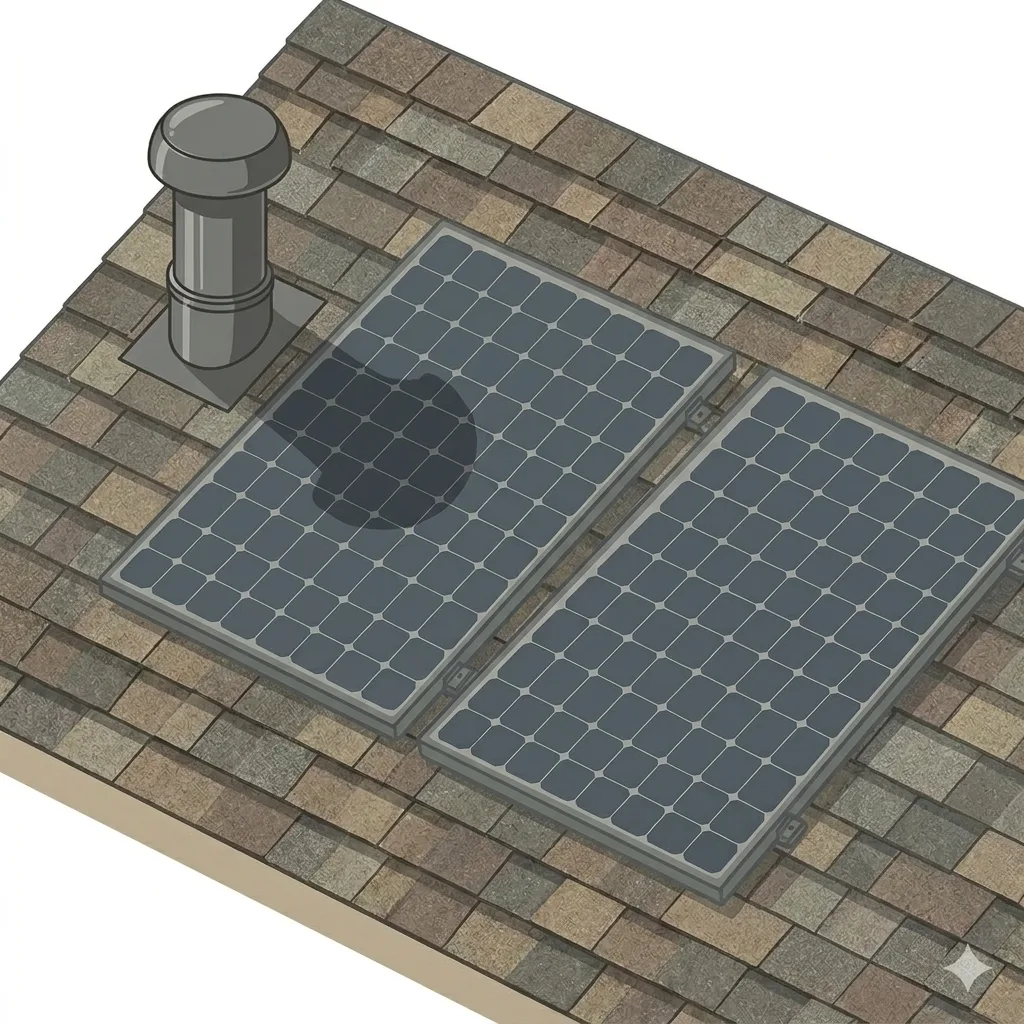
Solar cells in a panel are wired in series, like links in a chain. Every cell in the string must carry the same current. When one cell is shaded, it stops generating electricity and instead becomes a resistive load: blocking current flow the way a kink blocks a garden hose. The unshaded cells try to push current through the shaded cell anyway, forcing it into reverse bias.
Without protection, the shaded cell dissipates power as heat rather than generating it. Researchers at the University of Beira Interior measured the impact: shading just 20% of a single cell in a 60-cell module caused a 3.2% power loss. At 60% shading on one cell, power dropped by 36%. Shade an entire 20-cell sub-string and the loss reached 41%.
The Hot Spot Problem
The real danger goes beyond lost production. When a shaded cell is forced into reverse bias, it can become a "hot spot", a localized area where power is dissipated as heat instead of electricity. Testing by SUPSI and EPFL measured outdoor hot spot temperatures exceeding 150°C in standard PERC modules, with indoor testing reaching up to 190°C.
At those temperatures, solder joints melt, anti-reflective coatings degrade, encapsulant materials brown and delaminate, and backsheets can scorch. In extreme cases, hot spots have caused panel fires. NREL researchers found that thermal runaway in bypass diodes themselves, caused by prolonged forward-bias operation under partial shading, was a documented failure mode in fielded rooftop systems.
What Bypass Diodes Do
Bypass diodes are small semiconductor components installed in a panel's junction box, wired in reverse parallel across groups of series-connected cells. Under normal conditions, they do nothing: the diode is reverse-biased and electrically invisible.
When cells in their group become shaded, the bypass diode forward-biases and conducts, providing an alternative current path around the shaded section. The panel loses the output of that one cell group, typically one-third of total output for a standard 60-cell panel with three bypass diodes, but the remaining sections continue producing at full capacity.
Modern panels typically use Schottky barrier diodes with a forward voltage drop of 0.3–0.5 V, which replaced older PN junction diodes (0.7 V drop) to reduce power losses during bypass operation.
When Did Bypass Diodes Become Standard?
The concept is not new: the first U.S. patent for a bypass diode assembly in photovoltaic modules was filed in 1984. But widespread adoption followed the publication of IEC 61215 in 1993, which included bypass diode thermal testing as part of the design qualification standard for crystalline silicon modules. By the mid-to-late 1990s, bypass diodes were standard in virtually all commercial solar panels.
Panels manufactured before the mid-1990s, and some budget or specialty panels produced more recently, may lack bypass diodes entirely. Community forums document cases of panels from as recently as 2011 arriving with no diodes in the junction box. Without bypass diodes, even minor obstructions like dirt accumulation or bird droppings on a single cell group can reduce string output to near zero rather than just losing one sub-string's contribution.
How to Check Your Panels
If you have older panels and want to know whether they include bypass diodes, there is a non-invasive test: cover roughly one-third of the panel's cells with cardboard and measure voltage and current with a multimeter. If voltage drops but current holds steady, the bypass diodes are present and working. If both current and voltage drop significantly, the panel likely lacks functioning bypass diodes.
For older panels without bypass diodes, external bypass diodes can be added across each panel's terminals. This provides whole-panel bypass protection, cruder than the sub-string protection built into modern panels, but far better than no protection at all.
Beyond Bypass Diodes: Modern Shade Mitigation
Bypass diodes are a reactive, coarse-grained solution. They only activate after shading has impacted a cell section, and when they do, you lose the entire bypassed group's output, even if only one cell is partially shaded.
For installations with unavoidable shading, module-level power electronics offer finer-grained control:
-
Power optimizers (SolarEdge, Tigo, Huawei) let each panel operate at its own maximum power point, preventing one shaded panel from dragging down the entire string. Tigo optimizers can be added selectively to shaded panels only, making them a practical retrofit option.
-
Microinverters (Enphase) convert DC to AC at each panel independently. Panels are connected in parallel, so no panel affects any other. They cost roughly three times more than optimizers but provide full panel-level independence.
-
Cell-string optimizers (JinkoSolar MX with Maxim chips) replace each bypass diode with a DC-DC converter that performs maximum power point tracking at the cell-string level. Field tests showed 15–20% increased energy harvesting under shading compared to standard bypass diodes.
The Bottom Line
For most residential solar installations on unshaded roofs, the bypass diodes built into modern panels provide all the protection needed. If you are evaluating older panels, whether inherited, purchased used, or still on your roof from an early installation, checking for bypass diodes is one of the first things worth doing. And if your installation has persistent shading from trees, chimneys, or neighboring structures, panel-level electronics like optimizers or microinverters will recover significantly more energy than bypass diodes alone.