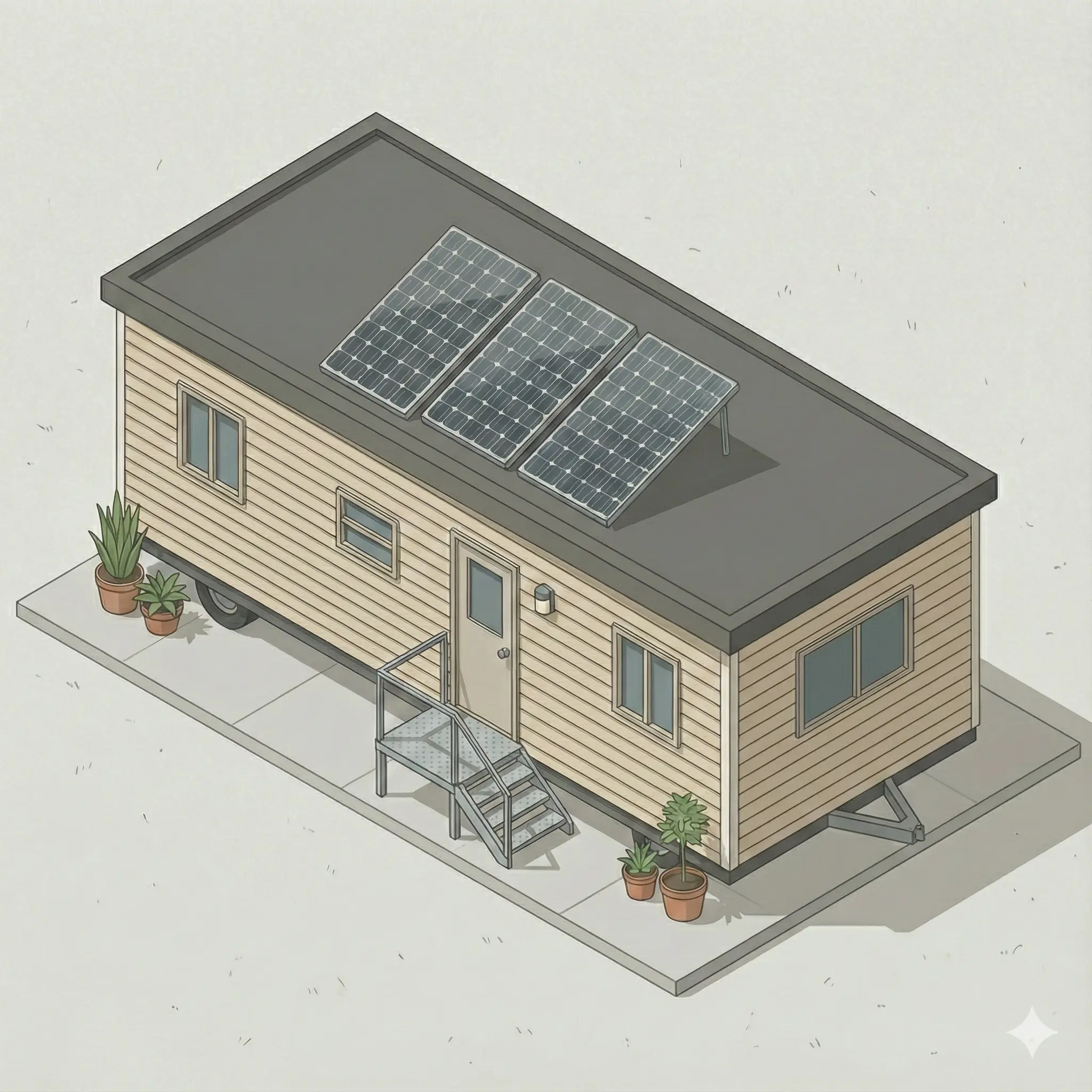
If you live in a mobile or manufactured home, you have probably watched the solar revolution happen for everyone else. You see panels going up on traditional stick-built houses, on big box stores, and even on parking lot carports. Meanwhile, you are sitting there with your monthly electric bill, wondering, "What about me? Can I put solar panels on my mobile home?"
The short answer is: Yes, absolutely.
But—and this is a big "but"—it is not quite as simple as slapping some glass on the roof and plugging it in. Mobile homes are special. They are built differently, financed differently, and often live in communities with their own unique sets of rules.1
This guide is going to be your bible. We aren't just going to give you a "maybe." We are going to walk you through every single nut, bolt, dollar, and law involved in getting solar power for your manufactured home. We will talk about why your roof structure scares solar installers, why putting panels in your yard might actually be the genius move you haven't thought of, and how to pay for it all without getting ripped off.
We are writing this for you—the homeowner who wants to save money, be independent, and stop renting their electricity from the utility company. We will keep the language simple. No engineering jargon without a clear explanation. Just straight talk about how to turn your mobile home into a power plant.
---
Chapter 1: The Mobile Home Difference (And Why It Matters)
To understand solar, you first have to understand your home. If you talk to a generic solar salesperson, they might treat your home like any other house. That is a mistake that can cost you thousands of dollars or damage your home.
Stick-Built vs. Factory-Built
Traditional houses ("stick-built") are constructed on a permanent concrete foundation. They usually have heavy-duty wooden frames, 2x6 or 2x8 roof rafters, and thick walls. They are over-engineered to stay put for 100 years.2
Your manufactured home was built in a factory. It was designed to be strong, yes, but also lightweight enough to be pulled down a highway at 60 miles per hour. This means the builders used lighter materials. Instead of massive roof beams, you might have smaller trusses—sometimes made of 2x2 lumber—engineered to hold exactly the weight of the roof and a specific amount of snow, and not much else.2
This doesn't mean your home is "cheap." It means it is efficient. But efficiency leaves very little "wiggle room" for extra weight. And solar panels are heavy. A typical setup can add 500 to 1,000 pounds to your roof. If you don't respect the engineering limits of your home, that weight can cause bowing ceilings, leaks, or even a collapse.4
The 1976 Turning Point (HUD Code)
In the world of manufactured homes, there is one year that changes everything: 1976.
Before June 15, 1976, mobile homes were pretty unregulated. We call these "Pre-HUD" homes. The construction standards varied wildly. After that date, the U.S. Department of Housing and Urban Development (HUD) established strict safety and construction codes.
Why does this matter for solar?
- Post-1976 Homes: These have a "HUD Label" (a metal tag on the back exterior) and a "Data Plate" inside (usually in a closet or under the sink). They were built to known standards. Engineers can look up the specs and tell you if the roof can hold solar.5
- Pre-1976 Homes: These are the "wild west." It is very rare to find a solar installer willing to put panels on a Pre-HUD roof because they simply cannot guarantee it is safe. If you have a Pre-HUD home, don't worry—we have a solution for you later in the "Ground Mounts" chapter.2
Real Estate vs. Personal Property
This is the other big difference. Is your home "Real Estate" or is it "Chattel"?
- Real Estate: You own the land, the home is on a permanent foundation, and you surrendered the title to the county. It's taxed like a house.
- Personal Property (Chattel): You rent the land (like in a park) or the home is still legally a vehicle (it has a title at the DMV). It's taxed more like a car.5
This affects how you get a loan for solar. Banks love lending money for Real Estate improvements. They are much more hesitant to lend money for improvements on "Personal Property" because if you default, they can't easily foreclose on the land.6
---
Chapter 2: The Roof Reality Check
Let's get right to the scary part: your roof. This is the number one reason mobile homeowners get told "no" by solar companies. But if you know what to look for, you can turn that "no" into a "yes."
The Anatomy of a Mobile Home Roof
Your roof isn't just a lid; it's a complex system of trusses. A truss is a triangular wooden frame that holds up the ceiling and the roof deck.
In many manufactured homes, these trusses are designed to handle:
- Dead Load: The weight of the roof materials itself.
- Live Load: Temporary weight like snow, rain, or a repairman walking on it.
- Wind Uplift: The force of the wind trying to peel the roof off like a sardine can.2
When you add solar, you are changing all three.
- Added Dead Load: Solar panels weigh about 2.5 to 3 pounds per square foot. That sounds light, but spread over the whole roof, it adds up.
- Wind Load: This is the big danger. Solar panels sit a few inches off the roof. When wind hits your home, it can get under the panels and pull up on them. This creates a massive "uplift" force. If your trusses aren't strapped down tightly to the walls, the panels could rip the roof decking right off.2
The Structural Engineering Inspection
You cannot eyeball this. You need a Structural Engineer.
If you hire a reputable solar installer, they will handle this. They will come to your house (or look at photos) and do a few things:
- Check the HUD Tag: To find the wind zone rating.
- Measure the Joists: They might peek into a vent or crawl into the attic space to see if you have 2x2, 2x3, or 2x4 trusses.
- Check the Span: How wide is the home? A double-wide has a longer span to support than a single-wide.
The engineer will then write a letter. It will either say, "Good to go," or "Needs Reinforcement."
- Reinforcement: This usually means adding extra wood framing inside the roof cavity or installing supports. To be honest, this is often so expensive ($2,000+) that it kills the project. If you need reinforcement, you should probably skip the roof and put the panels on the ground instead.2
Roof Material Matters: Metal vs. Shingle
Mobile homes typically have one of three roof types, and each one plays differently with solar.
1. Standing Seam Metal Roofs
This is the "Solar Jackpot." If you have a metal roof with raised seams (ridges), you are in luck.
- The Advantage: Installers can use special clamps (like the S-5! clamp) that grab onto the metal seam. They don't have to drill holes in your roof! No holes means no leaks. It is faster, cheaper, and safer.1
2. Composition Shingle Roofs
These look like standard house roofs.
- The Process: Installers have to drill lag bolts through the shingles and into the trusses below. Then they use metal "flashing" (flat sheets of metal) to slide under the shingles and seal the hole.
- The Risk: Finding the truss is hard. In a mobile home, the trusses are often smaller and spaced irregularly. If the installer misses the truss and just bolts into the thin plywood deck, the panels will rip out in the first strong wind.4
3. Flat or Bowed Roofs ("Melt-Down" Roofs)
Older homes often have roofs that are arched (bowed) or flat, covered in asphalt or a rubber coating.
- The Verdict: These are very difficult for solar. Flat roofs tend to collect water. Drilling holes in a roof that already pools water is a recipe for disaster. Most solar companies will refuse to touch these roofs because of the liability.1
The "Carport" Option
Do you have a large carport or patio cover?
Sometimes, the structure of the attached carport is actually sturdier (or easier to reinforce) than the home itself. Plus, if it leaks, it's just leaking on your car, not your living room.
- Constraint: The carport must be permanently anchored. If it's just a flimsy aluminum awning held up by thin poles, it can't hold panels. It needs 4x4 or 6x6 posts and a solid permit.2
Summary Checklist: Is My Roof Ready?
| Factor | Green Light (Easy) | Yellow Light (Caution) | Red Light (Stop) |
|---|---|---|---|
| Age | 2000 or newer | 1976 - 1999 | Pre-1976 |
| Material | Standing Seam Metal | Asphalt Shingle | Flat/Rolled Asphalt |
| Structure | 2x4 Trusses | 2x3 Trusses | 2x2 or 1x2 Trusses |
| Condition | Perfect shape | Minor wear | Sagging or leaks present |
---
Chapter 3: Ground Mounts—The Secret Weapon
If the last chapter depressed you about your roof, cheer up. There is a solution that bypasses the roof entirely: The Ground Mount.
A ground mount is exactly what it sounds like. You build a metal rack in your backyard, anchor it to the ground, and mount the panels there. For many mobile homeowners, this is actually the superior choice, not just a backup plan.8
Why Ground Mounts Win for Mobile Homes
- Zero Roof Anxiety: You never have to worry about your roof collapsing, leaking, or blowing away. Your home stays exactly as it is.9
- Perfect Angles: Your roof faces whichever way your house was parked. If your home faces East/West, you lose a lot of solar power. A ground mount can be pointed directly South (in the Northern Hemisphere) and tilted at the perfect angle to catch every drop of sunlight. This means you generate more power with fewer panels.9
- Cooler Panels = More Power: Here is a physics fact: Solar panels hate heat. As they get hotter, they produce less electricity. On a roof, heat is trapped under the panels. On a ground mount, air flows freely underneath, keeping them cool and boosting efficiency.9
- Easy Cleaning: When snow piles up or dust covers the panels, you don't need a ladder. You just walk out with a broom or a hose. Keeping panels clean can boost your energy by 5-10%.8
The Challenges of Ground Mounts
It's not magic; it has costs.
1. The Price Tag:
Ground mounts generally cost more upfront—usually 10% to 15% more than a roof mount. Why? Because you are building a structure from scratch. You have to buy steel pipe, concrete, and pay for labor to dig holes and trenches. On a roof, the "structure" is already there.11
2. The Trenching:
You have to get the power from the yard to your house. This means digging a trench.
- Depth: The National Electrical Code (NEC) usually requires burying wires 18 inches deep (for PVC conduit) or 24 inches deep (for direct burial cable).
- Labor: If your ground is rocky, digging that trench can be backbreaking or expensive work.13
3. Yard Space:
A 5-kilowatt system (typical size) might need 300 to 400 square feet of space. That is a space about the size of two parking spots. If you live in a cramped park, you might not have the room.8
Types of Ground Foundations
You can't just set the rack on the grass. The wind will grab it like a kite. It needs to be anchored.
- Concrete Piers: This is the most common. You dig deep holes (post holes), stick the metal poles in, and fill it with concrete. It's solid and permanent.14
- Driven Piles: A machine pounds steel beams into the ground. This is fast but requires heavy equipment access to your backyard.14
- Ground Screws: These are giant metal screws that are twisted into the earth. They work great in rocky soil where digging is hard.
- Ballast Mounts: If you cannot dig at all (maybe you have septic lines everywhere), you can use a "ballast" mount. This sits on top of the ground and is held down by heavy concrete blocks. It looks a bit industrial, but it works without digging.14
---
Chapter 4: The Electrical Puzzle
Okay, we have covered the structural part. Now let's talk about the sparky part. Connecting a solar system to a mobile home's electrical panel can be tricky.
The "120% Rule" (Simplified)
Your home has a main breaker panel (the gray box with all the switches). This panel has a rating, usually 100 Amps or 200 Amps. This rating tells you how much electricity the metal "busbar" inside can handle before it melts.
The Electrical Code has a safety rule called the 120% Rule. It says you can't feed more power into that busbar than 120% of its rating.
- The Math: (Busbar Rating x 1.2) - Main Breaker Size = Max Solar You Can Add.
Scenario A: The Old Home
You have a 100 Amp panel with a 100 Amp main breaker.
- Math: (100 x 1.2) - 100 = 20 Amps.
- Result: You can only install a 20 Amp solar breaker. That allows for a tiny solar system (maybe 3.8 kilowatts). That might not be enough to power your whole home.15
Scenario B: The New Home
You have a 200 Amp panel with a 200 Amp main breaker.
- Math: (200 x 1.2) - 200 = 40 Amps.
- Result: You can install a 40 Amp solar breaker. That allows for a nice 7.6 kilowatt system. Much better!
What If My Panel Is Too Small?
If you are stuck in Scenario A (the 100 Amp limit), you have two choices:
- Panel Upgrade: You pay an electrician to rip out your old 100 Amp panel and install a new 200 Amp panel.
- Cost: $1,500 - $3,000.
- Bonus: Your electrical system becomes safer and more modern.17
- Line-Side Tap: This is a "cheat code." Instead of feeding the solar power through a breaker inside the panel, the electrician connects the solar wires to the main service lines before they even hit your main breaker.
- Benefit: You bypass the 120% rule completely. You can put a huge solar system on a small panel.
- Problem: Not all utility companies allow this. And many mobile home panels are "All-in-One" units where the meter and breaker are sealed together, making it physically impossible to squeeze wires in there.18
The Wiring Under Your House
In a regular house, wires run through the attic. In a mobile home, they often run under the floor, in the crawl space.
When you run solar wires from a ground mount or roof to your panel, you might have to go under the "chassis" (the metal frame of the home).
Code Warning (NEC 550.15):
Any wiring under your home that is exposed to weather or physical damage must be in a conduit (pipe). You cannot just have bare wires dangling where a raccoon could chew them or a weed eater could slash them.
- Best Practice: Use Schedule 80 PVC (the thick gray pipe) or metal conduit (EMT). It must be strapped securely to the chassis, not dragging on the ground.20
---
Chapter 5: Financing and Insurance
You know it's technically possible. Now, how do you pay for it, and how do you protect it?
The Financing Struggle: Real vs. Personal Property
We mentioned earlier that banks treat "Chattel" (mobile homes on leased land) differently. This is huge for solar loans.
- Traditional Solar Loans: Companies like Mosaic, GoodLeap, or Sunlight Financial dominate the solar industry. They offer "zero down" loans. However, many of them require you to own the land. If you are in a mobile home park, they might deny you because they can't put a lien on your property.5
- Personal Loans: Your best bet might be a standard personal loan from your credit union. They look at your credit score and income, not your house. The interest rate might be higher (8-12%), but it's a cleaner deal without putting your home at risk.22
The 30% Federal Tax Credit (ITC)
Here is the good news: Uncle Sam doesn't care if you live in a mansion or a single-wide. The Residential Clean Energy Credit applies to everyone.
- The Deal: You get a tax credit equal to 30% of the total cost of your system.
- Example: You spend $15,000 on solar. You get a $4,500 credit on your federal taxes.
- How to Claim: You file IRS Form 5695 with your taxes.
- The Catch: It is a non-refundable credit. This means it can reduce your tax bill to $0, but the IRS won't send you a check for the difference. If you only owe $2,000 in taxes, you use $2,000 of the credit and "roll over" the remaining $2,500 to next year.23
Note on Leases (PPA): If you lease the panels (where the solar company still owns them), they get the tax credit, not you. You just get a slightly lower electric bill. For most mobile homeowners, buying is smarter than leasing.25
Insurance: Don't Skip This Call
Imagine this: You install $15,000 of solar panels. A massive hailstorm smashes them to bits. You call your insurance agent, and they say, "Sorry, those weren't on the policy."
- Step 1: Call your insurer before you install.
- Step 2: Ask to increase your "Dwelling Coverage". Solar panels attached to the roof are considered part of the structure. If your home is insured for $50,000 and you add $15,000 of solar, you need to bump your coverage to $65,000.
- Step 3: If you do a Ground Mount, ask about "Other Structures" coverage. Standard policies often limit "Other Structures" (like sheds) to 10% of the home's value. That might only be $5,000—not enough to cover a big solar array. You may need a "rider" or endorsement to cover the full value.26
---
Chapter 6: Dealing with Park Management and HOAs
If you own your own land, you are the king of your castle. But if you live in a park, you have a landlord. And landlords can be... difficult.
"Can They Ban Solar?"
This is a legal grey area that depends on your state.
- Solar Rights Acts: States like California, Florida, and Arizona have laws saying HOAs and landlords cannot "unreasonably restrict" solar.
- California's SB 1190: This specific law prevents mobile home parks from blocking solar if you meet safety codes.28
- Reasonable Restrictions: Even with these laws, the park can say "No" to things that are unsafe or unsightly. They can require:
- Engineering letters proving the roof is safe.
- Wires to be hidden (not draped over the side).
- Panel frames to match the roof color.
Ground Mounts in Parks
This is usually where the fight happens. You rent the "pad" (the ground). The park rules usually say you can't build permanent structures on the pad.
- The Argument: A ground mount is a "structure."
- The Counter-Argument: If the law says you have a right to solar, and your roof is too weak for solar, then the ground mount is your only option. Therefore, banning the ground mount is effectively banning solar, which might be illegal in your state.
- Negotiation Tip: Show them a professional plan. Show them how it will be skirted or landscaped so it doesn't look like an eyesore. Many managers just fear "ugly" DIY projects. If yours looks professional, they might say yes.30
Community Solar: The Loophole
If the park says "Absolutely Not," or your roof is completely shaded by trees, look for Community Solar.
This is like a subscription service. A big solar farm is built somewhere else in your county. You "subscribe" to a few panels at that farm. The electricity they make shows up as a credit on your electric bill.
- Pros: No installation, no fight with the landlord, no upfront cost.
- Cons: You save less money (maybe 10% savings vs. 90% savings if you owned the panels). But saving 10% is better than saving 0%.31
---
Chapter 7: The "Lite" Option: Portable Solar Generators
Maybe you have read this far and thought, "This sounds like a nightmare. Permits? Engineering? Trenching?"
If you just want backup power for emergencies, or you want to dabble in solar without a construction project, look at Portable Solar Generators.
These are basically big batteries in a box with outlets on the front. You throw some folding solar panels in the yard, plug them in, and charge up the box. Then you plug your fridge or phone into the box.
- Brands: EcoFlow, Jackery, Bluetti, Anker.
- Pros: No permits. No installation. No roof weight. You can take it with you if you move.
- Cons: They are expensive per watt. You have to manually set up the panels every time you want to charge. They cannot run your whole house (like your central AC or dryer) unless you spend a fortune ($5,000+).33
Sizing Tip: Look for "Watt-Hours" (Wh).
- 500 Wh: Charges phones, runs a laptop.
- 2000 Wh: Runs a fridge for a day, runs a TV, lights.
- Chemistry: Look for LiFePO4 (Lithium Iron Phosphate) batteries. They last for 3,000+ cycles (10 years). The older "NMC" lithium batteries only last 500-800 cycles.34
---
Chapter 8: Installation Step-by-Step Guide
If you are ready to pull the trigger on a full system, here is your roadmap.
Step 1: The Energy Audit (Do This First!)
The cheapest energy is the energy you don't use. Mobile homes are notorious for being leaky.
- Seal the gaps in your skirting.
- Check the insulation in your belly (floor).
- Switch every lightbulb to LED.
- Why? If you cut your energy use by 20%, you can buy a solar system that is 20% smaller and cheaper. That saves you thousands.2
Step 2: Sizing Your System
Grab your electric bill. Look for your "Annual Usage" or "Average Daily Usage" in kWh.
- Small Home: Uses ~15 kWh/day. Needs a 4 kW system.
- Medium Home: Uses ~30 kWh/day. Needs an 8 kW system.
- Cost Estimate (2025): Expect to pay about $2.70 per watt.
- 5 kW system = ~$13,500.
- Minus 30% Tax Credit = $9,450 Net Cost.35
Step 3: Finding an Installer
This is hard. Many big national solar companies simply have a policy: "No Mobile Homes." They don't want the liability.
- Tip: Look for local installers. Small, family-owned solar companies are often more flexible and willing to do the custom engineering work required.
- The Question: Ask them specifically: "Have you installed on a HUD-code manufactured home before?" If they hesitate, hang up.
Step 4: Permitting
Your installer handles this. They will draw up plans and submit them to:
- The City/County: For electrical and zoning permits.
- The State: In some states (like Washington), you need a specific "Alteration Permit" from the Department of Labor & Industries (L&I) for mobile homes.37
- The Utility: To get "Permission to Operate" (PTO) so you can send power back to the grid.
Step 5: Installation Day
- Roof Mount: 1-2 days. They locate trusses, install mounts (drilling or clamping), run wires, and lay panels.
- Ground Mount: 2-3 days. Day 1 is digging holes and pouring concrete. Day 2 is building the rack. Day 3 is wiring.
Step 6: The Switch Flip
Once the utility company inspects the system and swaps your meter for a "bi-directional" meter (one that spins backward), you get the green light. You turn the big switch on, and you are officially a solar power plant!
---
Chapter 9: Maintenance (Set It and Forget It?)
Solar is low maintenance, but not no maintenance.
1. Cleaning:
Panels get dirty. Pollen, dust, and bird droppings block the sun.
- Action: Once or twice a year, hose them down. Use a soft brush (like a car wash brush) if they are really grimy. Never use a pressure washer—you can crack the glass or damage the seals.8
2. Torque Checks:
Mobile homes vibrate more than regular homes (especially in high winds). Aluminum wires and connectors can loosen over time due to heating and cooling cycles.
- Action: Every 2-3 years, have a pro check the connections. Loose wires cause arcs, and arcs cause fires.38
3. Inverter Watch:
Your inverter usually has an app. Check it once a month. If one panel is showing zero power, you might have a blown fuse or a bad optimizer. Don't wait a year to notice your system is broken.39
---
Conclusion: Is It Worth It?
Let's wrap this up with a reality check.
Scenario 1: The Slam Dunk
You own your land. You have a double-wide with a decent metal roof or a big backyard. You pay $200/month for electricity.
- Verdict: Go for it. You will likely pay off the system in 6-8 years and then enjoy free power for the next 20 years.
Scenario 2: The Hard Pass
You live in a park with strict rules. Your home is a 1972 single-wide with a sagging roof. You plan to move in 3 years.
- Verdict: Don't do it. The upfront cost and structural headaches aren't worth it. Look at portable solar generators for emergencies, or just focus on insulation to lower your bill.
For everyone in the middle, it takes homework. But the freedom of making your own power—and the feeling of watching your electric meter spin backward—is a pretty amazing reward for the effort.
Good luck, and may the sun always shine on your panels!
---
Reference Data Tables
Table 1: Is Your Roof Ready? (Roof Types)
| Roof Type | Material | Solar Difficulty | Notes |
|---|---|---|---|
| Standing Seam | Metal | Easy | No drilling required! Clamps attach to seams. |
| Corrugated | Metal | Medium | Requires drilling through the "humps" of the metal. |
| Shingle | Asphalt | Hard | Must locate narrow trusses accurately to avoid leaks. |
| Flat / Bowed | Rolled/Tar | Very Hard | High leak risk. Most installers will decline. |
| TPO Membrane | Rubber/Plastic | Medium | Common on newer homes. Requires specialized anchors. |
Table 2: Roof vs. Ground Mount Cost Breakdown (5kW System)
| Expense Item | Roof Mount Cost | Ground Mount Cost | Why the difference? |
|---|---|---|---|
| Equipment | $6,000 | $6,000 | Panels/Inverters cost the same. |
| Mounting Hardware | $1,500 | $3,500 | Ground mount needs steel pipe & concrete foundation. |
| Labor & Trenching | $4,000 | $5,500 | Digging trenches adds labor cost. |
| Permits & Engineering | $1,500 | $1,800 | Ground mounts often need soil/zoning checks. |
| Total Before Tax Credit | $13,000 | $16,800 | |
| Net Cost (After 30% Credit) | $9,100 | $11,760 |
Table 3: Appliance Wattage Guide (For Sizing)
If you are buying a portable generator, you need to know what your stuff uses.
| Appliance | Running Watts | Starting Watts (Surge) |
|---|---|---|
| Central AC (3 Ton) | 3,500 W | 10,000 W+ |
| Window AC Unit | 500 - 1,200 W | 1,500 W |
| Refrigerator | 150 - 400 W | 1,200 W |
| Space Heater | 1,500 W | 1,500 W |
| Microwave | 1,000 W | 1,500 W |
| TV (LED) | 60 - 100 W | 100 W |
| Phone Charger | 5 - 20 W | 20 W |
| CPAP Machine | 30 - 60 W | 60 W |
Table 4: Key Electrical Terms Simplified
- Volt (V): The "pressure" of the electricity. Your outlets are 120V. Your dryer is 240V.
- Amp (A): The "volume" of electricity flowing. Your main breaker (100A or 200A) limits the total flow.
- Watt (W): The total power. Volts x Amps = Watts. This is what panels produce.
- Kilowatt-Hour (kWh): A measure of energy over time. Running a 1,000-watt microwave for 1 hour = 1 kWh. This is what you pay for on your bill.
- Inverter: The box that takes the DC power (direct current) from the panels and turns it into AC power (alternating current) that your house uses.
Data Sources:.1
Works cited
- Complete Guide to Solar Panels for Mobile Homes and Trailers - EcoFlow, accessed December 5, 2025, https://www.ecoflow.com/us/blog/solar-panel-mobile-homes-guide
- Can You Put Solar Panels on a Mobile Home? Here's What You ..., accessed December 5, 2025, https://www.terli.net/blog/can-you-put-solar-panels-on-a-mobile-home.html
- Energy-Efficient Manufactured Homes, accessed December 5, 2025, https://www.energy.gov/energysaver/energy-efficient-manufactured-homes
- ADVISORY FOR MANUFACTURED HOME ROOF MOUNTED SOLAR PHOTOVOLTAIC SYSTEMS - California Department of Housing and Community Development - CA.gov, accessed December 5, 2025, https://www.hcd.ca.gov/sites/default/files/docs/manufactured-and-mobilehomes/solar-pv-advisory.pdf
- Can You Add Solar Panels to a Manufactured Home and Still Qualify ..., accessed December 5, 2025, https://www.triadfs.com/news/can-you-add-solar-panels-to-a-manufactured-home-and-still-qualify-for-financing
- MA Properties Online | Solar Power Explained, accessed December 5, 2025, https://www.mapropertiesonline.com/blog/Solar-Power-Explained
- MANUFACTURED HOME SOLAR PHOTOVOLTAIC SYSTEM REQUIREMENTS INSTRUCTIONS, accessed December 5, 2025, https://www.wma.org/sites/main/files/file-attachments/hcd_mh_120_new_07-16.pdf
- Solar Panels on Ground vs Roof: Which Mount Is Better? | Angi, accessed December 5, 2025, https://www.angi.com/articles/solar-panels-on-ground-vs-roof.htm
- Should I Use Ground or Roof Solar Panels?, accessed December 5, 2025, https://1sourcesolar.com/ground-mounted-versus-roof-mounted-panels/
- Solar Ground Mount vs. Roof Mount Racking: Which is Best? - Sun Valley Solar Solutions, accessed December 5, 2025, https://www.sunvalleysolar.com/blog/solar-ground-mount-vs-roof-mount-racking
- Ground-Mounted Solar Panels: If You Have The Space, Go For It | EnergySage, accessed December 5, 2025, https://www.energysage.com/solar/alternatives-to-rooftop-solar/ground-mounted-solar/
- Ground-Mount Vs Roof-Mount Solar Racking - Nuance Energy, accessed December 5, 2025, https://nuanceenergy.com/solar-blog/ground-mount-vs-roof-mount-solar-racking
- Ground-Mounted vs Roof-Mounted Solar Panels: Which Should You Choose? - EcoFlow, accessed December 5, 2025, https://www.ecoflow.com/us/blog/ground-vs-roof-solar-panels
- 3 Reasons to Ground Mount Solar - Ready Rack Solar, accessed December 5, 2025, https://www.readyracksolar.com/news/3-reasons-to-ground-mount-solar
- Line Side Tap vs. Load Side Tap: Everything You Need To Know - Velo Solar, accessed December 5, 2025, https://www.velosolar.com/line-side-tap-vs-load-side-tap/
- Backfed breaker or Line side tap? - NAZ Solar Electric Forum, accessed December 5, 2025, https://forum.solar-electric.com/discussion/comment/126656
- Is an Electrical Panel Upgrade Needed for Solar? - Boston Solar, accessed December 5, 2025, https://www.bostonsolar.us/solar-blog-resource-center/blog/do-i-need-to-upgrade-my-electrical-panel-when-going-solar/
- Supply-Side-Tap (Line-Side Connection) - renvu, accessed December 5, 2025, https://www.renvu.com/blogs/learn/supply-side-tap-line-side-connection
- Line-Side Tap - Solar Panel Talk, accessed December 5, 2025, https://www.solarpaneltalk.com/forum/solar-panels-for-home/solar-panels-for-your-home/345780-line-side-tap
- 550.15(H) Under-Chassis Wiring (Exposed to Weather). - Electrical License Renewal, accessed December 5, 2025, https://www.electricallicenserenewal.com/Electrical-Continuing-Education-Courses/NEC-Content.php?sectionID=155.0
- I need guidance on some conduit rules | DIY Solar Power Forum, accessed December 5, 2025, https://diysolarforum.com/threads/i-need-guidance-on-some-conduit-rules.103021/
- Homeowner's Guide to Solar - Department of Energy, accessed December 5, 2025, https://www.energy.gov/eere/solar/homeowners-guide-solar
- Residential Clean Energy Credit | Internal Revenue Service, accessed December 5, 2025, https://www.irs.gov/credits-deductions/residential-clean-energy-credit
- Solar Tax Credit: What It Is, How It Works - NerdWallet, accessed December 5, 2025, https://www.nerdwallet.com/taxes/learn/solar-tax-credit
- Ownership vs lease let's discuss : r/solar - Reddit, accessed December 5, 2025, https://www.reddit.com/r/solar/comments/18zc3pj/ownership_vs_lease_lets_discuss/
- Does homeowners insurance cover solar panels? - Kin Insurance, accessed December 5, 2025, https://www.kin.com/blog/solar-panel-insurance/
- Does Home Insurance Cover Solar Panels? | EcoFlow ZA, accessed December 5, 2025, https://www.ecoflow.com/us/blog/does-home-insurance-cover-solar-panels
- SB 1190 (Laird) - SENATE HEALTH - CA.gov, accessed December 5, 2025, https://sjud.senate.ca.gov/sites/sjud.senate.ca.gov/files/sb_1190_laird_sjud_analysis.pdf
- Gov. Newsom Signs SB 1190 to Promote Solar in Mobilehome Parks | Senator John Laird, accessed December 5, 2025, https://sd17.senate.ca.gov/news/gov-newsom-signs-sb-1190-promote-solar-mobilehome-parks
- Preserving Your Power: 10 Tips for Negotiating a Solar Farm Lease | Dean Mead, accessed December 5, 2025, https://www.deanmead.com/preserving-power-10-tips-negotiating-solar-farm-lease/
- Community Solar Program - Georgia Power, accessed December 5, 2025, https://www.georgiapower.com/residential/save-money-and-energy/products-programs/residential-solar-solutions/community-solar.html
- Illinois Community Solar: Local Clean Energy, accessed December 5, 2025, https://uslightenergy.com/community-solar/illinois-community-solar/
- What Size Solar Generator Do I Need? For House, Camping, Camper and More - Jackery, accessed December 5, 2025, https://www.jackery.com/blogs/buying-advice/what-size-solar-generator-do-i-need
- Camp, cabin, or crisis: the ideal solar generator size for 3 different scenarios, accessed December 5, 2025, https://naturesgenerator.com/blogs/news/camp-cabin-or-crisis-the-ideal-solar-generator-size-for-3-different-scenarios
- 5kW Solar Panel Systems: How Much Do They Cost? - EnergySage, accessed December 5, 2025, https://www.energysage.com/solar/5kw-solar-systems-compare-prices-installers/
- 5kW Solar System Cost In 2025: Pricing, Output & State By State Breakdown, accessed December 5, 2025, https://www.solarpermitsolutions.com/blog/5kw-solar-system-cost-2025
- Installing solar panels on your manufactured or mobile home - Lni.wa.gov, accessed December 5, 2025, https://lni.wa.gov/forms-publications/F622-098-000.pdf
- Top 10 Beginner Mistakes When Building a DIY Solar System - YouTube, accessed December 5, 2025, https://www.youtube.com/watch?v=-3dNJAe8XEc
- Common Mistakes to Avoid When Installing Solar Panels - EcoFlow, accessed December 5, 2025, https://www.ecoflow.com/us/blog/solar-panel-installation-common-mistakes
- How Many Solar Panels to Power a Mobile Home?, accessed December 5, 2025, https://www.pepsolar.com/blog/how-many-solar-panels-to-power-a-mobile-home/