When you flip a light switch, you rarely think about where the electricity comes from. But if you are like millions of other American homeowners, you are starting to pay closer attention. Maybe it is the rising numbers on your monthly utility bill, or perhaps it is the news about climate change and the grid’s reliability. You are looking up at your roof and wondering: Is there a better way?
This brings us to a fundamental question: Is sunlight renewable?
On the surface, the answer seems obvious. The sun rises every morning. It has done so for billions of years and will likely continue to do so long after we are gone. But for a homeowner making a financial decision that costs thousands of dollars, "renewable" means more than just "it comes back tomorrow." It involves economics, physics, environmental impact, and government policy. It is about understanding the difference between burning a fuel that runs out and tapping into a flow that never stops.
This report is designed to be your ultimate guide. We will strip away the complex jargon and look at the hard facts. We will explore how a giant ball of fusing gas 93 million miles away can power your toaster. We will dig into the economics of why solar panels are considered an "inflation hedge." We will look at the environmental "price tag" of making solar panels and how quickly they pay that debt back.
Most urgently, we will address the elephant in the room: the major changes coming to the United States solar market in 2025. With the recent passage of the "One Big Beautiful Bill Act," the financial landscape for solar is changing dramatically on December 31, 2025. 1 Understanding this deadline is not just about renewable energy—it is about your bank account.
So, let’s start with the star of the show. Is the sun truly renewable? The answer lies in the physics of the stars.
---
2. The Physics of Forever: How the Sun Works
To understand why we call solar energy "renewable," we have to leave Earth for a moment and look at the sun itself. It isn’t a battery, and it isn’t a fire. It is a nuclear fusion reactor.
2.1 The Nuclear Engine
The sun is a "yellow dwarf" star, roughly 4.6 billion years old. 3 It is made mostly of hydrogen gas. In the core of the sun, the pressure is so intense that hydrogen atoms are crushed together to form helium. This process is called nuclear fusion.
When two hydrogen atoms fuse into one helium atom, they lose a tiny bit of mass. That lost mass doesn’t just disappear; it turns into pure energy. This is Einstein’s famous equation, $E=mc^2$—energy equals mass times the speed of light squared. Because the speed of light is a huge number, a tiny bit of mass creates a massive amount of energy. 3
Every single second, the sun converts about 600 million tons of hydrogen into helium. 4
2.2 The "Finite" Infinite
Is this fuel source infinite? Technically, no. Like a car with a massive gas tank, the sun eventually runs out of gas.
- The Main Sequence: The sun is currently in the stable part of its life, called the "main sequence." It has been burning for about 4.6 billion years and has enough hydrogen to keep burning for another 5 billion years. 5
- The End Game: When the hydrogen runs out, the sun will expand into a "Red Giant." It will get so big that it will likely swallow Mercury, Venus, and maybe even Earth. After that, it will collapse into a small, dense "white dwarf". 3
So, in the strictest scientific sense, the sun is not infinite. However, for humans, 5 billion years is practically forever. If you are planning for a 30-year mortgage or even the next few generations of your family, the sun is effectively eternal. We call it "renewable" because we cannot deplete it. Whether you use the sunlight hitting your roof or not, the sun will burn at the same rate. Using solar power doesn't "use up" the sun. 4
2.3 The Power of "Flow" vs. "Stock"
This brings us to a critical concept in understanding energy: the difference between a Stock and a Flow.
Imagine you have two sources of water:
- A Pond (Stock): This is a fixed amount of water. If you pump water out, the level goes down. If you pump it out faster than rain refills it, the pond dries up.
- A River (Flow): This is water that is constantly moving. You can put a water wheel in the river to generate power. The water spins the wheel and keeps flowing. 7
Fossil fuels (coal, oil, gas) are Stocks. They are stored underground. We have a limited supply. Every barrel of oil we burn is one less barrel left for the future. We are draining the pond. 9
Solar energy is a Flow. It is like the river. The sun bathes the Earth in a constant stream of photons (light particles). If we don't catch them, they hit the ground and turn into heat. They are gone. By putting up a solar panel, we are simply dipping a bucket into the river of energy that is already flowing past us. We aren't using up the source; we are just catching what is there. 10
2.4 The Scale of the Resource
The amount of energy in this "flow" is hard to wrap your head around. The sun blasts the Earth with thousands of times more energy than we need. In fact, one hour of sunlight hitting the Earth holds more energy than the entire human population uses in a full year. 12
This is why solar is so appealing. We aren't fighting for a scarce resource. We are trying to catch a tiny fraction of an abundant one. The challenge isn't finding the energy; the challenge is building the buckets (solar panels) to catch it efficiently.
---
3. The Technology: Turning Light into Electricity
Now that we know the sun provides the fuel, how do we turn it into the electricity that runs your refrigerator? The magic happens in the Photovoltaic (PV) cell. "Photo" means light, and "Voltaic" means electricity.
3.1 From Sand to Solar Panels
The main ingredient in most solar panels is silicon. Silicon is the second most common element in the Earth’s crust. It is found in sand (silica). 4 But you can't just glue sand to your roof.
- Purification: The sand is heated to extremely high temperatures to remove oxygen and impurities, creating pure metallurgical-grade silicon.
- Crystallization: This silicon is melted and grown into large crystals (ingots).
- Wafering: The ingots are sliced into ultra-thin wafers, thinner than a human hair.
- Doping: This is the cool part. The silicon wafers are treated with other chemicals to create an electric field. One side is "doped" with phosphorous to give it extra electrons (negative charge). The other side is doped with boron to create "holes" for electrons (positive charge). This creates a p‑n junction. 6
3.2 The Photovoltaic Effect
When sunlight hits this silicon sandwich, it acts like a billiard ball striking a rack of pool balls.
- Impact: A particle of light (photon) hits a silicon atom.
- Release: It knocks an electron loose from its orbit.
- Movement: Because of the electric field we created (the p‑n junction), that loose electron is pushed in a specific direction.
- Current: When you connect wires to the top and bottom of the cell, these moving electrons flow out as Direct Current (DC) electricity. 8
There are no moving parts. No gears grinding, no pistons firing, no fuel burning. Just a rock (silicon) sitting in the sun, silently pushing electrons around. This is why solar panels are so durable and can last for 25 to 30 years or more. 4
3.3 Types of Solar Panels
As a homeowner, you might hear about different types of panels. The two main ones are:
- Monocrystalline: These are made from a single, continuous crystal structure. They are usually black and have higher efficiency. They are better for roofs with limited space because they produce more power per square foot. 13
- Polycrystalline: These are made from many silicon fragments melted together. They often have a blue, speckled look. They are slightly less efficient but historically cheaper to make. However, as technology improves, monocrystalline panels are becoming the standard for homes because the price gap has closed. 13
3.4 The Inverter: The Translator
The electricity coming out of your solar panels is DC (Direct Current). But your home and the utility grid run on AC (Alternating Current). You cannot plug a DC solar panel directly into your wall outlet.
This is where the Inverter comes in. It is the "brain" of the system.
- String Inverters: All your panels are connected in a row (a string) and go to one big box on the wall. This is simple and cost-effective. However, if one panel is shaded by a tree, it can drag down the performance of the whole string, like a kink in a hose. 14
- Microinverters: These are small inverters attached to the back of each individual solar panel. They convert the power right there on the roof. If a bird poops on one panel or a chimney casts a shadow, only that one panel is affected. The rest keep working at full power. This is the most popular choice for residential homes today because it offers better reliability and monitoring. 15
---
4. The Environmental Scorecard: Is It Actually Green?
A common question—and sometimes a myth—is that solar panels are bad for the environment because of the energy used to make them. It is true that melting sand into silicon takes a lot of heat, usually from factories in places like China that might use coal power. So, does the good outweigh the bad?
4.1 The Carbon Debt
Think of a solar panel like a credit card purchase. When you manufacture the panel, you are "spending" energy and creating carbon emissions. This is the Carbon Debt.
- Mining: You have to dig up the quartz and metals.
- Manufacturing: You have to heat furnaces to 2,000°F.
- Transport: You have to ship the panels to the US.
When the panel first arrives at your house, it has a negative environmental impact. It hasn't generated any clean power yet.
4.2 The Payback Period
However, research shows that solar panels pay off this debt very quickly. This is called the Energy Payback Time (EPBT).
- For a modern solar panel, the EPBT is typically 1 to 2 years. 4
- This means that within the first two years of sitting on your roof, the panel generates enough clean energy to "cancel out" all the energy used to mine, build, and ship it.
4.3 Net Positive for Decades
Since solar panels are designed to last 25 to 30 years, that leaves roughly 23 to 28 years of pure, clean energy generation. During this time, the panel is carbon negative. It is preventing tons of CO₂ from entering the atmosphere that would have been created if you bought that power from a coal or gas plant. 17
Let’s look at the numbers. The National Renewable Energy Laboratory (NREL) compared the "lifecycle emissions" of different energy sources. This includes everything from building the plant to burning the fuel.
Table 1: Lifecycle Emissions of Energy Sources (Grams of CO₂ per kWh)
| Energy Source | Lifecycle Emissions (g CO₂/kWh) | How Much Dirtier than Solar? |
|---|---|---|
| Coal | ~1,001 | 23x Higher |
| Natural Gas | ~486 | 11x Higher |
| Solar PV | ~43 | Baseline |
Source: NREL Lifecycle Assessment Harmonization 17
As you can see, even accounting for the manufacturing, solar is vastly cleaner than fossil fuels. Coal releases 23 times more carbon pollution for every unit of electricity produced. 17
4.4 The Recycling Question
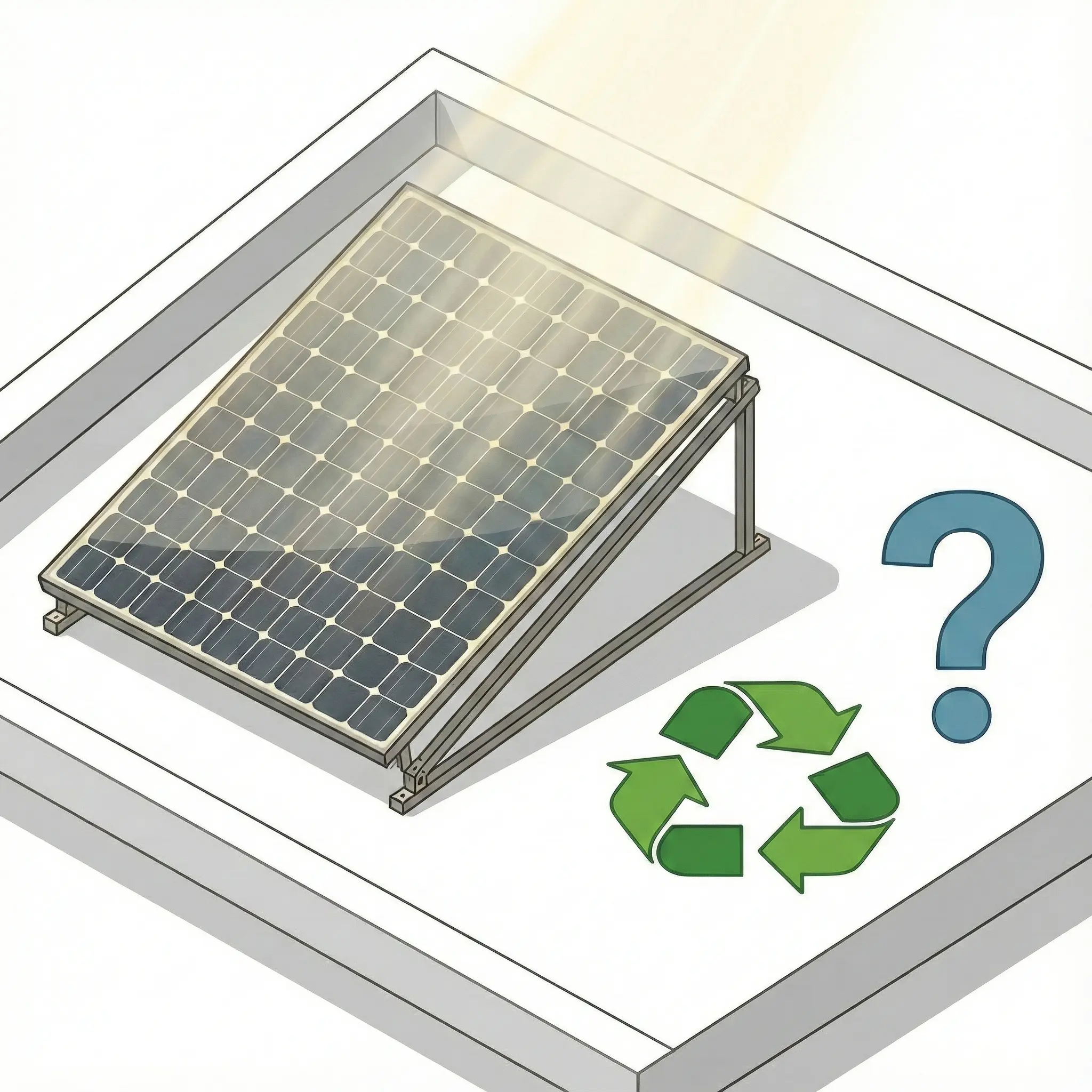
What happens when the panels die in 30 years? This is a valid concern. We don't want mountains of old panels in landfills.
Fortunately, solar panels are mostly made of materials we know how to recycle: glass (about 75% of the weight), aluminum frames, and copper wiring. 4 The challenge has been separating the silicon cells.
New recycling technologies are emerging that can recover up to 95% of the valuable materials in a panel. As the volume of old panels increases, a recycling industry is growing to meet the demand. It is not perfect yet, but it is far better than the waste from fossil fuels (like coal ash), which is toxic and difficult to manage. 4
---
5. Resource Economics: Why "Renewable" Saves You Money
We established that the sun is a "Flow" resource. This has profound implications for your wallet. When you switch to solar, you are fundamentally changing the way you buy energy.
5.1 Variable Costs vs. Fixed Costs
When you buy electricity from the utility company, you are paying a Variable Cost.
- The utility company buys fuel (coal, gas, uranium).
- The price of that fuel changes. If there is a war abroad or a pipeline breaks, gas prices go up.
- The utility passes those costs on to you.
- Historically, electricity rates in the US rise by about 2-3% per year. In recent years, they have jumped much faster in many states. 18
When you buy a solar system, you are swapping that variable cost for a Fixed Cost.
- You pay for the panels upfront (or take out a loan with a fixed payment).
- Once you own the equipment, the fuel (sunlight) is free.
- You have effectively pre‑paid for 25 years of electricity at today's price.
5.2 The Inflation Hedge
This makes solar power a hedge against inflation. Imagine if you could pre‑pay for 25 years of gasoline for your car at 2005 prices. You wouldn't care if gas prices tripled next year; you already paid.
Solar does the same for your home electricity. If the utility company raises rates by 10% next year, your solar savings effectively increase by 10% because you are avoiding that higher cost. 15
5.3 Return on Investment (ROI)
For most homeowners, solar is an investment product. You put money in, and you get money out (in the form of savings).
- Payback Period: This is how long it takes for the savings to equal the cost of the system. In the US, the average solar payback period is between 6 and 10 years. 4
- Profit Zone: If your system pays for itself in 8 years and lasts for 25 years, that means you have 17 years of free power.
- Lifetime Savings: Depending on your state's electricity rates, a typical home solar system can save between $20,000 and $100,000 over its lifetime. 20
5.4 Home Value
Unlike a car, which loses value the moment you drive it off the lot, solar panels can increase the value of your home. Studies have shown that homes with owned solar systems (not leased) sell for a premium. Buyers like the idea of moving into a house with no electric bill. On average, solar can add about $15,000 to the resale value of a home. 12
---
6. The 2025 Policy Cliff: The "One Big Beautiful Bill"
This section is perhaps the most important part of this report for anyone considering solar right now. The rules of the game are about to change.
For nearly two decades, the US government has supported homeowners who go solar through tax credits. But in 2025, a major legislative shift occurred. A new law, referred to as the "One Big Beautiful Bill Act" (OBBBA), was signed on July 4, 2025. 1 This law creates a strict deadline that every homeowner needs to know.
6.1 The Death of Section 25D
The primary incentive for homeowners has been Section 25D, also known as the Residential Clean Energy Credit. This allowed you to deduct 30% of the cost of your solar installation directly from your federal income taxes.
- If you bought a $30,000 system, the government gave you a $9,000 tax credit.
- This credit made the "payback period" much shorter.
The Warning: Under the new OBBBA law, Section 25D is scheduled to expire completely on December 31, 2025. 1
Unlike previous years where the credit might drop slowly (e.g., from 30% to 26%), this is a hard cutoff. If your system is installed on January 1, 2026, you get $0 in federal tax credits as a homeowner. 23
6.2 The "Placed in Service" Rule
It is not enough to just sign a contract or put down a deposit by December 31. The IRS requires the system to be "placed in service" by that date. This generally means the installation is complete and the system is capable of producing power. 1
- The Risk: Solar installations take time. You have to get permits, HOA approval, and utility inspections. This process takes 3 to 5 months on average. 24
- The Bottom Line: If you want the 30% credit, you cannot wait until November 2025 to call an installer. You need to be signing contracts by mid‑2025 to ensure you beat the deadline.
6.3 The Rise of Leasing (Section 48E)
So, will solar die in 2026? No. But the way you get it will change.
While the homeowner credit (Section 25D) is ending, the commercial tax credit (Section 48E) was extended. This creates a loophole. 25
- Solar Leasing / PPA: If you lease a system instead of buying it, the solar company owns the panels. Because they are a business, they can claim the commercial tax credit.
- The Shift: After 2025, we expect the market to shift back to leasing. Solar companies will likely offer "zero down" leases where they take the tax credit and pass some savings to you in the form of a lower monthly bill. 26
- The Trade‑off: While leasing is easy, you lose the long‑term ROI of ownership. You don't own the asset, and it doesn't add the same value to your home.
6.4 The "FEOC" Restriction
The new law also includes strict rules about where the solar panels come from. To qualify for the commercial credits, projects generally cannot use components from a "Foreign Entity of Concern" (FEOC)—a label that largely targets Chinese manufacturers. 27
This is designed to boost American manufacturing, but in the short term (2026‑2027), it might limit the supply of "approved" panels and batteries, potentially keeping prices high.
6.5 The Verdict for Homeowners
If you want to own your system: You have a closing window. You need to install in 2025 to get the 30% discount. Waiting until 2026 effectively raises the price of your system by 30%. 28
Table 2: Financial Impact of the 2025 Deadline (Typical System)
| Scenario | 2025 Installation | 2026 Installation |
|---|---|---|
| System Price | $30,000 | $30,000 |
| Federal Tax Credit | -$9,000 (30%) | $0 |
| Net Cost to You | $21,000 | $30,000 |
| Payback Period | ~7 Years | ~10+ Years |
Note: This assumes a cash purchase. In 2026, you might choose a lease instead to avoid the high upfront cost, but you sacrifice long‑term savings.
---
7. Living with Solar: Myths and Reality
Let’s move away from the spreadsheets and talk about daily life. What is it actually like to have a power plant on your roof? There are a few persistent myths that need busting.
7.1 Myth: "It doesn't work when it's cloudy."
Reality: Solar panels do not need direct, blinding sunlight to work. They run on light, not heat. Even on a cloudy day, there is plenty of diffuse light (which is why you can still see outside).
- On a heavily overcast day, panel production might drop to 10-25% of its peak. 29
- Germany is one of the world leaders in solar power, and it is not exactly known for being a tropical paradise. It gets about as much sun as Alaska, yet solar works great there. 16
7.2 Myth: "Solar doesn't work in the cold."
Reality: Solar panels actually love the cold! Electronics hate heat. As temperature rises, resistance in the wires increases, and efficiency drops.
- A crisp, sunny winter day is often when a solar panel is most efficient. As long as the panel isn't covered in snow, it will produce power very effectively in the winter. 30
7.3 Myth: "I'll have power during a blackout."
Reality: This is the most dangerous misconception. If you have a standard solar system and the grid goes down (like during a storm), your solar panels will turn off.
- Why? Safety. If your panels kept pushing electricity into the wires while a utility worker was trying to fix the line down the street, it could electrocute them. This is called "anti‑islanding". 21
- The Solution: If you want power during an outage, you need a Battery (like a Tesla Powerwall or FranklinWH). A battery creates a "microgrid" for your house. It physically disconnects you from the street grid and keeps your home running on solar power. Without a battery, you are in the dark just like your neighbors. 31
7.4 Myth: "Maintenance is a nightmare."
Reality: Solar panels are "set it and forget it."
- Cleaning: In most areas, rain cleans the panels for you. You rarely need to go up there with a hose.
- Snow: Panels produce a little heat, so snow melts off them faster than the rest of the roof.
- Monitoring: Most systems come with an app on your phone. You can check it once a month to make sure everything is running. If something breaks (usually the inverter, not the panels), the warranty typically covers it. 14
---
8. The Battery Revolution: Energy Independence
We mentioned batteries above, but they deserve their own section. In 2025, solar is rarely sold alone. It is almost always "Solar + Storage."
8.1 Why Add a Battery?
- Backup Power: As mentioned, this is the only way to keep the lights on during a blackout. As climate change makes storms more severe and the grid more unstable, this peace of mind is valuable. 32
- Time‑of‑Use (TOU) Rates: Many utility companies now charge different prices for electricity at different times. Power is expensive in the evening (5 PM – 9 PM) when everyone comes home. Power is cheap during the day.
- Without a battery: You sell your solar power to the grid during the day (cheap) and buy power back at night (expensive).
- With a battery: You store your free solar power during the day and use it yourself at night. You avoid paying those high evening rates. 15
8.2 Battery Chemistry
Most home batteries use Lithium‑Ion technology, similar to your phone or electric car.
- NMC (Nickel Manganese Cobalt): Common in earlier Powerwalls. High energy density (holds a lot of power in a small space).
- LFP (Lithium Iron Phosphate): The new standard (used by companies like FranklinWH and newer Teslas). They are slightly heavier but are safer (less risk of fire) and last longer (more charge cycles). 19
8.3 The "Virtual Power Plant"
In some states, you can even link your battery with your neighbors' batteries. During a heatwave when the grid is strained, the utility company might pay you to send some of your stored battery power back to the grid. This is called a Virtual Power Plant (VPP), and it turns your home into a mini‑power station that earns extra cash. 33
---
9. Steps to Going Solar: A 2025 Action Plan
If you have decided that tapping into the renewable flow of the sun is right for you, here is your roadmap. Remember the deadline: December 31, 2025.
Step 1: Check Your Bill (Today)
Look at your utility bill. Find your "Annual Usage" in kWh. A typical home uses about 10,000 to 12,000 kWh per year. This number tells installers how big of a system you need.
Step 2: Get Quotes (Week 1)
Get 3 to 5 quotes. Do not just take the first guy who knocks on your door.
- Look for local companies with a track record, not just national sales armies.
- Check the Price Per Watt ($/W). A fair cash price in 2025 is typically between $2.50 and $3.50 per watt. 20 If they are quoting $5.00/watt, walk away.
Step 3: Choose Financing (Week 2)
- Cash: Best savings.
- Solar Loan: Good option, but watch out for "dealer fees" (hidden costs added to the loan amount to lower the interest rate).
- Lease/PPA: Only do this if you cannot take the tax credit yourself.
Step 4: Site Survey & Design (Month 1)
The installer will come out, check your roof, and check your electrical panel. They will design the system.
Step 5: Permitting (Months 2‑3)
This is the waiting game. Your installer submits paperwork to the city and the utility. This can take anywhere from 2 weeks to 2 months. This is why you must start early. If you start in October 2025, you might get stuck in "permit purgatory" and miss the tax credit deadline. 24
Step 6: Installation (1‑3 Days)
The easy part! The crew shows up, bolts the racks to the roof, snaps in the panels, and wires it up. It usually takes less than 3 days. 34
Step 7: Inspection & Activation (Month 4)
The city inspector checks the work. Then the utility company swaps your meter and gives you Permission to Operate (PTO). Flip the switch. You are now powered by a star.
---
10. Conclusion: The Verdict
So, let’s return to our original question: Is sunlight renewable?
From a physics standpoint, it is a river of energy that will flow for another 5 billion years. It is cleaner, vaster, and more reliable than any fossil fuel stock we can dig out of the ground.
From an economic standpoint, it is a way to trade a lifetime of unpredictable monthly bills for a secure, fixed asset. It is an inflation hedge that adds value to your home.
But from a homeowner's standpoint in the United States right now, sunlight is an opportunity with an expiration date. The sun isn't going anywhere, but the government's offer to help you pay for the bucket to catch it is. The end of the Section 25D tax credit in 2025 marks the end of an era for cheap, ownership‑based solar.
If you have been on the fence, the time for waiting is over. The technology is proven, the financial math works, and the environmental benefits are clear. The sun is shining, the river is flowing, and for a few more months, Uncle Sam is offering to pay for 30% of your bucket.
Is sunlight renewable? Yes.
Is the 30% discount renewable? No.
The choice is yours.
---
Key Data Summary
Table 3: Installation Timeline for 2025 Success
| Phase | Typical Duration | Deadline to Start |
|---|---|---|
| Consultation & Quotes | 1‑2 Weeks | May/June 2025 |
| Contract Signing | 1 Week | July 2025 |
| Site Survey & Design | 2‑3 Weeks | August 2025 |
| Permitting (The Bottleneck) | 4‑8 Weeks | September 2025 |
| Installation | 1‑3 Days | November 2025 |
| Inspection & PTO | 2‑4 Weeks | December 2025 |
| "Placed in Service" | Deadline | Dec 31, 2025 |
Warning: Timelines vary by city. Start as early as possible to avoid the end‑of‑year rush. 24
Works cited
- Residential Solar Tax Credit Going Away In US After 2025 - GreenLancer, accessed December 5, 2025, https://www.greenlancer.com/post/solar-tax-credit-ending
- One Big Beautiful Bill Act - Wikipedia, accessed December 5, 2025, https://en.wikipedia.org/wiki/One_Big_Beautiful_Bill_Act
- What is the Life Cycle Of The Sun? - Universe Today, accessed December 5, 2025, https://www.universetoday.com/articles/life-of-the-sun
- Understanding the Facts About Solar Energy Longevity - LSP, accessed December 5, 2025, https://lsp.global/facts-about-solar-energy/
- How Old Is the Sun? | NASA Space Place, accessed December 5, 2025, https://spaceplace.nasa.gov/sun-age/
- Sun - Wikipedia, accessed December 5, 2025, https://en.wikipedia.org/wiki/Sun
- accessed December 5, 2025, https://lifestyle.sustainability-directory.com/area/flow-fund-model/#:~:text=The Flow-Fund Model is,%2C fuel%2C raw materials).
- What is renewable energy? | United Nations, accessed December 5, 2025, https://www.un.org/en/climatechange/what-is-renewable-energy
- Difference Between Renewable & Nonrenewable Resources | Inspire Clean Energy, accessed December 5, 2025, https://www.inspirecleanenergy.com/blog/clean-energy-101/difference-between-renewable-nonrenewable-energy
- Flow‑Fund Model → Area - Lifestyle → Sustainability Directory, accessed December 5, 2025, https://lifestyle.sustainability-directory.com/area/flow-fund-model/
- Understanding Stock-Flow and Fund-Service Resources in Ecological Economics, accessed December 5, 2025, https://sustainability.shiksha/ecological-economics/understanding-stock-flow-ecological-economics/
- Benefits of Residential Solar Electricity | Department of Energy, accessed December 5, 2025, https://www.energy.gov/energysaver/benefits-residential-solar-electricity
- Solar Panel Cost in 2025: Pricing and Savings Breakdown - This Old House, accessed December 5, 2025, https://www.thisoldhouse.com/solar-alternative-energy/solar-panel-cost
- Solar Panel Maintenance Checklist: Boost Efficiency, accessed December 5, 2025, https://goyellowball.com/solar-panel-maintenance-checklist/
- The Benefits of Solar Energy Economics Explained_Solar ROI_NA-Hoymiles, accessed December 5, 2025, https://www.hoymiles.com/us/solar-roi/the-benefits-of-solar-energy-economics-explained.html
- Debunking Solar Panel Myths, accessed December 5, 2025, https://everlightsolar.com/debunking-solar-panel-myths/
- Is solar energy worse for the climate than burning fossil fuels?, accessed December 5, 2025, https://skepticalscience.com/is-solar-energy-worse-for-the-climate-than-burning-fossil-fuels.htm
- Comparing Renewable Energy vs. Fossil Fuels - SmartEnergy, accessed December 5, 2025, https://smartenergy.com/energyguides/comparing-renewable-energy-vs-fossil-fuels/
- Solar payback in 2025: how long until panels truly pay? - Anern Store, accessed December 5, 2025, https://www.anernstore.com/blogs/diy-solar-guides/solar-payback-2025-how-long
- Solar Panel Cost In 2025: It May Be Lower Than You Think | EnergySage, accessed December 5, 2025, https://www.energysage.com/local-data/solar-panel-cost/
- Debunking Solar Myths - The Truths About Residential Solar Panels, accessed December 5, 2025, https://rhinorenewableswnc.com/debunking-solar-myths-the-truths-about-residential-solar-panels/
- FAQs for modification of sections 25C, 25D, 25E, 30C, 30D, 45L, 45W, AND 179D under Public Law 119-21, 139 Stat. 72 (July 4, 2025), commonly known as the One, Big, Beautiful Bill (OBBB) | Internal Revenue Service, accessed December 5, 2025, https://www.irs.gov/newsroom/faqs-for-modification-of-sections-25c-25d-25e-30c-30d-45l-45w-and-179d-under-public-law-119-21-139-stat-72-july-4-2025-commonly-known-as-the-one-big-beautiful-bill-obbb
- Federal Solar Tax Credit In 2025: How Does it Work? - EnergySage, accessed December 5, 2025, https://www.energysage.com/solar/solar-tax-credit-explained/
- Why Solar Power Installation Takes Time (2025 Guide) - EcoFlow, accessed December 5, 2025, https://www.ecoflow.com/us/blog/solar-power-installation-timeline-guide
- Updates on the Solar Investment Tax Credit (ITC) for 2025, accessed December 5, 2025, https://www.solartopps.com/blog/commercial-residential-solar-tax-credit-ending-2025/
- Are Solar Panels Worth It in 2026 and Beyond? Rising Electricity Prices Say Yes, accessed December 5, 2025, https://www.solarreviews.com/blog/are-solar-panels-worth-it-2026
- House Committee passes one big beautiful bill – impact on Energy' - Hogan Lovells, accessed December 5, 2025, https://www.hoganlovells.com/en/publications/house-passes-one-big-beautiful-bill-impact-on-energy
- Is Solar Worth It? Payback, Tax Credits & Resilience - EcoFlow, accessed December 5, 2025, https://www.ecoflow.com/us/blog/benefits-of-solar-energy
- Energy expert busts common myth about the reliability of solar panels: 'Don't let [them] fool you' - The Cool Down, accessed December 5, 2025, https://www.thecooldown.com/green-tech/solar-panels-myth-weatherproof/
- Top Ten Residential Solar Misconceptions - Exact Solar, accessed December 5, 2025, https://exactsolar.com/top-ten-residential-solar-misconceptions/
- Franklin Home Power Eliminates Fear of Power Outages and Fire - FranklinWH, accessed December 5, 2025, https://www.franklinwh.com/success-stories/franklin-home-power-eliminates-fear-of-power-outages-and-fire
- New Orleans homeowner has little concern about power outages thanks to his 'solar addiction' - YouTube, accessed December 5, 2025, https://www.youtube.com/watch?v=BnpZVSsRKeg
- Californians Are Saying Goodbye to Power Outages and High Energy Bills with Latest Battery Tech - Los Angeles Times, accessed December 5, 2025, https://www.latimes.com/specialsupplements/story/innovative-technology-for-energy-independence
- How Long to Install Solar Panels? Complete Timeline, accessed December 5, 2025, https://southfacesolar.com/solar-blog/how-long-to-install-solar-panels-complete-timeline/
- How Long Does It Take to Install Solar Panels For Your Home? - Semper Solaris, accessed December 5, 2025, https://www.sempersolaris.com/blog/how-long-to-install-solar-panels-for-your-home/