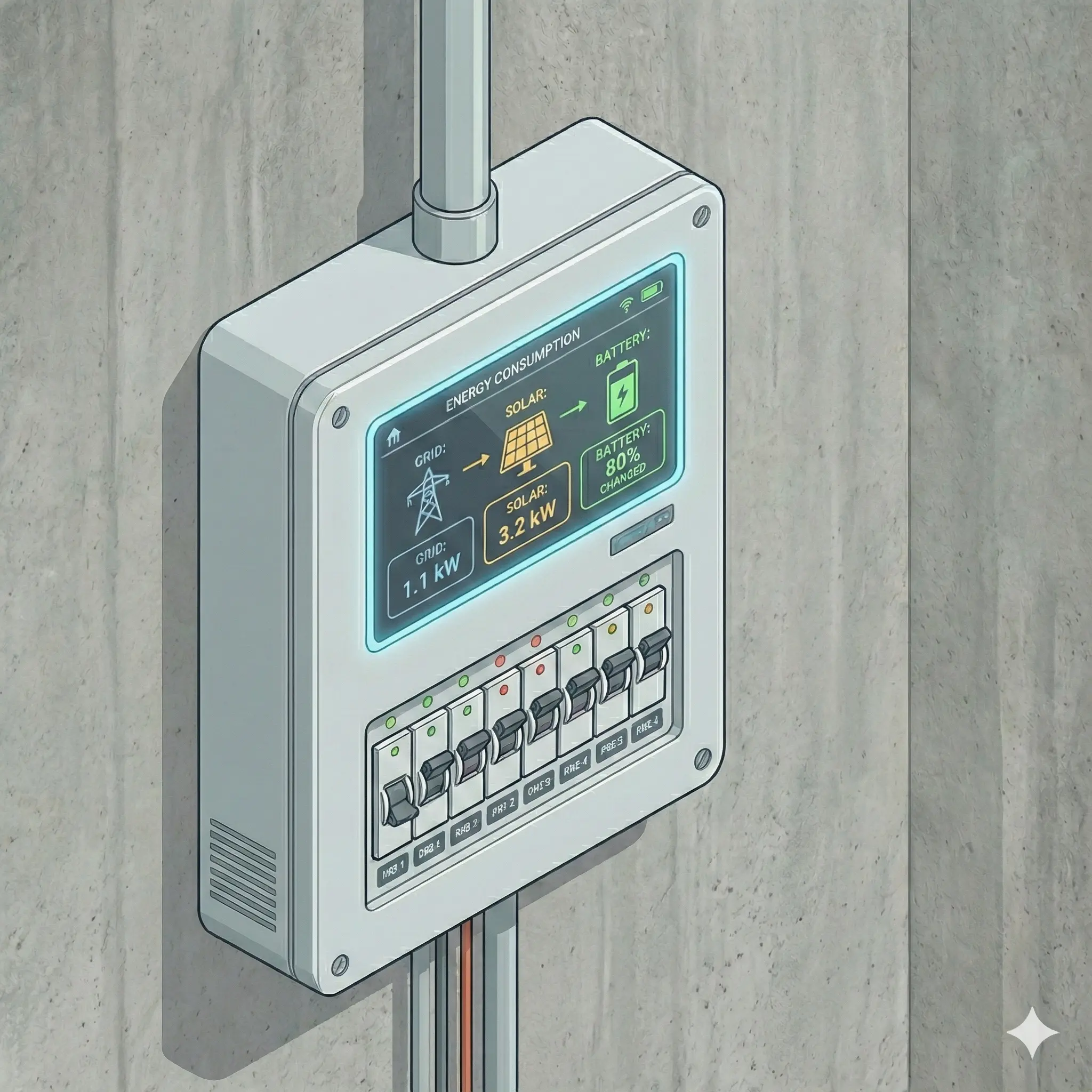
For the better part of a century, the residential electrical panel has remained virtually unchanged. Often relegated to the garage, a dark basement corner, or a utility closet, the standard "breaker box" consists of a metal enclosure housing a series of electromechanical switches. Its primary and singular function has been safety: to interrupt the flow of electricity if the current exceeds the safe capacity of the wiring, thereby preventing fires. It is a passive, reactive device. It does not monitor, it does not communicate, and it does not manage. It simply sits in wait for a failure event.1
However, the demands placed on the modern American home have shifted radically in the last decade. The residential structure is no longer merely a consumption endpoint for the utility grid. With the rise of rooftop photovoltaic (PV) solar systems, residential battery energy storage, and electric vehicles (EVs), the home is transforming into a dynamic microgrid—a bi‑directional energy hub that generates, stores, and manages massive amounts of power.3
1.2 The Rise of the Smart Panel
Into this evolving landscape enters the smart electrical panel. This technology represents a fundamental reimagining of home energy infrastructure. It upgrades the passive safety capabilities of the traditional breaker box with active, digital intelligence. By integrating real‑time metering, computerized logic, and internet connectivity, smart panels transform the electrical distribution center into the "brain" of the home’s energy system.1
This report provides an exhaustive analysis of this emerging technology. It explores the operational mechanics of smart panels, the diverse ecosystem of hardware options available in 2025, the economic implications for homeowners including Return on Investment (ROI) and tax incentives, and the practical realities of installation and retrofitting. The analysis draws upon extensive data to guide homeowners through the complexities of modernizing their electrical infrastructure.
---
2. Technical Architecture and Operational Mechanics
2.1 Anatomy of a Smart Panel
To understand the capabilities of a smart panel, one must first dissect its architecture. Unlike a standard panel, which is purely electromechanical, a smart panel is a cyber‑physical system. It combines high‑voltage electrical hardware with sophisticated computing and networking components.
2.1.1 Circuit‑Level Metering
The most defining feature of a smart panel is its ability to measure energy usage with granular precision. In a traditional setup, the utility meter measures the aggregate energy usage of the entire home. The homeowner receives a bill at the end of the month stating they used 1,000 kilowatt‑hours (kWh), but they have no visibility into where that energy went.
Smart panels utilize Current Transformers (CTs) or integrated solid‑state sensors on every single circuit. This allows the system to monitor voltage, current, power factor, and frequency for each breaker slot independently.6 The data is collected in real‑time—often with millisecond resolution—allowing the system to distinguish between the power draw of a refrigerator compressor, a gaming console, or a hairdryer.5 This circuit‑level visibility is the foundation of all advanced energy management features.
2.1.2 Digital Control and Actuation
Beyond monitoring, smart panels possess the capability of actuation. Traditional breakers must be manually toggled by a human hand. Smart panels, however, incorporate motorized breakers or relays that allow the system to electronically "trip" or "reset" a circuit (though remote resetting is often restricted by safety codes to prevent closing a breaker onto a fault).
This capability enables Remote Control, allowing users to turn circuits on or off via a smartphone application from anywhere in the world. More importantly, it enables Automated Logic, where the panel’s onboard computer can shed loads automatically based on pre‑programmed rules—such as turning off the pool pump if the grid fails and battery levels drop below 50%.7
2.1.3 Connectivity and Computing
The "smart" aspect is powered by an onboard computer processor and a suite of connectivity options. Most smart panels connect to the home’s local network via Wi‑Fi or Ethernet. Many premium models also include a cellular LTE backup module to ensure the panel remains online even if the home’s internet service provider (ISP) experiences an outage.3
This connectivity allows for Over‑the‑Air (OTA) software updates, ensuring the hardware stays current with new features, updated utility rate tariffs, and improved safety algorithms. It also facilitates integration with other smart home ecosystems, such as Amazon Alexa, Google Home, or specific solar inverter platforms.10
2.2 The Physics of Energy Management
The operational benefits of smart panels can be categorized into three primary domains: efficiency, protection, and optimization.
2.2.1 Phantom Load Detection
"Phantom load" or "vampire power" refers to the electricity consumed by devices when they are in standby mode or turned off but still plugged in. This includes cable boxes, game consoles, microwave clocks, and chargers. The Department of Energy estimates this can account for 10‑20% of a home's electricity usage.
Smart panels shine a light on this invisible waste. By analyzing the baseline draw of every circuit, the system can identify that the "Guest Room" circuit is drawing a continuous 60 watts despite nothing being in use. Homeowners can then identify the culprit device or simply schedule that circuit to turn off automatically during the day or night, effectively eliminating the waste without unplugging devices manually.4
2.2.2 Proactive Safety Monitoring
Standard breakers are binary: they are either On or Off. They only trip when a catastrophic overload or short circuit occurs. Smart panels, by continuously monitoring the electrical waveform, can detect subtle anomalies that precede a failure.
For instance, if a homeowner’s air conditioner compressor begins to draw slightly more current than its historical average, or if the voltage on a specific circuit begins to sag, the smart panel can recognize this pattern as a sign of equipment degradation.5
2.2.3 Dynamic Load Management
Perhaps the most critical function of the smart panel in a modern, electrified home is Dynamic Load Management. This feature allows the panel to balance the home's total power demand against the available supply.
As homes add Electric Vehicle Service Equipment (EVSE), heat pumps, and induction ranges, the total potential electrical load often exceeds the capacity of the home's main service feed (typically 100 or 200 amps). Traditionally, this would require an expensive "service upgrade" from the utility. A smart panel can avoid this by monitoring the total load. If the total draw approaches the service limit, the panel can automatically pause the EV charger or cycle off the water heater until the load decreases, keeping the home within its safety envelope without physical infrastructure upgrades.5
---
3. The Hardware Ecosystem: Market Leaders and Challengers
The market for smart electrical panels has exploded in recent years, with established electrical giants competing against agile Silicon Valley startups. The solutions generally fall into three categories: Full Panel Replacements, Smart Breaker Systems, and Retrofit Sub‑Panels.
3.1 SPAN: The Integrated Smart Panel
Category: Full Replacement
Target Audience: Tech enthusiasts, Solar/Battery owners, Whole‑home renovations
Founded by former Tesla engineers, SPAN has positioned itself as the premium brand in the space. The SPAN panel replaces the entire main breaker box with a sleek, white, app‑centric unit.
- Capabilities: The SPAN panel provides monitoring and control for up to 32 circuits (standard model) or 48 circuits (using the newer Panel 48). Every slot is "smart," offering total visibility.9
- The Interface: The SPAN app is widely regarded as the industry standard for usability. It allows users to categorize circuits into "Must Have," "Nice to Have," and "Non‑Essential." In the event of a power outage, the panel automatically sheds the non‑essential loads to preserve battery life, a feature SPAN claims can extend backup duration by 40%.8
- EV Integration: SPAN offers a proprietary EV charger, the SPAN Drive, which integrates directly into the panel's logic for solar charging and dynamic load management.14
- Limitations: The hardware is expensive (approx. $3,500 for the panel alone), and installation requires a complete replacement of the existing service entrance, which is labor‑intensive. It also relies heavily on internet connectivity for its advanced features.8
3.2 Leviton Smart Load Center
Category: Smart Breaker System
Target Audience: Aesthetics‑conscious homeowners, Modular upgraders
Leviton, a company with over a century of history, takes a different approach. Their Smart Load Center uses a standard‑looking panel enclosure (distinguished by a white finish and optional window) but locates the intelligence inside the breakers themselves.
- Hydraulic‑Magnetic Technology: Leviton uses hydraulic‑magnetic tripping mechanisms, which are more precise and temperature‑stable than the standard thermal‑magnetic breakers used by competitors.16
- Modularity: The key advantage of the Leviton system is flexibility. Homeowners can install the panel with standard "dumb" breakers to save money and only swap in "smart" breakers for specific circuits they wish to monitor (e.g., the HVAC or EV charger).
- Limitations: The system is proprietary; Leviton panels only accept Leviton breakers. Some users have reported "nuisance tripping" with certain appliances, and the app interface is often described as less polished than SPAN's.16
3.3 Schneider Electric (Square D) Energy Center / Pulse
Category: Full Replacement
Target Audience: Reliability‑focused users, Heavy‑duty applications
Schneider Electric, the parent company of Square D, offers the Energy Center (sometimes referred to as Pulse). This is a robust, industrial‑grade solution designed to be the convergence point for utility power, solar, battery, and generator inputs.
- Wiser Ecosystem: The panel integrates with Schneider's "Wiser" energy monitoring platform. It is designed to be "solar‑ready" out of the box, often reducing the complexity of wiring renewable systems.6
- Reliability: Leveraging Square D’s massive reputation, this panel is often favored by traditional electricians who value build quality and component longevity over flashy software features.19
3.4 Lumin
Category: Retrofit / Sub‑Panel
Target Audience: Existing homeowners, Retrofit applications
Lumin offers a solution for homeowners who do not want to rip out their existing electrical panel. The Lumin Smart Panel is essentially a sub‑panel that sits downstream of the main box.
- How it Works: The installer moves specific circuits (typically the 12 most important ones) from the main panel to the Lumin unit. This adds smart monitoring and control to those specific loads without requiring a full service change.6
- Hardware Agnostic: Lumin is compatible with any brand of existing panel and works with almost any inverter or battery system, making it a highly versatile retrofit option.20
- Limitations: It only makes part of the home smart. If a circuit isn't moved to the Lumin box, it remains dumb and unmonitored.20
3.5 EcoFlow and Anker: The Portable Power Integrators
Category: Smart Transfer Switches
Target Audience: Portable power station users, Backup resilience
Companies like EcoFlow (Smart Home Panel 2) and Anker (Solix) have entered the market with specialized panels designed to integrate their large portable battery generators (like the Delta Pro) into the home.
- Plug‑and‑Play Backup: These panels act as advanced transfer switches. They allow the home to pull power from portable batteries during outages and can manage TOU arbitrage by charging the batteries from the grid when cheap and discharging them when expensive.21
- Simplicity: These are often marketed as more consumer‑friendly, "plug‑and‑play" solutions compared to the hard‑wired permanence of a SPAN or Schneider system.23
Table 1: Comparative Analysis of Smart Panel Ecosystems
| Feature | SPAN Panel | Leviton Smart Load Center | Schneider Pulse | Lumin Smart Panel | EcoFlow Smart Panel |
|---|---|---|---|---|---|
| Type | Full Replacement | Smart Breaker System | Full Replacement | Retrofit Sub‑panel | Backup Interface |
| Control Scope | Whole Home (32‑48 circuits) | Modular (Per Breaker) | Whole Home | Partial (12 circuits) | Partial (10‑12 circuits) |
| Hardware Cost | High (~$3,500) | Medium ($2,500 + breakers) | High (~$3,000) | Medium (~$2,500) | Low‑Medium (~$1,500) |
| Retrofit Friendly | Low | Low | Low | High | High |
| Key Strength | Software & Battery Integration | Aesthetics & Modularity | Durability & Solar Ready | Universal Compatibility | Portable Battery Integration |
| Reference | 9 | 16 | 6 | 6 | 21 |
---
4. Installation Realities and Physical Challenges
Marketing materials for smart panels often show pristine, futuristic devices floating on a perfect wall. The reality of installing these devices in existing American homes is far more complex and involves significant physical and logistical challenges.
4.1 The Drywall and Physical Footprint Dilemma
One of the most overlooked aspects of upgrading to a smart panel is the physical size difference. Smart panels, due to their integrated computers, communication buses, and spacing for cooling, are often significantly larger than the vintage 100‑amp panels they replace.
For example, a SPAN panel measures roughly 39 inches in height.9 If the existing panel is a compact 20‑inch box recessed into a finished hallway wall, the installation will require cutting a significantly larger opening.
4.1.1 Structural Intervention
This process often involves cutting into studs or headers, requiring light carpentry work that typical electricians may not perform. If the panel is surface‑mounted (sticking out from the wall), it may encroach on garage clearance or hallway width.
4.1.2 Drywall Repair
Once the new, larger panel is installed, the surrounding drywall is often damaged. Gaps between the new metal enclosure and the existing sheetrock are common. Electricians are rarely skilled drywall finishers; they will mount the panel safely, but the homeowner is frequently left with a functional panel surrounded by jagged drywall, exposed insulation, or mismatched paint. Budgeting for a general contractor or drywall specialist to perform "make‑good" repairs—patching, taping, texturing, and painting—is an essential but often hidden cost of the project.24
4.2 Internet Dependency and Connectivity
A smart panel is an Internet of Things (IoT) device. Its "smart" features—app control, remote monitoring, software updates—rely on a stable connection to the internet.
4.2.1 Connectivity Options
Most panels offer Wi‑Fi, Ethernet, and Cellular options.
- Wi‑Fi: While convenient, Wi‑Fi signals can be weak in garages, basements, or exterior walls where panels are typically located. A signal strength (RSSI) of –60 dBm or better is generally recommended for reliable performance.
- Ethernet: Hardwiring the panel via Ethernet is the gold standard for reliability. It is immune to Wi‑Fi interference and password changes.
- Cellular: Many premium panels include a cellular modem as a backup. However, this is often a fallback for critical data and may not support high‑bandwidth real‑time monitoring features.26
4.2.2 The "Offline" Failure Mode
Homeowners often ask: What happens if the internet goes down?
In the event of an internet outage, the smart panel reverts to a "dumb" panel. The physical breakers still function; safety protection remains active. However, the app control will fail. The user will lose the ability to remotely turn circuits on or off or view live energy data.
A specific nuance involves the interaction with smartphones during outages. Snippet 27 highlights a "WiFi Assist" issue. If the home has lost internet connectivity (e.g., a storm knocks out the cable line) but the router is still powered (by a battery), the phone may connect to the Wi‑Fi but realize there is no internet. The phone’s operating system (iOS or Android) will often automatically disconnect from the Wi‑Fi to switch to cellular data. This prevents the user from communicating with the smart panel locally over the Wi‑Fi network. Users must manually disable "WiFi Assist" or "Smart Network Switching" to maintain a local connection to their panel during a grid‑plus‑internet blackout.
4.3 Generator Integration Limitations
While smart panels integrate seamlessly with battery systems (like Powerwalls), their relationship with traditional standby generators (like Generac) is more complicated.
- Lack of Digital Communication: Most standby generators use proprietary communication protocols to talk to their own Automatic Transfer Switches (ATS). A third‑party smart panel (like SPAN) generally cannot "talk" to the generator to see fuel levels or maintenance status.
- Wiring Complexity: The smart panel must usually be installed downstream of the generator’s transfer switch. While the smart panel can detect when the grid is down and the generator is running, it treats the generator simply as an alternative power source. It cannot remotely start or stop the generator in the same integrated way it can manage a battery.
- Load Shedding Benefit: Despite the lack of deep integration, the smart panel adds value by managing the load placed on the generator. By automatically shedding non‑essential circuits, a smart panel allows a homeowner to install a smaller, less expensive generator (e.g., 12 kW instead of 22 kW) while still powering the whole home effectively.28
---
5. Energy Management and Economic Returns
The financial case for a smart panel rests on more than just "cool data." It involves tangible economic returns through energy arbitrage, solar optimization, and battery efficiency.
5.1 Time‑of‑Use (TOU) Arbitrage
Utility companies are increasingly moving to Time‑of‑Use (TOU) rate structures, where electricity is significantly more expensive during peak demand hours (typically 4 PM to 9 PM) and cheaper during the day or late at night.
A smart panel can automate savings in this environment. The user can program the panel to recognize these peak windows.
- Action: At 4 PM, the panel automatically pauses the EV charger, sets the electric water heater to "off," and ensures the pool pump is disabled.
- Action: At 9 PM, when rates drop, the panel reactivates these heavy loads.
- Impact: This automated "load shifting" can save homeowners between $300 and $800 annually, depending on the severity of the rate differential.6
5.2 Optimizing Solar and Battery ROI
For homes with solar and batteries, the smart panel acts as a force multiplier.
5.2.1 The 40% Battery Extension
In a standard backup scenario, a battery powers a dedicated sub‑panel with a fixed set of "critical loads" (e.g., fridge, lights, router). If the homeowner wants to use the microwave or coffee maker during an outage, they are out of luck if those circuits weren't wired to the backup panel. Conversely, if the battery is running low, the homeowner cannot easily turn off the critical loads to save power without flipping breakers in the dark.
A smart panel makes the entire home backed up, but dynamically managed. The software monitors the battery's state of charge.
- High Charge: You can run the AC and the microwave.
- Low Charge: The panel automatically cuts power to the AC and microwave to ensure the fridge and lights stay on through the night.
- Result: Data indicates this intelligent management extends the effective backup duration of a battery system by up to 40%, potentially saving the homeowner from needing to purchase a second battery (a $10,000+ savings).6
5.2.3 Solar Self‑Consumption
In markets where utilities pay very little for exported solar power (such as California's NEM 3.0), the goal is to use all solar power on‑site ("self‑consumption"). Smart panels can trigger heavy loads—like an EV charger—to turn on specifically when solar production is high, effectively storing that free solar energy in the car's battery rather than selling it back to the grid for pennies.11
---
6. Financial Incentives: Tax Credits and Rebates (2025)
The cost of smart panels can be offset significantly by federal and local incentives, but the eligibility rules are nuanced and require careful navigation.
6.1 Federal Tax Credits: The IRA Breakdown
The Inflation Reduction Act (IRA) provides two primary tax credit vehicles: Section 25C and Section 25D. Confusing these two can lead to missed savings.
6.1.1 The Energy Efficient Home Improvement Credit (Section 25C)
- Scope: This credit covers standalone upgrades to the electrical panel.
- Amount: It offers a tax credit of 30% of the project cost, but it is capped at $600.
- Requirement: To qualify, the panel upgrade must be installed in conjunction with and enable the installation of another qualified energy‑efficient improvement, such as a heat pump, heat pump water heater, or central air conditioner. You cannot simply claim this credit for replacing an old panel with a smart one if no other efficiency work is being done.32
6.1.2 The Residential Clean Energy Credit (Section 25D)
- Scope: This credit covers solar electric systems, solar water heating, and battery storage technology.
- Amount: It offers a tax credit of 30% of the project cost with NO DOLLAR CAP.
- The Nuance: If the smart panel is installed as a necessary component to enable the installation of the solar or battery system (e.g., the old panel was unsafe or lacked capacity for the solar tie‑in), the cost of the smart panel can often be included in the total solar/battery project cost.
- Impact: Instead of a $600 cap, a homeowner spending $4,000 on a smart panel as part of a solar project could receive a $1,200 credit (30% of $4,000). IRS guidance focuses on whether the expenditure is "properly allocable" to the renewable energy property.34 Note: Always consult a qualified tax professional for specific tax advice.
6.2 Utility‑Specific Rebates
Beyond federal credits, local utilities offer aggressive rebates to encourage electrification.
- PG&E (California) – Empower EV Program: This program has offered incentives of up to $2,500 (and higher for income‑qualified households) for panel upgrades required to install EV charging equipment.37
- Green Mountain Power (Vermont) – BYOD Program: While technically a battery incentive, GMP's "Bring Your Own Device" program offers up to $9,500 in rebates for battery systems. Since smart panels significantly enhance the efficacy of these batteries for grid services, they are often installed as part of these subsidized packages.38
- SCE (Southern California Edison) – Charge Ready Home: Similar to PG&E, SCE offers rebates up to $4,200 for panel upgrades necessary for Level 2 EV charging stations.40
---
7. Conclusion: The Foundation of the Future Home
The transition from the analog breaker box to the smart electrical panel is not merely a gadget upgrade; it is a foundational shift in how residential structures interact with the energy grid.
For the average homeowner, the decision to upgrade involves balancing the high upfront cost—ranging from $4,000 to $9,000 installed—against the long‑term benefits of safety, efficiency, and resilience. For those simply looking to keep the lights on, a standard panel remains a viable, cost‑effective solution.
However, for the growing cohort of homeowners investing in solar arrays, battery backup, and electric vehicles, the smart panel is the linchpin that ties these disparate systems together. It unlocks the true ROI of renewable assets, provides unprecedented security during grid failures, and offers a level of visibility into home energy usage that was previously impossible.
As the grid becomes more decentralized and electricity rates more volatile, the value of having a "brain" managing the home's energy flow will only increase. By leveraging the available tax credits (Section 25D) and utility rebates, homeowners can future‑proof their properties, turning the forgotten gray box in the garage into the most intelligent appliance in the home.
---
Quick Reference Data Tables
Table 2: Financial Summary (Estimated 2025 Pricing)
| Component | Standard Panel Upgrade | Smart Panel Upgrade |
|---|---|---|
| Hardware Cost | $200 – $500 | $2,500 – $3,500 |
| Labor & Installation | $1,500 – $3,000 | $2,000 – $5,500 |
| Total Project Cost | $1,700 – $3,500 | $4,500 – $9,000 |
| Federal Tax Credit (25C) | $0 (typically) | $600 (capped) |
| Federal Tax Credit (25D) | n/a | 30% of total (uncapped)* |
| Net Cost (Best Case) | $1,700 | ~$3,150 (w/ 25D applied) |
*25D applies only if the panel is installed to enable solar/battery storage properties.
Table 3: Smart Panel vs. Generator vs. Battery
| Feature | Generator + Standard Panel | Battery + Standard Panel | Battery + Smart Panel |
|---|---|---|---|
| Fuel Source | Natural Gas / Propane | Stored Electricity | Stored Electricity |
| Backup Scope | Whole Home (if sized large) | "Critical Loads" Only (Fixed) | Whole Home (Dynamic) |
| Runtime | Indefinite (as long as fuel lasts) | Limited (Hours) | Extended (+40% via management) |
| Noise | High (Engine noise) | Silent | Silent |
| Load Shedding | Basic (AC lockout module) | None (Manual breaker flip) | Advanced (App controlled) |
---
Works cited
- accessed December 5, 2025, https://www.mistersparky.com/charleston/about-us/blog/2025/june/smart-electrical-panels-what-to-know/#:~:text=A%20smart%20electrical%20panel%20is%20an%20advanced%20version%20of%20a,enhance%20energy%20efficiency%20and%20safety.
- Smart Panels vs. Standard Panels: Which Is Right For You? – Integra Electrical, accessed December 5, 2025, https://www.integraelectrical.co/blog/smart-panels-vs.-standard-panels
- Smart vs. traditional electrical panels: Benefits, costs, and solar integration, accessed December 5, 2025, https://solarunitedneighbors.org/resources/smart-vs-traditional-electrical-panels-benefits-costs-and-solar-integration/
- The Role of Smart Electrical Panels – Rhino Renewables Solar & Electric, accessed December 5, 2025, https://rhinorenewableswnc.com/the-role-of-smart-electrical-panels/
- Smart Electrical Panel Guide: What Are They and How Do They Work? – Palmetto Solar, accessed December 5, 2025, https://palmetto.com/home-electrification/smart-electrical-panel
- Smart Electrical Panel Guide 2025: Complete Comparison & Installation – SolarTech, accessed December 5, 2025, https://solartechonline.com/blog/smart-electrical-panel-guide/
- Smart Electrical Panels: What to Know – Mister Sparky, accessed December 5, 2025, https://www.mistersparky.com/charleston/about-us/blog/2025/june/smart-electrical-panels-what-to-know/
- SPAN® | Smart Electrical Panels, accessed December 5, 2025, https://www.span.io/
- Friends of SPAN® | What's Inside, accessed December 5, 2025, https://www.span.io/friends/whats-inside
- Reducing the Cost of Electrification with Alternatives to Electric Panel Upgrades .. | Energy Star, accessed December 5, 2025, https://www.energystar.gov/sites/default/files/asset/document/Reducing%20the%20Cost%20of%20Electrification%20with%20Alternatives%20to%20Electric%20Panel%20Upgrades.pdf
- Smart Electrical Panels: Optimize Energy Management and Efficiency in Your Home – A1 SolarStore Magazine, accessed December 5, 2025, https://a1solarstore.com/blog/smart-electrical-panels-energy-management-in-your-home.html
- SPAN Panel System Designs & Specifications – SPAN, accessed December 5, 2025, https://support.span.io/hc/en-us/articles/4411673294743-SPAN-Panel-System-Designs-Specifications
- How to assign your Backup Priorities – SPAN, accessed December 5, 2025, https://support.span.io/hc/en-us/articles/4411661794839-How-to-assign-your-Backup-Priorities
- SPAN® Panel | Lower your energy bill, accessed December 5, 2025, https://www.span.io/panel
- New Home Construction Customers – SPAN, accessed December 5, 2025, https://support.span.io/hc/en-us/articles/25135036893975-New-Home-Construction-Customers
- Smart load center recommendation. SPAN , Leviton? GFCI/AFCI? : r/AskElectricians – Reddit, accessed December 5, 2025, https://www.reddit.com/r/AskElectricians/comments/1kexwxj/smart_load_center_recommendation_span_leviton/
- Span or Leviton Smart Panel? : r/electrical – Reddit, accessed December 5, 2025, https://www.reddit.com/r/electrical/comments/1fskkqd/span_or_leviton_smart_panel/
- Best Electrical Panels for Solar and EV Charging in California, accessed December 5, 2025, https://copperfield-electric.com/best-electrical-panels-for-solar-and-ev-charging-in-california/
- Top 5 Best Electrical Panel Brands for a Safe Home 2025, accessed December 5, 2025, https://callalliedelectric.com/electrical-panel-replacement/brands/
- "Smart" Panel choices for dynamically selecting critical loads for whole home backup : r/solar – Reddit, accessed December 5, 2025, https://www.reddit.com/r/solar/comments/1aehw0l/smart_panel_choices_for_dynamically_selecting/
- What is "Energy Arbitrage"? Using Your Home Battery to Save Money on Time-of-Use Rates, accessed December 5, 2025, https://www.ecoflow.com/us/blog/energy-arbitrage-home-battery
- Smart Home Panels & Transfer Switches – Off Grid Stores, accessed December 5, 2025, https://offgridstores.com/collections/smart-home-panels-transfer-switches
- Transfer Switch Compatible with Power Kits | EcoFlow US, accessed December 5, 2025, https://us.ecoflow.com/products/transfer-switch
- Problems That Can Occur With Drywall and How Panel Mounting Solutions Can Help, accessed December 5, 2025, https://fastmount.com/blog/drywall-panel-mounting-solutions/
- Solutions to Common Drywall Problems – The Spruce, accessed December 5, 2025, https://www.thespruce.com/solutions-to-common-drywall-problems-p2-4120949
- Using Wifi with SPAN, accessed December 5, 2025, https://support.span.io/hc/en-us/articles/20423504238103-Using-Wifi-with-SPAN
- Stay Connected to your Smart Panel During an Internet Outage, accessed December 5, 2025, https://luminsmart.freshdesk.com/support/solutions/articles/72000649090-stay-connected-to-your-smart-panel-during-an-internet-outage
- Can I install SPAN with a standby generator?, accessed December 5, 2025, https://support.span.io/hc/en-us/articles/6064757711255-Can-I-install-SPAN-with-a-standby-generator
- Using a Transfer Switch – Generators – Honda Power Equipment, accessed December 5, 2025, https://powerequipment.honda.com/generators/using-a-transfer-switch
- What Is Energy Arbitrage, and Why It Matters for Homeowners | NeoVolta, accessed December 5, 2025, https://neovolta.com/blog/what-is-energy-arbitrage-and-why-it-matters-for-homeowners/
- A Guide To Smart Electrical Panels – Paradise Energy Solutions, accessed December 5, 2025, https://www.paradisesolarenergy.com/blog/smart-electrical-panel-overview/
- 25C Electrical Panel Tax Credits: A Guide for Homeowners – Rewiring America, accessed December 5, 2025, https://homes.rewiringamerica.org/federal-incentives/25c-electrical-panel-tax-credits
- Electric Panel Upgrade Tax Credit | ENERGY STAR, accessed December 5, 2025, https://www.energystar.gov/about/federal-tax-credits/electric-panel-upgrade
- IRA fact sheets | Rewiring America, accessed December 5, 2025, https://www.rewiringamerica.org/research/ira-electrification-fact-sheets-tax-credits-rebates
- 25C Residential Energy Efficiency Tax Credit and 25D Residential Clean Energy Tax Credit, accessed December 5, 2025, https://assets.ctfassets.net/v4qx5q5o44nj/3FYfJiYMILiXGFghFEUx0D/279f180456183d560d9c68d4de8baa67/factsheet_25C_25D.pdf
- Energy Efficient Home Improvement Credit | Internal Revenue Service, accessed December 5, 2025, https://www.irs.gov/credits-deductions/energy-efficient-home-improvement-credit
- Empower EV Program | PG&E, accessed December 5, 2025, https://www.pge.com/en/clean-energy/electric-vehicles/empower-ev-program.html
- Bring Your Own Device – Green Mountain Power, accessed December 5, 2025, https://greenmountainpower.com/rebates-programs/home-energy-storage/bring-your-own-device/
- GMP's Successful Rebate Programs Continue in 2024 and Income‑Eligible GMP Customers Can Save Even More on Heat Pumps – Green Mountain Power, accessed December 5, 2025, https://greenmountainpower.com/news/gmps-successful-rebate-programs-continue-in-2024/
- Rebates for Electrical Panel Upgrades: Charge Ready Home, accessed December 5, 2025, https://evhome.sce.com/
- Best home electrical panel upgrade cost: Smart 2025 Guide, accessed December 5, 2025, https://sartellelectrical.com/home-electrical-panel-upgrade-cost/
- What Is a Smart Electrical Panel? | Home Energy Upgrade 2025 – The Electricians, accessed December 5, 2025, https://www.theelectriciansco.com/blog/smart-electrical-panel/
- Cost to Replace the Electrical Panel for Your Home – NerdWallet, accessed December 5, 2025, https://www.nerdwallet.com/home-ownership/home-improvement/learn/cost-to-replace-electrical-panel