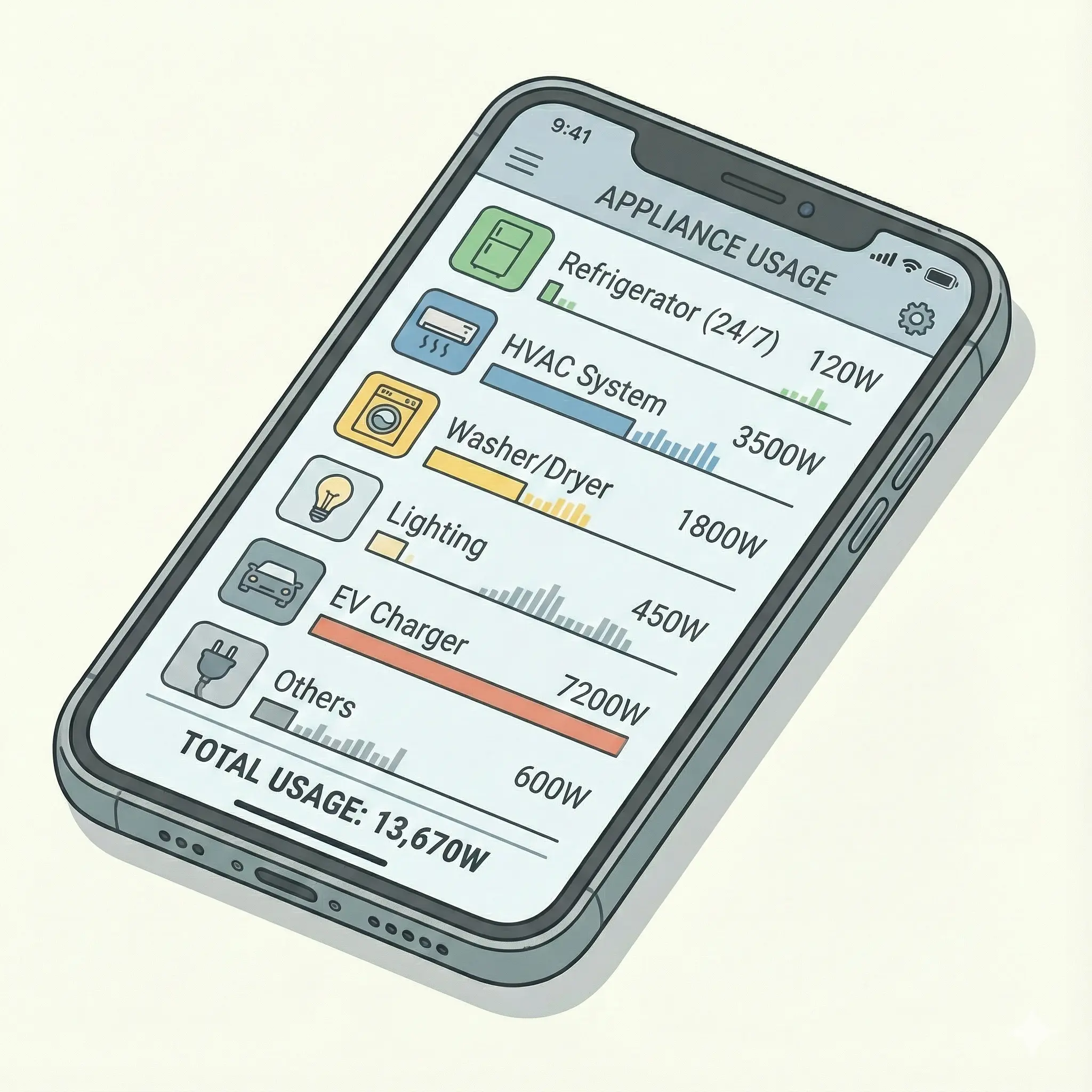
The American home is undergoing its most significant electrical transformation since the introduction of the circuit breaker. For decades, the relationship between a homeowner and their energy usage was passive, opaque, and strictly transactional. You flipped a switch, the light turned on, and a month later, a bill arrived with a single, aggregated total. There was no feedback loop, no granularity, and arguably, very little control.
In 2025, that dynamic has been fundamentally disrupted. We are witnessing the convergence of three massive trends: the widespread electrification of home appliances (heat pumps, induction stoves), the rapid adoption of Electric Vehicles (EVs), and the proliferation of distributed energy resources like rooftop solar and battery storage.1 Suddenly, the home is not just a destination for energy; it is a complex micro‑grid with variable loads, intermittent generation, and significantly higher power demands.
This shift has made "energy blindness" expensive. With utility providers increasingly moving toward Time‑of‑Use (TOU) rate structures—where electricity prices can triple during peak evening hours—the timing of your energy usage has become just as critical as the amount you use.3 Running a clothes dryer at 5:00 PM versus 9:00 PM is no longer a matter of convenience; it is a financial decision.
To navigate this new landscape, homeowners are turning to a spectrum of monitoring and management technologies. These range from simple smart plugs that track the power draw of a single lamp, to "listen‑and‑learn" whole‑home monitors, all the way up to smart electrical panels that act as the central nervous system of the house.4 This report provides an exhaustive guide to these options, analyzing the hardware, the software ecosystems, and the real‑world experiences of users who are taking control of their energy destiny.
---
2. The Invisible Drain: Why Monitoring Matters
Before evaluating the tools, it is crucial to understand the problem. Energy waste in the modern home is rarely the result of a single catastrophic failure; rather, it is the accumulation of inefficiencies, "vampire" loads, and mistimed usage.
2.1 The Anatomy of Household Consumption
Data consistently highlights that thermal loads—heating and cooling—are the dominant energy consumers in US households. In 2025, HVAC systems account for approximately 52% to 54% of total home energy usage.6 Water heating follows as a distant second, consuming roughly 18% of the energy budget. This means that nearly three‑quarters of a monthly bill is determined by just two systems.
However, the "long tail" of smaller devices creates a significant, often overlooked drain. Lighting, refrigeration, and washing equipment typically consume between 4% and 9% each. But the most insidious category is what experts term "phantom loads" or "vampire power"—energy consumed by devices that are ostensibly turned off but remain in standby mode.8
2.2 The Phantom Load Menace
Phantom loads are the silent budget killers of the digital age. In a thoroughly connected home, dozens of devices sip power 24/7 to maintain Wi‑Fi connections, listen for remote control signals, or update internal clocks. While a few watts here and there seem negligible, the cumulative effect is substantial.
The worst offenders identified in 2025 include:
- Cable Boxes and DVRs: These devices often run near full power even when "off" to maintain program guides and recording schedules, drawing 20‑50 watts continuously.2
- Gaming Consoles: Modern consoles often default to an "instant‑on" mode that keeps the system primed for updates and voice commands, consuming significant standby power compared to a true "energy saver" shut down.10
- Smart Speakers and IoT Hubs: While individual units are efficient, the sheer volume of smart devices—from hubs to voice assistants—raises the home's baseload.9
- Older Audio/Video Equipment: Amplifiers, subwoofers, and receivers often lack the efficient sleep modes of newer tech, remaining warm to the touch (a sure sign of wasted energy) even when inactive.9
A baseline energy monitor can reveal that a house "at rest"—with everyone asleep and lights off—might still be drawing 300 to 500 watts. Over a year, a 400‑watt continuous phantom load amounts to nearly 3,500 kWh. At an average rate of $0.15/kWh, that is over $500 annually spent on effectively nothing.11 This realization is often the primary ROI driver for installing monitoring hardware. As one user noted, "Monitoring works because it makes invisible electricity visible".12
---
3. Retrofit Solutions: Whole‑Home Energy Monitors
For the millions of existing homes where a full electrical panel replacement is not feasible, whole‑home energy monitors represent the most practical upgrade path. These systems retrofit into existing breaker boxes, using Current Transformer (CT) clamps to measure the magnetic field generated by electricity flowing through wires. They provide a "dashboard" for the home's energy, bridging the gap between the meter and the homeowner.
3.1 Emporia Vue 3: The Data‑Driven Workhorse
In the landscape of 2025, the Emporia Vue 3 stands out as the pragmatic, high‑value choice for users who want deterministic, granular data.13
3.1.1 Architecture and Installation
The Vue 3 system is designed for "invasive" but comprehensive installation. The main unit installs inside the electrical panel and connects to the main service lines via two large 200A CT clamps. This provides total household consumption data. However, its superpower lies in the 16 smaller sensor ports that allow for individual circuit monitoring.13
By clamping these sensors around the wires for the air conditioner, dryer, oven, and EV charger, the system eliminates ambiguity. There is no algorithm guessing if the spike in usage is the toaster or the hair dryer; if the sensor on Breaker 4 sees current, the app reports it definitively.14
Installation is not for the faint of heart. It involves working inside a live panel, and managing the "rat's nest" of wires can be daunting. Users have reported that while the hardware is solid, the cable management for 16 separate sensors plus the main unit can crowd smaller panels.13 One specific user grievance in 2025 has been the Wi‑Fi antenna installation; the knockout mount design has been described as "loose" or requiring improvisation with glue or tape to secure properly.15
3.1.2 The "Excess Solar" Ecosystem
Emporia has aggressively pivoted from simple monitoring to active management, particularly for solar owners. The "Excess Solar Management" feature is a standout capability in 2025.16 This system solves a critical economic problem: selling solar power back to the grid is increasingly unprofitable under new net‑billing schemes (like NEM 3.0 in California).
The Vue 3 monitors solar production in real‑time. When it detects that the home is generating more power than it is using, it can automatically trigger connected Emporia devices—specifically their EV charger and smart plugs—to turn on. This allows a homeowner to charge their car using only surplus sunshine, effectively fueling their vehicle for free rather than exporting that power for pennies.16 This automation happens dynamically; if a cloud passes over and solar production drops, the EV charger can pause or throttle down to avoid pulling from the grid.18
Table 3.1: Emporia Vue 3 at a Glance
| Feature | Details |
|---|---|
| Monitoring Type | Circuit‑Level (Physical CT Clamps) |
| Capacity | 2 Main Sensors + 16 Branch Circuit Sensors |
| Data Update Rate | 1‑Second Intervals (Real‑Time) |
| Solar Capability | Net Metering + Excess Solar Automation |
| Connectivity | Wi‑Fi (2.4 GHz) |
| Primary Advantage | Accuracy and Granularity |
| Primary Drawback | Complex, crowded installation in panel |
3.2 Sense: The Evolution and the Pivot
For years, Sense has been the prominent alternative to circuit‑level monitors. Its appeal was simplicity: install just two clamps on the main lines, and its machine learning algorithms would "listen" to the electrical noise, identifying unique signatures for the toaster, the garage door, and the dishwasher.4
3.2.1 The Technology of Disaggregation
Sense's technology relies on high‑resolution sampling (over 1 million times per second) to analyze current waveforms. It attempts to disaggregate the total load into individual appliances. While magically simple in theory, the reality has been mixed. Users have long reported that while Sense is excellent for tracking overall trends and distinct resistive loads (like a kettle), it struggles with complex, variable‑speed motors found in modern efficient HVAC systems and washing machines.19
3.2.2 The 2025 Hardware Sunset
In a major strategic shift, Sense announced in late 2025 that it would cease sales of its standalone consumer hardware by December 31, 2025.21 This marks the end of the "add‑on" era for Sense and the beginning of its integration era.
Sense is pivoting to become a software layer embedded directly inside next‑generation smart meters (AMI 2.0) through partnerships with major meter manufacturers like Landis+Gyr and Itron.23 For the consumer, this means the future of Sense is hardware‑free. If your utility installs a Sense‑enabled meter (like the Landis+Gyr Revelo), you simply download the app and connect to the meter via Wi‑Fi to get the same insights that previously required a $300 electrician‑installed box.22
This transition has caused anxiety among existing users regarding long‑term support, though Sense has committed to continuing app updates and server maintenance for legacy hardware.22
3.3 Niche and Open Source Alternatives
Beyond the big two, the market offers specialized alternatives:
- Eyedro: Favored by users who dislike subscription models and want robust, cloud‑based desktop reporting. It is often praised for its ease of setup compared to the wire‑heavy Emporia.4
- Iotawatt: A favorite among the open‑source and Home Assistant community. Unlike the proprietary cloud dependence of Sense or Emporia, Iotawatt allows users to own their data locally. This appeals to privacy‑conscious users who want to integrate energy data into their own self‑hosted automation servers without relying on a company's server uptime.25
---
4. The Smart Plug Revolution: Matter 1.5 and Device Control
While whole‑home monitors watch the big picture, smart plugs manage the details. In 2025, the smart plug market has been unified and supercharged by the Matter standard.
4.1 Matter 1.5: The Universal Translator
The fragmentation of the smart home—where a plug works with Alexa but not Apple Home—is largely over. The Matter protocol now allows devices to work locally across all major ecosystems. Crucially, the release of Matter 1.5 in late 2025 introduced comprehensive support for energy management.26
Before Matter 1.5, energy data (Watts, Volts, kWh) was non‑standard; you often had to use the manufacturer's proprietary app to see it. Matter 1.5 created a standardized "Electrical Energy Tariff Device Type," allowing energy data to flow freely from a plug into any controller, whether that's Apple Home, Google Home, or Home Assistant.26 This update also enables plugs to report their "carbon impact" and cost based on tariff data shared by the utility, enabling truly smart automation.26
4.2 Leading Smart Plugs
The market has coalesced around a few key players who have embraced this new standard.
- TP‑Link Kasa (KP125M): Widely regarded as the "Best Overall" plug of 2025.28
- Eve Energy: Positioning itself as the premium option, Eve uses Thread networking instead of Wi‑Fi. Thread creates a low‑power mesh network that becomes more robust as you add devices, unlike Wi‑Fi which can bog down a router. Eve plugs are renowned for their privacy‑first approach (no cloud account required) and high‑quality app. With Matter support, they are now accessible to Android users as well.28
- Outdoor Monitoring: For outdoor loads like pool pumps or holiday lights, the Tapo P400M and Kasa EP40M offer weather‑resistant monitoring. These are critical for tracking seasonal energy hogs that often go unnoticed.31
Table 4.1: Smart Plug Comparison
| Model | Protocol | Energy Monitoring | Matter Support | Best For |
|---|---|---|---|---|
| Kasa KP125M | Wi‑Fi | Yes | Yes | General use, affordability |
| Eve Energy | Thread | Yes | Yes | Privacy, Apple users, Mesh building |
| Tapo P110M | Wi‑Fi | Yes | Yes | Budget monitoring |
| Emporia Smart Plug | Wi‑Fi | Yes | No (Cloud Integration) | Integration with Vue 3 / Solar |
---
5. The Infrastructure Leap: Smart Electrical Panels
For homeowners undertaking a renovation, building a new home, or installing a comprehensive solar‑plus‑battery system, the Smart Electrical Panel is the gold standard. These devices replace the passive breaker box with a computer‑controlled distribution system.
5.1 SPAN: The "Apple" of Electrical Panels
SPAN has established itself as the market leader in this premium category. Its panel completely replaces the main service panel and offers control over up to 32 circuits via a sleek, intuitive app.5
5.1.1 The Killer Feature: Avoided Service Upgrades
The strongest economic argument for SPAN is not just monitoring, but capacity management. Many older US homes have 100A or 125A service, which is insufficient for a modern electrification suite (EV charger + heat pump + induction stove). Upgrading the service feed from the utility to 200A or 400A can cost between $4,000 and $15,000 and take months of permitting and trenching.5
SPAN solves this via software. It monitors the total household current in real‑time. If the load approaches the 100A limit, it can automatically shed low‑priority loads (like pausing the EV charger) to keep the house running without tripping the main breaker. This "dynamic load management" often allows homeowners to electrify without paying for a service upgrade, instantly offsetting the panel's high hardware cost (approx. $3,500‑$4,500).34
5.1.2 Battery Synergy
SPAN's other major strength is battery optimization. In a standard battery backup installation, the homeowner must choose a few "critical circuits" (fridge, lights, Wi‑Fi) to be powered during an outage. These are hard‑wired into a sub‑panel and cannot be changed easily.
SPAN allows for dynamic backup. During a grid outage, the homeowner can use the app to turn any circuit on or off. If the outage is expected to last three days, you can turn off the AC to save the battery. If you need to run the microwave for 5 minutes, you can toggle it on, use it, and toggle it off. This granular control can extend the runtime of a Tesla Powerwall or similar battery by up to 40%.36
5.2 Savant: The Modular Challenger
While SPAN replaces the panel, Savant offers a modular solution that appeals to the retrofit market and the professional smart home integrator.
5.2.1 The Smart Budget System
Launched in 2025, Savant's "Smart Budget" system is designed specifically to compete on the "service upgrade avoidance" front. Instead of a full panel swap, Savant uses Power Modules that install into existing standard panels (like Square D). These modules provide the same metering and control capabilities but can be scaled—you can make just the heavy loads smart, rather than the whole house.38
Priced starting around $1,500 (hardware) and available in Q2 2025, the Savant system is significantly more accessible than a full SPAN install.
5.3 The Traditionalists: Schneider and Leviton
The old guard of the electrical industry has also entered the fray.
- Schneider Home: Offers the "Pulse" panel, a fully integrated system that pairs with Schneider's own battery and inverter. While the hardware is industrial‑grade, early user feedback in 2025 has highlighted software teething issues, particularly regarding app migration and stability compared to the tech‑native user experience of SPAN.5
- Leviton Load Center: Takes a hybrid approach with "smart breakers." You can install a standard Leviton panel and buy smart breakers ($100+ each) only for the circuits you want to monitor. This allows for a flexible middle ground, though it lacks the holistic "whole home" load shedding algorithms of SPAN.41
5.4 Lumin: The Retrofit Middle Ground
Lumin offers a "smart sub‑panel" solution. It sits downstream of your existing main panel and intercepts specific circuits (usually the 12 most critical ones). It provides control and monitoring for those specific lines without requiring a main panel replacement. This is an excellent option for adding battery optimization to an existing system without ripping out the main service entrance.5
Table 5.1: Smart Panel Ecosystem Comparison
| Feature | SPAN | Savant Smart Budget | Schneider Pulse | Leviton Load Center |
|---|---|---|---|---|
| Form Factor | Full Panel Replacement | Modules in Existing Panel | Full Panel Replacement | Smart Breakers |
| Retrofit Friendly | Low (Requires Swap) | High (Add‑on) | Low | Medium |
| Control Granularity | All Circuits (32‑48) | Selected Modules | All Circuits | Selected Breakers |
| Battery Optimization | High (Dynamic) | High (Ecosystem) | High (Integrated) | Medium |
| Est. Hardware Cost | $4,500+ | $1,500+ | $4,000+ | ~$100/circuit |
| Key Strength | User Interface & Features | Modularity & Cost | Hardware Durability | Flexibility |
---
6. Solar and EV Integration: The "Killer App"
The true value of these systems is unlocked when they are coupled with Solar and Electric Vehicles. As noted, net metering is disappearing. In many states, the grid is no longer a bank account where you deposit power for free; it is a market that buys low and sells high.
6.1 The Mechanics of Self‑Consumption
To maximize ROI on a solar system in 2025, you must practice self‑consumption. You want to use your solar power while it is being generated.
- Scenario: It is noon. Your solar panels are generating 6 kW. Your house is idling at 1 kW. The excess 5 kW is flowing to the grid, earning you a credit of perhaps $0.05/kWh.
- The Opportunity: If you plug in your EV, you could pump that 5 kW into the car's battery. That saves you from having to buy that power later at the retail rate of $0.30/kWh. You are effectively "paying yourself" the difference.
6.2 Automation in Action
Manual management of this is impossible; clouds move, and production fluctuates. This is where the Emporia Vue 3 and SPAN systems shine.
- Emporia's Solution: The Vue 3 talks to the Emporia EV Charger. It watches the net meter. As soon as it sees export, it tells the charger to ramp up current to match the excess exactly. If the dryer turns on, the charger ramps down. It ensures not a single watt is sold back to the grid cheaply if the car can take it.16
- SPAN's Solution: SPAN Drive offers similar functionality but integrated into the panel. Because SPAN controls the whole house, it can prioritize. It can decide that if the battery is full and the sun is shining, the excess should go to the car before it goes to the grid.43
---
7. The Future Horizon: AMI 2.0 and the Utility Cloud
While we focus on hardware inside the home, a revolution is happening on the side of the house at the meter itself. This is AMI 2.0 (Advanced Metering Infrastructure).
7.1 The Meter as an App Store
New meters, such as the Landis+Gyr Revelo, are essentially powerful edge computers. They can sample data at high resolutions, similar to a Sense monitor. Through partnerships with companies like Sense, utilities are beginning to offer "downloadable" monitoring.44
- The Implications: Instead of buying a $200 monitor, you might subscribe to a "Premium Data" service from your utility for $5/month. This service would use the meter's native computing power to disaggregate your loads and send data to an app.45
- Privacy and Control: This shifts the locus of control. With a SPAN or Emporia system, you own the hardware and the data. With AMI 2.0, the utility owns the hardware. While this lowers the barrier to entry, it raises privacy questions about how granular data regarding your daily habits might be used or monetized by the provider.44
---
8. Financial Analysis and Conclusion
Is it worth it? The answer depends on your profile.
8.1 The ROI Calculation
- For the "Vampire Hunter": A $30 smart plug or a $150 Emporia monitor can pay for itself in under a year simply by helping you identify and kill 200 W of phantom loads ($250/year savings).12
- For the Solar Owner: The ROI is embedded in the "self‑consumption" rate. Increasing self‑consumption from 40% to 80% via automated EV charging can save hundreds of dollars annually, improving the payback period of the entire solar array by years.5
- For the Renovator: The SPAN panel's ROI is binary. If it saves a $10,000 service upgrade, the ROI is immediate and massive (over 200%). If purchased purely for monitoring, the 10‑year payback is harder to justify financially, though the "soft" benefits of safety and backup control are significant.
8.2 Final Recommendations
- The Renter or Apartment Dweller: Start with Matter‑compatible Smart Plugs (Kasa or Eve). Focus on your entertainment center and home office. The investment is low (<$50), and the savings on phantom loads are real.
- The Existing Homeowner (No Renovation Planned): The Emporia Vue 3 is the undisputed value leader. It provides the granular data you need to optimize your HVAC and appliances without the cost of a panel swap. If you have solar, its automation features are a game‑changer.
- The Major Renovator or New Build: If you are building a home or adding significant loads (EV, Heat Pump), the SPAN Panel is a future‑proof infrastructure investment. It offers the most elegant user experience and provides critical capacity insurance against the need for utility upgrades.
- The Passive Observer: If you are unwilling to install hardware, check with your utility about AMI 2.0 rollouts. You may soon be able to access Sense‑powered insights directly from your existing meter, ushering in a new era of software‑defined energy visibility.
In 2025, energy monitoring is no longer a novelty for tech enthusiasts; it is a fundamental tool for financial efficiency and home resilience. Whether you spend $20 on a plug or $5,000 on a panel, the era of flying blind is over.
Works cited
- Top 2025 Electrical Trends Every Homeowner Should Know — From Smart Wiring to Energy Efficiency, accessed December 4, 2025, https://energizedelectricllc.com/blog/top-2025-electrical-trends-every-homeowner-should-know-from-smart-wiring-to-energy-efficiency/
- Average Household Power Consumption: Complete 2025 Guide & Stats — SolarTech, accessed December 4, 2025, https://solartechonline.com/blog/average-household-power-consumption-guide-2025/
- NEW enhanced money‑saving insights from SPAN — SPAN® Blog, accessed December 4, 2025, https://www.span.io/blog/new-enhanced-money-saving-insights-from-span
- Best Home Energy Monitors of 2025 — Picks by Bob Vila, accessed December 4, 2025, https://www.bobvila.com/reviews/best-home-energy-monitors-2025/
- Smart Electrical Panel Guide 2025: Complete Comparison & Installation — SolarTech, accessed December 4, 2025, https://solartechonline.com/blog/smart-electrical-panel-guide/
- What Uses the Most Electricity in a Home? — ElectricityPlans, accessed December 4, 2025, https://electricityplans.com/what-uses-the-most-electricity-in-a-home/
- What Appliances Use The Most Home Electricity? — Direct Energy, accessed December 4, 2025, https://www.directenergy.com/en/learn/reduce-energy-costs/what-uses-most-electricity-in-my-home
- Which Household Appliances Use the Most Electricity? — Universal Home Experts, accessed December 4, 2025, https://www.universalhomeexperts.com/which-household-appliances-use-the-most-electricity/
- Energy Vampires: Everything You Need to Know | EnergySage, accessed December 4, 2025, https://www.energysage.com/energy-management/phantom-loads-overview/
- Don't Let Phantom Power Trick You into Higher Energy Use This Season, accessed December 4, 2025, https://investor.pgecorp.com/news-events/press-releases/press-release-details/2025/Dont-Let-Phantom-Power-Trick-You-into-Higher-Energy-Use-This-Season/default.aspx
- How do you monitor and optimize energy usage in a smart home? — Reddit, accessed December 4, 2025, https://www.reddit.com/r/smarthome/comments/1n6w4gm/how_do_you_monitor_and_optimize_energy_usage_in_a/
- Home Energy Monitor: An Ultimate Guide — EcoFlow, accessed December 4, 2025, https://www.ecoflow.com/us/blog/home-energy-monitor-bill-savings
- Best Home Energy Management Systems 2025 | Save Money & Cut Energy Bills, accessed December 4, 2025, https://www.greenerwisdom.com/blog/best-home-energy-management-systems
- Emporia Vue 3 Home Energy Monitor | 8 Critical Load Sensors — Signature Solar, accessed December 4, 2025, https://signaturesolar.com/emporia-vue-3-home-energy-monitor-8-critical-load-sensors/
- Emporia Vue Gen 3 — First thoughts 2025 : r/EmporiaEnergy — Reddit, accessed December 4, 2025, https://www.reddit.com/r/EmporiaEnergy/comments/1o4mbdf/emporia_vue_gen_3_first_thoughts_2025/
- Excess Solar | Emporia Home Energy Management Platform, accessed December 4, 2025, https://www.emporiaenergy.com/home-energy-management/excess-solar/
- Solar EV Charging: What You Need To Know — Emporia Energy, accessed December 4, 2025, https://www.emporiaenergy.com/blog/solar-ev-charging-what-you-need-to-know/
- Excess Solar Management | Help Center — Emporia Energy, accessed December 4, 2025, https://help.emporiaenergy.com/en/articles/9084304-excess-solar-management
- REVIEW: The Sense Energy Monitor—Track Electricity Usage in Real Time and Save Money—is it worth it? — Tampa Bay Solar, accessed December 4, 2025, https://tampabaysolar.com/blog/sense-energy-monitor-track/
- Sense is going away | DIY Solar Power Forum, accessed December 4, 2025, https://diysolarforum.com/threads/sense-is-going-away.115336/
- Sense: Data-driven Home Energy Efficiency — Reddit, accessed December 4, 2025, https://www.reddit.com/r/Sense/
- Monitors to Meters, Your Sense Experience Will Continue as We Transition, accessed December 4, 2025, https://community.sense.com/t/monitors-to-meters-your-sense-experience-will-continue-as-we-transition/23080
- Sense-enabled meter partners, accessed December 4, 2025, https://sense.com/resources/sense-enabled-meter-partners/
- Smart Meters and Sense: Frequently Asked Questions, accessed December 4, 2025, https://help.sense.com/hc/en-us/articles/24730157580051-Smart-Meters-and-Sense-Frequently-Asked-Questions
- Any experience with or thoughts on the SPAN panel? : r/solar — Reddit, accessed December 4, 2025, https://www.reddit.com/r/solar/comments/14fr9eq/any_experience_with_or_thoughts_on_the_span_panel/
- Matter 1.5 Introduces Cameras, Closures, and Enhanced Energy ..., accessed December 4, 2025, https://csa-iot.org/newsroom/matter-1-5-introduces-cameras-closures-and-enhanced-energy-management-capabilities/
- Home Energy Monitoring Devices: 12 Top Picks for 2025 — Whole House Fan, accessed December 4, 2025, https://www.wholehousefan.com/blogs/wholehousefans/home-energy-monitoring-devices
- The Best Smart Plugs and Power Strips for 2025 — PCMag, accessed December 4, 2025, https://www.pcmag.com/picks/the-best-smart-plugs-and-power-strips
- The best smart plugs in 2025 — Engadget, accessed December 4, 2025, https://www.engadget.com/home/smart-home/best-smart-plug-131542429.html
- The best smart plugs for starting a smart home in 2025 — Good Housekeeping, accessed December 4, 2025, https://www.goodhousekeeping.com/uk/product-reviews/tech/g28393904/best-smart-plugs/
- Best smart plugs 2025: Reviews and buying advice | PCWorld, accessed December 4, 2025, https://www.pcworld.com/article/583524/best-smart-plugs.html
- The Best Matter-Compatible Outdoor Smart Plugs, accessed December 4, 2025, https://www.matteralpha.com/explainer/best-matter-compatible-outdoor-smart-plugs
- SPAN® Home app | Control your home's energy from anywhere — Span.IO, accessed December 4, 2025, https://www.span.io/app
- This Smart Electric Panel at CES 2025 Gives You the Power to Control Your Consumption, accessed December 4, 2025, https://www.cnet.com/home/energy-and-utilities/this-smart-electric-panel-at-ces-2025-gives-you-the-power-to-control-your-consumption/
- Older Home Electrification — SPAN Panel or Service Upgrade or ...?? : r/solar — Reddit, accessed December 4, 2025, https://www.reddit.com/r/solar/comments/1nd2s68/older_home_electrification_span_panel_or_service/
- The SPAN Smart Electrical Panel: Automate Your Energy, accessed December 4, 2025, https://www.sunation.com/automate-your-energy-with-span-smart-electrical-panel/
- SPAN® | Smart Electrical Panels, accessed December 4, 2025, https://www.span.io/
- Savant, accessed December 4, 2025, https://savant.com/news/SAVANT Brings New Premium GE Smart Lighting and Shading for Residential Pros, Siri Voice Integration, and Groundbreaking Smart Power Solution to the 2025 IBS Builder Show in Las Vegas
- Savant, accessed December 4, 2025, https://savant.com/news/SAVANT Brings New Premium GE Smart Lighting and Shading for Residential Pros, Siri Voice Integration, and Groundbreaking Smart Power Solution to Lightapalooza 2025
- Schneider Home app seems to be complete shit... What am I missing? : r/Sense — Reddit, accessed December 4, 2025, https://www.reddit.com/r/Sense/comments/1mray0g/schneider_home_app_seems_to_be_complete_shit_what/
- What Is a Smart Electrical Panel? | Home Energy Upgrade 2025 — The Electricians, accessed December 4, 2025, https://www.theelectriciansco.com/blog/smart-electrical-panel/
- "Smart" Panel choices for dynamically selecting critical loads for whole home backup : r/solar — Reddit, accessed December 4, 2025, https://www.reddit.com/r/solar/comments/1aehw0l/smart_panel_choices_for_dynamically_selecting/
- Marketing resources — Span.IO, accessed December 4, 2025, https://www.span.io/website-resources
- AMI 2.0: Planning for Next‑Gen Advanced Metering Infrastructure | Deloitte US, accessed December 4, 2025, https://www.deloitte.com/us/en/Industries/energy/articles/next-gen-advanced-metering-infrastructure.html
- Sense Announces New Load Visibility Solution to Eliminate Distribution Grid Blind Spots, accessed December 4, 2025, https://www.prnewswire.com/news-releases/sense-announces-new-load-visibility-solution-to-eliminate-distribution-grid-blind-spots-302617758.html