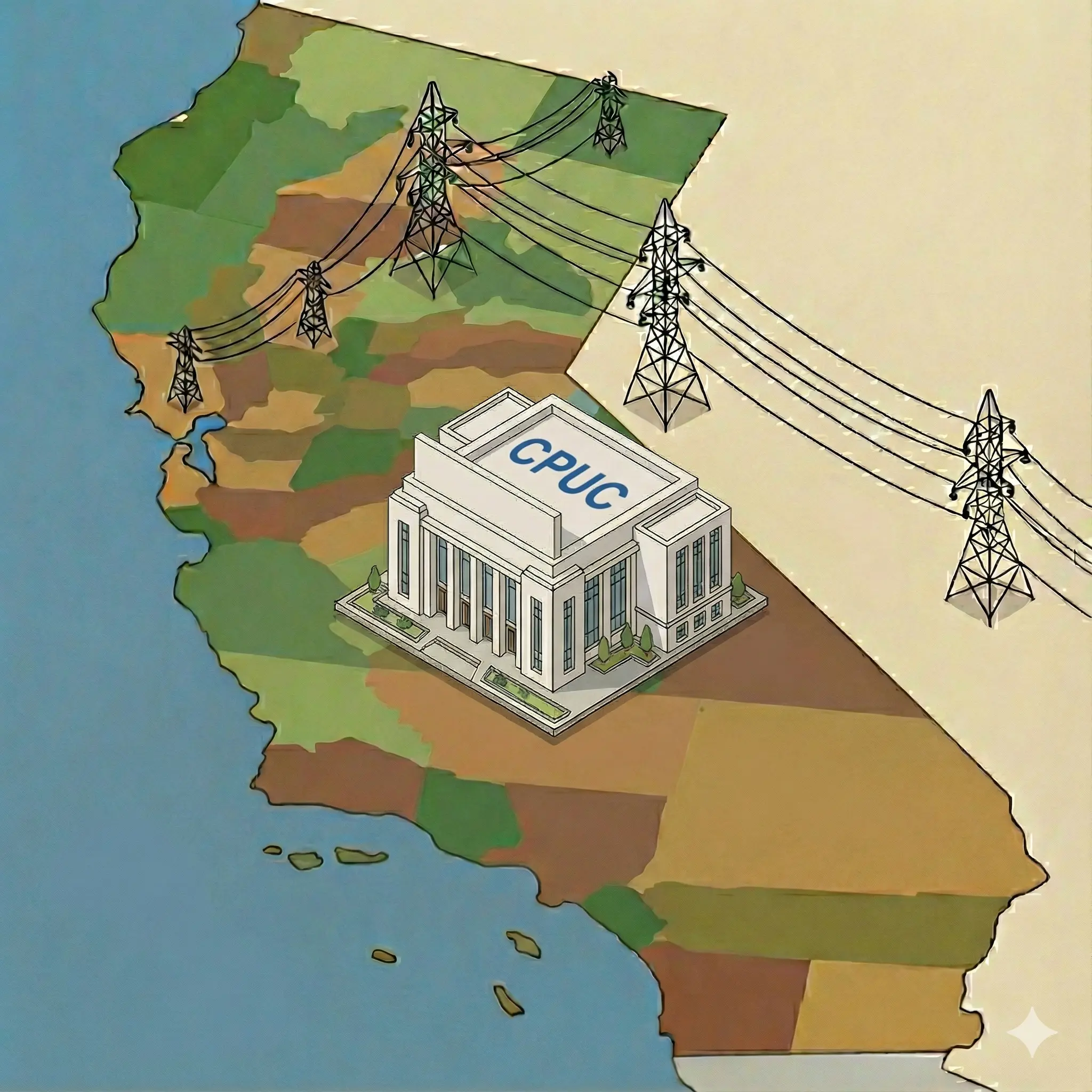
The American residential energy landscape is currently navigating a period of profound structural disruption, a transformation largely emanating from the policy laboratories of the West Coast. At the center of this seismic shift stands the California Public Utilities Commission (CPUC), a regulatory body whose recent decisions have fundamentally rewritten the economic contract between electric utilities and homeowners. For nearly two decades, the prevailing model for residential renewable energy was built upon the concept of Net Energy Metering (NEM), a policy that effectively utilized the electric grid as a virtual battery for solar-equipped households. This framework catalyzed the adoption of over 1.5 million solar systems in California, creating a robust distributed energy market that served as a blueprint for the rest of the United States.
However, the regulatory epoch that favored aggressive solar adoption through retail-rate incentives has abruptly concluded. Through a series of landmark proceedings in 2023 and 2024—most notably the implementation of the Net Billing Tariff (NEM 3.0) and the Income-Graduated Fixed Charge (IGFC)—the CPUC has pivoted toward a new paradigm. This new regime prioritizes grid reliability, cost equity, and the integration of energy storage over simple solar generation. The stated rationale for this pivot rests on the contentious theory of the "cost shift," which posits that the financial benefits enjoyed by solar adopters have inadvertently burdened non-solar ratepayers with billions of dollars in fixed infrastructure costs.
This report offers an exhaustive examination of these regulatory changes, designed specifically for US homeowners who are navigating the complex intersection of policy, technology, and household finance. It delves into the institutional history of the CPUC to explain the mechanisms of its power; it analyzes the technical intricacies of the new billing tariffs to reveal the new economic reality of solar ownership; and it explores the broader national implications as other states look to California for regulatory precedence. By synthesizing data from regulatory filings, economic impact studies, and market analyses, this document serves as a strategic roadmap for understanding the future of home energy in an era of high fixed costs and electrified living.
1. The Institutional Architecture: Understanding the CPUC
To fully comprehend the changes appearing on monthly utility bills, one must first interrogate the institution mandating them. The California Public Utilities Commission is not merely an administrative agency; it is a constitutionally established regulatory authority with influence that rivals the legislative and executive branches of many states. Its decisions ripple through the economy, affecting everything from the price of charging an electric vehicle to the viability of the solar installation industry.
1.1 Constitutional Mandate and Regulatory Scope
Established by a constitutional amendment in 1911 during the Progressive Era, the entity originally known as the Railroad Commission was created to check the monopoly power of the Southern Pacific Railroad. Over the ensuing century, its jurisdiction expanded to encompass the essential services that underpin modern life: privately owned electric, natural gas, telecommunications, water, railroad, and passenger transportation companies.
It is crucial for homeowners to distinguish the CPUC’s jurisdiction from that of municipal utilities. The CPUC regulates Investor-Owned Utilities (IOUs), which are private, for-profit corporations granted a monopoly franchise to serve specific geographic territories. In California, the three dominant IOUs are Pacific Gas and Electric (PG&E), Southern California Edison (SCE), and San Diego Gas & Electric (SDG&E). Collectively, these entities serve approximately 75% of California’s electrical demand. The CPUC does not regulate publicly owned utilities (POUs) such as the Sacramento Municipal Utility District (SMUD) or the Los Angeles Department of Water and Power (LADWP), although these entities often look to CPUC rulings as a benchmark for their own rate designs.
The Commission’s core mandate is multifaceted and often contradictory. It is charged with ensuring that consumers have safe, reliable utility service at reasonable rates, while simultaneously protecting ratepayers from fraud and promoting the health of the state's economy. In the 21st century, this mandate has been further complicated by legislative requirements to reduce greenhouse gas emissions, turning the CPUC into a primary engine of climate policy. The tension between keeping rates "reasonable" and funding the massive infrastructure required for decarbonization and wildfire hardening is the central conflict defining the Commission's current era.
1.2 Governance and Decision-Making Structure
The CPUC is governed by five Commissioners, who are appointed by the Governor of California and confirmed by the State Senate for staggered six-year terms. This structure is designed to insulate regulators from the immediate pressures of the electoral cycle, allowing them to make technically complex decisions that may be politically unpopular but necessary for long-term grid stability. However, the appointment process inherently links the Commission’s philosophy to the broader energy agenda of the executive branch.
The current Commission, led by President Alice Reynolds, operates through a formal legal process that resembles a court system. Major policy changes, such as the revision of solar tariffs or the imposition of fixed charges, occur within "proceedings." These are lengthy, litigious affairs assigned a docket number (e.g., R.20-08-020 for the NEM revisit) and presided over by Administrative Law Judges (ALJs).
In these proceedings, various stakeholders submit testimony and evidence. The key players typically include:
- The Utilities (IOUs): Advocating for rate structures that ensure revenue sufficiency and recovery of infrastructure investments.
- The Public Advocates Office (Cal Advocates): An independent division within the CPUC statutorily mandated to represent the interests of ratepayers, particularly focusing on keeping bills low.
- Intervenors: Non-profit groups representing specific interests, such as The Utility Reform Network (TURN) representing consumers, the California Solar & Storage Association (CALSSA) representing the industry, and environmental organizations like the Sierra Club or the Natural Resources Defense Council (NRDC).
The ALJ reviews thousands of pages of technical and economic analysis before issuing a "Proposed Decision" (PD). The five Commissioners then vote on this proposal, often after a period of public comment and closed-door revisions. For the homeowner, this opaque bureaucracy means that a decision impacting their financial return on a solar investment by 75% is the product of years of technocratic debate, buried in pdf filings that rarely reach the public consciousness until implementation is imminent.
1.3 The Economics of Regulation: Revenue Requirements and Decoupling
A fundamental concept necessary for understanding the CPUC’s recent actions is the "Revenue Requirement." This represents the total amount of money a utility is authorized to collect from its customers to cover its operating expenses, pay for capital investments (like poles, wires, and substations), and earn a guaranteed Rate of Return (profit) for its shareholders.
California utilizes a regulatory mechanism known as "decoupling." In a traditional utility model, a utility’s profit is tied to the volume of electricity it sells—the more power you use, the more money they make. Decoupling breaks this link. The CPUC authorizes a set revenue amount the utility is allowed to collect, regardless of how much electricity is actually sold. If sales drop (due to energy efficiency or rooftop solar), the utility is allowed to raise the rate per kilowatt-hour (kWh) in the following year to make up the difference and hit its revenue target.
This mechanism is critical to understanding the "cost shift" argument. When a homeowner installs solar and reduces their purchase of grid electricity, the utility’s authorized revenue requirement does not decrease. The fixed costs of the grid (wildfire insurance, transmission lines, pension obligations) remain. Under decoupling, the uncollected revenue from the solar home must be recovered by raising rates on the remaining non-solar customers. This structural reality creates an inherent zero-sum game between solar adopters and non-adopters within the IOU model, driving much of the regulatory animus against Net Metering.
2. The Legacy of Incentives: The Rise of the Solar State
To appreciate the magnitude of the current regulatory disruption, one must contextually anchor it against the backdrop of the policies that preceded it. For nearly twenty years, California operated under a regulatory philosophy that explicitly subsidized and encouraged distributed generation, creating the largest solar market in the United States.
2.1 The California Solar Initiative and NEM 1.0
The modern solar era began in earnest with the California Solar Initiative (CSI), a $3.3 billion program launched in 2006 under Governor Arnold Schwarzenegger. The CSI provided direct cash rebates for solar installations, which stepped down over time as adoption targets were met. These rebates, combined with the federal Investment Tax Credit (ITC), significantly lowered the upfront cost of solar.
However, the primary economic driver was Net Energy Metering (NEM 1.0). Under this tariff, the relationship between the homeowner and the utility was simple:
- One-to-One Crediting: If a solar system produced 1 kWh of electricity that was exported to the grid, the homeowner received a credit for 1 kWh on their bill. This credit was valued at the full retail rate.
- The Grid as Battery: This effectively allowed the grid to function as a 100% efficient, free battery. A homeowner could generate excess power during the day (when rates might be high) and use that credit to offset consumption at night.
- Annual True-Up: The billing cycle was annualized. A homeowner could build up credits all summer and draw them down in winter. If, at the end of the year, the system generated more than the home consumed, the utility would pay a small wholesale rate for the net surplus (Net Surplus Compensation), though the primary value was in offsetting the retail bill.
This structure was incredibly lucrative. With retail rates in California climbing steadily, the "avoided cost" for the homeowner was high. Payback periods for purchased systems dropped to the 5-7 year range, offering an internal rate of return (IRR) that outperformed the stock market for a virtually risk-free asset.
2.2 NEM 2.0: The First Compromise
As solar adoption surged, utilities began to sound the alarm about the financial sustainability of NEM. In 2016, the CPUC adopted a successor tariff, NEM 2.0. This was widely seen as a victory for the solar industry, as it preserved the core structure of retail-rate net metering.
- Non-Bypassable Charges (NBCs): The main concession was that solar customers had to pay NBCs (roughly $0.02-$0.03 per kWh) on all energy they consumed from the grid, which could not be offset by solar credits.
- Mandatory Time-of-Use (TOU): NEM 2.0 customers were required to switch to Time-of-Use rate plans, where electricity is more expensive during "peak" hours (typically 4 PM – 9 PM) and cheaper during the day. This slightly eroded the value of solar, as systems generate the most power when rates are now lowest (midday), but the economics remained robust.
Under this regime, the solar market matured. Third-party ownership models (leases and Power Purchase Agreements) flourished, allowing homeowners to go solar with zero money down. Companies like Sunrun, Tesla, and SunPower built billion-dollar businesses on the predictability of these cash flows. By 2022, California had installed over 13 gigawatts of rooftop solar capacity, fundamentally altering the state's load profile.
3. The Great Revaluation: Anatomy of the NEM 3.0 Decision
The stability of the NEM 2.0 era ended with the initiation of Rulemaking 20-08-020, the proceeding to revisit the Net Energy Metering tariff. This proceeding became one of the most contentious and heavily lobbied regulatory battles in the history of the CPUC, reflecting a deep ideological divide over the future of the electric grid.
3.1 The "Lookback Study" and the Cost Shift Narrative
The proceeding was underpinned by a "Lookback Study" conducted by Verdant Associates and released in January 2021. This study, along with white papers from the consultancy Energy and Environmental Economics (E3), provided the evidentiary basis for the utilities' arguments.
- The Findings: The study concluded that NEM 2.0 participants covered only a fraction of their cost of service. The analysis suggested that because solar owners pay lower bills, they contribute less to the fixed costs of the grid, yet they still rely on the grid for power at night and for voltage support.
- Quantifying the Subsidies: The Public Advocates Office estimated that this "cost shift" had ballooned to $3.4 billion annually by 2021 and was projected to reach $8.5 billion by 2024 if left unchecked. They argued this burden fell disproportionately on non-solar customers, who tend to be lower-income and more likely to be renters.
3.2 The Battle of Proposals
Throughout 2021 and 2022, competing proposals were submitted to the ALJ.
- The Utility Proposal: The IOUs pushed for a "Net Billing" structure with instantaneous netting (no monthly banking), a drastic reduction in export credits to the wholesale rate, and a "Grid Participation Charge"—a fixed monthly fee of roughly $8 per kW of installed solar capacity (e.g., $64/month for an 8kW system).
- The Solar Industry Proposal: CALSSA and SEIA argued for a gradual "glide path" that would slowly reduce export credits over nearly a decade, allowing the market to adjust. They fiercely opposed any discriminatory fixed charges on solar owners, arguing it would violate the Public Utilities Regulatory Policies Act (PURPA).
3.3 Decision 22-12-056: The Net Billing Tariff
On December 15, 2022, the five Commissioners voted unanimously to adopt Decision 22-12-056. The decision was a decisive shift toward the utility perspective, though it excluded the controversial solar-specific fixed charge (the "Grid Participation Charge") which had drawn immense public outrage.
- Effective Date: The new tariff, officially named the Net Billing Tariff (NBT) but universally called NEM 3.0, applied to all interconnection applications submitted after April 14, 2023.
- The Core Change: It fundamentally severed the link between retail rates and export credits. Instead of a 1:1 trade, exports would be valued based on their "Avoided Cost"—a much lower and highly variable metric.
4. Technical Mechanics of the Net Billing Tariff (NEM 3.0)
For the homeowner, understanding NEM 3.0 requires moving beyond the simple concept of a "bill offset" and entering the world of complex, hourly energy accounting. The tariff is designed to send precise price signals that reflect the real-time conditions of the grid.
4.1 The Avoided Cost Calculator (ACC)
The heart of NEM 3.0 is the Avoided Cost Calculator. This is a complex algorithm updated annually that determines the value of a kilowatt-hour of electricity at every hour of the year.
- The Philosophy: The ACC attempts to calculate what the utility saves by buying a kWh from a neighbor's roof instead of generating it or buying it from a utility-scale solar farm.
- The Reality of Supply: California has an abundance of solar energy during midday hours. Consequently, the marginal value of additional solar energy at 1:00 PM is extremely low—often near zero. The utility saves almost nothing because it arguably has too much solar power already during those hours.
- The Price Collapse: Under NEM 3.0, the export credit for solar energy sent to the grid during daylight hours averages between $0.04 and $0.08 per kWh. This is a roughly 75% reduction from the retail rate, which hovers between $0.30 and $0.50 per kWh depending on the territory and tier.
4.2 Hourly Profiles and 576 Rates
Unlike the flat or simple Time-of-Use rates of the past, NEM 3.0 export rates vary by the hour, by the month, and by the utility.
- Granularity: There are effectively 576 distinct export prices (24 hours x 2 types of days x 12 months).
- The Peak Window: The ACC places a very high value on energy delivered when the grid is stressed. In late summer (August/September) during the evening ramp (5 PM – 8 PM), export credits can surge to over $2.00 or even $3.00 per kWh. This signal is explicitly designed to incentivize battery discharge during these critical hours to prevent blackouts.
4.3 Instantaneous Netting vs. Monthly Netting
A subtle but devastating technical change in NEM 3.0 is the shift to "instantaneous netting."
- Old Way (NEM 2.0): Netting happened over the billing interval (usually hourly). If you generated 5 kWh and used 5 kWh in the same hour, they canceled out perfectly.
- New Way (NEM 3.0): Netting happens instantly. If you turn on a microwave (high draw) while a cloud passes over (low generation), you might import grid power for a few minutes. Later, the sun comes out and you export. You pay retail for the import and get paid wholesale (ACC) for the export, even if they happen within the same hour. This prevents "masking" of consumption and further erodes value without a battery.
4.4 The "Glide Path" and Export Adders
To soften the blow for the industry, the CPUC included a temporary "Export Adder" for residential customers of PG&E and SCE (SDG&E customers were excluded as their solar penetration was deemed high enough).
- The Adder: This is an additional few cents per kWh added to the ACC export rate. It is available for customers who interconnect within the first five years of the program.
- Step Down: The adder decreases by 20% annually. Customers who lock in the adder keep it for 9 years. While helpful, analysis shows it does not fundamentally restore the economics of solar-only systems to NEM 2.0 levels.
5. The Ideological Battleground: The "Cost Shift" Controversy
The regulatory upheaval of the last two years cannot be understood without delving into the "Cost Shift" debate—the ideological engine driving the CPUC’s reform agenda. This is a polarized conflict with two distinct narratives regarding fairness and the future of the grid.
5.1 The Utility and Ratepayer Advocate Perspective
The central thesis of the utilities and the Public Advocates Office is that Net Metering is a regressive cross-subsidy.
- The "Hidden Tax": They argue that the electric grid has massive fixed costs—maintaining transmission towers, hardening lines against wildfires, funding public purpose programs like low-income assistance (CARE). These costs are mostly recovered through the volumetric (per kWh) rate.
- The Loophole: When a solar customer reduces their net kWh usage to zero, they effectively opt out of paying these fixed costs. However, they still require the grid to be there at night, during storms, and to start their large appliances (inrush current).
- The Burden Shift: Because the utility is revenue-neutral (due to decoupling), the uncollected fixed costs must be collected from someone else. Since solar adopters have historically been wealthier homeowners, the burden shifts to non-solar renters and lower-income families. The Public Advocates Office pegged this shift at $8.5 billion/year, calling it an unsustainable "reverse Robin Hood" scenario.
5.2 The Solar Industry and Environmental Perspective
Solar advocates, represented by groups like the Solar Rights Alliance and the California Solar & Storage Association, reject the "cost shift" premise as fundamentally flawed accounting designed to protect monopoly profits.
- The Value of Avoided Infrastructure: They argue that the utilities' math ignores the massive savings provided by distributed generation. By generating power locally, rooftop solar reduces the need to build expensive long-distance transmission lines, which are the primary driver of rate increases and wildfire risk.
- The "Vibrant Clean Energy" Modeling: Advocates cite independent modeling by Dr. Christopher Clack (Vibrant Clean Energy) which suggests that optimizing the grid with local solar and storage could save California ratepayers $120 billion by 2050 compared to a centralized, utility-dependent model.
- Profit Motive Critique: Advocates point out that IOUs earn a guaranteed Return on Equity (typically 10%) on capital expenditures (CapEx). If a utility builds a substation, they profit. If a thousand homeowners buy solar panels, the utility earns nothing. Thus, the "cost shift" narrative is viewed as a strategic PR campaign—orchestrated by the Edison Electric Institute (EEI)—to crush competition from self-generation and preserve the utility's monopoly on capital deployment.
- Benefit Omission: Critics argue the CPUC’s analysis undervalues resilience, reduced greenhouse gas emissions, and the conservation of land (utility-scale solar requires bulldozing desert ecosystems; rooftop solar uses existing structures).
5.3 Synthesis: A Clash of Visions
Ultimately, the CPUC aligned with the utility view, prioritizing a "cost-of-service" model over the "value-of-solar" model. This decision marks a philosophical retreat from viewing the grid as a collaborative commons and a return to viewing it as a centralized service where all participants must pay a toll for access.
6. Structural Reform: The Income-Graduated Fixed Charge (AB 205)
While NEM 3.0 redefined the value of solar energy, a parallel track of regulation has moved to redefine the cost of grid access. This is the Income-Graduated Fixed Charge (IGFC), a policy mandated by state legislation and implemented by the CPUC in 2024.
6.1 Legislative Origins: AB 205
In a move that surprised many observers, the California Legislature passed Assembly Bill 205 in June 2022 as part of a budget trailer bill. The bill included a provision requiring the CPUC to authorize a fixed monthly charge for residential customers that would be "income-graduated," meaning higher-income households would pay a higher fixed fee than lower-income households.
- The Goal: The legislative intent was ostensibly to lower the volumetric (per kWh) rate of electricity. California’s electricity rates are among the highest in the nation. High volumetric rates discourage "electrification"—switching from gas cars to EVs or gas furnaces to heat pumps—because the "fuel" (electricity) is too expensive. By shifting costs from the per-kWh rate to a fixed monthly fee, the legislature hoped to make the marginal cost of using electricity cheaper, encouraging decarbonization.
6.2 The Proposal Phase and Public Outrage
The implementation proceeding (R.22-07-005) saw aggressive proposals from the utilities.
- The High Fixed Charge: The Joint IOUs (PG&E, SCE, SDG&E) proposed fixed charges ranging from $51 to $73 per month for households earning over $180,000. This would have been the highest mandatory fixed charge in the United States.
- The Backlash: The proposal triggered a firestorm of opposition. Critics argued that a high fixed charge destroys the incentive to conserve energy (since you pay the fee regardless of usage) and punishes low-energy users, such as those living in apartments or small efficient homes. A coalition of legislators even introduced AB 1999 in 2024 to repeal the mandate, though it failed to advance.
6.3 The Final Decision (May 2024)
Recognizing the political toxicity of the high charge, the CPUC adopted a much more moderate version in Decision 24-05-028, set to be implemented in late 2025 and early 2026.
Table 2: Adopted Income-Graduated Fixed Charge Tiers
| Tier Description | Eligibility Criteria | Monthly Fixed Charge |
|---|---|---|
| Tier 1 (Low-Income) | Enrolled in CARE (California Alternate Rates for Energy) | ~$6.00 |
| Tier 2 (Moderate-Income) | Enrolled in FERA (Family Electric Rate Assistance) or Deed-Restricted Affordable Housing | ~$12.00 |
| Tier 3 (All Others) | Not enrolled in CARE or FERA (Default Tier) | ~$24.15 |
Source: CPUC Decision 24-05-028 Fact Sheet
6.4 The Volumetric Reduction and "All Others"
The compromise solution notably abandoned complex income verification (like checking IRS data) due to privacy and logistical concerns. Instead, it effectively created a "Default" tier of $24.15 for anyone not actively enrolled in a poverty assistance program.
- The Trade-Off: In exchange for this fixed charge, the volumetric rate for all customers will be reduced by approximately 5 to 7 cents per kWh.
- Winners and Losers:
- Winner: A wealthy family in a large house in the Central Valley running AC and charging two EVs. They pay $24 extra but save 5 cents on thousands of kWh, resulting in a net bill decrease.
- Loser: A middle-class retiree in a coastal apartment who uses very little power. They pay the $24 charge but don't use enough electricity for the 5-cent rate cut to offset it. Their bill goes up.
- Solar Impact: For solar owners, the fixed charge is a sunk cost that cannot be offset by generation. It increases the "payback period" by adding ~$290/year to the bill that solar savings cannot erase.
7. Economic Implications for US Homeowners in 2025
For the homeowner assessing their energy options in 2025, the landscape has bifurcated. The simple economics of "install solar panels and wipe out your bill" are dead. The new market is driven by arbitrage—the strategic management of energy timing.
7.1 The Collapse of Solar-Only Economics
Under NEM 3.0, installing a solar system without a battery is a financially risky proposition for most households.
- The Export Problem: A typical home consumes energy in the morning and evening but generates solar power from 10 AM to 3 PM. Without a battery, 50-70% of that solar generation is exported to the grid. Under NEM 3.0, those exports are sold for pennies.
- Reduced Offset: A solar-only system that offset 100% of a bill under NEM 2.0 might only offset 50-60% of the bill value under NEM 3.0, despite producing the same amount of energy.
- Extended Payback: The payback period for cash-purchased solar-only systems has extended from ~5 years to 8-10+ years.
7.2 The Battery Imperative: Solar + Storage
The market has shifted entirely to paired storage. Batteries allow the homeowner to bypass the Avoided Cost Calculator.
- Self-Consumption Strategy: Instead of exporting excess solar at $0.05/kWh, the battery stores it. That energy is then discharged at 7 PM to run the house. This saves the homeowner from buying grid power at the peak rate of $0.50-$0.60/kWh. The battery effectively makes the solar energy worth retail rates again.
- ROI Recovery: By adding a battery, the system cost increases significantly (often by $10,000 - $15,000), but the annual savings increase disproportionately because the homeowner avoids peak pricing. The payback period for Solar + Storage systems settles into the 6-8 year range, making it the preferred economic choice.
Table 3: ROI Comparison Under NEM 3.0 (Typical CA Home)
| System Configuration | System Cost (Net of 30% Tax Credit) | Annual Bill Savings | Payback Period | 25-Year Lifetime Savings |
|---|---|---|---|---|
| Solar Only (6kW) | ~$12,000 | ~$1,100 | 10.9 Years | ~$35,000 |
| Solar + Battery (6kW + 10kWh) | ~$22,000 | ~$2,800 | 7.8 Years | ~$85,000 |
Source: Aggregated data from Solar.com, Enact Solar, and Solar Builder Magazine analyses
7.3 Financing Shifts: The Return of the PPA
The high interest rate environment of 2023-2024, combined with the higher capital cost of battery systems, has reshaped financing.
- Cash is King: High interest rates on solar loans (often 9-11% unless bought down with heavy dealer fees) erode the savings of solar. Cash purchases offer the best return.
- TPO Resurgence: Third-Party Ownership (Leases and Power Purchase Agreements) is seeing a resurgence. In a TPO model, the solar company owns the system and the battery, claiming the tax credits. They sell the power to the homeowner at a fixed rate. This insulates the homeowner from the technology risk of the battery degradation and the complexity of the NEM 3.0 tariff management.
8. Technological Adaptation and the Virtual Power Plant
The CPUC’s regulatory pressure has forced rapid technological innovation. The home is evolving from a passive load to a dynamic node on the grid.
8.1 Smart Batteries and AI Optimization
Hardware alone is insufficient; software is the key differentiator.
- Tesla Powerwall & Time-Based Control: The Tesla Powerwall ecosystem has adapted to NEM 3.0 with sophisticated logic. The "Time-Based Control" mode forecasts solar production and grid pricing. It ensures the battery charges strictly from solar and discharges during the specific hours when rates are highest. Crucially, it knows when to dump power to the grid—specifically during the rare "export adder" windows in September evenings when compensation creates a windfall.
- Load Management: Smart panels (like those from SPAN or Schneider Electric) are becoming essential. These allow homeowners to circuit-level manage their home. For example, a smart panel can ensure the EV charger never runs during peak pricing windows, or that the electric dryer pauses if the battery gets too low.
8.2 Virtual Power Plants (VPPs)
The ultimate vision of the CPUC is the Virtual Power Plant. Programs like the Emergency Load Reduction Program (ELRP) allow aggregators (like Tesla, Sunrun, or OhmConnect) to bundle thousands of home batteries together.
- The Mechanism: During a grid emergency (like a heatwave), the utility sends a signal to the aggregator. The aggregator commands thousands of batteries to discharge simultaneously, stabilizing the grid.
- Compensation: Homeowners are paid for this participation, often at rates much higher than standard exports ($2.00/kWh during events). This creates a new revenue stream that helps subsidize the cost of the battery.
9. The National Landscape: California as a Bellwether
While the CPUC regulates only California, its policy decisions act as a contagion in the national regulatory environment. Trends established in San Francisco typically migrate to Phoenix, Raleigh, and Tallahassee within 2-3 years.
9.1 The Spread of Net Billing
- Arizona: The Arizona Corporation Commission has already adopted a "Resource Comparison Proxy" (RCP) model, which is effectively Net Billing. Solar exports are valued at a rate slightly lower than retail, updated annually.
- North Carolina: Under the "Solar Choice" proceeding, Duke Energy moved to a complex "bridge rate" and eventual net billing structure that mirrors aspects of the California model.
- Hawaii: Hawaii remains the "Ghost of Christmas Future" for California. Having ended net metering years ago due to massive saturation, Hawaii’s market is almost 100% battery-attached. The "Smart Export" and "Customer Grid Supply Plus" programs require curtailment (shutting off solar) when the grid is full.
9.2 The Resistance: Florida and the Veto
Florida offers a counter-example. In 2022, the Florida legislature passed a bill written with the help of Florida Power & Light (FPL) that would have dismantled net metering using the exact "cost shift" arguments pioneered by the CPUC. However, Governor Ron DeSantis vetoed the bill, citing the economic pressure of inflation and the desire not to raise costs on homeowners. This demonstrates that while the regulatory logic of the CPUC is spreading, the political will to implement it varies by state.
10. Strategic Roadmap for Homeowners: The 2025 Playbook
For the US homeowner—whether in California or looking on from a state likely to follow suit—the rules of engagement have changed. Navigating this new environment requires a shift in strategy.
10.1 Assessing Your Status (Grandfathering)
- Existing Solar Owners: If you have a system installed under NEM 1.0 or 2.0, guard your status. Do not expand your system by more than 10% or 1kW without consulting an expert, as this can void your grandfathering and force you onto NEM 3.0. You can generally add a battery to an existing system without triggering a switch, which is a highly recommended upgrade for resilience.
- Prospective Buyers: If buying a home with solar, verify the NEM status. A home with 15 years left on a NEM 2.0 agreement has a tangible financial asset attached to it that a NEM 3.0 system does not offer.
10.2 Sizing for Self-Consumption
The old logic was "offset 100% of usage." The new logic is "offset 100% of daytime usage and cover the evening peak."
- Don't Oversize: Building a massive system to export power is now throwing money away. Systems should be sized to charge the battery and cover the home's daytime load.
- West-Facing Panels: Traditionally, south-facing panels were best for total generation. Under NEM 3.0, west-facing panels may be superior because they generate power late in the afternoon (4 PM - 6 PM) when electricity is most expensive, reducing the need to draw from the battery or grid.
10.3 Selecting the Right Contractor
The complexity of the ACC means "solar sales" has become "energy arbitrage consulting."
- The Litmus Test: Ask a potential installer to explain how their proposal accounts for the Avoided Cost Calculator and the specific hourly export rates of your utility. If they only talk about "net metering" or "bill offset" without nuance, they are likely using outdated models.
- Battery Chemistry: Demand Lithium Iron Phosphate (LFP) batteries. They are safer and have longer cycle lives (often 6,000+ cycles) than the older Nickel Manganese Cobalt (NMC) chemistry. Since NEM 3.0 requires daily cycling (charging and discharging every day), cycle life is the most critical spec.
10.4 The Electrification Synergy
Finally, the CPUC’s rate design (high fixed charge, lower volumetric rate) is a clear signal to electrify.
- The "Gas Trap": Staying on natural gas for heating and cooking while paying the high electric fixed charge is the worst of both worlds.
- The Pivot: The most economic move for a California homeowner in 2026 will likely be to accept the high fixed charge and then ruthlessly exploit the lower volumetric rates by switching to an EV and a heat pump, powered by a solar+battery system that shields them from peak pricing.
Conclusion
The decisions handed down by the California Public Utilities Commission in the early 2020s mark the end of the "early adopter" phase of the renewable energy transition. The era of simple, subsidized solar is over. The CPUC has successfully engineered a transition to a "Grid 2.0" model—one that is more complex, more expensive in fixed terms, and heavily dependent on consumer investment in storage technology.
While the "cost shift" debate will rage on in academic and legal circles, the reality for the homeowner is settled: the grid is no longer a free battery. It is a marketplace with volatile pricing. Those who ignore this reality will find solar to be a disappointing investment. Those who adapt—by treating their home as a micro-utility with storage, automation, and strategic consumption—can still secure energy independence and financial savings. As the CPUC’s influence radiates outward, this model of high-tech, self-reliant energy management is poised to become the new standard for the American homeowner.
Works cited
- About the California Public Utilities Commission (CPUC) - CA.gov, accessed December 3, 2025, https://www.cpuc.ca.gov/about-cpuc/cpuc-overview/about-us
- California Public Utilities Commission - Wikipedia, accessed December 3, 2025, https://en.wikipedia.org/wiki/California_Public_Utilities_Commission
- Rooftop solar incentive to cost customers without solar an estimated $8.5 billion by the end of 2024 - Public Advocates Office, accessed December 3, 2025, https://www.publicadvocates.cpuc.ca.gov/-/media/cal-advocates-website/files/press-room/reports-and-analyses/240822-public-advocates-office-2024-nem-cost-shift-fact-sheet.pdf
- PREPARED TRACK A REPLY TESTIMONY OF TYSON SIEGELE ON BEHALF OF THE CALIFORNIA ENVIRONMENTAL JUSTICE ALLIANCE IN R.22-07-005, THE, accessed December 3, 2025, https://www.cpuc.ca.gov/-/media/cpuc-website/divisions/energy-division/documents/demand-response/demand-response-workshops/advanced-der---demand-flexibility-management/track-a-reply-testimony/r2207005-ceja-siegele-track-a-reply-testimony.pdf
- Water Division - California Public Utilities Commission - CA.gov, accessed December 3, 2025, https://www.cpuc.ca.gov/about-cpuc/divisions/water-division
- Net Energy Metering and Net Billing - California Public Utilities Commission, accessed December 3, 2025, https://www.cpuc.ca.gov/industries-and-topics/electrical-energy/demand-side-management/customer-generation/net-energy-metering-and-net-billing
- U.S. Net Metering Policies by State: A Comprehensive Comparison - EcoFlow, accessed December 3, 2025, https://www.ecoflow.com/us/blog/net-metering-state-policies-explained
- Net Billing Tariff - California Public Utilities Commission - CA.gov, accessed December 3, 2025, https://www.cpuc.ca.gov/industries-and-topics/electrical-energy/demand-side-management/customer-generation/nem-revisit/net-billing-tariff
- Proposal to Modernize Rooftop Solar Program Would Support Customer Equity and Help Sustain California's Clean Energy Progress | Edison International, accessed December 3, 2025, https://newsroom.edison.com/releases/proposal-to-modernize-rooftop-solar-program-would-support-customer-equity-and-help-sustain-californias-clean-energy-progress
- What is NEM 3.0 and How Will it Impact California Solar Owners ..., accessed December 3, 2025, https://www.solar.com/learn/nem-3-0-proposal-and-impacts-for-california-homeowners/
- 2024 Updates to Net Billing (NEM 3) - Revel Energy, accessed December 3, 2025, https://revel-energy.com/2024-net-billing-updates-nem-3/
- What Is NEM 3.0? Complete Guide To California's New Solar Policy (2025) - SolarTech, accessed December 3, 2025, https://solartechonline.com/blog/what-is-nem-3-0-california-solar-guide/
- California's rooftop solar debate is raging again - Canary Media, accessed December 3, 2025, https://www.canarymedia.com/articles/solar/californias-rooftop-solar-debate-is-raging-again
- The Utility "Cost Shift" Fallacy: How the utilities use tricky math to vilify rooftop solar - City of San Diego, accessed December 3, 2025, https://www.sandiego.gov/system/files/webform/agenda-public-comments/the_utility_cost_shift_fallacy_how_the_utilities_use_tricky_math_to_vilify_rooftop_solar.pdf?sandread=11624d431a314415
- The utilities are lying about rooftop solar: facts about the "cost shift ..., accessed December 3, 2025, https://solarrights.org/cost-shift/
- How utilities invented the lie about rooftop solar - Solar Rights Alliance, accessed December 3, 2025, https://solarrights.org/blog/2025/01/18/how-utilities-invented-the-lie-about-rooftop-solar/
- SB 1292 (Bradford) [pdf] - Senate Bill Policy Committee Analysis - CA.gov, accessed December 3, 2025, https://autl.assembly.ca.gov/system/files/2024-06/sb-1292-bradford.pdf
- Income Graduated Fixed Charge Update - California Choice Energy Authority, accessed December 3, 2025, https://californiachoiceenergyauthority.com/income-graduated-fixed-charge-update/
- ab 1999 - assembly committee on utilities and energy, accessed December 3, 2025, https://trackbill.com/s3/bills/CA/2023/AB/1999/analyses/assembly-committee-on-utilities-and-energy.pdf
- PUBLIC UTILITIES COMMISSION OF THE STATE OF CALIFORNIA R E S O L U T I O N, accessed December 3, 2025, https://docs.cpuc.ca.gov/PublishedDocs/Published/G000/M555/K816/555816677.pdf
- CPUC Decision Cuts Price of Electricity Under New Billing Structure ..., accessed December 3, 2025, https://www.cpuc.ca.gov/-/media/cpuc-website/divisions/energy-division/documents/demand-response/demand-flexibility-oir/ab205_factsheet_050824.pdf
- Enact study reveals California residential solar customers can achieve return on investment of 4.8 years of NEM 3.0 scheme, accessed December 3, 2025, https://enact.solar/enact-study-reveals-california-residential-solar-customers-can-achieve-return-on-investment-of-4-8-years-of-nem-3-0-scheme/
- Is Solar Worth It In California In 2025? Complete Homeowner's Guide - SolarTech, accessed December 3, 2025, https://solartechonline.com/blog/is-solar-worth-it-california-2025/
- Net Billing Tariff (NEM 3.0) | Tesla Support, accessed December 3, 2025, https://www.tesla.com/support/energy/solar-panels/learn/net-billing
- Nationwide net metering shifts: Let's assess the myths and impact of changing solar compensation, accessed December 3, 2025, https://solarbuildermag.com/featured/nationwide-net-metering-shifts-lets-assess-the-myths-and-impact-of-changing-solar-compensation/
- Proven NEM 3.0 Strategies California Solar Installers Use in 2025, accessed December 3, 2025, https://energyscaperenewables.com/post/nem-3-0-proven-strategies-california-solar-installers-use-in-2025/