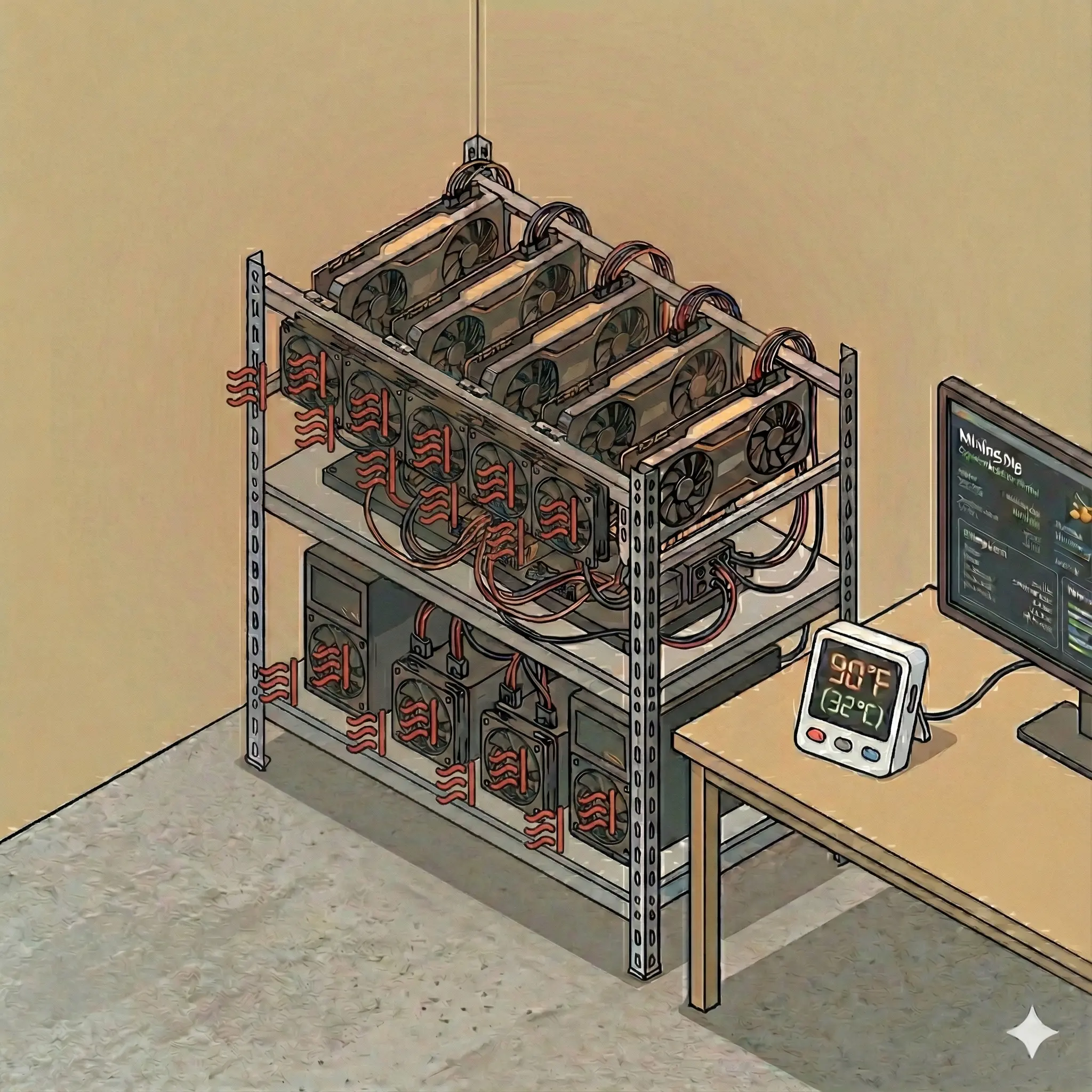
The modern residential energy landscape in the United States is undergoing a profound transformation, driven by the intersection of volatile utility costs, the proliferation of distributed renewable generation, and the explosive growth of high-performance computing. For decades, the paradigm of home heating has been linear: energy is purchased—whether as natural gas, propane, fuel oil, or electricity—and converted into thermal energy through combustion or resistance, representing a sunk cost to the homeowner. Simultaneously, the digital economy, characterized by cryptocurrency mining and the burgeoning field of localized Artificial Intelligence (AI), has traditionally been viewed as an energy sink, consuming vast quantities of power and generating waste heat that requires active, often expensive, removal.
This report explores the "Computational Furnace," a concept that merges these two formerly distinct thermodynamic processes into a unified, circular energy model. By relocating high-density computing hardware—specifically Application-Specific Integrated Circuits (ASICs) for cryptocurrency mining and high-performance Graphics Processing Units (GPUs) for AI inference—within the residential thermal envelope, US homeowners can effectively "burn" electricity twice. The first combustion is digital, performing computational work that secures blockchain networks or processes large language models (LLMs), thereby generating revenue or utility. The second combustion is physical, capturing the inevitable waste heat from these processes to maintain thermal comfort in the home.
The analysis presented herein provides an exhaustive technical and economic evaluation of this dual-use energy strategy. It moves beyond superficial observations of "free heat" to rigorously examine the thermodynamic limits, hardware specifications, acoustic engineering challenges, hydronic integration methods, and financial arbitrage opportunities inherent in the system. Furthermore, it addresses the critical integration of residential solar photovoltaic (PV) systems, where computational loads act as dynamic "excess energy diverters," stabilizing grid interaction and maximizing the return on solar investments.
2. Thermodynamic Fundamentals of Computational Heating
To assess the viability of a computer as a heating appliance, one must first establish the underlying physics governing the conversion of electrical energy into thermal energy within semiconductor devices. The skepticism often directed at the efficiency of "crypto heaters" frequently stems from a misunderstanding of the First Law of Thermodynamics in the context of information processing.
2.1 The Physics of Joule Heating in Semiconductors
At the microscopic level, modern processors—whether Central Processing Units (CPUs), GPUs, or ASICs—operate using Complementary Metal‑Oxide‑Semiconductor (CMOS) logic. These circuits consist of billions of transistors acting as binary switches. Ideally, these switches would consume no power in a static state, but in reality, they are subject to parasitic capacitance and leakage currents. 1
When a transistor switches state (from logic 0 to 1 or vice versa), it must charge or discharge the microscopic capacitance of its gate and interconnect wiring. This process requires energy, mathematically defined by the dynamic power consumption formula:
$$P = \frac{1}{2} C V^2 f$$
Where:
- $P$ is the dynamic power consumption.
- $C$ is the total capacitance being switched.
- $V$ is the supply voltage.
- $f$ is the switching frequency.
As the electrical current flows through the resistive elements of the silicon lattice and the metal interconnects to charge these capacitors, energy is dissipated as heat via Joule heating. According to the First Law of Thermodynamics (Conservation of Energy), the electrical energy entering the device must exit as either work or heat. Since a computer processor performs no external mechanical work—it does not lift a weight, spin a turbine, or propel a vehicle—virtually 100% of the electrical energy drawn from the wall outlet is converted into thermal energy. 2
While a minute fraction of energy is stored temporarily in the magnetic states of hard drives or emitted as light from LEDs, these quantities are negligible in the context of a 3,000‑watt mining rig. Even the acoustic energy generated by cooling fans is eventually absorbed by the walls and furniture of the room, thermalizing into heat. Therefore, for all practical engineering purposes, a computer is a 100% efficient electric resistance heater. 4
2.2 Efficiency Comparisons: Resistive vs. Computational vs. Heat Pump
A critical distinction must be made between "generation efficiency" and "coefficient of performance" (COP) when evaluating heating technologies.
- Electric Resistive Heaters: A standard space heater, baseboard heater, or electric furnace passes current through a high‑resistance alloy, typically nichrome. This process is 100% efficient at converting electricity to heat. 1 kilowatt‑hour (kWh) of electricity produces exactly 3,412 British Thermal Units (BTU) of heat.
- Computational Heaters: A mining rig or AI server drawing 1 kW of electricity also produces exactly 3,412 BTU of heat. Detailed calorimetric testing has confirmed that, watt‑for‑watt, a high‑performance gaming PC produces the exact same thermal output as a standard space heater. 3 The air temperature rise across the device is purely a function of the power dissipated and the airflow volume.
- Heat Pumps: The engineering distinction lies here. A heat pump (air‑source or geothermal) does not create heat; it moves heat from a cold reservoir (outdoors) to a warm reservoir (indoors) using a vapor‑compression cycle. Modern heat pumps can achieve a COP of 3.0 to 4.5, meaning 1 kWh of electricity moves 3 to 4.5 kWh of thermal energy. 2
Thermodynamic Implications: A computational heater cannot compete with a heat pump on pure electrical heating efficiency. Replacing a heat pump with a crypto miner increases the raw electricity consumption required to heat the home by a factor of 3 to 4. However, the computational furnace competes favorably with electric baseboards, oil‑filled radiators, and electric furnaces, which all operate at a COP of 1.0. The "efficiency" of a computational heater is financial, not thermodynamic: it creates a secondary revenue stream that subsidizes the input energy cost, potentially driving the effective COP to infinity if the revenue exceeds the electricity cost. 7
3. The Hardware Landscape: Selecting the Thermal Engine
The choice of hardware dictates the heating capacity, noise profile, electrical infrastructure requirements, and potential revenue generation. The market is currently segmented into three distinct categories: Industrial ASICs, High‑Performance GPUs, and Consumer Heater‑Miners.
3.1 Industrial ASICs (Application‑Specific Integrated Circuits)
ASICs are specialized hardware designed to execute a single hashing algorithm with maximum efficiency. In the context of residential heating, they act as high‑density baseload heaters.
3.1.1 Bitcoin Miners (SHA‑256)
The Bitmain Antminer series represents the standard for industrial Bitcoin mining. These units are designed for data centers, not living rooms, presenting specific integration challenges.
- Antminer S19 Series (S19j Pro, S19k Pro): These are currently the workhorses of the industry. An S19k Pro typically draws between 2,800 and 3,250 watts. 8 In thermal terms, this equates to approximately 9,500 to 11,000 BTU/hr. This thermal output is comparable to a large portable space heater or a small dedicated furnace stage, capable of heating a 500‑800 square foot space in a moderate climate.
- Antminer S21: The newest generation of hardware offers higher electrical efficiency (17.5 Joules per Terahash). While "efficiency" in mining usually refers to operations per watt, for a homeowner, this metric translates to higher revenue density per unit of heat generated. The S21 draws approximately 3,500 watts (12,000 BTU/hr), pushing the limits of standard residential electrical circuits. 9
- Acoustic Profile: The primary barrier to residential adoption is noise. ASICs utilize high‑RPM industrial fans (often 6,000+ RPM) to force air through dense heatsinks. This generates noise levels between 75 dB and 85 dB. 10 This is equivalent to running a leaf blower or a vacuum cleaner continuously. Consequently, these units require significant acoustic mitigation or placement in non‑living spaces (garages, basements, attics) to be viable as home heaters.
3.1.2 Altcoin Miners (Kaspa, Scrypt)
- Kaspa KS3: Mining the KHeavyHash algorithm, the Bitmain Antminer KS3 draws roughly 3,200 to 3,500 watts. 11 Thermally, it is identical to a Bitcoin miner. However, the profitability dynamics differ significantly; alternative cryptocurrencies like Kaspa (KAS) often exhibit higher volatility, potentially offering higher short‑term yields but with greater long‑term risk compared to Bitcoin. 13
- IceRiver KS3M: Another popular Kaspa miner, drawing around 3,400 watts. While heavily marketed for home use due to varying form factors, the high‑wattage units still produce industrial‑level noise and heat, necessitating similar integration strategies to Antminers. 15
3.2 High‑Performance GPUs (General Purpose Computing)
Unlike ASICs, Graphics Processing Units (GPUs) are versatile processors capable of handling various tasks, from AI inference and training to 3D rendering and video transcoding. This versatility makes them particularly attractive for the "prosumer" homeowner.
- NVIDIA RTX 4090: As the flagship consumer GPU, the RTX 4090 has a Thermal Design Power (TDP) of 450 watts. A workstation equipped with dual RTX 4090s can draw over 1,000 watts under full load, producing ~3,400 BTU/hr. 16
- Heat Density: The 4090 features a massive die size and high transistor density, creating intense localized heat. This makes it particularly suitable for liquid cooling loops, which can capture this heat more effectively than air coolers in a quiet home environment.
- Dual‑Use Utility: Beyond cryptocurrency mining, these GPUs can power local AI "agents" (such as Llama 3 or Mistral models), render complex video projects, or participate in distributed compute networks like Vast.ai or Render Network, often yielding significantly higher revenue per kilowatt‑hour than pure mining. 18
- Multi‑GPU Workstations: Enthusiasts often build rigs with 4x RTX 3090 or 4090 cards for deep learning applications. Such a setup can draw 1,800 to 2,000 watts, acting as a powerful room heater. 20 The significant advantage of GPUs over ASICs is the potential for silence; consumer PC cases and fans (e.g., Noctua) or custom water‑cooling loops can maintain these systems at whisper‑quiet levels (<40 dB), allowing for direct placement in offices or living rooms. 21
3.3 Consumer "Heater‑Miners"
A niche market segment has emerged that attempts to package mining hardware directly as residential heating appliances, prioritizing aesthetics and ease of use over raw performance.
- Heatbit: This device markets itself as an upscale space heater and air purifier that mines Bitcoin. It resembles a high‑end Dyson product and is designed to be silent and visually unobtrusive. However, technical reviews suggest that the premium price point ($700+) often outweighs the mining capability, as the internal chips are often older, less efficient generation silicon. It serves as a "plug‑and‑play" solution for non‑technical users but offers a much longer Return on Investment (ROI) compared to raw hardware. 23
- Qarnot: A French pioneer in "computing heaters," Qarnot developed radiators embedded with CPUs/GPUs. While originally targeted at individual consumers, the company has largely pivoted to Business‑to‑Business (B2B) operations, installing these units in social housing projects, offices, and swimming pools to manage the logistics of hardware upgrades and maintenance more effectively. 25
Table 1: Comparative Analysis of Thermal Engines
| Hardware Type | Example Model | Power Draw (Watts) | Heat Output (BTU/hr) | Noise Level | Primary Revenue Source | Suitability for Living Space |
|---|---|---|---|---|---|---|
| Industrial ASIC | Antminer S21 | 3,500 W | 11,940 | 75+ dB | Bitcoin Mining | Low (Requires mitigation) |
| Mid‑Range ASIC | Antminer S19k Pro | 2,800 W | 9,550 | 75+ dB | Bitcoin Mining | Low (Requires mitigation) |
| Altcoin ASIC | Kaspa KS3 | 3,200 W | 10,900 | 75+ dB | Kaspa Mining | Low (Requires mitigation) |
| High‑End GPU | Dual RTX 4090 | 1,000 W | 3,410 | 35‑45 dB | AI Rental / Rendering | High (Quiet operation) |
| Heater‑Miner | Heatbit | 1,400 W | 4,770 | <30 dB | Bitcoin Mining | High (Designed for home) |
4. Engineering Air‑Cooled Home Integration
For most homeowners, integrating air‑cooled mining hardware into the home's HVAC system represents the most accessible entry point. However, this approach requires careful engineering to manage the substantial airflow requirements and mitigate the industrial noise levels.
4.1 Direct Ducting and HVAC Plenum Integration
A common and effective method involves placing the miner in a remote, uninhabited location—such as an attic, basement, or garage—and ducting the waste heat into the home's existing air handling system.
- Impedance Matching and Static Pressure: ASICs move a high volume of air, typically between 300 and 500 Cubic Feet per Minute (CFM). However, the small 120 mm fans on these units are designed for high static pressure across the heatsink, not for pushing air through long runs of ductwork. Connecting a miner directly to household ductwork can create backpressure, causing the miner's fans to stall or over‑spin, leading to overheating. 29
- Booster Fans: To overcome static pressure losses in the ducts, it is standard engineering practice to install an auxiliary inline duct fan (e.g., AC Infinity Cloudline series) downstream of the miner. This fan actively pulls air through the miner and pushes it into the ductwork, ensuring consistent airflow and allowing the miner's internal fans to run at lower, quieter speeds. 6‑inch or 8‑inch insulated flex duct is typically used to match the CFM requirements. 29
4.1.1 The "Miner Box" Plenum Design
To effectively manage noise and heat distribution, engineers and DIY enthusiasts typically construct a "hot box" or plenum chamber.
- Intake: Cool air is drawn from the outdoors (in winter) or a cool basement reservoir. This air passes through a filter before entering the miner.
- Process: The air passes through the miner, absorbing heat and rising in temperature by 15°F to 30°F depending on airflow velocity.
- Exhaust Management: The heated air exits the miner into a diverter assembly.
- Automated Dampers: A motorized "Y" damper or a set of zone dampers is critical for seasonal control.
- Winter Mode: The damper directs the hot air into the home's return air plenum or directly into a supply register for a specific zone (e.g., a basement or garage).
- Summer Mode: The damper switches to vent the hot air directly outdoors, preventing the heat from entering the living space.
- Control Logic: The dampers are wired to a smart thermostat or a home automation controller (like Home Assistant). When the thermostat calls for heat (Stage 1), the dampers open to the house. If the house reaches the setpoint, the system can either divert the heat outdoors or throttle the miner's power down to an idle state. 29
4.2 Acoustic Mitigation Strategies
The noise generated by an ASIC is a complex profile consisting of broadband wind noise and high‑pitched tonal whine from the fan motors and blade passage frequency. Reducing this from 75 dB to a livable 40 dB requires a multi‑layered approach.
- Mass‑Loaded Enclosures: Constructing a soundproof box using high‑density materials like Medium Density Fiberboard (MDF) or drywall helps block sound transmission. Lining the interior with mass‑loaded vinyl (MLV) or acoustic foam absorbs internal reflections. It is crucial to design the enclosure with baffled intake and exhaust paths (mazes) that allow air to flow but force sound waves to bounce multiple times, losing energy with each reflection. 10
- Reactive Silencers: Aftermarket mufflers—often 3D printed or fabricated from sheet metal—can be attached to the miner's intake and exhaust. These act similarly to automotive mufflers, using expansion chambers or destructive interference to cancel out specific frequencies.
- Fan Replacements and Shrouds: Replacing the stock high‑RPM fans with 3D‑printed shrouds that adapt the square miner face to 6‑inch or 8‑inch round ducting allows the use of larger, slower‑spinning inline fans. These larger fans can move the same volume of air at a much lower RPM, significantly reducing the high‑pitched motor whine. 10
4.3 Filtration and Particulate Control
Miners act as high‑volume vacuum cleaners, drawing in massive amounts of air. Dust accumulation on the heatsinks forms an insulating layer, degrading thermal performance and potentially causing chip failure due to overheating.
- MERV Ratings: Intake air must be filtered. A filter with a MERV rating of 8 to 11 is generally recommended. While higher ratings (MERV 13+) offer better filtration, they impose significant static pressure resistance, which can choke the airflow unless the filter surface area is drastically increased. A common solution is to build a filter box that accommodates a standard 20×20 furnace filter, providing a large surface area to minimize pressure drop while protecting the equipment. 31
5. Engineering Liquid‑Cooled & Hydronic Integration
Liquid cooling represents the "gold standard" for residential integration. Water (or dielectric fluid) has a specific heat capacity approximately four times that of air, making it a far superior medium for capturing and transporting heat. Liquid cooling allows for the capture of 95%+ of the waste heat and facilitates integration with existing hydronic heating systems, such as radiant floors and radiators.
5.1 Immersion Cooling: The Physics of the "Digital Boiler"
Immersion cooling involves submerging the entire electronic hash board (and often the power supply unit) in a non‑conductive, dielectric fluid. This fluid is typically an engineered mineral oil or a synthetic hydrocarbon.
- Dielectric Breakdown and Viscosity: The fluid must have a high dielectric strength to prevent electrical short circuits between components. Viscosity is also a critical factor; the fluid must be thin enough to be pumped efficiently and to flow into the microscopic gaps between the heatsink fins, yet viscous enough to maintain a boundary layer. Engineered fluids (like those from Shell or 3M) are designed for this specific balance. 32
- Material Compatibility: Not all plastics and rubbers are compatible with mineral oils. PVC and standard rubber gaskets can degrade, swell, or harden over time when exposed to hydrocarbons. Construction of DIY immersion tanks requires careful selection of oil‑resistant materials (e.g., Viton gaskets, silicone tubing) to prevent leaks and equipment damage. 34
- Tank Systems: Manufacturers like Fog Hashing and Apexto produce turnkey tanks (C1, C2, C6 models) designed for home use. These tanks include the fluid reservoir, circulation pump, and an external dry cooler (radiator). For heating applications, the dry cooler is replaced or augmented with a liquid‑to‑liquid heat exchanger. 32
5.2 Hydro‑Specific Hardware
Recognizing the limitations of air cooling, manufacturers have released "Hydro" versions of their ASICs (e.g., Antminer S19 Hydro, S21 Hydro). These units feature factory‑installed water blocks on the hash boards instead of air heatsinks.
- Closed Loop Requirements: Unlike immersion, these units use a standard water loop. However, the water must be distilled and treated with corrosion inhibitors and biocides to prevent galvanic corrosion (due to mixed metals like aluminum and copper) and algae growth. These units connect via quick‑disconnect fittings to an external Cooling Distribution Unit (CDU) or a home‑built heat rejection loop. 37
5.3 Heat Exchanger Design and Hydronic Integration
To transfer the heat from the miner's loop (oil or glycol) to the home's heating loop (water), a Brazed Plate Heat Exchanger (BPHE) is required. This device keeps the two fluids physically separate while allowing thermal energy to pass between them.
- Sizing the Exchanger: The BPHE must be sized according to the thermal load. A 3,500‑watt miner produces roughly 12,000 BTU/hr. A 30 to 50 plate heat exchanger (typically 5" × 12") is generally sufficient to transfer this load with a reasonably small approach temperature (the difference in temperature between the two fluids). 39
- Thermodynamic Matching:
- Primary Loop (Miner): Driven by a pump capable of handling the fluid's viscosity.
- Secondary Loop (Home): Connected to the radiant floor manifold or a buffer tank.
- Temperature Regimes: ASICs typically operate with fluid output temperatures between 40 °C and 60 °C (104 °F – 140 °F). This temperature range is ideal for radiant floor heating, which typically requires water between 30 °C and 45 °C.
- Limitations with Radiators: Traditional cast iron radiators or hydronic baseboards often require water temperatures of 60 °C to 80 °C (140 °F – 180 °F) to be effective. Mining waste heat is often too cool for these emitters. In such homes, the mining heat is best utilized for pre‑heating the boiler return water or pre‑heating Domestic Hot Water (DHW), thereby reducing the fuel consumption of the main boiler rather than replacing it entirely. 7
5.4 Pool Heating Applications
One of the most effective uses for mining waste heat—particularly in the shoulder seasons or summer—is swimming pool heating. A pool acts as a massive thermal battery. A single 3 kW S19 ASIC running 24/7 adds 72 kWh of heat per day to the pool. For a standard 10,000‑gallon pool, this can maintain a comfortable temperature without the exorbitant cost of running a resistive pool heater. The integration is simple: a titanium heat exchanger (to resist pool chlorine/salt) is placed between the miner loop and the pool filtration loop. 43
5.5 Pump Selection and Head Pressure
Moving fluid through restrictive water blocks and plate heat exchangers requires careful pump selection. A standard PC water‑cooling pump, like the D5 Vario, is known for high reliability and good flow rates but has relatively low head pressure (the ability to push fluid against resistance). For complex loops involving multiple miners, restrictive heat exchangers, and long pipe runs to a mechanical room, a DDC pump or a dedicated hydronic circulator (e.g., Taco or Grundfos) is often required. The DDC offers higher head pressure, ensuring adequate flow velocity to maintain turbulent flow in the heat exchanger, which maximizes heat transfer efficiency. 46
6. Economic Analysis: The Subsidized Heating Model
The core economic argument for the computational furnace is not necessarily that mining is independently profitable, but that it lowers the net effective cost of heating. By generating revenue, the device subsidizes the electricity it consumes.
6.1 Baseline Energy Costs (Winter 2024‑2025)
To understand the arbitrage, we must establish baseline energy costs.
- Electricity: The US average residential electricity rate is approximately $0.16–$0.18 per kWh. However, regional variance is high; New England rates can exceed $0.30/kWh, while the Pacific Northwest and parts of the Midwest see rates below $0.10/kWh. 48
- Natural Gas: Average costs hover around $1.05–$1.50 per therm. One therm contains 29.3 kWh of potential heat energy.
- Cost per kWh of heat (Gas): Assuming an 85% efficient furnace, the cost is approximately $0.05 to $0.06 per delivered kWh of heat.
- Cost per kWh of heat (Electric Resistive): At $0.16/kWh, electric heat is roughly 3x more expensive than natural gas. 50
The Arbitrage Goal: For a computational heater to be viable, the mining revenue must bridge the gap between the $0.16 cost of electricity and the $0.05 cost of natural gas.
6.2 Revenue Offset Scenarios
Let us model a scenario using a 3,000‑watt miner (72 kWh/day consumption).
- Operational Cost (at $0.12/kWh): $8.64 per day.
- Heat Generated: 72 kWh (approx. 245,000 BTUs).
Scenario A: High‑Efficiency Miner (Antminer S21) in 2025
- Estimated Mining Revenue: $9.00 – $14.00 per day (dependent on Bitcoin price and network difficulty). 52
- Net Result: $0.36 to $5.36 per day in profit.
- Effective Heating Cost: Negative. The homeowner is effectively paid to heat their home.
Scenario B: Mid‑Tier Miner (Antminer S19k Pro) in 2025
- Estimated Mining Revenue: $4.50 – $7.00 per day. 54
- Net Cost: $1.64 – $4.14 per day.
- Comparison: Purchasing 72 kWh of resistive heat from the grid would cost $8.64. Using the miner reduces this cost to ~$2.00. This brings the effective cost of electricity down to ~$0.03/kWh, making it cheaper than natural gas.
6.3 The AI Rental Alternative
The cryptocurrency market is notoriously volatile. A more stable and potentially lucrative model is emerging in the form of renting hardware for AI inference. Platforms like Vast.ai and RunPod allow users to rent out their consumer GPUs to researchers and developers.
- Hardware: Dual NVIDIA RTX 4090 Workstation.
- Rental Rate: ~$0.30 – $0.40 per hour per card. 18
- Power Consumption: ~400 W per card.
- Revenue per kWh: $0.30 / 0.4 kWh = $0.75 per kWh.
- Analysis: With electricity costing $0.16/kWh, the AI server generates nearly 5× its energy cost in revenue. This completely subsidizes the heating and amortizes the hardware cost rapidly. Unlike mining, which is a race to the bottom on efficiency, AI rental pays a premium for availability and memory bandwidth. This represents the strongest economic case for the "Computational Furnace" in 2025. 56
7. Solar Integration & Grid Interactivity
For homeowners with solar PV systems, computational heating acts as a perfect "excess diversion" load, solving the problem of low feed‑in tariffs (Net Metering 3.0).
7.1 The "Solar Diverter" Strategy
In many jurisdictions, exporting excess solar power to the grid yields pennies (or zero). It is economically irrational to sell power for $0.03/kWh if one can use it to mine Bitcoin earning $0.10/kWh.
- Automation Logic: Using home automation platforms like Home Assistant, homeowners can create sophisticated logic to track the solar inverter's export data via Modbus or CT clamps.
- Trigger: "If Solar Export > 3,000 W, Turn ON Miner."
- Dynamic Scaling: Advanced setups use firmware like BraiinsOS to dynamically scale the frequency and wattage of the ASIC in real‑time. If a cloud passes over and solar production drops, the automation instantly throttles the miner down to prevent drawing from the grid. This ensures that the mining operation runs on 100% renewable, "free" surplus energy. 58
7.2 ESP32 and Relay Control
For simpler resistive loads or basic miner control, DIY enthusiasts utilize ESP32 microcontrollers coupled with Solid State Relays (SSRs). Projects like the "PV Mate" or open‑source solar diverters monitor grid export at the meter. When export is detected, the ESP32 pulses the relay to modulate power to a resistive heating element (like a water heater) or triggers a smart plug to activate a mining rig. This granular control ensures that self‑consumption is maximized before any energy is leaked to the grid. 62
7.3 The Thermal Battery Concept
By running the miner during the day—coincident with peak solar production—the heat is generated when the sun shines. By dumping this heat into a high‑mass medium, such as a concrete slab radiant floor or a large water buffer tank, the home acts as a thermal battery. The mass absorbs heat during the day and radiates it slowly throughout the evening, effectively time‑shifting the solar energy without the need for expensive chemical batteries. 64
8. Distributed Computing & The Rise of Local AI
The landscape of 2025 is shifting toward decentralized infrastructure. Homeowners are increasingly building "Local LLM" servers—private AI brains hosted at home to ensure privacy and avoid cloud subscription costs.
8.1 Distributed Inference Networks (DePIN)
Projects like Petals and Vast.ai are pioneering the concept of decentralized AI.
- Mechanism: Petals allows users to host specific layers of massive open‑source models (like Llama 3 70B) on consumer GPUs. When a user on the network sends a query, it is routed through multiple home nodes, each processing a fraction of the request. 65
- Incentivization: Emerging protocols (DePIN – Decentralized Physical Infrastructure Networks) are beginning to incentivize this participation via crypto‑tokens or fiat payments. A home server runs a portion of a neural network, the GPU spins up to process the inference, generates heat for the home, and earns credits. 67
- Heating Profile: Unlike mining, which offers a constant, steady‑state thermal load, AI inference is "bursty." The load spikes when a request is received and drops when idle. This makes it less ideal for baseload heating unless the network demand is saturated. For heating purposes, this intermittency necessitates a thermal buffer (water or concrete) to smooth out the heat delivery.
9. Safety, Insurance, and Regulatory Considerations
Deploying industrial‑grade 3,000‑watt loads in a residential setting carries significant risks. Ignoring safety protocols can lead to catastrophic failure, fire, and financial loss.
9.1 Electrical Safety and The Continuous Load Rule
The US National Electrical Code (NEC) defines heaters—and by extension, mining rigs running 24/7—as continuous loads.
- The 80% Rule: A circuit breaker can only be loaded to 80% of its rating for continuous operation.
- A standard 15 A / 120 V household circuit can safely support only 1,440 W continuous ($15 A × 120 V × 0.80).
- A 20 A / 120 V circuit handles 1,920 W.
- Infrastructure Requirement: Most modern ASICs (drawing 3,000 W+) require a dedicated 240 V circuit, typically a 20 A or 30 A double‑pole breaker similar to what is used for a clothes dryer or electric vehicle charger. Attempting to run a high‑power miner on standard residential wiring using adapters is a severe fire hazard due to wiring overheating and plug melting. 29
- Wiring Quality: Old wiring (aluminum or knob‑and‑tube) is wholly unsuitable for these loads. Homeowners must ensure their electrical panel has sufficient capacity and should hire a licensed electrician to install dedicated sub‑panels and commercial‑grade PDUs (Power Distribution Units).
9.2 Insurance Implications
Standard homeowners insurance policies are designed for typical residential risks. They often contain exclusions for "business activities" or "industrial operations."
- Coverage Gaps: If a fire is caused by a mining rig, an insurance adjuster may deny the claim if they classify the setup as an undeclared commercial data center operation. The distinction between a "hobby" (one rig) and a "business" (a rack of rigs) is often undefined in standard policies. 69
- Material Change in Risk: Installing high‑density computing equipment may be viewed as a "material change in risk." Failure to notify the insurer can void the policy.
- Solutions: Homeowners should proactively contact their insurance agent to seek specific endorsements for "high‑performance computer equipment" or "home business" coverage. For larger setups (typically > 10 kW), specialized commercial property insurance policies (e.g., from providers like AnchorWatch or Founder Shield) are necessary. These policies specifically cover mining rigs, infrastructure, and liability, filling the gaps left by residential policies. 71
9.3 Thermal Runaway and Safety Shutoffs
For immersion cooling systems, safety interlocks are mandatory. If the circulation pump fails, the dielectric fluid inside the tank can rapidly boil, creating pressure buildup and a potential fire hazard. Systems must be equipped with flow sensors and high‑temperature cutoff switches that physically cut power to the miner if flow is lost or temperatures exceed safe limits. 31
10. Conclusion: The Future of Residential Energy
The "Computational Furnace" represents a sophisticated intersection of thermodynamics, economics, and digital infrastructure. For the US homeowner in cool climates, utilizing the waste heat from computing is not just physically viable—it is, in many scenarios, the most financially rational heating strategy available.
While a computer can never surpass the thermodynamic efficiency of a heat pump, the economic efficiency of a miner or AI server—which generates revenue to offset its own energy cost—can make it the cheapest heating source available, potentially yielding a net profit. This effectively decouples the cost of heat from the cost of energy.
Recommendations for the Homeowner:
- Start Small: Do not invest in industrial infrastructure immediately. A single high‑end gaming PC (RTX 4090) or a silence‑modded ASIC is the best entry point to test thermal impact and noise tolerance.
- Respect the Infrastructure: Do not attempt to plug 3,000 W loads into standard wall outlets. Proper electrical provisioning (240 V circuits) is non‑negotiable for safety.
- Prioritize Silence: For occupied living spaces, liquid cooling or immersion is the only viable long‑term solution for ASIC hardware. Air‑cooled units should be relegated to basements or outbuildings.
- Leverage Automation: Use smart thermostats and Home Assistant to ensure the "heater" only runs when heat (or profit) is needed, and to integrate seamlessly with solar production.
- Verify Insurance: Protect your home and investment by ensuring your insurance policy explicitly covers your computing equipment.
By treating the microprocessor not just as a logic gate, but as a heating element, homeowners can transform the winter energy bill from a sunk cost into an investment in the digital economy, securing both their digital assets and their physical comfort.
Works cited
- Is using a computer an efficient form of heating, or does it generate less heat than a resistor wire would? – Quora, accessed December 3, 2025, https://www.quora.com/Is-using-a-computer-an-efficient-form-of-heating-or-does-it-generate-less-heat-than-a-resistor-wire-would
- Electric Resistance Heating | Department of Energy, accessed December 3, 2025, https://www.energy.gov/energysaver/electric-resistance-heating
- Gaming PC vs. Space Heater Efficiency | Puget Systems, accessed December 3, 2025, https://www.pugetsystems.com/labs/articles/gaming-pc-vs-space-heater-efficiency-511/
- Is it electrically inefficient to use my computer as a heat source in the winter? – Reddit, accessed December 3, 2025, https://www.reddit.com/r/AskEngineers/comments/17n344z/is_it_electrically_inefficient_to_use_my_computer/
- Advert for a 'seriously more efficiënt' heater, scam. : r/thermodynamics – Reddit, accessed December 3, 2025, https://www.reddit.com/r/thermodynamics/comments/17q2ltj/advert_for_a_seriously_more_efficiënt_heater_scam/
- Heat Pumps vs Solar Panels: Which Saves You More on Energy Bills? – Kiplinger, accessed December 3, 2025, https://www.kiplinger.com/personal-finance/how-to-save-money/heat-pumps-vs-solar-panels-which-gives-more-energy-savings
- Lowering The Electricity Bill By Mining Cryptocurrency – Hackaday, accessed December 3, 2025, https://hackaday.com/2021/03/01/lowering-the-electricity-bill-by-mining-cryptocurrency/
- How Much Does Antminer S19 Pro Make Per Day? – Bitcoin mining – ECOS, accessed December 3, 2025, https://ecos.am/en/blog/how-much-does-antminer-s19-pro-make-per-day/
- Antminer S21 188TH/S Bitcoin Miner With 3550W Power Supply from Bitmain – Newegg.com, accessed December 3, 2025, https://www.newegg.com/p/3GG-0036-00067?item=9SIB5Z8K950813&source=region
- How to Soundproof a Bitcoin Miner – Koinly, accessed December 3, 2025, https://koinly.io/blog/how-to-soundproof-mining-machine/
- Bitmain Antminer KS3 For Sale – EZ Blockchain, accessed December 3, 2025, https://ezblockchain.net/hardware/antminer-ks3/
- Bitmain Antminer KS3 8.3Th ASIC KASPA Miner USA SELLER – eBay, accessed December 3, 2025, https://www.ebay.com/itm/335623067506
- Best Kaspa ASIC Rigs: 7 Miners To Watch For Maximum Profitability – EZ Blockchain, accessed December 3, 2025, https://ezblockchain.net/article/7-best-kaspa-miners-to-watch/
- Kaspa (KAS) Price Prediction 2025 2026 2027 – Changelly, accessed December 3, 2025, https://changelly.com/blog/kaspa-kas-price-prediction/
- IceRiver KS3M – Profitability Calculator | NiceHash, accessed December 3, 2025, https://www.nicehash.com/profitability-calculator/iceriver-ks3m
- Dual 4090 Render build Question : r/nvidia – Reddit, accessed December 3, 2025, https://www.reddit.com/r/nvidia/comments/y2kjd5/dual_4090_render_build_question/
- 1-7x NVIDIA GeForce RTX 4090 GPU Scaling | Puget Systems, accessed December 3, 2025, https://www.pugetsystems.com/labs/articles/1-7x-nvidia-geforce-rtx-4090-gpu-scaling/
- Pricing – Vast AI, accessed December 3, 2025, https://vast.ai/pricing
- From the IT Dungeon to AI Lab: Building Stark Insider's Research Infrastructure, accessed December 3, 2025, https://www.starkinsider.com/2025/09/ai-llm-lab-server-build-lessons-learned.html
- Home built 4x 4090 workstation for Deep Learning : r/buildapc – Reddit, accessed December 3, 2025, https://www.reddit.com/r/buildapc/comments/1cd4tow/home_built_4x_4090_workstation_for_deep_learning/
- BIZON G3000 – 2 GPU 4 GPU RTX 5090 4090 Deep Learning Workstation PC, accessed December 3, 2025, https://bizon-tech.com/bizon-g3000.html
- Building a quiet LLM machine for 24/7 use, is this setup over‑kill or smart? : r/LocalLLaMA, accessed December 3, 2025, https://www.reddit.com/r/LocalLLaMA/comments/1malflg/building_a_quiet_llm_machine_for_247_use_is_this/
- HeatBit is a crypto mining space heater that could help out with UBI – 311 Institute, accessed December 3, 2025, https://www.311institute.com/heatbit-is-a-crypto-mining-space-heater-that-could-help-out-with-ubi/
- Heatbit Mini – This Bitcoin Miner Heats Your House! – YouTube, accessed December 3, 2025, https://www.youtube.com/watch?v=5HGpICPj4iw
- Apparently Home Heaters Now Mine Crypto – Futurism, accessed December 3, 2025, https://futurism.com/cryptocurrency-heater-qarnot
- Qarnot's Wall‑Mounted Heater Also Mines Cryptocurrency – PCMag, accessed December 3, 2025, https://www.pcmag.com/news/qarnots-wall-mounted-heater-also-mines-cryptocurrency
- High‑Performance Computing & Heating as a Service – ViodiTV, accessed December 3, 2025, https://www.viodi.tv/2025/08/09/high-performance-computing-heating-as-a-service/
- With Qarnot computing, ENGIE Rassembleurs d'Energies turns data into a free heat source, accessed December 3, 2025, https://www.engie.com/en/turns-data-into-free-heat-source
- A Guide To Heating Your Home With Bitcoin Mining – Braiins, accessed December 3, 2025, https://braiins.com/blog/guide-home-hvac-heating-bitcoin-mining
- How to Soundproof a Server Cabinet – Sound Control Services, accessed December 3, 2025, https://www.soundcontrolservices.co.uk/guides-and-information/how-to-soundproof-a-server-cabinet
- Mining equipment: controlling the fire risks – Dafo Vehicle, accessed December 3, 2025, https://www.dafo-vehicle.com/segments/mining-and-construction/mining-equipment
- Immersion Cooling Suite C6 – Fog Hashing, accessed December 3, 2025, https://shop.foghashing.io/products/immersion-cooling-kit-c6
- A Beginner's Guide to Immersion Cooling Your ASIC Miner – CryptoMinerBros, accessed December 3, 2025, https://www.cryptominerbros.com/blog/immersion-cooling-for-asic-miners/
- How to Setup Immersion Cooling for Your ASIC Miner?, accessed December 3, 2025, https://asicmarketplace.com/blog/immersion-cooling-setup-for-asic-miner/
- FogHashing C2 Immersion Cooling Kit – Vipera Tech, accessed December 3, 2025, https://viperatech.com/product/foghashing-c2-immersion-cooling-kit
- Immersion Cooling Kit C2 – Fog Hashing, accessed December 3, 2025, https://shop.foghashing.io/products/immersion-cooling-kit-c2-1
- Top 10 Crypto Mining Machines in 2025: A Complete Guide – CoinSwitch, accessed December 3, 2025, https://coinswitch.co/switch/crypto-mining-machines/
- 6‑Bit Hydro Cooling Cabinet For Antminers – Apexto Mining, accessed December 3, 2025, https://apextomining.com/product/6-bit-antminer-water-cooling-system-used-with-professional-antminer-s19-hydro-mining-machine-overclocking/
- Plate Heat Exchangers (Copper Brazed) – Alfa Heating Supply, accessed December 3, 2025, https://alfaheating.com/collections/plate-heat-exchangers
- Plate Heat Exchanger – DIWH Heating, accessed December 3, 2025, https://www.diwhheating.com/Plate-Heat-Exchanger-5-x-12-50-1-1-4-Ports-p/5600001.htm
- Brazed Plate Heat Exchangers – PexUniverse, accessed December 3, 2025, https://pexuniverse.com/brazed-plate-heat-exchangers
- Repurposing waste heat from bitcoin mining can lower heating costs and mitigate emissions, accessed December 3, 2025, https://k33.com/research/archive/articles/repurposing-waste-heat-from-bitcoin-mining-can-lower-heating-costs-and
- From Waste to Warmth: How Bitcoin Mining Heat is Becoming a Valuable Resource | by Lumerin Protocol – Medium, accessed December 3, 2025, https://medium.com/lumerin-blog/from-waste-to-warmth-how-bitcoin-mining-heat-is-becoming-a-valuable-resource-36936c29737c
- Immersion Cooling an S19J Pro Bitcoin ASIC Miner With a Two Loop Heat Exchanger, accessed December 3, 2025, https://www.youtube.com/watch?v=1LZ8lemCdFE
- How to Build a Hot Tub Mining Machine – Braiins, accessed December 3, 2025, https://braiins.com/blog/how-to-build-a-hot-tub-mining-machine
- Choosing a pump for your water‑cooled PC – Titan Rig, accessed December 3, 2025, https://www.titanrig.com/blog/post/water-cooling-components-pumps
- Which pump should you use? D5 or DDC? – ekwb.com, accessed December 3, 2025, https://www.ekwb.com/blog/which-pump-should-you-use-d5-or-ddc/
- Average Energy Prices, Chicago‑Naperville‑Elgin – December 2024, accessed December 3, 2025, https://www.bls.gov/regions/midwest/news-release/averageenergyprices_chicago.htm
- Electricity Rates by State | December 2025 | Choose Energy, accessed December 3, 2025, https://www.chooseenergy.com/electricity-rates-by-state/
- Winter residential energy expenditures vary by heating fuel – EIA, accessed December 3, 2025, https://www.eia.gov/todayinenergy/detail.php?id=66364
- US Energy Information Administration, Winter Fuels Outlook – EIA, accessed December 3, 2025, https://www.eia.gov/outlooks/steo/report/winterfuels.php
- BITMAIN AntMiner S21 Pro – Profitability Calculator | NiceHash, accessed December 3, 2025, https://www.nicehash.com/profitability-calculator/bitmain-antminer-s21-pro
- Is Crypto Mining Profitable in 2025? Real Numbers and ROI Models – Barchart.com, accessed December 3, 2025, https://www.barchart.com/story/news/36419713/is-crypto-mining-profitable-in-2025-real-numbers-and-roi-models
- BITMAIN Antminer S19k Pro (120Th) – Profitability Calculator | NiceHash, accessed December 3, 2025, https://www.nicehash.com/profitability-calculator/bitmain-antminer-s19k-pro-(120th)
- Is Mining Still Profitable in July 2025? Crypto Miner Earnings Breakdown – Vipera Tech, accessed December 3, 2025, https://viperatech.com/news-details/is-mining-still-profitable-in-july-2025-crypto-miner-earnings-breakdown
- Rent RTX 4090 GPUs on Vast.ai for $0.29/hr – Vast.ai, accessed December 3, 2025, https://vast.ai/pricing/gpu/RTX-4090
- Look on vast.ai instead of AWS, you can rent machines with older GPU's dirt cheap... – Hacker News, accessed December 3, 2025, https://news.ycombinator.com/item?id=40976564
- edge‑mining/addon: Installation process for the Home Assistant add‑on – GitHub, accessed December 3, 2025, https://github.com/edge-mining/addon
- Automated Control Of Home Temperature With Mining Heat Exhaust – Braiins, accessed December 3, 2025, https://braiins.com/blog/controlling-home-temperature-bitcoin-mining-heat
- Controlling Bitcoin Antminer for house heating – Energy – Home Assistant Community, accessed December 3, 2025, https://community.home-assistant.io/t/controlling-bitcoin-antminer-for-house-heating/753510
- Solar Powered BTC Mining Automation with HA – Home Assistant Community, accessed December 3, 2025, https://community.home-assistant.io/t/solar-powered-btc-mining-automation-with-ha/888308
- PVmate – Green Energy System Solution, accessed December 3, 2025, https://gessbg.eu/wp-content/uploads/2024/10/PVmate-Solar-Energy-Diverter.pdf
- Solar diverter project using an ESP32 and solid state relay – Home Assistant Community, accessed December 3, 2025, https://community.home-assistant.io/t/solar-diverter-project-using-an-esp32-and-solid-state-relay/821927
- Harness Surplus Solar Energy: Easy Bitcoin Mining – Blockpit, accessed December 3, 2025, https://www.blockpit.io/blog/earn-bitcoins-with-surplus-solar-energy
- Attributing Distributed LLMs with Petals – inseq 0.7.0.dev0, accessed December 3, 2025, https://inseq.org/en/latest/examples/petals.html
- Distributed Inference and Fine‑tuning of Large Language Models Over The Internet – arXiv, accessed December 3, 2025, https://arxiv.org/html/2312.08361v1
- Distributed Inference Protocol Project (DIPP) : r/LocalLLaMA, accessed December 3, 2025, https://www.reddit.com/r/LocalLLaMA/comments/1ng64ib/distributed_inference_protocol_project_dipp/
- Decentralized AI Training: Architectures, Opportunities, and Challenges – Galaxy, accessed December 3, 2025, https://www.galaxy.com/insights/research/decentralized-ai-training
- Home Mining with ASIC Miners and Homeowners Insurance Impact – Auterra, accessed December 3, 2025, https://www.auterrainc.com/technology/asic-miners-homeowners-insurance-impact/
- Homeowner's Insurance and Crypton Mining – Reddit, accessed December 3, 2025, https://www.reddit.com/r/homeowners/comments/1913xeq/homeowners_insurance_and_crypton_mining/
- Crypto Mining Insurance: Property & Liability – Fullsteam, accessed December 3, 2025, https://www.fullsteam.io/insights/crypto-mining-insurance-property-liability
- Protecting Mining Rigs And Infrastructure With Bitcoin Mining Property Insurance, accessed December 3, 2025, https://www.anchorwatch.com/blog/protecting-mining-rigs-and-infrastructure-with-bitcoin-mining-property-insurance
- Insurance for Crypto Mining Companies – Founder Shield, accessed December 3, 2025, https://foundershield.com/business-insurance/web3/crypto-mining/
- Protecting Your Bitcoin Mining Operations: Insurance 101 – Hylant, accessed December 3, 2025, https://hylant.com/insights/blog/protecting-your-bitcoin-mining-operations-insurance-101
- Identifying and Preventing Fire Hazards in Mines – MSHA Safety Services, accessed December 3, 2025, https://mshasafetyservices.com/identifying-and-preventing-fire-hazards-in-mines/