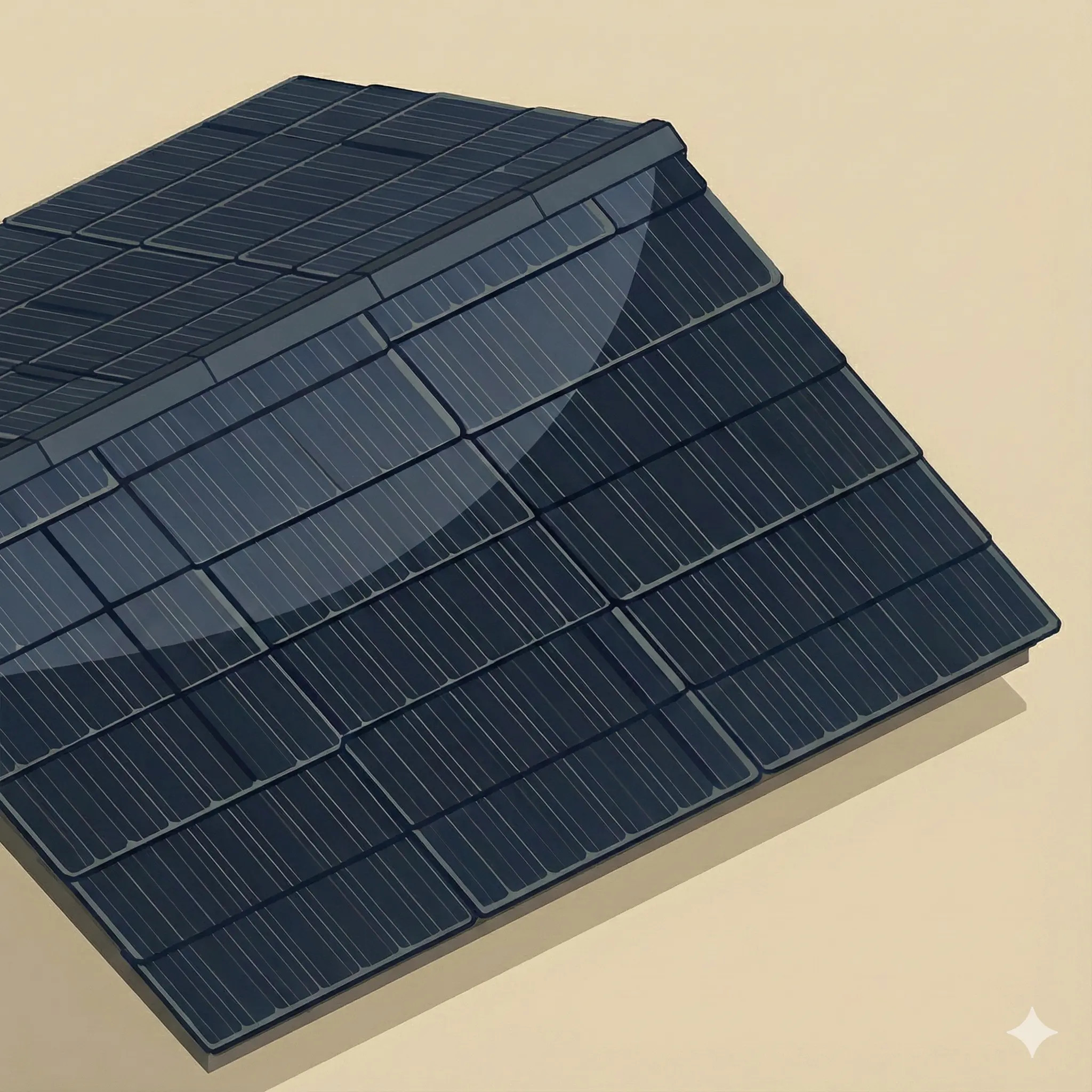
The residential energy landscape in the United States has reached a definitive inflection point in late 2025. For decades, the roofing industry and the solar energy sector operated as distinct, adjacent verticals; roofers provided the weather‑sealed envelope protecting the asset, while solar installers treated that envelope merely as a mounting platform for rack‑mounted photovoltaic (PV) arrays. This separation of function—Building‑Applied Photovoltaics (BAPV)—resulted in functional but aesthetically discordant systems that often compromised the architectural integrity of American homes. However, the maturation of Building‑Integrated Photovoltaics (BIPV), specifically in the form of solar shingles and solar tiles, has fundamentally collapsed these two industries into a single trade.
This report provides an exhaustive analysis of the solar shingle market as it stands in late 2025. It evaluates the technological maturity of leading systems, the thermodynamic challenges inherent to flush‑mounted PV, and the radical shifts in economic viability precipitated by the "One Big Beautiful Bill Act" (OBBBA). As the legislative framework for renewable energy undergoes its most significant contraction in twenty years, American homeowners face a complex decision matrix involving curb appeal, energy independence, and a rapidly closing window for federal tax incentives.
The premise of the solar shingle is deceptively simple: replace the inert, protective layer of a roof (asphalt, slate, or tile) with an active material that serves the dual purpose of weatherization and electricity generation.1 This duality, while aesthetically superior, introduces complex engineering tradeoffs regarding heat dissipation, maintenance, and installation velocity. Furthermore, the market has bifurcated into two distinct technological philosophies: the "nailable" integrated asphalt shingle, championed by GAF Energy and CertainTeed, which seeks to leverage the existing roofing labor force; and the "premium glass tile" approach, exemplified by Tesla and Luma Solar, which positions the roof as a luxury technology product.3
As we navigate this analysis, a recurring theme emerges: while the technology of solar shingles has finally met the durability and efficiency requirements of the mass market, the economic incentives that initially fueled their adoption are facing an abrupt legislative hard stop. The expiration of the Section 25D Residential Clean Energy Credit on December 31, 2025, creates a "now or never" dynamic for ownership, pushing the industry toward a lease‑dominated model in 2026.4
2. The Legislative Landscape: The One Big Beautiful Bill Act (OBBBA)
The financial architecture of the US solar market has been fundamentally rewritten by the enactment of the "One Big Beautiful Bill Act" (OBBBA) on July 4, 2025.5 This legislation represents a pivot from broad, unrestricted subsidization of residential solar ownership toward a more constrained, industrial policy‑focused approach. Understanding the OBBBA is prerequisite to any financial analysis of solar shingles in 2025.
2.1 The Termination of Section 25D
For nearly two decades, the Section 25D Residential Clean Energy Credit provided a 30% tax credit to homeowners who purchased solar systems (via cash or loan). This incentive has been the bedrock of residential solar ROI calculations. Under the OBBBA, Section 25D is officially terminated effective December 31, 2025.4
The implications of this termination are absolute. Unlike previous legislative iterations that included "safe harbor" provisions allowing projects to qualify if a deposit was paid or construction commenced, the OBBBA strictly requires that the system be "placed in service" by the end of 2025.6 "Placed in service" is defined by the IRS as the point at which the property is ready and available for its specific use—meaning the installation must be complete, inspected, and operational.
For homeowners considering solar shingles in Q4 2025, this creates immense pressure. Solar shingle installations, particularly for complex roof lines or systems requiring full tear‑offs (like Tesla's), often have lead times of weeks or months.8 A project signed in October 2025 that encounters weather delays and is not operational until January 2, 2026, will see its net cost increase by 43% instantly, as the 30% credit vanishes. This legislative cliff edge renders the ownership model of solar shingles economically uncompetitive for many households starting January 1, 2026.9
2.2 The Rise of Section 48E and Third‑Party Ownership
While the OBBBA eliminates the homeowner credit, it retains the Investment Tax Credit (ITC) for commercial entities under the restructured Section 48E, valid through 2027.10 This discrepancy creates a "leasing loophole" that is expected to dominate the market in 2026.
Under Section 48E, a third‑party solar provider (the lessor) who retains ownership of the system can claim the 30% credit. The homeowner, entering into a lease or Power Purchase Agreement (PPA), does not own the shingles but pays for the electricity they generate (PPA) or a fixed monthly fee (lease). The provider can then theoretically pass a portion of the tax credit's value to the homeowner in the form of lower rates.7
This shifts the solar shingle value proposition from asset appreciation (increasing home value via ownership) to utility cost reduction (lowering monthly bills via usership). However, this shift is complicated by the fact that solar shingles are structurally integral to the home. Unlike rack‑mounted panels, which can be removed at the end of a lease, solar shingles are the roof. Leasing a roof introduces complex legal questions regarding home sales, mortgage refinancing, and liability that do not exist with standard panel leases.2
2.3 Foreign Entity of Concern (FEOC) Restrictions
The OBBBA introduces strict industrial policy requirements tied to the Section 48E credit. Starting in 2026, for a project to qualify for the full credit, it must meet domestic content thresholds and avoid "Foreign Entities of Concern" (FEOC). Specifically, at least 40% of the manufactured products in the system must come from non‑FEOC sources (primarily targeting Chinese supply chains), escalating to 60% by 2030.7
This provision heavily favors manufacturers with domestic production capacity. GAF Energy, which manufactures its Timberline Solar shingles in Georgetown, Texas, is well‑positioned to meet these requirements.12 Conversely, companies relying on imported cells or components from FEOC‑designated nations may struggle to offer competitive lease rates in 2026, as they will be ineligible for the full tax equity benefits.
Data synthesized from.4
3. The Thermodynamics of BIPV: The Heat Problem
To understand the performance characteristics of solar shingles in 2025, one must delve into the thermodynamics of photovoltaic semiconductors. Solar shingles face a physics problem that traditional rack‑mounted panels do not: the lack of convective cooling.
3.1 Convective Cooling and the Air Gap
Traditional solar panels (BAPV) are mounted on rails that hold the modules 3 to 6 inches above the roof deck. This "air gap" is crucial for efficiency. As the sun heats the dark panels, the air beneath them warms and rises, creating a natural chimney effect (convection) that pulls cooler air in from the bottom. This constant airflow dissipates heat, keeping the operating temperature of the silicon cells closer to ambient temperature.13
Solar shingles, by definition, are Building‑Integrated. They are nailed directly to the roof deck (plywood or OSB) or integrated into the roof surface. There is no air gap. Consequently, the heat generated by solar absorption cannot escape via convection from the rear. Instead, it is conducted into the roof deck and the attic space below, or it must radiate upward. This results in BIPV systems operating at significantly higher temperatures than BAPV systems—often 20°C to 30°C hotter under peak irradiance.16
3.2 Temperature Coefficients and Efficiency Loss
The efficiency of silicon solar cells is inversely correlated with temperature. This relationship is governed by the temperature coefficient, a specification that indicates the percentage of power loss for every degree Celsius the cell temperature rises above Standard Test Conditions (STC, which is 25°C).18
- Monocrystalline Silicon Physics: Most premium solar shingles in 2025 (e.g., GAF, Tesla, CertainTeed) use monocrystalline PERC (Passivated Emitter and Rear Cell) or similar high‑efficiency silicon technologies. A typical high‑quality monocrystalline cell has a temperature coefficient of roughly -0.30% to -0.40% per °C.19
- The Calculation of Loss: If a solar shingle operates at 70°C (158°F) on a summer day, it is 45°C above the STC of 25°C.
- Temperature Delta: 45°C
- Coefficient: -0.35% / °C
- Efficiency Loss: 45 * 0.35% = 15.75%
- Comparative Loss: A rack‑mounted panel with the same cells might operate at 50°C due to airflow.
- Temperature Delta: 25°C
- Efficiency Loss: 25 * 0.35% = 8.75%
The solar shingle in this scenario loses nearly 7% more power than the traditional panel solely due to thermal buildup.20 Over the 25‑year life of the system, this thermodynamic penalty results in thousands of kilowatt‑hours of lost production compared to a rack‑mounted system of the same nameplate rating. This physical reality forces BIPV systems to cover a larger surface area to achieve the same net energy yield as a traditional array.14
3.3 Attic Heat Load and Degradation
The heat trapped by solar shingles does not just disappear; much of it conducts downward into the roof deck and the attic. This can increase the cooling load of the home, forcing air conditioning systems to work harder, which counterintuitively eats into the energy savings the solar roof provides.22 Furthermore, sustained high heat can accelerate the degradation of the adhesives, encapsulants, and backsheets used in the shingles. While manufacturers warrant power output for 25 years, the thermal stress on BIPV components is objectively higher than on BAPV components, raising long‑term questions about delamination or electronic failure rates in extreme climates like Arizona or Nevada.16
4. Market Leaders: The "Glass Tier" (Tesla & Luma)
The market for solar shingles in 2025 is segmented into two distinct categories based on material composition and installation philosophy. The first is the "Glass Tier," representing luxury, high‑cost, full‑roof replacement systems.
4.1 Tesla Solar Roof
The Tesla Solar Roof remains the most visible and controversial product in the sector. It does not use asphalt; instead, it employs tempered glass tiles that replace the entire roof surface.
- Architecture: The system comprises "Active Tiles" (containing PV cells) and "Inactive Tiles" (dummy glass tiles). They are visually identical from the street, allowing installers to navigate complex roof geometries (hips, valleys, dormers) where solar collection is impossible, without breaking the visual aesthetic. The tiles are smaller than traditional panels, measuring roughly 15" x 45", with a power output of 72 watts per active tile.3
- Aesthetics: The primary value proposition is the seamless, "infinite" look. It mimics high‑end slate or flat tile roofing. This aesthetic commands a massive premium, with installed costs often exceeding $63 per square foot, or $100,000+ for an average home.23
- Installation & Maintenance: Installation requires a complete tear‑off of the existing roof. The process is labor‑intensive, requiring specialized "Tesla Certified" crews. The interplay of glass tiles and metal flashing at the ridges and valleys has been a source of leaks for some owners, attributed to installation complexity rather than product failure.24
- Warranty: Tesla offers a robust warranty suite: 25 years for product integrity, weatherization (leaks/wind), and power output. The power warranty guarantees 95% output after 5 years and max 0.5% annual degradation thereafter.1
4.2 Luma Solar
Luma Solar positions itself as the ultra‑premium, "storm‑proof" alternative. It was the first fully integrated solar roof system in the US and targets the custom luxury home market.
- Wind & Durability: Luma's standout feature is its wind rating of 200+ mph.1 This far exceeds the standard Class F (110 mph) or 130 mph ratings of competitors, making it the system of choice for High Velocity Hurricane Zones (HVHZ) like the Florida coast and the Caribbean.
- Performance: Luma shingles are upgradeable. The system allows for the solar insert to be replaced without tearing up the roofing structure, offering a degree of future‑proofing not seen in Tesla or GAF systems. Output is approximately 80 watts per shingle with 22.1% efficiency.1
- Cost: Like Tesla, this is a luxury product. Costs are high, and the system is typically sold through a select network of high‑end roofers rather than mass‑market channels.
5. Market Leaders: The "Asphalt Tier" (GAF Energy & CertainTeed)
The second market segment, and the one driving mass adoption in 2025, is the "Asphalt Tier." These systems are designed to integrate seamlessly with standard asphalt shingles and, crucially, to be installed by regular roofing crews.
5.1 GAF Energy Timberline Solar
GAF Energy, a sister company to GAF (the largest roofing manufacturer in North America), launched the Timberline Solar Energy Shingle (ES) to solve the "roofer problem."
- The Nailable Breakthrough: The Timberline ES is the world's first nailable solar shingle. It is constructed with a flexible polymer base that allows it to be nailed to the roof deck using a standard roofing nail gun, just like a regular asphalt shingle. This eliminates the need for specialized racking or complex glass mounting systems.3
- Ecosystem Integration: The solar shingles are designed to mate perfectly with GAF's "Timberline HDZ" asphalt shingles. A homeowner can replace their roof, installing solar on the south‑facing slopes and cheap asphalt shingles on the north, with a unified aesthetic and water barrier.
- Performance: The ES 2 model (2025 iteration) outputs 57 watts per shingle with an impressive 23% efficiency, rivaling standard panels.3
- Cost: By utilizing general roofing labor rather than specialized solar technicians, GAF has driven the cost down to approximately $15–$18 per square foot installed. This price point makes it the most accessible BIPV product on the market.8
- Warranty: GAF offers the "Golden Pledge" warranty when installed by Master Elite contractors, covering both the roof and the solar system against leaks for 25 years. This single‑source warranty is a significant advantage over the "blame game" that can occur between separate solar and roofing companies.1
5.2 CertainTeed Solstice Shingle
CertainTeed, another giant in building materials, offers the Solstice Shingle. Like GAF, it focuses on integration with its asphalt product lines.
- Power Density: CertainTeed emphasizes high power output, with shingles rated at 70 watts and a high wattage per square foot (approx. 16.1 W/sq ft).8
- Installation: The system uses a deck‑mounted approach that is screw‑based rather than nail‑based for the active units, ensuring secure attachment for wind resistance (rated 110 mph, upgradeable to 130 mph).27
- Water Management: The Solstice system features integrated water channels and raised fastener locations to mitigate the risk of leaks—a critical engineering consideration for any deck‑mounted system.28
- Warranty: CertainTeed offers a comprehensive warranty that covers the entire roofing system, including workmanship, for 25 years when installed by credentialed installers. Their warranty also includes coverage for wind blow‑off and hail damage (Class 4 rating).29
Table 2: Comparative Technical Specifications of Leading Solar Shingle Systems (2025)
| Feature | Tesla Solar Roof | GAF Timberline Solar ES 2 | CertainTeed Solstice | Luma Solar |
|---|---|---|---|---|
| Material Composition | Tempered Glass Tiles | Nailable PV/Asphalt | Monocrystalline/Asphalt | Metal/Glass Upgradeable |
| Power Output (per unit) | ~72 Watts | 57 Watts | 70 Watts | 80 Watts |
| System Efficiency | Not Disclosed (Est. 18‑20%) | ~23% | ~19.85% | 22.1% |
| Wind Rating | 110 mph (Class F) | 130 mph | 110 mph (up to 130) | 200+ mph |
| Impact Rating | Class 4 (Hail) | Class 3/4 | Class 4 | Class 4 |
| Installation Method | Full Roof Tear‑off (Glass) | Nailable (Standard Gun) | Deck Mounted (Screws) | Deck Mounted |
| Est. Cost Installed | ~$63.00 / sq ft | ~$15.00 – $18.00 / sq ft | ~$12.00 – $16.00 / sq ft | Premium Custom |
| Primary Target | Luxury / Design‑First | Mass Market / Re‑roofing | High Performance / Re‑roofing | Hurricane Zones / Luxury |
Data synthesized from.1
6. Installation Realities: Labor, Speed, and Complexity
The installation process differentiates these products more than their electrical specifications. In 2025, the labor shortage in skilled trades has made installation velocity a key cost driver.
6.1 The "Roofing First" Approach (GAF/CertainTeed)
The installation of a GAF Timberline Solar roof is essentially a standard roofing job with an electrical component.
- Tear‑off: The old roof is removed to the deck.
- Deck Prep: Underlayment and ice/water shields are installed (standard roofing practice).
- Shingling: Roofers install standard asphalt shingles on non‑solar planes. On solar planes, they nail down the Timberline ES shingles. The wiring is located on the side or top of the shingle and is connected as they go.
- Completion: The ridge cap is installed. An electrician makes the final "home run" connections to the inverter.
- Advantage: This process is fast. A typical home can be completed in 2‑3 days.8 The labor pool is vast because any GAF‑certified roofer can be trained to do it.
6.2 The "Precision Tile" Approach (Tesla)
Installing a Tesla Solar Roof is more akin to installing a puzzle.
- Precision Decking: The roof deck must be perfectly flat. Any warping in the plywood must be corrected, or the glass tiles will crack or sit unevenly.
- Layout: The layout must be calculated precisely to ensure the tiles fit the roof dimensions without awkward cuts (glass tiles cannot be cut in the field like asphalt; custom metal flashing pieces are used for edges).
- Flashing: Extensive metal work is required at all hips, ridges, and valleys to waterproof the transition between glass tiles. This is the most technically demanding part and the most common source of failure if rushed.24
- Disadvantage: Installation can take 5‑10 days or more. It requires specialized "Solar Roof" crews, which are scarcer than general roofers, leading to longer backlogs and higher costs.8
6.3 The Retrofit Fallacy
A critical insight for homeowners is that solar shingles are almost never viable as a retrofit. You cannot simply patch a patch of solar shingles into an existing asphalt roof. The aesthetic mismatch and the requirement to interlock with specific roofing ecosystems mean that solar shingles are exclusively a product for new construction or full roof replacements (re‑roofing).8
7. Durability and Risk Factors
7.1 Leaks and Water Intrusion
The "number one" fear for any roof penetration is water. Solar shingles, by integrating the generation into the weather barrier, theoretically reduce risk by eliminating the dozens of lag‑bolt penetrations required for rack systems. However, reality is nuanced.
7.2 Flashing Factor
Leaks in solar shingle systems rarely occur through the shingle. They occur at the flashings— the metal edges where the system meets a wall, a chimney, or a vent.
7.3 User Reports
There are anecdotal reports, particularly with early Tesla installations, of leaks developing at the transition points between active and inactive tiles. These are often attributed to crew error rather than design failure.25
7.4 Standard Flashing
Conversely, nailable systems like GAF use standard flashing techniques familiar to all roofers, potentially lowering this risk.1
7.5 Fire Safety (Class A)
All major solar shingle systems in 2025 carry a Class A fire rating, the highest available. This means they are effective against severe fire exposure and are not readily flammable. This integration of "Rapid Shutdown" devices (often required by NEC code) ensures that the high‑voltage DC on the roof can be de‑energized instantly in an emergency, protecting firefighters.3
7.6 Wind Uplift
Solar shingles are aerodynamically superior. Being flush with the deck, they experience minimal uplift. This is why Luma Solar can achieve 200+ mph ratings.1
8. Financial Modeling: The Economics of 2025 vs. 2026
The decision to adopt solar shingles in late 2025 is primarily an economic calculation driven by the looming tax credit expiration.
8.1 Scenario A: Purchase in 2025 (The Last Chance)
- System: 10 kW GAF Timberline Solar system.
- Gross Cost: $45,000 (including associated roofing work).
- Incentive: Section 25D Credit (30%) = -$13,500.
- Net Cost: $31,500.
- Condition: Must be operational by Dec 31, 2025.
8.2 Scenario B: Purchase in 2026 (The Cliff)
- System: 10 kW GAF Timberline Solar system.
- Gross Cost: $45,000.
- Incentive: None (Section 25D expired).
- Net Cost: $45,000.
8.3 Scenario C: Lease in 2026 (The New Normal)
- System: 10 kW system Leased/PPA.
- Ownership: Third‑party provider owns the system.
- Incentive: Provider claims Section 48E credit (30%).
Table 3: Cost Comparison – Solar Shingles vs. Traditional Panels (2025)
| Metric | Solar Shingles (BIPV) | Traditional Panels (BAPV) + New Roof | Traditional Panels (Existing Roof) |
|---|---|---|---|
| Gross Cost (10kW) | $45,000 – $60,000+ | $40,000 ($20k Solar + $20k Roof) | $20,000 – $25,000 |
| Price Per Watt | $4.50 – $7.00 | $4.00 (Combined) | $2.50 – $3.50 |
| 2025 Tax Credit | Yes (30%) | Yes (30% on Solar portion only) | Yes (30%) |
| Efficiency | 15‑23% (Heat Losses) | 20‑23% (Cooler Operation) | 20‑23% |
| ROI Period | 10‑15 Years | 8‑10 Years | 5‑7 Years |
| Aesthetic Value | High (Premium) | Neutral/Negative | Neutral/Negative |
Data synthesized from.9
9. Conclusion
The solar shingle market in 2025 represents a triumph of engineering and a crisis of policy. Technologically, products like GAF’s Timberline Solar and Tesla’s Solar Roof have solved the fundamental challenges of durability, waterproofing, and aesthetics that plagued earlier BIPV generations. The "nailable" shingle, in particular, has successfully bridged the gap between the roofing and solar trades, creating a scalable pathway for mass adoption.
However, the "One Big Beautiful Bill Act" has placed a distinct expiration date on the ownership model for these systems. The termination of Section 25D at the end of 2025 means that for the vast majority of US homeowners, the window to own a solar roof and claim a federal subsidy is closing rapidly.
Strategic Recommendations for Homeowners:
- Immediate Action for Ownership: If you intend to buy a solar roof, you must sign contracts immediately (Q3/Q4 2025) and verify that the installer guarantees "placed in service" status before December 31, 2025. Missing this deadline by one day costs thousands of dollars.4
- Evaluate the "Two Birds" Scenario: Solar shingles only make financial sense if you need a new roof. If your current roof has 10+ years of life, traditional panels are the superior economic choice due to higher efficiency and lower installation costs.2
- The 2026 Lease Strategy: If you miss the 2025 deadline, do not buy cash in 2026. Look for Lease/PPA options that leverage the Section 48E commercial credit. Expect these leases to be bundled with domestic (non‑FEOC) equipment to maximize the lessor's tax benefits.7
In summary, the solar shingle has arrived as a mature building product, but its future as a consumer financial asset is being reshaped by the gavel of legislation. 2025 is the year of the owner; 2026 will be the year of the lessee.
Works cited
- Best Solar Shingles for 2025 – CNET, accessed December 2, 2025, https://www.cnet.com/home/solar/best-solar-shingles/
- Solar Shingles: Pros, Cons, How to Choose in 2025 – NerdWallet, accessed December 2, 2025, https://www.nerdwallet.com/home-ownership/solar/learn/solar-shingles
- Top 5 Solar Roofing Manufacturers California 2025 – Horizon Roofing, accessed December 2, 2025, https://horizonroofingca.com/solar-roofing-manufacturers-ca-2025/
- A Complete Guide to the Federal Solar Tax Credit December 2025 …, accessed December 2, 2025, https://www.mpowersolar.com/post/your-complete-guide-to-the-federal-solar-tax-credit-2025-new-york
- The History & Future of the Solar Tax Credit in 2025 – GreenLancer, accessed December 2, 2025, https://www.greenlancer.com/post/solar-energy-tax-credit-2025
- How the Federal Solar Tax Credit Works In 2025 – Paradise Energy Solutions, accessed December 2, 2025, https://www.paradisesolarenergy.com/blog/how-does-the-solar-tax-credit-work/
- The Final Version of the Solar Tax Credit Changes from the One Big …, accessed December 2, 2025, https://www.solarinsure.com/final-changes-to-solar-tax-credit-from-h-r-1
- Solar Roof Tiles: Complete 2025 Guide To Costs, Installation & Best …, accessed December 2, 2025, https://solartechonline.com/blog/solar-roof-tiles-complete-guide/
- Solar Shingles vs. Traditional Solar Panels: The Complete 2025 Cost‑Benefit Analysis, accessed December 2, 2025, https://hixonsroofing.com/solar-shingles-vs-traditional-solar-panels-the-complete-2025-cost-benefit-analysis/
- The Federal Solar Tax Credit is changing: What homeowners need …, accessed December 2, 2025, https://enphase.com/blog/homeowners/solar-tax-credit-updates-obbb
- Federal Solar Tax Credit In 2025: How Does it Work? – EnergySage, accessed December 2, 2025, https://www.energysage.com/solar/solar-tax-credit-explained/
- Solar Roof Warranties and Certifications FAQs – GAF Roofing, accessed December 2, 2025, https://www.gaf.com/en-us/plan-design/solar-roof/warranties-and-certifications-faq
- Solar Shingles vs Solar Panels 2025 Guide – Horizon Roofing, accessed December 2, 2025, https://horizonroofingca.com/solar-shingles-vs-solar-panels/
- Solar Shingles vs. Solar Panels: comparison – A1 SolarStore Magazine, accessed December 2, 2025, https://a1solarstore.com/blog/solar-shingles-vs.-solar-panels-who-wins.html
- Solar Shingles vs Rack-Mounted Panels: A Side‑by‑Side, accessed December 2, 2025, https://www.theshinglemaster.com/solar-shingles-vs-rack-mounted-panels-a-side-by-side/
- What Are the Effects of Temperature on Solar Panel Efficiency? – EcoFlow, accessed December 2, 2025, https://www.ecoflow.com/us/blog/effects-of-temperature-on-solar-panel-efficiency
- Solar Panel Efficiency vs Temperature, accessed December 2, 2025, https://gosmartroof.com/blogs/solar-panel-efficiency/
- How Do Temperature and Shade Affect Solar Panel Efficiency? – Boston Solar, accessed December 2, 2025, https://www.bostonsolar.us/solar-blog-resource-center/blog/how-do-temperature-and-shade-affect-solar-panel-efficiency/
- What Is the Impact of Temperature on the Efficiency of Different Solar Panel Types? → Learn, accessed December 2, 2025, https://energy.sustainability-directory.com/learn/what-is-the-impact-of-temperature-on-the-efficiency-of-different-solar-panel-types/
- Maximize Solar Panel Efficiency: Temperature Coefficient Guide – Couleenergy, accessed December 2, 2025, https://couleenergy.com/maximize-solar-panel-efficiency-temperature-coefficient-guide/
- Solar Roof Shingles vs Panels: Which Technology Maximizes Your Home's Energy Potential?, accessed December 2, 2025, https://www.moserbaersolar.com/building-integrated-pv-solutions/solar-roof-shingles-vs-panels-which-technology-maximizes-your-homes-energy-potential/
- How Summer Heat Can Damage Your Roof – Andy Janovich Roofing, accessed December 2, 2025, https://www.andyjanovichroofingne.com/blog/2025/july/how-summer-heat-can-damage-your-roof/
- 2025 Expert Review: Tesla Solar Roof Costs More than Ever – SolarReviews, accessed December 2, 2025, https://www.solarreviews.com/blog/how-much-does-the-tesla-solar-roof-cost-compared-to-conventional-solar
- Tesla Solar Roof vs GAF Timberland Solar shingles : r/TeslaSolar – Reddit, accessed December 2, 2025, https://www.reddit.com/r/TeslaSolar/comments/1ikvyy3/tesla_solar_roof_vs_gaf_timberland_solar_shingles/
- Worst decision was to get Tesla solar : r/TeslaSolar – Reddit, accessed December 2, 2025, https://www.reddit.com/r/TeslaSolar/comments/1ie6mby/worst_decision_was_to_get_tesla_solar/
- CertainTeed Solar Solstice Shingle – EnergySage, accessed December 2, 2025, https://www.energysage.com/equipment/solar-panels/certainteed-solar/Solstice_Shingle-40c23885/
- Residential Roofing – CertainTeed, accessed December 2, 2025, https://www.certainteed.com/products/residential-roofing
- Solar – CertainTeed, accessed December 2, 2025, https://www.certainteed.com/products/solar
- WARRANTY – Elf & Sons Roofing, accessed December 2, 2025, https://elfandsonsroofing.com/wp-content/uploads/2023/09/Solstice-Shingle-Warranty.pdf
- 2025 Guide: Top 5 Solar Shingles Brands for Your Home, accessed December 2, 2025, https://lyndseyroofing.com/solar-shingles-top-5-brands-to-consider-in-2025/
- Do Solar Panels Damage Your Roof and Cause Roof Leaks? – PPM Solar, accessed December 2, 2025, https://ppm.solar/can-solar-panels-cause-roof-leaking/
- Peak Roofing, a Division of Summit Energy, Launches Solstice®, An Innovative Solar Shingle System From CertainTeed, accessed December 2, 2025, https://summitsolar.com/peak-roofing-a-division-of-summit-energy-launches-solstice-an-innovative-solar-shingle-system-from-certainteed/
- Should You Buy Solar Shingles? – This Old House, accessed December 2, 2025, https://www.thisoldhouse.com/solar-alternative-energy/should-you-buy-solar-shingles