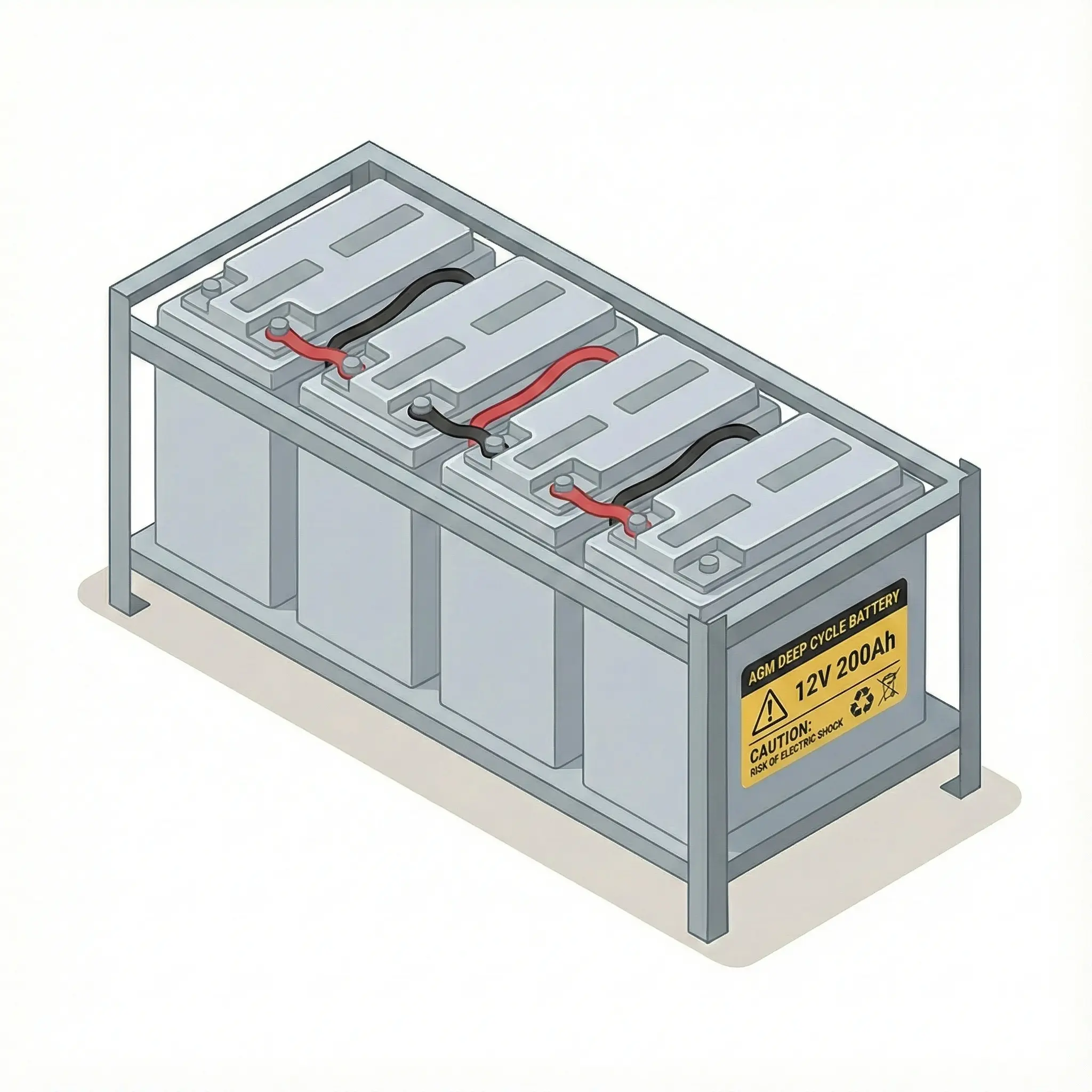
The global transition toward decentralized energy storage has placed unprecedented scrutiny on battery chemistry. For decades, the lead‑acid battery has been the workhorse of off‑grid energy, evolving from the primitive flooded cells of the 19th century to the sophisticated Valve Regulated Lead Acid (VRLA) Absorbed Glass Mat (AGM) architectures of the modern era. As residential solar arrays, recreational vehicles (RVs), and marine vessels increasingly demand higher energy density and cycle life, the AGM battery finds itself at a technological crossroads.
This report serves as an exhaustive, evidence‑based deep dive into the performance, longevity, and economic viability of AGM technology in 2025. By synthesizing technical datasheets from industry leaders like Trojan, Lifeline, and Victron Energy with field data from user forums and independent testing, this analysis dissects the gap between laboratory promises and real‑world failure modes. We explore the specific mechanisms of degradation—sulfation, stratification, and thermal runaway—and critically evaluate the emergence of "Advanced Energy Storage" (AES) and carbon‑enhanced lead‑acid variants. Furthermore, this report conducts a rigorous Levelized Cost of Storage (LCOS) analysis, contrasting the total cost of ownership of premium AGM systems against the rapidly maturing Lithium Iron Phosphate (LiFePO4) market. The findings suggest that while AGM retains specific tactical advantages in start‑stop automotive and safety‑critical standby applications, its role in daily‑cycling renewable energy systems is being severely eroded by fundamental electrochemical limitations and unfavorable long‑term economics.
1. The Evolution and Architecture of VRLA Technology
To evaluate the current standing of AGM batteries, one must first understand the engineering context from which they emerged. The fundamental chemistry of lead‑acid batteries—two lead plates submerged in sulfuric acid—has remained largely unchanged for over 150 years. However, the physical implementation of this chemistry has undergone radical shifts to address the primary weakness of the flooded cell: the need for maintenance and the risk of spillage.
1.1 From Flooded to Valve Regulated
1 While robust, this maintenance requirement renders FLA batteries unsuitable for enclosed spaces, sensitive electronics environments, or applications where accessibility is limited.
The Valve Regulated Lead Acid (VRLA) design was introduced to solve this fluid loss problem. VRLA batteries operate on the principle of oxygen recombination. During charging, oxygen generated at the positive plate diffuses through the separator to the negative plate, where it reacts to form water, effectively recycling the electrolyte. To facilitate this gas transfer, the electrolyte must be immobilized. This led to two distinct technologies: Gel and AGM.
1.2 The Absorbed Glass Mat (AGM) Mechanism
2 This led to two distinct technologies: Gel and AGM.
3 This mat acts as a sponge, holding the electrolyte in suspension while maintaining contact with the active plate material.
The architectural advantages of this design are multifaceted:
- Low Internal Resistance: The tight packing of the glass mats and plates reduces the distance ions must travel, significantly lowering internal electrical resistance compared to flooded or Gel batteries. This trait allows AGM batteries to accept high charge currents and deliver massive surges of power, making them exceptionally responsive.
- Spill‑Proof Construction: Because the acid is absorbed into the mat, there is no free liquid to spill. This allows the battery to be mounted in virtually any orientation (except upside down) without leaking, a critical feature for marine and RV applications where vessel movement is constant.
- Vibration Resistance: The compression of the plate pack within the case provides structural integrity, making AGMs highly resistant to vibration damage—a primary killer of batteries in automotive and marine environments.
1.3 The Recombination Efficiency
4 Because the acid is absorbed into the mat, there is no free liquid to spill.
5 The success of an AGM battery hinges on its recombination efficiency. In a high‑quality AGM cell, over 99% of the gases generated during standard charging are recombined.2 However, this system is not perfectly sealed. VRLA batteries are equipped with a one‑way pressure relief valve. If the battery is overcharged (voltage too high) or charged too rapidly, gas generation exceeds the recombination rate. Internal pressure builds until the valve opens, venting hydrogen and oxygen into the atmosphere.6 Unlike flooded batteries, this lost water cannot be replaced. Consequently, "drying out" becomes a primary and irreversible failure mode for AGM batteries subjected to improper charging regimes.
2. Technical Anatomy: Grid Alloys and Plate Design
The longevity of a lead‑acid battery is not determined merely by its chemistry, but by its physical construction. A critical distinction exists in the market between "starting" batteries, "deep cycle" batteries, and the ambiguous "dual purpose" category. This distinction is rooted in plate geometry and grid metallurgy.
2.1 Starting Batteries: Surface Area and Porosity
Starting batteries are engineered for a singular purpose: to deliver a massive burst of current for a few seconds to crank an internal combustion engine. Power (Amps) in a lead‑acid battery is a function of surface area. To maximize surface area, manufacturers utilize a large number of very thin lead plates with a highly porous, sponge‑like active material structure.
This "sponge lead" allows for rapid chemical reactions, delivering the high Cold Cranking Amps (CCA) required for ignition. However, this architecture is structurally fragile. When a starting battery is deeply discharged, the active material undergoes volumetric expansion. Thin plates cannot withstand this mechanical stress; the active paste sheds from the grid and falls to the bottom of the case, leading to rapid capacity loss and potential short circuits. A starting battery subjected to deep cycling (e.g., running a fridge in a camper) may fail in as few as 30 to 100 cycles.
2.2 Deep Cycle Construction: Density and Thickness
True deep cycle AGM batteries utilize a fundamentally different design philosophy. They employ fewer, significantly thicker solid lead plates with a denser active material paste. High‑density paste is less porous, which restricts the immediate flow of ions, resulting in lower CCA ratings compared to starting batteries of the same size.
However, the thick plates and dense paste are robust enough to withstand the repeated expansion and contraction cycles associated with deep discharge. This physical durability allows deep cycle batteries to be discharged to 50% or even 80% of their capacity hundreds or thousands of times.
2.3 The "Dual Purpose" Compromise
The recreational market often demands a battery that can do both: start a heavy marine diesel engine and run the house loads (lights, pumps, inverters) while at anchor. This led to the "Dual Purpose" AGM. These batteries utilize plate thickness that falls between starting and deep cycle specifications.
While convenient, dual‑purpose batteries represent an engineering compromise. They typically lack the extreme cycling longevity of a dedicated industrial traction battery and arguably fall short of the peak cranking performance of a dedicated starter unit. For casual weekend use, they are sufficient; for full‑time off‑grid living or serious cruising, they often prove to be the "jack of all trades, master of none," failing prematurely when treated as a true deep cycle bank.
2.4 Grid Alloys: Calcium vs. Antimony vs. Pure Lead
The composition of the lead grid itself plays a vital role in battery characteristics.
- Lead‑Calcium: Most modern AGM batteries use a lead‑calcium alloy. Calcium increases the mechanical strength of the grid and, crucially, raises the voltage at which water electrolysis occurs. This significantly reduces gassing and self‑discharge, making the battery "maintenance‑free".
- Pure Lead (TPPL): Thin Plate Pure Lead (TPPL) batteries, such as those from Odyssey or NorthStar, use high‑purity lead (99.99%). Because pure lead resists corrosion better than alloys, the plates can be made thinner (increasing surface area for high CCA) without sacrificing as much longevity. However, these batteries typically require higher charging voltages and are more expensive.
3. Performance Characterization: Capacity, Efficiency, and Peukert's Law
When designing an energy storage system for a home or vehicle, three electrical characteristics of AGM batteries must be understood: usable capacity, round‑trip efficiency, and the Peukert effect. These factors dictate the actual, real‑world performance of the battery bank, often diverging significantly from the nominal specifications on the label.
3.1 The Usable Capacity Myth
A 100Ah AGM battery does not provide 100Ah of usable energy. To preserve the cycle life of a lead‑acid battery, industry standard practice limits discharge to 50% Depth of Discharge (DoD). While an AGM battery can be discharged to 80% or even 100%, doing so drastically reduces its lifespan (discussed in Section 4).
Therefore, system designers must apply a 2:1 sizing factor. To obtain 5kWh of usable daily energy, one must install 10kWh of AGM storage. This "dead weight" significantly impacts the spatial and weight footprint of the system. For mobile applications like RVs, hauling hundreds of pounds of lead that serves only as a chemical buffer is a substantial efficiency penalty.
3.2 Round‑Trip Efficiency (RTE)
Round‑trip efficiency describes the ratio of energy retrieved from the battery compared to the energy put in during charging. Energy is lost primarily as heat due to internal resistance and the entropy of the chemical reaction.
- AGM Efficiency: High‑quality AGM batteries typically demonstrate a coulombic efficiency of roughly 90‑95% but an energy efficiency (Round Trip) of roughly 80‑85%. This means that for every 10 kWh of solar energy generated, only 8 to 8.5 kWh is effectively stored and retrieved. The remaining 1.5‑2 kWh is dissipated as heat.
- Implications for Solar Sizing: This inefficiency has a direct economic cost. To compensate for the 15‑20% loss, the solar array must be oversized. In systems relying on generator backup, this translates to longer runtimes, higher fuel consumption, and increased engine wear. In contrast, Lithium chemistries typically offer 95‑98% RTE, allowing for smaller solar arrays and shorter generator cycles.
3.3 Peukert’s Law and Voltage Sag
Lead‑acid batteries are subject to Peukert’s Law, which describes how battery capacity decreases as the rate of discharge increases. The nominal capacity of a battery is usually rated at the "20‑hour rate" (C/20). A 100Ah battery can deliver 5 Amps for 20 hours.
However, if a user attempts to draw 100 Amps to run a microwave or air conditioner (a 1C rate), the effective capacity of that AGM battery might drop to 50Ah or less. The internal resistance causes significant voltage sag under heavy load. If the voltage drops below the inverter's low‑voltage cutoff (often 10.5V or 11.0V), the system will shut down, even if the battery technically has charge remaining.
This phenomenon makes AGM batteries poor candidates for high‑power applications unless the bank is massively oversized to keep the per‑battery current draw low. Lithium batteries, with much lower Peukert constants, are virtually immune to this effect, delivering their full rated capacity even at high discharge rates.
4. Cycle Life Analysis: Manufacturer Claims vs. Field Reality
The central metric for storage economics is cycle life: the number of charge/discharge cycles a battery can perform before its capacity degrades to 80% of its original rating. A comprehensive analysis of datasheets from various manufacturers reveals a wide spectrum of performance claims, heavily dependent on the Depth of Discharge (DoD) and the quality of manufacturing.
4.1 Comparative Analysis of Manufacturer Data
We have analyzed technical datasheets from generic suppliers (UPG, Renogy) and premium industrial manufacturers (Lifeline, Trojan, Victron). The data highlights a distinct tiered market.
4.1.1 Tier 3: Generic / Consumer Grade (e.g., UPG, Renogy)
These batteries are often rebranded and sold through general retailers. Their focus is low upfront cost.
- Cycle Life: Datasheets typically indicate approximately 400‑600 cycles at 50% DoD.
- Deep Discharge: At 100% discharge, survival drops precipitously to fewer than 200 cycles.
- Use Case: Suitable for weekend camping or backup power where cycling is infrequent.
4.1.2 Tier 2: Premium Deep Cycle (e.g., Fullriver, Trojan Solar AGM)
These are purpose‑built for renewable energy and traction.
- Cycle Life: Claims often reach 1,000 cycles at 50% DoD.
- Construction: Thicker plates and better separators allow for sustained deep cycling.
- Use Case: Standard off‑grid cabins, heavy‑use marine house banks.
4.1.3 Tier 1: Advanced / Mil‑Spec (e.g., Lifeline, Trojan AES, Victron Super Cycle)
These batteries utilize advanced materials (pure lead, carbon additives) to push the limits of lead‑acid chemistry.
- Lifeline GPL Series: Originally designed for military aircraft, these hand‑made US batteries claim over 1,000 cycles at 50% DoD and substantial resilience to 80% DoD (~550 cycles).
- Trojan AES (Advanced Energy Storage): This line incorporates carbon additives to combat sulfation. Datasheets claim up to 2,500 cycles at 60% DoD and a validation of 1,200 cycles at 100% DoD. This is a remarkable claim for lead‑acid technology, aiming to bridge the gap with lithium.
- Victron Super Cycle: Utilizing a new chemistry paste and electrochemistry, these claim ~1,000 cycles at 50% DoD and tolerance for occasional 100% discharge.
4.2 Data Synthesis Table: Cycle Life at Varying DoD
The following table synthesizes the specific data points extracted from the research materials to provide a direct comparison.
| Manufacturer / Series | Technology | Cycles @ 30% DoD | Cycles @ 50% DoD | Cycles @ 80% DoD | Cycles @ 100% DoD | Data Source |
|---|---|---|---|---|---|---|
| UPG / Universal | Generic AGM | ~900 | 400‑500 | ~250 | <200 | 5 |
| Renogy Deep Cycle | Consumer AGM | ~1100 | ~600 | ~300 | ~200 | 17 |
| Fullriver DC | Premium AGM | ~1500 | ~1000 | ~500 | ~400 | 19 |
| Trojan Solar AGM | Industrial AGM | ~1700 | ~1000 | ~600 | ~400 | 18 |
| Victron Super Cycle | Advanced AGM | ~1800 | ~1000 | ~700 | ~400 | 25 |
| Lifeline GPL | Mil‑Spec AGM | ~1500+ | ~1000+ | ~550 | Not Rated | 20 |
| Trojan AES | Carbon AGM | 3000+ | 2000+ | ~1600 | 1200 | 23 |
4.3 The Divergence of Lab vs. Field
It is imperative to note that datasheet curves are generated under ideal laboratory conditions: constant temperature (usually 25°C), immediate recharge after discharge, and a specific charging algorithm. Real‑world conditions rarely match these parameters.
In a solar application, a battery might be discharged to 50% overnight. The next day might be cloudy, recharging the battery only to 80%. This Partial State of Charge (PSOC) cycling is the primary cause of premature failure in AGM batteries, often cutting the "datasheet life" in half.28 The sulfate crystals that form during the 50% discharge do not fully dissolve during the partial recharge. Over days or weeks, these crystals harden (sulfate), permanently reducing capacity. A battery rated for 1,000 cycles might fail in 300 cycles if consistently operated in PSOC.28
5. Failure Modes in Stationary and Mobile Storage
Understanding how AGM batteries fail is crucial for diagnosing system issues and setting realistic expectations. While "old age" is the desired end‑of‑life mechanism, most AGM batteries in solar/RV service die from murder, not natural causes.
5.1 Sulfation: The Silent Killer
Sulfation is the formation of lead sulfate (PbSO₄) crystals on the battery plates. This is a normal part of the discharge chemistry.
- Discharge: Pb + PbO₂ + 2H₂SO₄ → 2PbSO₄ + 2H₂O
- Charge: 2PbSO₄ + 2H₂O → Pb + PbO₂ + 2H₂SO₄
Soft vs. Hard Sulfation:
If the battery is promptly and fully recharged, the sulfate remains amorphous ("soft") and easily converts back to active material. However, if the battery sits in a discharged state, or remains in PSOC for extended periods, the sulfate recrystallizes into a stable, hard structure. These hard crystals act as insulators, blocking the active material and increasing internal resistance.
Symptoms:
- Voltage Sag: The battery voltage drops rapidly under load.
- False Peak: During charging, the voltage rises instantly to the absorption setpoint (e.g., 14.4V), tricking the charger into thinking the battery is full. The charger switches to Float prematurely, leaving the battery uncharged.
5.2 Thermal Runaway and Case Swelling
AGM batteries are susceptible to a catastrophic failure mode known as thermal runaway. This is often evidenced by a swollen, bulging case—a symptom frequently reported in user forums.
The Mechanism:
Charging a lead‑acid battery is an exothermic process. In an AGM battery, the oxygen recombination cycle generates significant heat.
- Trigger: If the battery is overcharged (voltage too high) or charged too rapidly, gas generation exceeds the recombination rate.
- Heat Accumulation: As the internal temperature rises, the electrochemical reaction accelerates (Arrhenius equation), drawing more current from the charger.
- Feedback Loop: This increased current generates more heat. Since the plastic case is a poor thermal conductor, the heat cannot escape. The electrolyte heats up, lowering the battery's internal resistance further, drawing even more current.
- Physical Deformation: The internal pressure exceeds the valve's venting capacity, or the heat softens the ABS plastic case. The internal pressure causes the case to bulge outward, looking like a "swollen" balloon.
Prevention: Thermal runaway is prevented by using temperature‑compensated charging, which lowers the charging voltage as the battery temperature rises.
5.3 Electrolyte Dry‑Out
VRLA batteries rely on a delicate balance of electrolyte. They are "starved electrolyte" designs. While the recombination valve preserves moisture, it is not perfect.
- Venting: Every time the pressure relief valve opens (due to overcharging or heat), hydrogen and oxygen escape. This represents water leaving the system that can never be replaced.
- Consequence: As the mat dries out, internal resistance increases. The battery loses capacity and runs hotter, eventually leading to thermal runaway or open‑circuit failure. This is why "maintenance‑free" does not mean "care‑free"—charging parameters must be precise to prevent venting.
6. The Challenge of Solar Integration
Integrating AGM batteries into solar systems introduces specific challenges related to charge profiles and intermittency. The "set and forget" mentality often leads to rapid system failure.
6.1 The Charge Profile Requirement
AGM batteries require a specific 3‑stage charge profile: Bulk, Absorption, and Float.
- Bulk: Constant current until voltage reaches the absorption setpoint (typically 14.4V – 14.7V).
- Absorption: Constant voltage while current tapers off. This is the most critical phase for AGM. It must be held long enough to dissolve soft sulfates (saturation) but not so long as to dry out the electrolyte.
- Float: Reduced voltage (typically 13.5V – 13.8V) to maintain charge without gassing.
Common Error: Many users leave solar charge controllers on default "Sealed" or "Flooded" settings. Flooded settings often include an "Equalization" phase (15.5V+), which is fatal to most AGM batteries as it causes massive venting and dry‑out.34 Conversely, generic "Sealed" settings may have an absorption voltage that is too low (e.g., 14.1V), leading to chronic undercharging and sulfation.29
6.2 The "Tail Current" Termination
Advanced systems (like Victron) use "Tail Current" to determine when the battery is full. Instead of a fixed timer (e.g., "absorb for 2 hours"), the charger waits until the current flowing into the battery drops below a threshold (e.g., 1% of capacity, or 1A for a 100Ah battery) while at absorption voltage. This is the only accurate way to ensure a full charge. Solar controllers relying on simple timers often terminate absorption too early on cloudy days, or too late on sunny days.
6.3 Temperature Compensation
The Nernst equation dictates that the voltage required to drive the chemical reaction changes with temperature.
- Cold: Voltage must be increased.
- Hot: Voltage must be decreased.
- The Rule: A standard compensation factor is -24mV per °C (for a 12V battery) relative to 25°C.
- Scenario: In freezing conditions (0°C), the absorption voltage might need to be boosted to 15.0V to effectively charge. Without this compensation, the battery remains undercharged. Conversely, at 40°C (104°F), charging at 14.4V is essentially overcharging, cooking the battery; the voltage should be dropped to ~14.0V. Many budget solar controllers lack remote temperature sensors, measuring the air temp at the controller rather than the battery core, leading to dangerous errors.
7. Mobile Applications: The Alternator Conflict
In RV and marine environments, charging a large AGM house bank from the vehicle's engine alternator is a standard requirement, but one fraught with technical peril.
7.1 The Alternator Burnout Risk
Alternators are air‑cooled devices designed to top off a starter battery (which requires only a few Amp‑hours of replacement). They are not designed to run at full rated output for hours.
- Low Resistance: A depleted 400Ah AGM bank has extremely low resistance. When connected to an alternator, it will demand the maximum current the alternator can produce.
- Thermal Failure: A 100A alternator might be capable of 100A for 5 minutes, but only 50A continuous. The AGM bank will pull 100A for an hour. The alternator windings overheat, insulation melts, and the alternator fails.
7.2 The Charging Incompatibility
Standard alternators are "dumb" voltage sources. They typically output a fixed voltage (e.g., 14.0V or 14.4V).
- Lack of Profile: They do not perform a Bulk/Absorb/Float algorithm.
- Voltage Drop: Long wire runs from the engine to the house bank result in voltage drop. The alternator might put out 14.4V, but the battery only sees 13.6V, resulting in slow, incomplete charging.
7.3 The DC‑DC Charger Solution
The industry standard solution in 2025 is the DC‑DC Charger (or Battery‑to‑Battery charger).
- Function: This device sits between the starter battery and the house bank. It acts as a smart load on the alternator.
- Benefits:
- Current Limiting: It limits the draw to a safe level (e.g., 30A or 50A), protecting the alternator from burnout.
- Voltage Boosting: It takes the alternator voltage (even if it sags to 13V) and boosts it to the precise absorption voltage required by the AGM (e.g., 14.7V).
- Isolation: It prevents the house loads from draining the starter battery when the engine is off.
- Profile: It executes a proper 3‑stage charge profile, ensuring the AGM bank is fully saturated.
8. Advanced Lead Technologies: Carbon and Foam
Recognizing the limitations of standard AGM—specifically the poor PSOC performance—manufacturers have innovated. The most significant advancements are Carbon‑Enhanced AGM and Carbon Foam batteries.
8.1 Carbon‑Enhanced AGM (e.g., Trojan AES, Victron Super Cycle)
These batteries add carbon to the negative active material (NAM).
- Mechanism: Carbon is highly conductive and has a high surface area. It acts somewhat like a supercapacitor within the battery, accepting charge current more readily than lead sulfate.
- Performance: This results in batteries like the Trojan AES, which claims 1,200 cycles at 100% DoD.24 This is a massive improvement over standard AGM.
8.2 Firefly Oasis (Carbon Foam)
The Firefly Oasis battery utilizes a patented microcell carbon foam grid structure rather than a traditional lead grid.
- The Promise: The carbon foam increases the surface area of the plates exponentially. This allows for faster charging and, crucially, complete resistance to sulfation. Firefly claims these batteries can sit in a discharged state for months and be restored to full capacity, mimicking the resilience of Lithium without the BMS complexity.
- The Market Reality: Despite the technological promise, Firefly has been plagued by supply chain instability and corporate volatility. Reports from 2022‑2024 indicate difficulty in obtaining units and warranty support issues.47 While the technology solves the AGM sulfation problem, the product availability remains a significant risk factor for system designers in 2025.
9. Economic Analysis: Levelized Cost of Storage (LCOS)
The decision between AGM and Lithium (LiFePO4) often comes down to upfront cost ("sticker shock") versus long‑term value. A rigorous economic analysis reveals that for daily cycling applications, AGM is financially irrational.
9.1 The "Usable Energy" Normalization
To compare costs fairly, one must compare "usable" energy, not nameplate capacity.
- Scenario: A cabin requires 5 kWh of usable energy per day.
- AGM Solution: Requires 10 kWh of capacity (to adhere to 50% DoD).
- Lithium Solution: Requires ~6 kWh of capacity (adhering to 80% DoD).
9.2 Upfront Cost Comparison (2025 Estimates)
| Component | AGM System (10 kWh Nameplate) | LiFePO4 System (6 kWh Nameplate) |
|---|---|---|
| Unit Price | ~$250 per kWh | $400 – $600 per kWh |
| Total Bank Cost | ~$2,500 | $2,400 – $3,600 |
| Wiring/BOS | Higher (heavier gauge for low voltage) | Lower |
| Upfront Total | $2,500 – $3,000 | $3,000 – $4,000 |
Note: The upfront gap has narrowed significantly as Lithium prices have fallen.
9.3 Lifetime Cost (10‑Year Horizon)
The divergence occurs when cycle life is factored in.
- AGM Lifespan: Rated for ~500 cycles at 50% DoD. In daily use, this is roughly 1.5 to 2 years. Even optimistic scenarios (weekend use) might yield 3‑4 years.
- Replacements: Over 10 years, the AGM bank will likely need replacement 3 to 5 times.
- Lithium Lifespan: Rated for 3,000 – 5,000 cycles. This exceeds the 10‑year horizon. No replacement needed.
Total Cost of Ownership (10 Years):
| Cost Category | AGM System | LiFePO4 System |
|---|---|---|
| Initial Purchase | $2,500 | $3,500 |
| Replacement 1 (Year 3) | $2,700 (inflation) | $0 |
| Replacement 2 (Year 6) | $2,900 (inflation) | $0 |
| Replacement 3 (Year 9) | $3,100 (inflation) | $0 |
| Efficiency Losses | ~$500 (extra fuel/solar) | ~$0 |
| Total 10‑Year Cost | $11,700 | $3,500 |
| Cost per kWh Cycle | ~$0.57 | ~$0.14 |
Conclusion: For any application that cycles daily, AGM is roughly 3‑4 times more expensive than Lithium over the system's life.
10. Case Studies and Field Reports
Analyzing user reports from community forums provides validation of the technical failure modes discussed above.
Case Study A: The "Sulfur Smell" Incident
Scenario: A user with 7 sealed AGM batteries connected to a solar array experienced a strong sulfur smell and hot batteries.
Analysis: This is a classic case of thermal runaway. The sulfur smell indicates that the internal pressure relief valves opened, venting hydrogen sulfide gas. This was likely caused by cell imbalance or charger failure. Once venting occurs, the electrolyte dries out, resistance spikes, and the battery effectively cooks itself. The user was advised to disconnect immediately, as the mix of hydrogen and oxygen is explosive.
Case Study B: The Swollen Renogy Battery
Scenario: A user with a 100Ah Renogy AGM under the bonnet of a 4x4 reported the case becoming swollen after a trip in hot weather.
Analysis: Placing an AGM battery in an engine bay ("under bonnet") subjects it to extreme heat. Combined with alternator charging (which may not be temperature compensated), the battery entered a state of overcharge and overheating. The plastic case softened and bulged under internal pressure. Experts agreed that if it has swollen, it is gone and should not be relied on.
Case Study C: The "Magical" Voltage
Scenario: A user reported their battery showed 12.8V (full) but died instantly when a load was applied.
Analysis: This confirms severe sulfation or internal grid corrosion. The battery can hold a surface charge (voltage potential), but the high internal resistance prevents current flow. This "false capacity" often misleads users who rely solely on voltage to determine health.
11. Conclusion
The landscape of energy storage in 2025 presents a clear dichotomy. AGM technology, once the pinnacle of off‑grid reliability, has been superseded in almost every performance metric by Lithium Iron Phosphate (LiFePO4) for deep‑cycle applications.
The Verdict on AGM:
- Performance: Limited by Peukert's law, PSOC intolerance, and low energy density.
- Economics: While upfront costs are lower, the Levelized Cost of Storage is drastically higher due to short cycle life.
- Viability: AGM is effectively obsolete for daily‑cycling solar homes and full‑time RV living.
Where AGM Still Wins:
However, AGM is not dead. It remains the superior engineering choice for:
- Starter Batteries: No other chemistry delivers CCA as reliably and cheaply.
- Extreme Cold Charging: For remote, unheated autonomous systems (e.g., weather stations in the Arctic) where charging must occur below freezing without heating pads.
- Safety‑Critical Standby: UPS systems where the complexity of a Lithium BMS introduces a point of failure that is unacceptable.
For the vast majority of homeowners, sailors, and van‑lifers, the data is unequivocal: the era of lead is ending, and the "economy" of AGM is a financial illusion.
12. Legal Disclaimer
The information contained in this report is for educational and informational purposes only and does not constitute professional engineering, financial, or electrical advice. While every effort has been made to ensure the accuracy of the technical data, chemical analysis, and market pricing as of early 2025, battery performance can vary significantly based on specific usage patterns, environmental conditions, manufacturing batches, and system maintenance. References to specific brands or models (e.g., Trojan, Battle Born, Victron, Renogy, Lifeline) are for comparative technical analysis and do not imply endorsement, sponsorship, or affiliation. Users should consult with certified electricians and refer to official manufacturer datasheets before designing, installing, or modifying energy storage systems. The handling of lead‑acid and lithium batteries involves risks of fire, explosion, and chemical burns; all safety protocols must be followed. The author and publisher assume no liability for damages, injuries, or financial losses resulting from the use or misuse of this information.
Works cited
- Deep-cycle battery and starting battery : What is the difference? - Dolphin Charger, accessed December 1, 2025, https://www.dolphin-charger.com/news/deep-cycle-battery-starting-battery
- Sealed Lead‑Acid Batteries - Universal Power Group, accessed December 1, 2025, http://www.upgi.com/media/2637/sealed-lead-acid-batteries-317.pdf
- Deep Cycle vs Starting Battery: Which Is Right for You?, accessed December 1, 2025, https://manlybattery.com/deep-cycle-vs-starting-battery-which-is-right-for-you/
- Gel and AGM Batteries | Victron Energy, accessed December 1, 2025, https://www.victronenergy.com/batteries/gel-and-agm-batteries
- Sealed Lead‑Acid Battery - Universal Power Group, accessed December 1, 2025, http://files.upgi.com:8086/UPGFileService.svc/GetSpecSheet/45972
- Why do some AGM or GEL batteries bulge or appear sucked‑in?, accessed December 1, 2025, https://discoverbattery.com/support/learning-center/learning-center-articles/why-do-some-agm-or-gel-batteries-bulge-or-appear-sucked-in
- What is the difference between a deep cycle and starting battery, accessed December 1, 2025, https://www.techbatterysolutions.com/resource-and-information-center/battery-basics/what-is-the-difference-between-a-deep-cycle-and-starting-battery/
- Deep Cycle vs. Starting Batteries: Understanding the Difference - Bioenno Power, accessed December 1, 2025, https://www.bioennopower.com/blogs/news/deep-cycle-vs-starting-batteries-explained
- The Difference Between Dual Purpose, Deep Cycle, and Starting Batteries For Boats, accessed December 1, 2025, https://www.relionbattery.com/blog/the-difference-between-dual-purpose-deep-cycle-and-starting-batteries
- Fullriver DC Battery Range - Deep-cycle AGM batteries - R&J Batteries, accessed December 1, 2025, https://www.rjbatt.com.au/products/brands/fullriver-dc-battery-range
- Shop Fullriver DC Series AGM Batteries | Deep Cycle Power, accessed December 1, 2025, https://fullriverbattery.com/battery-series/dc-series/
- RV Camper Battery Lifespan & Replacement Planning: AGM vs LiFePO4, accessed December 1, 2025, https://manlybattery.com/rv-camper-battery-lifespan-replacement-planning-agm-vs-lifepo4/
- Charging Efficiency: LiFePO4 vs. AGM/Gel Batteries - RTF | Rethinking The Future, accessed December 1, 2025, https://www.re-thinkingthefuture.com/technologies/gp6518-charging-efficiency-lifepo4-vs-agm-gel-batteries/
- Lithium vs AGM Batteries: Which Is Better for Off‑Grid Living?, accessed December 1, 2025, https://www.theoffgridshop.com.au/blogs/article/lithium-vs-agm-batteries-which-is-better-for-off-grid-living
- Early Battery Failure — northernarizona-windandsun - NAZ Solar Electric Forum, accessed December 1, 2025, https://forum.solar-electric.com/discussion/356996/early-battery-failure
- AGM Question: DOD% vs Life Expectancy - DIY Solar Power Forum, accessed December 1, 2025, https://diysolarforum.com/threads/agm-question-dod-vs-life-expectancy.8297/
- renogy - deep cycle agm battery, accessed December 1, 2025, https://images.thdstatic.com/catalog/pdfImages/1a/1a0027c6-98ef-41dc-8940-6458fa13c369.pdf
- 90+ Years of True Deep‑Cycle Experience and Expertise - Solacity, accessed December 1, 2025, https://www.solacity.com/docs/Trojan/TrojanBattery_SOLAR.pdf
- Maximize Fullriver AGM Battery Life: Usage, Charging, Climate Tips, accessed December 1, 2025, https://fullriverbattery.com/articles/ft-series/how-long-does-a-fullriver-agm-battery-last/
- Lifeline GPL-31T-2V AGM 2Volt 630AH - Solar Biz, accessed December 1, 2025, https://www.thesolarbiz.com/lifeline-gpl-31t-2v-agm-2volt-630ah.html
- Lifeline GPL-31T AGM Sealed Battery 12V 105Ah - NAZ Solar Electric, accessed December 1, 2025, https://www.solar-electric.com/lifeline-gpl-31t-agm-sealed-battery.html
- TROJAN BATTERY, accessed December 1, 2025, https://golfcar.com.tw/en/download/TrojanBattery_SOLAR.pdf
- Trojan AES AGM Batteries, accessed December 1, 2025, https://www.trojanbattery.com/technology/trojan-aes-batteries
- THE NEW TROJAN AES BATTERY DELIVERS UP TO 3X THE CYCLE LIFE OF STANDARD AGM., accessed December 1, 2025, https://assets.ctfassets.net/nh2mdhlonj7m/3dx8ba11m95kmk6QoQsOWs/37cd443c4314c827ba8b3b10c35eca4a/20230313-AES-Golf-SellSheet.pdf
- the AGM Super Cycle battery - Victron Energy, accessed December 1, 2025, https://www.victronenergy.com/upload/documents/Datasheet-AGM-Super-Cycle-battery-EN.pdf
- AGM batteries damaging Motorhome chargers - Forums - Out & About Live, accessed December 1, 2025, https://forums.outandaboutlive.co.uk/topic/41641-agm-batteries-damaging-motorhome-chargers/
- [2025 Guide] What Is An AGM Battery and How Long Can It Last? | Renogy US, accessed December 1, 2025, https://www.renogy.com/blogs/general-solar/what-is-an-agm-battery
- Battery Failure Mode: Negative Plate Sulfation, accessed December 1, 2025, https://discoverbattery.com/support/learning-center/application-101/battery-failure-mode-negative-plate-sulfation
- Don't Kill That New AGM Battery - Practical Sailor, accessed December 1, 2025, https://www.practical-sailor.com/blog/dont-kill-that-new-agm-battery
- BU-804b: Sulfation and How to Prevent it - Battery University, accessed December 1, 2025, https://batteryuniversity.com/article/bu-804b-sulfation-and-how-to-prevent-it
- Battery Looking Bloated? Here's What a Swollen 12V Battery Means - KickAss Products, accessed December 1, 2025, https://kickassproducts.com.au/blogs/in-depth-guides/battery-looking-bloated-here-s-what-a-swollen-12v-battery-means-and-what-to-do-about-it
- Swollen 100AH deep cycle AGM, help. - DIY Solar Power Forum, accessed December 1, 2025, https://diysolarforum.com/threads/swollen-100ah-deep-cycle-agm-help.3640/
- How Temperature Affects AGM Battery Performance - DC Direct, accessed December 1, 2025, https://dcdirect.com.au/blogs/news/how-temperature-affects-agm-battery
- Fighting Sulfation in AGMs - Practical Sailor, accessed December 1, 2025, https://www.practical-sailor.com/systems-propulsion/fighting-sulfation-in-agms
- Victron AGM batteries 12/230 no longer holding charge - Q&A and troubleshooting, accessed December 1, 2025, https://community.victronenergy.com/t/victron-agm-batteries-12-230-no-longer-holding-charge/11715
- Small $100 "gateway drug" Hobby solar system | Page 2 | DIY Solar Power Forum, accessed December 1, 2025, https://diysolarforum.com/threads/small-100-gateway-drug-hobby-solar-system.3033/page-2
- Lead acid battery charging in cold weather - Victron Energy, accessed December 1, 2025, https://www.victronenergy.com/blog/2019/01/09/lead-acid-battery-charging-in-cold-weather/
- charging AGM batteries in cold climates - NAZ Solar Electric Forum, accessed December 1, 2025, https://forum.solar-electric.com/discussion/16261/charging-agm-batteries-in-cold-climates
- Victron Energy 12V/165Ah AGM Deep Cycle Battery - NAZ Solar Electric, accessed December 1, 2025, https://www.solar-electric.com/victron-energy-12v-165ah-agm-deep-cycle-battery.html
- Charging an Absorbed Glass Mat (AGM) Battery, accessed December 1, 2025, https://federalbatteries.com.au/news/charging-absorbed-glass-mat-agm-battery
- DC to DC Charger for Camper: Charge Efficiently While Driving - EcoFlow, accessed December 1, 2025, https://www.ecoflow.com/ca/blog/dc-to-dc-charger-for-camper
- DC to DC Charger Buying Guide (Updated for 2025) - The Van Conversion, accessed December 1, 2025, https://www.thevanconversion.com/post/dc-to-dc-charger-buying-guide
- The Ultimate Guide to Battery‑to‑Battery DC/DC Chargers: Why They're a Game‑Changer for Off‑Grid Power on the move, accessed December 1, 2025, https://www.alpha-batteries.co.uk/blog/the-ultimate-guide-to-battery-to-battery-dc-dc-chargers-why-theyre-a-game-changer-for-off-grid-power-on-the-move/
- Cycle Life vs. Depth of Discharge - Rolls Battery Technical Support, accessed December 1, 2025, https://support.rollsbattery.com/en/support/solutions/articles/8136-cycle-life-vs-depth-of-discharge
- Firefly Oasis Group 12V 31 Battery - e Marine Systems, accessed December 1, 2025, https://www.emarineinc.com/Firefly-Oasis-12V-Group-31-Battery
- Firefly Energy, accessed December 1, 2025, https://fireflyenergy.com/transportation
- FIREFLY CARBON FOAM BATTERIES, accessed December 1, 2025, https://www.totalbattery.com/product/firefly-energy/
- firefly g31 carbon foam group 31 12v 116 ah deep cycle g31 firefly, accessed December 1, 2025, https://www.completebattery.com/FIREFLY-G31-CARBON-FOAM-GROUP-31-12-VOLT-116-AH-DEEP-CYCLE-G31-FIREFLY-G31-FIREFLY
- Best AGM Batteries For Solar: 2025 Expert Reviews & Buying Guide - SolarTech, accessed December 1, 2025, https://solartechonline.com/blog/best-agm-battery-for-solar/
- Battle Born Batteries, BB10012, 100AH LiFePO4 Battery - Inverter Supply Renewable Energy Source, accessed December 1, 2025, https://www.invertersupply.com/index.php?main_page=product_info&products_id=12846
- How to Calculate the Energy Cost of Different Battery Chemistries. - Fortress Power, accessed December 1, 2025, https://www.fortresspower.com/how-to-calculate-the-energy-cost-of-different-battery-chemistries/
- Lithium‑ion vs Lead‑Acid cost analysis - PowerTech Systems, accessed December 1, 2025, https://www.powertechsystems.eu/home/tech-corner/lithium-ion-vs-lead-acid-cost-analysis/