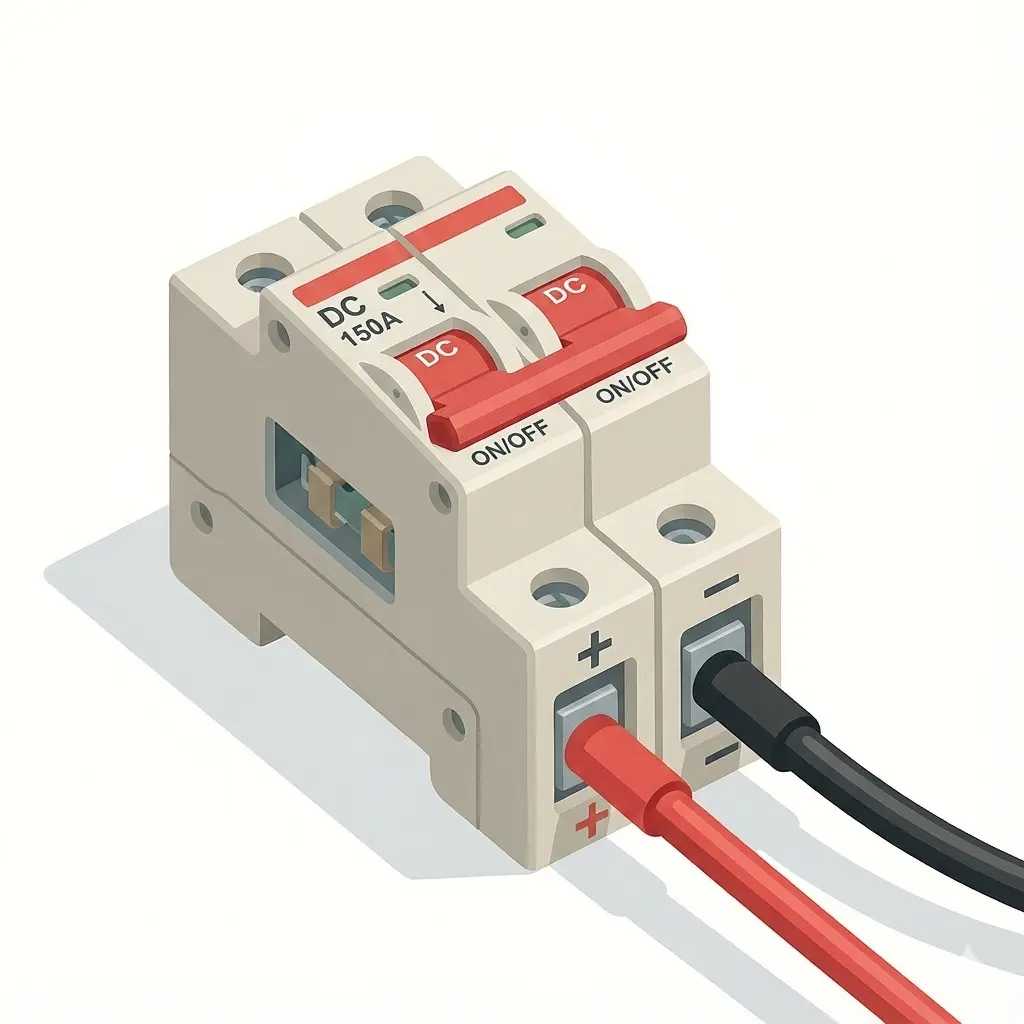
The transition of residential energy infrastructure from centralized utility dependance to distributed generation has introduced high-voltage Direct Current (DC) systems into the domestic environment. While the solar photovoltaic (PV) industry has matured significantly, the "Do-It-Yourself" (DIY) and independent installer segments face a critical safety challenge: the selection and application of appropriate DC overcurrent protection. Unlike Alternating Current (AC), which benefits from a natural zero-crossing point that aids in arc extinction, DC power presents unique and formidable challenges in interruption, particularly at the higher voltages (150V–1000V DC) common in modern solar arrays.
This investigative report provides an exhaustive analysis of DC circuit breakers utilized in solar PV applications. It synthesizes data from National Electrical Code (NEC) articles, Underwriters Laboratories (UL) standards, forensic teardown analyses of market-available devices, and documented field performance reports. The findings indicate a critical divergence in safety and performance between purpose-built, certified DC protection devices and generic, often non-compliant alternatives flooding the online marketplace.
Key findings include the non-negotiable necessity of magnetic blowout mechanisms in DC breakers, the catastrophic risks associated with improper polarity in polarized breaker installations, and the documented thermal failures of low-cost import breakers due to substandard contact materials and arc chute designs. Furthermore, the report clarifies the complex regulatory landscape distinguishing UL 489B listed devices from UL 1077 recognized components, a distinction often misunderstood by consumers but vital for code compliance and insurance validity. The analysis suggests that while cost pressures drive consumers toward generic import devices, the risk of thermal runaway, arc flash, and fire is significantly elevated compared to verified Tier 1 components.
---
1. Introduction: The High-Voltage DC Landscape
The residential solar landscape has undergone a voltage revolution. Early off-grid systems operated at safe, low voltages—typically 12V, 24V, or 48V—where electrical arcing was manageable and component stresses were minimal. However, the drive for efficiency and the physics of transmission losses have pushed system voltages dramatically higher. Modern grid-tie inverters and high-voltage Maximum Power Point Tracking (MPPT) charge controllers now routinely operate at string voltages between 150V and 600V DC in residential settings, with commercial systems pushing to 1000V or 1500V.
This shift has fundamentally altered the safety equation. A 600V DC arc acts very differently from a 120V AC arc. It is tenacious, hot, and difficult to extinguish. When a homeowner or installer selects a circuit breaker for these applications, they are not merely installing a switch; they are installing a life-safety device capable of containing a plasma event that exceeds the surface temperature of the sun.
The market has responded with a bifurcated supply chain. On one side, established electrical manufacturers produce rigorous, certified devices designed to contain these forces. On the other, a proliferation of low-cost, unverified components has flooded online marketplaces, often bearing confusing specifications and dubious certifications. This report aims to demystify the technology, regulations, and market reality of DC circuit protection to empower safe decision-making.
---
2. The Physics of Direct Current Interruption
To understand the critical importance of selecting the correct DC circuit breaker, one must first grasp the fundamental physics of electrical arcing and interruption. The behavior of DC electricity differs radically from AC, creating distinct engineering challenges for protection devices. The failure to respect these physical differences is the root cause of many solar electrical fires.
2.1 The Zero-Crossing Phenomenon and Arc Sustainment
In Alternating Current (AC) systems, the voltage and current oscillate sinusoidally. In the United States, this oscillation occurs at 60 Hz, meaning the current reverses direction 120 times per second. Crucially, this means the current passes through zero amperes 120 times every second. This "zero-crossing" is a natural aid to circuit interruption. When an AC circuit breaker's contacts separate, an arc forms. However, milliseconds later, the current naturally drops to zero. At this instant, the energy input to the arc ceases, the plasma cools, and the dielectric strength of the air gap recovers. Unless the voltage is extremely high or the contact gap is very small, the arc self-extinguishes. 1
Direct Current (DC), by contrast, maintains a constant voltage and unidirectional current flow. There is no zero-crossing. The current flows continuously at its magnitude unless acted upon by an external force. When DC contacts separate, the inductance in the system—from wiring loops, the PV modules themselves, and connected equipment—fights the change in current (L di/dt), generating a voltage spike that attempts to maintain the current flow.
This results in a continuous, stable plasma stream. This DC arc typically burns at temperatures between 6,000 K and 20,000 K. 3 Without a mechanism to actively destabilize it, a DC arc can persist across a significant air gap, melting the breaker's internal mechanism, welding contacts, and eventually igniting the plastic housing. The arc effectively becomes a conductive wire made of superheated gas, allowing the fault current to continue flowing indefinitely. 1
2.2 Principles of DC Arc Extinction
Because DC arcs do not self-extinguish, DC circuit breakers must employ active mechanisms to force extinction. The primary method relies on increasing the arc voltage until it exceeds the system supply voltage. Once the voltage drop across the arc is higher than the source voltage driving it, the arc can no longer be sustained. This is achieved through three simultaneous processes implemented within the breaker's "arc chute" or quenching chamber:
- Arc Lengthening: The physical separation of the moving contact from the stationary contact stretches the arc. As the arc column lengthens, its electrical resistance increases, requiring more voltage to sustain the same current. However, simple mechanical separation is rarely fast or long enough to interrupt high-voltage DC on its own.
- Arc Cooling: The arc is forced against the walls of the arc chute, which are often made of ablative materials or ceramics. This removes thermal energy from the plasma core, reducing its conductivity.
- Arc Splitting: The most critical mechanism involves driving the arc into a stack of metal plates known as "splitter plates" or de-ion plates. These plates chop the single long arc into a series of smaller, short arcs. Each transition from the arc plasma to a metal plate creates a cathode-anode voltage drop, typically 20–30 Volts per plate. A stack of 10 plates, for example, introduces a minimum 200V–300V drop. If the system voltage is 150V, the arc is instantly extinguished because the required sustain voltage exceeds the supply. 3
2.3 Magnetic Blowout and the Lorentz Force
The engineering challenge lies in moving the arc from the contacts into the splitter plates quickly enough to prevent damage. In AC breakers, the magnetic field generated by the current oscillates, and the turbulence helps move the arc. In DC, the field is static. Therefore, DC breakers utilize Magnetic Blowout technology.
This mechanism leverages the Lorentz Force, a fundamental principle of electromagnetism. The Lorentz Force law states that a charged particle moving through a magnetic field experiences a force perpendicular to both its velocity and the magnetic field lines.
The equation is expressed as:
$$\mathbf{F} = q(\mathbf{E} + \mathbf{v} \times \mathbf{B})$$
Where:
- $\mathbf{F}$ is the force vector.
- $q$ is the electric charge.
- $\mathbf{v}$ is the velocity vector of the charge carriers (the current).
- $\mathbf{B}$ is the magnetic field vector.
In the context of a DC circuit breaker:
- The current ($\mathbf{v}$) is the fault current flowing across the arc gap.
- The magnetic field ($\mathbf{B}$) is provided by a permanent magnet or a blowout coil positioned next to the contacts.
- The resulting force ($\mathbf{F}$) physically pushes the ionized plasma (the arc) sideways, away from the contacts and deep into the arc chute. 5
This interaction is why many DC breakers are polarized. The direction of the force vector $\mathbf{F}$ depends on the direction of the current vector $\mathbf{v}$ relative to the magnetic field vector $\mathbf{B}$.
- Correct Polarity: If wired correctly, the current flows in the designed direction. The Lorentz force pushes the arc into the arc chute, extinguishing it safely.
- Reverse Polarity: If the current flows in the opposite direction (due to wiring error or backfeed), the direction of the force vector $\mathbf{F}$ reverses. Instead of pushing the arc into the extinguishing chamber, the magnetic field pulls the arc out of the chute and into the mechanical guts of the breaker. The arc is not extinguished; it stays centered on the mechanism, leading to catastrophic melting and fire. 7
---
3. Regulatory Framework: NEC and UL Standards
For US homeowners, compliance with the National Electrical Code (NEC) and adherence to safety standards established by Underwriters Laboratories (UL) are paramount. These codes are not arbitrary; they are written in blood, evolving after investigations into fires and failures.
3.1 National Electrical Code (NEC) Requirements
NEC Article 690 specifically governs Solar Photovoltaic Systems. Several key sections dictate the selection, sizing, and application of overcurrent protection devices (OCPDs).
3.1.1 Voltage Ratings and Limitations (NEC 690.7)
The NEC mandates that the maximum PV system voltage must be calculated based on the lowest expected ambient temperature. PV modules have a negative temperature coefficient for voltage, meaning their Open Circuit Voltage (Voc) rises as the temperature drops.
- Residential Limit: For one- and two-family dwellings, PV system DC circuits shall not exceed 600 Volts.
- Commercial/Other: Systems on other buildings can go up to 1000 Volts. 11
- Code Change (2023): The 2023 NEC introduced section 690.31(G), allowing voltages over 1000V (up to 1500V) in specific exterior locations or commercial installations, provided strict guarding and wiring methods are used. However, for most residential DIYers, 600V remains the hard ceiling. 11
Implication for Breaker Selection: Breakers must be rated for the maximum calculated voltage, not the nominal voltage. A "24V" nominal panel might reach 45V Voc in freezing weather. A string of 10 such panels would require a 500V or 600V rated breaker. Using a 250V breaker in this scenario is a direct code violation and a latent fire hazard.
3.1.2 Circuit Sizing and the "1.56 Rule" (NEC 690.8)
Solar circuits are unique because they are subject to continuous currents for long durations (defined as 3 hours or more) and environmental fluctuations that can boost output. The NEC requires a specific sizing calculation to prevent nuisance tripping and overheating of conductors and terminals.
- Factor 1: Irradiance Enhancement (125%). Solar irradiance can momentarily exceed Standard Test Conditions (1000 W/m²) due to reflection from clouds ("cloud edge effect") or snow. The code applies a 125% multiplier to the module's Short Circuit Current (Isc).
- Calculation A: $I_{max} = I_{sc} \times 1.25$.
- Factor 2: Continuous Load (125%). PV system currents are considered continuous. Standard OCPDs are typically rated for continuous operation at only 80% of their face value (to prevent heat accumulation). To compensate, the current is multiplied by another 125% (which is mathematically equivalent to dividing by 0.80).
- Calculation B: $Required Rating = I_{max} \times 1.25$.
Combining these factors yields the industry-standard 1.56 Rule ($1.25 \times 1.25 = 1.5625$).
- Sizing Equation: $Breaker Size \ge I_{sc} \times 1.56$.
Example:
A homeowner installs a string of panels where the module Isc is 10 Amps.
- Calculate Maximum Current: $10A \times 1.25 = 12.5A$.
- Calculate Breaker Size: $12.5A \times 1.25 = 15.625A$.
- Selection: The homeowner must select the next standard breaker size up, which is 20 Amps. A 15A breaker would be undersized and likely trip or overheat during peak summer production. 12
3.1.3 Arc-Fault and Ground-Fault Protection
The NEC requires specialized protection beyond simple overcurrent.
- Arc-Fault Circuit Interrupter (AFCI): NEC 690.11 mandates that DC PV systems operating at 80V or greater on or entering a building must have arc-fault protection. This device detects the specific "noise" signature of a series arc (e.g., a loose wire connector) and shuts down the circuit. Standard DC breakers DO NOT provide this protection; it is usually integrated into the inverter or charge controller. 17
- Ground-Fault Protection (GFP): NEC 690.41 requires DC PV systems to detect ground faults (current leaking to the frame/ground) and interrupt the fault path. This prevents shock hazards and fires caused by energized racking systems. 17
3.1.4 Disconnecting Means (NEC 690.13)
The code requires a disconnecting means that is "readily accessible" for emergency responders and maintenance. While a circuit breaker can serve as this disconnect, it must be rated for "load breaking." Not all devices sold as "breakers" are robust enough to be used as a routine switch. Using a non-switch-rated breaker to turn off a solar array under full load can degrade the contacts rapidly. 19
3.2 UL Standards: Listed vs. Recognized vs. Non-Compliant
A major source of confusion and risk in the DIY market is the difference between various UL marks and the lack thereof.
3.2.1 UL 489B: The Gold Standard
UL 489B is the specific standard for "Molded-Case Circuit Breakers for Use with Photovoltaic Systems."
- Scope: These devices are tested specifically for high-voltage DC solar applications. They undergo rigorous testing for arc interruption, thermal endurance, and environmental resilience.
- Application: A UL 489B listed breaker is permitted to be used as the primary branch circuit protection and disconnect for a PV array. It can be installed in a standard combiner box or panel. 20
3.2.2 UL 1077: Supplementary Protectors
UL 1077 covers "Supplementary Protectors for Use in Electrical Equipment."
- Scope: These are tested as components within a larger assembly. They are not tested to the same standalone safety standards as branch circuit breakers.
- Application: These are often found inside inverters or industrial machines. Critical Warning: A UL 1077 protector generally cannot be used as the sole overcurrent protection or disconnect for a solar circuit in the US. Inspectors will reject systems using UL 1077 devices as main PV breakers. They are "supplementary"—meaning they must be backed up by a branch-rated (UL 489) device upstream. 23
3.2.3 Unlisted / False Markings
The "gray market" is rife with devices that carry no valid UL mark. Some may display "CE" (Conformité Européenne), which is a self-certification by the manufacturer and holds little weight with US inspectors. Others may feature fake UL logos or confusing terms like "Designed to UL standards" without actual listing. Installing unlisted breakers is a violation of NEC 110.3(B) and 690.9(D), which require listed equipment. 26
---
4. Classification of DC Circuit Breakers
The market offers two primary architectures for DC circuit breakers: Polarized and Non-Polarized. Understanding the distinction is vital for safety, particularly in systems with battery storage or potential backfeed.
4.1 Polarized DC Circuit Breakers
Polarized breakers are designed for current to flow in one specific direction. They utilize permanent magnets or asymmetric blowout coils to direct the arc into the quenching chamber.
- Mechanism: The magnetic field $\mathbf{B}$ is fixed in orientation (e.g., North-South permanent magnets). Therefore, the Lorentz force direction ($\mathbf{F} \propto \mathbf{v} \times \mathbf{B}$) depends entirely on the current direction $\mathbf{v}$.
- Identification: These breakers are marked with (+) and (-) symbols or "Line" and "Load" text on the terminals.
- Advantages:
- Cost: Simpler internal design allows for lower manufacturing costs.
- Size: Often available in smaller DIN-rail form factors (e.g., 13mm width).
- Efficiency: Highly effective arc extinction if and only if current flows in the correct direction. 28
- Disadvantages & Risks:
- Strict Polarity: Reversing the connections is dangerous.
- Reverse Current Failure: In a fault condition where current flows backward (e.g., a short circuit on the solar roof wiring where the battery backfeeds current up to the roof), the breaker's magnetic field will push the arc away from the quenching chamber. The arc is directed into the spring mechanism or latch, often causing the breaker to fail catastrophically (melt or explode) rather than open. 7
- Application Limits: NOT recommended for battery circuits involving inverter/chargers where current naturally reverses direction (charging vs. discharging). While some installers use polarized breakers in bidirectional circuits by wiring them in complex series/parallel arrangements, this is prone to error and generally discouraged in favor of non-polarized options. 29
4.2 Non-Polarized DC Circuit Breakers
Non-polarized breakers are bidirectional. They can interrupt fault current regardless of the direction of flow, making them significantly safer for complex systems.
- Mechanism: These devices typically use one of two methods:
- Symmetric Design: The arc chute and blowout mechanism are designed geometrically to capture the arc regardless of deflection direction.
- Dual Magnetic Blowout: The breaker contains electromagnetic coils that are energized by the fault current itself. Because the magnetic field polarity flips when the current direction flips, the cross-product ($\mathbf{F} \propto \mathbf{v} \times \mathbf{B}$) remains constant. The force vector $\mathbf{F}$ always points toward the arc chute. 29
- Advantages:
- Safety: Eliminates the risk of reverse-polarity installation errors.
- Versatility: Ideal for battery banks (charging/discharging) and solar combiner boxes where backfeed scenarios are possible.
- Reliability: Consistent performance in complex fault scenarios. 29
- Disadvantages:
- Cost: Typically 20–50% more expensive than polarized equivalents.
- Size: Often physically larger (wider modules) to accommodate larger arc chutes and more complex internal geometry. 20
Technical Insight: The "Non-Polarized" label on some cheap imports has been questioned in forensic teardowns. True non-polarized breakers (like those from Noark or Schneider) have physically larger arc chambers. Some generic brands label breakers as non-polarized but simply omit the magnets entirely, relying on weaker air-blast or thermal rising to quench arcs. This drastically reduces their interrupting capacity (AIC) and makes them unsuitable for high-fault-current applications like battery banks. 34
---
5. Market Landscape: Brand Analysis and Comparison
The market for DC breakers is strictly bifurcated. On one side are established, certified manufacturers (Tier 1) who produce compliant safety equipment. On the other is a vast "gray market" of low-cost imports that mimic the form factor of legitimate devices but often lack the internal engineering to perform safely.
5.1 Tier 1: Established and Certified Manufacturers
These brands provide full datasheets, warranty support, and verifiable UL listings. Their products are tested by Nationally Recognized Testing Laboratories (NRTLs).
MidNite Solar / CBI
- Overview: MidNite Solar is a dominant player in the US off-grid and DIY solar market. Their DIN-rail breakers are manufactured by CBI (Circuit Breaker Industries) in South Africa.
- Technology: Unlike most competitors that use thermal-magnetic trips, CBI breakers use Hydraulic-Magnetic technology.
- Mechanism: A silicone fluid-filled dashpot controls the time delay. The trip point is determined solely by the magnetic pull of the coil, not by the heating of a bimetallic strip.
- Significance: This makes the breaker's rating independent of ambient temperature. A 15A breaker holds 15A whether it is -20°F or 120°F. This is a massive advantage in rooftop combiner boxes that can get extremely hot, preventing "nuisance tripping" that plagues thermal breakers. 35
- Reliability: Extremely high. Documented failure rates are negligible. When they do "fail," it is often a loose terminal connection rather than an internal mechanism failure. 37
- Offerings: The MNEPV series includes both polarized and non-polarized options, rated up to 150V, 300V, and 600V DC. They are rated for 100% continuous duty (though NEC rules still apply). 38
Schneider Electric (Square D / Multi9)
- Overview: A global electrical giant. The C60H-DC series (often branded as Multi9) is a staple in industrial and high-end residential solar.
- Technology: Thermal-Magnetic. These use a bimetallic strip for overload (slow) and a magnetic coil for short-circuit (fast).
- Specs: Multi-standard compliance (UL 1077, IEC 60947-2). They are typically polarized. The C60 series is known for high electrical endurance (cycles). 40
- Design Note: Schneider breakers often use specific "comb busbars" for banking, and their terminals are high-torque cage clamps designed to prevent wire loosening. 43
Noark Electric
- Overview: Noark is a major supplier for solar distributors and increasingly popular in the DIY space for offering high-value, UL-listed components.
- Technology: The Ex9BP series offers true non-polarized options suitable for PV and storage.
- Specs: UL 489B listed options are available (unlike many competitors who only offer UL 1077). They boast high interrupting ratings (10kA) and 5-year warranties. 23
Eaton / Bussmann
- Overview: Industrial heavyweights. Eaton breakers are often physically larger and feature robust cage-clamp terminals.
- Anti-Counterfeit Stance: Eaton has actively campaigned against the gray market, publishing guides on how to spot fake breakers, emphasizing the weight and printing quality differences. 26
5.2 The Gray Market: Generic and Rebranded Imports
Brands such as TOMZN, Chtaixi, Suntree, Liesui, and GEYA dominate online marketplaces like Amazon, AliExpress, and eBay. While visually similar to Tier 1 products (often cloning the Schneider C60 form factor), forensic analysis reveals significant internal deficits.
Teardown Observations
Independent analysts and YouTubers (e.g., Will Prowse, BigClive, David Poz) have performed destructive testing and teardowns on these devices.
- Mechanism: Many "1000V" rated cheap breakers are simply AC breaker designs with a permanent magnet hot-glued inside the casing. Some lack splitter plates entirely or have significantly reduced plate counts (e.g., 4 plates vs. 12 plates in a legitimate breaker). This reduces the arc voltage drop, making it likely the arc will not extinguish. 10
- Materials: Contacts often use copper-plated steel or low-grade brass instead of silver-tungsten alloys. This leads to higher contact resistance, heat buildup, and eventual welding of contacts under load.
- Plastic Housing: The casing material is often standard ABS rather than glass-filled nylon or high-temperature thermoset plastic. In failure scenarios, the plastic melts and deforms, jamming the trip mechanism and preventing the breaker from opening even if the coil activates. 49
Documented Failures
- TOMZN: User reports indicate units tripping at currents well below their rating as they age (drifting calibration) or failing to trip at all while the casing melts. One report noted a unit reaching 80°C–100°C before failing. 49
- Chtaixi: Specific reports cite terminal screws stripping or loosening over time due to thermal cycling, leading to arcing at the terminal and subsequent fires. Users have reported "constant battles" to keep terminals tight. 52
- Suntree: Reports of failure in disconnecting under load, with internal components burning out and the breaker failing to isolate the circuit. 9
Table 1: Comparative Analysis of Breaker Classes
| Feature | Tier 1 (MidNite, Schneider, Noark) | Generic Import (TOMZN, Chtaixi, etc.) |
|---|---|---|
| Certification | UL 489B / UL 489 Listed (Verified) | Usually none, or fake CE/IEC markings |
| Trip Mechanism | Hydraulic-Magnetic or High-Quality Thermal | Low-grade Thermal-Magnetic (temp sensitive) |
| Arc Chute | Large volume, many splitter plates, robust | Small, few plates, relies on simple air gap |
| Contact Material | Silver-Tungsten / Silver-Nickel | Copper-plated Steel / Brass |
| Terminals | High-torque cage clamps, plated | Simple screw clamps, prone to loosening |
| Interrupt Rating | Verified 10kA+ | Claims 6kA/10kA, often fails in testing |
| Plastic Case | Fire-retardant, high-temp thermoset | Standard ABS plastic, melts under stress |
| Cost (63A 2-Pole) | $40 - $80 | $10 - $20 |
---
6. Failure Analysis and Safety Risks
Forensic data from user reports and teardowns highlights three primary failure modes in DC solar protection. These are not theoretical; they are the mechanisms by which fires start.
6.1 Thermal Runaway and Melting
A recurring theme in user reports regarding generic breakers is the "melting" phenomenon. Users describe breakers becoming too hot to touch, plastic housings deforming, and smoke emission without the breaker tripping. 50
- Root Cause: High Internal Resistance. This stems from poor contact pressure between the internal moving parts and inferior contact materials that oxidize rapidly.
- The Joule Heating Effect: According to Joule’s Law ($P = I^2R$), heat generation increases with the square of the current. A cheap breaker with marginally higher internal resistance (e.g., 5 milliohms vs. 1 milliohm) can generate 25 times more heat at high currents.
- Example: At 60 Amps, a 1mΩ resistance generates 3.6 Watts of heat (manageable). A 5mΩ resistance generates 18 Watts. Concentrated in a small plastic box, 18 Watts is enough to soften ABS plastic. 57
- Outcome: The heat generated at the contacts conducts into the bimetallic strip and the terminal lugs. If the bimetallic strip is of poor quality, it may not deflect sufficiently. Worse, the softening plastic casing can physically compress the mechanism, jamming the latch. The breaker effectively becomes a resistive heater until it catches fire or the wire melts.
6.2 Reverse Polarity Catastrophe
In polarized breakers, reversing the polarity effectively weaponizes the arc suppression system against the device.
- Scenario: A DIY installer uses a polarized breaker between a charge controller and a battery. They wire it assuming "Line" is the solar side. However, at night, the battery voltage is higher than the controller voltage. If the charge controller develops a short circuit (FET failure), the battery will dump thousands of amps backwards through the breaker.
- Mechanism Failure: When the breaker attempts to open to clear this fault, the current vector $\mathbf{v}$ is reversed. Consequently, the Lorentz force $\mathbf{F}$ reverses. The arc is pushed away from the splitter plates and into the spring/latch mechanism.
- Result: The arc does not extinguish. It consumes the internal mechanism, welding the contacts shut. The battery continues to dump current into the shorted controller until wires melt or the battery explodes. This is a common cause of combiner box and inverter fires. 7
6.3 Terminal Burnout: The "Cold Flow" Issue
A significant percentage of "breaker failures" are actually installation failures centered on the wire terminals. 53
- Cold Flow (Creep): Copper wiring, especially fine-stranded PV wire, exhibits "cold flow" under pressure. Over time, the copper strands deform and move away from the screw pressure, loosening the connection.
- Thermal Cycling: Solar systems undergo extreme daily thermal cycles (heating up during the day, cooling at night). This expansion and contraction further loosen screw terminals.
- Oxidation: As the joint loosens, air enters, oxidizing the copper. Copper oxide is a semiconductor (higher resistance), leading to more heat, which accelerates the loosening. This is a runaway feedback loop.
---
7. Installation Best Practices and Sizing Guide
To ensure a safe, code-compliant installation, the following methodologies should be strictly adhered to.
7.1 System Sizing Methodology
For a solar PV source circuit (string breaker), follow this step-by-step process:
- Identify Isc: Locate the Short Circuit Current (Isc) on the solar panel nameplate (e.g., 9.0A).
- Calculate Maximum Current: Multiply Isc by 1.25 (NEC 690.8(A)).
- $9.0A \times 1.25 = 11.25A$.
- Apply Continuous Load Factor: To size the breaker for continuous operation, multiply by 1.25 again (NEC 690.8(B)).
- $11.25A \times 1.25 = 14.06A$.
- Select Standard Size: Round up to the next standard breaker size. In this case, a 15A breaker.
- Simplified Equation: $Breaker Rating \ge I_{sc} \times 1.56$.
- Verify Voltage: Ensure the breaker's voltage rating exceeds the array's temperature-corrected $V_{oc}$.
- Example: A string of 10 panels with a total $V_{oc}$ of 400V requires a breaker rated for at least 500V or 600V DC. A 250V breaker is insufficient and dangerous. 11
7.2 Wiring and Terminals
- Ferrules: The use of wire ferrules (crimp-on sleeves) is highly recommended for stranded wire in screw terminals. Ferrules create a solid gas-tight mass that resists cold flow and allows the screw to bite without damaging individual strands.
- Note: While cage-clamp terminals (found on Schneider/Eaton) handle stranded wire well, simple screw clamps (found on generics) chew up strands. Ferrules prevent this. 61
- Torque Specifications: Tightening "until it feels tight" is insufficient. Manufacturers specify torque values (e.g., 20 in-lbs or 2.5 Nm). Failure to use a torque screwdriver results in under-tightening (high resistance/fire) or over-tightening (stripped threads/crushed wire). This is the single most common cause of "breaker failure". 38
- Retightening: It is good practice to check terminal tightness after a few weeks of operation (thermal cycling) and annually thereafter.
7.3 Enclosures and Environmental Derating
Breakers produce heat. Installing multiple breakers side-by-side in a combiner box without air gaps can lead to nuisance tripping due to mutual heating.
- Derating: If the ambient temperature in the combiner box exceeds 40°C (104°F), thermal-magnetic breakers must be derated or sized larger.
- Advantage MidNite: Hydraulic-magnetic breakers (like MidNite/CBI) are immune to this heat-induced derating, making them superior for rooftop combiner boxes exposed to direct sun. 35
---
8. Counterfeit Detection
The market is plagued by counterfeit devices that mimic reputable brands like Square D, ABB, and Schneider.
Indicators of Counterfeits:
- Weight: Counterfeits are significantly lighter due to missing internal arc chutes and thinner metal components. A real breaker might weigh 100g; a fake might weigh 53g. 27
- Printing Quality: Authentic breakers usually have laser-etched or high-quality pad-printed text. Fakes often use blurry ink or stickers.
- Missing Certifications: Lack of UL holographic labels or listing numbers.
- Price: A 250A DC molded case circuit breaker (MCCB) from a Tier 1 brand typically costs $300+. A generic version for $40 is physically incapable of containing the materials (silver, copper, arc plates) required for safe interruption. If the price seems too good to be true, the breaker is likely a fire hazard. 47
---
9. Conclusion
The selection of DC circuit breakers for solar PV systems is not merely a matter of component compatibility; it is a critical safety decision governed by the unforgiving physics of DC arcing. The evidence synthesized in this report points to an unambiguous conclusion: generic, unlisted, and low-cost DC breakers pose a significant and documented fire risk.
While the initial cost savings of brands like TOMZN or Chtaixi may appeal to the DIY demographic, the forensic evidence of melting casings, failed trip mechanisms, and inadequate arc suppression reveals these devices to be false economies. For residential applications, specifically those attached to dwellings, the use of UL 489B listed breakers from Tier 1 manufacturers (MidNite Solar, Noark, Schneider, Eaton) is the only path that ensures compliance with the NEC and protects life and property.
Furthermore, the nuances of installation—specifically torque specifications, the use of ferrules, and the strict observance of polarity—are as critical as the device selection itself. A high-quality breaker installed with loose connections is as dangerous as a low-quality breaker. As PV systems voltage ceilings continue to rise (pushing toward 1000V in residential sectors), the margin for error diminishes, making adherence to these engineering standards indispensable.
---
Legal Disclaimer
The information contained in this report is for educational and informational purposes only and does not constitute professional engineering or legal advice. Electrical codes and standards (such as the NEC and UL) vary by jurisdiction and are subject to change. The installation, maintenance, and repair of high-voltage DC electrical systems involve significant risks, including fire, electrocution, and death. All electrical work should be performed by qualified, licensed professionals in accordance with local regulations. The author and publisher disclaim any liability for injury, damage, or loss resulting from the use of or reliance on the information provided herein. Users should always consult official manufacturer documentation and local Authorities Having Jurisdiction (AHJ) for specific project requirements.
Works cited
- Blowout Magnets - What They Are & Why Use Them? - Durakool, accessed December 1, 2025, https://www.durakool.com/information/technology/application-notes/blowout-magnets-what-they-are-why-use-them/
- Understanding the AC and DC Circuit Breaker Difference - GEYA Electrical, accessed December 1, 2025, https://www.geya.net/ac-and-dc-circuit-breaker-difference/
- DC Circuit Breaking Technology: Arc Interruption Physics - sinobreaker, accessed December 1, 2025, https://sinobreaker.com/de/dc-circuit-breaking-arc-extinction-technology/
- Study of wall ablation on low-voltage arc interruption: The effect of Stefan flow | Journal of Applied Physics | AIP Publishing, accessed December 1, 2025, https://pubs.aip.org/aip/jap/article/125/21/213302/959012/Study-of-wall-ablation-on-low-voltage-arc
- Lorentz force - Wikipedia, accessed December 1, 2025, https://en.wikipedia.org/wiki/Lorentz_force
- The magnetic force on a moving charge, accessed December 1, 2025, http://labman.phys.utk.edu/phys222core/modules/m4/The%20magnetic%20force.html
- Polarity DC Circuit Breaker Guide: Safety, Selection & Installation Tips - viox electric, accessed December 1, 2025, https://viox.com/polarity-dc-circuit-breaker-guide/
- DC Circuit Breaker Fires!! | Page 2 - DIY Solar Power Forum, accessed December 1, 2025, https://diysolarforum.com/threads/dc-circuit-breaker-fires.30544/page-2
- DC circuit breaker catching fire from two strings of solar PV connected in parallel, one of which sustained bullet damage : r/SolarDIY - Reddit, accessed December 1, 2025, https://www.reddit.com/r/SolarDIY/comments/1ekgy2w/dc_circuit_breaker_catching_fire_from_two_strings/
- DC breakers from China. Why bother. - DIY Solar Power Forum, accessed December 1, 2025, https://diysolarforum.com/threads/dc-breakers-from-china-why-bother.73700/
- Code Corner 2023 NEC 690.7 and 690.31(G) - Mayfield Renewables, accessed December 1, 2025, https://www.mayfield.energy/technical-articles/code-corner-2023-nec-690-7-and-690-31g/
- How to Calculate Solar Panel Wire Size - PowMr, accessed December 1, 2025, https://powmr.com/blogs/accessories/solar-panel-wire-size
- Into the Forest — Details of PV Systems that Inspectors and Installers Need to Know, accessed December 1, 2025, https://iaeimagazine.org/columns/photovoltaic/into-the-forest-details-of-pv-systems-that-inspectors-and-installers-need-to-know/
- PV to the inverter wire sizing | DIY Solar Power Forum, accessed December 1, 2025, https://diysolarforum.com/threads/pv-to-the-inverter-wire-sizing.104162/
- accessed December 1, 2025, https://powmr.com/blogs/accessories/solar-panel-circuit-breaker#:~:text=Breaker%20size%20%3D%201.56%20%C3%97%20Isc,string%20current%20remains%205.45A.
- How to Size Solar Panel Circuit Breaker - PowMr, accessed December 1, 2025, https://powmr.com/blogs/accessories/solar-panel-circuit-breaker
- A Guide to NEC Article 690: Solar Photovoltaic (PV) Systems - ExpertCE, accessed December 1, 2025, https://expertce.com/learn-articles/guide-to-nec-article-690-solar/
- ARTICLE 690 Solar Photovoltaic (PV) Systems, accessed December 1, 2025, https://enkonnsolar.com/wp-content/uploads/2023/08/Article-690-Photovoltaic-PV-System.pdf
- Solar, Part 3, based on the 2023 NEC - Mike Holt, accessed December 1, 2025, https://www.mikeholt.com/newsletters.php?action=display&letterID=2819
- AC vs DC Circuit Breakers: 9 Key Differences You Should Know, accessed December 1, 2025, https://www.weishoelec.com/Blog/ac-vs-dc-circuit-breakers/
- UL 489B | UL Standards & Engagement, accessed December 1, 2025, https://www.shopulstandards.com/ProductDetail.aspx?UniqueKey=30753
- Miniature Circuit Breakers : UL 489B, DC Rated - c3controls, accessed December 1, 2025, https://www.c3controls.com/products/dc-miniature-circuit-breakers/
- Ex9BP2PC10 - DIN rail type MCBs - Noark, accessed December 1, 2025, https://products.na.noark-electric.com/products/Ex9BP2PC10
- What is the Difference Between UL Listed and UL Recognized? - Bel Fuse, accessed December 1, 2025, https://www.belfuse.com/resource-library/blog/what-is-the-difference-between-ul-listed-and-ul-recognized
- UL Listed vs. UL Certified (or Recognized): Guide for Industrial Use - Simcona, accessed December 1, 2025, https://simcona.com/blog/ul-certified-vs-ul-listed-recognized
- Three Steps to Verify Circuit Breaker Authenticity - Van Meter Inc., accessed December 1, 2025, https://www.vanmeterinc.com/blog/three-steps-to-verify-circuit-breaker-authenticity
- How Can You Tell a Fake Circuit Breaker - AlpVision, accessed December 1, 2025, https://alpvision.com/identifying-a-fake-circuit-breaker/
- Advantages and Disadvantages of Non-polarized and Polarized DC Circuit Breakers - usfull, accessed December 1, 2025, https://www.usfull.com/advantages-and-disadvantages-of-non-polarized-and-polarized-dc-circuit-breakers/
- DC MCB Polarity vs Non-Polarity: What Every Electrical Engineer Needs to Know?-SOWER, accessed December 1, 2025, https://gbsower.com/vi/dc-mcb-polarity-vs-non-polarity-what-every-electrical-engineer-needs-to-know/
- AC vs DC Breakers: 5 Critical Safety Differences - LETOP, accessed December 1, 2025, https://letopv.com/difference-between-ac-circuit-breaker-and-dc-circuit-breaker/
- Polarized vs non polarized | DIY Solar Power Forum, accessed December 1, 2025, https://diysolarforum.com/threads/polarized-vs-non-polarized.55654/
- What Are the 10 Critical Differences Between Polar and Non-Polar DC Circuit Breakers?, accessed December 1, 2025, https://gbsower.com/what-are-the-10-critical-differences-between-polar-and-non-polar-dc-circuit-breakers/
- Why use non-polar DC miniature circuit breakers? - Knowledge, accessed December 1, 2025, https://www.chyt-solar.com/info/why-use-non-polar-dc-miniature-circuit-breaker-89177079.html
- MNEDC breakers, really non polarized? - DIY Solar Power Forum, accessed December 1, 2025, https://diysolarforum.com/threads/mnedc-breakers-really-non-polarized.66042/
- QY - Series Miniature Circuit Breakers - MidNite Solar, accessed December 1, 2025, https://www.midnitesolar.com/pdfs/MNEPV_Series_Circuit_Breakers_DataSheet.pdf
- Midnite Solar? | DIY Solar Power Forum, accessed December 1, 2025, https://diysolarforum.com/threads/midnite-solar.29127/
- breaker problem - MidNite Solar, accessed December 1, 2025, https://midniteftp.com/forum/index.php?topic=3374.0
- mnepv-600rt 16a - MidNite Solar, accessed December 1, 2025, https://www.midnitesolar.com/productPhoto.php?product_ID=336&productCat_ID=16&sortOrder=21
- mnepv breakers - MidNite Solar, accessed December 1, 2025, http://www.midnitesolar.com/productPhoto.php?product_ID=183
- C60H-DC | Schneider Electric Israel, accessed December 1, 2025, https://www.se.com/il/en/product-range/2157-c60hdc/
- M9U21104 - Miniature circuit breaker (MCB), Multi9 C60H-DC, 1P, 4A, C curve, 5kA (UL 1077), 6kA (IEC/EN 60947-2), accessed December 1, 2025, https://www.se.com/au/en/product/M9U21104/miniature-circuit-breaker-mcb-multi9-c60hdc-1p-4a-c-curve-5ka-ul-1077-6ka-iec-en-609472/
- Final Distribution - Multi 9, accessed December 1, 2025, https://www.srentp.com/09_Multi%209%20comprehensive%20catalogue.pdf
- Multi9 - RS Online, accessed December 1, 2025, https://docs.rs-online.com/2651/A700000009686075.pdf
- DC Miniature Circuit Breakers Ex9BP (New) - NOARK Electric, accessed December 1, 2025, http://www.noark.eu/en/products/Photovoltaics/DC_Miniature_Circuit_Breakers_Ex9BP_%28New%29
- Low Voltage DC Series - NOARK Electric, accessed December 1, 2025, https://na.noark-electric.com/wp-content/uploads/2024/11/NOARK_DC_Products_Guide.pdf
- Counterfeit and Gray Market Breakers - YouTube, accessed December 1, 2025, https://www.youtube.com/watch?v=VaWLOqsAZJM
- Testing Cheap DC Breakers And How To Not Start Fires | Hackaday, accessed December 1, 2025, https://hackaday.com/2025/10/28/testing-cheap-dc-breakers-and-how-to-not-start-fires/
- A Look Inside This Cheap DC Circuit Breaker - YouTube, accessed December 1, 2025, https://www.youtube.com/watch?v=EwPKySsAl5Q
- Testing Cheap DC Breakers from Amazon.com - YouTube, accessed December 1, 2025, https://www.youtube.com/watch?v=ufj_iJzFIEU
- TOMZN Circuit Breakers can be dangerous. - DIY Solar Power Forum, accessed December 1, 2025, https://diysolarforum.com/threads/tomzn-circuit-breakers-can-be-dangerous.106052/
- Main DC inline fuse and/or holder is melting | Good Sam Community - 2010236, accessed December 1, 2025, https://community.goodsam.com/discussions/fifthwheelforum-board/main-dc-inline-fuse-andor-holder-is-melting/2010236
- Fire Danger | DIY Solar Power Forum, accessed December 1, 2025, https://diysolarforum.com/threads/fire-danger.104824/
- I had a DC breaker burn up. Why? | DIY Solar Power Forum, accessed December 1, 2025, https://diysolarforum.com/threads/i-had-a-dc-breaker-burn-up-why.64127/
- How safe are the Chinese dc breakers? | Page 2 | DIY Solar Power Forum, accessed December 1, 2025, https://diysolarforum.com/threads/how-safe-are-the-chinese-dc-breakers.77959/page-2
- Circiut breakers melting - DoItYourself.com, accessed December 1, 2025, https://www.doityourself.com/forum/electrical-ac-dc/337966-circiut-breakers-melting.html
- Sub panel melted, just behind hot connection, melting the plastic in the panel and part of the breaker - what would cause this? : r/askanelectrician - Reddit, accessed December 1, 2025, https://www.reddit.com/r/askanelectrician/comments/q1mm9q/sub_panel_melted_just_behind_hot_connection/
- Do DC breakers work? | Page 2 - DIY Solar Power Forum, accessed December 1, 2025, https://diysolarforum.com/threads/do-dc-breakers-work.61203/page-2
- Why would a circuit breaker melt? - Quora, accessed December 1, 2025, https://www.quora.com/Why-would-a-circuit-breaker-melt
- I had a DC breaker burn up. Why? | Page 2 - DIY Solar Power Forum, accessed December 1, 2025, https://diysolarforum.com/threads/i-had-a-dc-breaker-burn-up-why.64127/page-2
- Solar Panel Breaker Calculations - Watts247 Affordable DIY Solar, accessed December 1, 2025, https://watts247.com/docs/solar-panel-breaker-calculations/
- pv wire and ferrule question | DIY Solar Power Forum, accessed December 1, 2025, https://diysolarforum.com/threads/pv-wire-and-ferrule-question.72993/
- 4. DC wiring - Victron Energy, accessed December 1, 2025, https://www.victronenergy.com/media/pg/The_Wiring_Unlimited_book/en/dc-wiring.html
- Why You Should Use Cage Clamp Terminial Blocks VS Screw Terminals - YouTube, accessed December 1, 2025, https://www.youtube.com/watch?v=eHeIDHOsx_4
- Solar Snack - Finding Torque Specs for Breakers - YouTube, accessed December 1, 2025, https://www.youtube.com/watch?v=ThjiBJ7YR8A
- 5 Common DC Circuit Breaker Mistakes in Solar Installations (And How to Avoid Them)?, accessed December 1, 2025, https://gbsower.com/de/5-common-dc-circuit-breaker-mistakes-in-solar-installations-and-how-to-avoid-them/
- Inside a fake un-trippable circuit breaker. - YouTube, accessed December 1, 2025, https://www.youtube.com/watch?v=2TJEzdqtXlQ