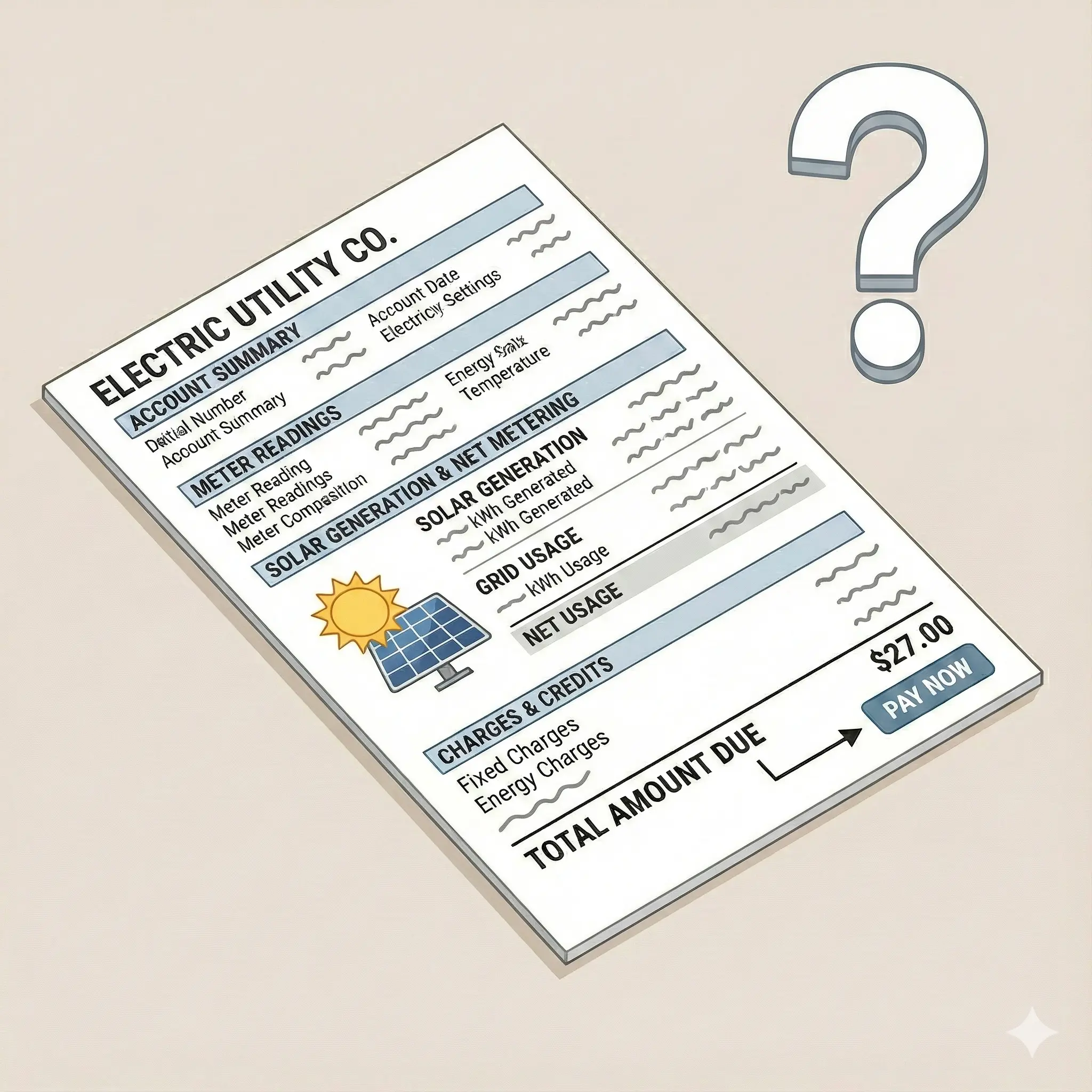
The adoption of residential solar photovoltaic (PV) systems marks a pivotal transition in the economic history of the American household. For over a century, the relationship between the utility company and the homeowner was defined by a unidirectional flow of both electrons and currency. The utility generated power, transmitted it across vast infrastructure, delivered it to the home, and billed the customer based on a simple accumulation of kilowatt-hours (kWh). In this traditional model, the homeowner was a passive consumer, and the electric bill was a static invoice for services rendered.
The installation of rooftop solar fundamentally alters this dynamic, converting the homeowner into a "prosumer"—an entity capable of both consuming and producing energy. This shift necessitates a complete overhaul of the billing mechanisms that underpin the electrical grid. No longer a simple receipt, the modern solar utility bill has evolved into a complex financial ledger involving bi-directional accounting, time-differentiated valuation, non-bypassable surcharges, and annual reconciliation cycles.1 For the uninitiated homeowner, this transition often results in profound confusion, characterized by the "App vs. Bill" discrepancy—a widespread phenomenon where the production data shown on solar monitoring platforms fails to align with the credits appearing on utility statements.4
This report provides an exhaustive analysis of the mechanisms governing solar utility billing in the United States. Through a detailed examination of regulatory frameworks in key markets—specifically California, North Carolina, Virginia, and Florida—we deconstruct the evolving nature of Net Energy Metering (NEM) and its successor, Net Billing Tariffs (NBT). The research highlights a clear industry trajectory: as solar penetration increases, utilities are moving away from the simple 1:1 retail credit models of the past toward sophisticated "avoided cost" frameworks. These new structures, exemplified by California’s NEM 3.0 and North Carolina’s Solar Choice Rider, aggressively decouple the value of imported energy from exported energy, placing a premium on self-consumption and battery storage while diminishing the financial returns of pure grid export.6
The implications of this shift are significant. The passive approach to solar ownership—where one simply installs panels and watches the meter spin backward—is becoming obsolete. The modern solar investment requires active management and a nuanced understanding of rate structures to maximize Return on Investment (ROI). This document serves as a technical guide to navigating this new economic landscape, offering an evidence-based dissection of how energy is measured, valued, and billed in the era of distributed generation.
Chapter 1: The Physics of the Bi-Directional Grid
To comprehend the financial complexity of a solar bill, one must first grasp the underlying physical reality of how energy moves through a grid-tied residential system. The most persistent source of consumer frustration stems from a misunderstanding of where measurement occurs relative to generation and consumption.
1.1 The Concept of "Behind the Meter" Operations
In a standard grid-tied solar installation, the photovoltaic system is electrically connected to the home’s main service panel or a sub-panel. This connection point is technically described as "behind the meter." This spatial designation is critical because it defines the visibility—or lack thereof—that the utility company has into the home’s energy dynamics.
When solar panels generate direct current (DC) electricity, it is converted to alternating current (AC) by the inverter and fed directly into the home’s breaker panel. According to the laws of physics, electricity follows the path of least resistance. Consequently, the energy generated by the solar system will first flow to the active loads within the home—refrigerators, HVAC systems, lighting, and computers—before it attempts to flow out to the grid. This internal consumption happens instantaneously and, crucially, is invisible to the utility’s revenue meter.4
The utility revenue meter sits at the property boundary, acting as a gatekeeper. It measures the net flow of electricity crossing that boundary, not the total activity occurring within it. Therefore, the utility is unaware of any solar energy that is generated and immediately consumed by the home. This "self-consumed" energy reduces the amount of power the homeowner must purchase, effectively lowering the bill by reducing the volume of imports, but it does not appear as a distinct line item or credit on the statement.
1.2 The Mechanics of the Bi-Directional Meter
Modern "smart meters" or bi-directional meters are distinct from the analog electromechanical meters of the past. While an old meter simply spun a single dial, modern digital meters record energy flow in multiple "registers" or channels.
- Channel 1 (Delivered/Imported): This register counts electricity flowing from the grid to the house. This typically occurs at night, during cloudy weather, or when household demand spikes above the solar system’s instantaneous output (e.g., when an electric dryer and air conditioner run simultaneously).1
- Channel 2 (Received/Exported): This register counts electricity flowing from the house to the grid. This occurs only when the solar system’s production exceeds the home’s immediate consumption. This "spillover" energy is what generates billing credits under Net Metering policies.1
The relationship between these two channels forms the basis of the "Net" in Net Metering. However, because the meter cannot see the internal self-consumption, the "Export" number on the bill will invariably be lower than the "Production" number on the solar monitoring app.
1.3 The Sponge Analogy: Visualizing Self-Consumption
Industry experts and technical support representatives frequently employ the "Sponge Analogy" to explain the physics of self-consumption to homeowners.9
- The Bucket: Represents the house.
- The Sponge: Represents the home’s electrical loads (appliances, lights).
- The Water: Represents the energy produced by the solar panels.
- The Overflow Rim: Represents the utility meter.
When the solar system produces energy (pours water), it falls directly onto the sponge (loads). If the sponge is dry (high household demand), it absorbs the water immediately. The water never reaches the rim of the bucket. In this scenario, the utility meter sees nothing—zero export and zero import. The homeowner has powered their home with solar, but the bill shows no "solar activity," only a lack of grid usage.
Only when the sponge is fully saturated (loads are satisfied) does the water level rise and spill over the rim of the bucket. This overflow is the only portion of the energy that the utility meter measures and credits. Thus, a homeowner could generate 50 kWh of solar energy in a day, but if their home consumed 45 kWh of that energy directly, the utility bill would only register 5 kWh of export.
1.4 Mathematical Definition of Discrepancies
The discrepancy between the solar app and the utility bill is not an error but a difference in measurement points.
-
Solar App (Gross Production): Measured at the inverter.
$$\text{App Value} = \text{Total Solar Generation}$$
-
Utility Bill (Net Export): Measured at the grid connection.
$$\text{Bill Value} = \text{Total Solar Generation} - \text{Self-Consumption}$$
Therefore, the formula for Self-Consumption can be derived as:
$$\text{Self-Consumption} = \text{Solar App Production} - \text{Utility Bill Export}$$
.10
For homeowners, this implies that the "missing" energy was not lost; it was used to offset retail purchases, which is often the most financially valuable use of solar power. Understanding this physical reality is a prerequisite for interpreting the financial data presented on the monthly statement.
Chapter 2: The Evolution of Compensation Models
The financial value of the energy that "spills over" to the grid is determined by the specific regulatory tariff governing the interconnection. Over the past two decades, these tariffs have evolved from simple incentives designed to jumpstart a nascent industry into complex rate structures intended to manage grid stability and cost-shifting.
2.1 The Golden Age: Net Energy Metering (NEM 1.0)
In the early phases of solar adoption, most states implemented what is now known as traditional Net Metering or NEM 1.0. Under this model, the grid effectively functions as a perfect battery with 100% round-trip efficiency.
- The Mechanism: For every kilowatt-hour (kWh) exported to the grid, the customer receives a credit equal to the full retail price of a kWh imported from the grid.
- The Economics: If a customer pays $0.15 per kWh for electricity, their solar exports are valued at $0.15 per kWh. This 1:1 exchange rate allows homeowners to "bank" excess summer production to offset winter usage, or daytime production to offset nighttime usage, without any loss in value.2
- The Implication: Under NEM 1.0, the specific time of day that energy is produced or consumed is largely irrelevant. The bill is calculated based on the net aggregate usage over the billing cycle. If the meter spins backward as much as it spins forward, the energy charge is zero.
2.2 The Transitional Phase: NEM 2.0 and Time-of-Use
As solar adoption grew, utilities argued that NEM 1.0 overcompensated solar owners for energy produced during midday when wholesale power prices are low, while allowing them to draw power during expensive peak hours for free. This led to the introduction of NEM 2.0, most notably in California.
- Time-of-Use (TOU) Mandates: NEM 2.0 typically forces solar customers onto Time-of-Use rate plans. In this structure, the value of electricity changes throughout the day.
- Valuation Shift: A kWh exported at noon (Off-Peak) might be credited at $0.20, while a kWh consumed at 7:00 PM (On-Peak) might cost $0.45.
- Non-Bypassable Charges (NBCs): NEM 2.0 introduced the concept that certain grid fees cannot be offset by solar credits. Even if a customer produces more energy than they consume, they must pay a small fee (e.g., $0.02/kWh) for every kWh imported from the grid to fund public programs.14
Under NEM 2.0, the "1:1" concept still exists in terms of energy (a kWh is a kWh), but the monetary value depends on the clock. It incentivized West-facing panels to capture late-afternoon sun and slight behavioral changes to reduce peak-hour consumption.
2.3 The Modern Era: Net Billing Tariffs (NEM 3.0)
The most recent and drastic shift is toward Net Billing Tariffs (NBT), exemplified by California’s NEM 3.0 and similar structures in states like North Carolina and Hawaii.
- Decoupling: Net Billing fundamentally breaks the link between import rates and export credits. The transaction is no longer a swap; it is a buy-sell arrangement.
- Avoided Cost Pricing: Exports are no longer credited at the retail rate. Instead, they are credited at the "Avoided Cost"—essentially the wholesale price the utility would have paid to buy that power from a large power plant.
- The Spread: Under these tariffs, a customer might pay $0.30/kWh to buy power but receive only $0.05-$0.08/kWh for selling it. This creates a massive spread that destroys the value of exporting energy.6
This shift changes the primary financial directive for solar owners: Self-Consumption is King. Under Net Billing, every kWh used by the home saves the full retail rate ($0.30), while every kWh sent to the grid earns only pennies ($0.05). This economic reality drives the adoption of battery storage systems, which allow homeowners to store their cheap midday power and use it themselves in the evening, rather than selling it to the utility at a loss.16
Chapter 3: Anatomy of the Modern Solar Bill
While utility bills vary by region, they share common structural elements that confound solar owners. A line-by-line dissection reveals that "Total Amount Due" is often the sum of several distinct financial streams, some of which are immune to solar offsets.
3.1 Unbundling: Generation vs. Delivery
Standard electric bills often bundle costs into a single rate. Solar bills frequently unbundle these to show exactly what the solar is—and isn't—paying for.
- Generation Charges: The cost of creating the electricity. This includes fuel (coal, gas) and power plant operations. Solar credits typically offset Generation charges very effectively, often reducing them to zero or creating a surplus credit.
- Transmission and Delivery Charges: The cost of maintaining the poles, wires, substations, and meters. This is often the stickiest part of the bill. In many jurisdictions, solar credits can offset the variable portion of delivery (the per-kWh charge), but not the fixed portion (the customer connection fee).18
A common point of confusion arises when a customer sees a negative balance (credit) for Generation but a positive balance (charge) for Delivery. This reflects the utility's accounting logic: "You provided power (Generation credit), but we still had to transport it to your neighbors (Delivery charge)."
3.2 Non-Bypassable Charges (NBCs)
Non-Bypassable Charges are the utility industry's answer to the "death spiral"—the fear that solar customers will defect from the grid's funding base while still relying on it for backup. NBCs are fees mandated by regulators to fund specific public goods, such as low-income assistance, wildfire recovery funds, nuclear decommissioning trusts, and energy efficiency programs.20
The Critical Rule of NBCs: They are assessed on all imported energy, regardless of exports.
- Scenario: A home imports 500 kWh from the grid and exports 600 kWh to the grid.
- Net Result: -100 kWh (Net Producer).
- NBC Calculation: The customer still pays NBCs on the 500 kWh imported.
Because NBCs cannot be offset by solar credits, it is mathematically impossible for most grid-tied solar customers to have a $0.00 bill. There will almost always be a "minimum bill" component comprised of these non-nettable fees.22
3.3 The "True-Up" Statement and the Annual Cycle
For standard ratepayers, the billing horizon is 30 days. For solar customers, the horizon is often 12 months. This "Annual True-Up" cycle is designed to account for seasonal variability—banking excess credits in the summer to pay for deficits in the winter.
- The Monthly Statement: Under an annual billing plan, the monthly bill typically only demands payment for the minimum connection fee and NBCs. The energy charges (or credits) are tracked in a "sub-account" or ledger but are not due immediately.
- The Reconciliation: At the end of the 12-month period (the anniversary of the system's activation), the utility reconciles the ledger.
- Net Consumer: If the customer used more energy than they produced over the year, they owe the full balance of the accumulated deficit. This can result in a "bill shock"—a surprise invoice for hundreds or thousands of dollars—if the customer has not been tracking their running balance.24
- Net Producer: If the customer produced more than they used, the remaining credits are typically not paid out at the retail rate. Instead, the balance is reset to zero, and the customer receives a "Net Surplus Compensation" (NSC) payment calculated at the wholesale rate (often $0.02-$0.04/kWh).
Insight: The devaluation of surplus credits at the True-Up creates a disincentive for drastically oversizing solar systems. Producing 120% of annual needs yields diminishing returns because the extra 20% is sold at wholesale prices, not retail prices.26
Chapter 4: California Deep Dive (PG&E, SCE, SDG&E)
California represents the bleeding edge of solar policy in the United States. Its transition from NEM 2.0 to NEM 3.0 serves as a bellwether for national trends. The complexity of California bills is unrivaled, featuring granular TOU windows and intricate credit calculations.
4.1 Legacy Tariffs: NEM 1.0 and 2.0
Customers who secured their interconnection status prior to April 14, 2023, largely operate under NEM 2.0. This status is preserved for 20 years from the Permission to Operate (PTO) date.14
- Structure: NEM 2.0 customers operate on mandatory Time-of-Use rates. The bill displays a grid of "TOU Periods"—Peak, Off-Peak, and sometimes Super-Off-Peak (or Partial-Peak).
- Netting: Usage is netted within each billing interval (typically hourly). This means if a customer exports 1 kWh at 1:00 PM (Off-Peak) and imports 1 kWh at 7:00 PM (Peak), they do not break even. They earn a credit of ~$0.20 and incur a charge of ~$0.45, resulting in a net cost of $0.25 despite having "net zero" energy usage.15
- Minimum Delivery Charge: PG&E customers, for example, face a Minimum Delivery Charge (roughly $10/month). If their accumulated energy charges are less than this amount, they simply pay the minimum. If their energy charges exceed the minimum, they pay the actual charges. This ensures the utility always collects at least a baseline revenue for maintaining the connection.23
4.2 The New Reality: NEM 3.0 (Net Billing Tariff)
Effective April 15, 2023, new solar customers in Investor-Owned Utility (IOU) territories (PG&E, SCE, SDG&E) fall under the Net Billing Tariff (NBT). This tariff radically alters the bill structure.
- The Avoided Cost Calculator (ACC): The defining feature of NEM 3.0 is the ACC, a complex algorithm that assigns a distinct export value to every hour of the year—8,760 separate prices.
- Spring Midday Crash: During spring afternoons, when solar production is highest and grid demand is low, the export credit can drop to near zero ($0.00/kWh). The grid simply does not need the power.
- September Spike: Conversely, during September evenings (6 PM - 8 PM), when the grid is strained, export credits can surge to over $2.00 or $3.00 per kWh.
- The Average: The weighted average export rate is approximately $0.05 to $0.08 per kWh, a drastic reduction from the retail rates of $0.30-$0.50 per kWh.6
- Lock-In Period: To provide investment certainty, NBT customers lock in their ACC schedule for 9 years. This prevents the export rates from plummeting further in the immediate future, though they are subject to updates every two years.31
- Electrification Rates: NEM 3.0 mandates enrollment in specific "Electrification" TOU plans (e.g., PG&E E-ELEC, SCE TOU-D-PRIME). These plans feature high fixed monthly fees (often $15+) but offer lower per-kWh rates for importing power, designed to encourage the adoption of EVs and heat pumps.32
4.3 Reading the "Non-Nettable" Charges
In Southern California, particularly for SCE and SDG&E customers, the bill explicitly separates charges into "Nettable" and "Non-Nettable" categories.
- Nettable: These are Generation and Transmission charges that can be offset by solar export credits.
- Non-Nettable: These include the Wildfire Fund, Nuclear Decommissioning, and Public Purpose Programs.
- The Bottom Line: A customer might see a "Generation Credit" of -$50.00 but a "Total Amount Due" of $18.50. This positive balance represents the sum of the fixed customer charge and the Non-Nettable charges on imported energy. Under NEM 3.0, generating more solar power cannot eliminate this portion of the bill.22
Chapter 5: The Carolinas Deep Dive (Duke Energy)
The solar market in North and South Carolina, dominated by Duke Energy (Duke Energy Carolinas and Duke Energy Progress), offers a case study in regulated compromise. The billing structure here has recently shifted from a straightforward net metering model to a tiered system with a controversial "Minimum Monthly Bill."
5.1 The Transition: Rider NMB vs. Rider RSC
Following a 2023 regulatory settlement, Duke Energy introduced two primary riders for solar customers. The distinction between them determines the financial viability of the system.
- Rider NMB (Net Metering Bridge): This is a transitional tariff available to a limited capacity of customers (first-come, first-served) until 2027. It functions similarly to legacy net metering but with monthly netting. Excess energy at the end of the month is credited at a wholesale rate (~$0.03-$0.04/kWh) rather than rolling over at retail value. This prevents the "banking" of summer credits to offset winter bills, significantly reducing the system's annual value.7
- Rider RSC (Residential Solar Choice): This is the permanent successor tariff. It mandates Time-of-Use (TOU) rates with Critical Peak Pricing (CPP).
- Critical Peak Pricing: During designated "critical" events (e.g., extreme winter cold snaps), the cost of electricity can spike dramatically. Rider RSC customers are exposed to these price spikes, making load management (or battery storage) essential to avoid punitive charges during grid emergencies.7
5.2 The Minimum Monthly Bill (MMB) Controversy
A unique feature of the Duke Energy billing arrangement is the "Minimum Monthly Bill," which functions differently than a standard fixed charge.
-
The Structure: The bill includes a "Basic Facilities Charge" (roughly $14.00). However, the tariff establishes a minimum total bill amount—typically $30.00 (varies slightly by jurisdiction and recent rate cases).
-
The Calculation:
$$\text{Total Bill} = \text{Greater of}$$
-
The Impact: If a solar customer offsets 100% of their energy usage, their calculated bill would theoretically be just the $14 Basic Charge. However, the MMB forces the bill up to $30.00.
- The "Dead Zone": This creates a financial "dead zone." For a customer whose calculated usage bill is between $14 and $30, every additional kWh of solar energy produced has a marginal value of zero. Saving an extra dollar of electricity does not lower the bill because the $30 floor remains in effect.37
- Rationale: Duke Energy argues that the $14 basic charge does not cover the full fixed costs of grid maintenance, and the $30 minimum ensures that solar customers contribute their fair share to infrastructure upkeep.37
5.3 Credit Reset Dates
For Duke Energy Progress customers, the annual "true-up" or credit reset date was recently shifted from May 31 to April 30. While this appears bureaucratic, it has material consequences.
- Old Schedule (May 31): Credits accumulated during the spring were wiped out just before the high-demand summer season, leaving customers vulnerable to summer bills.
- New Schedule (April 30): Credits are wiped out in late spring, allowing customers to start the "solar year" with a clean slate just as production ramps up. This allows the accumulation of summer credits that can be carried forward into the winter, generally benefiting the solar owner.40
Chapter 6: Virginia Deep Dive (Dominion Energy)
In Virginia, the billing landscape for Dominion Energy customers is defined by a specific regulatory cliff rooted in system size. The "Standby Charge" creates a bifurcation in the residential solar market that drives system design decisions.
6.1 The 15 kW Threshold and Standby Charges
For residential customers, the mechanics of the bill change drastically if the solar system's AC capacity exceeds 15 kW.
- Systems ≤ 10 kW (Legacy) / 15 kW (Current): These systems operate under standard residential net metering rules. Customers pay standard rates and are not subject to demand charges.
- Systems > 15 kW: These systems trigger the "Standby Charge" (Rider GS).
- The Charge: The utility assesses a monthly fee based on the peak demand (measured in kW) that the home places on the grid, in addition to the volumetric energy charges (kWh).
- The Rates: The typical standby charge is composed of a Transmission Standby charge (~$1.40/kW) and a Distribution Standby charge (~$2.79/kW), totaling roughly $4.20 per kW of peak demand.41
The Financial Consequence:
Consider a home with a 16 kW solar system. On a cloudy July afternoon, solar production drops near zero. Simultaneously, the homeowner runs the AC, the electric oven, and an EV charger, pulling a peak load of 12 kW from the grid for 30 minutes.
- Result: The homeowner is charged a Standby Fee of $12 \text{ kW} \times \$4.20 = \$50.40$ for that month.
- Avoidance Strategy: To avoid this punitive charge, installers frequently design systems with a maximum inverter rating of 14.9 kW AC. Even if the DC capacity of the panels is higher (e.g., 18 kW DC), "clipping" the output to stay under the 15 kW AC threshold preserves the more favorable billing status.42
6.2 Shared Solar and the Minimum Bill
Virginia has also implemented a Shared Solar (Community Solar) program, allowing customers to subscribe to off-site solar arrays. However, this program comes with the highest minimum bill in the nation.
- The Cost: Subscribers to shared solar projects must pay a minimum bill of approximately $55 per month. This charge is intended to cover the fixed costs of the distribution network that the utility argues are not recovered when customers offset their usage with remote solar credits.
- Equity Exemption: Crucially, low-income customers are exempt from this minimum bill requirement, a policy design intended to ensure that the benefits of renewable energy remain accessible to vulnerable populations.44
Chapter 7: Florida Deep Dive (FPL)
Florida Power & Light (FPL) operates under a Net Metering framework that is structurally simpler than California's but contains unique features regarding credit banking and cash-out valuations.
7.1 The Reserve Bucket
Unlike systems that convert export immediately into dollar credits, FPL’s system maintains a "kWh Reserve" bucket.
- The Mechanism: When a customer exports more energy than they import in a given month, the excess kilowatt-hours are added to their Reserve.
- The Banking: These credits roll over month-to-month. If a customer has a high-usage month (e.g., July AC usage), the utility first pulls from the accumulated Reserve to offset the imports 1:1. This preserves the full retail value of the solar energy throughout the year.47
7.2 The Annual Cash-Out
The critical caveat in Florida is the annual reset. At the end of the calendar year (usually December/January), FPL clears the Reserve bucket.
- The Valuation: Any credits remaining in the bank at the end of the year are not rolled over to the next year. Instead, they are cashed out at the COG-1 Rate (Avoided Cost), which tracks the utility’s fuel and generation costs.
- The Rate: The COG-1 rate is typically very low, often between $0.02 and $0.03 per kWh, compared to the retail rate of ~$0.12-$0.14 per kWh.49
- Strategic Implication: This structure discourages "Net Positive" systems. It is financially inefficient to end the year with a large surplus. A surplus of 1,000 kWh would save a homeowner ~$130 if used to offset usage, but forces a cash-out payment of only ~$25. Therefore, the optimal system design in Florida targets 90-100% offset, rather than 110-120% offset, to avoid "selling low" at the end of the year.49
Chapter 8: The Role of Batteries and Load Management
The divergence of billing structures across these states points to a unifying theme: the grid is no longer a free storage medium. The introduction of Net Billing (NEM 3.0), Standby Charges (VA), and Minimum Monthly Bills (NC) fundamentally alters the ROI equation, elevating the role of battery storage from a luxury backup item to a central financial instrument.
8.1 Battery Storage as an Economic Tool
In a Net Billing environment (like CA NEM 3.0), the primary value of a battery is solar self-consumption arbitrage.
- The Problem: Midday solar export is worth $0.05/kWh. Evening grid import costs $0.40/kWh.
- The Battery Solution: The battery charges during the day (capturing the $0.05 energy) and discharges in the evening (offsetting the $0.40 cost). This effectively increases the value of the solar energy by 800%.
- Mode of Operation: Modern batteries (Tesla Powerwall, Enphase IQ Battery) operate in "Time-Based Control" or "Self-Consumption" modes, which use predictive algorithms to minimize bill costs rather than just prioritizing backup reserves.50
8.2 Peak Shaving and Demand Management
In jurisdictions with demand charges (like Virginia’s >15 kW standby fees) or critical peak pricing (Duke Energy’s Rider RSC), batteries perform peak shaving.
- Mechanism: The battery monitoring software detects when the home’s grid draw is approaching a threshold (e.g., 10 kW). It instantly discharges power to supply the load, keeping the grid draw below the trigger point.
- Financial Impact: By "flattening" the home's demand curve, the battery can prevent the triggering of expensive demand fees, effectively acting as an insurance policy against high-consumption events.17
8.3 Virtual Power Plants (VPPs)
Emerging programs are allowing homeowners to monetize their batteries further by participating in Virtual Power Plants. In these setups, utilities pay homeowners to discharge their batteries to the grid during extreme stress events.
- Example: In California and parts of New England, programs like the "Emergency Load Reduction Program" (ELRP) can pay homeowners $2.00 per kWh for energy exported during grid emergencies—a rate significantly higher than standard export credits. This adds a third revenue stream (Grid Services) to the traditional streams of Bill Savings and Backup Power.52
Chapter 9: Future Outlook and Consumer Strategy
The trend line for solar billing is clear: increased complexity and a shift toward fixed cost recovery. Utilities argue that as solar penetration rises, the volumetric rate (cents per kWh) becomes an unstable revenue mechanism. Consequently, we are seeing a push for:
- Income-Graduated Fixed Charges (IGFC): Proposals in California seek to lower the per-kWh rate but introduce high fixed monthly fees based on household income. This would further dilute the savings potential of solar, as a larger portion of the bill becomes unavoidable.
- Dynamic Pricing: The move toward "Real-Time Pricing," where rates change every hour based on wholesale market conditions, is likely to accelerate. This will reward smart homes with automated energy management systems (smart thermostats, automated EV chargers) that can respond to price signals instantly.
Conclusion: The Educated Prosumer
For the US homeowner, the era of "set it and forget it" solar is ending. The modern utility bill is a sophisticated financial instrument that requires active interpretation.
- Verify the Tariff: Know whether you are on a legacy NEM plan or a modern NBT plan.
- Audit the True-Up: Track the annual ledger monthly to avoid end-of-year shock.
- Align Consumption: Shift heavy loads (EV charging, dishwashers) to solar production windows or low-rate TOU periods.
- Consider Storage: In almost all new regulatory environments, batteries are becoming essential to preserve the economic value of solar generation.
By bridging the gap between the solar app’s data and the utility bill’s reality, homeowners can move from confusion to mastery, ensuring their transition to renewable energy remains both environmentally and financially sustainable.
Disclaimer
This report is based on publicly available information, utility tariff sheets, regulatory filings, and user reports as of late 2024 and early 2025. Utility rates, riders, and regulatory policies are subject to change by state Public Utility Commissions and legislative bodies. This document reflects the author’s analysis and interpretation of these complex systems and is not intended as legal or financial advice. Readers are encouraged to consult with local solar professionals and tax advisors regarding their specific circumstances. No company or utility mentioned herein is accused of fraud, misconduct, or illegal activity; discrepancies in billing are analyzed as structural and regulatory features of the evolving energy market.
Works cited
- How to Read Your Solar Electric Bill? A Beginner's Guide, accessed December 1, 2025, https://solarsme.com/solar-electric-bill-read-made-easy-for-solar-panels-homeowner/
- Net Metering vs. Net Billing Explained - EnergySage, accessed December 1, 2025, https://www.energysage.com/solar/net-metering-vs-net-billing/
- Net Billing vs. Net Metering For Solar Overproduction - Paradise Energy Solutions, accessed December 1, 2025, https://www.paradisesolarenergy.com/blog/net-billing-vs-net-metering-for-solar/
- I have solar and my generation does not match my SmartHub usage., accessed December 1, 2025, https://hilco.coop/solar-solutions/i-have-solar-and-my-generation-does-not-match-my-smarthub-usage
- Why Your Bill Doesn't Match Your Solar App? Understanding Solar Net Metering, accessed December 1, 2025, https://powernw.com/library/why-your-bill-doesnt-match-your-solar-app/
- Understanding NEM 3.0 in California - GreenLancer, accessed December 1, 2025, https://www.greenlancer.com/post/nem-3-0
- Net Metering - NC Public Staff, accessed December 1, 2025, https://publicstaff.nc.gov/electric/net-metering
- Why Your Solar Bill Doesn't Match Your Solar App - Energy Select, accessed December 1, 2025, https://energyselectllc.com/blog/why-your-solar-bill-doesnt-match-your-solar-app/
- What to Know About Self-Consumption - EnergySage, accessed December 1, 2025, https://www.energysage.com/energy-storage/self-consumption/
- What is the formula used to calculate self-consumption? - Pylon, accessed December 1, 2025, https://pylon.elevio.help/en/articles/232-what-is-the-formula-used-to-calculate-self-consumption
- accessed December 1, 2025, https://support.smappee.com/hc/en-gb/articles/360044277371-How-is-Self-Consumption-and-Self-Sufficiency-calculated#:~:text=Self%2Dconsumption%20is%20the%20percentage,%2D%20Export)%20%2F%20Total%20production.
- How is Self-Consumption and Self-Sufficiency calculated - Support - Smappee, accessed December 1, 2025, https://support.smappee.com/hc/en-gb/articles/360044277371-How-is-Self-Consumption-and-Self-Sufficiency-calculated
- Understanding Net Metering vs. Net Billing: Key Differences and Benefits - Supra Hitech, accessed December 1, 2025, https://suprahitech.com/blog/net-metering-vs-net-billing
- UPDATED — The ultimate guide to NEM 2.0: non-bypassable charges explained, accessed December 1, 2025, https://aurorasolar.com/blog/the-ultimate-guide-to-nem-2-0-part-1-non-bypassable-charges/
- NEM 2.0 vs NEM 3.0 Vanishing Solar Incentives in California - Maktinta Energy, accessed December 1, 2025, https://www.maktinta.com/post/nem-2-0-vs-nem-3-0-california-solar-incentives
- NEM 3.0 in California: What You Need to Know - EnergySage, accessed December 1, 2025, https://www.energysage.com/blog/net-metering-3-0/
- Key Differences Between NEM 2.0 vs. NEM 3.0 - Exro Technologies, accessed December 1, 2025, https://www.exro.com/industry-insights/california-net-energy-metering-policies
- Reading your electricity bill: a beginner's guide | Aurora Solar, accessed December 1, 2025, https://aurorasolar.com/blog/reading-your-electricity-bill-a-beginners-guide/
- Understanding Your Electric Bill - SVCE - Silicon Valley Clean Energy, accessed December 1, 2025, https://svcleanenergy.org/your-bill/
- Understanding Your NEM Bill | Help Center - SCE, accessed December 1, 2025, https://www.sce.com/customer-service-center/help-center/solar/net-energy-metering/understanding-nem-bill
- What are non-bypassable charges - Freedom Forever, accessed December 1, 2025, https://freedomforever.com/blog/non-bypassable-charges/
- Understanding Your Solar Bill | San Diego Gas & Electric, accessed December 1, 2025, https://www.sdge.com/solar/solar-billing-plan/UnderstandingYourSolarBill
- Helping you understand Net Energy Metering with Paired Storage Bill - PGE, accessed December 1, 2025, https://www.pge.com/assets/pge/docs/account/billing-and-assistance/nem-bill-explainer.pdf
- Understanding your True-Up Bill for Rooftop Solar Customers - San Jose Clean Energy, accessed December 1, 2025, https://sanjosecleanenergy.org/understanding-your-true-up-bill-for-rooftop-solar-customers/
- Understanding Your Annual True-Up Statement - Simply Solar, accessed December 1, 2025, https://simplysolar.com/blog/understanding-your-annual-true-up-statement/
- Understanding Your True-Up Statement - Solar Rights Alliance, accessed December 1, 2025, https://solarrights.org/blog/2023/09/26/understanding_your_true_up_statement/
- Understanding your PG&E True-up bill - California Solar, accessed December 1, 2025, https://www.cal-solar.coop/blog/understanding-your-pgampe-true-up-bill
- California NEM 2.0 true cost : r/solar - Reddit, accessed December 1, 2025, https://www.reddit.com/r/solar/comments/186z7zs/california_nem_20_true_cost/
- How Rates Work | PG&E, accessed December 1, 2025, https://www.pge.com/en/account/rate-plans/how-rates-work.html
- What Is NEM 3.0? Complete Guide To California's New Solar Policy (2025) - SolarTech, accessed December 1, 2025, https://solartechonline.com/blog/what-is-nem-3-0-california-solar-guide/
- The Impact of NEM 3.0 on Utility Rate Inflation - Energy Toolbase, accessed December 1, 2025, https://www.energytoolbase.com/blog/utility-rates/the-impact-of-nem3-on-utility-rate-inflation/
- Net Energy Metering and Net Billing - California Public Utilities Commission, accessed December 1, 2025, https://www.cpuc.ca.gov/industries-and-topics/electrical-energy/demand-side-management/customer-generation/net-energy-metering-and-net-billing
- Understanding Your Detailed Solar Bill - SDGE, accessed December 1, 2025, https://www.sdge.com/sites/default/files/documents/Understanding%20Your%20Detailed%20Solar%20Bill%20-%20CCA.pdf
- Don't Get Left Behind! What You Need to Know About the Latest Net Metering Changes, accessed December 1, 2025, https://redgroupnc.com/what-you-need-to-know-about-the-latest-net-metering-changes/
- Solar experience with Duke Energy Progress (North Carolina) - Reddit, accessed December 1, 2025, https://www.reddit.com/r/solar/comments/1hfgwsg/solar_experience_with_duke_energy_progress_north/
- Understanding Solar Net Metering Changes Impacting Duke Energy Customers, accessed December 1, 2025, https://www.energync.org/blog/understanding-solar-net-metering-changes-impacting-duke-energy-customers/
- Understanding the Minimum Bill - Duke Energy Florida, accessed December 1, 2025, https://duke-energy.com/minimum
- Complete Guide to Going Solar with Duke Energy South Carolina - SolarReviews, accessed December 1, 2025, https://www.solarreviews.com/blog/going-solar-with-duke-energy-sc
- Duke Energy's New Solar Program in North Carolina, accessed December 1, 2025, https://southern-energy.com/north-carolina-net-metering-101/
- Notice for Solar owners with Duke Energy - Credit Resets : r/triangle - Reddit, accessed December 1, 2025, https://www.reddit.com/r/triangle/comments/1defb85/notice_for_solar_owners_with_duke_energy_credit/
- Schedule 1 - Dominion Energy, accessed December 1, 2025, https://www.dominionenergy.com/-/media/content/rates-and-tariffs/pdfs/virginia/residential/schedule-1.pdf
- What are Dominion's Standby Fees? - Virtue Solar, accessed December 1, 2025, https://www.virtuesolar.com/2024/07/05/what-are-dominions-standby-fees/
- Dominion Energy Standby Charge AC Capacity Calculation (Virginia Net Metering customers) : r/TeslaSolar - Reddit, accessed December 1, 2025, https://www.reddit.com/r/TeslaSolar/comments/11sfmkn/dominion_energy_standby_charge_ac_capacity/
- Virginia approves $55 minimum bill for community solar – the highest nationwide, accessed December 1, 2025, https://pv-magazine-usa.com/2022/07/11/virginia-approves-55-minimum-bill-for-community-solar-the-highest-nationwide/
- Virginia's State Corporation Commission upholds the highest monthly minimum bill for shared solar customers in the country - Southern Environmental Law Center, accessed December 1, 2025, https://www.selc.org/press-release/virginias-state-corporation-commission-upholds-the-highest-monthly-minimum-bill-for-shared-solar-customers-in-the-country/
- Shared Solar and Community Solar - Virginia Department of Energy, accessed December 1, 2025, https://energy.virginia.gov/renewable-energy/SS_CS.shtml
- Clean Energy | Net Metering FAQs - FPL, accessed December 1, 2025, https://www.fpl.com/clean-energy/net-metering/faq.html
- Rates | How to Read Your Meter - FPL, accessed December 1, 2025, https://www.fpl.com/rates/read-meter.html
- How to Read FPL Netmetering Bill with Solar Panels - Florida Solar Design Group, accessed December 1, 2025, https://floridasolardesigngroup.com/how-to-read-fpl-netmetering-bill-with-solar-panels
- Net Billing Tariff (NEM 3.0) | Tesla Support, accessed December 1, 2025, https://www.tesla.com/support/energy/solar-panels/learn/net-billing
- Confused About Self-Consumption vs. Self-Sufficiency in My Solar/Battery Setup - Reddit, accessed December 1, 2025, https://www.reddit.com/r/SolarUK/comments/1iilvca/confused_about_selfconsumption_vs_selfsufficiency/
- Maximize solar ROI with California net energy metering changes - Enel North America, accessed December 1, 2025, https://www.enelnorthamerica.com/insights/blogs/maximize-solar-roi-with-NEM-3
- How Solar Billing Plans Work | SCE, accessed December 1, 2025, https://www.sce.com/clean-energy-efficiency/solar-generating-your-own-power/billing-incentives/solar-billing-plan