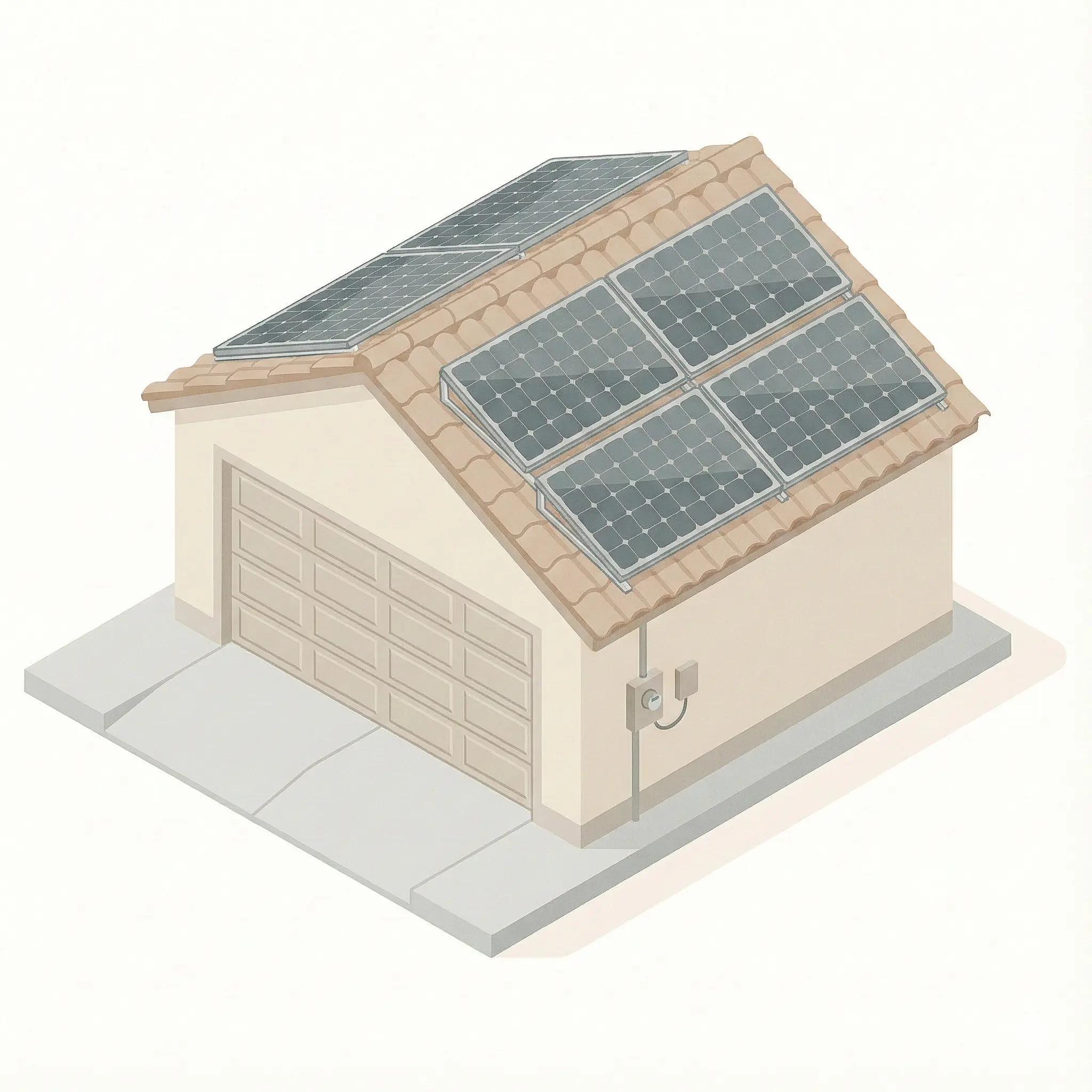
The residential solar energy landscape in the United States is undergoing a significant architectural shift. As homeowners exhaust the viable surface area of their primary dwellings—or seek to preserve the aesthetic integrity of street-facing rooflines—the detached garage has emerged as a critical frontier for photovoltaic (PV) deployment. This report, produced from the perspective of technical investigative analysis, provides an exhaustive examination of the engineering, regulatory, financial, and logistical complexities inherent in electrifying detached accessory structures.
Unlike standard rooftop installations, the "garage solar" paradigm introduces a distinct set of challenges and opportunities. Our research indicates that while detached structures offer unique advantages—specifically regarding increased energy storage limits under NFPA 855 and potential exemptions from Rapid Shutdown requirements under NEC 2023—they simultaneously present acute risks regarding structural integrity, insurance under-coverage, and interconnection complexity.
This document serves as a deep-dive resource for homeowners, installers, and policymakers. It synthesizes data from structural engineering protocols, National Electrical Code (NEC) interpretations, insurance actuarial standards, and real-world user experiences to provide a granular roadmap for navigating the detached solar project. The analysis reveals that the success of these installations hinges not merely on panel wattage, but on the successful management of "balance of system" factors: the thermal protection of batteries in unconditioned spaces, the physics of voltage drop over extended feeder circuits, and the legal nuances of "Other Structures" insurance endorsements.
1. Structural Integrity and Engineering Feasibility
The foundational viability of any solar project rests on the host structure’s ability to bear static and dynamic loads. Detached garages in the US housing stock, particularly those built prior to 1980, frequently deviate from the framing standards applied to primary residences. This discrepancy necessitates a rigorous structural audit before permit application.
1.1 The Rafter Dimension Deficit
A prevailing issue identified in the analysis of older detached garages is the widespread use of nominal 2x4 lumber for roof rafters, often spaced at 24 inches on center. Modern residential codes typically mandate 2x6 or deeper members to accommodate snow loads and prevent deflection.
- Deflection Criteria: Structural guidelines explicitly state that rafters exhibiting roof sag—measured in inches as greater than the rafter length in feet divided by 20—are structurally deficient for solar loads. 1 For example, a 10-foot rafter run should not exhibit more than 0.5 inches of sag.
- The 2x4 Challenge: In the case of a 1927-era garage featuring "old growth" redwood 2x4 rafters, engineering discourse highlights a critical distinction between wood quality and dimensional capacity. While old-growth lumber possesses superior density and shear strength compared to modern spruce-pine-fir (SPF), the geometric constraints of a 2x4 spanning significant distances (e.g., over 8 feet) often result in failure under the combined "dead load" of the array and "live loads" of wind or snow. 2
- Load Sharing Factors: The International Building Code (IBC) Table A2.2 illustrates that load-sharing factors—the ability of adjacent rafters to assist a loaded member—drop precipitously for 2x4s compared to 2x8s, especially when sheathed with thinner materials like 7/16" OSB. 3
1.2 Remediation Strategies and "Sistering"
When a garage roof fails the initial span check, the standard engineering remedy is "sistering." This process involves bolting a new, dimensionally larger lumber member (e.g., a 2x6) alongside the existing 2x4 rafter.
- Engineering Consensus: Professional commentary suggests that while a 550 lb array (comprising ten 400W panels) averages only ~3 lbs per square foot—less than the weight of two layers of asphalt shingles—the point loading on mid-span rafters requires reinforcement to prevent long-term creep and sagging. 2
- The Cost of Compliance: Homeowners are advised to budget for "wet stamped" engineering plans. Services like GreenLancer are frequently cited as necessary to generate the engineering statements required by permitting offices to certify that an older structure meets current codes. 2
1.3 Roof Sheathing and Anchor Pull-Out
The interface between the solar racking and the roof is defined by the lag screw's "pull-out" strength.
- Material Limitations: Many detached garages utilize spaced plank sheathing (common in cedar shake eras) or thin 7/16" OSB. These materials offer reduced purchase for lag screws compared to the 5/8" or 3/4" CDX plywood found on main dwellings.
- Attachment Protocol: To mitigate this, installers must prioritize hitting the center of the rafter. Missed pilots in thin garage sheathing are a primary vector for leaks and structural failure during high-wind events. The use of specialized racking solutions, such as the IronRidge XR series, is recommended to ensure load distribution across multiple rafters, thereby reducing the stress on any single point of attachment. 2
2. Electrical Interconnection: The Trenching and Feeder Equation
Connecting a detached power plant to the main grid requires bridging the physical gap between the garage and the main service panel (MSP). This "feeder circuit" represents the single largest variable cost in garage solar projects and involves complex trade-offs between labor, material cost, and electrical efficiency.
2.1 The Physics of Trenching
Trenching is the most labor-intensive component of the interconnection process.
- Cost Realities: The average cost for professional trenching hovers around $950 but fluctuates wildly based on geology and obstacles. Standard rates range from $5 to $12 per linear foot, but "challenging digs" involving rocky soil or existing hardscape can spike to $40 per foot. 6
- Depth Requirements:
- PVC Conduit: Requires a trench depth of 18 inches to the top of the pipe to meet code. This is the standard for most residential jobs but carries a higher risk of striking existing utility lines due to the depth. 7
- Rigid Metal Conduit (RMC): Offers a strategic alternative. RMC allows for a shallow burial depth of just 6 inches (where not subject to vehicle traffic). While the material cost of threaded steel pipe is significantly higher than PVC, the drastic reduction in labor (digging 6 inches vs. 18 inches) can make it the more economical choice for DIYers or sites with difficult soil. 7
- User Experiences: In one case study, a homeowner paid an additional $2,680 solely for the trenching and conduit work to connect a garage 100 feet away. 8 Conversely, DIY estimates for material alone (conduit and wire) can be as low as $15.75 per linear foot, provided the homeowner performs the excavation. 9
2.2 Voltage Drop: The Silent Efficiency Killer
As the distance between the garage inverter and the main panel increases, the resistance of the wire converts valuable solar energy into waste heat—a phenomenon known as voltage drop.
-
The 3% Rule: The NEC recommends keeping voltage drop under 3% for branch circuits. For a garage 100+ feet away, this physics constraint dictates the wire size more than the ampacity rating of the circuit. 10
-
The Calculation:
$$VD = \frac{2 \cdot L \cdot I \cdot R}{1000}$$
Where L is the one-way length, I is the current, and R is the resistance per 1,000 feet.
- Scenario: A 150-foot run carrying 8.23 amps on standard #14 wire results in a 7.75-volt drop. On a 120V circuit, this is a 6.4% drop, well above the 3% limit, potentially causing inverter faults or dimming lights. Upgrading to #12 wire reduces resistance, bringing the drop to ~4.98 volts (4.1%), which is still marginal. 11
-
The Aluminum Solution: To combat voltage drop without incurring the prohibitive cost of heavy-gauge copper, aluminum feeder wire is the industry standard for subpanels. "Sweet spot" pricing often makes #2 Aluminum (rated for ~90A) cheaper than #6 Copper (rated for ~55A). Although aluminum has higher resistance, the massive gauge increase more than compensates, lowering voltage drop significantly for long runs. 12
-
The Transformer "Hack": For extreme distances where voltage drop makes low-voltage runs impractical, technical discussions highlight a transformer-based solution. By stepping up voltage to 240V at the source and stepping it down to 120V at the load, current is halved, and voltage drop is quartered. This allows for the use of smaller, cheaper wire over long distances, utilizing readily available 5kVA transformers. 7
2.3 Subpanel Sizing and EV Integration
The detached garage is rarely just a solar host; it is increasingly an energy hub for Electric Vehicle (EV) charging.
- Load Calculation: A standard 60-amp subpanel in a garage may be insufficient for a modern solar-plus-EV setup. An EV charger (drawing 48A continuous on a 60A breaker) leaves little headroom.
- Dynamic Load Management: To avoid costly service upgrades (e.g., trenching new 100A lines), smart EV chargers (e.g., Wallbox, Tesla Universal Wall Connector) can now integrate with power meters to perform dynamic load management. These systems monitor the total subpanel load and throttle the EV charging speed in real-time if other loads (like an air compressor or welder) spike, ensuring the feeder breaker never trips. 14
- Future-Proofing Conduit: A recurring "regret" in user testimonials is undersizing the conduit. Installing 1.5-inch or 2-inch conduit costs marginally more in materials but allows for the future pulling of heavy-gauge wires for bi-directional charging or Level 2 chargers, which 1-inch conduit often cannot accommodate. 13
3. The Regulatory Maze: NEC 2023, Fire Codes, and Rapid Shutdown
The regulatory environment for detached structures is currently in a state of flux, with significant ambiguity surrounding the interpretation of "Rapid Shutdown" rules in the 2023 National Electrical Code (NEC).
3.1 The Rapid Shutdown (RSD) Controversy
Rapid Shutdown requirements (NEC 690.12) were introduced to protect firefighters from high-voltage DC shock when accessing a roof during a fire. The code mandates that conductors inside the array boundary be de-energized to 80V or less within 30 seconds of switch activation.
- The "Non-Enclosed" Exception: A critical update in NEC 2023, Section 690.12 Exception No. 2, explicitly exempts PV equipment on "non-enclosed detached structures" from RSD requirements. This includes carports, solar trellises, and parking shade structures. 17
- The Logic: Firefighters do not perform vertical ventilation operations (cutting holes in the roof) on open-air carports. Therefore, the risk of shock is negligible, and the cost of RSD hardware (optimizers/microinverters) is deemed unnecessary. 19
- The Garage Ambiguity: The controversy arises with the enclosed detached garage. Structurally, it is detached like a carport. However, because it is "enclosed" (having walls), it falls under the definition of a "building" where rooftop operations might occur.
- Strict Interpretation: Most Authorities Having Jurisdiction (AHJs) interpret that standard enclosed garages do not qualify for the exception. They require full Rapid Shutdown compliance, necessitating the use of Module Level Power Electronics (MLPE). 20
- Impact: Homeowners hoping to save costs by using simple string inverters (without optimizers) on a detached garage will likely fail inspection if the structure has walls, despite being detached from the dwelling unit. 20
3.2 Fire Code Setbacks and Pathways
Fire codes (NFPA 1 and International Fire Code) mandate clear pathways on roofs for firefighter access.
- Standard Setbacks: For residential roofs, a 36-inch pathway from gutter to ridge is typically required, along with an 18-inch to 36-inch setback from the ridge itself to allow for smoke ventilation cuts. 22
- The "Group U" Loophole: An obscure but vital exception exists in some jurisdictions for "Group U" structures (Utility/Miscellaneous). Research suggests that unoccupied, non-habitable detached structures may not require the same 3-foot setbacks as the main residence. 24
- Verification: This is highly jurisdiction-specific. If a garage contains an Accessory Dwelling Unit (ADU) or even a finished office, it loses this "Group U" status and must comply with strict residential setbacks. 20
3.3 Arc Fault Protection (AFCI)
Regardless of the structure's status, DC circuits operating at 80V or greater "on or in" a building must have Arc-Fault Circuit Interrupter (AFCI) protection to prevent fires caused by loose connections. 26
- Metal Conduit Exception: Code provides an exception for circuits run entirely in metal raceways (conduit) or enclosed metal cable trays. In theory, if a garage array's DC runs are fully enclosed in metal conduit from the panel to the inverter, component-level AFCI might be waived, though practically, most modern inverters include this protection inherently. 26
4. The Storage Opportunity: Batteries in the Garage
Perhaps the most significant advantage of the detached garage is its favorable treatment under energy storage safety codes, specifically NFPA 855.
4.1 Expanding Storage Limits
As residential battery systems grow (e.g., 100 kWh+ for whole-home backup), the main residence becomes a restrictive envelope.
- The 40 kWh Cap: Inside a dwelling unit or attached garage, fire codes typically cap aggregate energy storage at 40 kWh.
- The 80 kWh Allowance: For detached garages and accessory structures, this limit is often doubled to 80 kWh. 27 This regulatory allowance makes the detached garage the only viable location for massive "off-grid style" battery banks (e.g., 4-6 Tesla Powerwalls or large server-rack banks) without requiring expensive fire-rated dedicated rooms.
4.2 The Thermal Challenge: LiFePO4 in the Cold
While the code permits batteries in the garage, the physics of Lithium-Iron Phosphate (LiFePO4) chemistry presents a challenge.
- The Freezing Threshold: LiFePO4 batteries generally cannot be charged below freezing (32°F / 0°C). Doing so causes permanent plating of metallic lithium on the anode, destroying the cell.
- Insulation and Heating: Detached garages are often unconditioned. Investigative analysis of DIY solutions reveals a robust community practice of building insulated battery cabinets utilizing rigid foam insulation and low-wattage heating elements.
- Seedling Mat Solution: A common, cost-effective method involves using seedling heat mats controlled by a temperature switch (thermostat) inside the battery cabinet. These mats provide gentle, non-combustible heat to keep the cells above 40°F during winter nights. 30
- Enclosure Options: For those avoiding DIY, specialized insulated enclosures (e.g., from MidNite Solar) are available but expensive. The market lacks affordable, pre-insulated residential battery cabinets, forcing many to rely on custom solutions. 32
4.3 Fire Detection Requirements
NFPA 855 mandates fire detection in areas containing Energy Storage Systems (ESS).
- Heat vs. Smoke: In a garage environment, standard smoke alarms are prone to false positives from vehicle exhaust. Consequently, code requires the installation of a heat detector interconnected with the main dwelling's smoke alarm system. 27
- Impact Protection: Batteries installed in a garage must be protected from vehicle impact. This usually necessitates the installation of bollards or wheel stops if the battery is mounted on a wall that a car pulls up to. 33
5. Financial Implications: Insurance, Appraisal, and Taxes
The financial profile of a garage solar project is distinct from a rooftop install, primarily due to the way insurance policies classify "Other Structures."
5.1 The Insurance Coverage Gap
This is the single most critical financial risk identified in the report.
- Coverage B (Other Structures): Standard Homeowners policies (HO-3) cover the main house under "Coverage A." Detached structures (garages, sheds) fall under "Coverage B."
- The 10% Trap: Coverage B is typically capped at 10% of the Coverage A limit automatically.
- The Math: If a home is insured for $400,000, the total coverage for all detached structures is $40,000.
- The Risk: A high-end detached garage might have a replacement value of $30,000 on its own. Adding a $30,000 solar-plus-storage system pushes the total value to $60,000—well beyond the $40,000 cap. In the event of a total loss (fire), the homeowner would be underinsured by $20,000. 35
- The Fix: Homeowners must contact their agent to add a specific endorsement increasing Coverage B limits. This is often a nominal monthly cost but is strictly necessary to protect the asset. 38
5.2 Property Value and Appraisals
- Owned vs. Leased: Solar systems only increase property appraisal value if they are owned (cash or loan). Leased systems are liabilities (personal property) that do not transfer value to the real estate. 39
- Valuation Metrics: Studies indicate a home value increase of approximately $20 for every $1 of annual utility savings. For a garage system saving $1,000/year, this equates to a $20,000 value bump. 41 However, this value is contingent on the system being functional and aesthetically acceptable.
5.3 Federal Tax Credits (ITC)
- Eligibility of Ancillary Costs: The 30% Federal Investment Tax Credit (ITC) is applicable to the solar equipment and "balance of system" costs.
- Inclusions: Trenching, conduit, and subpanel upgrades required for the solar installation are generally considered eligible expenses. 42
- Exclusions: General repairs, such as replacing the entire garage roof because it was old, are typically not eligible, although the specific "solar roofing" products (like solar shingles) would be. 43
6. Connectivity: The Digital Lifeline
Modern inverters and battery systems are IoT devices requiring constant internet connection for firmware updates, warranty validation, and user monitoring. The detached garage poses a "digital gap" that is often overlooked until the end of the project.
6.1 Data Connection Strategies
- WiFi Extenders: The most common "first try," often resulting in frustration. Inverters mounted inside metal garages or behind thick stucco struggle to maintain connection with a house router 50 feet away. 44
- Powerline Adapters (EoP): These devices send data signals over the electrical wires. While theoretically sound, the high-frequency noise generated by solar inverters and MPPT controllers can severely degrade the signal, making them unreliable for solar monitoring. 44
- Hardwired Ethernet: The "Gold Standard." If trenching for power, best practice dictates laying a second, separate conduit (1-inch PVC) specifically for outdoor-rated CAT6 ethernet cable. This ensures bulletproof data connectivity for the inverter and any future smart EV chargers. 44
- Wireless Bridges: For scenarios where trenching data lines is impossible, a Point-to-Point (PtP) Wireless Bridge (e.g., Ubiquiti NanoStation) is the recommended solution. Unlike standard WiFi extenders, these directional radios create a dedicated high-speed link between the house and garage, easily punching through walls and distance. 47
7. Legal and Zoning: HOAs and Aesthetics
7.1 The "Street-Facing" Battle
Detached garages are often situated in ways that make their roof planes highly visible from the street, triggering Homeowners Association (HOA) architectural review conflicts.
- Solar Rights Acts: Many states (e.g., Florida, California) have statutes preventing HOAs from prohibiting solar. Florida Statute 163.04 specifically forbids HOAs from denying permission, though they can dictate location unless that location impairs performance. 48
- Performance Metrics: The legal standard often revolves around efficiency. If an HOA demands the panels be moved to the rear (north-facing) roof to be hidden, and that move reduces production by more than 10%, the HOA's demand is typically unenforceable. Homeowners must come armed with "shading reports" and production estimates to prove that the street-facing garage roof is the only viable option. 48
Table 2: Comparison of Solar Siting - Main House vs. Detached Garage
| Feature | Main House Roof | Detached Garage Roof |
|---|---|---|
| Structural Risks | Low (Standard Framing) | High (Older 2x4 Rafters common) |
| Electrical Cost | Low (Close to MSP) | High (Trenching & Feeder Wire) |
| Battery Limit (NFPA 855) | 40 kWh | 80 kWh |
| Rapid Shutdown (NEC 2023) | Required | Exempt (Only if non-enclosed/carport) |
| Insurance Risk | Covered (Coverage A) | High Risk (Coverage B Cap) |
| Aesthetics | Often Street Facing | Can be Hidden (depending on lot) |
Conclusion
The deployment of solar photovoltaic systems on detached garages represents a high-reward, high-complexity strategy for residential energy independence. For homeowners, the detached garage is a "sleeping giant"—a structure that, with the right engineering, can host larger battery banks and massive solar arrays without cluttering the primary residence's roofline.
However, the "balance of system" complexity cannot be overstated. The project requires a convergence of structural reinforcement (sistering rafters), electrical heavy-lifting (trenching and voltage drop calculations), and savvy insurance management (increasing Coverage B limits). The regulatory landscape remains a minefield, particularly regarding the interpretation of "enclosed" structures for Rapid Shutdown exemptions.
Ultimately, the detached garage solar project is not a DIY weekend task but a significant infrastructure upgrade. When executed correctly—respecting the physics of voltage drop, the chemistry of battery thermal management, and the constraints of structural engineering—it transforms a simple parking structure into a resilient, decentralized power plant.
Legal Disclaimer
This report is for informational purposes only and does not constitute legal, financial, or engineering advice. Building codes (NEC, IBC, IRC) and fire codes (NFPA) vary significantly by state and municipality. Homeowners should consult with licensed structural engineers, master electricians, and insurance professionals to verify compliance with local regulations and to assess the specific conditions of their property.
Works cited
- Structural Criteria for Residential Rooftop Solar Energy Installations - Anaheim.net, accessed December 1, 2025, https://www.anaheim.net/DocumentCenter/View/9420/PV-Structural-Criteria
- Panel Weight and Roof Reinforcement | DIY Solar Power Forum, accessed December 1, 2025, https://diysolarforum.com/threads/panel-weight-and-roof-reinforcement.69166/
- Detailed Structural Commentary for Rooftop PV Arrays for the National Simplified Residential PV and Energy Storage Permit Guidelines - SolSmart, accessed December 1, 2025, https://solsmart.org/wp-content/uploads/2021/09/Step_6_Detailed_Simplified_Permit_PV_ESS_Commentary_9.16.21.pdf
- Structural Requirements for Residential Solar Panels — APE, accessed December 1, 2025, https://www.apestructures.com/ape-blog/h8rls3iqy8o1dccgei51d6agztpriu
- Weight on Roof - Should I be Worried? : r/solar - Reddit, accessed December 1, 2025, https://www.reddit.com/r/solar/comments/wu75by/weight_on_roof_should_i_be_worried/
- How Much Does Trenching Cost? [2025 Data] - HomeAdvisor, accessed December 1, 2025, https://www.homeadvisor.com/cost/landscape/trenching/
- Trenching and running power to detached garage about 135 feet away, accessed December 1, 2025, https://diy.stackexchange.com/questions/123662/trenching-and-running-power-to-detached-garage-about-135-feet-away
- Can I request to have my solar system installed on my detached garage? : r/TeslaSolar, accessed December 1, 2025, https://www.reddit.com/r/TeslaSolar/comments/ujzknb/can_i_request_to_have_my_solar_system_installed/
- How Much Does It Cost to Dig a Trench? [2025 Data] - Angie's List, accessed December 1, 2025, https://www.angi.com/articles/trenching-cost.htm
- Solar Voltage Drop Calculator (Everything You Need to Know) - ShopSolar, accessed December 1, 2025, https://shopsolarkits.com/blogs/learning-center/solar-voltage-drop-calculator
- How to Calculate Voltage Drop in Solar Systems - Electrical Trader, accessed December 1, 2025, https://electricaltrader.com/blogs/news/how-to-calculate-voltage-drop-in-solar-systems
- Voltage Drop for a Residential Sub Panel to a Detached Garage - Home Improvement Stack Exchange, accessed December 1, 2025, https://diy.stackexchange.com/questions/227737/voltage-drop-for-a-residential-sub-panel-to-a-detached-garage
- Wiring for EV chargers in detached garage - Home Improvement Stack Exchange, accessed December 1, 2025, https://diy.stackexchange.com/questions/237228/wiring-for-ev-chargers-in-detached-garage
- Adding an EV Charger to Garage Sub Panel? : r/AskElectricians - Reddit, accessed December 1, 2025, https://www.reddit.com/r/AskElectricians/comments/1n67b1q/adding_an_ev_charger_to_garage_sub_panel/
- Best load-management solution for two EVSEs on a 100A subpanel : r/evcharging - Reddit, accessed December 1, 2025, https://www.reddit.com/r/evcharging/comments/18kj2sg/best_loadmanagement_solution_for_two_evses_on_a/
- What do you wish you'd known before you installed solar panels on your home. - Reddit, accessed December 1, 2025, https://www.reddit.com/r/solar/comments/xwdsol/what_do_you_wish_youd_known_before_you_installed/
- 2023 NEC Updates to Rapid Shutdown Requirements - Mayfield Renewables, accessed December 1, 2025, https://www.mayfield.energy/technical-articles/2023-nec-updates-to-rapid-shutdown-requirements/
- 690.12 Rapid Shutdown of PV Systems on Buildings. - Electrical License Renewal, accessed December 1, 2025, https://www.electricallicenserenewal.com/Electrical-Continuing-Education-Courses/NEC-Content.php?sectionID=1549
- Do solar shade structures on commercial parking garages need rapid shutdown, accessed December 1, 2025, https://forums.mikeholt.com/threads/do-solar-shade-structures-on-commercial-parking-garages-need-rapid-shutdown.2581079/
- Panel setback on roof of non dwelling | DIY Solar Power Forum, accessed December 1, 2025, https://diysolarforum.com/threads/panel-setback-on-roof-of-non-dwelling.92875/
- Are rapid shut downs required on a detached garage? : r/diySolar - Reddit, accessed December 1, 2025, https://www.reddit.com/r/diySolar/comments/1albmss/are_rapid_shut_downs_required_on_a_detached_garage/
- Residential Solar Panel Requirements - NFPA, accessed December 1, 2025, https://www.nfpa.org/news-blogs-and-articles/blogs/2024/02/29/residential-solar-panel-requirements
- 2018 Modified Roof Setbacks for Residential Solar PV Systems, accessed December 1, 2025, https://www.solarelectricsupply.com/media/sparsh/product_attachment/CALSSA_Modified_Setbacks_and_Pathways_06-20-2018.pdf
- Fire Code Offsets For Detached Structures - Mike Holt's Forum, accessed December 1, 2025, https://forums.mikeholt.com/threads/fire-code-offsets-for-detached-structures.128600/
- Fire setbacks for detached garages : r/solar - Reddit, accessed December 1, 2025, https://www.reddit.com/r/solar/comments/r8wa4p/fire_setbacks_for_detached_garages/
- California Rapid Shutdown Requirements | DIY Solar Power Forum, accessed December 1, 2025, https://diysolarforum.com/threads/california-rapid-shutdown-requirements.90891/
- Energy Storage System (ESS) - Town of Wayland, accessed December 1, 2025, https://www.wayland.ma.us/building-department/pages/energy-storage-system-ess
- Residential Energy Storage System Regulations - NFPA, accessed December 1, 2025, https://www.nfpa.org/news-blogs-and-articles/blogs/2021/10/01/residential-energy-storage-system-regulations
- New Winter Battery Shed Build-Canada | DIY Solar Power Forum, accessed December 1, 2025, https://diysolarforum.com/threads/new-winter-battery-shed-build-canada.97292/
- How to Build a Heated Insulated Battery Box for Off Grid Solar Power - YouTube, accessed December 1, 2025, https://www.youtube.com/watch?v=OjP0Mwi0tlk
- The Best Battery Enclosure looks like this?! (Self-Heating) - YouTube, accessed December 1, 2025, https://www.youtube.com/watch?v=f-mWmhh7i0U
- Battery Box Enclosures - The Solar store, accessed December 1, 2025, https://thesolarstore.com/collections/battery-box-enclosures
- Energy Storage System Permits | Brookline, MA - Official Website, accessed December 1, 2025, https://www.brooklinema.gov/3576/Energy-Storage-System-Permits
- New Residential Energy Storage Code Requirements, accessed December 1, 2025, https://sustainableenergyaction.org/resources/new-code-requirements-for-residential-energy-storage-systems/
- Understanding Other Structures Coverage [Insure It All] - Hippo Insurance, accessed December 1, 2025, https://www.hippo.com/learn-center/other-structures-coverage
- Do Solar Panels Affect My Home Insurance?, accessed December 1, 2025, https://grimesinsurance.com/do-solar-panels-affect-my-home-insurance/
- Other Structures Coverage - Homeowners Insurance - Lemonade, accessed December 1, 2025, https://www.lemonade.com/homeowners/explained/other-structures/
- Does Homeowners Insurance Cover Solar Panels? - Policygenius, accessed December 1, 2025, https://www.policygenius.com/homeowners-insurance/solar-panel-insurance/
- Solar Appraisal Value - Kokosing Solar, accessed December 1, 2025, https://kokosingsolar.com/solar-appraisal-value/
- Do solar panels add to the value of a home? : r/RealEstate - Reddit, accessed December 1, 2025, https://www.reddit.com/r/RealEstate/comments/xii5k4/do_solar_panels_add_to_the_value_of_a_home/
- Do Solar Panels Increase Home Value? - This Old House, accessed December 1, 2025, https://www.thisoldhouse.com/solar-alternative-energy/do-solar-panels-increase-home-value
- Federal Tax Credits for Energy Efficiency, accessed December 1, 2025, https://www.energystar.gov/about/federal-tax-credits
- USA: Main panel upgrade with solar qualifies for federal tax credit or not - Reddit, accessed December 1, 2025, https://www.reddit.com/r/solar/comments/1i9v5xm/usa_main_panel_upgrade_with_solar_qualifies_for/
- How to Get Internet in My Detached Garage, accessed December 1, 2025, https://www.danleys.com/blog/get-detached-garage-internet/
- I have just had a solar panel system installed on my garage - JustAnswer, accessed December 1, 2025, https://www.justanswer.co.uk/electronics/m4nhd-just-solar-panel-system-installed-garage.html
- What's the Best way to extend WiFi to detached garage and backyard? : r/smarthome, accessed December 1, 2025, https://www.reddit.com/r/smarthome/comments/su64mj/whats_the_best_way_to_extend_wifi_to_detached/
- Wireless solution to feed CT clamp data to hybrid inverter | DIY Solar Power Forum, accessed December 1, 2025, https://diysolarforum.com/threads/wireless-solution-to-feed-ct-clamp-data-to-hybrid-inverter.46853/
- Florida COA & HOA Restrictions on Solar Panels | The Orlando Law Group, accessed December 1, 2025, https://www.theorlandolawgroup.com/blog/all/florida-coa-hoa-restrictions-on-solar-panels-what-you-need-to-know/