Michigan Solar Incentives 2025: The Complete Homeowner’s Guide
Executive Summary
For homeowners in Michigan, the landscape of home energy is shifting rapidly. Rising electricity rates, increasing concerns about grid reliability during severe weather, and a global push toward renewable energy have brought solar power into the mainstream conversation. However, for the average resident, the decision to install solar panels is rarely about global trends—it is about the kitchen table budget. It is about monthly bills, upfront costs, and the practical return on investment.
Navigating the web of federal tax codes, state legislation, and utility company rate books can feel overwhelming. Information is often scattered, outdated, or buried in dense legal jargon. This report aims to dismantle that complexity. It provides a comprehensive, plain-language analysis of every financial incentive, legal protection, and economic reality facing Michigan homeowners considering solar energy in 2025.
The analysis indicates that while Michigan does not offer massive upfront cash rebates like some sunnier states, the combination of federal tax credits, state-sponsored low-interest financing, and new legal protections for homeowners creates a compelling financial case. The data suggests that for many households, the “payback period”—the time it takes for the system to pay for itself—is between 9 and 12 years, leaving decades of essentially free electricity thereafter. 1
TL;DR: The “Too Long; Didn’t Read” Summary
For readers seeking an immediate understanding of the bottom line without navigating the full depth of the report, the following summary highlights the most critical incentives active in 2025.
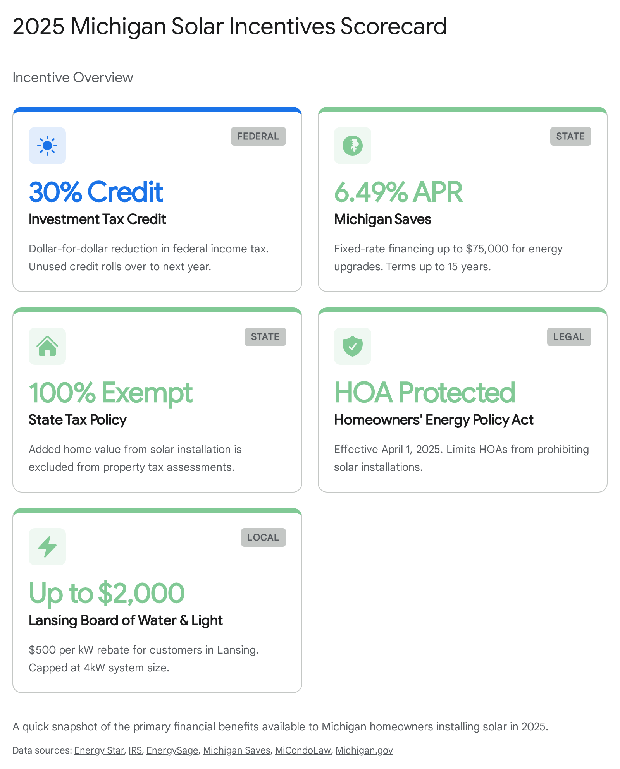
- The Federal Heavy Lifter: The United States government continues to offer the Residential Clean Energy Credit. This allows homeowners to deduct 30% of the entire solar project cost from their federal income taxes. This incentive is stable and available through 2032. 3
- The State Financing Engine: Michigan Saves, the state's green bank, provides unsecured personal loans for solar projects. For 2025, interest rates are typically between 6.49% and 6.75%, with terms extending up to 15 years, making monthly payments manageable without requiring home equity. 5
- The Lansing Exclusive: Residents served by the Lansing Board of Water & Light (BWL) are eligible for a rare cash rebate of $500 per kilowatt, capped at $2,000. This is currently the most significant utility‑specific cash incentive in the state. 7
- The Property Tax Shield: Michigan law dictates that the value added to a home by a solar energy system is exempt from property taxes. Homeowners gain the market value of the upgrade without suffering a higher annual tax bill. 9
- The HOA Key: Effective April 1, 2025, the Homeowners' Energy Policy Act effectively bans Homeowners Associations from prohibiting rooftop solar, granting residents in subdivisions new rights to generate their own power. 11
- The Utility Reality: Major utilities like DTE and Consumers Energy operate under a “Distributed Generation” model, not traditional Net Metering. This means they pay significantly less for exported power than they charge for imported power, making system sizing and battery storage critical calculations. 13
---
Part 1: The Federal Investment Tax Credit (ITC)
The cornerstone of solar affordability in the United States is the Federal Residential Clean Energy Credit, widely referred to as the Investment Tax Credit (ITC). For Michigan homeowners, this single policy is responsible for slashing nearly one‑third of the upfront cost of going solar. It is not a rebate check that arrives in the mail; rather, it is a dollar‑for‑dollar reduction in the income taxes a household owes to the federal government.
The Mechanics of the 30% Credit
The Inflation Reduction Act of 2022 secured the stability of this credit for a decade. Through December 31, 2032, homeowners can claim a credit equal to 30% of their total system cost. 4 It is important to clarify that this is a credit, not a deduction. A tax deduction merely lowers the income on which a person is taxed, but a tax credit directly reduces the tax bill itself.
For example, if a homeowner purchases a solar system for $20,000, the credit amount is $6,000. If that homeowner owes the IRS $10,000 in taxes for the year, applying the credit would reduce that liability to $4,000. If the taxes were already paid through paycheck withholdings, the IRS would refund the difference.
Comprehensive Coverage of Costs
One of the most favorable aspects of the ITC is its broad definition of “qualified expenses.” The 30% rate applies to a wide array of costs associated with the installation, not just the solar panels themselves.
The IRS allows the credit to be applied to:
- Solar Photovoltaic (PV) Panels: The actual hardware that sits on the roof or ground.
- Balance of System Equipment: This includes wiring, inverters (which convert the electricity from DC to AC), and mounting racking.
- Labor Costs: All onsite labor for preparation, assembly, and original installation is covered, including permitting fees and inspection costs.
- Energy Storage Technology: Batteries with a capacity of at least 3 kWh are fully eligible for the 30% credit, even if they are installed separately from the solar panels. 3
- Sales Taxes: Any sales tax paid on the eligible equipment can be included in the total cost basis.
However, there are strict limits. The credit generally does not cover roof repairs or replacements, even if the repair is necessary to support the solar panels. For instance, if a homeowner spends $15,000 on a new shingle roof and $20,000 on solar panels, they can typically only claim the 30% credit on the $20,000 solar portion. 15
Eligibility and the “Primary Residence” Rule
To qualify for the credit, the solar system must be installed in a home located in the United States used as a residence by the taxpayer. This includes a primary residence (where the person lives most of the time) and can also apply to a secondary residence, such as a vacation cottage in Northern Michigan, provided the taxpayer uses it as a home and does not rent it out. 4
The credit is available for existing homes and new construction. However, it is generally not available for properties that are exclusively used as rentals. Landlords have different tax incentives (often the Commercial ITC), but the Residential Clean Energy Credit discussed here is strictly for residents. 4
The “Non‑Refundable” Nuance and Carryover
A common point of confusion regards the “non‑refundable” nature of the credit. Being non‑refundable means that the credit cannot exceed the amount of tax a person owes. If a homeowner earns a $6,000 credit but only owes $4,000 in federal taxes for the year, the IRS will not send a check for the extra $2,000.
However, the value is not lost. The tax code allows the unused portion of the credit to be carried forward to future tax years. 4 In the scenario above, the remaining $2,000 credit would “roll over” to the next year’s tax return, reducing the tax liability for that year. This carryover mechanism ensures that retirees or those with lower annual tax liabilities can still eventually capture the full value of the incentive, provided they pay some federal taxes over time. 4
Filing the Claim
Claiming the incentive is a standardized part of the annual tax filing process. Homeowners must complete IRS Form 5695 (Residential Energy Credits). 10
- Documentation: It is vital to retain the final invoice from the solar installer, which clearly itemizes the cost of the system.
- Form 5695: The taxpayer enters the total qualified costs on Part I of the form to calculate the credit.
- Form 1040: The result flows onto the main tax return (Form 1040), lowering the total tax due.
While the credit is secure through 2032, the rate is scheduled to decrease in the future: it will drop to 26% in 2033 and 22% in 2034. 4 For the entirety of 2025, however, the full 30% rate is in effect.
---
Part 2: Financing Solar in Michigan – The “Green Bank” Advantage
While the federal tax credit is substantial, it is a backend incentive—homeowners usually have to wait until tax season to see the money. The hurdle of the upfront cost remains. A typical residential solar array in Michigan (6‑7 kW) often carries a gross price tag between $15,310 and $21,435. 16 For many families, paying this amount in cash is not feasible.
To bridge this gap, Michigan utilizes a specialized financial tool known as Michigan Saves.
Understanding Michigan Saves
Michigan Saves operates as the state’s “green bank.” It is a nonprofit organization dedicated to making energy improvements accessible. It does not lend money directly; rather, it facilitates loans by partnering with a network of credit unions and banks. By providing a loan loss reserve—essentially an insurance policy for the lenders—Michigan Saves allows these credit unions to offer loans with lower interest rates and more flexible terms than they would for a standard personal loan. 5
The 2025 Loan Terms
For the year 2025, the Michigan Saves Home Energy Loan offers terms that are generally superior to high‑interest credit cards or unsecured personal loans from national banks.
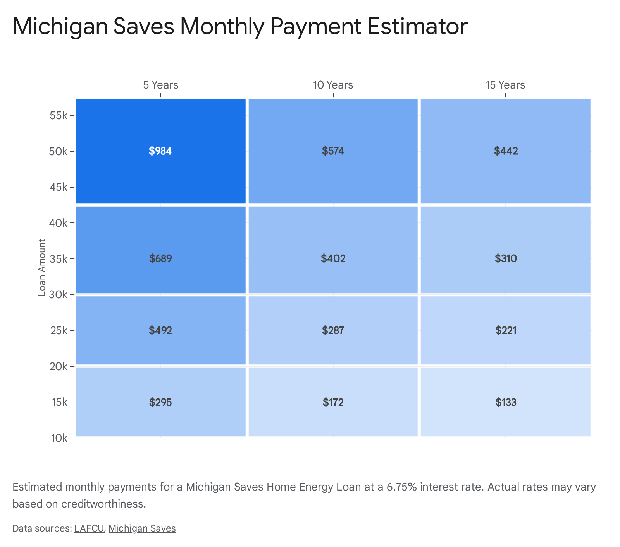
- Interest Rates: Rates are typically fixed around 6.49% to 6.75%. 5
- Loan Limits: Homeowners can borrow from as little as $1,000 up to $75,000. 5
- Repayment Terms: The repayment period can extend up to 15 years (180 months). 6
Unsecured vs. Secured Financing
A critical advantage of the Michigan Saves program is that the loans are unsecured. Unlike a Home Equity Line of Credit (HELOC) or a second mortgage, the Michigan Saves loan does not use the borrower’s home as collateral. 5 This means there is no lien placed on the property, and the homeowner does not risk foreclosure specifically due to defaulting on the solar loan. This structure simplifies the process, avoids appraisal fees, and speeds up approval times.
The Authorized Contractor Requirement
Accessing these loans requires working with a Michigan Saves Authorized Contractor. The program vets contractors to ensure they meet insurance and licensing requirements. A homeowner cannot simply hire a handyman or perform a DIY installation and qualify for this specific financing. The process typically involves the contractor providing a unique code or link to the homeowner, who then applies online. Decisions are often rendered in minutes. 5
---
Part 3: The Utility Situation – DTE, Consumers Energy, and “Outflow”
Perhaps the most complex aspect of solar in Michigan—and the source of significant frustration for some homeowners—is the relationship with the utility company. Understanding how the utility credits solar energy is essential for calculating the true return on investment.
Historically, Michigan operated under “Net Metering,” a simple system where every kilowatt‑hour (kWh) sent to the grid was credited at the full retail rate. If a homeowner bought a kWh for 15 cents and sold one back for 15 cents, it was an even trade.
This system has been replaced by Distributed Generation (DG).
The “Inflow/Outflow” Model
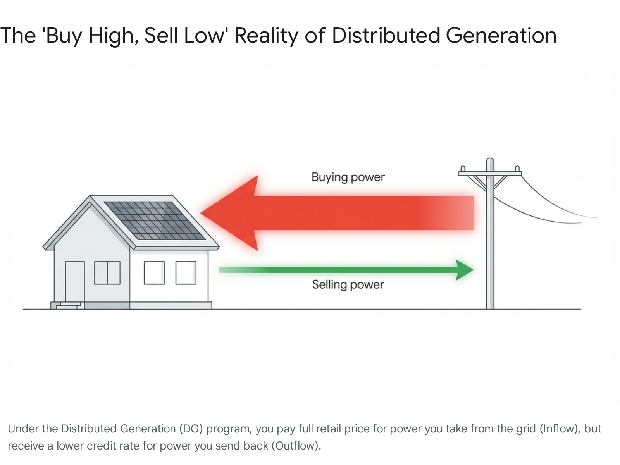
Under the DG program used by DTE Energy and Consumers Energy, the transaction is split into two distinct parts: Inflow and Outflow. This model treats the homeowner as two different entities: a customer buying power and a generator selling power.
- Inflow (Buying Power): When the solar panels are not producing enough energy (such as at night or on cloudy days), the home draws electricity from the grid. The homeowner pays the full retail rate for this power. This rate includes costs for the power supply, distribution (poles and wires), and various surcharges.
- Current Cost Estimate: Residential rates can range from roughly 16 to 24 cents per kWh, depending on the time of day and the specific rate plan. 19
- Outflow (Selling Power): When the solar panels produce more energy than the home is using (such as on a sunny afternoon when no one is home), the excess flows back onto the grid. The utility pays the homeowner for this power. However, under DG, they do not pay the full retail price. They typically credit only the “Power Supply” portion of the rate, excluding the distribution costs.
- Current Credit Estimate: The credit is often significantly lower, hovering around 8 to 9 cents per kWh. 14
This creates a disparity. The homeowner is buying electricity at a premium retail price and selling it back at a wholesale‑like discount.
The Math of Self‑Consumption
This “buy high, sell low” dynamic fundamentally changes the strategy for solar system design in Michigan. Under the old Net Metering rules, oversizing a system was beneficial because the grid acted as a 100% efficient battery. Under DG, sending power back to the grid results in a financial loss of value.
Therefore, the most valuable kilowatt‑hour is the one the homeowner uses instantly. If a solar panel generates 1 kWh and the air conditioner immediately uses it, the homeowner has saved the full retail cost (e.g., 18 cents) because they avoided buying that power from the utility. If that same 1 kWh is sent to the grid, it is only worth ~9 cents. This incentivizes “self‑consumption”—using appliances during the day when the sun is shining, rather than at night.
“Smart Hours” and Time‑of‑Use Rates
Both DTE and Consumers Energy have transitioned most residential customers to Time‑of‑Day (TOD) or “Smart Hours” rate plans. These plans charge different prices for electricity based on when it is used.
- Peak Hours: Usually weekdays from 3:00 PM to 7:00 PM (DTE) or 2:00 PM to 7:00 PM (Consumers). During these hours, electricity is most expensive, often surging to 20‑25 cents per kWh or more during summer months. 14
- Off‑Peak Hours: Mornings, late nights, and weekends. Electricity is cheaper during these times. 14
For solar owners, this presents a partial advantage. Solar panels are often still generating power during the early part of the 3 PM – 7 PM peak window. By generating their own power during these expensive hours, homeowners avoid the highest possible charges. This “peak shaving” effect helps improve the economics of the system, even with the reduced Outflow credits. 14
---
Part 4: Local Rebates – The Lansing Bonus
While DTE and Consumers Energy cover the vast majority of the state, they are investor‑owned utilities. Municipal utilities often operate under different rules, and for residents of the state capital, this is good news.
The Lansing Board of Water & Light (BWL) offers a direct solar rebate program that stands out in the current Michigan landscape.
- Rebate Structure: BWL provides a rebate of $500 for every kilowatt (kW) of solar installed. 7
- The Cap: The rebate is capped at $2,000, which corresponds to the first 4 kW of a system. 7
For a homeowner in Lansing installing a typical 7 kW system, this $2,000 is a cash payment that directly offsets the installation cost. When combined with the 30% federal tax credit, Lansing residents arguably have the lowest effective cost for solar in the state.
Other Municipal Utilities:
Homeowners served by other smaller municipal utilities (such as those in Traverse City, Holland, or Marquette) should check their specific provider’s website. These incentive programs can open and close rapidly based on budget availability, and they operate independently of the larger statewide trends. 7
---
Part 5: The “Hidden” Incentive – Property Tax Exemption
A significant concern for fiscally responsible homeowners is the impact of home improvements on property taxes. Typically, adding value to a home—such as renovating a kitchen or finishing a basement—leads to a higher assessed value and, consequently, a higher annual tax bill. Since a solar energy system can add $15,000 to $25,000 to the value of a property, the fear of a tax hike is valid.
However, Michigan provides a specific statutory protection to prevent this.
The Solar Energy Property Tax Exemption
Under Michigan law (specifically MCL 211.7h), the value added by a solar energy system is exempt from property taxes. Homeowners gain the market value of the upgrade without suffering a higher annual tax bill. 9
How It Works:
If a home is assessed at $200,000 and the homeowner installs a $20,000 solar system, the assessor is prohibited from raising the assessment to $220,000 based on that addition.
- The Savings: With Michigan property tax rates averaging around 1.5% to 2%, avoiding taxes on a $20,000 improvement saves the homeowner roughly $300 to $400 every year. Over the 25‑year lifespan of the panels, this amounts to $7,500 to $10,000 in avoided taxes—a “hidden” incentive that is often overlooked in ROI calculations.
Filing Requirements:
While the exemption is statutory, the process for claiming it can vary by jurisdiction.
- Form 5762: The Michigan Department of Treasury has a form titled “Solar Energy System Report” (Form 5762). While often used for larger commercial systems (over 2 MW), residential systems are generally exempt automatically under the residential clauses. However, homeowners are advised to communicate with their local assessor upon completion of the project to ensure the improvement is coded correctly in the property record. 21
---
Part 6: A New Dawn for Rights – The HOA Law of 2025
For decades, Homeowners Associations (HOAs) have been a formidable barrier to solar adoption. Bylaws written in the 1980s or 90s often contained broad prohibitions on “exterior modifications” or specifically banned solar panels for aesthetic reasons. Homeowners who wanted to invest in clean energy were often blocked by their neighborhood boards.
This dynamic changes fundamentally in 2025.
The Homeowners' Energy Policy Act
Governor Whitmer signed the Homeowners' Energy Policy Act (Act 68 of 2024), which officially takes effect on April 1, 2025. 11 This legislation aligns Michigan with other solar‑friendly states by limiting the power of HOAs to restrict solar energy systems.
Key Provisions of the Law:
- Prohibition on Bans: The Act essentially voids any provision in an HOA agreement that prohibits the installation of solar energy systems. An HOA can no longer say “No” simply because they do not like the look of panels.
- Solar Policy Requirement: HOAs are required to adopt a written “solar energy policy statement” within one year of the Act’s effective date. This forces boards to create clear, transparent guidelines rather than making arbitrary decisions. 11
- Limitations on Restrictions: While HOAs can still enforce reasonable restrictions (such as requiring wiring to be hidden or preferring certain panel placements), they generally cannot impose requirements that would:
- Increase the cost of the system by more than $1,000.
- Decrease the efficiency or performance of the system by more than 10%. 22
Practical Implication:
If an HOA demands that a homeowner move panels from the south‑facing roof (where they are most efficient) to the north‑facing roof (to hide them from the street), and that move results in a 20% loss of power generation, the homeowner can refuse, citing the state law. The “10% rule” is a powerful tool for ensuring that aesthetic preferences do not destroy the economic viability of the project.
For homeowners who have been denied in the past, the spring of 2025 represents an opportunity to resubmit applications. The legal ground has shifted in their favor.
---
Part 7: The Economics of Solar in Michigan (ROI)
Ultimately, the decision to go solar often comes down to the numbers. Does the investment make sense? To answer this, one must look at a representative scenario for a Michigan home in 2025.
The “Average” Scenario
Consider a typical Michigan household looking to install a 7‑kilowatt (kW) system, which covers a significant portion of average annual usage.
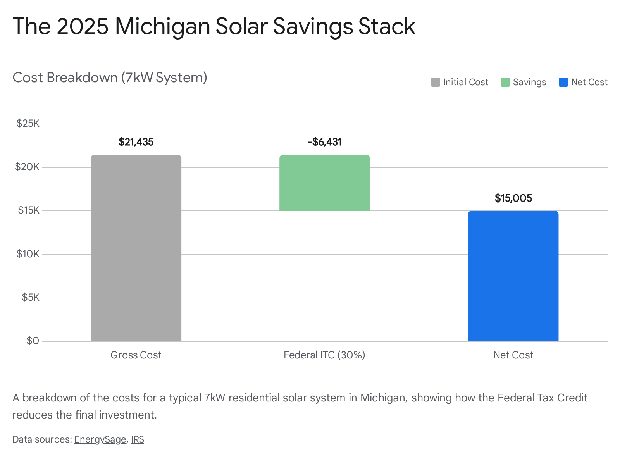
- Gross System Cost: $21,435 (Estimated at ~$3.06 per watt). 16
- Less Federal Tax Credit (30%): –$6,430.
- Net Investment: $15,005.
This “Net Investment” is the true cost the homeowner must recoup through energy savings.
The Payback Period
Using the current “Inflow” rate of roughly 18 cents/kWh (savings) and factoring in the reduced “Outflow” credit for exported power, the average payback period in Michigan is estimated between 9 and 12 years. 1
- Years 1‑10: The monthly savings on the electric bill are essentially “paying back” the initial $15,000 investment.
- Years 11‑25: Once the break‑even point is reached, the electricity generated is pure profit. The system continues to produce free power, protecting the homeowner from future utility rate hikes.
The Cost of Waiting:
It is worth noting that utility rates in Michigan have historically risen by significant margins year over year. As rates go up, the value of the solar energy produced goes up, potentially shortening the payback period faster than estimated. Conversely, waiting to install means continuing to “rent” power at increasing rates with no end date. 1
---
Part 8: The Role of Battery Storage
In 2025, the conversation about solar in Michigan is increasingly becoming a conversation about batteries. The shift to Distributed Generation (where selling to the grid is less profitable) has made energy storage a critical component for maximizing value.
A battery system, such as a Tesla Powerwall or Enphase IQ Battery, allows a homeowner to store the excess energy generated at noon and use it at 7:00 PM.
- Maximizing Savings: Instead of selling excess power for 9 cents (Outflow) and buying it back later for 18 cents (Inflow), the battery allows the homeowner to keep that power. This effectively forces the “Net Metering” math to work within the home.
- Backup Security: Michigan experiences frequent power outages due to storms. A standard solar system shuts down when the grid goes down (for safety). A solar + battery system can isolate itself from the grid (“island”) and keep the lights, fridge, and internet running during a blackout.
- Incentive Eligibility: Crucially, battery storage systems (over 3 kWh) are eligible for the 30% Federal ITC. 7 This significantly reduces the cost of adding resilience to the home.
While adding a battery increases the upfront cost—often by $10,000 to $15,000—it is the only way to achieve true energy independence and maximize the financial return under current utility rules.
---
Part 9: Navigating the Process – A Step‑by‑Step Guide
For homeowners ready to proceed, the path from idea to installation follows a predictable sequence.
Step 1: The Energy Audit
Before generating power, it is wise to reduce consumption. Many utilities offer free or low‑cost energy audits. Improving insulation or sealing windows can reduce the size of the solar system needed, saving money on the equipment.
Step 2: Multiple Quotes
The “Rule of Three” applies: always obtain at least three quotes. Homeowners should look specifically for Michigan Saves Authorized Contractors, as this indicates a level of vetting. Quotes should be compared not just on total price, but on “price per watt” and the quality of the warranty offered.
Step 3: Verification of Savings
When reviewing a quote, the homeowner should ask the installer: “How did you calculate the payback period? Did you use the current Distributed Generation outflow rates, or did you assume 1‑to‑1 Net Metering?” If an installer is using old Net Metering assumptions, their savings estimates will be inflated and inaccurate.
Step 4: Financing and Permitting
Once a contractor is selected, they will typically handle the Michigan Saves loan application and the local building permits. They will also file the “Interconnection Application” with DTE or Consumers Energy. This step can take time—often 4 to 8 weeks—as the utility reviews the engineering plans.
Step 5: Installation and Inspection
The physical installation is often the quickest part, taking 1 to 3 days. Following installation, a municipal inspector must approve the work.
Step 6: Permission to Operate (PTO)
The system cannot be turned on until the utility company grants “Permission to Operate” and swaps the electric meter for a bi‑directional meter capable of tracking Inflow and Outflow. Turning the system on before this step can result in billing errors or fines.
---
Conclusion
The year 2025 marks a pivotal moment for residential solar in Michigan. The convergence of stabilized federal tax credits, accessible state‑backed financing, and groundbreaking homeowner rights legislation has created a robust environment for adoption. While the utility buyback rates present a challenge, they have also spurred the adoption of smarter technologies like battery storage, leading to more resilient homes.
For the Michigan homeowner, solar is no longer a speculative technology or a purely environmental statement. It has matured into a financial instrument—a hedge against rising costs and a tool for independence. By understanding the specific incentives and rules outlined in this report, residents can navigate the market with confidence, turning the roof over their heads into a long‑term asset.
Works cited
- Michigan Solar Panel Cost: Savings and Payback (December 2025) – PowerOutage.us, accessed December 18, 2025, https://poweroutage.us/solar/mi
- Michigan Solar Panel Cost: 2025 Expert Guide – SolarReviews, accessed December 18, 2025, https://www.solarreviews.com/solar-panel-cost/michigan
- Federal Tax Credits for Energy Efficiency, accessed December 18, 2025, https://www.energystar.gov/about/federal-tax-credits
- Residential Clean Energy Credit | Internal Revenue Service, accessed December 18, 2025, https://www.irs.gov/credits-deductions/residential-clean-energy-credit
- Michigan Saves – LAFCU, accessed December 18, 2025, https://www.lafcu.com/michigansaves
- Home Energy Improvements | Michigan Saves, accessed December 18, 2025, https://michigansaves.org/home-energy-improvements/
- Michigan Solar Incentives, Tax Credits & Rebates 2025 | EnergySage, accessed December 18, 2025, https://www.energysage.com/local-data/solar-rebates-incentives/mi/
- 2025 Michigan Solar Tax Credits, Rebates & Other Incentives – EcoWatch, accessed December 18, 2025, https://www.ecowatch.com/solar/incentives/mi
- Solar Power – Gather Information – State of Michigan, accessed December 18, 2025, https://www.michigan.gov/mpsc/consumer/be-informed/tips/solar-power-consumer-tips/solar-power---gather-information
- Free Michigan Solar Incentives: Register for Solar Panels (Open Enrollment), accessed December 18, 2025, https://michigan.statesolar.org/
- Michigan Homeowners' Energy Policy Act Takes Effect April 1, 2025: Does Your HOA Have a Solar Energy Policy?, accessed December 18, 2025, https://micondolaw.com/2025/02/13/michigan-homeowners-energy-policy-act-takes-effect-april-1-2025-does-your-hoa-have-a-solar-energy-policy/
- MCL – Act 68 of 2024 – Michigan Legislature, accessed December 18, 2025, https://www.legislature.mi.gov/Laws/MCL?objectName=mcl-Act-68-of-2024
- Distributed Generation | Consumers Energy, accessed December 18, 2025, https://www.consumersenergy.com/residential/renewable-energy/distributed-generation
- Residential Electric Pricing Options – DTE Energy, accessed December 18, 2025, https://www.dteenergy.com/content/dam/dteenergy/deg/website/residential/Service-Request/pricing/residential-pricing-options/ResidentialElectricRateCard.pdf
- Homeowner's Guide to the Federal Tax Credit for Solar Photovoltaics – Department of Energy, accessed December 18, 2025, https://www.energy.gov/sites/prod/files/2021/02/f82/Guide to Federal Tax Credit for Residential Solar PV - 2021.pdf
- Michigan Solar Panel Cost: 2025 Prices and Savings – EnergySage, accessed December 18, 2025, https://www.energysage.com/local-data/solar-panel-cost/mi/
- Michigan Saves Lenders | Clean Energy Financing, accessed December 18, 2025, https://michigansaves.org/lenders/
- Calculate Your Monthly Payments – Michigan Saves, accessed December 18, 2025, https://michigansaves.org/calculator/
- Electric Pricing Options – DTE Energy, accessed December 18, 2025, https://www.dteenergy.com/us/en/residential/service-request/pricing/rate-options/residential-pricing-options.html
- Time of Use Plans – Consumers Energy, accessed December 18, 2025, https://www.consumersenergy.com/residential/rates/electric-rates-and-programs/rate-plan-options/smart-hours
- 5762, 2025 Solar Energy System Report, accessed December 18, 2025, https://www.michigan.gov/treasury/-/media/Project/Websites/treasury/STC/Forms/Form-5762---2025-Solar-Energy-System-Report.pdf?rev=edc9788bf2254da69358b39e0b1937b2&hash=3DB48BF52C9161FA7C47022F58514827
- Solar Access Laws by State: Can Your HOA Stop Your Solar Panels? – Palmetto, accessed December 18, 2025, https://palmetto.com/policy/solar-access-laws-by-state