The world of home energy has shifted dramatically in the last twelve months. We have seen sweeping changes at the federal level that have rewritten the financial playbook for solar power across the United States. Simultaneously, right here in Wisconsin, our state programs have pivoted to cushion the landing, and our local utility companies are updating their rate books with numbers that will directly impact your monthly budget.
It is a lot to take in. You might be hearing conflicting information. Maybe your neighbor tells you solar is "dead" because the federal tax credit is gone. Maybe a guy in a polo shirt knocking on your door tells you it’s "free" (spoiler: it’s not). The truth, as usual, lies somewhere in the messy middle.
This report is your definitive roadmap. We aren’t selling panels, batteries, or financing plans. Our goal is to act as your "Solar Sherpa"—guiding you through the jargon, the spreadsheets, and the fine print of Wisconsin’s 2026 solar incentives. We will break down exactly what has changed, what money is left on the table, and how to figure out if harnessing the sun is still a bright idea for your bank account.
TL;DR (Too Long; Didn’t Read)
We know life is busy. If you only have two minutes to spare between shoveling the driveway and getting the kids to hockey practice, here is the executive summary of the solar situation in Wisconsin as of January 1, 2026.
| What Changed? | The Details | The Verdict for You |
|---|---|---|
| Federal Tax Credit | It is GONE. The "One Big Beautiful Bill" Act repealed the 30% Residential Clean Energy Credit (Section 25D) for any systems installed after Dec 31, 2025. 1 | You can no longer deduct 30% of the system cost from your federal taxes. This increases your upfront net cost significantly compared to last year. |
| State Rebate | It is BIGGER. Focus on Energy has raised the residential rebate to $600 per kilowatt (kW), up to a cap of $2,400. 3 | This is a huge jump from the old $300 flat rebate. It helps offset the loss of the federal credit, though it doesn't fully replace it. |
| Tax Exemptions | Still Safe. Wisconsin still charges $0 sales tax on solar equipment and $0 property tax on the value added to your home. 5 | These "hidden" incentives save you thousands upfront and over the life of the system. |
| Utility Rates | Going Up. Utilities like Alliant and We Energies have raised rates for 2026. 7 | Even though solar costs more upfront now, the "cost of doing nothing" (paying the utility) is also getting more expensive, preserving the return on investment. |
| Net Metering | Utility-Dependent. Xcel and MGE are generally solar-friendly. We Energies and Alliant pay much less for exported power. 9 | Your ROI depends heavily on your zip code. Strategies like "self-consumption" and batteries are crucial in some territories. |
---
Part 1: The Federal Shake-Up (The "One Big Beautiful Bill")
To understand where we are today, we have to look at the legislative earthquake that hit the solar industry last year. For nearly two decades, the bedrock of the residential solar market in the United States was the Federal Investment Tax Credit (ITC).
Often referred to simply as "the tax credit," this policy allowed homeowners to claim a credit worth 30% of the total cost of their solar installation against their federal income tax liability. If you spent $20,000 on a system, the IRS gave you a $6,000 credit. It was simple, powerful, and drove massive adoption.
The Repeal of Section 25D
However, the legislative landscape shifted with the passage of the "One Big Beautiful Bill" Act (OBBB). This legislation, aimed at overhauling the tax code and reducing federal expenditures, targeted several consumer-facing energy credits for early termination.
According to the latest guidance from the IRS and legislative texts, the OBBB officially repealed Section 25D, the section of the tax code authorizing the Residential Clean Energy Credit, effective December 31, 2025. 1
This was a "hard stop." Unlike previous phase-outs where the credit dropped from 30% to 26% to 22%, this legislation effectively zeroed out the incentive for any residential property placed in service on or after January 1, 2026.
What "Placed in Service" Means
This is the critical legal distinction that has caused so much confusion in recent months. The IRS defines "placed in service" as the moment when the property is installed and ready for use. 11
- Scenario A: You bought panels in November 2025, they were installed on your roof, inspected, and turned on by December 30, 2025. Congratulations. You likely qualify for the 2025 tax credit of 30% when you file your taxes this April.
- Scenario B: You signed a contract in July 2025, paid a deposit, but due to supply chain delays or snow, the installation wasn't finished until January 2, 2026. Tough Luck. Under the OBBB rules, your "placed in service" date is in 2026, and you are arguably ineligible for the federal credit. 2
The Financial Impact on Homeowners
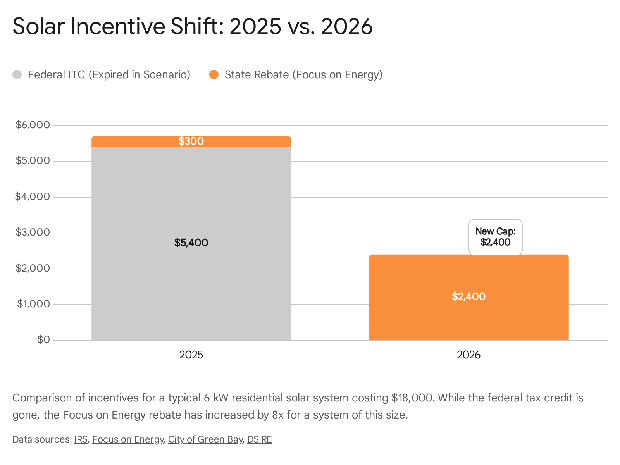
The loss of the ITC is undeniably a financial blow. On a typical 6 kW residential system costing roughly $18,000 (before incentives), the 30% credit was worth $5,400. That is a significant amount of money that is no longer available to reduce the net cost of the system.
However, as we will explore in the next section, the story doesn't end there. Markets adapt. In response to the federal pullback, Wisconsin's state-level administrators realized that without a boost, the local solar industry could stall. This realization birthed the new, aggressive rebate structure we see today.
---
Part 2: The Wisconsin Pivot (Focus on Energy 2026)
While Washington D.C. was closing the door, Madison kicked one open.
Focus on Energy is Wisconsin’s statewide energy efficiency and renewable resource program. It is funded by ratepayers (that's you—check the little "WI Focus on Energy" line item on your electric bill) and works with utilities to reduce energy waste. For years, their solar rebate was a modest "thank you" check—typically around $300 to $500. It was nice to have, but it didn't move the needle much on a $20,000 purchase.
Recognizing the "solar cliff" created by the federal repeal, Focus on Energy has completely restructured its residential solar offering for 2026.
The New 2026 Residential Rebate
As of January 1, 2026, the prescriptive rebate for residential solar photovoltaic (PV) systems has increased significantly.
- The New Rate: $600 per kilowatt (kW) of installed capacity. 3
- The Cap: The maximum rebate per household is $2,400. 3
This is a structural shift from a "flat fee" to a "capacity-based" incentive that rewards larger systems (up to a point).
Incentive Math: The "Sweet Spot"
To maximize this rebate, you need to understand the math.
- System Size: 1 kW is roughly 2-3 solar panels. A typical Wisconsin home needs between 5 kW and 8 kW to offset its usage significantly.
- The Calculation:
- If you install a 2 kW system: 2 x $600 = $1,200.
- If you install a 4 kW system: 4 x $600 = $2,400 (You hit the cap).
- If you install an 8 kW system: 8 x $600 = $4,800... BUT the cap applies, so you only get $2,400.
Insight: The "Sweet Spot" for maximizing the rebate percentage is a 4 kW system. For systems larger than 4 kW, the per-watt value of the rebate dilutes. However, most homeowners will still install larger systems (6-8 kW) because the energy savings over time are worth more than the rebate cap.
Eligibility and Rules (The Fine Print)
Focus on Energy doesn't just hand out cash to anyone with a ladder and a panel. There are strict eligibility criteria you must meet.
1. The Utility Requirement
You must be a residential customer of a participating utility. 4
- Who is in: Alliant Energy, Madison Gas & Electric (MGE), We Energies, Wisconsin Public Service (WPS), Xcel Energy, and hundreds of municipal utilities and electric cooperatives across the state.
- Who is out: A few very small municipal utilities that chose not to join the program. Always check your bill—if you see a "Focus on Energy" charge, you are in.
2. The 135-Degree Rule (Orientation)
Wisconsin sits at a high latitude. We need to catch every photon we can. Therefore, the program requires that your system be efficient.
- The Rule: Panels must be installed within 135 degrees of due South. 12
- Translation: Due South is 180° on a compass.
- South (180°) is perfect.
- Southeast and Southwest are excellent.
- Due East (90°) and Due West (270°) are generally acceptable (they are exactly 90 degrees from South).
- North-facing roofs are ineligible. If your only available roof space faces North, Focus on Energy will likely deny the rebate application because the system won't produce enough power to justify the subsidy.
3. The Shade Rule
You cannot cut down your neighbor's oak tree, but Focus on Energy won't pay for panels that sit in its shadow.
- The Rule: The system must have less than 15% obstacle shading based on an industry-accepted analysis tool (like a "Solmetric SunEye" or software modeling). 12
- Implication: If you live in a heavily wooded lot, you might be disqualified unless you do some trimming.
4. The Paperwork Process (Critical!)
This is where most people mess up. You cannot install the system and then ask for the money.
- Step 1: Reservation. Your contractor must submit an Online Reservation Application before installation begins. This "locks in" your funds. 12
- Step 2: Installation. The work gets done.
- Step 3: Final Application. Once the system is running, you (or your contractor) submit the final proof of installation to get the check.
- Deadlines: Funding is limited and awarded on a first-come, first-served basis. For 2026, applications for systems installed by year-end must typically be submitted by Jan 31, 2027. 12
Note on the "Rural Bonus":
In previous years (2024-2025), Focus on Energy offered an extra $300 bonus for homes in specific rural zip codes. This bonus has been discontinued for 2026. 13 The increase in the base rate to $600/kW is intended to replace and simplify these various add-ons.
---
Part 3: The "Hidden" Discounts (Tax Exemptions)
Beyond the direct cash rebate, Wisconsin state law offers two powerful tax exemptions that act as "silent incentives." You don't get a check in the mail for these, but you save money by not paying it out.
1. The Sales Tax Exemption (Saving ~5.5%)
In Wisconsin, the sale of "solar energy systems" is 100% exempt from state sales and use tax. 5
- The Logic: The state wants to lower barriers to entry. Charging tax on a clean energy appliance would be counterproductive.
- The Scope: This exemption covers the equipment itself—the panels, the inverter, the racking, and the batteries. It typically applies to the "tangible personal property."
- The Value: On a $20,000 gross system cost, the taxable material portion might be $12,000 to $15,000. With a state sales tax of 5% (plus county taxes of 0.5%), you are saving roughly $600 to $800 upfront.
- Homeowner Tip: When reviewing quotes from installers, look at the line item for "Tax." It should be $0.00. If an installer attempts to charge you sales tax, they may be inexperienced or misinformed. Point them to Wisconsin Statute 77.54(56).
2. The Property Tax Exemption (Saving Thousands Over Time)
This is arguably the most valuable long-term incentive in the state.
Generally, any home improvement that adds value to your property—like a remodeled kitchen, a finished basement, or a new deck—increases your property tax assessment. If your home value goes up by $20,000, and your local tax rate is 2%, your tax bill goes up by $400 every single year.
Solar is different.
Under Wisconsin Statute 70.111(18), any value added to a property by a "solar energy system" is exempt from general property taxes. 6
- How it works:
- You install a solar system worth $25,000.
- Your home's market value theoretically increases by $25,000 (studies show solar homes sell for a premium).
- The tax assessor notes the improvement but excludes that $25,000 from your taxable value.
- The Savings:
- Assessment Value: $25,000
- Avg. WI Property Tax Rate: ~1.7% to 2.0%
- Annual Savings: $425 to $500 per year.
- 25-Year Savings: $10,625 to $12,500.
Crucial Nuance: The exemption applies to the energy system. If you build a brand new detached garage specifically to hold the solar panels, the garage structure is taxable. Only the panels and wiring on top of it are exempt.
---
Part 4: The Utility Landscape (The Battle for Net Metering)
Here is where the rubber meets the road. Or, more accurately, where the electrons meet the grid.
The financial viability of your solar project depends heavily on your specific utility provider. While the sun shines the same on Madison as it does on Milwaukee, the value of that sunshine is completely different depending on who sends you your bill.
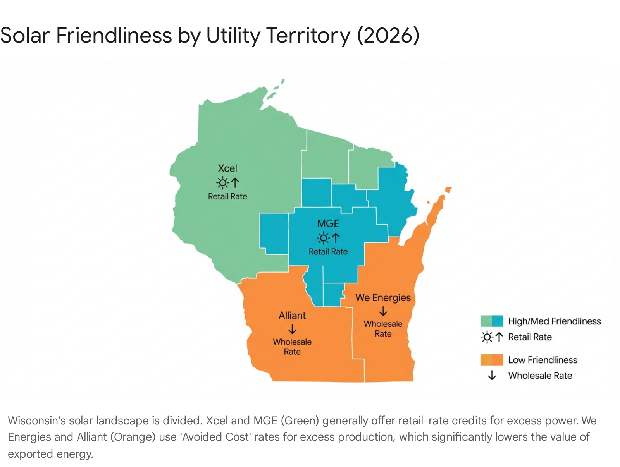
This is due to Net Metering. This policy determines how the utility credits you for the extra electricity your solar panels produce during the day that you don't use immediately.
1. We Energies (Milwaukee & Southeast WI)
We Energies serves the most populous part of the state, and unfortunately for solar enthusiasts, it has some of the most restrictive solar buyback policies.
- The Policy: CGS-NM (Customer Generation Solar - Net Metering) for systems < 300 kW. 9
- The Mechanism:
- Instant Use: Any solar power you use immediately (e.g., your A/C is running while the sun is out) offsets your bill at the full retail rate (approx. 16-19 cents/kWh). This is great.
- Exported Power: Any solar power you don't use flows back to the grid. We Energies pays you for this at the "Avoided Energy Cost Rate."
- The 2026 Buyback Rate: For 2026, this rate is approximately 3.17 cents per kWh (or slightly higher for on-peak times). 9
- Comparison: You buy power from them at ~19 cents. You sell it to them at ~3 cents. It is a massive disparity.
- The Fee: We Energies charges a "Generation Customer Charge" of about $0.059/day (roughly $1.80/month) just for having the system. 9
Strategy for We Energies Customers:
You must prioritize Self-Consumption.
- System Sizing: Do not build a system that produces 100% of your energy if you are rarely home during the day. You will sell most of it back for pennies.
- Load Shifting: Run your dishwasher, laundry, and EV charger at noon, not at night.
- Batteries: This is a prime territory for battery storage. Storing that excess power to use at night (saving 19 cents) is far better than selling it (garning 3 cents).
2. Alliant Energy (Southern & Central WI)
Alliant Energy has followed a similar path to We Energies, moving away from 1-to-1 net metering for new customers.
- The Policy: Parallel Generation / Net Metering.
- The Rates: Like We Energies, Alliant credits excess generation at an "Avoided Cost" rate, which fluctuates but typically lands in the 3-7 cents/kWh range. 10
- 2026 Rate Hikes: Alliant settled a rate case for 2026-2027. The fixed monthly charge for residential customers is rising to $16.00 in 2026 and $17.00 in 2027. 16
- Why this matters: A high fixed charge reduces the total amount of the bill you can eliminate. Even if you generate infinite power, you still pay that $16/month.
- Strategy: Similar to We Energies. Avoid oversizing. Focus on offsetting expensive daytime usage.
3. Xcel Energy (Western & Northern WI)
If you are an Xcel customer, count yourself lucky. Xcel generally maintains a more traditional and friendly net metering structure.
- The Policy: Net Energy Billing Service (Pg-1). 17
- The Mechanism:
- Xcel typically offers 1-to-1 retail net metering for systems up to 100 kW.
- If you export 1 kWh, you get a credit for 1 kWh. You can "bank" these credits to use in later months.
- The True-Up: At the end of the year (or billing cycle), if you have a net surplus (you produced more than you used all year), they cash you out at a lower wholesale rate (the "Avoided Cost").
- Solar*Rewards: Xcel also runs a program called Solar*Rewards. 18
- This is a production-based incentive. In 2025, it paid around $0.03/kWh on top of your net metering benefits for 10 years.
- Caveat: Availability for 2026 needs to be confirmed as these programs fill up instantly. Even without it, the base net metering is excellent.
Strategy for Xcel Customers:
You can aggressively size your system to cover 100% of your usage. The 1-to-1 banking means your summer surplus can pay for your winter heating (if you have electric heat) or lights.
4. Madison Gas & Electric (MGE)
MGE serves the capital city and has a reputation for green energy leadership, though their policies have become more complex.
- The Policy: Net Metering for systems up to 100 kW. 20
- The Mechanism:
- Net Seller Status: MGE determines if you are a "Net Seller" based on your previous 12 months.
- If you are not a Net Seller (i.e., you use more than you produce), you generally get credited at the standard retail rate for your exports. 20
- If you are a Net Seller, the excess is credited at the "Parallel Generation Buyback Rate" (wholesale), roughly $0.03 - $0.04/kWh.
- 2026 Rates: MGE residential electric rates are set to increase slightly in 2026 and 2027. 22
- Green Power Tomorrow: Note that if you participate in their green energy purchasing program, it complicates the credit calculation. 23
Strategy for MGE Customers:
Aim to offset 90-95% of your usage. Try to stay just under the "Net Seller" threshold to ensure your credits remain at the high retail value.
5. Rural Electric Cooperatives
Wisconsin has dozens of electric co-ops (e.g., Pierce Pepin, Vernon Electric, Eau Claire Energy).
- The Rule: There is no rule. Each co-op board sets its own policy.
- Eau Claire Energy: Offers a rebate program but check for "MemberSolar" options. 24
- Vernon Electric: Offers community solar buy-ins and specific interconnection policies. 25
- Pierce Pepin: Offers a $300 rebate (matching Focus on Energy in some cases) and loan financing. 27
Advice: If you are in a co-op, do not assume anything. Call your member services department and ask for their "Distributed Generation Policy."
---
Part 5: Is Solar Right for You? A Step-by-Step Self-Audit
We have thrown a lot of data at you. Now, let’s simplify it. Before you call a contractor, run through this mental checklist to see if your home is a good candidate for solar in the 2026 landscape.
Step 1: The Ownership Check
- Do you own your home? (Yes/No)
- No: If you rent, you cannot install panels. Look into Community Solar programs (like "Solar Shares" from MGE or "SolarNow" from We Energies) where you can subscribe to a solar farm.
- Yes: Proceed to Step 2.
Step 2: The Roof Audit
- Does your roof face South, Southeast, or Southwest?
- No (North only): Stop. Solar is likely not viable for you. The rebates won't apply, and the physics don't work.
- Yes: Proceed.
- Is it shaded? (Trees, tall buildings, chimneys)
- Yes (Heavy Shade): Unless you can trim the trees, solar won't produce enough ROI.
- No: Proceed.
- How old is the roof?
- >15 years: You should probably replace the roof before installing solar. Taking panels off to replace shingles later is expensive ($3,000+).
- <10 years: Good to go.
Step 3: The Utility Check
- Who is your utility provider?
- Xcel / MGE / Friendly Co-op: You are in the "Green Zone." You can likely offset 100% of your bill and see a payback in 9-11 years.
- We Energies / Alliant: You are in the "Orange Zone." You need to be careful.
- Do you have high daytime usage (work from home, electric heat, pool pump)? Yes: Solar is still good.
- Is your house empty all day? Yes: You might need a battery to make the math work, or a smaller system.
Step 4: The Financial Check
- Do you pay federal taxes?
- Wait, why does this matter? The Federal Tax Credit is gone for 2026, so this actually matters less than it used to! In 2025, if you had no tax liability, the credit was useless. Now, with the Focus on Energy rebate being a direct check (cash), solar is actually more accessible to retirees or low-income homeowners who didn't have the tax liability to use the old federal credit.
---
Part 6: The Economics of Solar in 2026 (ROI Analysis)
Let’s run the numbers. We will create a hypothetical scenario for a typical Wisconsin home to see how the investment looks without the federal tax credit but with the new state rebate.
The Scenario:
- Location: Madison, WI (MGE Territory - Friendly Net Metering)
- System Size: 6 kW (approx. 15-16 panels)
- Annual Production: ~7,200 kWh
- Gross Cost: $3.00 per watt = $18,000 (Prices have stabilized).
The "Cash" Breakdown
| Line Item | Amount | Notes |
|---|---|---|
| Gross System Cost | $18,000 | Typical installer price for 6 kW. |
| (-) Focus on Energy Rebate | -$2,400 | Capped at $2,400 (4kW x $600 = $2,400). |
| (-) Federal Tax Credit | $0 | Repealed for 2026. |
| Net Cost to You | $15,600 | This is your out-of-pocket total. |
The Return on Investment
- Electricity Savings:
- Current Rate: ~$0.17/kWh.
- Year 1 Savings: 7,200 kWh x $0.17 = $1,224.
- Simple Payback Period:
- $15,600 (Net Cost) ÷ $1,224 (Year 1 Savings) = 12.7 Years.
Analysis:
A 12.7-year payback is longer than the 8-9 year paybacks we saw when the 30% federal credit was active.
- However: This assumes electricity prices stay flat. They won't. If rates rise by 3% per year (a conservative estimate given recent rate cases), the payback drops to around 10-11 years.
- System Life: Solar panels are warrantied for 25 years. This means you have 14+ years of "free" electricity after the system pays for itself.
- Total Profit: Over 25 years, the system will save roughly $40,000 in bills. Subtract the $15,600 cost, and you are up $24,400.
ROI vs. Stock Market:
The internal rate of return (IRR) is roughly 6-8%. This is tax-free (savings aren't taxed). It is a lower risk than the stock market and hedges against inflation.
Financing Options (If You Don't Have $15k Cash)
Without the federal credit, financing becomes more critical.
- Solar Loans: Many Wisconsin credit unions (like Clean Energy Credit Union) offer specialized solar loans.
- Pros: No money down.
- Cons: Interest rates in 2026 are likely 7-9%. This eats into your savings.
- HELOC (Home Equity Line of Credit): Often lower rates than unsecured solar loans.
- "Dealer Fee" Warning: Be wary of installers offering "2.99% interest." They often charge a "Dealer Fee" of 20-30% upfront to buy down the rate. This inflates the gross cost of the system significantly. Always ask for the "Cash Price" to compare.
---
Part 7: Batteries – The New Necessity?
For years, batteries (like the Tesla Powerwall) were considered a luxury item in Wisconsin. We have a reliable grid, and with 1-to-1 net metering, the grid acted as a "free battery."
In 2026, the calculus has changed, especially for We Energies and Alliant customers.
Why Batteries Matter Now
If your utility pays you 3 cents for exports but charges you 18 cents for imports, every kWh you export is a financial loss.
- Without Battery: You generate excess power at noon. It goes to the grid. You get 3 cents. At 7 PM, you cook dinner. You buy power for 18 cents. Net Cost: 15 cents.
- With Battery: You generate excess power at noon. It goes into your battery. You get 0 cents (but keep the energy). At 7 PM, you drain the battery. You buy 0 power. Net Cost: 0 cents.
Incentives for Storage
The federal tax credit repeal likely impacts standalone storage as well (Section 25D covered "battery storage technology").
- Focus on Energy: Currently, Focus on Energy does not have a widespread residential battery rebate, though they have piloted programs in the past.
- Utility Programs: Some utilities, like Xcel, have experimented with "Battery Connect" programs where they pay you to access your battery during peak events. 29 These are niche but growing.
Verdict: If you are in a "Low Buyback" utility territory, ask your installer to model the economics of a hybrid system (Solar + Battery). It might actually have a better long-term ROI than solar alone, despite the higher upfront cost.
---
Part 8: Solar Access Rights (Can My HOA Say No?)
You have crunched the numbers. You are ready to go. But then you get a letter from your Homeowners Association (HOA) stating that "roof penetrations are prohibited" or "solar panels are unsightly."
Do not panic. The law is on your side.
Wisconsin has some of the strongest "Solar Access" laws in the Midwest. Specifically, Wisconsin Statute 236.292 and Section 66.0401. 30
The "Three Tests" of Enforceability
Under state law, no political subdivision (city/town) or restriction on platted land (HOA covenant) can prevent or "unduly restrict" a solar energy system unless the restriction meets ALL THREE of these criteria:
- Health & Safety: It must serve to preserve or protect public health or safety.
- Cost: It must not significantly increase the cost of the system.
- Efficiency: It must not significantly decrease the efficiency of the system.
Common Disputes and Outcomes
- "Move them to the back roof."
- If your back roof faces North, moving panels there would reduce efficiency by 30-40%. This violates criterion #3. The HOA cannot enforce this.
- "Build a ground mount instead."
- Ground mounts require trenching, concrete, and extra racking. This usually costs $3,000-$5,000 more than a roof mount. This violates criterion #2 (significantly increases cost). The HOA cannot enforce this.
- "We don't like the look of blue panels. Use black ones."
- All-black panels are widely available and cost roughly the same as blue/silver ones. This restriction generally does not increase cost or decrease efficiency. The HOA likely CAN enforce this.
Advice: If your HOA pushes back, print out Wisconsin Statute 66.0401 and politely hand it to the board president. In 99% of cases, they back down once they realize the law overrides their bylaws.
---
Part 9: Hiring an Installer (The Buying Guide)
The solar industry is like the Wild West. There are incredible, local craftsmen, and there are "solar bros" who just want to sign a contract and flip it to a subcontractor.
How to Vet an Installer in 2026
- Focus on Energy Trade Ally: This is non-negotiable. To get the $2,400 rebate, your installer MUST be a registered Trade Ally. You can find the list on the Focus on Energy website. 4
- Local vs. National:
- Local Installers (e.g., Arch, SunVest, Full Spectrum): They know the specific interconnection rules for We Energies vs. Alliant. They are still here when it snows.
- National Door-Knockers: Often aggressive sales tactics. They might not know about the specific Wisconsin rebate rules or the 135-degree orientation requirement.
- Get 3 Quotes: Prices vary.
- Target Price: In 2026, you should be paying around $2.80 to $3.20 per watt (cash price) for a standard residential system. If a quote is $4.00/watt, run.
- Check the "Production Guarantee": A good installer will guarantee that your system produces X amount of power. If it underproduces, they cut you a check for the difference.
Group Buy Programs (Grow Solar)
Keep an eye out for "Group Buy" programs like Grow Solar (e.g., Grow Solar Jefferson + Waukesha, Grow Solar Greater Milwaukee). 33
- How it works: A non-profit (like the Midwest Renewable Energy Association) organizes hundreds of homeowners to buy solar at once.
- The Benefit: Volume pricing. You might get a discount of $0.10-$0.20 per watt below market rate.
- The Timeline: These usually run in the summer/fall, so watch for announcements in mid-2026.
---
Part 10: Conclusion
So, is 2026 the year you go solar?
The expiration of the federal tax credit is a hurdle, no doubt. It changes the math. But Wisconsin’s response—a robust $2,400 state rebate, strong tax exemptions, and solid legal protections—keeps the door wide open.
- If you are an Xcel or MGE customer, the green light is flashing. The economics are fantastic.
- If you are a We Energies or Alliant customer, the yellow light is on. Proceed with caution, size your system correctly, and seriously consider storage.
Ultimately, solar in Wisconsin is about more than just ROI. It is about energy independence. It is about locking in your electricity price for 25 years while your neighbors watch their bills climb. And it is about knowing that even in the frozen depths of January, those panels on your roof are silently harvesting value from the sun.
Your Next Move:
- Find your last 12 months of electric bills.
- Calculate your total kWh usage.
- Contact a Focus on Energy Trade Ally for a quote.
- Do the math using the $600/kW rebate.
The sun is shining, Wisconsin. Go catch it.
Disclaimer: This report provides educational information based on data available as of January 1, 2026. Tax laws and utility rates are subject to change. Always consult with a qualified tax professional and your specific utility provider before making financial investments.
Works cited
- 2025 Year-End Guide: Tax Credits, Incentives, accessed January 1, 2026, https://www.cbia.com/news/small-business/2025-year-end-guide-tax-credits-incentives
- FAQs for modification of sections 25C, 25D, 25E, 30C, 30D, 45L, 45W, AND 179D under Public Law 119-21, 139 Stat. 72 (July 4, 2025), commonly known as the One, Big, Beautiful Bill (OBBB) | Internal Revenue Service, accessed January 1, 2026, https://www.irs.gov/newsroom/faqs-for-modification-of-sections-25c-25d-25e-30c-30d-45l-45w-and-179d-under-public-law-119-21-139-stat-72-july-4-2025-commonly-known-as-the-one-big-beautiful-bill-obbb
- OEI December 2025 Newsletter - GovDelivery, accessed January 1, 2026, https://content.govdelivery.com/accounts/WIPSC/bulletins/3ff0ee8
- Solar Rebate, Residential | Green Bay, WI, accessed January 1, 2026, https://www.greenbaywi.gov/DocumentCenter/View/15715/FOESolarRebateResidential
- Sales Tax Exemption for Energy Systems and Prairie or Wetland Planning Services (General Fund Taxes - Wisconsin Legislative Documents, accessed January 1, 2026, https://docs.legis.wisconsin.gov/misc/lfb/budget/2021_23_biennial_budget/302_budget_papers/322_general_fund_taxes_sales_and_use_taxes_sales_tax_exemption_for_energy_systems_and_prairie_or_wetland_planning_services.pdf
- Biogas, Solar, and Wind Energy Equipment Exemption - DSIRE, accessed January 1, 2026, https://programs.dsireusa.org/system/program/detail/178
- Alliant Energy Rate Hike for 2026-2027 - Citizens Utility Board of Wisconsin, accessed January 1, 2026, https://cubwi.org/alliant-energy-rate-hike-for-2026-2027/
- Learn about our 2025-2026 rate proposal - We Energies, accessed January 1, 2026, https://www.we-energies.com/olb/24/2024-06-we-rate.pdf
- Customer generation rates - We Energies, accessed January 1, 2026, https://www.we-energies.com/olb/25/2025-01-we-customer-generation-rates.pdf
- Wisconsin Solar: Costs, Incentives & Savings, accessed January 1, 2026, https://palmetto.com/local/wisconsin/
- Residential Clean Energy Credit | Internal Revenue Service, accessed January 1, 2026, https://www.irs.gov/credits-deductions/residential-clean-energy-credit
- Solar for Homes | Focus on Energy, accessed January 1, 2026, https://focusonenergy.com/residential/solar-for-homes
- Make 2026 the Year You Go Solar: Key Incentives to Know ..., accessed January 1, 2026, https://statelinesolar.net/make-2026-the-year-you-go-solar-key-incentives-to-know/
- Free Wisconsin Solar Incentives: Claim Solar Panels (Open Enrollment), accessed January 1, 2026, https://wisconsin.statesolar.org/
- 70.111(18) - Wisconsin Legislature, accessed January 1, 2026, https://docs.legis.wisconsin.gov/document/statutes/70.111(18)
- PSC Approves Rate Case Settlement with Alliant - RENEW Wisconsin, accessed January 1, 2026, https://www.renewwisconsin.org/psc-approves-rate-case-settlement-with-alliant/
- DISTRIBUTED GENERATION TARIFF OPTIONS - Xcel Energy, accessed January 1, 2026, https://www.xcelenergy.com/staticfiles/xe-responsive/Working%20With%20Us/Renewable%20Developers/WI%20Parallel%20Generation%20Tariff%20Info%20Sheet%202024_FINAL.pdf
- Solar*Rewards - On-site Renewable Energy, accessed January 1, 2026, https://my.xcelenergy.com/s/renewable/solar-rewards
- Everything You Need to Know About Xcel Energy's Solar*Rewards Program in 2025, accessed January 1, 2026, https://cedarcreekenergy.com/everything-you-need-to-know-about-xcel-energys-solarrewards-program-in-2025/
- Net Metering - Parallel Generation - Madison Gas and Electric, accessed January 1, 2026, https://www.mge.com/MGE/media/MGE-Library/documents/rates-electric/e11-2-0-pg2-20240326.pdf
- Net Metering - Madison Gas and Electric, accessed January 1, 2026, https://www.mge.com/smart-energy/clean-energy/solar-energy/net-metering
- MGE's Rate Requests for 2026 and 2027 - Madison Gas and Electric, accessed January 1, 2026, https://www.mge.com/my-account/rates/mge-rate-requests-for-2026-and-2027
- Rates - Madison Gas and Electric, accessed January 1, 2026, https://www.mge.com/my-account/rates/rates
- Membersolar - Eau Claire Energy Cooperative, accessed January 1, 2026, https://www.ecec.com/energy-efficiency/renewable-energy/membersolar
- Westby Community Solar Farm - Vernon Electric Cooperative, accessed January 1, 2026, https://www.vernonelectric.org/westby-community-solar-farm
- Distributed Generation - Vernon Electric Cooperative, accessed January 1, 2026, https://www.vernonelectric.org/distributed-generation
- Residential and Commercial Solar Rebate Program - DSIRE, accessed January 1, 2026, https://programs.dsireusa.org/system/program/detail/740/residential-and-commercial-solar-rebate-program
- Renewable Energy - Pierce Pepin Cooperative Services, accessed January 1, 2026, https://piercepepin.coop/renewable-energy
- Renewable Battery Connect - Xcel Energy, accessed January 1, 2026, https://wi.my.xcelenergy.com/s/renewable/battery-connect
- Solar Access Laws by State: Can Your HOA Stop Your Solar Panels? - Palmetto, accessed January 1, 2026, https://palmetto.com/policy/solar-access-laws-by-state
- Wisconsin Laws and Policies, accessed January 1, 2026, https://energyonwi.extension.wisc.edu/reset/wisconsin-laws-and-policies/
- Wisconsin Solar and Wind Rights - DSIRE, accessed January 1, 2026, https://programs.dsireusa.org/system/program/detail/313
- Grow Solar Green Bay, accessed January 1, 2026, https://energizegreenbay.com/grow-solar/
- Grow Solar Milwaukee-Waukesha | Start your solar journey today!, accessed January 1, 2026, https://www.growsolar.org/milwaukee-waukesha/