As of January 7, 2026, the landscape for residential solar energy in Texas has matured into a complex ecosystem of federal tax credits, state-level protections, and highly specific utility incentives. The era of simple, one‑size‑fits‑all solutions has passed. In its place is a market where financial viability depends heavily on a homeowner's specific location, their choice of retail electric provider (REP), and increasingly, the integration of battery storage systems.
This report serves as an exhaustive resource for Texas homeowners navigating this transition. It analyzes the financial mechanisms available to offset the cost of solar installation, covering the foundational Federal Investment Tax Credit (ITC), state property tax exemptions, and the fragmented patchworks of rebates offered by transmission and distribution utilities (TDUs) like Oncor and CenterPoint, as well as municipal entities like Austin Energy and CPS Energy.
Crucially, the report highlights the paradigm shift occurring in 2026: the transition from "solar‑only" incentives to "solar‑plus‑storage" incentives. With the rise of Virtual Power Plants (VPPs) and the restructuring of utility rebates to favor grid resilience, batteries have become a central component of the modern Texas solar financial model.
1.2 TL;DR (Too Long; Didn't Read)
For readers seeking immediate takeaways, the following points summarize the current state of solar incentives in Texas:
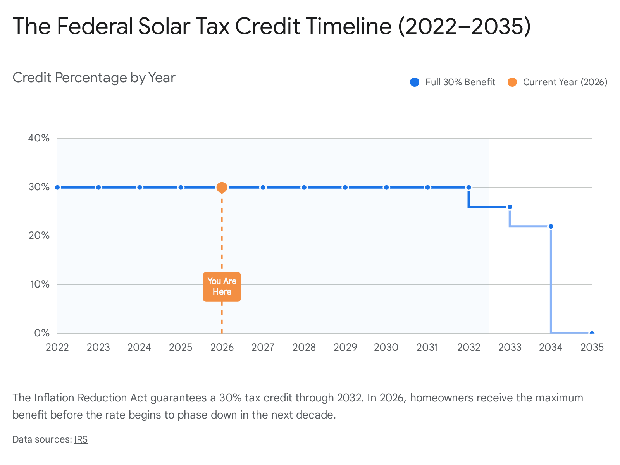
- The Federal Tax Credit is Stable: The Inflation Reduction Act has locked in the 30% Investment Tax Credit (ITC) for 2026.1
- Property Taxes are Protected: Texas law prevents county appraisal districts from increasing a home's taxable value due to the installation of solar or wind energy devices. Homeowners retain 100% of the equity gain tax‑free.2
- Location Dictates Rebates:
- Dallas/Fort Worth (Oncor): Significant rebates (up to $9,000) are available, but strictly for systems that include battery storage. Solar‑only installations largely no longer qualify for direct cash incentives.3
- Houston (CenterPoint): A standard offer rebate of approximately $135 per installed kilowatt (kW) exists but is subject to rapid fund exhaustion.4
- Austin: A $2,500 rebate is available for homeowners who complete a mandatory education course. Austin Energy utilizes a "Value of Solar" tariff rather than traditional net metering.5
- Batteries are Essential: Due to low export rates (buyback rates) in deregulated areas, storing energy for evening use is now the primary method for maximizing savings. Furthermore, participation in Virtual Power Plant (VPP) programs can generate recurring monthly revenue.6
- HOA Restrictions are Limited: Homeowners Associations cannot ban solar installations. Updates to the law in 2025 clarified protections for solar shingles and tiles, ensuring aesthetic concerns cannot be used as a de‑facto ban.7
---
2. The Texas Energy Landscape: Understanding the Market
To understand where the money comes from, one must first understand how the Texas grid operates. Unlike most states with vertically integrated utilities (where one company owns the power plant, the wires, and sends the bill), Texas operates a unique deregulated market for approximately 85% of its population.
2.1 The Deregulated Zones (Oncor, CenterPoint, AEP)
In areas like Dallas, Fort Worth, Houston, and Corpus Christi, the electricity market is split.
- Transmission and Distribution Utilities (TDUs): Companies like Oncor and CenterPoint own the physical infrastructure—the poles, wires, and meters. They are responsible for maintaining the grid and fixing outages. They are also the entities that typically offer equipment rebates (e.g., cash for installing batteries or efficient AC units) to reduce strain on their infrastructure.
- Retail Electric Providers (REPs): Companies like TXU, Gexa, Reliant, and Chariot Energy handle billing and customer service. These companies determine the buyback rate—the price paid for excess solar energy sent back to the grid.
In these zones, a homeowner's financial return is a combination of the hardware rebate from the TDU and the ongoing bill credits from the REP.
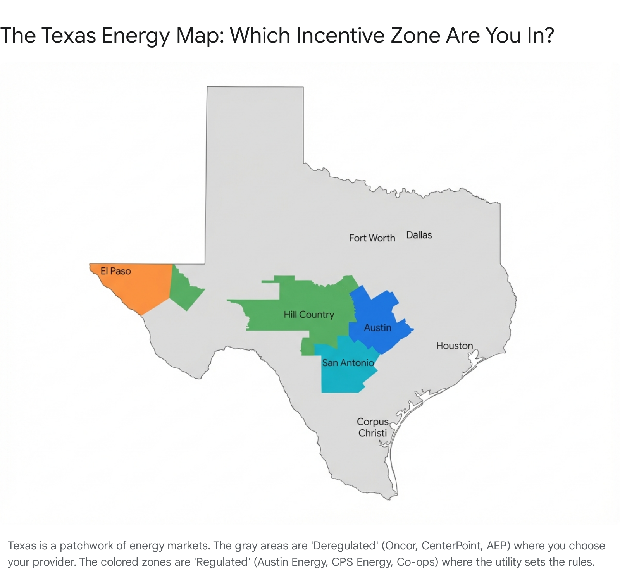
2.2 The Regulated Zones (Municipalities and Co‑ops)
In areas like Austin (Austin Energy), San Antonio (CPS Energy), and the Hill Country (Pedernales Electric Cooperative), the utility is a monopoly. The city or cooperative owns the wires and sends the bill. In these regions, solar incentives are centralized. The same entity provides the rebate and sets the buyback rules. These programs are often driven by local political goals regarding renewable energy adoption and carbon reduction.
---
3. Federal Incentives: The Bedrock of Solar Finance
The most significant financial incentive available to Texas homeowners in 2026 is federal, not local. The Residential Clean Energy Credit, extended and expanded by the Inflation Reduction Act, provides the foundation for solar economics.
3.1 The Residential Clean Energy Credit (ITC)
For systems placed in service during 2026, the federal government allows homeowners to claim a tax credit equal to 30% of the total project cost.1
3.1.1 Eligible Expenses
The 30% credit applies to a comprehensive list of costs associated with the installation:
- Solar Photovoltaic (PV) Panels: The core hardware.
- Balance of System Equipment: Inverters, racking, wiring, and conduit.
- Labor Costs: Allocations for onsite preparation, assembly, and original installation.
- Permitting and Inspection Fees: Costs paid to local municipalities.
- Energy Storage Technology: Standalone batteries (like Tesla Powerwall or Enphase IQ Battery) qualify, provided they have a capacity of at least 3 kilowatt‑hours (kWh).1
It is important to note that the credit does not cover structural improvements to the home that are not directly related to solar generation, such as general roof replacements, unless the roofing material itself generates power (e.g., solar shingles).
3.1.2 Mechanism of the Credit
The ITC is a non‑refundable credit. This distinction is vital for financial planning. If a homeowner is eligible for a $10,000 credit but only owes $6,000 in federal taxes for the year 2026, the IRS will not issue a refund check for the $4,000 difference.
However, the unused portion of the credit is carried forward to the subsequent tax year. The homeowner can apply the remaining $4,000 credit against their 2027 tax liability.1 This carryforward provision ensures that the value of the incentive is rarely lost, provided the homeowner has sufficient tax liability over time.
3.2 The Phase‑Down Schedule
While the 30% rate is secure for 2026, it is not permanent. The legislation includes a scheduled phase‑down beginning in the next decade.
- 2022 – 2032: 30% Credit.1
- 2033: 26% Credit
- 2034: 22% Credit
- 2035: Credit expires (unless renewed by Congress).1
This stability allows homeowners in 2026 to make decisions without the panic of an immediate year‑end expiration, a common sales tactic used in previous years.
---
4. State‑Level Rights and Protections
Texas does not levy a state income tax, meaning there is no state‑level equivalent to the federal ITC. However, the Texas Legislature has enacted robust legal protections that improve the financial viability and accessibility of solar energy.
4.1 The Solar Property Tax Exemption
A common concern for homeowners is that adding a solar system—often valued at $20,000 to $50,000—will trigger a reassessment of their property and a subsequent increase in property taxes. In Texas, this concern is addressed by the Renewable Energy Systems Property Tax Exemption.2
4.1.1 How It Works
Under the Texas Tax Code, the value added to a property by a solar or wind‑powered energy device is 100% exempt from taxation.
- Example: If a home is appraised at $350,000 and the homeowner installs a solar system valued at $30,000, the market value of the home may rise to $380,000. However, the taxable value remains at $350,000 (assuming no other changes). The $30,000 in added equity is effectively invisible to the tax assessor.8
4.1.2 Filing Requirements
This exemption is not automatic. Homeowners must affirmatively file Form 50‑123 ("Exemption Application for Solar or Wind‑Powered Energy Devices") with their local County Appraisal District (CAD).
- Deadline: The application must be filed between January 1 and April 30 of the year following the installation.2 For a system installed in 2026, the filing window opens January 1, 2027.
4.2 Solar Rights and HOA Restrictions
Historically, Homeowners Associations (HOAs) presented a significant barrier to solar adoption, often citing aesthetic concerns. Texas law has progressively curtailed the power of HOAs to prohibit solar installations.
4.2.1 The Limits of HOA Authority
Under Texas Property Code, HOAs are prohibited from enforcing blanket bans on solar energy devices.7 An HOA cannot deny a solar application simply because "it looks ugly" or "we don't like solar."
However, HOAs retain the right to regulate placement, provided the restrictions do not significantly impact performance. They can require that:
- Panels do not extend beyond the roofline.
- Panels run parallel to the roofline (no ground mounts or tilted racks on a pitched roof).
- Frames are silver, black, or bronze tone.
- Panels are placed on the back of the home, unless this placement reduces the system's energy production by more than 10% compared to the optimal location.7
4.2.2 2025 Updates: Solar Shingles
In the 89th Regular Session (2025), the Texas Legislature passed HB 431, which updated the definition of "solar energy device" to explicitly include solar roof tiles and shingles.7 This was a necessary modernization to protect homeowners installing Building‑Integrated Photovoltaics (BIPV), such as the Tesla Solar Roof or GAF Timberline Solar shingles. HOAs can no longer argue that these devices do not qualify for protection because they function as roofing material rather than traditional "panels."
---
5. Utility‑Specific Incentives: The Detailed Breakdown
Incentives in Texas are highly localized. A homeowner's zip code determines their TDU service area and, consequently, their eligibility for thousands of dollars in potential rebates. The following sections detail the major programs active in 2026.
5.1 Oncor Electric Delivery (DFW, Waco, Midland, Odessa)
Oncor serves the largest number of customers in the deregulated market, covering the Dallas‑Fort Worth metroplex and huge swathes of West Texas.
5.1.1 The Residential Solar Program
Historically, Oncor offered rebates for solar‑only systems. However, as grid stability has become a priority, the program has shifted entirely toward energy storage.
- Rebate Value: The maximum incentive can reach up to $9,000, but this high figure is typically reserved for large systems that pair substantial solar capacity (up to 15 kW) with significant battery storage.3
- 2026 Requirement: To qualify for the residential solar rebate in 2026, the installation must include a battery energy storage system. Solar‑only installations are generally ineligible for this specific incentive stream.3
- Technical Constraints:
- The system size must be between 3 kW and 15 kW (DC).
- Panels must be oriented with an azimuth between 67.5° (East‑Northeast) and 292.5° (West‑Northwest) to maximize production during peak hours.3
- Process: Homeowners cannot apply directly. They must work with an Oncor Participating Service Provider. These are solar installation companies that have registered with Oncor and agreed to the program's terms. The rebate is paid to the installer, who then passes the savings to the homeowner as a discount on the invoice.9
- Availability: Funding is annual and limited. Programs typically open in late January or early February and can close quickly once the budget is exhausted. Homeowners in Oncor territory should confirm funding availability immediately upon receiving a quote.
5.2 CenterPoint Energy (Houston Metro Area)
CenterPoint Energy manages the grid for the greater Houston area.
5.2.1 Residential Solar Standard Offer Program (SOP)
CenterPoint offers a "Standard Offer Program" designed to reduce peak demand on the grid.
- Rebate Value: The incentive is approximately $135 per kW of installed solar capacity.4
- For an 8 kW system: ~$1,080.
- For a 12 kW system: ~$1,620.
- Caps: The incentive is capped at a system size of 15 kW.
- Process: Similar to Oncor, this rebate is processed by the installer (Project Sponsor). It is not a check mailed to the homeowner. The rebate is deducted from the total project cost.
- Availability: CenterPoint's programs are notorious for subscribing quickly. The program operates on a first‑come, first‑served basis, and funds for the year can be depleted within months of the program opening.10
5.2.2 Hard‑to‑Reach Program
For households with an annual income at or below 200% of the federal poverty guidelines, CenterPoint offers the "Hard‑to‑Reach" SOP. This program provides significantly higher incentives, often covering the full cost of certain efficiency measures, although solar‑specific allocations under this umbrella are rarer and more competitive.11
5.3 AEP Texas (Corpus Christi, Laredo, Rio Grande Valley)
AEP Texas serves the southern and western portions of the state.
5.3.1 SMART Source Solar PV Program
AEP Texas operates the SMART Source program to incentivize solar adoption.
- Rebate Value: The program offers rebates up to a maximum of $3,000 per residential installation.12
- Structure: The rebate is often tiered. For example, a system might earn a certain dollar amount per watt for the first 3 kW, and a different amount for subsequent capacity.
- Availability: This program is highly volatile. In previous years, funds have been exhausted within days of the program opening in January. Homeowners in AEP territory must act with extreme speed at the beginning of the budget cycle.14
5.4 Austin Energy (City of Austin)
Austin Energy is a vertically integrated municipal utility, meaning it controls both the grid and the billing.
5.4.1 The Residential Solar Rebate
Austin Energy offers a flat rebate to encourage residential solar adoption.
- Rebate Value: $2,500 for qualifying systems.5
- Prerequisites: Homeowners are required to complete the Austin Energy Solar Education Course before their rebate application can be approved. This helps ensure customers understand the financial mechanics of their system before purchasing.15
- System Requirements: The system must be at least 3 kW in size and installed by a participating contractor.
5.4.2 The Value of Solar (VoS) Rate
Austin Energy does not use "Net Metering." Instead, it uses a "Value of Solar" tariff.
- Mechanism: The homeowner is billed for their total home energy consumption at the standard residential rate. Independently, the solar system's total production is credited at the VoS rate.
- 2026 Rate: The VoS rate is approximately 9.91 cents per kWh.16
- Implication: If the residential consumption tier rate is close to 10 cents, the offset is nearly 1:1. However, if the homeowner enters high usage tiers (e.g., 12+ cents/kWh), the solar credit may not fully offset the cost of energy consumed.
5.5 CPS Energy (San Antonio)
CPS Energy serves San Antonio and surrounding areas.
5.5.1 Sustainable Tomorrow Energy Plan (STEP)
As of 2026, CPS Energy has largely transitioned its residential focus away from direct solar rebates and toward energy efficiency (insulation, HVAC) and commercial solar incentives.
- Residential Status: Direct cash rebates for residential solar are currently limited or unavailable, having been deprioritized in favor of commercial programs. Homeowners should check the STEP portal for any flash‑funding or pilot programs, but should not rely on a standard rebate for their financial modeling.17
- Commercial Incentives: For business owners, schools, and non‑profits, rebates remain robust, offering up to $0.60 per AC Watt with a cap of $80,000.18
---
6. The Battery Revolution and Virtual Power Plants (VPPs)
A critical shift in 2026 is the necessity of battery storage. In previous years, batteries were viewed as luxury items for backup power. Today, they are essential financial tools.
6.1 The Economic Case for Batteries
In deregulated areas (Oncor/CenterPoint), Retail Electric Providers (REPs) are not required to offer 1:1 net metering. Many plans offer low export rates (e.g., 3 cents/kWh) while charging high import rates (e.g., 16 cents/kWh).
- The Problem: Sending solar power to the grid at 3 cents and buying it back at night for 16 cents destroys the ROI of a solar system.
- The Solution: A battery allows the homeowner to store that solar energy during the day and use it in the evening, effectively "buying" it from themselves at 0 cents instead of from the grid at 16 cents. This is known as Self‑Consumption or Time‑of‑Use Arbitrage.
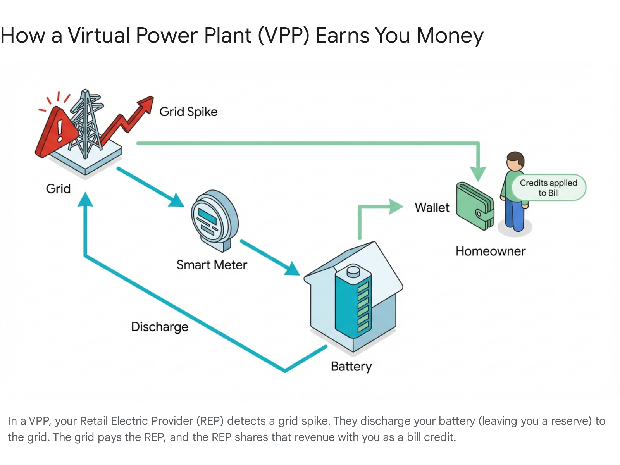
6.2 Virtual Power Plants (VPPs) / ADERs
The most advanced incentive in Texas is the Virtual Power Plant. The Public Utility Commission of Texas (PUCT) and ERCOT have established pilot programs allowing small distributed batteries to aggregate and act like a large power plant.
6.2.1 How VPPs Work
Homeowners grant permission for a third party (like an aggregator or REP) to control their battery during specific "grid events"—moments when demand is critically high (e.g., a summer heatwave).
6.2.2 Active Programs in 2026
- Tesla Electric: Available to Powerwall owners in deregulated zones. Tesla acts as the REP and manages the battery's exports. Participants have reported earning significant bill credits—sometimes exceeding $100 in a single summer month—by selling power when the grid price hits its cap.6
- Octopus Energy: The "Intelligent Octopus" program offers flat monthly bill credits (e.g., $20‑$40) simply for connecting a compatible battery (like Enphase or Tesla) to their platform, plus potential additional earnings for grid support.19
---
7. Solar Buyback Plans: Navigating the Deregulated Market
For homeowners in the deregulated zones (Oncor, CenterPoint, AEP), the choice of Retail Electric Provider (REP) and specific electricity plan is as important as the choice of solar panels.
7.1 Types of Buyback Plans
In 2026, plans generally fall into three categories:
| Plan Type | Mechanics | Best Suited For | Risk Profile |
|---|---|---|---|
| Real‑Time Wholesale (RTW) | Import at retail rate. Export at the real‑time wholesale market price (changes every 15 mins). | Battery Owners. Batteries can discharge when prices spike to high levels ($3.00+/kWh). | High. Wholesale prices can be negative or near zero for long periods. |
| Capped Credit / Avoided Cost | Import at ~14¢. Export at a fixed lower rate (3¢‑5¢). | Solar‑Only Homes. Better than nothing, but incentivizes high self‑consumption during the day. | Low. Predictable but low yield. |
| 1:1 Buyback (Capped) | Import at 14¢. Export at 14¢. Credits capped at monthly import usage. | Net Zero Homes. Allows homeowners to offset their energy charge completely (but usually not TDU fees). | Low. The ideal scenario, but increasingly rare. |
7.2 Leading Providers in 2026
Based on market data for 2026, the following providers are notable for their solar‑friendly policies:
- Gexa Energy: Known for the "Solar Export Saver" plan, which often provides a reasonable credit balance, though terms can vary by region.21
- Chariot Energy: A subsidiary of Hanwha Q Cells (a major panel manufacturer), Chariot offers plans like "Shine" and "GreenVolt" designed specifically to support solar adoption. They often offer favorable rollover terms for credits.22
- Almika Solar: A niche provider that specializes in solar customers, often providing plans that allow for offsetting TDU charges, a rarity in the broader market.23
7.3 The "Free Nights" Warning
A popular plan type in Texas is "Free Nights and Weekends." Solar homeowners must approach these with caution.
These plans typically charge a significantly higher daytime rate to subsidize the free nights. Since solar panels produce power during the day, homeowners on these plans are often credited for their solar exports at $0 (since daytime power is not free, but the buyback is often tied to the plan structure) or offset against a very expensive daytime rate. Without a battery to shift solar production to the expensive evening hours or a massive load shift to the free night hours, these plans can negate the financial benefits of solar.24
---
8. Financial Analysis: Is It Worth It?
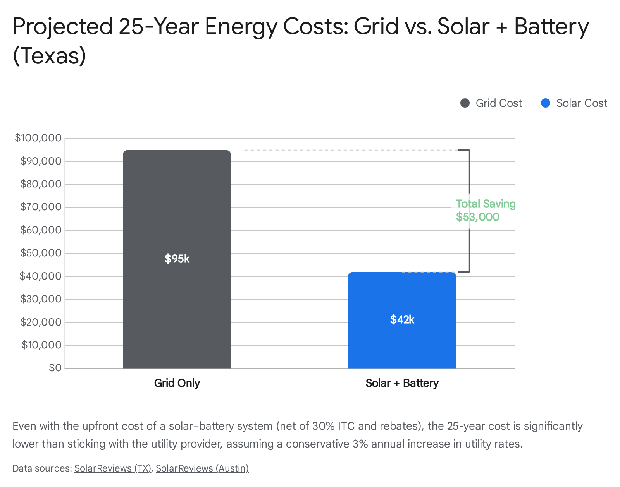
Ultimately, the decision to install solar comes down to the numbers. Does the combination of federal tax credits, state exemptions, utility rebates, and avoided energy costs justify the investment?
8.1 ROI Comparison
Consider a standard scenario for a Texas home:
- System: 10 kW Solar + 1 Battery.
- Gross Cost: $35,000.
- Incentives:
- Federal ITC (30%): ‑$10,500.
- Utility Rebate (e.g., Oncor): ‑$5,000 (hypothetical average based on variable rebate pool).
- Net Cost: $19,500.
If the system saves the homeowner an average of $200 per month on electricity (a conservative estimate given rising rates and VPP earnings), the simple payback period is approximately 8.1 years. With the warranty of panels typically lasting 25 years, this leaves nearly 17 years of "free" energy production.
8.2 Financing: Cash vs. Loan vs. PPA
- Cash: Delivers the highest ROI. The homeowner claims all incentives directly.
- Solar Loan: The most common method. Homeowners should be wary of "dealer fees" (origination fees) which can be as high as 20‑30% of the loan amount, artificially inflating the gross system price to buy down the interest rate.
- PPA / Lease: In a Power Purchase Agreement (PPA), a third party owns the system and sells the power to the homeowner. Warning: In Texas, PPA customers often forfeit the 30% Federal ITC and the local utility rebate to the third‑party owner. Furthermore, PPA contracts can complicate the sale of the home. For most Texas homeowners, ownership (Cash or Loan) is financially superior to leasing.
---
9. Consumer Protection and Scams
The high interest in solar has attracted bad actors to the market. Homeowners must be vigilant against deceptive marketing practices.
9.1 The "Free Solar" Myth
Advertisements claiming "Governor Announces Free Solar Program" or "No Cost Solar" are almost universally misleading. There is no state‑sponsored program in Texas that provides free solar panels to the general public. These ads are typically lead‑generation tactics for solar loans. The term "no cost" usually refers to "$0 down financing," which is a loan, not a gift.
9.2 Verification Steps
Before signing a contract, homeowners should:
- Verify the Installer: Check if the installer is a "Participating Service Provider" with the local utility (e.g., Oncor or CenterPoint). If they are not, the homeowner cannot claim the utility rebates.
- Check the TDU Rebate Status: Ask the installer explicitly: "Are funds still available for the Oncor/CenterPoint rebate, and have you reserved them for my project?"
- Review the Electric Plan: Demand an analysis of which specific electricity plan will be used. A solar system paired with the wrong electric plan (e.g., a plan with no buyback credits) can result in a bill that never decreases.
10. Conclusion
In 2026, solar power in Texas represents a convergence of opportunity and complexity. The stability of the Federal ITC, combined with the maturation of battery technology and VPP markets, offers a path to energy independence and significant financial savings. However, this path is narrow. It requires careful navigation of TDU rebates, precise selection of retail electric plans, and a clear understanding of the new "solar‑plus‑storage" paradigm. For the homeowner in Dallas, the battery is the key to unlocking the Oncor rebate. For the homeowner in Houston, speed is the key to capturing the CenterPoint incentive. And for the homeowner in Austin, education is the gateway to the rebate. By leveraging these incentives and avoiding the pitfalls of incompatible electric plans, Texans can secure their energy future against the volatility of the grid.
Works cited
- Residential Clean Energy Credit | Internal Revenue Service, accessed January 7, 2026, https://www.irs.gov/credits-deductions/residential-clean-energy-credit
- Solar Exemptions | Travis Central Appraisal District, accessed January 7, 2026, https://traviscad.org/solar/
- Oncor Rebates 2026: Solar, HVAC & Energy Efficiency Incentives – Quick Electricity, accessed January 7, 2026, https://quickelectricity.com/oncorincentives/
- Installation of Residential Solar System – CenterPoint Energy, accessed January 7, 2026, https://www.centerpointenergy.com/en-us/SaveEnergyandMoney/Pages/Installation-of-residential-solar-systems.aspx?sa=ho&au=res
- Rebates for Home Rooftop Solar Systems – Austin Energy, accessed January 7, 2026, https://austinenergy.com/green-power/solar-solutions/for-your-home
- Tesla Electric Virtual Power Plant Pilot with ERCOT, accessed January 7, 2026, https://www.tesla.com/support/energy/virtual-power-plant/tesla-electric
- Solar Rights & Regulations | www.gosolartexas.org, accessed January 7, 2026, https://www.gosolartexas.org/solar-rights-regulations
- Guide to Texas Solar Incentives & Tax Credits in 2026 – SolarReviews, accessed January 7, 2026, https://www.solarreviews.com/solar-incentives/texas
- Residential Solar Program – Oncor, accessed January 7, 2026, https://www.oncor.com/takealoadofftexas/pages/residentialsolar
- Solar Panel Cost Houston: What You'll Really Pay in 2026 – Suntria, accessed January 7, 2026, https://suntria.com/blog/solar-panel-cost-houston/
- CenterPoint Incentives 2026: Free A/C Tune‑Ups & Rebates in Houston – Quick Electricity, accessed January 7, 2026, https://quickelectricity.com/centerpoint-incentives-houston/
- Texas Solar Incentive Programs, accessed January 7, 2026, https://www.solarinsure.com/texas-incentive-programs
- AEP Texas SMART Source Solar PV Program, accessed January 7, 2026, https://solarsme.com/aep-texas-smart-source-solar-pv-program/
- AEP Texas Solar PV Incentive Program Homepage, accessed January 7, 2026, https://www.txreincentives.com/
- Going Solar with Austin Energy: What You Need to Know – SolarReviews, accessed January 7, 2026, https://www.solarreviews.com/blog/going-solar-with-austin-energy
- Solar Solutions – Austin Energy, accessed January 7, 2026, https://austinenergy.com/green-power/solar-solutions
- Rooftop Solar (Commercial) – CPS Energy, accessed January 7, 2026, https://www.cpsenergy.com/en/my-business/savenow/rooftop-solar-comm.html
- Rooftop Solar Incentives – CPS Energy, accessed January 7, 2026, https://www.cpsenergy.com/en/my-home/savenow/solar-photovoltaic-rebate/comm-solar-rebate-incentive-tiers.html
- Join the Octopus VPP and Monetize your Battery Energy Storage | NATiVE Solar, accessed January 7, 2026, https://nativesolar.com/octopus-virtual-power-plant-texas/
- Octopus Energy customers in Texas supercharge savings with home battery program, accessed January 7, 2026, https://octopusenergy.com/press-releases/octopus-energy-customers-in-texas-supercharge-savings-with-home-battery-program
- Compare the Best Solar Buyback Plans in Texas, accessed January 7, 2026, https://www.choosetexaspower.org/solar-buyback-plans/
- Texas Solar Buyback Plans & Net Metering Programs (2026 Guide) – Quick Electricity, accessed January 7, 2026, https://quickelectricity.com/texas-solar-buyback-net-metering-programs/
- Texas Solar Buyback Plans, accessed January 7, 2026, https://www.texaspowerguide.com/solar-buyback-plans-texas/
- Texas Free Night's Energy Plan 2 Year Followup : r/TexasSolar, accessed January 7, 2026, https://www.reddit.com/r/TexasSolar/comments/1mzqjw1/texas_free_nights_energy_plan_2_year_followup/