If you are reading this over your morning coffee on January 7, 2026, trying to figure out if solar panels are still a smart move for your Georgia home, you have likely noticed that the headlines are confusing. You might have heard that "solar is dead" because of federal changes, or you might have neighbors rushing to sign "no cost" lease agreements. The reality is somewhere in the middle, and it is far more complex than it was just twelve months ago.
The rules of the game have completely flipped in the last week. As of seven days ago, on December 31, 2025, the federal tax credit for buying solar panels for your residential home essentially evaporated for the average purchase.1 The "One Big Beautiful Bill," signed into law in the summer of 2025, brought an abrupt end to the era of easy 30% tax refunds for homeowners who purchase their systems with cash or loans.2 If you buy panels today, expecting a check from the IRS next April to cover a third of the cost, you are going to be very disappointed.
However, solar is absolutely not dead in Georgia. It has simply changed lanes. The industry has shifted from an ownership model to a "usership" model, driven by corporate tax incentives that survived the legislative chopping block.4 Simultaneously, the local utility landscape remains a patchwork of confusing rate plans. Georgia Power has maintained its specific buyback rates that penalize solar-only systems, while Electric Membership Corporations (EMCs) like Jackson EMC and Cobb EMC have quietly rebooted their rebate programs for the 2026 calendar year, offering lifelines to savvy customers.6
This report is designed to be your survival guide. We will move past the sales fluff and get down to the hard math. We will explore why leasing has become the dominant financial strategy, why a battery is no longer optional if you want to save money, and how to navigate the tricky waters of Homeowners Associations (HOAs) after the state legislature failed to pass protective laws last year. We will walk through every detail—from the tax code loopholes to the exact cent-per-kilowatt math—so you do not get ripped off in this new "wild west" market of 2026.
1.1 The "Too Long; Didn't Read" (TL;DR) for January 2026
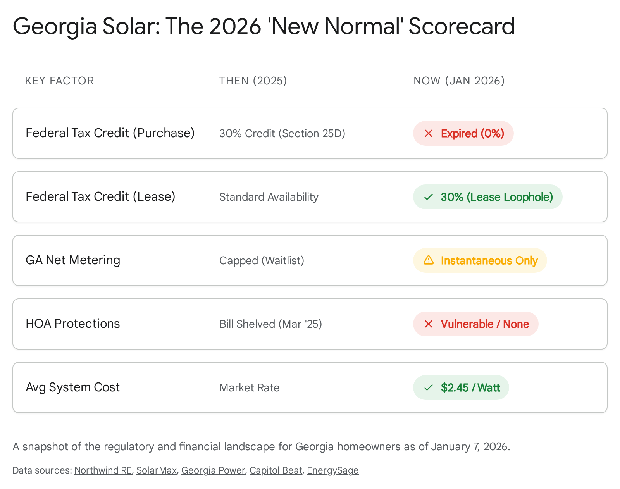
For those who need the bottom line immediately, here is the summary of the situation as of this morning. First, buying solar panels with cash or a standard loan is now financially difficult for most households because the Residential Clean Energy Credit (Section 25D) has expired.2
Second, leasing is the new buying. Because of a specific structure in the tax code known as Section 48E, businesses can still claim a 30% tax credit for solar investments. When you lease a system, the solar company owns it, claims that credit, and passes the savings on to you in the form of a lower monthly payment.4 In 2026, leasing is almost always the path to immediate savings.
Third, batteries are mandatory. Georgia Power does not pay you the full retail price for the extra electricity you send to the grid. They pay you a rate based on "avoided cost," which is roughly 7 cents per kilowatt-hour, while selling it to you for about 14 cents.9 If you do not have a battery to save your solar power for your own use, you are essentially losing money on every exported kilowatt.
Fourth, your HOA is still the boss. The Georgia legislature failed to pass the "Solar Access" bill (HB 389) during the 2025 session.11 This means if your neighborhood covenants say "no solar," they legally mean it. You must check your bylaws before signing any contract.
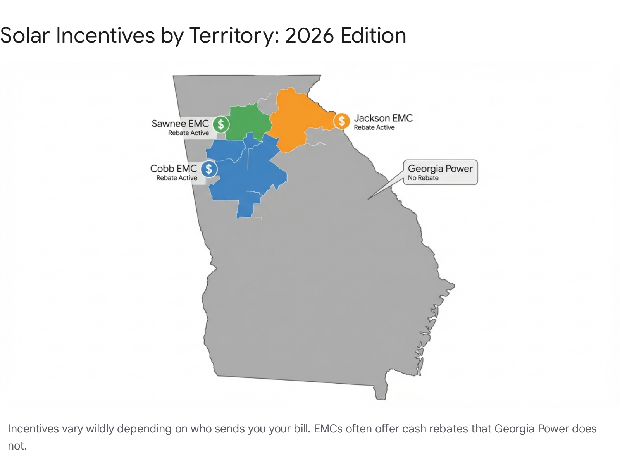
Finally, local rebates are alive and well. While the federal government pulled back, local co‑ops like Sawnee EMC, Jackson EMC, and Cobb EMC have active rebate programs for 2026.6 If you live in these territories, you have access to funds that Georgia Power customers do not.
2. The Death of Section 25D: Why You Can’t Claim the Tax Credit Anymore
For nearly two decades, the absolute bedrock of the American solar industry was the Residential Clean Energy Credit, known formally in the tax code as Section 25D.15 You probably knew it simply as "the 30% tax credit." It was a simple, powerful incentive: if you spent $20,000 on a solar system, the IRS would let you deduct $6,000 from the taxes you owed. It made expensive systems affordable and drove the adoption of clean energy across millions of American rooftops.
That era ended abruptly one week ago. To understand why you cannot claim this credit today, we have to look at the legislative earthquake that hit in 2025.
2.1 The "One Big Beautiful Bill" (OBBB) and the 2025 Cutoff
In July 2025, President Trump signed the "One Big Beautiful Bill" (OBBB) into law.2 While the legislation had broad economic goals, it specifically targeted "green energy handouts" for elimination. The language of the bill was clear and decisive regarding residential solar. It stated that the credit allowed under Section 25D would not be allowed for any expenditures made after December 31, 2025.1
This was a major departure from previous policy shifts. In the past, when solar credits were set to expire, Congress often included "safe harbor" provisions. These provisions usually allowed homeowners to claim the credit if they had paid a deposit or started construction before the deadline, even if the system was not turned on yet. The OBBB contained no such safety net for residential projects.2 The rule was strict: if your system was not fully installed and "placed in service"—meaning it was operational and ready to generate power—by midnight on New Year's Eve 2025, you missed the boat completely.2
If you are buying a system today in cash or getting a loan from a bank, you are paying 100% of the sticker price. There is no $6,000 or $10,000 refund coming next April to help you pay off that loan. This change drastically alters the return on investment for a purchased system, extending the "break-even" point by several years.
2.2 The Survivor: Section 48E (The Commercial Credit)
Here is where the situation gets interesting—and where your opportunity lies in 2026. The same law that killed the homeowner credit left the commercial credit, known as Section 48E, mostly intact for the immediate future.3 This section of the tax code is designed for businesses that invest in clean energy property.
The logic of the solar market in 2026 hinges on this distinction. You, as a homeowner, are not a business. You cannot claim Section 48E. However, solar leasing companies—like Sunrun, Tesla, or local Georgia installers—are absolutely businesses. When they install a solar system on your roof under a lease agreement, they remain the legal owner of that equipment. Because they are the owner, and they are a business, they can claim the 30% commercial tax credit.5
This creates a massive "corporate loophole" that benefits you indirectly. In a competitive market, these companies use that 30% tax credit to lower the price they charge you. They effectively say, "We will take the federal tax credit, and in exchange, we will give you a lower monthly lease payment than you could get if you took out a loan to buy the system yourself".17
It is important to note that this commercial credit has its own ticking clock. The OBBB includes provisions that will eventually phase this out or require strict "domestic content" (Made in the USA) thresholds starting in later years, potentially 2027 or 2028.18 But for 2026, the window is wide open. This creates a unique market dynamic where leasing is subsidized by the government, while owning is not.
2.3 The "Lease vs. Buy" Math Flip
In 2024 and 2025, any honest energy advisor would have told you that buying was almost always better than leasing. When you bought, you kept the tax credit, you added equity to your home, and you had no long‑term contract hanging over your head. In 2026, the math has inverted completely.
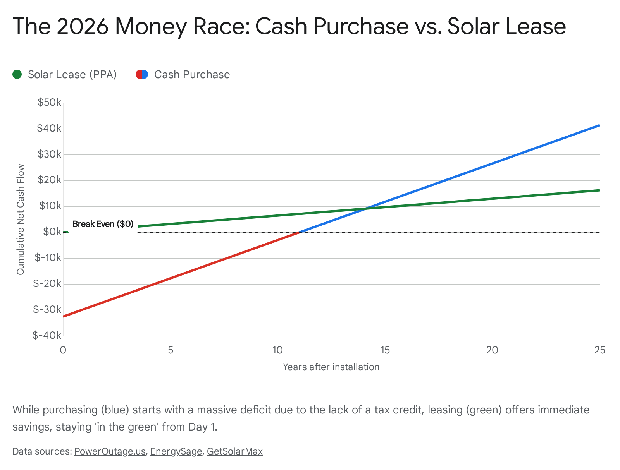
When we look at the financials side‑by‑side, the disparity is stark. If you choose to buy with cash or a loan in 2026, your upfront cost is high—likely between $25,000 and $40,000 for a standard system with a battery.19 You receive zero federal tax relief. You are responsible for all maintenance. While you own the asset, the return on investment is slow because you paid full price.
On the other hand, leasing in 2026 offers a low upfront cost, usually zero dollars down.20 While you do not get the tax credit directly, the leasing company claims the 30% credit and passes that value through to you via a subsidized monthly payment.21 The maintenance is the installer's responsibility, not yours. The result is that the 25‑year savings potential of a lease is now often higher than buying, simply because the monthly cost is significantly lower than a loan payment for the same unsubsidized equipment.
This shift means that in 2026, leasing is the primary vehicle for residential solar in Georgia. If a salesperson tries to sell you a cash system today without explicitly explaining that you have lost the tax credit, they are doing you a disservice. They are selling you a 2025 product in a 2026 market.
3. Georgia Power: The 5,000 Cap and the "Avoided Cost" Trap
If the federal tax changes are the "Storm" that has hit the solar industry, Georgia Power's rate policies are the rocky "Terrain" you have to navigate. You need to understand this terrain intimately to ensure your solar investment actually saves you money. The utility's policies determine how much your solar energy is worth, and right now, they are designed to pay you as little as possible.
3.1 The "Net Metering" Myth
You may have heard friends or neighbors say things like, "The electric company sends me a check for my power!" or "My meter spins backward, and I treat the grid like a free battery!" That arrangement is called Net Metering. In a true Net Metering scenario, every kilowatt‑hour (kWh) of solar energy you send to the grid cancels out one kWh you buy from the grid later. It is a one‑for‑one swap that makes solar very lucrative.
In Georgia, however, true Net Metering is effectively a unicorn. In 2019, the Georgia Public Service Commission (PSC) forced Georgia Power to offer true Net Metering with monthly netting.21 However, there was a major catch: they capped enrollment at only 5,000 customers total.21
The reality for you in 2026 is that this cap was reached way back in 2021.21 If you are signing up for solar today, you absolutely cannot get into that program. It is closed to new participants. Do not let anyone tell you otherwise.
3.2 The Current Reality: Instantaneous Netting
Since you missed the 5,000 customer cap, any new solar customer in 2026 will be placed on the "Smart Usage" or "RNR" (Renewable and Non‑Renewable) tariff with a mechanism called "Instantaneous Netting".22 This sounds like boring technical jargon, but it is actually a critical concept that determines how your money is counted.
Instantaneous Netting works exactly how it sounds: the utility measures your energy usage and production second by second. This is very different from monthly netting.
When your solar panels produce energy at the exact second your air conditioning unit is running, you use that solar power for free. You avoid buying electricity from Georgia Power. This is "Self‑Consumption," and it is the best‑case scenario. You save whatever the retail price of electricity is—let's say approximately 14 cents per kWh.23
However, if your solar panels produce energy while you are at work and your house is quiet, that energy flows out to the grid. Because the netting is instantaneous, you don't get to "bank" that energy for later. Instead, Georgia Power buys that exported energy from you instantly. And here is the trap: they don't pay you the retail price of 14 cents. They pay you a much lower wholesale rate.
3.3 The "Avoided Cost + 4 Cents" Math
As of the 2025 Rate Case decision, which froze base rates through 2028, the compensation formula for this exported solar energy is specific.9 You are paid the "Solar Avoided Cost" plus a small bonus adder.
The "Solar Avoided Cost" is essentially what it would cost Georgia Power to generate that electricity themselves or buy it from a large power plant. This rate fluctuates slightly based on fuel prices but generally hovers around 2.7 to 3.0 cents per kWh.23 To this, the PSC added a "4 cent adder" to try to make solar slightly more attractive.9
When you do the math, the total buyback rate comes out to roughly 6.7 to 7.0 cents per kWh.24
The problem is immediately obvious. You buy electricity from Georgia Power at roughly 14 cents. You sell your excess solar electricity to them at roughly 7 cents. Every time you send a kilowatt‑hour of solar power to the grid, you are losing 50% of its value instantly. You are buying high and selling low—the opposite of a good investment strategy.
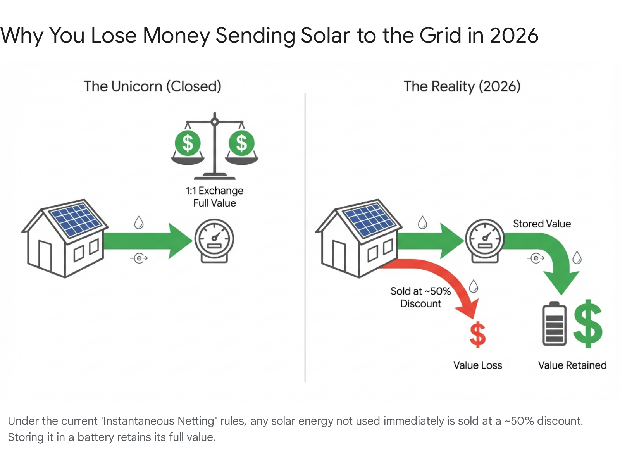
The solution to this financial trap is simple physics: you must store that energy instead of selling it. This brings us to the most critical hardware change of 2026: the absolute necessity of home batteries.
4. The Battery Necessity: Why "Solar‑Only" is a Bad Investment
In the landscape of 2026 Georgia, installing a solar panel system without a battery is like buying a car without wheels—it has potential, but it will not get you where you want to go. Because of the disparity between the price you pay for electricity and the price you are paid for your exports, your financial goal is to never send power to the grid if you can help it. You want to keep every single electron you generate on your property.
4.1 How the Battery Fixes the Math
To understand the financial power of a battery, we have to look at a typical day in the life of a Georgia homeowner.
Imagine it is a Tuesday morning in July. You leave for work at 8:00 AM. By 10:00 AM, the Georgia sun is blazing, and your solar panels are generating huge amounts of power. But your house is empty. The lights are off, the TV is off, and the air conditioning is set to an eco‑mode. Your home cannot consume all that power.
Without a battery, that excess power flows out through your meter to Georgia Power. They credit your account at the "avoided cost" rate of roughly 7 cents per kWh. You are earning pennies.
Now fast forward to 7:00 PM. You come home, cook dinner using an electric oven, turn on the TV, and crank down the AC to cool off the house. The sun is setting or already down. Your solar panels are producing little to no energy.
Without a battery, you have to buy electricity from Georgia Power to run your appliances. They charge you the full retail rate of 14 cents per kWh. Effectively, you sold your own clean power for 7 cents in the morning and bought it back for 14 cents in the evening. You lost 7 cents on every unit of energy.
Now, let's look at the scenario with a battery. In the morning, when your panels produce that excess power, it does not go to the grid. It flows into your Tesla Powerwall 3 or Enphase IQ battery sitting in your garage. It sits there, storing that value.
In the evening, when you turn on the oven, the battery discharges that stored power. You run your home on your own sunshine from the morning. You buy zero electricity from Georgia Power. You have effectively saved the full 14 cents per kWh. By shifting the time you use the energy, the battery doubles the value of your solar production.
4.2 The "Solar Plus Storage" Programs
Georgia Power recognizes this reality. In their 2025 Integrated Resource Plan (IRP), the utility introduced specific programs to encourage "Solar Plus Storage".9 While they haven't rolled out massive cash rebates for batteries like some other states, their new rate plans are designed to make the battery economically viable by ensuring you can maximize that self‑consumption.
These programs are not just about saving you money; they are about grid stability. Georgia is facing unprecedented energy demand from new data centers and industrial growth.25 By encouraging homeowners to store their own power and use it during peak evening hours, the utility reduces the strain on the grid. For you, the homeowner, it means that a battery is the key to unlocking the true savings potential of solar in 2026.
5. The EMC and Municipal Utility Spotlights
If you are one of the millions of Georgians who are not Georgia Power customers, your rules are completely different. You likely get your power from an Electric Membership Corporation (EMC) or a municipal utility. These are non‑profit cooperatives owned by their customers, or city‑owned entities, and they often have much better incentives in 2026 than the investor‑owned giant next door.
The geography of Georgia solar is a patchwork. Your neighbor across the street might be on a different utility provider than you, with completely different financial outcomes for solar.
5.1 Jackson EMC: The Gold Standard
Jackson EMC, serving a large swath of Northeast Georgia including parts of Gwinnett, Hall, Jackson, and Barrow counties, has consistently been a leader in Georgia solar. For 2026, they have confirmed that their rebate programs are active.13
Historically, and continuing into this year, Jackson EMC has offered a rebate of approximately $450 per kilowatt (kW) of installed solar capacity, with a cap that typically sits around $4,500.27 For a standard home installing an 8 kW system, this is a check for $3,600 back in your pocket. This is real cash that significantly lowers the net cost of the system.
There is one critical condition you must meet: you must use a contractor from their "Right Choice" approved network.13 This is actually a benefit to you. The "Right Choice" network vets installers for quality and insurance, helping you weed out the fly‑by‑night companies that often plague the solar industry.
A savvy tip for 2026: If you choose to lease your system to take advantage of the federal tax credit loophole, you need to check if Jackson EMC allows the rebate to go to the homeowner or if it must go to the system owner (the leasing company). In many cases, the leasing company will take the rebate and use it to lower your monthly lease price even further. Ask this question specifically when getting quotes.
5.2 Cobb EMC: The Innovator
Cobb EMC, serving Northwest Georgia, is another pro‑renewable utility. After their popular "Energy Network" incentive funds ran dry in 2025 due to high demand, they have rebooted the program for "early 2026".7
While their direct solar rebate amounts can vary, Cobb EMC is known for innovative pilot programs. They have previously offered significant incentives for energy efficiency upgrades that pair well with solar, such as smart thermostats and Level 2 EV chargers.14
A unique feature for Cobb EMC members is their experimentation with battery programs. They have explored demand‑response initiatives where they pay you to use your battery during peak times. When you talk to an installer in Cobb County, ask them specifically about "Peak Shaving" programs or battery incentives with Cobb EMC. Even if there isn't a direct cash rebate for the panels, the battery incentives can be substantial.
5.3 Sawnee EMC: Reliable and Flexible
Sawnee EMC, covering parts of Forsyth and surrounding counties, offers a straightforward approach. They have confirmed a general energy efficiency rebate program for 2026.6 While their solar‑specific rebates are sometimes smaller than Jackson's, they offer a very flexible alternative for homes that simply cannot do solar.
If your home is covered in shade from beautiful Georgia pines, or if your roof faces north, Sawnee EMC offers a "Solar REC" (Renewable Energy Credit) program.28 This allows you to purchase "blocks" of solar energy generated elsewhere for just 1 penny extra per kWh. While this doesn't lower your bill (it actually raises it slightly), it allows you to power your home with 100% green energy without installing a single panel or fighting with your HOA.
5.4 Central Georgia EMC & GreyStone Power
Other large co‑ops like Central Georgia EMC and GreyStone Power have also had rebate programs in the past. In 2026, these funds are often allocated on a "first‑come, first‑served" basis or even via a lottery system due to their popularity.29
The action item here is urgency. If you are a customer of these co‑ops, you cannot afford to wait until the summer to make a decision. These incentive funds often dry up by the second quarter of the year. If you are interested, you should be calling them in January to verify the current status of their 2026 funds.
6. The HOA Battlefield: You Are On Your Own
For many Georgia homeowners, the biggest barrier to solar isn't the cost or the technology—it is the neighborhood Homeowners Association (HOA). This is the hardest pill to swallow for many residents who assume they have the right to improve their property.
6.1 The Failure of HB 389
In early 2025, there was significant hope among solar advocates. House Bill 389 was introduced in the Georgia legislature with the specific goal of protecting homeowners' rights to install solar. 30 The bill was designed to be a "Solar Rights Act," similar to laws in Florida or Texas, which would have prohibited HOAs from banning solar panels or charging unreasonable fees for their review.
However, that hope was dashed. The bill faced stiff opposition and was withdrawn and recommitted in February 2025, never passing before the legislative session ended.11
This means that today, in 2026, Georgia remains a "property rights" state in a way that oddly works against you. The law generally prioritizes the contract rights of the HOA over your individual property rights. If you bought a home and signed an HOA covenant that restricts "exterior modifications" or explicitly bans solar panels, that contract is valid and enforceable in a Georgia court.31
6.2 What Can You Do?
Since you do not have the law on your side to force the issue, you have to use diplomacy, strategy, and negotiation. You cannot simply demand your rights; you have to persuade the board.
First, read your bylaws before you do anything else. Do not guess what they say. Get the actual document and search for "solar," "energy," and "exterior modifications." Does it explicitly say "No Solar Panels"? Or does it say "Solar panels must be approved by the Architectural Review Committee (ARC)"? If it is the latter, you have a fighting chance.
Second, consider the "Invisible Install." Many Architectural Review Committees are concerned solely with "curb appeal" and aesthetics. They don't want to see the panels from the street. If you have a south‑facing roof on the back of your house, propose installing panels there. Offer to install black‑on‑black panels that blend in with your shingles. Show them that you are willing to compromise on aesthetics to get approval.
Third, use the "Energy Independence" argument. Remind the board that solar increases property values—roughly 4% on average across the U.S..32 Higher property values benefit the entire neighborhood.
Finally, organize your neighbors. An HOA board works for the community. If you can get 50 neighbors to sign a petition saying they want the solar rules updated, the board can vote to change the rules. There is strength in numbers.
Warning: Do not let a solar installer tell you, "Oh, don't worry, they can't stop you." In Georgia, in 2026, they absolutely can. If you install panels without written approval, the HOA can fine you daily and even force you to take the system down at your own expense.
7. Financial Deep Dive: The New ROI Calculation
Now that we understand the rules, let's put real numbers to this. We need to look at the Return on Investment (ROI) for a standard Georgia home to see how the numbers shake out in 2026.
Let's assume a typical scenario:
- Average Electric Bill: $150 per month.
- System Size Needed: 8 kW (roughly 20 panels).
- Battery Needed: 13.5 kWh (equivalent to 1 Tesla Powerwall 3).
7.1 Scenario A: Buying Cash (The "Old Way") - NOT RECOMMENDED
If you try to buy this system with cash or a loan in 2026, here is the math:
- System Cost (Panels): Roughly $20,000 (at $2.50/watt).
- Battery Cost: Roughly $12,000 installed.
- Total Upfront Cost: $32,000.
- Federal Tax Credit: $0 (Expired for residential purchase).
- Net Cost: $32,000.
Now, let's look at the savings. With a battery, you can offset almost all of your $150 bill. Let's say you save roughly $140 a month, or $1,680 a year.
- Payback Period: $32,000 cost divided by $1,680 annual savings equals roughly 19 Years.
Verdict: This is a terrible investment for most families. Locking up $32,000 of cash for a 19‑year payback is simply not smart money. Unless you are an environmental purist who hates debt and contracts, buying cash in 2026 makes little financial sense.
7.2 Scenario B: The "Solar Lease" (The "New Way") - RECOMMENDED
Now, let's look at the lease option that takes advantage of the Section 48E commercial tax credit.
- Upfront Cost: $0.
- Structure: A 25‑Year Power Purchase Agreement (PPA) or Lease.
- How it works: The installer (Sunrun, Tesla, or a local partner) buys the $32,000 system. They claim the ~$9,600 tax credit (Section 48E) and depreciate the asset.
- Your Price: Because they got that $9,600 subsidy, they can offer you a lower monthly payment. They set your lease payment at roughly $110 per month.
Let's check the monthly budget:
- Old Grid Bill: $150.
- New Lease Payment: $110.
- Remaining Grid Bill: ~ $10 (basic connection fees).
- Total New Cost: $120.
- Immediate Savings: $30 per month.
Verdict: This is why leasing has taken over in 2026. You get immediate cash flow positive results—saving $360 a year from Day 1—without the massive upfront loss of the expired tax credit. The payback period is essentially "Day 1."
7.3 Scenario C: The "EMC Hybrid" (Buying with Rebate)
If you are lucky enough to live in Jackson EMC territory, the buying math gets a little better, but it is still tough.
- Total Cost: $32,000.
- Jackson Rebate: -$3,600 (approx. for 8 kW).
- Federal Credit: $0.
- Net Cost: $28,400.
- Payback Period: roughly 16.9 Years.
Verdict: Even with the rebate, buying is difficult without the federal tax credit. Leasing might still win on immediate cash flow, unless you plan to live in the house for 30 years and absolutely hate the idea of a long‑term contract.
8. Step‑by‑Step Guide to Going Solar in 2026
If you have looked at the numbers and decided that saving $30‑$50 a month with a lease is worth it, do not just click the first ad you see on Facebook. You need to follow a strict protocol to protect yourself.
Step 1: Gather Your Data
Before you talk to anyone, get your last 12 months of electricity bills. You need to know your Annual kWh Usage. Do not just look at the dollar amount; look at the kilowatts. A solar system is sized based on energy, not dollars.
Step 2: Get 3 Specific Quotes
Do not compare apples to oranges. When you call installers, ask for three quotes with these exact parameters so you can compare them fairly:
- Quote A (The Control): Cash price, 100% offset of your energy usage, with a battery included.
- Quote B (The 2026 Standard): Lease/PPA, 0% down, with a battery included.
- Quote C (The Competitor): Lease/PPA from a different company, same specs.
Red Flag Warning: If a salesperson quotes you a system without a battery in Georgia Power territory, hang up. They are selling you a system that will lose money because of the buyback rates. They are either incompetent or hope you don't know the math.
Step 3: Ask the "Hard Questions"
When the salesperson is at your kitchen table (or on Zoom), ask these questions verbatim. Their answers will tell you if they are honest.
- "Since the Residential 25D tax credit expired, are you using the Commercial 48E credit in this lease price?" (They should say yes).
- "What is the specific escalator on this lease?" (This is crucial. An escalator is the amount your payment goes up every year. Ideally, you want a 0% escalator (fixed payment) or a 2.9% escalator. If it is 3.9% or higher, walk away. That is too high and might eventually cost more than grid power).
- "Does this quote account for the Georgia Power 'Avoided Cost' buyback rate, or is it faking the savings by assuming Net Metering?" (This is the #1 way people get scammed).
Step 4: The HOA Pre‑Check
Before you sign the contract, take the "Design Proposal" (the picture of the panels on your roof) to your HOA board. Get an email or letter saying "Approved." Do not rely on the solar company's promise that "we handle the HOA." If the HOA denies it later, you are the one who has to pay to remove the panels, not the solar company.
9. Deep Dive: The Tech Stack for Georgia 2026
We mentioned that batteries are mandatory, but not all batteries are created equal. Since you are likely leasing in 2026, you will be offered a "package deal." You need to know how to grade the equipment they offer you.
9.1 The Battery Chemistry War: LFP vs. NMC
In 2026, you will see two main types of batteries on the market.
- NMC (Nickel Manganese Cobalt): These are used in older Tesla Powerwalls (v2) and some LG Chem units. They are energy‑dense, meaning they are small and light, but they have shorter lifespans and handle heat less effectively.
- LFP (Lithium Iron Phosphate): These are used in the Tesla Powerwall 3, Enphase IQ 5T, and FranklinWH batteries.
Recommendation: Demand LFP. Georgia summers are hot. LFP batteries handle heat much better than NMC batteries. They also last nearly twice as many cycles (6,000+ vs 3,000) and are chemically safer (less risk of thermal runaway). Since you are leasing for 25 years, you want a battery that won't die in Year 10.
9.2 Inverters: String vs. Micro
- String Inverters (e.g., Tesla, SolarEdge): This system uses one central box on the side of your house.
- Pro: Cheaper, which means a lower lease payment for you.
- Con: If one panel is shaded by a Georgia pine tree or covered in pollen, the output of the whole system can drop.
- 2026 Note: The Tesla Powerwall 3 has an integrated solar inverter. This is the most common package you will see in 2026 leases. It is a "hybrid" string inverter that is very efficient.
- Microinverters (e.g., Enphase): These are little chips under each panel.
- Pro: Best for shade. If a pine tree shades half your roof, the other half keeps working 100%. They are also safer because they don't run high‑voltage DC power across your roof.
- Con: More expensive.
Recommendation: If you have any shade trees near your roof, insist on Microinverters (Enphase). If your roof is wide open to the southern sky with zero shade, the String Inverter (Tesla PW3) is fine and will save you money.
9.3 The "Smart Panel" Upgrade
Since Georgia Power rates are getting more complex, ask if your installation includes a Smart Span Panel or similar "smart circuit breaker" technology. This hardware replaces your old breaker box and allows you to control exactly which circuits (AC, Dryer, EV Charger) use your battery power and which ones shut off to save energy. In a lease, this is often a small adder but adds huge control value, letting you stretch your battery power further during an outage.
10. Future Outlook: What Happens in 2027 and Beyond?
We are currently in the "2026 Window," but solar is a long‑term relationship. It is important to look ahead at what is coming down the pike.
10.1 The 48E Phase Down
The Commercial Tax Credit (48E) that makes leasing cheap today is not permanent. Under the "One Big Beautiful Bill," it is scheduled to phase this out or require stricter "domestic content" (Made in the USA) thresholds starting in 2027 or 2028.18 This means that lease prices will likely rise in 2027 as the subsidy shrinks. 2026 is likely the "sweet spot" where lease prices are lowest because the industry is desperate to maintain volume after the purchase credit expired.
10.2 Georgia Power's 2028 Rate Case
The current rate freeze ends in 2028.34 In the 2028 Rate Case, energy analysts expect Georgia Power to push for even more changes to manage the grid. This could include mandatory "Demand Charges" for residential customers—charging you based on your highest usage hour of the month, not just total usage.
This possibility reinforces the "Battery First" strategy. A battery protects you from Demand Charges just like it protects you from low export rates. If you have a battery, you are "future‑proofed" against whatever new rates come in 2028.
10.3 Potential Return of State Incentives?
With the failure of HB 389, there is a grassroots movement building for the 2027 legislative session to try again for solar rights. However, do not wait for the government. In Georgia politics, utility lobbying is incredibly strong. It is safer to assume no new help is coming and make the math work today based on the current reality.
11. Conclusion: The Dawn of the "User‑ship" Era
The "Golden Era" of owning solar panels with massive government checks in the mail is over. We have entered the "User‑ship Era."
In 2026, solar is less of a financial investment product and more of a utility service. You are essentially firing Georgia Power as your primary provider and hiring a solar company to be your new, cheaper, cleaner provider. You do not own the power plant on your roof, but you get to enjoy the cheaper electricity it produces.
For Georgians, this shift is actually a simplifying force. You no longer have to worry about maintenance, inverters breaking, or claiming tax credits. You just pay a lower bill.
However, the risks are real. The lack of HOA protections and the tricky buyback rates from Georgia Power mean you must be vigilant. Get a battery. Read the fine print. And enjoy the sunshine—it's the only thing inflation hasn't made more expensive.
---
Appendix: Detailed EMC Contact List (Jan 2026)
| Utility Provider | Program Name | Contact | 2026 Status |
|---|---|---|---|
| Jackson EMC | Right Choice Sun Power | 1‑800‑462‑3691 | Active (Rebate Available) |
| Cobb EMC | Energy Network | 770‑429‑2100 | Active (Rebate Available) |
| Sawnee EMC | Energy Efficiency Rebates | 770‑887‑2363 | Active (Rebate/REC) |
| Georgia Power | RNR / Solar Buyback | 1‑888‑660‑5890 | Active (No Rebate) |
(Note: Always verify rebate availability immediately before signing. Funds are limited and subject to change without notice.)
Works cited
- FAQs for modification of sections 25C, 25D, 25E, 30C, 30D, 45L, 45W, AND 179D under Public Law 119‑21, 139 Stat. 72 (July 4, 2025), commonly known as the One, Big, Beautiful Bill (OBBB) | Internal Revenue Service, accessed January 7, 2026, https://www.irs.gov/newsroom/faqs-for-modification-of-sections-25c-25d-25e-30c-30d-45l-45w-and-179d-under-public-law-119-21-139-stat-72-july-4-2025-commonly-known-as-the-one-big-beautiful-bill-obbb
- Congress and Trump End Solar Tax Credit: What Homeowners Need to Know Before Dec 31, 2025, accessed January 7, 2026, https://www.northwindre.com/congress-and-trump-end-solar-tax-credit-what-homeowners-need-to-know-before-dec-31-2025
- Trump and the Fate of the 30% Solar Tax Credit, accessed January 7, 2026, https://www.solar.com/learn/trump-and-the-fate-of-the-30-solar-tax-credit/
- Solar Leasing Could Be a Better Deal Thanks to Trump's Tax Changes. Here's Why | EnergySage, accessed January 7, 2026, https://www.energysage.com/news/trumps-tax-changes-impact-tpo-solar/
- Pinellas Park Solar: The 2026 Corporate Tax Loophole Explained – SolarMax, accessed January 7, 2026, https://getsolarmax.com/pinellas-park-solar-the-2026-corporate-tax-loophole-explained/
- Rebates and Incentives | Sawnee EMC, accessed January 7, 2026, https://sawnee.coop/rebates-and-incentives
- Energy Efficiency Incentive – Cobb EMC, accessed January 7, 2026, https://cobbemc.com/energy-efficiency-incentive
- Federal Solar Tax Credit (ITC): Ending January 1, 2026, accessed January 7, 2026, https://www.solartopps.com/blog/federal-solar-tax-credit-ending-january-1-2026/
- Georgia Power Company's 2025 Integrated Resource Plan Docket No. 56002, accessed January 7, 2026, https://www.georgiapower.com/content/dam/georgia-power/pdfs/company-pdfs/2025-Integrated-Resource-Plan.pdf
- 2026 Georgia Power Net Metering | EnergySage, accessed January 7, 2026, https://www.energysage.com/local-data/net-metering/georgia-power/
- GA HB389 | 2025‑2026 | Regular Session – LegiScan, accessed January 7, 2026, https://legiscan.com/GA/bill/HB389/2025
- Bill Text: GA HB389 | 2025‑2026 | Regular Session – Introduced – LegiScan, accessed January 7, 2026, https://legiscan.com/GA/text/HB389/id/3114016
- Rebates and Incentives | Jackson Electric Cooperative, accessed January 7, 2026, https://www.jackelec.com/rebates-and-incentives
- Energy Network – Cobb EMC, accessed January 7, 2026, https://www.cobbemc.com/energy-network
- Residential Clean Energy Credit | Internal Revenue Service, accessed January 7, 2026, https://www.irs.gov/credits-deductions/residential-clean-energy-credit
- Sarasota Solar: The 2026 Corporate Tax Loophole Explained – SolarMax, accessed January 7, 2026, https://getsolarmax.com/sarasota-solar-the-2026-corporate-tax-loophole-explained/
- Indian Rocks Beach Solar: The 2026 Corporate Tax Loophole Explained – SolarMax, accessed January 7, 2026, https://getsolarmax.com/indian-rocks-beach-solar-the-2026-corporate-tax-loophole-explained/
- The Final Version of the Solar Tax Credit Changes from the One Big Beautiful Bill, accessed January 7, 2026, https://www.solarinsure.com/final-changes-to-solar-tax-credit-from-h-r-1
- Georgia Solar Panel Cost: Savings and Payback (January 2026) – PowerOutage.us, accessed January 7, 2026, https://poweroutage.us/solar/ga
- Leasing vs. Buying Solar Panels: What's Best for You? – Palmetto, accessed January 7, 2026, https://palmetto.com/solar/leasing-vs-buying-solar-pros-cons-advantages-disadvantages-benefits-drawbacks
- Behind the meter solar workshop Q&A – Georgia Power, accessed January 7, 2026, https://www.georgiapower.com/content/dam/georgia-power/pdfs/residential-pdfs/residential-rate-plans/georgia-power-btm-solar-faq-document-august-2021.pdf
- Net Metering – DSIRE, accessed January 7, 2026, https://programs.dsireusa.org/system/program/detail/574
- Electric Bills Decoded: Which Electricity Rate is Best If I Want to Go Solar?, accessed January 7, 2026, https://www.southface.org/electric-bills-decoded-which-electricity-rate-is-best-if-i-want-to-go-solar/
- Free Georgia Solar Incentives: Register for Solar Program (Open Enrollment), accessed January 7, 2026, https://georgia.statesolar.org/
- Media Advisories – Georgia Public Service Commission, accessed January 7, 2026, https://psc.ga.gov/newsroom/media-advisories/
- Georgia Power highlights first contracts under new rules & regulations, continued economic growth and updated forecasts in latest filings with Georgia PSC, accessed January 7, 2026, https://www.georgiapower.com/news-hub/press-releases/georgia-power-highlights-new-customer-contracts-continued-economic-growth-updated-forecasts-in-latest-filings-with-georgia-psc.html
- Georgia | Energy Outlet, accessed January 7, 2026, https://energy-outlet.com/taxonomy/term/22
- Solar Renewable Energy Credit Program – Sawnee EMC, accessed January 7, 2026, https://sawnee.coop/solar-renewable-energy-credit-program
- Tax Incentives for Solar Power in Atlanta, GA – Better Tomorrow Solar, accessed January 7, 2026, https://www.bettertomorrowsolar.com/benefits-of-solar/solar-incentives/
- Georgia approves solar energy device protections for homeowners associations, accessed January 7, 2026, https://citizenportal.ai/articles/2292055/Georgia/Georgia-approves-solar-energy-device-protections-for-homeowners-associations
- Can You Get Solar if You Reside in An HOA, accessed January 7, 2026, https://hoamemberservices.com/resources/can-you-get-solar-if-you-reside-in-an-hoa/
- Georgia Solar Incentives, Tax Credits & Rebates (2026 Guide) – This Old House, accessed January 7, 2026, https://www.thisoldhouse.com/solar-alternative-energy/solar-incentives-georgia
- Senate Finance bill modifies the House‑passed approach to clean energy credits, but also includes drastic cuts and unworkable rules – The Tax Law Center, accessed January 7, 2026, https://taxlawcenter.org/blog/senate-finance-bill-modifies-the-house-passed-approach-to-clean-energy-credits-but-also-includes-drastic-cuts-and-unworkable-rules
- Georgia PSC approves plan to freeze Georgia Power base rates through at least 2028, accessed January 7, 2026, https://www.georgiapower.com/news-hub/press-releases/georgia-psc-approves-plan-to-freeze-base-rates-through-2028.html
- Commissioners Approve Three‑Year Rate Freeze for Georgia Power, accessed January 7, 2026, https://psc.ga.gov/site/assets/files/8840/media_advisory_2025_gp_rate_freeze_approval.pdf