It is January 7, 2026. If you are a homeowner in Rhode Island, you might be feeling a mix of relief and regret as you look out at your frost-covered roof. The relief comes from having survived the absolute frenzy of the last six months—the "Solar Rush of 2025" that saw installer trucks parked on every street from Woonsocket to Westerly. The regret, perhaps, comes from the nagging feeling that you missed the boat.
For years, the headlines screamed about the federal Investment Tax Credit (ITC)—that famous "30% off coupon" from Uncle Sam. But as of midnight on New Year's Eve, that tax credit for residential solar installations has officially expired.1 The legislative changes enacted last year held firm, and despite the frantic lobbying and the hope for a last-minute extension, the residential credit is gone for systems placed in service after December 31, 2025.
So, here we are in the cold light of early 2026. The tax credit is history. The installers are catching their breath. And you are holding an electric bill from Rhode Island Energy that looks more like a mortgage payment than a utility statement. You are asking the question that thousands of your neighbors are asking: "Is solar dead in Rhode Island?"
The answer, surprisingly, is a resounding "No." In fact, for many households, the financial case for solar in Rhode Island is stronger today than it was five years ago, even without the federal help.
This report is designed to be your comprehensive manual for navigating this new reality. We are not going to sugarcoat the loss of the tax credit. It hurts. Losing a 30% discount is significant. However, Rhode Island is unique. We live in a state with some of the highest electricity prices in the nation and some of the most robust state-level incentives to match.3
Over the next extensive chapters, we will walk through every single dollar available to you. We will decode the complex choice between the "REG Program" and "Net Metering." We will show you how a battery in your garage can earn you a paycheck every summer. We will explore the new "Solar for All" programs that are finally launching to help low-and-moderate-income families.
1.1 Executive Summary (TLDR)
For those who need the bottom line immediately, here is the state of play as of January 7, 2026:
- The Federal Tax Credit is Gone: New residential solar projects no longer qualify for the 30% ITC. If you install now, you pay the net price unless you qualify for specific business or commercial credits.1
- Electricity Rates Are Your Motivator: Rhode Island residential rates are hovering near 29-30 cents per kilowatt-hour (kWh). Doing nothing means paying this rate forever, which is a financial bleed far worse than the cost of a solar loan.4
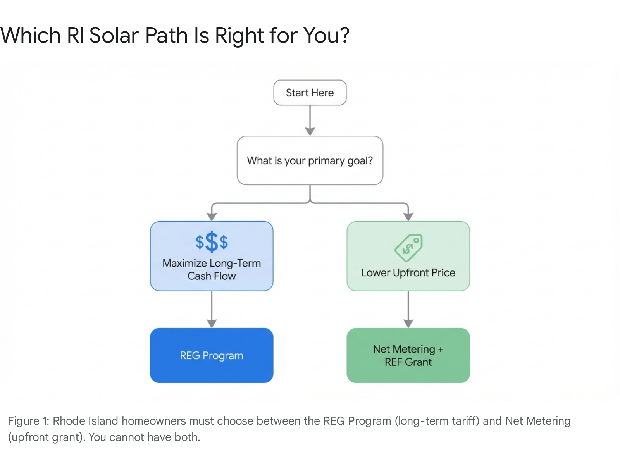
- You Must Choose a Path: You cannot have it all. You must select either the Renewable Energy Growth (REG) program (a guaranteed income contract with the utility) OR Net Metering combined with the Renewable Energy Fund (REF) grant (an upfront cash discount).5
- Batteries Are Lucrative: The Connected Solutions program is still active and paying roughly $225 per kilowatt per year for battery performance. This is one of the few "free money" programs left and makes energy storage highly attractive.6
- Time is of the Essence for 2025 Rates: The state runs on a "Program Year" that ends March 31. Enrolling before April 1, 2026, allows you to lock in the 2025 tariff rates, which are known and favorable.7
---
2. The Economic Landscape of 2026
To understand why you should invest tens of thousands of dollars into your home energy system in 2026, we first have to step back and look at the broader economic environment in Rhode Island. It is easy to focus on the cost of the solar panels, but the real number you need to focus on is the "Cost of Doing Nothing."
2.1 The "Cost of Doing Nothing": 30 Cents and Climbing
In many parts of the United States, electricity is cheap. In states like Washington or Idaho, residents pay 10 or 11 cents per kWh. If those homeowners lose a 30% tax credit, solar often stops making sense. The payback period stretches to 20 years, and it becomes a "lifestyle choice" rather than a financial one.
Rhode Island is different. We are at the end of the energy pipeline. We rely heavily on natural gas for generation, and we have significant transmission and distribution costs. As of early 2026, the average Rhode Island homeowner is paying a "Standard Offer" rate plus delivery charges that total approximately 29.11 cents per kWh.3
Let's break down what that means for a typical family in Warwick or Cranston living in a 2,000-square-foot home:
- Average Usage: 750 kWh per month (9,000 kWh per year).
- Monthly Bill: $218.
- Annual Cost: $2,619.
Now, assume a conservative inflation rate of 3% per year for electricity. (Note: In recent years, we have seen spikes much higher than that, but let’s be conservative).
- Year 1: $2,619
- Year 5: $2,947
- Year 10: $3,416
- Year 20: $4,591
Over the next 25 years—the warrantied life of a solar panel system—that homeowner will pay roughly $95,000 to the utility company if they do nothing. That is the baseline. That is the money that is leaving your bank account no matter what.
When you look at solar in 2026, the question is not "Can I get a tax credit?" The question is "Can I install a system for less than $95,000?" The answer is almost certainly yes. Even without the tax credit, a typical 9kW system might cost $30,000. Trading $30,000 today to save $95,000 over time is still a massive win, tax credit or not.
2.2 The Post-ITC Market Correction
The second factor defining early 2026 is market availability. In late 2025, you couldn't get an installer on the phone. They were booked solid, rushing to finish jobs before the December 31st deadline to capture the tax credit for their clients.
This "rush" distorted prices. Basic economics tells us that when demand exceeds supply, prices rise. Installers didn't need to negotiate in October 2025. They could charge a premium because customers were desperate.
Now, in January 2026, that pressure has evaporated. The phone lines are quiet. Installers are looking at empty calendars for February and March.
- Negotiating Power: You, the homeowner, have the leverage again.
- Equipment Costs: The global supply chain has caught up. The shortage of inverters that plagued late 2025 is easing.
- Timeline: Instead of waiting 6 months for an install, you might be able to get on the roof in 4 weeks.
While you lost the 30% federal credit, you might find that system prices (the gross cost) drop by 10-15% as installers sharpen their pencils to win business in this new "winter" of the solar industry.
---
3. The Great Decision: REG vs. Net Metering
This is the most critical chapter of this handbook. If you take nothing else away, please understand this: Rhode Island is unique. In almost every other state, you go solar, you get "Net Metering," and you're done.
In Rhode Island, you stand at a fork in the road. You must choose between two mutually exclusive incentive programs. You cannot choose both. Your choice will determine how you are paid, how your system is wired, and how much money you save.
The two paths are:
- The Renewable Energy Growth (REG) Program
- Net Metering with the Renewable Energy Fund (REF) Grant
3.1 Path A: The Renewable Energy Growth (REG) Program
The REG program is a "Feed-in Tariff." This is a fancy way of saying that you are becoming a power supplier for Rhode Island Energy.
How It Works:
When you install a system under the REG program, your solar panels are not just slowing down your meter. They are often wired to a dedicated "generation meter" that measures every single electron the system produces before it goes anywhere else.
Rhode Island Energy agrees to buy 100% of that solar production from you at a fixed price for a fixed term (15 or 20 years).
The Bill Credits and Cash Payments:
This can be confusing, so let’s slow down. You don't just get a check for everything.
- The Bill Credit: First, the utility calculates the value of your generation. They apply a credit to your electric bill to offset your regular charges (lights, TV, fridge).
- The Cash Payment (PBI): If the value of your generation is higher than your bill (which it often is), or based on the specific tariff mechanics, the remainder is paid to you as a direct deposit or check. This is called the Performance-Based Incentive (PBI).7
The Rates (2025 Program Year):
Since it is January 7, 2026, we are still operating under the 2025 Program Year rules, which run until March 31, 2026. If you enroll now, you lock in these rates for the next 15-20 years.
- 15-Year Contract: 33.85 cents per kWh (approximate for small solar).
- 20-Year Contract: 32.35 cents per kWh.7
Why Choose REG?
- Guaranteed High Rate: The REG rate (e.g., 33.85 cents) is fixed. It is currently higher than the standard residential rate (29 cents). You are effectively earning a "premium" on every unit of energy you make.
- Stability: If electricity prices crash (unlikely, but possible with new technologies like fusion in the distant future), your rate is locked. You have a contract.
- Cash Flow: This is one of the few ways to get actual cash out of your roof, rather than just credits that sit on a bill.
The "Gotcha": Taxes
This is the most important warning about the REG program. Because you are signing a contract to "sell" power, the IRS has historically viewed the cash payments (PBI) as taxable income.8 You will likely receive a 1099 form from Rhode Island Energy at the end of the year.
- If you are in a 22% or 24% tax bracket, paying tax on your solar income reduces your effective return.
- Note: The "Bill Credit" portion is usually not taxed (it’s a reduction of expense), but the cash payment portion often is. You must consult a tax professional.
3.2 Path B: Net Metering + The Renewable Energy Fund (REF) Grant
This is the "standard" model used in 40+ other states, but Rhode Island sweetens it with a grant to make up for not choosing the REG tariff.
How It Works:
You do not have a separate generation meter that sells everything. Your solar connects to your main breaker panel.
- Self-Consumption: When your panels are producing, your house uses that power first. Your meter stops spinning or slows down.
- Export: If you produce more than you need (sunny afternoon), the excess flows back to the grid. Your meter spins backward.
- Banking Credits: You earn "Net Metering Credits" for that export. These credits sit in a "bank" on your account. You use them at night or in the winter when the sun isn't shining.
The Financial Mechanism:
- Value: You are credited at the retail rate. If the rate is 29 cents today, your credit is worth 29 cents. If rates go up to 35 cents in 2028, your credit is worth 35 cents. This is an inflation hedge.
- The REF Grant: Because you aren't getting the high guaranteed REG rate, the state offers you an upfront check to lower the cost of the system.
- Grant Amount: Approximately $0.65 per watt, capped at $5,000 per project.9
- Flow of Funds: The money typically goes to your installer, who then deducts it from your final invoice. It reduces the amount you have to borrow.
Why Choose Net Metering + REF?
- Immediate Discount: In a post-ITC world, getting $5,000 off the top is hugely valuable. It lowers your loan principal immediately.
- Tax Simplicity: Net metering credits are generally not taxable income. They are considered a reduction in personal household expense.
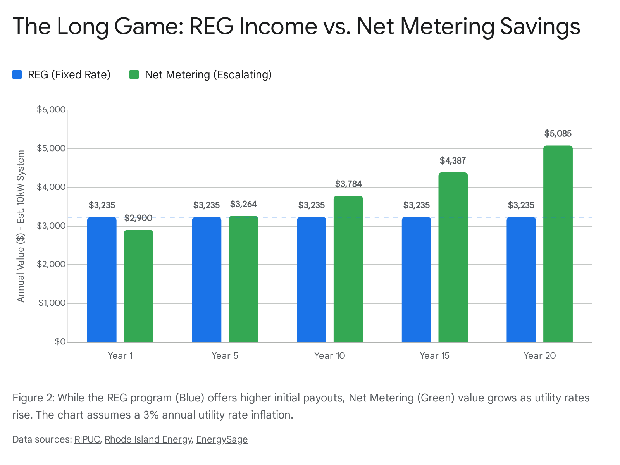
- Future Proofing: If you believe electricity rates will skyrocket to 40 or 50 cents, Net Metering is better because your savings grow with the rates. The REG rate is stuck at 32 cents forever.
3.3 The Final Verdict for 2026
So, which one wins?
Without the federal tax credit to offset the gross cost, the REF Grant (Path B) has become the dominant choice for homeowners in early 2026. Why? Because the $5,000 grant helps fill the hole left by the missing tax credit. It lowers your financing needs immediately.
However, if you have the cash to pay for the system outright and you want a secure, bond-like income stream, the REG program remains a powerful financial instrument.
---
4. The Hidden Goldmine: Connected Solutions (Batteries)
If you stopped reading after the solar panels, you would be leaving thousands of dollars on the table. The real excitement in Rhode Island's 2026 energy market is not on the roof; it is in the garage.
Rhode Island has one of the nation's most aggressive programs for Battery Energy Storage Systems (BESS). It is called Connected Solutions, and it changes the battery from a "luxury backup item" into an "income-generating asset."
4.1 How Connected Solutions Works
Most people buy a battery (like a Tesla Powerwall or Enphase IQ Battery) for peace of mind. They want the lights to stay on when a blizzard knocks out the grid.
Connected Solutions says: "We will pay you to use your battery when we need it."
- The Problem: On hot summer afternoons (July and August), everyone turns on their AC. The grid gets stressed. Rhode Island Energy has to buy expensive, dirty power from "peaker plants" to keep the lights on.
- The Solution: Instead of firing up a gas plant, they send a signal to your battery. Your battery discharges power into the grid (or into your home to offset your usage). This lowers the load on the network.
- The "Event": These events happen roughly 30-60 times a summer, usually between 2 PM and 7 PM. They last 2-3 hours.
- Your Control: You always retain a reserve (usually 20%) for your own backup. You are never left empty.
4.2 The Math: $225 Per Kilowatt
The payout is staggering. For the current program cycle, the incentive is approximately $225 per kilowatt (kW) of average power contributed during these events.6
Let's run the numbers for a typical setup in 2026:
- Battery System: 2x Tesla Powerwall 3s or similar.
- Discharge Capacity: Let’s say the utility draws an average of 6 kW from your system during events.
- Annual Payout: 6 kW x $225 = $1,350 per year.
- Lock-In Period: You can usually lock this rate for 5 years.
- Total 5-Year Income: $6,750.
Now, consider the cost. Without the federal tax credit, a battery system might cost $15,000 installed.
- The Connected Solutions income ($6,750) pays for nearly 45% of the battery cost.
- If you also factor in the "REF Storage Adder" (if available in the 2026 grant rounds—often a small kicker of a few hundred dollars), the battery becomes nearly half-price.
For a device that also provides blackout protection for your family, getting it at half-price is a phenomenal deal. This is why Rhode Island has one of the highest battery attachment rates in the country.
4.3 Compatibility Matters
Not every battery qualifies. You must install equipment that can "talk" to the grid signals. As of Jan 2026, the approved list typically includes:
- Tesla (Powerwall)
- Enphase (IQ Batteries)
- SolarEdge (Home Battery)
- Generac (PWRcell)
- FranklinWH
Warning: If you buy a cheap, off-brand battery system that cannot communicate with the Connected Solutions platform (often managed by a third party like EnergyHub), you get zero incentive revenue. Always verify the hardware with your installer.
---
5. State Tax Exemptions: The "Invisible" Incentives
We have talked about money coming in (grants, tariffs). Now let’s talk about money not going out. Rhode Island has permanently codified tax breaks that protect your solar investment. These are automatic, but you need to know they exist so you don't let a confused tax assessor charge you incorrectly.
5.1 The Sales Tax Exemption (7% Savings)
Rhode Island General Law completely exempts renewable energy systems from the state sales and use tax.10
- The Impact: On a $30,000 solar contract, the standard 7% sales tax would add $2,100 to your bill.
- The Result: You pay $0 tax. The price on the contract is the price you pay. This applies to the panels, the inverter, the racking, and the battery storage if installed as part of the system.
5.2 The Property Tax Exemption
In many states, if you build a $30,000 addition to your home, the town tax assessor comes by, reassesses your property value, and raises your annual property tax bill.
Rhode Island Law (§ 44-3-21) prohibits municipalities from assessing the value of a solar energy system for residential taxation.11
- The Scenario: You install a system. Your home's market value goes up (studies show solar homes sell for ~4% more).
- The Protection: Your town cannot raise your tax assessment based on that solar installation.
- The Savings: If your local tax rate is $15 per $1,000 of value, avoiding a tax hike on a $30,000 system saves you $450 per year. Over 20 years, that is $9,000 in avoided taxes.
Note: This exemption is strictly for the solar equipment. It does not freeze your assessment for other reasons (like a kitchen remodel or general market appreciation).
---
6. Solar for All: The New 2026 Frontier (Low Income Support)
For decades, solar was a luxury product for those with high credit scores and tax liability. In 2026, that changes fundamentally with the rollout of the Solar for All program, funded by the EPA's Greenhouse Gas Reduction Fund (GGRF).13
If you are a low-to-moderate income (LMI) homeowner, this section is for you.
6.1 What is Solar for All?
This is a federal program administered by states (in RI, often through the Rhode Island Infrastructure Bank and OER). Its goal is simple: Bring solar to households that cannot use tax credits or qualify for standard loans.
6.2 Who Qualifies?
Eligibility is typically based on Area Median Income (AMI).
- If your household income is 80% or less of the AMI for your county, you likely qualify.
- Residents in designated Disadvantaged Communities (DACs)—often mapped by census tract—may automatically qualify regardless of specific income checks.13
6.3 The Benefits
The Solar for All program in Rhode Island is designed to offer:
- Zero Upfront Cost: No down payments.
- Deep Subsidies: Grants that cover a significant portion of the system cost, far exceeding the standard REF grant.
- Guaranteed Savings: Program rules often mandate that the homeowner must see a minimum bill reduction (e.g., 20%) immediately.
- Friendly Financing: Low-interest or no-interest loans through the Rhode Island Infrastructure Bank (RIIB) that do not rely strictly on FICO scores.
Action Item: If you think you might qualify, do not sign a standard solar lease or loan agreement with a door-to-door salesperson. Contact the Rhode Island Office of Energy Resources (OER) or the Rhode Island Infrastructure Bank immediately to ask about the specific application portal for "Solar for All." You could save thousands more than a standard customer.
---
7. The Application Process: Timing is Everything
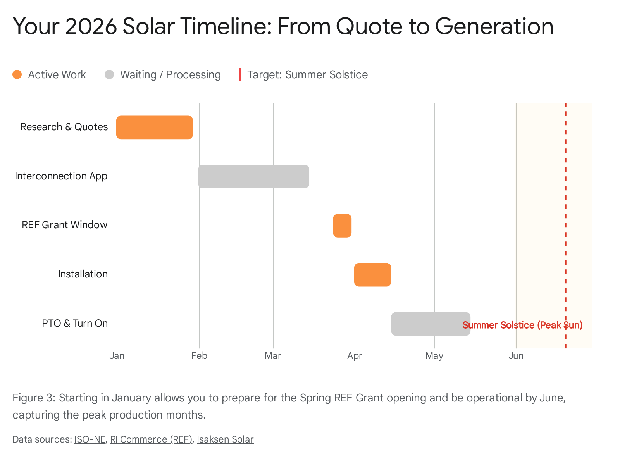
You have decided to go solar. You know which program you want. Now, how do you actually get it done? In Rhode Island, the timeline is dictated by the REF Grant "Blocks" and the utility interconnection queue.
7.1 The "REF Block" Strategy
The Renewable Energy Fund (REF) grant is not an open tap. It is released in "rounds" or "blocks."
- The Risk: Funds are limited. If a block opens on March 24th and fills up in 48 hours, and your application isn't ready, you miss out. You have to wait for the Summer block (usually July).
- The Strategy: By starting now (January 7), you give your installer 8 weeks to prepare the engineering diagrams, get the interconnection pre-approval, and have the application "loaded in the chamber" for the exact minute the portal opens in March.
7.2 Interconnection: The "Witness Test"
Rhode Island Energy is strict about safety.
- Application: Your installer submits an Interconnection Application (IA) to the utility.
- Review: The utility checks if the transformer on your street can handle the extra power. (This takes 15-20 business days).
- Upgrade Costs: In some dense neighborhoods, the utility might say, "The transformer is full. You need to pay $2,000 to upgrade it." This is a risk you should discuss with your installer upfront.
- The Meter Swap: After installation, the utility must come out to swap your meter (for Net Metering) or install a second meter (for REG). This can take a few weeks after the city inspection is done.
7.3 Operational Maintenance in Rhode Island
Once you are live, what about the weather?
- Snow: We live in New England. Snow will cover your panels. Do not scrape it off. You will void the warranty by scratching the glass. The panels are dark; they will warm up in the sun and the snow will slide off (often with a loud thump). You lose a few days of production, but you make it up in May and June.
- Coastal Wind: If you live in a high-wind zone (Narragansett, Newport), your racking system must be rated for higher wind loads. Ensure your installer uses "IronRidge" or "Unirac" systems rated for 110+ mph winds.
---
8. Financial Modeling: The Numbers Don't Lie
Let's put it all together. We will run a comparison of the two programs over 20 years.
The Scenario:
- Home Location: Warwick, RI.
- Annual Usage: 9,000 kWh.
- System Size: 7.5 kW (producing roughly 9,000 kWh/year).
- Gross System Cost: $26,250 ($3.50/watt – reflective of 2026 pricing).
8.1 Scenario A: Net Metering + REF Grant (Post-ITC)
- Gross Cost: $26,250
- REF Grant: -$4,875 (Estimated at $0.65/watt)
- Federal ITC: $0
- Net Cost: $21,375
- Year 1 Savings: 9,000 kWh * $0.29 (Retail Rate) = $2,610.
- Simple Payback: $21,375 / $2,610 = 8.1 Years.
- 20-Year Savings: Assuming rates rise 3% annually, total savings over 20 years = ~$70,000.
- ROI: You invest $21k to make $70k tax-free (savings).
8.2 Scenario B: REG Program (15-Year Tariff)
- Gross Cost: $26,250
- REF Grant: $0 (Not eligible).
- Federal ITC: $0
- Net Cost: $26,250
- Year 1 Income: 9,000 kWh * $0.3385 (REG Rate) = $3,046.
- Simple Payback: $26,250 / $3,046 = 8.6 Years.
- 20-Year Income: The rate is fixed for 15 years, then drops to market rate.
- Years 1-15: $3,046 * 15 = $45,690.
- Years 16-20: Market rate (variable).
- Tax Impact: If you pay 22% tax on the PBI, the payback extends slightly.
Analysis:
The Net Metering path currently offers a slightly faster payback (8.1 years vs 8.6 years) because of the upfront grant. It also acts as a better hedge against future inflation. However, the REG program offers higher cash flow in the early years.
---
9. Conclusion: The "Silver Lining" Playbook
The solar market in Rhode Island has changed, but it has not collapsed. The "Gold Rush" of the federal tax credit is over, but in its place, we have a mature, stable market supported by robust state policy.
If you are a homeowner in 2026, you have a clear "Silver Lining" Playbook:
- Exploit the REF Grant: Use the state's money to replace the federal tax credit.
- Monetize Your Battery: Use Connected Solutions to turn a backup appliance into a revenue generator.
- Trust the Utility Rates: Betting that Rhode Island electricity will stay expensive is one of the safest bets in finance. Avoiding that cost is your return on investment.
The best time to go solar may have been 2025. But the second best time is right now—before the Spring grant rounds fill up, before the summer heat spikes the grid, and before you pay another $2,600 bill to the utility company.
Go get your quotes. Compare the REF vs. REG numbers for your specific roof. And welcome to the era of energy independence.
Works cited
- Residential Clean Energy Credit | Internal Revenue Service, accessed January 7, 2026, https://www.irs.gov/credits-deductions/residential-clean-energy-credit
- Federal Solar Tax Credit (ITC): Ending January 1, 2026, accessed January 7, 2026, https://www.solartopps.com/blog/federal-solar-tax-credit-ending-january-1-2026/
- Electricity Rates by State (January 2026), accessed January 7, 2026, https://www.electricchoice.com/electricity-prices-by-state/
- Electricity Cost in Rhode Island: 2026 Electric Rates - EnergySage, accessed January 7, 2026, https://www.energysage.com/local-data/electricity-cost/ri/
- State and Federal Energy Incentives - Rhode Island Office of Energy Resources - RI.gov, accessed January 7, 2026, https://energy.ri.gov/incentives
- ConnectedSolutions Battery Demand Response Program - Enphase, accessed January 7, 2026, https://enphase.com/installers/grid-services/connectedsolutions
- 2025 Renewable Energy (RE) Growth Program, accessed January 7, 2026, https://www.rienergy.com/site/-/media/rie-jss-app/home/other-parties/business-partners/electric-procurement/RE-growth-program/2025-Small-Scale-Solar-RE-Growth-Program-One.ashx?sc_lang=en&hash=70C4D8C62548CD1C3D3EDA222B7931E5
- Rhode Island Energy Policies Regarding Reportable Income and The Rhode Island Renewable Energy Growth Program, accessed January 7, 2026, https://gridforce.my.site.com/servlet/servlet.FileDownload?file=0156T00000H8zBu
- Rhode Island Solar Incentives, Tax Credits & Rebates 2025 | EnergySage, accessed January 7, 2026, https://www.energysage.com/local-data/solar-rebates-incentives/ri/
- Rhode Island Solar Incentives, Tax Credits & Rebates (2026 Guide) - This Old House, accessed January 7, 2026, https://www.thisoldhouse.com/solar-alternative-energy/solar-incentives-rhode-island
- Solar Property Tax Exemption in Rhode Island, accessed January 7, 2026, https://isaksensolar.com/solar-property-tax-exemption-in-rhode-island/
- Rules and Regulations for Commercial Renewable Energy Systems Tangible Tax Value - Rhode Island Office of Energy Resources, accessed January 7, 2026, https://energy.ri.gov/sites/g/files/xkgbur741/files/documents/renewable/OER-Rules-and-Regulations---Commercial-Renewable-Energy-Systems-Tangible-Tax-Value.pdf
- Solar For All | Rhode Island Office of Energy Resources - RI.gov, accessed January 7, 2026, https://energy.ri.gov/resources/major-initiatives/epa-greenhouse-gas-reduction-fund-solar-all-program