If you live in Arizona, you know two things for sure: the summers are brutal, and the sun is relentless. For a long time, that blazing sun was just something to hide from, cranking the AC until the utility bill made you weep. But lately, you have probably noticed a change in the neighborhood. More and more roofs are sporting shiny blue or black panels. It is not just the eco-enthusiasts anymore; it is your neighbor, the retired couple down the street, and the young family next door. You are likely wondering: Are they seeing something I’m not? Is it still worth it to go solar in 2026? Or did I miss the boat?
The short answer is: Yes, solar can still save you a massive amount of money, but the game has changed completely.
Five or ten years ago, solar was simple. You put panels on the roof, the meter spun backward, and the utility company paid you retail rates for your power. Those days are largely gone. Today, getting the best deal requires a little more strategy. You have to understand how the tax credits work, exactly what your specific power company pays for your extra energy, and—increasingly—whether you need a battery to make the math work.
This report is your comprehensive roadmap. We are going to break down every single incentive available to Arizona homeowners right now. We are avoiding the dense legal jargon found in legislative bills. Instead, we are explaining it just like we are sitting at your kitchen table, looking at your power bill and a calculator. We will cover the massive federal tax breaks, the state perks that keep cash in your pocket, and the tricky, often confusing rules for the big utility companies like APS, SRP, and TEP.
TL;DR: The "Too Long; Didn't Read" Summary
We know you are busy. If you only have two minutes, here is your cheat sheet for the solar landscape in Arizona for 2026:
- The Big Fed Discount: You still get 30% off the total cost of your solar and battery system as a federal tax credit. This is the single biggest money-saver available, and it is locked in until 2032.1
- The Arizona Bonus: The state gives you an extra tax credit of 25% of the system cost, but it is capped at $1,000. Think of it as a flat $1,000 coupon off your state income taxes.3
- Tax-Free Shopping: You do not pay the 5.6% state sales tax on the equipment. On a typical system, that saves you roughly $1,000 to $2,000 upfront right at the register.5
- Property Tax Safe Zone: Adding solar raises your home's value, but Arizona law forbids the county assessor from raising your property taxes because of it. You get the value without the tax hike.7
- Batteries are the New Normal: Because utility companies (especially APS and SRP) pay much less for your exported solar power than they used to, adding a battery to store your own power is becoming the smartest financial move. It lets you use your own "free" power when rates are high.9
- HOAs Can't Stop You: Legally, your Homeowners Association cannot ban solar panels. They can ask you to move them slightly for aesthetics, but only if it doesn't hurt your system's performance or cost you more money.11
---
Chapter 1: The Heavy Hitter – The Federal Solar Tax Credit (ITC)
Let’s start with the biggest chunk of change you can get back: the Federal Residential Clean Energy Credit. You will often hear industry people call this the "ITC" (Investment Tax Credit). Don't let the acronym scare you. It is basically a massive coupon from the federal government to reward you for investing in your own energy production.
How Much Is It in 2026?
For the tax year 2026, the credit sits at 30% of your total system cost.1
This is not a flat rebate where everyone gets a $500 check. It is a percentage. That means the more you invest, the more you get back. If you buy a small, modest system, you get 30% of that cost. If you buy a massive system with three batteries, a new electrical panel, and premium panels, you still get 30% of that bigger number.
Let’s look at the math:
Imagine you hire a solar company to install a system on your roof. The total contract price is $25,000.
- Total Project Cost: $25,000.
- The Calculation: $25,000 x 0.30 = $7,500.
- The Benefit: You get a $7,500 credit on your federal taxes.
- Net Cost: Your "real" cost after the incentive is effectively $17,500.
What Expenses Are Included?
The IRS is surprisingly generous about what counts towards that "total cost." It is not just the glass panels on the roof. According to the IRS guidance on qualified expenses, the following are included 1:
- The Solar Panels: Obviously, the photovoltaic cells themselves.
- Labor Costs: The money you pay the crew to install it. This includes the onsite preparation, assembly, and original installation.
- Permitting Fees: The money paid to your city or county for building permits and inspection costs.
- Balance of System: This is fancy industry talk for wiring, mounting racks, conduit, and inverters (the box that turns solar DC power into the AC power your house uses).
- Batteries: This is a big one. As of recent rule changes under the Inflation Reduction Act, standalone battery storage qualifies for the 30% credit too, even if you don’t have solar panels! However, the battery must have a capacity of at least 3 kilowatt-hours (kWh).1
What is NOT Included?
It is important to know the limits so you don't get in trouble during an audit.
- Roof Repair: Generally, if you need to re-shingle your roof to install solar, the cost of the roofing materials is not eligible for the credit. Only the solar equipment itself counts. If you are re-doing the whole roof, you can't claim 30% of the roof cost, only the solar portion.1
- Interest: If you take out a loan to buy the panels, the loan origination fees or interest paid on the solar loan are not qualified expenses. You calculate the 30% on the cash price of the equipment, not the total payments you make over 20 years.1
Crucial Detail: It’s a "Non-Refundable" Tax Credit
This is the part that confuses the most people, and it is vital you understand it before you sign a contract. "Non-refundable" does not mean you don’t get the money. It simply dictates how you get the money.
Think of your federal income taxes like a bar tab. Every paycheck, your employer takes a little money out and sends it to the IRS to pay off your tab. At the end of the year, you file your return to see if you paid too much (refund) or too little (you owe).
The solar tax credit pays off your tab. It reduces your tax liability dollar-for-dollar.1
Scenario A: The High Earner
Let's say you have a good job and your total federal tax bill for the year 2026 is $10,000. (Note: This is your total liability, usually found on line 24 of your 1040 form, not just what you owe in April).
- You have a $7,500 solar tax credit.
- The IRS subtracts $7,500 from your $10,000 bill.
- You now only owe $2,500 for the year.
- The Refund: If you had already paid that full $10,000 through your paycheck withholding during the year, the IRS now sees that you overpaid by $7,500. They will send you a refund check for that amount.
Scenario B: The Retiree or Low Income Earner
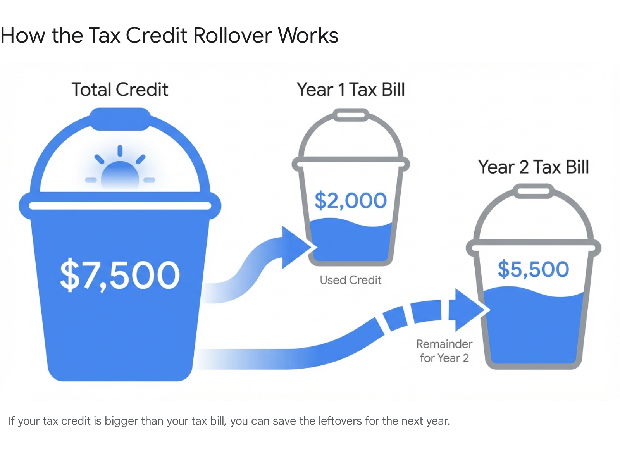
Maybe you are retired and live mostly on Social Security (which often isn't taxed) or have a lower taxable income. Your total tax bill for the year is only $2,000.
- You have a $7,500 solar tax credit.
- The IRS uses $2,000 of the credit to wipe your tax bill to zero. You pay nothing.
- The Leftover: You still have $5,500 of credit left over.
- Bad News: Because it is "non-refundable," the IRS will not write you a check for that extra $5,500. You don't get it as cash this year.
- Good News: You don't lose it! You can "carry it forward" to next year. You can use that remaining $5,500 to pay off your taxes in 2027, and so on, until the credit expires or is used up.1
Deadlines You Need to Know
The government likes to change rules, but right now, the schedule is set in stone until the early 2030s thanks to the Inflation Reduction Act.
- 2022 – 2032: The credit stays at 30%. You are safe for a while.
- 2033: It drops to 26%.
- 2034: It drops to 22%.
- 2035: It disappears for residential homeowners unless Congress renews it.1
So, while you don't need to panic and buy solar tomorrow, you do have a clear window of maximum opportunity.
---
Chapter 2: The Arizona Advantage – State Incentives
Arizona wants you to go solar, too. While the state doesn't have a massive cash rebate program like some other states used to, it offers some very specific tax breaks that lower the barrier to entry significantly.
1. The Residential Solar Energy Credit
This is the state cousin of the federal tax credit.
- The Deal: You get a tax credit worth 25% of your system cost against your Arizona state personal income taxes.
- The Catch: There is a rigid cap (limit) of $1,000.3
Realistically, almost every home solar system costs more than $4,000. So, 25% of that will always be more than $1,000. Therefore, to keep things simple, you should just think of this as a flat $1,000 discount on your state taxes.
How to Claim It:
You use Arizona Form 310 when you file your state return. Just like the federal credit, if you owe less than $1,000 in state taxes for the year, you can carry the extra over for up to five years.3
2. The Solar Equipment Sales Tax Exemption
This is a "hidden" incentive because you never see the money; you just don't have to spend it.
- The Rule: Arizona has a 5.6% state transaction privilege tax (sales tax). However, the retail sale and installation of solar energy devices are 100% exempt from this tax.5
- The Savings: On a $25,000 system, a 5.6% tax would be $1,400. You keep that money in your pocket automatically.
Warning: This exemption applies to the state tax. Some cities and towns in Arizona have their own local sales tax (often 1-2%), and they might still charge you. It depends on the specific city code. Check with your installer or your city hall to be sure.5 Most reputable installers will detail exactly which taxes are being waived in their quote.
3. The Energy Equipment Property Tax Exemption
Usually, if you build a fancy addition to your house like a pool or a new guest room, your property value goes up, and the county assessor raises your property taxes.
- The Rule: Arizona law (A.R.S. § 42-11054) says that the added value from a solar energy system is exempt from property tax assessments.7
- The Benefit: Your house is worth more (studies consistently show solar homes sell for a premium), but you don't pay taxes on that extra value. It’s a win-win for resale value. You generally need to provide documentation to the assessor to ensure they don't mistakenly reassess your home value upward based on the permit data.
---
Chapter 3: Understanding the "Solar Math" (Net Metering vs. Net Billing)
Before we talk about specific power companies like APS or SRP, we have to understand a concept that confuses everyone. This is the single most important chapter in this report. If you understand this, you won't get ripped off. If you ignore this, your solar investment might not pay off.
In the "old days," we had Net Metering.
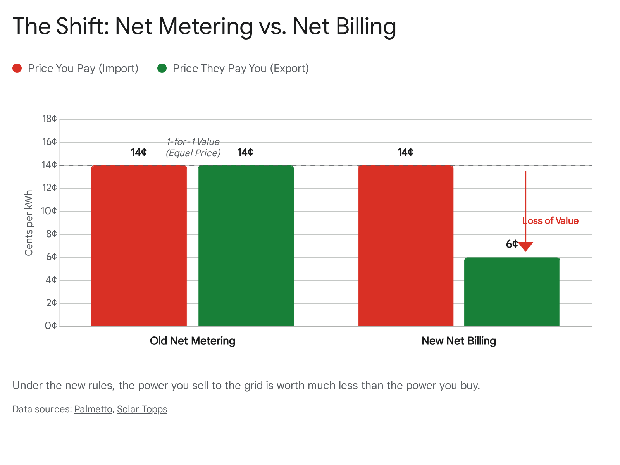
- How it worked: If you sent 1 kWh (kilowatt-hour) of solar electricity to the grid at noon, the utility gave you a credit for 1 kWh. You could use that credit at 8 PM to run your TV. It was a fair 1-for-1 swap.
- The Status: Net Metering is effectively dead in Arizona for new customers.16
Now, we have Net Billing (also called "Export Rates" or "RCP").
- How it works: The utility treats buying and selling separately.
- Buying: When you pull power from the grid (at night), you pay the full retail price (e.g., 14 to 15 cents).
- Selling: When you send extra solar power to the grid (at noon), they pay you a much lower "wholesale" rate (e.g., 3 to 7 cents).
The "Bucket" Analogy
Imagine your electricity is water.
- Solar Panel: A hose filling your bucket.
- Home Usage: A hole in the bottom of the bucket draining water (running your AC).
- Grid: A giant water tank you can borrow from or dump into.
Under the new rules:
- If your bucket is full and overflows into the tank (grid), the water company pays you pennies for that spillage.
- If your bucket is empty and you need to refill from the tank, the water company charges you dollars.
The Insight: The game is no longer about making as much power as possible to sell back to the utility. The game is now about keeping your power. You want to use your solar energy while it is being made (running the dishwasher at noon), or store it in a battery, so you don't have to sell it for pennies and buy it back for dollars. This shift is why batteries are becoming so critical in 2026.
---
Chapter 4: Salt River Project (SRP) – The Tough Nut to Crack
If you live in the Phoenix area, specifically Mesa, Gilbert, Chandler, Tempe, or parts of Scottsdale, you likely have SRP. SRP is known for having some of the most complicated solar rules in the country. They aren't regulated by the Arizona Corporation Commission (the state government watchdog) like other utilities, so they set their own rules.
The New 2026 Reality: E-16 and E-28
SRP recently overhauled its rate plans. Starting in late 2025 and moving into 2026, new solar customers generally have to choose between two main time-of-use plans: E-16 and E-28.17 This is a big change from the past, as older popular plans like E-27 (Customer Generation) are being phased out for new customers. If you go solar now, you are stepping into this new ecosystem.
Plan Option 1: E-28 (Conserve & Save)
- The Vibe: This is the simpler, safer plan for most families. It’s a classic "Time-of-Use" plan.
- The Rules: Electricity is expensive during "Peak Hours" (6 PM to 9 PM) and cheaper the rest of the day.
- The Solar Twist: Your solar panels produce power during the day (Off-Peak). If you export that power, SRP pays you an "Export Rate" (around 3.45 cents/kWh).19
- Strategy: You need to avoid using power from 6 PM to 9 PM. Since the sun is setting then, your solar panels won't help you much. You will need to conserve energy (turn up the thermostat) or use a battery to cover your usage during this window.
Plan Option 2: E-16 (Manage Demand & Save)
- The Vibe: High risk, high reward. Experts only.
- The Rules: This plan has lower energy rates per kWh than E-28, but it has a Demand Charge.
- What is a Demand Charge? This is a fee based on the single highest 30‑minute spike of power usage you have during peak hours (5 PM to 10 PM) all month.
- The Danger: If you run your AC, electric dryer, and oven all at once at 6 PM for just 30 minutes, your bill could skyrocket. You might pay a $50 or $100 "penalty" for that one mistake, even if you used very little electricity the rest of the month.18
- Strategy: This plan is generally not recommended for most homeowners unless you have a battery and smart home automation (like a smart thermostat or load controller) to ensure you never, ever spike your usage during peak hours.
SRP Battery Incentives (The Good News)
Because SRP's solar rules are tough, they offer some of the best incentives for batteries to help you manage it.
- Battery Partner Program: SRP has a "Bring Your Own Battery" program. You buy a battery (like a Tesla Powerwall), and you link it to their system.
- The Incentive: In previous pilots, this was up to $3,600 upfront or structured as per‑kWh payments (e.g., $300/kWh).22
- The Trade‑off: During extreme heatwaves (conservation events), SRP can remotely tell your battery to discharge power to the grid to help the community. You get paid for this service. It’s like renting out your battery when you’re not using it.
- The Benefit: This incentive helps pay for the battery, and the battery helps you navigate the E‑28 or E‑16 rate plans by powering your home during expensive evening hours.
Verdict on SRP: Solar is harder here than in other parts of the state. The payback period (time to break even) is longer. However, if you add a battery and join the Battery Partner program, you can make the math work and gain protection against blackouts.
---
Chapter 5: Arizona Public Service (APS) – The Standard Model
APS covers most of the rest of the state, including North Phoenix, Flagstaff, Yuma, and Prescott. They are regulated by the state commission, so their rules are a bit more standardized and predictable.
The "RCP" Rate (Resource Comparison Proxy)
APS uses the "Net Billing" method we discussed in Chapter 3. They call their export rate the Resource Comparison Proxy or RCP.
- The Rate: Each year, usually in September/October, this rate resets. As of late 2025/early 2026, the rate is hovering around 6 cents per kWh.14
- The "Lock-In": When you sign up for solar, you lock in your specific export rate for 10 years.16 This is crucial. Even if the rate drops for new customers next year, your rate stays the same.
- The Insight: This creates an incentive to move quickly. The rate has been dropping by about 10% each year (it used to be nearly 13 cents in 2017). Waiting until late 2026 might mean locking in a lower rate than if you acted in early 2026.
APS Residential Battery Pilot
APS has had a very popular program offering up to $3,750 per home for installing batteries.25
- How it Works: Similar to SRP, you get paid to let them use your battery data and occasionally manage the battery usage during peak grid stress.
- Status Check: As of early 2026, this program is extremely popular and often hits its capacity limit quickly. You essentially get paid to let them use your battery data.
- Waitlist: Even if the program is listed as "full" on the website, it is worth asking your installer to check the waitlist status. These programs often get new funding authorization from the Corporation Commission, so spots can open up.
Low‑Income Option: Solar Communities
If you can't afford a $20,000 system, APS has the Solar Communities program.
- How it works: APS installs solar panels on your roof for free. They own them. They maintain them. You pay nothing upfront.
- Your Benefit: You get a monthly bill credit (around $30 to $50 a month) for 20 years.
- Eligibility: This is strictly for limited‑ and moderate‑income households (generally under 200% of the federal poverty level). It’s a great way to help the environment and save a little cash without taking out a loan or worrying about maintenance.
---
Chapter 6: Tucson Electric Power (TEP) – The Southern Strategy
TEP serves the Tucson area and has a structure similar to APS but with its own flavor.
TEP Export Rates
Like APS, TEP uses an RCP rate. In 2025/2026, this rate is approximately 5.1 to 5.7 cents per kWh.14
- Lock-in: You also get a 10‑year lock‑in period for this rate.
- Instant Netting: TEP nets your power instantaneously. If you are making 5 kW and using 2 kW, you instantly sell 3 kW at ~5 cents. If a cloud rolls over one second later and you are making 1 kW and using 2 kW, you instantly buy 1 kW at full retail price. This instant switching makes batteries very attractive in Tucson to smooth out the bumps.
Energy Storage Rewards
TEP has arguably the most straightforward battery incentive right now.
- The Offer: They pay you $120 per kilowatt (kW) of battery capacity per season.
- The Math: A typical Tesla Powerwall or similar battery has about 5kW of continuous power output.
- $120 x 5 kW = $600 per season.
- There are two seasons (Summer and Winter).
- Potential Earnings: Up to $1,200 per year just for having a battery and letting TEP access it during peak events!
- Why it's great: Unlike a one‑time rebate, this is an ongoing payment that helps pay off the battery over time. It creates a recurring revenue stream for your home.
GoSolar Shares & GoSolar Home
If rooftop solar isn't for you (maybe your roof is too old or shaded), TEP offers "virtual" solar programs.
- GoSolar Shares: You buy "shares" of solar energy from TEP's large solar farms. You pay a small premium, but you lock in your energy rate for 20 years.
- GoSolar Home: You buy all your power from a local solar array for a fixed monthly price for 10 years. It simplifies your bill and supports green energy without any equipment on your house.
---
Chapter 7: The Battery Revolution – Storage Incentives
You might have noticed a theme in the utility chapters: Batteries. Five years ago, batteries were a luxury item for doomsday preppers. In 2026 Arizona, they are almost a financial necessity for solar economics.
Why the Shift?
It comes down to the "Buy Low, Sell High" principle, but in reverse.
Without a battery, you are selling your solar power to the utility at noon for 5 cents (Export Rate) and buying it back at night for 15 cents (Retail Rate). You are losing 10 cents on every unit of energy you trade.
With a Battery:
- Noon: Your solar panels power your AC. The excess power goes into your battery, not the grid. Value: You saved the stored energy for later.
- 6 PM: The sun goes down. Peak rates kick in. Your house switches to battery power.
- Result: You don't buy expensive grid power. You use your own "free" stored power. You avoid the 10‑cent loss.
Tax Incentive for Batteries
Remember, the 30% Federal Tax Credit applies to battery storage even if you add it to an existing solar system or buy it standalone And in Arizona, batteries are also exempt from sales tax.30 If you already have solar but no battery, 2026 is a great year to retrofit one and claim the 30% credit on the battery cost.
---
Chapter 8: Financing & Ownership – How You Pay Matters
How you pay for your system changes which incentives you can claim. This is a common pitfall.
1. Cash Purchase
- The Deal: You write a check for the full amount.
- Incentives: You get ALL the incentives. The 30% Fed credit, the $1,000 State credit, and the utility rebates are all yours.
- Pros: Best long‑term savings. No interest payments.
- Cons: Requires a lot of cash upfront ($20k+).
2. Solar Loan
- The Deal: You take a loan from a bank or credit union to pay for the system.
- Incentives: You still get ALL the incentives because you are the legal owner of the system.
- Pros: $0 down options available. Monthly payments might be lower than your electric bill.
- Cons: You pay interest. Warning: Some "low interest" solar loans have high "dealer fees" hidden in the upfront cost. Always ask for the "Cash Price" to compare.
3. Lease or PPA (Power Purchase Agreement)
- The Deal: A solar company installs the system on your roof. They own it. You just pay them a monthly rent (Lease) or buy the power from them (PPA).
- Incentives: The SOLAR COMPANY gets the 30% Federal Credit and the State Credit, not you. They might pass some savings to you in the form of a lower monthly payment, but you cannot file Form 5695 or Form 310.
- Pros: No debt. No maintenance (they fix it if it breaks).
- Cons: Lower total savings. Can make selling your house complicated (the buyer has to agree to take over the lease).
Verdict: If you have the tax liability to use the credits, buying (Cash or Loan) is almost always better financially than leasing.
---
Chapter 9: Know Your Rights – HOAs and Solar Access
One of the biggest fears homeowners have is, "Will my HOA let me do this?" In Arizona, we have powerful laws to protect you.
Arizona Revised Statute 33-1816
This is the golden law for solar owners. It states clearly that an HOA cannot prohibit the installation or use of a solar energy device.11
What HOAs CAN Do:
They can impose "reasonable restrictions."
- They can ask you to hide wiring or match the panel frame color to the roof.
- They can ask you to place panels on the back of the house IF it doesn't hurt performance.
What HOAs CANNOT Do:
They cannot force you to move panels to a spot where they won't work. The law specifically says their rules cannot:
- Prevent installation.
- Impair the function of the system.
- Adversely affect the cost or efficiency.
Real World Example:
If your HOA says, "You must put the panels on the north side of the roof so we can't see them from the street," but the north side gets 40% less sun, you can say no. The law backs you up because that restriction hurts the efficiency of the device.
---
Chapter 10: Is It Worth It? The Final Verdict
So, putting it all together for 2026.
The "Go Solar" Checklist:
- Do you pay taxes? You need a tax liability to use the 30% federal credit and $1,000 state credit.
- Does your roof get sun? Check for big shade trees or neighbor's two‑story additions.
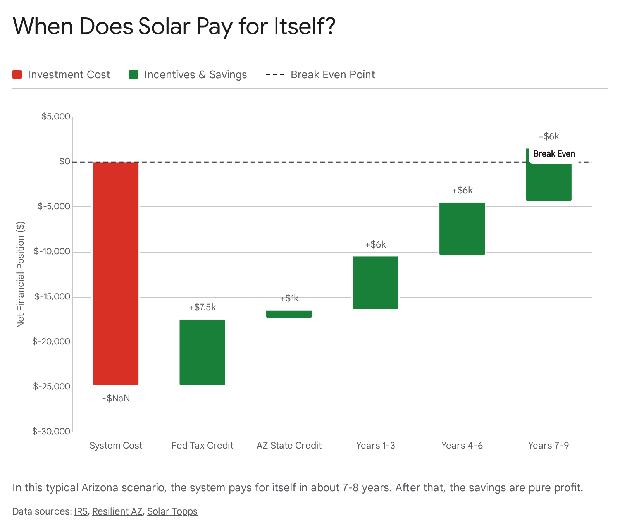
- Are you planning to stay? Solar pays for itself over 7‑10 years. If you are moving next year, it might not be worth the hassle, though it does add resale value.
The ROI (Return on Investment):
In Arizona, with the current incentives:
- Average System Cost (Cash): $20,000 – $30,000.
- After Incentives: $13,000 – $20,000.
- Annual Savings: $1,500 – $2,500 (depending on utility rates and AC usage).
- Payback Period: Roughly 6 to 9 years.
- Profit: After year 9, your energy is essentially free for the remaining life of the system (25+ years).
A Note on "Solar for All"
You might have heard about a federal program called "Solar for All" promising free solar for low‑income families. As of early 2026, the status of this grant funding is uncertain and has faced cancellations.35 Do not sign a contract based on the promise of this specific grant until you see official confirmation from the Arizona Governor's Office of Resiliency. Stick to the confirmed incentives we listed above (ITC, State Credit, Utility Rebates).
Final Steps
If you are ready to move forward:
- Get 3 Quotes: Never buy from the first person who knocks on your door. Prices vary wildly.
- Ask about the "Cash Price": Many installers hide high interest rates in a "low monthly payment." Ask what the price is if you wrote a check today.
- Check the License: Ensure your installer is licensed with the Arizona Registrar of Contractors (ROC).
- Read the Utility Fine Print: Make sure you know exactly which rate plan (E‑28, RCP, etc.) you are signing up for.
Going solar in Arizona is a journey, but with the 30% federal credit and the $1,000 state booster still active, 2026 is a fantastic time to secure your energy independence. Good luck, and stay cool!
Works cited
- Residential Clean Energy Credit | Internal Revenue Service, accessed January 3, 2026, https://www.irs.gov/credits-deductions/residential-clean-energy-credit
- Federal Tax Credits for Energy Efficiency, accessed January 3, 2026, https://www.energystar.gov/about/federal-tax-credits
- Pub 543 – Residential Solar Energy Credit – Arizona Department of Revenue, accessed January 3, 2026, https://azdor.gov/sites/default/files/2023-03/PUBLICATION_543.pdf
- Residential Solar and Wind Energy Systems Tax Credit – State of Arizona, accessed January 3, 2026, https://resilient.az.gov/clean-energy-hub/households/residential-solar-and-wind-energy-systems-tax-credit
- Solar and Wind Equipment Sales Tax Exemption – DSIRE, accessed January 3, 2026, https://programs.dsireusa.org/system/program/detail/119
- Solar Tax Exemptions – SEIA, accessed January 3, 2026, https://seia.org/solar-tax-exemptions/
- Renewable Energy Generation Incentives | Governor's Office of Resiliency, accessed January 3, 2026, https://resilient.az.gov/clean-energy-hub/tax-exempt-entities/renewable-energy-generation-incentives
- Energy Equipment Property Tax Exemption – DSIRE, accessed January 3, 2026, https://programs.dsireusa.org/system/program/detail/1683
- Arizona Solar Incentives 2025: Complete Tax Credits & Rebates Guide – SolarTech, accessed January 3, 2026, https://solartechonline.com/blog/arizona-solar-incentives-2025-guide/
- Arizona Rooftop Solar Policies: Your Complete Guide to Regulations and Incentives in 2025, accessed January 3, 2026, https://www.solartopps.com/blog/what-are-rooftop-solar-policies-arizona/
- HOA Solar Panel Rules in Arizona: What Homeowners Need to Know, accessed January 3, 2026, https://www.sunvalleysolar.com/blog/hoa-solar-panel-rules-in-arizona
- Arizona Revised Statutes Title 33. Property § 33-1816 – Codes – FindLaw, accessed January 3, 2026, https://codes.findlaw.com/az/title-33-property/az-rev-st-sect-33-1816/
- Federal Solar Tax Credit (ITC): Ending January 1, 2026, accessed January 3, 2026, https://www.solartopps.com/blog/federal-solar-tax-credit-ending-january-1-2026/
- Arizona Solar Incentives and Tax Credits in 2025 – Palmetto, accessed January 3, 2026, https://palmetto.com/policy/arizona-solar-incentives
- What You Need to Know About Arizona's Energy Equipment Property Tax Exemption, accessed January 3, 2026, https://solaroptimum.com/what-you-need-to-know-about-arizonas-energy-equipment-property-tax-exemption/
- APS Solar Buyback Rates for Arizona Homeowners for 2026, accessed January 3, 2026, https://www.solartopps.com/blog/aps-solar-buyback-rates-arizona-homeowners-2026/
- SRP's New Rate Plans: What Solar Customers Should Know, accessed January 3, 2026, https://www.sunvalleysolar.com/blog/srps-new-rate-plans-what-solar-customers-need-to-know
- Compare residential price plans | SRP, accessed January 3, 2026, https://www.srpnet.com/price-plans/residential-electric/compare-plans
- SRP Solar Price Plans, accessed January 3, 2026, https://www.srpnet.com/price-plans/residential-electric/solar/compare-solar-plans
- SRP's Standard Electric Price Plans Effective with the May 2019 Billing Cycle, accessed January 3, 2026, https://www.srpnet.com/assets/srpnet/pdf/price-plans/FY26/2025%20Ratebook%20E-28.pdf
- Solar energy options explained – SRP, accessed January 3, 2026, https://www.srpnet.com/price-plans/electric-pricing-public-process/solar-options
- SRP Battery Partner, accessed January 3, 2026, https://www.srpnet.com/energy-savings-rebates/home/residential-solar/battery-partner
- SRP Battery Partner™ program – GreaterGrid, accessed January 3, 2026, https://greatergrid.com/enroll/programs/batteries/srp-battery
- SRP Offers Incentive for Residential Battery Storage – SanTanValley.com, accessed January 3, 2026, https://www.santanvalley.com/news/arizona-news/srp-offers-incentive-for-residential-battery-storage?tmpl=component&print=1&format=print
- Arizona Public Service Residential Battery Pilot Overview | Tesla Support, accessed January 3, 2026, https://www.tesla.com/support/energy/powerwall/own/aps-residential-battery-pilot
- APS Solar Battery Pilot | SouthFace Solar & Electric | AZ, accessed January 3, 2026, https://southfacesolar.com/solar-blog/earn-up-to-3750-in-solar-battery-incentives-with-the-new-aps-residential-battery-pilot/
- Solar Communities Program – APS, accessed January 3, 2026, https://www.aps.com/en/About/Sustainability-and-Innovation/Technology-and-Innovation/Solar-Communities
- Solar Partner Program – APS, accessed January 3, 2026, https://www.aps.com/en/About/Sustainability-and-Innovation/Technology-and-Innovation/Solar-Partner-Program
- Resource Comparison Proxy Export Rate – Tucson Electric Power, accessed January 3, 2026, https://www.tep.com/rcp/
- Guide to Arizona Solar Incentives & Tax Credits in 2025, accessed January 3, 2026, https://www.sunvalleysolar.com/blog/guide-to-arizona-solar-incentives-tax-credits
- Energy Storage Rewards – Tucson Electric Power, accessed January 3, 2026, https://www.tep.com/energy-storage-rewards/
- Thinking About Solar? – Tucson Electric Power, accessed January 3, 2026, https://www.tep.com/thinking-about-solar/
- Go Solar with TEP – Tucson Electric Power, accessed January 3, 2026, https://www.tep.com/gosolartep/
- Arizona Solar Incentive Programs, accessed January 3, 2026, https://www.solarinsure.com/arizona-solar-incentives
- Solar for All Arizonans | Governor's Office of Resiliency, accessed January 3, 2026, https://resilient.az.gov/resiliency-programs/energy-programs/energy-affordability/solar-all-arizonans
- Arizona Democrats 'demand' Trump administration release solar grant funding – KJZZ, accessed January 3, 2026, https://www.kjzz.org/politics/2025-08-18/arizona-democrats-demand-trump-administration-release-solar-grant-funding