If you own a home in Puerto Rico, you know that electricity is not just a utility bill—it is a daily topic of conversation. You check the weather not just to see if it will rain, but to guess if the power might go out. You know the sound of a generator humming in the distance as well as you know the sound of the coquí. And you definitely know the shock of opening that monthly bill from LUMA Energy and wondering how the price per kilowatt-hour keeps climbing while the reliability seems to stay the same.
You are reading this because you are ready for a change. You have seen the solar panels popping up on roofs across your neighborhood—in San Juan, in Ponce, in the mountains of Utuado—and you are wondering if it is time to join them. You want to take control of your power. You want to lower that monthly bill. Most importantly, you want the peace of mind that comes from knowing your lights will turn on even when the grid goes dark.
The good news is that Puerto Rico is currently one of the best places in the world to go solar. The government, both locally and in Washington D.C., has rolled out a red carpet of incentives to help you make the switch. There are tax credits that can slash the cost of your system by thousands of dollars. There are laws that force the power company to pay you for the energy you share. There are even programs for low-income families that provide systems for free.
The bad news? Navigating these programs can feel like walking through a jungle without a map. There are federal tax forms that are confusing for Puerto Rico residents. There are local laws that are currently being fought over in court. There are rebate programs that open and close in the blink of an eye. There is a lot of noise, and unfortunately, there is some misinformation out there too.
This guide is your map. We have dug through thousands of pages of laws, regulations, and program guidelines—so you don't have to. We are going to break down every single incentive available in 2025. We will explain them in plain English, not legal jargon. We will tell you exactly who qualifies, how to apply, and what pitfalls to watch out for.
TL;DR: The Quick Summary for Busy Homeowners
We know you are busy. If you only have two minutes right now, here is the "Too Long; Didn't Read" summary of the most important points. But please, bookmark this report and read the deep dives later—the details are where you will save the real money.
- The Big Federal Discount (ITC): The US government offers a 30% tax credit on the cost of your solar and battery system. Crucial Detail: This is a tax credit, not an automatic discount. Because most Puerto Rico residents do not pay federal income tax, you generally cannot use this credit unless you have US-sourced income or file a federal tax return. Do not let a salesperson tell you otherwise without talking to a tax pro.
- The "Free Solar" Programs: There are massive government funds like the Puerto Rico Energy Resilience Fund (PR-ERF) and CDBG-MIT that offer free systems. Status Check: These are incredibly popular and operate on a lottery or waitlist system. As of late 2025, general applications are often closed or waitlisted. We will tell you how to watch for new openings.
- Net Metering is King: This is the law that lets you trade power with LUMA. When your panels make extra electricity during the day, you send it to the grid and get a 1:1 credit. You use those credits at night. It is the main engine that lowers your monthly bill. Warning: The Financial Oversight Board is challenging the law that protects this benefit, but current users are being "grandfathered" in. Locking in your system now is the best way to protect your savings for the next 20 years.
- Batteries are Mandatory: In the US, some people get solar without batteries. In Puerto Rico, that is a bad idea. If the grid goes down (which it does), a solar-only system shuts off. To have power during a blackout, you need a battery.
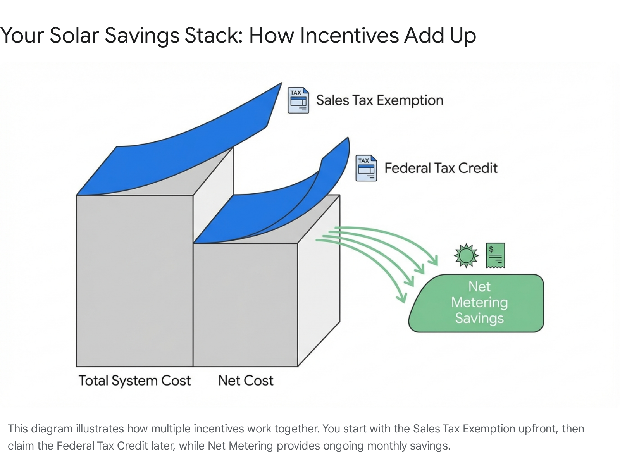
- Sales Tax Exemption: You should not pay the 11.5% IVU (sales tax) on your solar equipment. This is an automatic savings if your installer does the paperwork right.
---
Part 1: The Context – Why Solar is Different Here
To understand the incentives, you first need to understand the battlefield. Installing solar in Puerto Rico is different than installing it in Florida or California. The stakes are higher, the grid is weaker, and the economics are more intense.
The High Cost of Doing Nothing
You feel this every time you pay your bill. Puerto Rico has some of the highest residential electricity rates in the United States. While the mainland average hovers around 16 cents per kilowatt-hour (kWh), Puerto Rico rates frequently spike between 22 and 33 cents per kWh.
Why is it so expensive? Because for decades, the island has relied on burning imported oil and diesel to generate electricity.1 We are at the mercy of global oil markets. When a geopolitical crisis happens halfway across the world and oil prices jump, your electric bill in San Juan jumps too. Solar power breaks this cycle. Sunlight is the one fuel source we have in abundance, and it is free. It doesn't care about the price of a barrel of oil.
The Grid: Fragility and the Need for Resilience
We don't need to remind you of the history. Hurricanes Irma and Maria in 2017 devastated the grid. Hurricane Fiona in 2022 caused an island-wide blackout. But even on sunny days, the grid struggles. Aging power plants and fragile transmission lines mean that "relevos de carga" (load shedding) are a common part of life.
This reality dictates your solar strategy. In many parts of the world, solar is purely a financial investment. People install panels to save a few bucks and help the environment. In Puerto Rico, solar is a resilience investment. It is about survival and safety.2
This means you cannot just install panels. You must install a "hybrid" system that includes battery storage. In a standard "grid-tied" solar system (common in the states), if the grid goes down, your panels turn off. This is a safety feature to prevent your electricity from flowing back into the broken wires and electrocuting the line workers fixing them. But in Puerto Rico, if your panels turn off every time the grid blinks, you have gained nothing. You need batteries and a special "transfer switch" or gateway that disconnects you from the grid during a blackout, creating a self-sustaining "microgrid" in your own home.
The Key Players You Will Deal With
It is easy to get confused by the alphabet soup of agencies involved in Puerto Rico's energy. Here is who is who:
- PREPA (AEE - Autoridad de Energía Eléctrica): The government-owned utility that owns the power plants and wires. They are currently in bankruptcy and don't manage the day-to-day operations anymore.
- LUMA Energy: The private company that operates the transmission and distribution grid. They are the ones who fix the wires, read your meter, and send you the bill. You will deal with them for your solar connection.
- Genera PR: Another private company that now operates the legacy power plants.
- The Energy Bureau (PREB or NEPR - Negociado de Energía): The independent regulator. Think of them as the referee. They set the rates and make the rules that LUMA must follow.
- FOMB (The Financial Oversight and Management Board): Often called "La Junta." They oversee the island's finances to manage the debt crisis. They often intervene in energy policy if they think a law (like Net Metering) will hurt PREPA's ability to pay its debts.
Understanding this cast of characters helps you understand why the incentives are the way they are—and why they are sometimes under legal threat.
---
Part 2: The Federal Solar Tax Credit (ITC) – The Big Incentive
The Investment Tax Credit (ITC) is the heavyweight champion of solar incentives. It is a federal law, part of the US tax code, aimed at encouraging Americans to adopt renewable energy.
The Basics: How it Works
The ITC allows you to claim 30% of the total cost of your solar photovoltaic (PV) and battery storage system as a credit against your federal income taxes.3
Let's look at the math:
- Total System Cost: Let's say you install a 6kW solar system with a Tesla Powerwall battery. The total invoice is $25,000.
- The Calculation: You take 30% of that amount ($25,000 x 0.30).
- The Credit: You get a $7,500 tax credit.
This effectively lowers the price of your $25,000 system to $17,500. You can carry this credit forward to future tax years if you can't use it all in one year. The 30% rate is locked in through 2032 thanks to the Inflation Reduction Act.4
The Puerto Rico Problem: The "Bona Fide Resident" Rule
Here is where things get tricky, and where you need to be very careful. The ITC is a credit against US Federal Income Tax.
However, under Section 933 of the US Internal Revenue Code, "Bona Fide Residents" of Puerto Rico are generally exempt from paying US federal income tax on income earned within Puerto Rico.5 You pay Puerto Rico income tax (to Hacienda) instead.
The Catch-22: If you don't pay federal taxes, you have no federal tax bill to apply the credit against. A tax credit cannot reduce a tax bill of zero. It is non-refundable for individuals, meaning the IRS won't just send you a check for the difference.
Who CAN Use It?
You can utilize the 30% federal tax credit in Puerto Rico if:
- You are a Federal Employee: If you work for the US government (e.g., FBI, TSA, Postal Service) in Puerto Rico, your income is subject to US federal tax. You likely file a Form 1040. You can use the credit.
- You are Active Duty Military: Similar to federal employees, you file federal taxes.
- You Have US-Sourced Income: If you are a local resident but you have significant income from US investments, US rental properties, or a job based in the mainland that taxes you federally, you might have a federal tax liability. You can use the solar credit to offset that specific liability.
- You Have Children (Child Tax Credit Nuance): Some people confuse the Refundable Child Tax Credit (which Puerto Ricans do get) with the Solar Credit. They are different. Getting a refund check for your kids does not automatically mean you can get a refund check for your solar panels.
The "Direct Pay" Confusion
You might hear whispers about "Direct Pay" or "Elective Pay" under the Inflation Reduction Act. This is a new rule that allows tax-exempt entities (like non-profits, churches, and local governments) to treat the tax credit as a payment of tax and get a refund.4
- Does this apply to homeowners? Generally, NO. The "Direct Pay" provision is for organizations, not individuals. Do not bank on this unless you are installing solar on a business or non-profit entity that qualifies.
The Bottom Line on the ITC:
If you live and work in Puerto Rico for a local company and have no US-sourced income, do not assume you will get this $7,500 back. Ask your solar installer specifically: "I don't file a 1040. How does this credit help me?" If they say "Oh, don't worry, you'll get it," be skeptical. Talk to a Puerto Rico-certified CPA (Certified Public Accountant) before signing.
---
Part 3: The "Free Solar" Programs – Help for the Vulnerable
Recognizing that the tax credit leaves out many Puerto Rican families, the US Department of Energy (DOE) and the Puerto Rico Department of Housing have launched massive programs to provide solar systems at little to no cost. These are not loans; they are grants.
1. The Puerto Rico Energy Resilience Fund (PR-ERF) / Programa Acceso Solar
In 2023, the US Congress approved $1 billion specifically to improve energy resilience in Puerto Rico.2 This fund created the Programa Acceso Solar.
- The Goal: To install 30,000 to 40,000 residential solar and battery systems for the most vulnerable households.2
- The Cost: $0. The system is free. You do not pay for the equipment or the installation. You might pay a very small monthly fee (around $10-$45) for maintenance to ensure the system keeps working for years, but this is far less than an electric bill.7
- Who is Eligible? You generally must meet two criteria:
- Low Income: You must fall below certain income thresholds.
- Vulnerability: You must live in a "Last Mile" community (an area identified as having the longest outages) OR have a resident in the home with an Energy-Dependent Disability. This means someone who needs an electric wheelchair, an oxygen concentrator, or at-home dialysis.8
- How to Apply: You cannot apply directly to the DOE. You must go through a "Solar Ambassador." These are local non-profits and community groups selected by the DOE to find and help families.
- Examples of Solar Ambassadors: Cooperativa Hidroeléctrica de la Montaña, Grupo Resiliente, CODEVyS.2
- Current Status (Late 2025): The program operates in rounds. The application windows open and close based on funding availability. As of late 2025, many initial slots are filled, but the program is ongoing through the $1 billion allocation. You need to contact a Solar Ambassador near you to see if they are currently accepting "intake" forms.9
2. CDBG-MIT (Community Development Block Grant – Mitigation)
This program is managed locally by the Puerto Rico Department of Housing (Vivienda) using federal disaster recovery funds. It is often called the CEWRI program (Community Energy and Water Resilience Installations).10
- The Offer: It provides a voucher or direct installation of a solar and battery system. The maximum award is usually up to $30,000.
12 - Eligibility:
- You must own the home (single-family structure).
- It must be your primary residence.
- Your income must be below 200% of the Area Median Income (AMI). Wait, 200%? Yes. This is actually quite generous. For a family of four, the limit could be around $120,000 depending on the specific year's HUD tables.1
- The "Ticket" System: Because demand is so high, Vivienda uses a lottery or "ticket" system. In the August 2023 round, they released 6,000 tickets. They were gone almost instantly.
- Current Status (Late 2025): The program is currently closed to new applicants as they process the thousands of people on the waitlist from previous rounds.1
- What to do: Monitor the incentivosolar.pr.gov website. Do not pay anyone for a "ticket." Tickets are free and non-transferable. If another round opens, you need to be at your computer the second it goes live.
A Warning on Scams:
These "free solar" programs are magnets for scammers. You might see Facebook ads saying "Apply for Free Government Solar Here!" that lead to a private company just trying to sell you a lease.
- Official Sources Only: Only trust information from .gov websites (energy.gov or vivienda.pr.gov) or recognized non-profit Solar Ambassadors.
- Never Pay to Apply: Legitimate government assistance applications never require an application fee.
---
Part 4: Net Metering – The Engine of Your Savings
If the "free solar" programs are the lottery, Net Metering is your steady paycheck. This is the policy that makes solar economically viable for the 95% of people who have to pay for their systems.
How Net Metering Works
Imagine your solar system is a mini power plant.
- High Noon: At 12:00 PM, the sun is blazing. Your panels are pumping out 8 kilowatts (kW) of power. But your house—with the kids at school and you at work—is only using 2 kW to run the fridge and phantom loads.
- The Surplus: You have 6 kW of extra power. You don't throw it away. You send it backward through your electric meter into the LUMA grid.
- The Credit: Your meter counts this export. You are "banking" energy.
- The Night Shift: At 8:00 PM, the sun is down. Your panels are making zero power. You turn on the TV, the lights, and the AC. You are pulling power from LUMA.
- The Swap: Instead of charging you for that night-time power, LUMA deducts it from the credits you banked earlier in the day.
In Puerto Rico, the law currently mandates a 1:1 credit ratio. This is the "Holy Grail" of solar. It means one kWh sent to the grid is worth exactly the same as one kWh bought from the grid. If electricity costs 30 cents, your solar energy is worth 30 cents. This allows you to effectively "zero out" your energy usage bill (though you still pay a small $4 monthly connection fee).
The Battle for Act 10: "Grandfathering" is Your Protection
You need to know about a major legal fight happening right now involving Net Metering. It sounds boring, but it directly affects your wallet.
- The Conflict: The Financial Oversight Board (FOMB) has argued that Net Metering is too generous. They worry that if everyone goes solar and stops paying bills, the power company (PREPA) won't have enough money to pay its debts or maintain the poles and wires for people who can't afford solar. They want the rules to be reviewed and possibly changed to a lower credit rate (e.g., pay you wholesale rates instead of retail rates).13
- The Law (Act 10-2024): To protect homeowners, the Puerto Rico government passed Act 10 in 2024. This law says, "We promise not to change the Net Metering rules until at least 2030." It was designed to give you confidence to invest.15
- The Lawsuit: The FOMB sued to invalidate this law, arguing the government didn't have the right to tie the regulator's hands.
- The "Grandfather" Clause: Despite this fight, both sides generally agree on one thing: Existing customers should be protected. Under the current rules, once you sign your interconnection agreement and turn your system on, you are "grandfathered" in for 20 years.
13
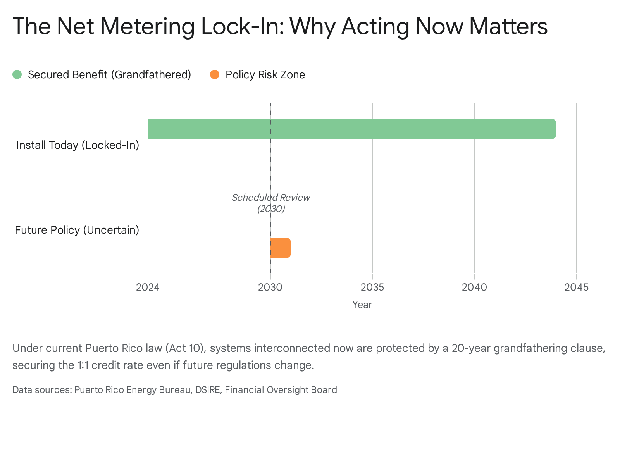
The Takeaway: The best way to protect yourself from future changes to Net Metering is to get your system installed and approved now. If the rules change in 2030, they will likely apply to new people joining the grid, not the people who are already on it.
---
Part 5: Local Tax Incentives – Automatic Savings
While the federal credit requires tax liability and the free programs require low income, the local Puerto Rico tax incentives are available to almost everyone.
1. The Sales Tax (IVU) Exemption
Puerto Rico has a high sales tax: 11.5%. On a $25,000 purchase, that tax would be nearly $3,000.
- The Incentive: Solar electric equipment is 100% exempt from the Sales and Use Tax (IVU).3
- What Counts: This exemption applies to the solar panels, the inverters, the batteries, and the racking hardware essential for the system to work.
- How it Works: This should be automatic. You shouldn't see "IVU" listed on the line items for the equipment in your quote.
- Note on Labor: Sometimes installation labor or miscellaneous construction materials (like conduit or cement pads) might still be taxed depending on how the installer bills it, but the main hardware cost should be tax-free.
- Your Job: Check your invoice. If you see an 11.5% tax charge on the whole project, ask your installer why. They might be making a mistake that costs you thousands.
2. Property Tax Exemption
In the US, adding a pool or a new room to your house increases your property value, which increases your annual property tax bill. Solar does increase your home value—studies show homes with solar sell for more—but in Puerto Rico, you are protected from the tax hit.
- The Law: Equipment used for the generation of renewable energy is exempt from property tax assessment.3
- The Benefit: You get the equity boost without the annual penalty.
---
Part 6: Financing – How to Pay for It
If you don't qualify for the free programs and you don't have $25,000 cash under your mattress, you need financing. Puerto Rico has a unique financial landscape that actually works in your favor here.
The "Cooperativas" (Credit Unions)
Puerto Rico is home to a powerful network of "Cooperativas de Ahorro y Crédito." These are member-owned non-profits, and they are extremely active in solar lending.
- Préstamos Verdes (Green Loans): Almost every major Cooperativa (like Cooperativa de Seguros Múltiples, Coop Rincon, etc.) offers a specific "Green Loan" product.18
- Why they are great: They often have lower interest rates than traditional personal loans and longer terms (up to 15 years). This allows you to spread the cost out so that your monthly loan payment is lower than your old electric bill.
- Flexibility: They are often more willing to work with local residents who might have non-traditional income sources compared to big US banks.
The Big Banks (Banco Popular, FirstBank, Oriental)
The major commercial banks are also aggressive in this space.
- Banco Popular: Offers "Green Loans" with competitive rates. For example, recent offers included rates around 4.75% to 7.95% depending on credit score and terms.19
- Green Mortgages: This is one of the smartest ways to finance solar. If you are buying a new home or refinancing your current one, you can add the cost of the solar system into the mortgage.
- Why do this? Mortgage rates are usually lower than personal loan rates. Plus, the interest on a mortgage is often tax-deductible (check with your CPA).
- FHA Options: The Federal Housing Administration (FHA) has an "Energy Efficient Mortgage" program that allows you to finance energy upgrades without a bigger down payment.
Leasing vs. Buying (The PPA Model)
You will see ads from companies like Sunnova or Sunrun offering "Solar for $0 Down" or "Just pay for the power." This is usually a Power Purchase Agreement (PPA) or Lease.
- How it works: The company buys the system and installs it on your roof. You pay nothing upfront. You sign a contract to buy the power that system produces for the next 25 years.
- The Pros: It is easy. If the system breaks, they fix it. You don't take on debt.
- The Cons:
- You lose the Tax Credit: The company owns the system, so they keep the 30% federal tax credit, not you.
- The Escalator: Many leases have an "escalator clause" where your payment goes up by 2.9% every year. In year 1, it looks cheap. In year 20, it might be expensive.21
- Selling Your Home: If you try to sell your house, the new buyer has to agree to take over your solar contract. Some buyers don't want to do that, which can complicate the sale.
Expert Advice: If you can qualify for a loan (via a Cooperativa or bank) to own the system, you are usually better off financially in the long run. You keep the tax incentives, you build equity, and you eventually own the power plant outright with no monthly payments.
---
Part 7: Technical Reality Check – Batteries & Equipment
In Puerto Rico, the hardware matters more than elsewhere. You need equipment that can survive the Caribbean environment—salt air, high heat, and hurricane-force winds.
The Battery is Non-Negotiable
We cannot stress this enough: Do not buy a solar-only system.
If the grid fails (blackout), a solar system without a battery must shut down. This is an automatic safety feature (called "anti-islanding") to protect linemen. In Puerto Rico, where outages are frequent, a solar-only system is virtually useless for resilience.
You need a battery (like a Tesla Powerwall, Enphase IQ Battery, or Sonnen) and a smart gateway. When the grid fails, the gateway instantly disconnects your house from the street and switches you to battery power. You might not even notice the lights flicker.
Understanding Battery Runtime
Homeowners often overestimate what a battery can do. A standard battery holds about 13.5 kWh of energy.
- Scenario A: The "Essentials" Mode. You only power the fridge, lights, fans, and Wi-Fi. Your battery will last 20+ hours. If the sun comes out the next day, the solar panels recharge the battery, and you can keep going indefinitely.
- Scenario B: The "Whole Home" Mode. You try to run the central air conditioning, the electric stove, and the pool pump. Your battery will die in 3 to 4 hours.
- Data Insight: A typical fridge uses about 1-2 kWh per day. A central AC unit can use 3-5 kWh per hour. You must choose what matters to you.
Hurricane Rating
Make sure your panels and racking (the metal rails that hold the panels) are rated for high wind speeds. Puerto Rico building codes are strict about this. Installers should be using racking certified for wind speeds of roughly 145-160 mph or more depending on your specific municipality and location (coastal vs. inland). Ask your installer: "Is this racking Miami-Dade certified?" (That is often the gold standard for hurricane resistance).
---
Part 8: The Application Roadmap – Step-by-Step
You are ready to move forward. Here is the step-by-step process of how a solar installation actually happens in Puerto Rico.
Step 1: The Audit
Grab your last 12 months of LUMA bills. Look at your monthly kWh usage. Do you average 400 kWh (very low)? 800 kWh (average)? 1,500 kWh (high)? You need a system designed to produce slightly more than your average to eliminate your bill.
Step 2: Get Multiple Quotes
Call at least three installers. The solar market in PR is like the Wild West. Prices vary wildly.
- Ask for: The "Cash Price" and the "Financed Price." (Sometimes they hide huge dealer fees in the financed price).
- Check Certifications: The installer MUST be registered with the Oficina de Política Pública Energética (OPPE) and listed as a certified contractor. If they aren't, you won't get the tax exemptions.
Step 3: Permitting (The Boring but Critical Part)
Once you sign, the installer handles the paperwork.
- OGPe Permit: The construction permit.
- Endorsement: Approval from the engineers.
- Interconnection Application: They submit a plan to LUMA saying "We want to connect this system."
Step 4: Installation
The crew arrives. Installation usually takes 1 to 3 days depending on the complexity of your roof and electrical panel.
Step 5: The Wait (Interconnection)
This is the frustration point. After installation, you cannot legally turn the system on (to export to the grid) until LUMA gives the "Permission to Operate" (PTO).
- Timeline: This used to take 6-12 months. It has improved to about 30-60 days in many cases, but delays happen.
- Self-Consumption: Some modern systems allow you to run in "self-consumption mode" (using your own solar power but not sending any back to the grid) while you wait. Ask your installer if this is an option, so your system isn't just a roof ornament while you wait for LUMA.
Step 6: The "Green" Bill
Once approved, your bill changes. You will see lines for "Medición Neta" (Net Metering). You should ideally see a bill for just $4.00 (the minimum connection fee) if your system is sized right.
---
Part 9: Consumer Protection – Avoiding Scams
With billions of dollars flowing into Puerto Rico solar, the sharks are circling. The Department of Consumer Affairs (DACO) regularly issues alerts about solar scams.21
Common Scams to Watch For
- "The Government Will Pay for It All" Lie: Salespeople might tell you that "Obama programs" or "Biden programs" will pay for everything, even if you are wealthy. This is false. The free programs have strict income limits.
- The "Tax Rebate" Check: They promise you will get a $10,000 check from the IRS next year. As we discussed, if you don't pay federal taxes, you don't get the credit.
- The "Ghosting" Installer: You pay a 50% deposit, and they disappear. Never pay more than 10-20% upfront. Pay the rest only when equipment arrives or installation is complete.
Your Rights
- The Contract: Read it. Does it have a cancellation clause?
- Warranties: Panels usually have 25-year warranties. Inverters have 10-15 years. Batteries have 10 years. Labor warranties vary—make sure you have at least 5-10 years on labor (roof leaks!).
- DACO: If you are scammed, file a complaint with DACO immediately. They have been aggressive in fining non-compliant solar companies.
---
Part 10: Other "Green" Rebates (Water Heaters & ACs)
Solar electricity isn't the only game in town. There are also efficiency rebates, though they are elusive.
LUMA Energy Efficiency Rebates
In 2024, LUMA launched a rebate program for energy-efficient appliances, including solar water heaters and high-efficiency AC units.22
- The Status: As of April 30, 2025, this program is paused/closed due to high demand.23
- The Lesson: These rebate pots of money run out fast. When you hear about a new LUMA rebate, apply immediately. Do not wait.
---
Conclusion: The Final Verdict
So, is going solar in Puerto Rico worth it?
If you look at the math, the answer is a resounding yes. You are trading a variable, expensive, and rising bill from a fragile utility for a fixed, lower payment on an asset you own.
If you look at the resilience, the answer is an even stronger yes. In a place where the grid is as uncertain as the weather, having your own power plant is not a luxury; it is a necessity for a secure home.
The incentives available right now—the 20-year lock-in on Net Metering, the tax exemptions, and the federal credit for those who qualify—create a powerful window of opportunity. But that window won't stay open forever. Federal funds are finite. Net Metering rules will eventually be reviewed.
The smartest move is to start the process now. Get your quotes. Check your eligibility. Secure your energy independence before the next storm—or the next rate hike—arrives.
---
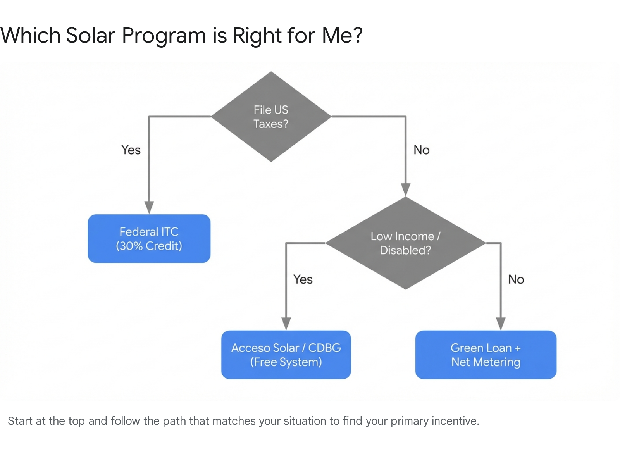
Final Decision Flowchart: Which Program is for You?
![][image3]
Works cited
- Solar Incentive Program - CDBG/MIT, accessed December 18, 2025, https://incentivosolar.pr.gov/en/
- Puerto Rico Energy Resilience Fund, accessed December 18, 2025, https://www.energy.gov/gdo/puerto-rico-energy-resilience-fund
- Puerto Rico Solar Incentives, Tax Credits, & Rebates (2025 Guide) - EcoGen America, accessed December 18, 2025, https://ecogenamerica.com/solar-incentives/puerto-rico/
- What Nonprofits Need to Know about the Investment Tax Credit in 2025, accessed December 18, 2025, https://www.cleanegroup.org/what-nonprofits-need-to-know-about-itc-2025/
- Publication 1321 (October 2025) - Special Instructions For Bona Fide Residents Of Puerto Rico Who Must File A US Individual Income Tax Return (Form 1040 or Form 1040-SR) - IRS, accessed December 18, 2025, https://www.irs.gov/pub/irs-pdf/p1321.pdf
- U.S. Department of the Treasury, IRS Release Final Rules on Provisions to Expand Reach of Clean Energy Tax Credits Through President Biden's Investing in America Agenda, accessed December 18, 2025, https://home.treasury.gov/news/press-releases/jy2157
- Solar Access Program | Department of Energy, accessed December 18, 2025, https://www.energy.gov/gdo/solar-access-program
- Generac Receives Up To $200 Million Award from U.S. Department of Energy to Supply Renewable Power to Puerto Rico's Most Vulnerable Residents, accessed December 18, 2025, https://www.generac.com/about/news/award-to-supply-renewable-power/
- Puerto Rico Energy Recovery and Resilience Newsletter – January 2025, accessed December 18, 2025, https://www.energy.gov/gdo/articles/puerto-rico-energy-recovery-and-resilience-newsletter-january-2025
- CEWRI Community Installations Program - CDBG-DR/MIT Recovery Funds, accessed December 18, 2025, https://recuperacion.pr.gov/en/cewri-ci/
- Community Energy & Water Resilience Program (CEWRI) - COSCDA, accessed December 18, 2025, https://coscda.org/wp-content/uploads/2024/09/Irmari-Rodriguez_COSCDA_ICF_CEWRI-Program.pdf
- HOME ENERGY RESILIENCE IMPROVEMENTS AND INCENTIVE SUBPROGRAMS - Incentivo Solar, accessed December 18, 2025, https://www.incentivosolar.pr.gov/en/documents/COMMUNITY%20ENERGY%20AND%20WATER%20RESILIENCY%20INSTALLATION%20PROGRAM%20(CEWRI-HH)%20-%20PROGRAM%20GUIDELINES%20(V.3)%20.pdf
- Act 10 FAQ - Financial Oversight and Management Board for Puerto Rico, accessed December 18, 2025, https://oversightboard.pr.gov/act-10-faq/
- BY ELECTRONIC MAIL April 10, 2024 Honorable Omar J. Marrero Díaz Executive Director Puerto Rico Fiscal Agency and Financial - IEEFA, accessed December 18, 2025, https://ieefa.org/sites/default/files/2024-06/FOMB%20-%20Letter%20-%20AAFAF%20-%20Act%2010-2024%20204%28a%29%20-%20April%2010%2C%202024.pdf
- Puerto Rico - Net Metering - DSIRE, accessed December 18, 2025, https://programs.dsireusa.org/system/program/detail/2846/puerto-rico-net-metering
- Puerto Rico - Sales and Use Tax Exemption for Solar Equipment - DSIRE, accessed December 18, 2025, https://programs.dsireusa.org/system/program/detail/3182
- Programs - DSIRE, accessed December 18, 2025, https://programs.dsireusa.org/system/program/pr
- Préstamos Verdes - Green Loans - Caribe Federal Credit Union, accessed December 18, 2025, https://caribefederal.com/en/prestamos-verdes/
- Equipment Financing - Renewable energy - Banco Popular, accessed December 18, 2025, https://www.popular.com/en/loans/equipment-financing/
- Mortgage Loans - Banco Popular, accessed December 18, 2025, https://www.popular.com/en/mortgages/
- DACO reports low solar consumer complaints despite soaring installations in Puerto Rico, accessed December 18, 2025, https://citizenportal.ai/articles/3857404/DACO-reports-low-solar-consumer-complaints-despite-soaring-installations-in-Puerto-Rico
- LUMA Introduces Innovative Energy Efficiency Rebate Program in Puerto Rico, accessed December 18, 2025, https://lumapr.com/news/luma-introduces-innovative-energy-efficiency-rebate-program-in-puerto-rico/?lang=en
- Home Efficiency Rebate Program - LUMA - Luma Energy, accessed December 18, 2025, https://lumapr.com/home-efficiency-rebate-program/?lang=en
[image3]: <https://storage.googleapis.com/wbcom-wattbuildcom-assets/content-pipeline/sc-149/image3-19cf4f8a.png