Welcome, neighbors! If you are reading this, you are probably tired of looking at your PECO, PPL, or Duquesne Light bill every month and watching the numbers climb higher. You have seen solar panels popping up on roofs in your neighborhood—maybe on a row home in Philly, a farmhouse in Lancaster, or a suburban split‑level in Pittsburgh—and you are wondering: Does this actually make sense for me?
I am writing this report for you. Not for the politicians in Harrisburg, not for the energy tycoons, but for the regular homeowner trying to figure out if solar power is a smart money move or just a fancy eco‑trend. We are going to strip away the jargon, look at the real numbers, and give you the plain truth about going solar in the Keystone State.
The Elephant in the Room: Why This Report is Urgent
Here is the deal, and I’m going to give it to you straight right off the bat: We are in a "now or never" moment.
The date is December 18, 2025.1 You might have heard the news back in July about the "One Big Beautiful Bill Act." It sounded catchy, but for solar homeowners, it dropped a hammer. The federal government decided to end the main solar tax credit—the one that pays for 30% of your system—on December 31, 2025.1
That is less than two weeks away.
Now, don't panic. If you already have your panels installed, you are golden. If you are just starting your research today, this report is going to be a reality check on what is still possible and what the landscape looks like moving forward. Even without that specific tax credit, Pennsylvania has some unique "hidden" perks that make solar surprisingly profitable compared to other states.
We are going to dig deep—and I mean deep—into every single dollar you can get back from the government, the utility companies, and the solar market itself. We will look at how to get a loan with 1% interest (yes, really), how to get paid for the energy you generate, and how to navigate the confusing world of tax credits before they vanish.
TL;DR (Too Long; Didn't Read) – The Quick Snapshot
For those of you who just want the bottom line before we dive into the details, here is the cheat sheet for Pennsylvania solar in late 2025:
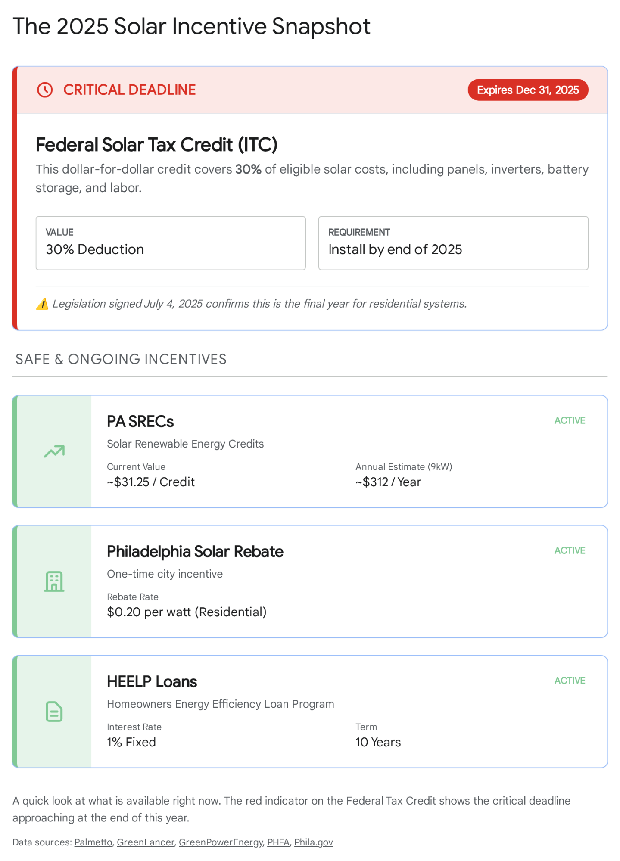
- The Big Discount (Federal ITC): You get 30% of the cost of your system back as a tax credit. BUT the system must be installed and turned on by December 31, 2025.1
- The "Bonus Checks" (SRECs): In PA, you get paid just for producing power, even if you use it yourself. It’s called an SREC. Right now, they are worth about $31 each. An average home earns about 10 of these a year. That’s roughly $300 a year in free money, just for having panels.5
- The "Electric Bank Account" (Net Metering): PA has excellent net metering rules. When you make extra power, the utility company credits you at the full retail price. It is a 1‑for‑1 swap. If you have extra credits left over in May, they cut you a check.7
- The "Hidden Gem" Loan (HEELP): If you meet income limits, you can get a loan for up to $10,000 at a fixed 1% interest rate for 10 years. This is virtually free money.9
- Philly Special: Live in Philadelphia? You get an extra rebate of $0.20 per watt. That’s usually around $1,000 to $1,200 cash back.11
- Taxes: You do have to pay sales tax on the equipment (bummer), but your property taxes should not go up because of the panels (bonus).13
Part 1: The Federal Solar Tax Credit (The Big One)
Let’s start with the heavy hitter. For years, the Residential Clean Energy Credit (often called the Investment Tax Credit, or ITC) has been the main reason solar made financial sense for middle‑class families. It has been the backbone of the solar industry, driving growth and making clean energy accessible to millions. But as we sit here in late 2025, that backbone is about to be removed for residential projects.
What is the Federal ITC?
Imagine walking into a car dealership, buying a car for $30,000, and the federal government handing you a coupon for $9,000 off. That is basically how this solar tax credit works. It is a 30% dollar‑for‑dollar reduction in your federal income taxes.15
It is important to understand that this is not a tax deduction. A deduction just lowers the amount of income you are taxed on. For example, a $1,000 deduction might only save you $200 or $300 depending on your tax bracket. A credit, on the other hand, is much more powerful. If you owe the IRS $10,000 in taxes at the end of the year, and you have a $9,000 solar credit, you now only owe $1,000. It wipes out your tax bill directly. If you already paid your taxes through your paycheck withholdings, the IRS sends you a refund check for the difference.
The 2025 Cliff: The "One Big Beautiful Bill"
Up until mid‑2025, the plan was for this 30% credit to stick around until 2032. We thought we had plenty of time. But politics can be unpredictable.
In July 2025, Congress passed and the President signed the "One Big Beautiful Bill Act".3 While the name sounds optimistic, for residential solar homeowners, it contained a tough pill to swallow. This new law dramatically changed the expiration schedule for the Residential Clean Energy Credit.
Here is the new reality we are facing right now:
- Installed by December 31, 2025: You get the full 30% credit.
- Installed January 1, 2026 or later: You get 0%. It goes away completely for residential home projects.1
This is why your phone might be ringing off the hook with solar sales calls right now. Installers are trying to squeeze everyone in before the ball drops on New Year's Eve. The industry is in a frenzy to complete projects, knowing that the economics of solar will shift significantly on January 1st.
The "Placed in Service" Rule
This is the most common question I get asked right now: "I signed a contract in November 2025. Am I safe?"
The IRS rules are strict, and they don't care about when you signed the contract or when you paid the deposit. The law says the system must be "placed in service" by the deadline.1
What does "placed in service" mean?
- It usually means the installation is complete, the panels are on the roof, the wiring is done, and the system is ready to produce power.
- It does not mean just having the equipment sitting in your garage.
- It does not mean just having the racking installed but not the panels.
If your installer is halfway done on December 31st—maybe they ran into a weather delay or a supply chain issue—you might be out of luck. This creates a high‑stakes environment for anyone starting a project in December. This is why choosing a fast, reliable local installer is more important right now than finding the absolute cheapest price. If the "cheap guy" delays you by two weeks into January, you effectively lose 30% of your money. That is a massive financial swing.
What Costs Can You Include?
If you are one of the lucky ones who manages to get your system installed and operating before the end of the year, you want to make sure you claim every penny you are entitled to. When you calculate that 30%, you can include a wide range of expenses.1
Eligible Expenses:
- Solar Panels: The cost of the photovoltaic cells themselves.
- Labor Costs: This includes onsite preparation, assembly, and original installation. It also includes permitting fees and inspection costs.
- Balance of System: This covers piping, wiring, mounting racks, and inverters.
- Energy Storage: Solar batteries (like the Tesla Powerwall or Enphase IQ Battery) are eligible if they have a capacity rating of 3 kilowatt‑hours or greater.17 This is a huge benefit, as batteries can be expensive.
- Sales Tax: Yes, you can include the sales tax you paid on the equipment in your total cost basis.
Ineligible Expenses:
- Roof Repairs: This is a common point of confusion. If you need to replace your roof to install solar, the cost of the roofing materials and labor generally cannot be claimed for the solar tax credit, unless the roofing material itself generates electricity (like solar shingles).
- Tree Trimming: If you cut down an oak tree to get more sun, that cost is on you. It does not qualify for the credit.
How to Claim the Credit
Claiming the credit requires filing IRS Form 5695 (Residential Energy Credits) when you file your 2025 federal tax return in early 2026.1
On this form, you will list the costs of your solar electric property. You will calculate 30% of that total. That number flows onto your main tax return (Form 1040) and reduces your tax liability.
Important Note on Tax Liability:
This is a non‑refundable credit. That means the credit cannot exceed the amount of tax you owe for the year. If your tax bill for the year is $0 (perhaps because you had no income), you can't use the credit to get a check back for $9,000.
However, under the old rules, you could "roll over" the unused portion to the next year. With the credit expiring, this gets tricky. Typically, tax law allows you to carry forward unused credits even if the credit has expired for new applicants, but you absolutely must check with a qualified tax professional (CPA) to confirm how the "One Big Beautiful Bill Act" treats carry‑forwards.16 Do not assume you can carry it forward indefinitely without checking the new regulations.
Part 2: Pennsylvania SRECs (The Gift That Keeps on Giving)
If the Federal Tax Credit is the "appetizer," SRECs are the steady "allowance" you get for doing your chores. And the best part? You don't actually have to do anything. This is a state‑level incentive that is completely separate from the federal tax credit, and it is not expiring in 2025.
What in the World is an SREC?
SREC stands for Solar Renewable Energy Credit.
Here is the simplest way to understand it:
When your solar panels run, they create two distinct things:
- Electricity: This is the physical energy that powers your fridge, keeps your lights on, and runs your TV. You use this to lower your electric bill.
- Green Attributes: This is the "bragging rights" that the electricity was made by the sun and not by burning dirty coal or gas.
In Pennsylvania, we have a law called the Alternative Energy Portfolio Standard (AEPS). This law says that utility companies (like PECO, PPL, or Duquesne Light) must get a certain percentage of their power from solar energy.
But here is the catch: Most utility companies do not own enough solar farms to meet this requirement. So, instead of building their own, they are allowed to buy these "bragging rights" from homeowners who did build solar.
The Magic Number:
For every 1,000 kilowatt‑hours (kWh) of electricity your panels make, you earn 1 SREC.5 It doesn't matter if you use that electricity in your house or send it back to the grid. If the panels produced it, you get the credit.
The "Border Wall" Boosted Prices
A few years ago, SREC prices in Pennsylvania were terrible. We are talking $5 or $10 per credit. It was hardly worth the paperwork.
Why were they so low? Because Pennsylvania had an "open border" policy for solar credits. Massive solar farms in other states could sell their credits into the Pennsylvania market. This flooded the market with supply, driving the price down for local homeowners.
That changed with the passage of Act 40. Pennsylvania effectively "closed the border," restricting the market primarily to systems located within the state.19 This reduced the supply of SRECs significantly. Basic economics took over: when supply goes down and demand stays steady (or rises), prices go up.
How Much Money are We Talking?
Thanks to the closed border, SREC prices have stabilized at a much healthier level for homeowners.
- Current Price (Dec 2025): The market value fluctuates like a stock, but recently it has been hovering around $31.25 per SREC.6
- Typical Production: A standard Pennsylvania home (about 2,500 sq ft) might install a 10‑kilowatt (kW) solar system. Given our weather—cloudy Pittsburgh days included—that system will produce roughly 11,000 to 12,000 kWh per year.
Let’s do the math for a typical year:
- 12,000 kWh produced ÷ 1,000 = 12 SRECs per year.
- 12 SRECs × $31.25 = $375 per year.
Now, you might be thinking, "Three hundred bucks? That won't change my life." And you are right, it won't buy you a private island. But let's look at the long game. Solar panels are built to last 25 to 30 years.
The Cumulative Impact:
If you earn roughly $375 a year for 15 years, you are looking at over $5,600 in total income. That is passive income. You don't have to work for it. You don't have to drive for Uber or sell things on eBay. You just sit on your couch while the sun hits your roof. This income can pay your water bill, cover your property taxes for a year, or pay for a nice family vacation. It is a significant financial sweetener that many people overlook when calculating the value of solar.
How Do I Actually Sell Them?
You are not going to be calling up PECO and negotiating a price for your credits. That would be a nightmare. Instead, you will use a middleman service called an Aggregator.
Common aggregators operating in Pennsylvania include:
- SRECTrade 5
- Flett Exchange 20
- Sol Systems 22
The Process:
- Sign Up: You create an account with one of these companies online. It is similar to setting up an online brokerage account.
- Register: They handle the paperwork to register your system with the state and the GATS registry (Generation Attribute Tracking System).6 This is the official database that tracks every SREC created.
- Auto‑Pilot: Most modern solar inverters (the box that converts solar power to usable electricity) are connected to the internet. They report your production data automatically. The aggregator sees how much you produced, "mints" the SRECs in the GATS system, and sells them on the market for you.
- Get Paid: They take a small fee for their service and deposit the rest directly into your bank account.
Fees:
Different aggregators charge different fees.
- Flett Exchange: They typically charge a flat fee, often around $2.50 per SREC.23 This is great for larger systems because the fee is capped per unit.
- SRECTrade: They often charge a percentage commission, which can be around 10% or have a minimum dollar amount.25
- Example: If you sell an SREC for $30:
- With a $2.50 flat fee, you net $27.50.
- With a 10% fee, you net $27.00.
- It pays to shop around and check the current fee schedules when you sign up.
Part 3: Net Metering (Your Electric Bank Account)
This is arguably the most important concept to understand. If the Tax Credit is the discount, and SRECs are the bonus, Net Metering is the engine that makes the whole machine run efficiently.
Pennsylvania has some of the best, most consumer‑friendly net metering laws in the country. This is a major advantage for PA homeowners compared to states with weaker policies.
How the Grid Becomes Your Battery
Solar panels have a fundamental "flaw": they work best when you are least likely to be home. They crank out maximum power at 1:00 PM on a Tuesday in July. You are probably at work, the kids are at camp, and your house is empty. The lights are off, the TV is off.
So, where does all that electricity go?
In some states, if you don't use it immediately, you lose it. Or the utility company pays you a tiny fraction of what it's worth (the "wholesale rate").
In Pennsylvania, you get the full retail rate.
The 1‑to‑1 Swap:
- Daytime (Production > Usage): Your panels make 20 kWh of power. Your house only uses 5 kWh. The extra 15 kWh flows backward through your electric meter and onto the grid. It travels down the wires to power your neighbor's house. Your meter literally spins backward (digitally speaking). You "bank" 15 credits.
- Nighttime (Usage > Production): The sun goes down. You come home, turn on the stove, blast the AC, and stream a movie. You pull 15 kWh from the grid to power your life.
- The Bill: The utility company looks at the math at the end of the month: You gave us 15. You took 15. Net result: 0. You pay nothing for that electricity.7
You are essentially using the utility grid like a giant, free battery. You deposit energy when you have a surplus, and you withdraw it when you have a deficit.
Who Plays by the Rules?
Almost everyone in Pennsylvania is covered by these strong rules.
- Investor‑Owned Utilities (IOUs): The big companies—PECO (Philadelphia area), PPL (Allentown/Scranton/Lancaster), Duquesne Light (Pittsburgh), Met‑Ed, Penelec, Penn Power, and West Penn Power—are all required by state law to offer this full 1‑to‑1 net metering.7
- The Exception: If you live in a small town with a "Municipal" electric company or are part of a "Rural Electric Cooperative," the rules might be different. They are not always bound by the same state mandates as the big IOUs. Some might offer net metering, but others might not. If you are in one of these areas, you must call them directly and ask for their specific "distributed generation" policy.
The "Cash Out" Day (May 31st)
What happens if your solar system is a beast? What if, over the course of the entire year, you actually produce more electricity than you use?
You don't lose those credits. In Pennsylvania, the "Solar Year" ends on May 31st. On that day, the utility company looks at your "bank account" of credits.
- If you have a negative balance (you used more than you made), you just pay your bill as normal.
- If you have a positive balance (you banked extra credits), the utility company writes you a check (or issues a bill credit) for the surplus.26
The Price to Compare:
When they cash you out, they pay you the "Price to Compare" (PTC). This is the cost of the generation of the electricity. It usually does not include the distribution cost (the cost to maintain the wires).
- Retail Rate: ~15‑18 cents/kWh (includes wires).
- Price to Compare: ~8‑12 cents/kWh (just the energy).
So, while you earn full retail credit during the month, the end‑of‑year cash out is slightly lower. But getting a check for $100 or $200 in June is still a fantastic feeling.
Why May 31st?
The date is chosen strategically. You build up a huge bank of credits during the sunny summer months (June, July, August). Then, during the dark, short days of winter (December, January, February), you slowly use up those banked credits. By the time May 31st rolls around, most homes have used up most of their bank, bringing their balance close to zero. It balances the seasonal cycle perfectly.
A Critical Warning on "Shopping for Rates"
Many Pennsylvanians use the "PA Power Switch" website to shop for cheaper electricity suppliers. This can be a great way to save money if you don't have solar.
If you have solar, be extremely careful.
Some third‑party Electric Generation Suppliers (EGS) do not offer net metering. If you switch from your default utility (like PPL) to a cheap third‑party supplier, you might lose your ability to bank your solar credits.8 You could end up giving your extra power to them for free!
- Rule of Thumb: Before you switch suppliers, ask specifically: "Do you offer Net Metering for solar customers?" Get it in writing.
- Safest Bet: For most solar homeowners, staying with the default utility (PECO, PPL, etc.) is the safest and easiest option. Their net metering policies are guaranteed by law.
Part 4: Financing – Getting Solar for (Almost) Free
A typical residential solar system can cost anywhere from $20,000 to $40,000 before incentives. Most of us don't have that kind of cash sitting under the mattress. This is where financing comes in, and Pennsylvania has a "secret weapon" that is the envy of other states.
The "Secret Weapon": PA HEELP Loan
The Homeowners Energy Efficiency Loan Program (HEELP) is a program run by the Pennsylvania Housing Finance Agency (PHFA). It is, without a doubt, the best way to pay for a portion of your solar system if you qualify.
The Terms are Insane:
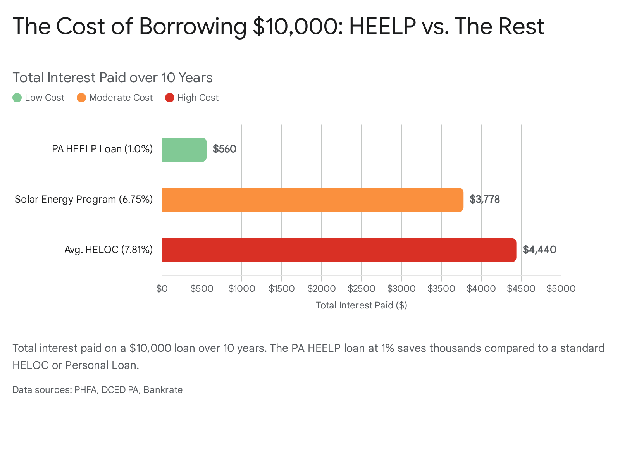
- Interest Rate: Fixed at 1%.9
- Term: 10 years.
- Loan Amount: $1,000 to $10,000.
- No Prepayment Penalty: You can pay it off early if you want.
Let that sink in: 1% interest. In an economic environment where mortgage rates are hovering around 6‑7%, car loans are at 8%, and credit cards are over 20%, a 1% loan is virtually free money. On a $10,000 loan over 10 years, you would pay less than $550 in total interest. That is almost unheard of.
The Catch: Income Eligibility
This program is designed for working families, so there are income limits. You have to earn below a certain amount to qualify. These limits are based on the "Area Median Income" (AMI) and vary by county and family size.
2025 Income Limits (Sample):
- Family of 1: ~$57,150 annual income.
- Family of 2: ~$65,300 annual income.
- Family of 3: ~$73,450 annual income.
- Family of 4: ~$81,600 annual income.9
Note: These are general figures. The exact limit depends on exactly where you live. Bucks County limits might be higher than Tioga County limits due to the cost of living differences. You should check the PHFA website for the specific chart for your county.
How to Use It:
Since the maximum loan is $10,000, it likely won't cover the entire cost of your solar system.
- Strategy: You can use the HEELP loan to pay for the first $10,000. Then, you can pay the remaining balance with cash or a different, higher‑interest loan. By mixing the 1% money with market‑rate money, you significantly lower your average interest rate for the whole project.
Solar Energy Program (SEP) Loans
If you make too much money for the HEELP loan, there is another state program called the Solar Energy Program (SEP).
- These loans are often geared toward businesses or larger projects, but residential projects can sometimes qualify under specific "high performance" guidelines.
- Interest Rates: These are higher than HEELP. Currently, they are around 6.75%.28
- This rate is decent—better than a credit card—but it's fairly comparable to what you might get from a bank. It’s not the "free money" slam dunk that HEELP is.
Home Equity Loans (HELOCs)
Many Pennsylvania homeowners choose to use a Home Equity Line of Credit (HELOC) to pay for solar.
- Pros: The interest on home equity loans is often tax‑deductible (check with your accountant).
- Cons: Interest rates in late 2025 are relatively high, averaging around 7.8%.29
Solar Company Financing
Almost every solar installer will offer you financing directly. "Zero down, low monthly payments!" they will say.
- Be Careful: They often advertise incredibly low interest rates, like "2.99%."
- The Hidden Fee: To get that 2.99% rate, they often charge a massive upfront "dealer fee" or "origination fee." This fee can add 20% to 30% to the total cost of your system.
- The Math: Always ask for the "Cash Price" versus the "Financed Price." If the cash price is $25,000 and the financed price is $32,000, that $7,000 difference is effectively prepaid interest. It might look like a low rate, but you are paying for it upfront. It is often smarter to take the lower cash price and find your own financing (like a HELOC or credit union loan).
Part 5: Philly & Local Incentives
If you live in the City of Brotherly Love, you are in luck. Philadelphia is unique in the state because it offers its own direct cash rebate on top of everything else.
The Philadelphia Solar Rebate
This is a straightforward incentive program run by the city to encourage green energy.
- The Deal: You get a check for $0.20 per watt of solar capacity installed.11
- The Cap: For residential homes, the rebate is capped at $1,000 per project. (Commercial projects have different rules).
- Example: If you install a typical 5,000‑watt system (5 kW), the math is: 5,000 watts × $0.20 = $1,000.
Permit Fees: A Hidden Cost
When budgeting, don't forget about permit fees. Every municipality charges for building and electrical permits.
- Pittsburgh: The fees are based on the value of the construction. For residential projects, it is typically $6.00 per $1,000 of value, plus a 40% upfront fee.30 On a $20,000 system, this adds up to a few hundred dollars.
- Philadelphia & Suburbs: Fees vary by township. Some eco‑friendly townships have waived solar permit fees to encourage adoption, while others charge flat fees. Ask your installer for an estimate of the permit costs in your specific town—they usually handle the paperwork, but you pay the bill.
Why No Statewide Rebate?
You might hear rumors about a "PA State Rebate" called the "Sunshine Program." Forget it. That program ran out of money and shut down over a decade ago.
There is a lot of outdated information floating around on the internet. If a website tells you there is a "PA State Solar Rebate" available to everyone, that website is old and wrong. Trust the current data: The only "cash back" incentives available right now are the Federal Tax Credit (expiring soon!), SRECs, and the Philadelphia rebate.5
The "Solar For All" Hope
You may have read news headlines about a massive federal program called "Solar For All." This is a $7 billion EPA program designed to bring solar to low‑income households. Pennsylvania received a chunk of this funding.
- Status (Dec 2025): As of right now, the program is not yet operational for homeowners to apply.31
- Advice: If you are a low‑income homeowner, this program might be amazing in 2026 or 2027. It could offer free or deeply discounted systems. However, we simply don't have the application forms or final rules yet. If you can qualify for the HEELP loan now, that is a bird in the hand. Waiting for a government program that hasn't launched yet is always a gamble.
Part 6: Taxes – The Good, The Bad, and The Assessment
Nobody likes talking about taxes, but when you are making a major investment in your home, you need to know the rules. In Pennsylvania, the tax situation for solar is a mixed bag.
The Bad News: Sales Tax
In some states, solar equipment is exempt from sales tax. Pennsylvania is not one of them.
- When you buy your solar system, you will have to pay the state sales tax on the equipment.13
- Statewide: 6%.
- Allegheny County: 7% (6% state + 1% local).
- Philadelphia: 8% (6% state + 2% local).
- The Impact: On a $20,000 system, that means you are paying anywhere from $1,200 to $1,600 in sales tax. It’s an added cost you need to budget for.
- Silver Lining: Remember that the Federal Tax Credit applies to the total cost of the system, including sales tax. So, you eventually get 30% of that sales tax back as a credit (if you install by Dec 31, 2025).1
The Good News: Property Tax Assessment
This is a common fear: "If I add a $30,000 high‑tech power plant to my roof, won't the tax assessor come out and raise my property taxes?"
Generally, the answer is NO.
While Pennsylvania does not have a single, ironclad state law that explicitly bans solar property tax increases in every single circumstance, the prevailing interpretation among assessors and the courts is favorable to homeowners.
- The Logic: Solar panels are typically classified as "machinery and equipment" (like a furnace or a central AC unit) rather than "real estate improvements" (like adding a new bedroom or a garage).14
- The Result: Your assessed home value should not increase just because you installed panels. This means your annual property tax bill stays the same.
- Resale Value: This is the best of both worlds. Studies show that homes with solar panels often sell for more money (increasing your resale value), but you don't have to pay taxes on that increased value while you live there.
- Appeal Rights: If for some reason a local assessor does try to raise your assessment based on solar, you have strong grounds to appeal. The Board of Appeals in counties like Bucks and others have procedures for this.34 You can argue that the panels are excluded machinery.
Part 7: The Math – Does it Actually Pay Off?
Let's put all these pieces together. Incentives are great, but the bottom line is: Does this save me money?
Let's look at a hypothetical family, the Millers, living in a standard suburban home in Pennsylvania.
The Scenario:
- Location: Chester County, PA (PECO territory).
- Electric Bill: Average of $150/month.
- Annual Usage: ~10,000 kWh.
- System Size Needed: 8 kW (Kilowatts).
- Gross Cost: $24,000 (Based on a typical $3.00 per watt average).36
The Breakdown (2025 Rules)
| Item | Amount | Notes |
|---|---|---|
| Gross Cost | $24,000 | Upfront price tag (panels + install) |
| Federal Tax Credit (30%) | -$7,200 | Must install by Dec 31, 2025!1 |
| Net Cost | $16,800 | What the system actually costs you |
Annual Savings & Income
Now, let's look at what the Millers get back every year:
- Bill Savings: By generating their own power, they eliminate that $150/month electric bill.
- $150 × 12 months = $1,800 per year in savings.
- SREC Income: Their 8 kW system produces roughly 9,000 kWh per year, which equals 9 SRECs.
- 9 SRECs × $31.25 = $281 per year in income.
- Total Annual Benefit: $1,800 (savings) + $281 (income) = $2,081.
Payback Period
To figure out how fast the investment pays off, we divide the Net Cost by the Annual Benefit.
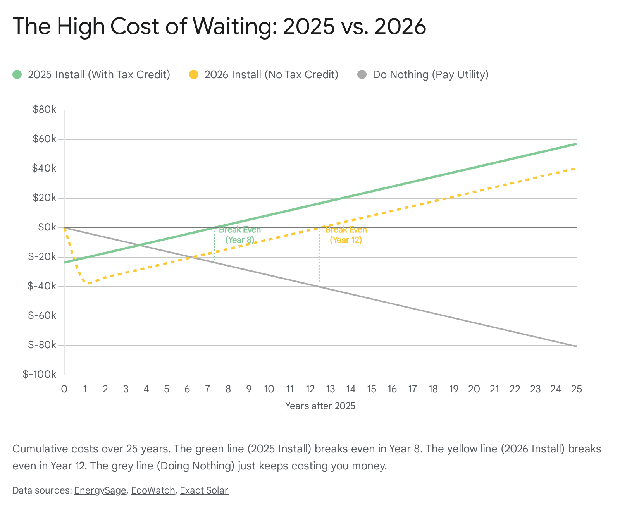
- $16,800 ÷ $2,081 = 8.1 Years.
The Verdict:
In just over 8 years, the system has completely paid for itself.
Since solar panels are warrantied for 25 years, that leaves you with roughly 17 years of free electricity.
- 17 years × $2,081 = $35,377 in pure profit.
- Note: This assumes electricity prices never go up. But we know they will go up. PECO and PPL raise rates almost every year. If electricity prices rise, your savings grow even larger, and your payback period gets even shorter.
What if you Miss the 2025 Deadline?
This is the scary part. Let's say the Millers hesitate. They wait until January 2026 to install. They miss the "One Big Beautiful Bill" cutoff.
- New Net Cost: $24,000 (No tax credit).
- Annual Benefit: Still $2,081.
- New Payback Period: $24,000 ÷ $2,081 = 11.5 Years.
It is still a decent investment—better than letting that money sit in a savings account earning 0.5%—but waiting just a few weeks cost them 3.5 years of savings. That is why the deadline is such a big deal.
Part 8: The Step‑by‑Step Action Plan
Okay, you are convinced. You want to beat the deadline. But how do you actually do it without getting ripped off? Here is your game plan for the next two weeks.
Step 1: Gather Your Data
Go find your electric bill. You don't just need the dollar amount; you need your annual kWh usage. Look for a graph on your bill or a line that says "Total Annual Usage." This number tells the installer exactly how many panels you need. If you use 12,000 kWh a year, you need a system that produces roughly that amount.
Step 2: Get 3 Quotes (Fast)
Do not just call one guy. Prices in the solar industry vary wildly. One company might charge $3.00 per watt, while another charges $4.50 for the exact same equipment.
- The Crucial Question: Ask every installer: "Can you guarantee installation and 'placed in service' status by December 31st?" Get this in writing. If they can't guarantee it, you are gambling with your 30% tax credit.
- Check the Equipment: Make sure they are using "Tier 1" panels. Brands like QCells, REC, and Maxeon are the gold standard. Avoid generic brands you've never heard of.
- Check the Warranties: You want a 25‑year warranty on production (how much power they make) and labor (fixing them if they break).
Step 3: Financing Check
- Income Check: Look at the HEELP income limits again. If you think you qualify, apply immediately. The Pennsylvania Housing Finance Agency moves at the speed of government. You need that approval process rolling now.
- Bank Check: If you don't qualify for HEELP, call your bank and ask about a Home Equity Line of Credit (HELOC). Compare that rate to whatever financing the solar installer offers. Remember: Cash price + HELOC is almost always cheaper than a solar loan with hidden dealer fees.
Step 4: Sign and Sit
Once you sign the contract, the installer takes over. They will handle the building permits and the interconnection application with your utility company.
- Heads Up: The "Interconnection" permission from PECO or PPL can take a few weeks. This is the bottleneck. Stay on your installer to make sure they filed the paperwork the same day you signed.
Step 5: Activation & Tax Forms
Once the system is installed and turned on:
- SREC Registration: Register with an SREC Aggregator (like SRECTrade or Flett Exchange) so you can start earning those credits immediately.
- Tax Prep: Save all your receipts and contracts. You will need them to file IRS Form 5695 with your taxes in April 2026.
- Enjoy: Go outside, watch your meter spin backward, and enjoy the feeling of producing your own clean power.
---
Conclusion: The Sun is Rising (But the Door is Closing)
Pennsylvania isn't known for being a tropical paradise. We have cloudy winters and rainy springs. But despite that, the Keystone State has quietly become one of the smartest places in the country to go solar. The combination of high electric rates (which creates big savings), strong net metering policies (which protect those savings), and the SREC market (which adds bonus income) creates a powerful financial argument for solar.
But we can't ignore the reality of December 2025. The end of the Residential Clean Energy Credit is a game‑changer.
- If you act now: You are locking in a 30% discount that makes the investment a "no‑brainer" with an 8‑year payback.
- If you wait: Solar still saves you money, and it is still a good thing for the planet, but the financial hill becomes steeper to climb.
My advice? If you have a south‑facing roof and a credit score over 650, pick up the phone and get a quote this week. It costs nothing to look, but waiting until January could effectively cost you $7,000.
Good luck, neighbors. Let the sun shine!
---
Appendix: Quick Reference Data
PA Utility Net Metering Policies
| Utility | Net Metering Policy | Cash Out Date | Reimbursement Rate |
|---|---|---|---|
| PECO | 1:1 Retail Rate | May 31 | Price to Compare |
| PPL | 1:1 Retail Rate | May 31 | Price to Compare |
| Duquesne Light | 1:1 Retail Rate | May 31 | Price to Compare |
| Met‑Ed / Penelec | 1:1 Retail Rate | May 31 | Price to Compare |
HEELP Income Limits (2025 Samples)
Note: These limits are examples and can vary by county. Always check the official PHFA website for your specific county limits.
| Family Size | Approx. Annual Income Limit |
|---|---|
| 1 Person | $57,150 |
| 2 People | $65,300 |
| 3 People | $73,450 |
| 4 People | $81,600 |
| 5 People | $88,150 |
| (Source: 9) |
Works cited
- The History & Future of the Solar Tax Credit in 2025 – GreenLancer, accessed December 18, 2025, https://www.greenlancer.com/post/solar-energy-tax-credit-2025
- Federal Solar Tax Credit In 2025: How Does it Work? | EnergySage, accessed December 18, 2025, https://www.energysage.com/solar/solar-tax-credit-explained/
- Congress Phases Out Energy Tax Credits | Pierce Atwood, accessed December 18, 2025, https://www.pierceatwood.com/alerts/congress-phases-out-energy-tax-credits
- Pennsylvania Solar Incentives, Tax Credits & Rebates 2025 | EnergySage, accessed December 18, 2025, https://www.energysage.com/local-data/solar-rebates-incentives/pa/
- Pennsylvania Solar Incentives for 2025: Net Metering, SRECs, and the Federal Tax Credit, accessed December 18, 2025, https://palmetto.com/policy/pennsylvania-solar-incentive-tax-credit-rebate-guide
- A 2025 Guide to SRECs in Pennsylvania: What They Are Worth to You?, accessed December 18, 2025, https://greenpowerenergy.com/2025-guide-pa-srec-system-opportunities/
- Solar Net Metering in Pennsylvania Guide, accessed December 18, 2025, https://publicservicesolar.com/solar-net-metering-in-pennsylvania-guide/
- Guide To Pennsylvania Net Metering In 2025 – SolarReviews, accessed December 18, 2025, https://www.solarreviews.com/blog/pennsylvania-net-metering
- Homeowners Energy Efficiency Loan Program (HEELP) – PHFA, accessed December 18, 2025, https://www.phfa.org/programs/repairs/heelp.aspx
- Free Pennsylvania Solar Incentives: Claim Solar Panels (Open Enrollment), accessed December 18, 2025, https://pennsylvania.statesolar.org/
- Pennsylvania Solar Incentives – SunnyMac, accessed December 18, 2025, https://sunnymacsolar.com/service-areas/solar-in-pennsylvania/pennsylvania-solar-incentives/
- Philadelphia Solar Rebate | Programs and initiatives, accessed December 18, 2025, https://www.phila.gov/programs/solar-rebate-program/
- Pennsylvania Solar Incentives, Tax Credits & Rebates (2025 Guide) – This Old House, accessed December 18, 2025, https://www.thisoldhouse.com/solar-alternative-energy/solar-incentives-pennsylvania
- Tax Implications of Land Conversions for Grid‑Scale Solar Development, accessed December 18, 2025, https://extension.psu.edu/tax-implications-of-land-conversions-for-grid-scale-solar-development
- Federal Tax Credits for Energy Efficiency, accessed December 18, 2025, https://www.energystar.gov/about/federal-tax-credits
- Residential Clean Energy Credit | Internal Revenue Service, accessed December 18, 2025, https://www.irs.gov/credits-deductions/residential-clean-energy-credit
- Solar Investment Tax Credit: What Changed? – Department of Energy, accessed December 18, 2025, https://www.energy.gov/eere/solar/articles/solar-investment-tax-credit-what-changed
- PA Solar SREC Program: Prices, Lifespan, and How to Benefit, accessed December 18, 2025, https://ethicalenergysolar.com/blog/pa-solar-srec-program/
- Pennsylvania – SREC Markets – SRECTrade, accessed December 18, 2025, https://www.srectrade.com/markets/rps/srec/pennsylvania
- Pennsylvania SREC Market Prices – Flett Exchange, accessed December 18, 2025, https://www.flettexchange.com/markets/pennsylvania/market-prices
- Our Team – Flett Exchange, accessed December 18, 2025, https://www.flettexchange.com/about-us
- SRECS – Sol Systems, accessed December 18, 2025, https://www.solsystems.com/services/srecs/
- Fee Details – Flett Exchange, accessed December 18, 2025, https://www.flettexchange.com/fee-schedule
- Why Has the Price for June 2025 Generated New Jersey SRECs Dropped? – Flett Exchange, accessed December 18, 2025, https://www.flettexchange.com/blog/post/why-has-price-june-2025-generated-new-jersey-srecs-dropped
- How much do you guys pay to sell your SRECs? : r/solar – Reddit, accessed December 18, 2025, https://www.reddit.com/r/solar/comments/1l5q5i8/how_much_do_you_guys_pay_to_sell_your_srecs/
- 2025 PECO Energy Net Metering, accessed December 18, 2025, https://www.energysage.com/local-data/net-metering/peco-energy/
- Loan Programs for Home Improvements & Repairs – PHFA, accessed December 18, 2025, https://www.phfa.org/programs/repairs.aspx
- CFA Interest Rates – PA Department of Community & Economic Development, accessed December 18, 2025, https://dced.pa.gov/programs-funding/commonwealth-financing-authority-cfa/cfa-interest-rates/
- Current home equity line of credit (HELOC) rates for December 2025 – Bankrate, accessed December 18, 2025, https://www.bankrate.com/home-equity/heloc-rates/
- pli‑fee‑schedule‑1‑1‑2025.pdf – Pittsburghpa.gov, accessed December 18, 2025, https://www.pittsburghpa.gov/files/assets/city/v/1/pli/documents/fees/pli‑fee‑schedule‑1‑1‑2025.pdf
- Solar for All – Philadelphia Green Capital Corp, accessed December 18, 2025, https://phillygreencapital.org/solar-for-all/
- Solar for All | Department of Environmental Protection – Commonwealth of Pennsylvania, accessed December 18, 2025, https://www.pa.gov/agencies/dep/programs-and-services/energy-programs-office/financial-options/energy-accelerator-program/solar-for-all
- Under state tax law, solar panels are equipment — not property – Williamsport Sun‑Gazette, accessed December 18, 2025, https://www.sungazette.com/news/top-news/2025/08/under-state-tax-law-solar-panels-are-equipment-not-property/
- Board of Assessment Appeals | Bucks County, PA, accessed December 18, 2025, https://www.buckscounty.gov/438/Board-of-Assessment-Appeals
- Tax Appeals | Department of Revenue | Commonwealth of Pennsylvania, accessed December 18, 2025, https://www.pa.gov/agencies/revenue/get-assistance/tax-appeals
- Pennsylvania Solar Panel Installations: 2025 Pricing & Savings – EnergySage, accessed December 18, 2025, https://www.energysage.com/local-data/solar/pa/