If you live in Maine, you know that our relationship with energy is… complicated. We have some of the most beautiful, rugged landscapes in the country, but we also have winters that can chill you to the bone and electric bills that can make your eyes water. Lately, it feels like every time you open an envelope from Central Maine Power (CMP) or Versant, the news isn't great. Rates have been climbing, the grid is under stress, and the old ways of heating our homes—primarily heating oil—are becoming volatile and expensive.
You have probably noticed the change in the landscape, too. Drive through any town from Kittery to Fort Kent, and you will see them: shiny blue or black rectangles perched on rooftops or sitting in fields. Solar power isn't just a California thing anymore; it has come to the Pine Tree State in a big way. But if you are like most Mainers, you are skeptical. You might be wondering: Does solar actually work up here? Is it worth the money? And what is the deal with all these "programs" I keep hearing about?
This guide is written specifically for you. We are not going to throw a textbook at you. We are going to sit down—figuratively speaking—at your kitchen table and walk through the reality of going solar in Maine in 2025. We will strip away the confusing jargon and get straight to the dollars and cents. We will look at the federal tax credits that act like a massive coupon from Uncle Sam, the state‑level policies that let you use the grid like a free battery, and the specific rules for 2025 that you need to know to avoid getting ripped off.
We will also be honest about what isn't available. There are no magic free lunches, and some "rebates" you might have heard rumors about simply don't exist for solar panels right now. By the end of this report, you will be the smartest person in the neighborhood when it comes to energy, armed with the knowledge to decide if solar is the right move for your family.
TL;DR: The Quick Summary for Busy Mainers
If you are in a rush and just want the headlines, here is the "Too Long; Didn't Read" version of the current state of solar in Maine:
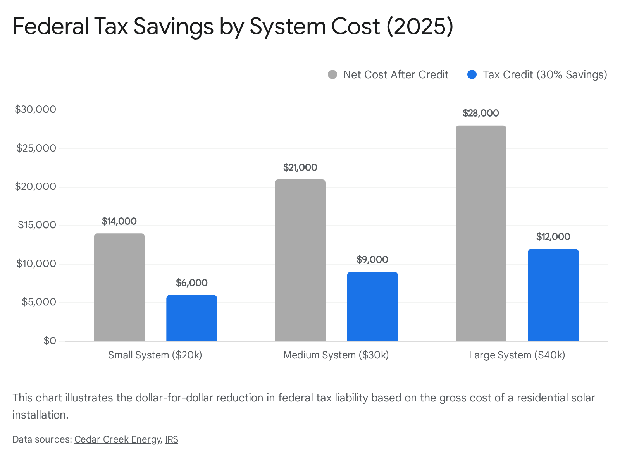
- The Big Federal Coupon (ITC): The US government covers 30% of the cost of your solar installation via a tax credit. This is available through 2032. If your system costs $20,000, you get a $6,000 credit on your taxes. 1
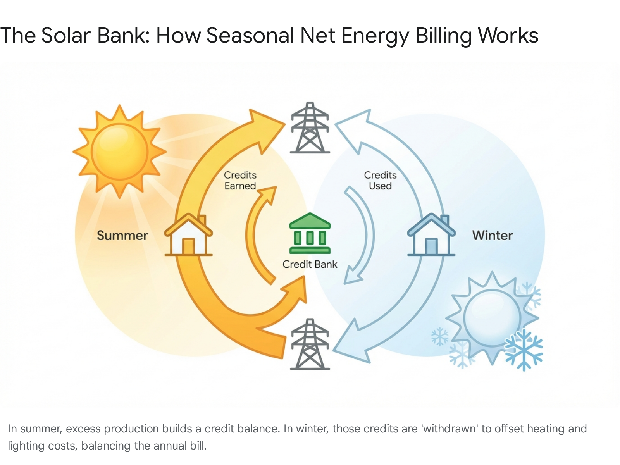
- Net Energy Billing (Your "Bank Account"): Maine lets you trade power with the power company. When you make extra energy in July, you send it to CMP or Versant and earn credits. You use those credits to pay your bill in January. It’s a 1-to-1 swap for residential customers. 3
- Tax Free: You do not pay the 5.5% Maine sales tax on solar equipment. 5 You also generally do not pay extra property taxes on the added value to your home, provided you file a specific form by April 1st. 6
- No State Rebates for Panels: Efficiency Maine Trust (EMT) is awesome, but right now they are not writing checks for solar panels. They are focused on heat pumps and weatherization. Do not budget for a state rebate check for the solar array itself. 8
- Community Solar Warning: If you subscribe to a solar farm instead of putting panels on your roof, be careful. Some programs create billing headaches or sell the "green" attributes (RECs) out of state, meaning your power isn't technically renewable. 9
- The Future is Electric: The best savings come when you pair solar with heat pumps, replacing expensive oil with your own cheap electricity.
---
Part 1: The Maine Solar Landscape in 2025
To understand why solar incentives work the way they do, we first have to look at the playing field. Maine is in a unique position. We are at the end of the energy pipeline for New England, meaning our energy costs are historically high. 11 We are also heavily dependent on heating oil, more so than almost any other state. This creates a "double whammy" of high costs for homeowners: you pay a lot to keep the lights on, and you pay a lot to keep the house warm.
The "Stranded Cost" Situation
You might have seen the phrase "stranded costs" or "rate adjustments" in the news or on your bill inserts. In 2025, the Maine legislature and the Public Utilities Commission (PUC) implemented changes to how electricity costs are shared. This was largely driven by two laws: LD 1792 and LD 1777. 12
Here is the simple version: The cost of maintaining the poles and wires (delivery) and the cost of the actual electricity (supply) have been fluctuating. To stabilize things for ratepayers, the state tweaked the rules. For residential customers of Central Maine Power (CMP), this resulted in a small decrease in bills (about $0.80/month on average), and for Versant customers in the Maine Public District, a decrease of about $2.87. 12
Why does this matter for solar? Because the value of your solar investment is directly tied to the price of electricity. If electricity from the grid is expensive, every kilowatt-hour (kWh) you make yourself is valuable "avoided cost." If electricity were free, solar would be worthless. Since Maine's rates remain high compared to the national average, the "savings per sunbeam" in Maine is actually much higher than in states with cheap power.
The Shift to Electrification
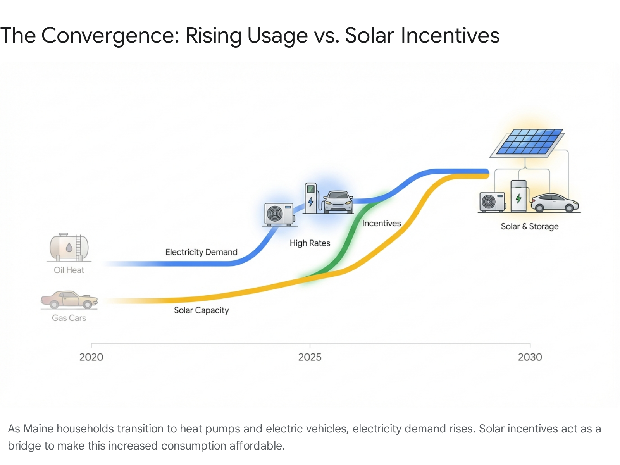
The state of Maine has a goal: Electrification. The plan is to move us away from burning fossil fuels in our basements (oil furnaces) and driveways (gas cars) and toward using electricity for everything. Heat pumps are the heroes of this story. Efficiency Maine has been incredibly successful in getting heat pumps into Maine homes. 13
However, this transition creates a new problem. If you switch from oil to heat pumps, your oil bill goes to zero, but your electric bill skyrockets because you are now using electricity to heat your home. This is where solar comes in. It acts as the financial bridge. By generating your own power, you can run those heat pumps for pennies on the dollar compared to buying power from the utility.
---
Part 2: The Heavy Lifter — The Federal Investment Tax Credit (ITC)
If you are looking for the single biggest reason to go solar, look to Washington D.C., not Augusta. The federal government offers the most lucrative financial incentive available to homeowners: the Residential Clean Energy Credit, commonly known as the ITC (Investment Tax Credit).
How the Math Works
As of 2025, the federal government allows you to deduct 30% of the total cost of your solar energy system from your federal income taxes. 1
It is crucial to understand the difference between a "tax deduction" and a "tax credit."
- Tax Deduction: This lowers your taxable income. If you earn $50,000 and have a $1,000 deduction, you are taxed as if you earned $49,000. It saves you a little bit.
- Tax Credit: This lowers your tax bill dollar-for-dollar. If you owe the IRS $5,000 and you have a $1,000 credit, you now owe $4,000. It is much more powerful.
Example:
Imagine the "Robinson Family" in Portland. They decide to install a rooftop solar system.
- Total Contract Price: $24,000.
- Federal Credit (30%): $7,200.
- Net Cost: $16,800.
The Robinsons will file their taxes the following year and claim that $7,200 credit. If they usually get a refund, their refund will be $7,200 bigger. If they usually owe money, they will owe $7,200 less.
What Expenses Can You Include?
The IRS is quite generous with what counts toward that "Total Contract Price." You can calculate the 30% credit based on:
- Solar Equipment: The PV panels, the racking/mounting rails, the wiring, and the conduit.
- Inverters: The device that converts the DC electricity from the panels into the AC electricity your house uses.
- Labor Costs: This is often the biggest chunk. You can include the cost of the solar installers, electricians, roofers (if they are doing work specifically for the solar install), and even the permitting fees paid to your town. 1
- Energy Storage (Batteries): If you decide to add a battery backup system (like a Tesla Powerwall or Generac PWRcell), the cost of the battery and its installation is also eligible for the 30% credit. The battery must have a capacity of at least 3 kilowatt-hours (kWh), which virtually all home batteries do. 15
What is NOT included?
You generally cannot claim the credit for a new roof unless the solar panels are integrated directly into the roofing material (like "solar shingles"). If you are just re‑shingling your roof to prepare for standard panels, the cost of the shingles is usually considered a home improvement, not a solar energy cost, and is not eligible for the 30% credit. Always consult a tax professional on this nuance.
The "Rollover" Safety Net
A very common question homeowners ask is: "What if I don't pay enough in taxes to use the whole credit?"
Let’s go back to the Robinsons. They have a $7,200 credit.
But let's say Mr. and Mrs. Robinson are retired or had a year with lower income. When they fill out their tax return (IRS Form 1040), they calculate their total federal tax liability for the year is only $4,000.
- Year 1: They use $4,000 of the solar credit to reduce their tax bill to $0.
- The Remaining $3,200: Does it vanish? No. It rolls over to the next tax year. 14
You can carry forward the unused portion of the credit to future tax years as long as the credit legislation remains active. Currently, the credit is locked in through 2032, so you have plenty of time to use it up.
Critical Dates: The Timeline
One of the best things about the current solar landscape is stability. In the past, this tax credit was constantly on the verge of expiring, causing "solar coaster" panic. Thanks to the Inflation Reduction Act passed in 2022, we have a long runway of stability.
- 2022 – 2032: The credit remains at 30%.
- 2033: The credit drops to 26%.
- 2034: The credit drops to 22%.
- 2035: The credit expires for residential systems (unless Congress acts). 14
For you, reading this in 2025, you are in the "safe zone." You do not need to rush to sign a contract tomorrow to save 30%, but you do need to understand that this is the best deal that has ever been offered, and it won't get better than this.
How to Claim It
Claiming the credit is surprisingly straightforward for most people.
- Keep your receipts: You need the final invoice from your solar installer showing the total amount you paid.
- File IRS Form 5695: This is the form for "Residential Energy Credits." You will fill in the cost of your system on the line for "Qualified solar electric property costs."
- Transfer to Form 1040: The result from Form 5695 goes onto your main tax return (Form 1040) on the line for "Residential Clean Energy Credit."
- Done.
Note: We are solar enthusiasts, not CPAs. Always check with a tax professional to confirm your specific eligibility, especially if you have a complicated tax situation.
---
Part 3: Net Energy Billing (NEB) — How Maine Solar Pays You Back
If the Federal Tax Credit helps you buy the system, Net Energy Billing (NEB) is what makes the system pay for itself over time. This is Maine's specific version of what other states call "Net Metering," and it is absolutely essential to making solar work in our climate.
The Problem: Summer Sun vs. Winter Heating
In Maine, we have a seasonal mismatch that is more extreme than in Florida or California.
- Summer: The sun is high, the days are long (15 hours of light in June!), and the weather is generally clear. Your solar panels will be screaming with power. You will likely be generating way more electricity than your home can use, even if you are running air conditioning.
- Winter: The sun is low in the sky, it sets at 4:15 PM in December, and your panels might be covered in snow for a few days after a storm. But this is exactly when you need power the most, especially if you have heat pumps running to keep the house warm.
Without a special policy, you would have too much power in July (and waste it) and not enough in January (and have to pay full price).
The Solution: The Grid as a Battery
Net Energy Billing solves this problem by turning the utility grid (CMP or Versant) into a giant, free battery for your home.
- The Overflow: When your panels produce excess power during a sunny July afternoon, that electricity flows out of your house, through your meter, and onto the utility grid. Your neighbors use it.
- The Credit: The utility measures this outflow. For every kilowatt-hour (kWh) you send them, they give you a credit.
- The Bank: These credits sit in a "bank" on your utility account.
- The Withdrawal: When winter comes and your panels aren't producing enough to run your lights and heat, you draw power from the grid like normal. But instead of paying cash for that power, the utility subtracts from your banked credits. 3
This system allows you to take the sunshine from July and use it to heat your home in January. It is an annual cycle of saving and spending energy.
The "Use It or Lose It" Rule
There is one very important catch to this system. You cannot hoard credits forever. In Maine, unused credits expire after 12 months.
The state rules require utilities to "annualize" the credits. If you still have credits left over at the end of the 12‑month period, they disappear. You do not get a check for them; they are essentially donated to the grid (specifically, the value is often remitted to low‑income assistance programs). 16
What this means for you:
Most solar installers will design your system to offset exactly 100% to 110% of your annual usage. If you build a massive system that produces 200% of what you need, you are paying for extra panels that generate free electricity for the power company, not for you. Bigger isn't always better; right‑sized is better.
Residential vs. Commercial Programs (The "Tariff" Confusion)
If you read the business section of the newspaper, you might see headlines about "Tariff Rates," "controversial subsidies," and "legislative reform" regarding solar. It is easy to get scared by this, but it is important to understand the distinction.
There are two main types of Net Energy Billing in Maine:
- The kWh Credit Program (Residential): This is for you. You swap one unit of energy for one unit of credit. It is a simple, physical trade. This program is stable and available to all residential customers. 3
- The Tariff Rate Program (Commercial): This is for big developers and businesses. They get paid a specific dollar amount for power, not just a bill credit. This is where the legislation (LD 1777) changed things in 2025 to lower costs for ratepayers. 3
For a standard homeowner putting panels on their own roof, the standard Net Energy Billing (kWh credit) program is still the law of the land, and it remains a very favorable deal.
CMP vs. Versant: The Credits
Depending on where you live, your credits have slightly different values because the cost of electricity is different.
- CMP Area: You get credited based on the full retail value of the power (Delivery + Standard Offer Supply). As of 2025, residential credits are roughly in the $0.20 – $0.23 per kWh range. This is high compared to the national average, which accelerates your payback period. 19
- Versant (Bangor Hydro District): Rates are similar to CMP, often slightly higher depending on the specific tariff year.
- Versant (Maine Public District): This is up in Aroostook County. The grid here is physically separate from the rest of New England (it connects through Canada). Rates and rules here can differ slightly, so always check your specific rate class. 19
---
Part 4: Keeping More Cash — Tax Exemptions
Maine wants you to go solar. The state government recognizes that solar helps reduce our dependence on imported fossil fuels. To encourage you, they have passed laws that stop the tax man from penalizing you for going green. These are "silent" incentives—you don't receive a check in the mail, but you avoid paying bills you otherwise would have owed.
1. The Sales Tax Exemption
In Maine, the general sales tax is 5.5%.
If you buy a new car or a giant TV for $20,000, you have to pay $1,100 in sales tax.
However, if you buy a solar energy system for $20,000, you pay $0 in sales tax. 5
How it works:
This exemption is codified in Maine law under 36 M.R.S. § 1760. It applies to the solar equipment itself. When you sign the contract with your solar installer, you should see the "Sales Tax" line item listed as $0.00. You do not need to file for a refund; the exemption is applied at the point of sale. This immediately saves you hundreds or thousands of dollars upfront.
2. The Property Tax Exemption
This is a big one, and it addresses a major fear for homeowners.
Common logic says: If I improve my home, my value goes up. If my value goes up, my town tax assessor raises my property taxes.
Generally, adding a solar array does increase your home's value. Studies (like those from Zillow) suggest homes with solar sell for about 4% more than comparable homes without it. 22 On a $400,000 home, that is a $16,000 increase in value. In a town with a high mill rate, that could mean an extra $300‑$400 a year in property taxes forever.
Maine Law (36 M.R.S. § 655 & § 656) prevents this.
The law states that renewable energy equipment (solar, wind) is exempt from property taxation. Your town is not allowed to increase your property tax valuation based on the value of the solar equipment. 6
- Eligibility: The energy must be used on‑site (or netted via NEB). If you build a massive solar farm to sell power to the grid for profit, that is taxable. But if you are just powering your house, you are exempt.
The "Gotcha": The April 1st Deadline
This exemption is not automatic. You have to ask for it.
- The Form: You must file the "Renewable Energy Investment Exemption Application" with your local municipal tax assessor.
- The Deadline: You must file it by April 1st of the first year you want to claim the exemption. 6
- The Risk: If you install solar in July 2025 and forget to file the form by April 1, 2026, the assessor is legally allowed to add the value of the solar panels to your assessment for that tax year. You can file it later for future years, but you might get stuck with a higher bill for one year. 25
- One‑Time Filing: Usually, you only need to file this once. As long as you don't change the system or move, the exemption sticks with the property. 25
---
Part 5: Efficiency Maine & The Rebate Landscape
One of the most common misconceptions we hear is: "I'm going to wait for the Efficiency Maine rebate for solar panels."
We hate to be the bearer of bad news, but: There is no state rebate for solar panels.
Efficiency Maine Trust (EMT) is the independent administrator for energy programs in the state. They are fantastic, and they offer millions of dollars in incentives, but their philosophy is "Efficiency First." They believe it makes more sense to help you reduce the energy you use (insulation, air sealing) and switch to efficient heating (heat pumps) before they help you generate energy. 8
The "Maine Solar Combo" Strategy
Just because there is no rebate for the panels doesn't mean you can't save money. The smartest financial move in Maine right now involves a two‑step "combo" play:
Step 1: Get the Heat Pumps (with Rebates)
Efficiency Maine offers massive rebates for Heat Pumps.
- Depending on your income and the type of system, you can get rebates ranging from hundreds to thousands of dollars. 13
- Heat pumps are incredibly efficient—often 300% to 400% efficient compared to an oil furnace.
- By installing heat pumps, you stop buying oil (which is expensive and volatile) and start using electricity.
Step 2: Get the Solar (with Tax Credits)
Now that your heating runs on electricity, your electric bill is going to go up.
- You install solar panels to generate that electricity.
- You use the 30% Federal Tax Credit to lower the cost of the solar.
- Result: You are now heating your home with sunlight, and the government helped pay for both the heater and the generator.
Financing Help: The Green Bank
While Efficiency Maine doesn't give you free cash for panels, they do help you borrow money cheaply. EMT acts as a "Green Bank," offering Home Energy Loans.
- These loans are designed for energy upgrades.
- They often have competitive interest rates and terms compared to credit cards or unsecured personal loans.
- You can use these loans to finance the "gap" between the system cost and the tax credit. 13
---
Part 6: Batteries — The "Peace of Mind" Purchase
With the increasingly intense storms we have seen in Maine—heavy wet snow, wind storms that knock out power for days—many homeowners are asking about batteries. Systems like the Tesla Powerwall or Generac PWRcell can keep your lights and fridge running when the grid goes down.
The Economics of Batteries
Here is the tough truth: In Maine, batteries rarely "pay for themselves" in a financial sense.
- Why? Because of Net Energy Billing (Part 3). Remember, the grid acts as a free battery. You can dump power onto the grid and take it back later at a 1‑to‑1 ratio. You don't need a physical battery to save money.
- Cost: A home battery system can add $10,000 to $15,000 (or more) to your project cost.
- Incentives: As of 2025, Efficiency Maine's battery incentives are primarily targeted at commercial systems or specific "load shifting" pilot programs. 27 There is generally no fat rebate check for a residential battery just for backup power.
So Why Buy One?
You buy a battery for resilience, not savings.
If you live in a rural area at the end of a dirt road and you lose power for 3 days every winter, a battery is amazing. It is silent, automatic, and refuels itself from the sun (unlike a gas generator that needs you to drag jerry cans through the snow).
- Federal Help: The 30% Federal Tax Credit does apply to batteries. 15 This takes some of the sting out of the price.
- The Verdict: If you hate power outages, get a battery. If you just want to lower your electric bill, skip the battery and spend that money on more panels or better insulation.
---
Part 7: Community Solar — Solar Without the Roof
Not everyone can put panels on their roof. Maybe you rent your home. Maybe you live in a condo. Maybe your house is surrounded by beautiful, 100‑year‑old pine trees that block the sun. Or maybe you just don't have the $20,000 upfront to buy a system.
This is where Community Solar comes in.
How It Works
Instead of putting panels on your roof, a developer builds a massive solar farm in a field somewhere in CMP or Versant territory.
- You "subscribe" to a slice of that farm.
- The farm generates power and sends it to the grid.
- The utility tracks how much power your "slice" made.
- You see credits appear on your CMP/Versant bill, lowering what you owe the utility.
- You then receive a separate bill from the Community Solar company for those credits, usually at a discounted rate (e.g., they give you $100 of credit, and you pay them $85 or $90).
The "Buyer Beware" Section
Community Solar can be a great deal, but it has become a bit of a "Wild West" in Maine. You need to be a savvy shopper.
- The "Dirty Solar" Controversy
The Maine Office of the Public Advocate has flagged a major issue with some contracts regarding Renewable Energy Certificates (RECs).
- When renewable energy is generated, two things are created: the electricity itself, and a certificate (REC) that proves it is "green."
- To claim you are using renewable energy, you must retire that REC.
- The Trick: Some community solar developers sell the electricity credits to you (the Maine homeowner), but they strip off the RECs and sell them to companies in Massachusetts or Connecticut who need them for compliance.
- The Result: If the RECs are sold elsewhere, the power you are getting is legally considered "null electricity" or "grid mix." It is not renewable. 9 You might save money, but you might not actually be lowering Maine's carbon footprint as much as you think. If "going green" is your main motivation, ask the company: "Do you retire the RECs on my behalf, or do you sell them?"
- Billing Glitches
There have been significant reports of billing delays and confusion. Because the utility (CMP/Versant) and the solar company have to talk to each other to apply the credits, things can get messy. Some customers have reported months where credits didn't show up, or confusion over whether the savings were calculated correctly against their specific delivery rate. 10
- Advice: Monitor your bills like a hawk. If you sign up, check every month to make sure the credits you were promised actually appear.
- Cancellation Fees
Read the fine print. Some contracts lock you in for years or charge a hefty fee if you move or want to cancel. Look for contracts that offer "no cancellation fees" or short notice periods.
---
Part 8: Solar for All — Help for Low‑Income Households
In April 2024, the EPA announced a massive grant for Maine: $62 million under the "Solar for All" program. 30 This is funded by the federal Inflation Reduction Act.
What Is It?
This money is specifically designed to help low‑income and disadvantaged households access solar energy. It acknowledges that while rich homeowners can easily get tax credits, low‑income families often can't afford the upfront cost of solar, or they rent and can't install panels.
When Does It Start?
As of late 2025, this program is still in the "ramp‑up" phase. The funding was obligated to the state by December 2024, and the Governor's Energy Office is working on the implementation plan. Benefits are expected to start reaching actual Maine people in 2026. 30
What to Expect:
- Subsidized Community Solar: Expect programs that offer community solar subscriptions with much deeper discounts (20‑50% savings) for income‑qualified households.
- Rooftop Grants: There may be programs that cover the upfront cost of rooftop solar for low‑income homeowners, essentially making the system free or very low cost.
- Advice: If you meet income qualifications (usually based on Area Median Income), do not sign a standard commercial solar contract right now. Wait to see what the Solar for All program rolls out in 2026. You might qualify for a much better deal that isn't available to the general market.
---
Part 9: The Numbers — Is It Worth It?
Let's stop talking theory and look at a hypothetical scenario for a standard Maine home in 2025.
Scenario: The "Miller Family" in Yarmouth
- Home: 3‑bedroom house.
- Heating: They just installed heat pumps and have an electric water heater.
- Annual Usage: 10,000 kWh (this is typical for a fully electrified home).
- System Size Needed: ~9 kilowatts (kW).
| Item | Estimated Cost | Notes |
|---|---|---|
| Gross System Cost | $27,000 | Approx $3.00/watt installed |
| Federal Tax Credit (30%) | –$8,100 | Claimed on next year’s taxes |
| Efficiency Maine Rebates | $0 | None for PV panels |
| Maine Sales Tax | $0 | Exempt (Saved ~$1,485) |
| Net Cost to Millers | $18,900 |
The Payback Math:
- Current Electric Bill: At roughly $0.23/kWh, the Millers spend about $2,300/year on electricity.
- Solar Bill: The solar system eliminates the usage charges. They still pay the fixed service charge (~$30/month) to CMP/Versant.
- Annual Savings: ~$2,000 in Year 1.
- Simple Payback Period: $18,900 (Net Cost) / $2,000 (Savings) = ~9.5 Years.
The Long‑Term View:
Solar panels are typically warranted for 25 years and often last 30+.
If the system pays for itself in 9.5 years, that leaves the Millers with 15.5 + years of free electricity.
- If electric rates rise (which they historically do), the savings grow larger every year, and the payback period gets shorter.
- If they sell the house, the system adds value (tax‑free property value increase).
Cash vs. Loan
- Cash: This offers the highest return on investment. You pay upfront, you own it immediately, and you have no interest payments.
- Solar Loan: Many installers (like ReVision Energy and others) offer financing.
- The Trap: Be careful of "low interest" loans (e.g., 2.99%) that come with high "dealer fees" (an upfront markup on the price). A $27,000 system might cost $35,000 if you choose the "low interest" loan.
- The Alternative: Many Mainers use a Home Equity Line of Credit (HELOC) or a standard loan from a local credit union. The rate might be higher (e.g., 7%), but the cash price is lower, and there are no hidden fees.
---
Part 10: Consumer Protection — Don't Get Burned
The solar "Gold Rush" in Maine has brought many incredible local companies who do great work. But whenever there is money to be made, bad actors show up, too. We have seen an increase in aggressive door‑to‑door sales tactics and misleading marketing.
The "Free Solar" Myth
If someone knocks on your door or calls you saying, "The State of Maine wants to give you free solar," or "We have been authorized by CMP to eliminate your bill," hang up or close the door.
- The state (Efficiency Maine) does not sell solar door‑to‑door.
- CMP and Versant do not partner with solar installers to sell you panels.
- "Free solar" usually refers to a Power Purchase Agreement (PPA) or lease where they own the panels and sell you the power. This can be a legitimate business model, but it is not a state giveaway.
Red Flags to Watch For
- Guaranteed Bill Elimination: No one can guarantee you will never have an electric bill. Even if you generate a million kilowatt‑hours, you still have to pay the fixed monthly service charge (about $30 for CMP residential customers). Any salesperson promising a "$0.00 bill" is lying.
- High Pressure: "You have to sign today or the rate goes up." Real incentives like the 30% Federal ITC are set by law for years. You have time to think.
- Interconnection Delays: Before your system can be turned on, CMP or Versant must approve the "interconnection." In some saturated areas of the grid, this can take time or require expensive upgrades. Make sure your contract specifies what happens if the utility denies the connection or requires a $5,000 transformer upgrade.
Who to Call for Help
Maine has robust consumer protection resources. If you feel something is wrong, or if a solar company isn't honoring their contract:
- Maine Office of the Public Advocate (OPA): They represent you, the ratepayer. Call them at 207‑624‑3687. 29
- Public Utilities Commission (PUC): They regulate the utilities and have a consumer assistance division to help with interconnection disputes. 32
---
Conclusion: The Road Ahead
2025 is a solid year to go solar in Maine. The technology is mature, the Federal tax credit is stable at its maximum 30%, and the Net Energy Billing rules for homeowners are favorable.
While the "Solar for All" program promises to help low‑income families soon, average homeowners have plenty of reason to act now. The convergence of high utility rates and reasonably priced equipment means the Return on Investment (ROI) is strong—typically under 10 years for a system that lasts 25 +.
The key is to view solar not just as a purchase, but as a prepayment on the next two decades of your energy. By locking in your cost of power now, you insulate yourself from whatever rate hikes CMP or Versant might announce in 2026, 2027, and beyond.
If you are ready to take the next step, here is your roadmap:
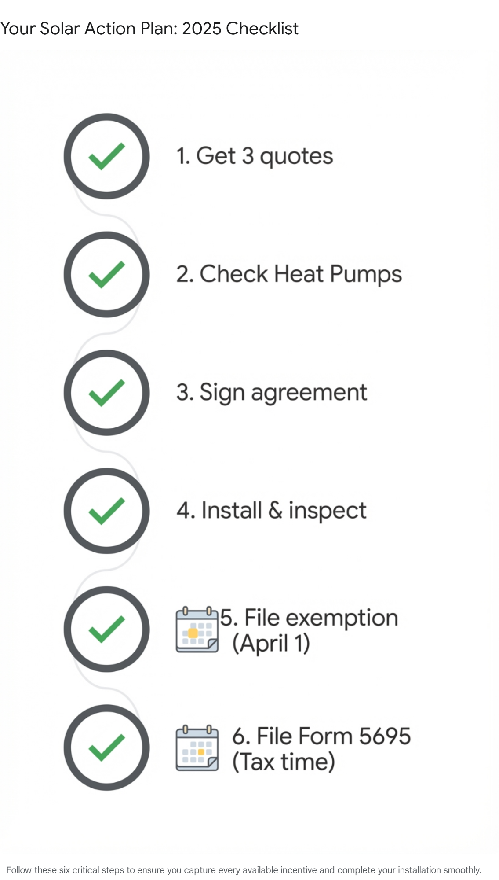
Get three quotes. Check references. File your property tax exemption form by April 1st. And enjoy the feeling of your meter spinning backward. Welcome to the energy revolution, Maine style.
Works cited
- 2025 Federal Solar Tax Credit Guide: Expert Insights to Help You Save, accessed December 18, 2025, https://cedarcreekenergy.com/2025-federal-solar-tax-credit-guide-expert-insights-to-help-you-save/
- Solar Investment Tax Credit (ITC) – SEIA, accessed December 18, 2025, https://seia.org/solar-investment-tax-credit/
- Net Energy Billing – DSIRE, accessed December 18, 2025, https://programs.dsireusa.org/system/program/detail/280
- Net Energy Billing – CMP – Central Maine Power, accessed December 18, 2025, https://www.cmpco.com/suppliersandpartners/servicesandresources/interconnection/net-energy-billing
- Maine Solar Incentives & Tax Credits Guide for 2025 – Maine Energy Experts, accessed December 18, 2025, https://maineenergyexperts.com/maine-solar-tax-credit/
- IN THE YEAR OF OUR LORD TWO THOUSAND TWENTY-FOUR ____ H.P. 725 – L.D. 1153 An Act Regarding Municipal Taxa – Maine Legislature, accessed December 18, 2025, https://www.mainelegislature.org/legis/bills/getPDF.asp?paper=HP0725&item=3&snum=131
- Property Tax Relief | Maine Revenue Services, accessed December 18, 2025, https://www.maine.gov/revenue/taxes/tax-relief-credits-programs/property-tax-relief-programs/property-tax-exemptions
- Solar Electric – Renewable Energy – Efficiency Maine, accessed December 18, 2025, https://www.efficiencymaine.com/renewable-energy/solar-electric/
- Maine official warns community solar projects might not be as 'clean' as they suggest, accessed December 18, 2025, https://www.mainepublic.org/business-and-economy/2022-02-01/maine-official-warns-community-solar-projects-might-not-be-as-clean-as-they-suggest
- Using community solar? Double check your electricity savings | Maine Public, accessed December 18, 2025, https://www.mainepublic.org/business-and-economy/2025-02-18/using-community-solar-double-check-your-electricity-savings
- POWER GUIDE | Maine Public Utilities Commission, accessed December 18, 2025, https://www.maine.gov/mpuc/electricity/archive/electric_restructuring/Powerguide.pdf
- New, balanced reforms to Net Energy Billing program to take effect – Maine Senate Democrats, accessed December 18, 2025, https://www.mainesenate.org/new-balanced-reforms-to-net-energy-billing-program-to-take-effect/
- Residential Rebates – Efficiency Maine, accessed December 18, 2025, https://www.efficiencymaine.com/docs/All-Rebates-Brochure.pdf
- Residential Clean Energy Credit | Internal Revenue Service, accessed December 18, 2025, https://www.irs.gov/credits-deductions/residential-clean-energy-credit
- Federal Tax Credits for Energy Efficiency, accessed December 18, 2025, https://www.energystar.gov/about/federal-tax-credits
- Title 35-A, §3209-A: Net energy billing – Maine Legislature, accessed December 18, 2025, https://www.mainelegislature.org/legis/statutes/35-a/title35-Asec3209-A.html
- RPS | MPUC – Maine.gov, accessed December 18, 2025, https://www.maine.gov/mpuc/regulated-utilities/electricity/renewable-programs
- Costs and Benefits of Net Energy Billing (NEB) – Maine Legislature, accessed December 18, 2025, https://legislature.maine.gov/doc/11392
- Net Energy Billing | MPUC – Maine.gov, accessed December 18, 2025, https://www.maine.gov/mpuc/regulated-utilities/electricity/neb
- Maine's Community Solar program becomes second largest in the country amid lucrative rates, accessed December 18, 2025, https://www.poweradvisoryllc.com/reports/maines-community-solar-program-becomes-second-largest-in-the-country-amid-lucrative-rates
- Maine Solar Incentive Programs, accessed December 18, 2025, https://www.solarinsure.com/maine-incentive-programs
- Maine Solar Incentives for solar panels 2025 – A1 SolarStore Magazine, accessed December 18, 2025, https://a1solarstore.com/blog/maine-solar-incentives.html
- Title 36, §656: Real estate – Maine Legislature, accessed December 18, 2025, https://legislature.maine.gov/statutes/36/title36sec656.html
- Mainers! Apply for Municipal Solar Tax Exemption – ReVision Energy, accessed December 18, 2025, https://www.revisionenergy.com/blogs/mainers-apply-april-1-for-municipal-solar-tax-exemption
- MAINE REVENUE SERVICES PROPERTY TAX DIVISION PROPERTY TAX BULLETIN NO. 29 – Maine.gov, accessed December 18, 2025, https://www.maine.gov/revenue/sites/maine.gov.revenue/files/2024-12/bulletin no 29_solar.pdf
- Maine Home Energy Rebates, accessed December 18, 2025, https://www.maine.gov/energy/initiatives/infrastructure/home-energy-rebates
- Energy Storage System Projects – Efficiency Maine, accessed December 18, 2025, https://www.efficiencymaine.com/energy-storage-system-projects/
- Mayor and Burlington Electric Department Announce New and Expanded Net Zero Energy Electrification Incentives, accessed December 18, 2025, https://www.burlingtonelectric.com/2025rebates/
- Public Advocate Addresses Inaccurate Billing Issues With Community Solar Companies – Maine.gov, accessed December 18, 2025, https://www.maine.gov/meopa/about/news/public-advocate-addresses-inaccurate-billing-issues-community-solar-companies
- Solar for All | Maine Department of Energy Resources, accessed December 18, 2025, https://www.maine.gov/energy/initiatives/infrastructure/solar-for-all
- Pricing – CMP – Central Maine Power, accessed December 18, 2025, https://www.cmpco.com/account/understandyourbill/pricing
- Community Solar | Maine Office of Public Advocate, accessed December 18, 2025, https://www.maine.gov/meopa/electricity/renewable-energy/community_solar
- Small Solar Interconnection Issues – MPUC – Maine.gov, accessed December 18, 2025, https://www.maine.gov/mpuc/consumer-assistance/small-solar-interconnection-issues