Welcome to Florida—the state where the sun works overtime, and your air conditioner never takes a day off. If you are reading this, you are probably tired of dreading the arrival of your electric bill. You have seen the solar panels popping up on roofs in your neighborhood like mushrooms after a rainstorm, and you are wondering: "Is this actually a good deal, or is it just a scam?"
You picked a very interesting time to ask that question. In fact, 2025 might be the most critical year in the history of residential solar power for Floridians.
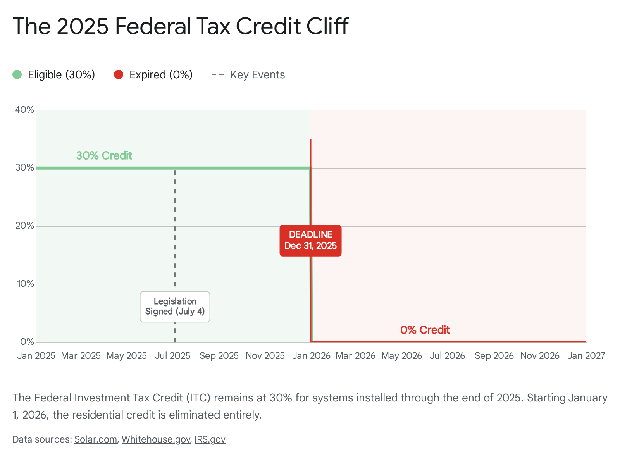
Here is the deal: For the last decade, the federal government has been handing out a massive coupon to help homeowners go solar. It’s called the Investment Tax Credit (ITC). But thanks to new laws passed this year, that coupon is about to expire. We are staring at a hard deadline of December 31, 2025.1
This report is going to walk you through everything—and I mean everything—you need to know. We aren't selling you panels. We aren't knocking on your door during dinner. We are just giving you the cold, hard facts about the hot Florida sun. We will cover the new federal laws, the specific perks you get for living in Florida, the rebates from your power company, and the traps you need to avoid.
Buckle up. We have a lot of ground to cover, and not much time left to cover it.
TL;DR: The "Too Long; Didn't Read" Summary
We know you are busy. If you only have two minutes, here are the five things you absolutely must know right now:
- The Deadline is Real: The federal solar tax credit (that 30% discount you hear about) is ending. President Trump signed the "One Big Beautiful Bill" in July 2025, which kills the credit for residential solar on December 31, 2025.1 If your system isn't turned on by New Year's Eve, you get $0 from the IRS.
- Florida Tax Perks: You pay 0% sales tax on solar equipment (saving you 6-7% upfront) and you get a 100% property tax exemption on the value the panels add to your home.3 These state perks are safe and aren't expiring this year.
- Net Metering Lives: Despite some scary political battles, Florida still has "1:1 Net Metering." This means your power company trades you credits for your extra solar power at full retail price. However, most utilities now charge a "minimum bill" of around $30 a month, so you will never have a strictly $0 bill.5
- Duke Energy Jackpot: If you are a Duke Energy customer, check out the "PowerPair" program. You could get up to $9,000 in rebates for installing solar plus a battery.7
- Danger Zone: Avoid "PACE" loans (often pitched as "no money down, pay on your property tax"). They can make it nearly impossible to sell your house later, and some counties are banning them due to bad practices.8
---
Part 1: The Federal "Code Red" (The 30% Tax Credit)
Let's start with the biggest chunk of money on the table. For a long time, the federal government has been the biggest investor in your home's roof. But the rules have changed, and the window of opportunity is slamming shut.
1.1 What is the Investment Tax Credit (ITC)?
You will hear people call this the "federal rebate," but that is not quite right. It is a tax credit.
Here is the difference:
- A Rebate: You buy something, and someone sends you a check in the mail later.
- A Deduction: You lower the amount of income the government taxes you on. (Like deducting mortgage interest).
- A Credit: This is a dollar-for-dollar reduction of the taxes you owe. It is like a gift card to pay your IRS bill.
How the Numbers Work in 2025:
Right now, the credit is worth 30% of the total cost of your solar system.10
Let’s say you live in a standard 2,000-square-foot home in Orlando. You get a quote for a 10-kilowatt (kW) solar system.
- Total Contract Price: $25,000.
- The Federal Credit (30%): $7,500.
- Net Cost: $17,500.
That $7,500 isn't money they send you. It is money you don't have to pay the IRS. If you file your taxes and owe the government $10,000 for the year, you use this credit, and boom—now you only owe $2,500.
1.2 The "One Big Beautiful Bill": A Historic Shift
For the last few years, the plan was simple. The Inflation Reduction Act of 2022 said this 30% credit would stick around until 2032. It was supposed to be a decade of stability.
But in politics, things change fast.
In July 2025, a major piece of legislation—referred to officially and unofficially as the "One Big Beautiful Bill"—was signed into law by President Trump.1 The goal of this bill was to end what the administration called "market-distorting subsidies" for green energy.
The research is crystal clear on what this means for you: The residential solar tax credit (Section 25D) is being terminated.
The law sets a hard expiration date: December 31, 2025.1
This is not a "phase down" like we saw in previous years (where it went from 30% to 26%). This is a cliff. One day it is 30%, the next day it is 0%.
1.3 The Vital Definition: "Placed in Service"
This is where homeowners get into trouble. You cannot just sign a contract in 2025 to get the credit. You cannot just pay for the panels.
The IRS uses a specific phrase: "Placed in Service".11
What does that mean?
According to IRS guidance, a solar system is placed in service when it has been fully installed and is ready to use.
- It does NOT mean: When you sign the paper.
- It does NOT mean: When the panels are delivered to your driveway.
- It DOES mean: The panels are on the roof, the wiring is done, and the system is capable of producing power.
Scenario A (The Safe Zone):
It is November 15, 2025. You hire a solar company. They rush the job. They finish the installation on December 28, 2025. You turn it on. It works.
- Result: You qualify for the 30% credit.
Scenario B (The Heartbreak):
It is December 10, 2025. You sign a contract. The installer says, "We are super busy, but we will try." They get the panels up on December 30th, but they don't finish the electrical wiring until January 2, 2026.
- Result: Because the system was not ready to use in 2025, you get $0. You just lost $7,500 because of a three-day delay.
The Lesson: Do not cut it close. The solar industry is experiencing a massive "rush" right now. Installers are booked solid. If you haven't started the process by early fall 2025, you are gambling with a lot of money.13
1.4 Eligibility: Do You Actually Pay Taxes?
This is the second biggest trap. The ITC is "non-refundable".10
That sounds like legal jargon, but it is simple: You can't get back more credit than you owe in taxes.
Let's say you are a retiree living in The Villages. Your house is paid off. You live on Social Security (which often isn't taxed) and a small withdrawal from your Roth IRA (which isn't taxed).
- Your Tax Bill: $0.
- Your Solar Credit: $7,500.
- What You Get: $0.
The IRS will not write you a check for the difference. The credit can only wipe out your tax debt; it cannot create a refund out of thin air.
The "Rollover" Question:
In the past, if you didn't have enough tax liability to use the whole credit in year one, you could "roll it over" to the next year. You could carry it forward for up to 5 years.
- The 2025 Complexity: With the program terminating, legal experts are debating how rollovers will work for credits earned in 2025 but carried into 2026. The general consensus is that if you earn the credit in 2025, you keep it. But you should absolutely check with a CPA. Do not assume.
1.5 What Costs Are Included?
The 30% applies to more than just the shiny blue rectangles on your roof. It covers almost everything required to make the system work 12:12
- Solar Panels: Obviously.
- Labor: The cost for the crew to install it.
- Inverters: The boxes that convert the electricity from DC (sun power) to AC (house power).
- Racking/Mounting: The metal rails that hold the panels to your roof.
- Batteries: If you install a battery storage system (3 kWh or larger), it qualifies too.10
- Sales Tax: Wait, you don't pay sales tax in Florida! (We will get to that).
- Permitting Fees: The money you pay the city for the permit.
What is NOT included?
- A New Roof: This is a common myth. If your roof is old and you need to replace it before putting solar on, you generally cannot claim the 30% credit on the cost of the roofing materials. You can only claim the solar portion.
---
Part 2: The Florida "Sunshine Incentives" (State Perks)
While the federal government is pulling the plug, the State of Florida is still holding the door open. Florida doesn't give you cash directly, but it stops the tax man from taking extra money from you.
2.1 The Solar Sales Tax Exemption
We all hate sales tax. In Florida, the state takes 6%, and your county usually adds another penny or two on the dollar. That adds up fast on a big purchase.
The Incentive:
Since 1997, Florida has exempted solar energy systems from sales and use tax.3 This is a permanent exemption.
Let’s do the math:
Imagine you are buying a new $30,000 car in Miami-Dade County (7% tax).
- You pay $2,100 in tax.
Now, imagine you are buying a $30,000 solar system in Miami-Dade County.
- You pay $0 in tax.
That is an immediate, guaranteed saving of 6-8% depending on where you live. You don't have to fill out a form to get this. The solar installer just shouldn't charge you tax on the invoice. If you see "Sales Tax" on your solar contract, stop. Tell them to remove it. It’s the law.
2.2 The Property Tax Exemption
This is the hidden hero of Florida solar incentives.
Usually, when you improve your house, your taxes go up.
- Build a pool? Assessment goes up. Taxes go up.
- Add a new bedroom? Assessment goes up. Taxes go up.
- Renovate the kitchen? Assessment goes up. Taxes go up.
But solar is different.
The Incentive:
Florida Statute allows for a 100% Property Tax Exclusion for residential renewable energy property.4
This means the Property Appraiser is legally forbidden from adding the value of your solar panels to your home's assessed value for tax purposes.
Why is this a big deal?
Studies by Zillow and the Lawrence Berkeley National Laboratory show that solar panels increase a home's resale value by about 4%. On a $400,000 home, that is a $16,000 increase in value.
- If that $16,000 were taxed at the average Florida rate (roughly 1% to 1.5%), you would pay an extra $160 to $240 every single year.
- Over the 25-year life of the panels, this exemption saves you roughly $4,000 to $6,000.
This exemption is currently active and protects you until at least 2037.15
2.3 The "No State Income Tax" Factor
It is worth noting the obvious: Florida has no state income tax.
This is great for your paycheck, but it means there is no "State Solar Tax Credit" because there is no state tax to deduct it from.
Some other states (like South Carolina or New York) offer a state credit on top of the federal one. Florida does not. We rely on the Sales Tax and Property Tax exemptions instead.
---
Part 3: Net Metering (How You Actually Save Money)
So far, we have talked about how to make the system cheaper to buy. Now, let's talk about how the system makes your monthly bill cheaper to pay.
This mechanism is called Net Metering. It is the engine that drives solar savings.
3.1 How Net Metering Works
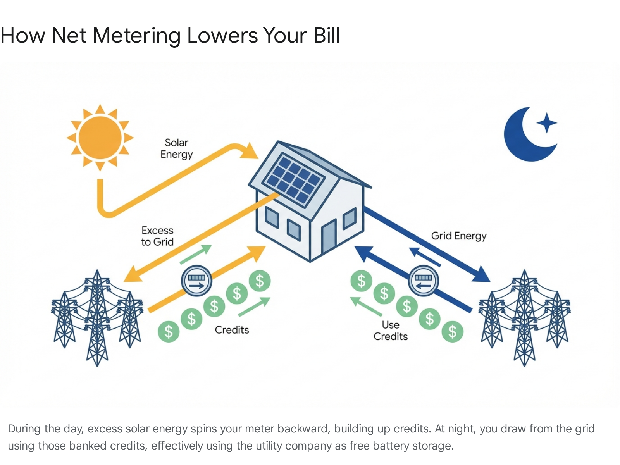
Think of the electric grid as a giant bank account for electricity.
- Morning/Afternoon: The sun is blazing. Your solar panels are cranking out power. But you are at work, and the kids are at school. Your AC is running, but your house isn't using all the power the panels are making.
- The Export: That extra energy doesn't go to waste. It flows backward through your electric meter and onto the grid. Your neighbors use it to run their fridges.
- The Credit: The power company counts every kilowatt-hour (kWh) you send them.
- Nighttime: The sun goes down. Your panels go to sleep. You come home, turn on the TV, cook dinner, and run the dishwasher. You are now pulling power from the grid.
- The Swap: Instead of charging you for that nighttime power, the utility company uses the "credits" you banked during the day.
The 1:1 Ratio:
In Florida, the law requires investor-owned utilities (like FPL, Duke, and TECO) to credit you at a 1:1 retail rate.5
- If you pay 15 cents for a kWh of power, they must credit you 15 cents for every kWh you give them.
- They do not charge you a fee for this "storage." It is an even swap.
3.2 Is Net Metering Safe? (The Political Drama)
You might have seen scary headlines about Florida "killing" solar. Here is what happened.
In 2022, the Florida Legislature passed a bill (HB 741) that would have phased out net metering. It would have allowed power companies to pay you much less for your solar power—basically "wholesale" rates instead of "retail" rates.16
The Plot Twist:
Governor Ron DeSantis vetoed the bill in April 2022.17 He said that with inflation rising, he didn't want to increase costs for Floridians.
The Current Status (2025):
Right now, Net Metering is safe. The 1:1 rule is still in effect.
However, power companies hate net metering because it cuts into their profits. They lobby against it constantly.
- The "Grandfather" Clause: Most proposals to end net metering include a "grandfathering" period (usually 20 years). This means if you get your system installed and approved before the rules change, you get to keep the old, good rates for 20 years.5 This is another reason why waiting is risky.
3.3 The "Minimum Bill" Catch
While they couldn't kill net metering, the power companies did manage to get one concession. It is called the Minimum Base Bill.
Even if you produce 100% of your own power, you are still connected to the grid. You still use their wires and poles. The utilities argued that solar customers weren't paying their fair share of the "upkeep" costs.
So, they introduced a floor:
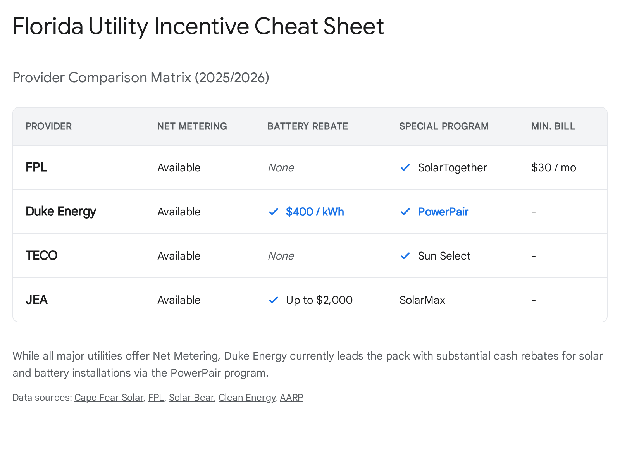
- FPL: Now charges a minimum of $30.00 a month (up from the old $25).6
- Duke Energy: Also charges a minimum of $30.00 a month.18
What this means:
You will never have a "$0" electric bill.
If you go on vacation for a month and turn off everything in your house, you still pay $30.
If you cover your roof in solar panels and generate a megawatt of power, you still pay $30.
When you are calculating your savings, be realistic. If your current bill is $150, you can save roughly $120. You cannot save the full $150.
3.4 The "True-Up" (Use It or Lose It)
Net metering credits roll over from month to month. If you bank a lot of credits in the sunny spring (April/May), you can use them to pay for your air conditioning in the blazing summer (July/August).
But you cannot hoard them forever.
Once a year—usually in January—the utility company clears the books. This is called the True-Up.
- If you have leftover credits, the utility will pay you for them.
- BUT: They pay you at the "wholesale" rate (also called "avoided cost"). This is usually around 3 to 4 cents per kWh.19
- Compare that to the retail rate you pay, which is around 15 to 16 cents.
The Strategy: Do not oversize your system just to "make money" selling power to the grid. It is a bad investment. You want to size your system to match your usage exactly—offsetting the expensive 15‑cent power, but not producing huge amounts of cheap 3‑cent power.
---
Part 4: The Utility Guide (Who Is Your Power Company?)
Florida is a patchwork quilt of power companies. The rules change depending on whose logo is on your bill. We have researched the four biggest players.
4.1 Duke Energy: The "PowerPair" Jackpot
If you live in the Duke Energy territory (areas like Orlando, St. Pete, Clearwater), you are the luckiest solar shopper in 2025.
Duke launched a pilot program called PowerPair to encourage people to buy batteries. Batteries help the grid by storing power for peak times.
The Incentives 20:
- Solar Rebate: They will pay you $0.36 per watt of solar installed, up to 10 kW.
- Example: For a 10 kW system, that is a check for $3,600.
- Battery Rebate: They will pay you $400 per kWh of battery storage, up to 13.5 kWh.
- Example: For a standard Tesla Powerwall (13.5 kWh), that is a check for $5,400.
- The Total: You could get $9,000 back.
The Catch:
To get this money, you usually have to join their "battery control" program. This gives Duke the right to drain your battery a little bit during "peak events" (like when everyone gets home at 6 PM and turns on the AC). You won't notice it much, and the $9,000 check makes it very worthwhile.
4.2 Florida Power & Light (FPL)
FPL is the giant. They serve half the state, from Miami up the coast and across to Fort Myers/Naples.
FPL does not offer a cash rebate for rooftop solar like Duke does. They rely on Net Metering.
The "SolarTogether" Option:
FPL pushes a program called SolarTogether.21
- This is "Community Solar."
- Instead of putting panels on your roof, you pay a monthly subscription fee to support FPL's massive solar farms out in the countryside.
- In exchange, you get credits on your bill.
- The Math: For the first 3-5 years, the subscription fee is actually higher than the credits you get. You are paying extra to be green. Eventually, the credits grow and you start saving money.
- Who is it for? Renters, people in condos, or people with very shady roofs. If you own a sunny roof, owning your own panels is almost always a better financial return.
Insurance Requirement:
FPL is strict about insurance. If you install a "Tier 2" system (which is anything bigger than 11.7 kW), they require you to carry a $1 million liability insurance policy.22 This can cost an extra $300‑$500 a year. Keep your system under 11.7 kW if you want to avoid this headache.
4.3 TECO (Tampa Electric)
Serving the Tampa Bay area, TECO is similar to FPL.
- Rebates: No direct cash rebates for solar installation.
- Sun Select: Their version of community solar. You can choose to buy portions of your energy from solar sources. It creates a "fuel charge" adjustment on your bill. Currently, the solar rate is slightly higher than the standard fuel rate, so it’s a premium product, not a savings product.23
4.4 JEA (Jacksonville Electric Authority)
JEA is a "municipal" utility, owned by the city, not investors. They play by their own rules.
- Battery Rebate: JEA has been a leader in storage. They offer a rebate of 30% of the cost of a battery system, up to $2,000.24
- Net Metering: JEA's policy has fluctuated. They have moved away from strict 1:1 retail net metering in the past, offering a lower rate for exported solar. You must check the current "Distributed Generation" rate sheet on their website before signing. It is often less generous than FPL or Duke.
---
Part 5: Paying for It (Financing Options)
A solar system costs as much as a new car—typically $20,000 to $40,000. Unless you have that hiding under your mattress, you need a way to pay for it.
5.1 Cash is King
If you can write a check, do it.
- Pros: You own the system instantly. You get the tax credit immediately. You pay $0 in interest.
- ROI: A cash system typically pays for itself in 6 to 9 years. After that, it’s 20 years of free power.
5.2 Solar Loans (Watch the "Dealer Fee")
Most people take a loan. There are specialized "Solar Lenders" (like Mosaic, GoodLeap, Sunlight) that partner with installers.
The Trap:
You will see ads for "2.99% Interest!" when mortgage rates are 7%. How do they do it?
They charge a Dealer Fee (or "Origination Fee").
They tack on an extra 25% to 30% to the loan amount upfront to buy down the interest rate.
- Cash Price: $25,000.
- Loan Price: $32,000.
- Interest: 2.99%.
Advice: Always ask the installer for the "Cash Price." Compare it to the financing price.
Often, you are better off getting a loan from your local credit union or using a HELOC (Home Equity Line of Credit). The rate might be higher (7‑8%), but you aren't paying that massive $7,000 fee upfront.
5.3 The PACE Program (DANGER! PROCEED WITH CAUTION)
This is the most controversial financing method in Florida.
PACE stands for "Property Assessed Clean Energy".8
The Pitch:
"No Money Down! No Credit Check Needed! Approvals based on home equity, not income! Pay it back on your property tax bill!"
It sounds amazing. But it has trapped thousands of Floridians in financial nightmares.
The Risks:
- It is a Tax Lien: The loan is attached to your house, not you. It becomes a lien that has "super-priority" over your mortgage.25
- You Can't Sell Your House: Because the PACE lien is "senior" to a mortgage, Fannie Mae and Freddie Mac (the federal mortgage backers) will generally refuse to buy a mortgage on a home with a PACE lien.
- If you try to sell your house, the buyer's bank will likely force you to pay off the entire solar loan (tens of thousands of dollars) at the closing table before they will lend money to the buyer.
- High Rates: The effective interest rates and fees are often higher than standard loans.26
- County Bans: The consumer protection issues are so bad that some counties, like Pinellas, have sued PACE providers or effectively banned them from operating residential programs because they deemed them predatory.9
Our Verdict: Unless you plan to die in your house and never refinance, be extremely careful with PACE.
---
Part 6: Consumer Protection (Don't Get Scammed)
The "rush" to beat the 2025 deadline brings out the best in technology and the worst in scammers.
6.1 The "Free Solar" Lie
If you see an ad on Facebook or a flyer on your door saying:
"New Florida Program: Free Solar for Zip Code 33xxx!"
"Governor Announces No‑Cost Solar Stimulus!"
IT IS A LIE.
There is no government program that installs solar for free.27
These are "lead generation" companies. They use these fake ads to get your phone number, then sell your data to aggressive telemarketers who will blow up your phone.
6.2 The "Utility Worker" Imposter
A person knocks on your door wearing a neon vest and holding a clipboard. They look like they work for FPL or Duke.
They say: "I need to audit your meter to see if you qualify for a rate reduction."
Reality:
Utility workers almost never knock on doors to sell things. This is a salesperson trying to trick you into showing them your electric bill so they can see your usage data and sell you solar.
- Action: Ask for ID. Do not show them your bill. Call the number on your actual electric bill to verify if they sent someone.
---
Part 7: Your Rights (HOAs and The Law)
"I want solar, but I live in a gated community and my HOA is strict."
Good news: The law is on your side.
7.1 The Florida Solar Rights Act
Florida Statute 163.04 is your shield.28
It explicitly states that a deed restriction, covenant, or binding agreement cannot prohibit a property owner from installing solar collectors.
What the HOA Cannot Do:
- They cannot say "No."
- They cannot deny you because they "don't like the look."
What the HOA Can Do:
- They can ask you to move the panels to a less visible location (like the back roof), BUT ONLY IF that move does not impair the system's performance.
- The Loophole: If moving the panels to the back roof makes them face East (less sun) or requires extra expensive wiring, the HOA cannot force you to do it.
Action Plan:
Do not just slap panels up. Follow the process. Submit an application to your Architectural Review Board (ARB). Cite Statute 163.04 in your application. If they deny it, they are breaking the law.
---
Conclusion: The Final Countdown
We have covered a lot of ground. Let's bring it back to the main point.
The year 2025 is a turning point. We are moving from an era of "government‑subsidized growth" to an era of "market-based solar."
The Window of Opportunity:
Right now, you have a unique chance to "stack" incentives:
- Federal: 30% Tax Credit (Ending Dec 31, 2025).
- State: 0% Sales Tax + 100% Property Tax Exemption.
- Utility: Net Metering (still 1:1) + Potential Rebates (Duke PowerPair).
If you combine all these, you can pay for 40% to 50% of your system with other people's money.
The Risk of Waiting:
If you wait until January 1, 2026:
- The 30% federal coupon is gone.
- The system costs you $7,500 more.
- The payback period (ROI) stretches from ~7 years to ~11 years.
Solar will still work in 2026. It will still save you money eventually. But the "slam dunk" financial return is available right now.
If you are thinking about it, stop thinking and start getting quotes. The sun is shining, but the clock is ticking.
Sources Cited:
- Federal Legislation & Tax Credit: 1
- Ending Market Distorting Subsidies for Unreliable, Foreign‑Controlled Energy Sources, accessed December 18, 2025, https://www.whitehouse.gov/presidential-actions/2025/07/ending-market-distorting-subsidies-for-unreliable-foreign%E2%80%91controlled-energy-sources/
- Florida Solar Incentives, Tax Credits & Rebates 2025 | EnergySage, accessed December 18, 2025, https://www.energysage.com/local-data/solar-rebates-incentives/fl/
- Florida Solar Incentives in 2025: Tax Credits, Net Metering, and More - Palmetto, accessed December 18, 2025, https://palmetto.com/policy/florida-solar-incentives
- What Florida's Net Metering Law Changes Mean, accessed December 18, 2025, https://floridasolardesigngroup.com/floridas-net-metering-law-changes-mean
- 2025 Florida Power & Light Rate Case Hub - AARP States, accessed December 18, 2025, https://states.aarp.org/florida/fpl-rate-case-update-2025
- PowerPair - Duke Energy, accessed December 18, 2025, https://www.duke-energy.com/partner-with-us/trade-allies/residential/powerpair
- Property Assessed Clean Energy (PACE) Program - MiramarFL.gov, accessed December 18, 2025, https://www.miramarfl.gov/Departments/Building-Planning-Zoning/Sustainable-Living/PACE-Program
- Consumer Alert: PACE Program Solicitations - Pinellas County, accessed December 18, 2025, https://pinellas.gov/story/consumer-alert-pace-program-solicitations/
- Residential Clean Energy Credit | Internal Revenue Service, accessed December 18, 2025, https://www.irs.gov/credits-deductions/residential-clean-energy-credit
- Energy Efficient Home Improvement Credit | Internal Revenue Service, accessed December 18, 2025, https://www.irs.gov/credits-deductions/energy-efficient-home-improvement-credit
- Instructions for Form 5695 (2025) | Internal Revenue Service, accessed December 18, 2025, https://www.irs.gov/instructions/i5695
- With a federal tax credit ending early, installing home solar is about to get more expensive, accessed December 18, 2025, https://nebraskapublicmedia.org/en/news/news-articles/with-a-federal-tax-credit-ending-early-installing-home-solar-is-about-to-get-more-expensive/
- Florida Solar Incentives, Tax Credits, Rebates & Grants [2025 Updated] - EcoFlow, accessed December 18, 2025, https://www.ecoflow.com/us/blog/florida-solar-incentives
- Florida Solar Incentives, Tax Credits, Rebates (2025) | ConsumerAffairs®, accessed December 18, 2025, https://www.consumeraffairs.com/solar-energy/florida-solar-incentives.html
- Florida Legislation Undercuts Rooftop Solar, Allows Monopoly Utilities to Charge Exorbitant Fees on Thousands of Floridians, accessed December 18, 2025, https://seia.org/news/florida-legislation-undercuts-rooftop-solar-allows-monopoly-utilities-charge-exorbitant-fees/
- POLICY UPDATE: Florida Legislators pass an Anti‑Solar Net Metering bill that would make Rooftop Sol - Energy Toolbase, accessed December 18, 2025, https://www.energytoolbase.com/blog/policyupdate/florida-passes-an-anti-solar-net-metering-bill/
- Understanding the Minimum Bill - Duke Energy Florida, accessed December 18, 2025, https://duke-energy.com/minimum
- 2025 Duke Energy Net Metering - EnergySage, accessed December 18, 2025, https://www.energysage.com/local-data/net-metering/duke-energy/
- Duke Energy Will Pay You Up to $9000 to Go Solar with a Battery!, accessed December 18, 2025, https://capefearsolarsystems.com/duke-energy-will-pay-you-up-to-9000-to-go-solar-with-a-battery/
- Energy My Way | SolarTogether | Residential - FPL, accessed December 18, 2025, https://www.fpl.com/energy-my-way/solar/solartogether-res.html
- Clean Energy | Net Metering FAQs - FPL, accessed December 18, 2025, https://www.fpl.com/clean-energy/net-metering/faq.html
- What 2025 Programs Does TECO Offer for Solar Users?, accessed December 18, 2025, https://solarbear.com/2025/07/29/what-2025-programs-does-teco-offer-for-solar-users/
- JEA's new solar program: The good, the bad, and the ugly, accessed December 18, 2025, https://cleanenergy.org/news/jeas-new-solar-program/
- Final PACE Rule Will Protect Homeowners, Improve Mortgage Performance - NCLC, accessed December 18, 2025, https://www.nclc.org/final-pace-rule-will-protect-homeowners-improve-mortgage-performance/
- PACE Program | Mike Fasano | Official Site - Pasco County Tax Collector, accessed December 18, 2025, https://www.pascotaxes.com/faqs/pace-program/
- How to avoid getting burned by solar or clean energy scams | Consumer Advice, accessed December 18, 2025, https://consumer.ftc.gov/consumer-alerts/2024/08/how-avoid-getting-burned-solar-or-clean-energy-scams
- Solar and HOAs in Florida: What Homeowners Need to Know, accessed December 18, 2025, https://www.floridapowerservices.com/solar-and-hoas-in-florida-what-homeowners-need-to-know/
- What Can Be Done About Solar Panels? - Florida Condo & HOA Law Blog, accessed December 18, 2025, https://www.floridacondohoalawblog.com/2024/04/29/what-can-be-done-about-solar-panels/
- The Dark Side of Solar - My Florida Legal, accessed December 18, 2025, https://www.myfloridalegal.com/sites/default/files/darksideofsolar.pdf