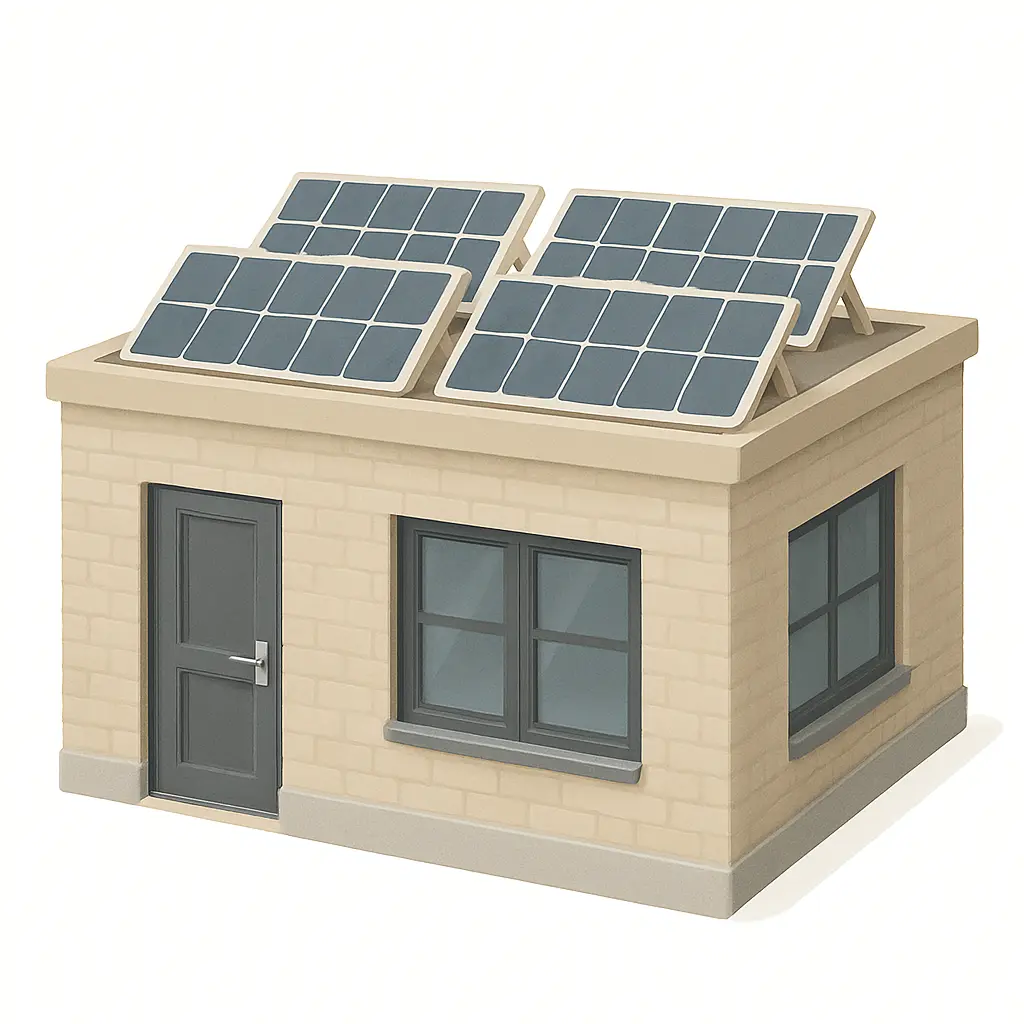
When considering a solar photovoltaic (PV) installation, many US home and business owners assume the ideal platform is a traditional pitched, south-facing roof. This perception, however, overlooks the significant, and often superior, engineering advantages of a flat roof. While a pitched roof presents a fixed, unchangeable set of geometric constraints, a flat roof is a blank canvas, offering total engineering control—a luxury that pitched-roof installations lack.
A. Escaping the "Accident of Architecture"
For a typical US residential home, the solar installer is "locked in" to the roof's existing azimuth (its directional orientation) and tilt (its angle).1 A perfect, south-facing roof with a 30-degree slope is a happy accident of architecture, not a deliberate design choice for energy generation. The installer must work with whatever direction the homebuilder happened to choose.
A flat roof, by contrast, solves this problem entirely. It provides a wide-open, customizable design surface.1 This fundamental difference elevates the installer from a mere equipment-fitter to a power plant designer. They are free to engineer the array for a single, optimized goal, be it maximum annual energy production, maximum financial value, or peak seasonal performance. This flexibility is especially helpful when designing around rooftop obstructions like vents, skylights, or HVAC units, which are common on both residential and commercial flat roofs.1
B. The Power of Perfect Positioning: Azimuth and Tilt
The energy-generating potential of a solar array is dictated primarily by its orientation relative to the sun. A flat roof allows for the optimization of the two most critical variables: azimuth and tilt.
- Achieving Ideal Azimuth: To maximize annual energy production in the northern hemisphere, solar panels must face "true south" (an azimuth angle of 180 degrees).3 A flat roof is the only common roof type that guarantees this perfect orientation is possible, regardless of which direction the building itself faces.4
- Engineering Optimal Tilt: Solar panels cannot be laid flat on the roof surface for reasons of both energy production and long-term system health. They must be tilted up using specialized mounting frames or "tilt kits".1 While a pitched roof forces the panels to adopt its own (often sub-optimal) angle, a flat-roof system can be tilted to the perfect angle to maximize sun capture and, therefore, energy output.2
Determining this "perfect" tilt depends on the asset owner's goal:
- For Maximum Annual Production: The industry rule-of-thumb is to set the panel's fixed-tilt angle equal to the site's latitude.8 In the continental US, the "sweet spot" for maximizing annual generation is generally between 15 and 40 degrees.3
- For Seasonal Optimization: A steeper tilt, such as 45 to 60 degrees, can be deliberately chosen to maximize production during the winter months when the sun is lower in the sky. This strategy is also highly effective at helping snow slide off the panels, a critical consideration in northern climates.5
C. The Production-Optimization Insight: Maximum Energy vs. Maximum Value
The engineering control offered by a flat roof unlocks a sophisticated, non-obvious strategic choice. The primary objective of the installation may not be to generate the maximum total annual energy (kWh), but rather to generate the maximum financial value.
The standard, south-facing array (at a tilt equal to latitude) is designed to produce a single, large "bell curve" of power that peaks at solar noon. This design is ideal for maximizing total energy production and is most valuable in regions with strong, traditional Net Metering programs, where the utility is required to purchase all exported power at or near the full retail rate.9
However, an increasingly popular alternative for flat roofs is a dual-tilt, east-west orientation.10 In this design, panels are mounted back-to-back at a lower tilt (typically 10-15 degrees), with half facing east and the other half facing west. This system produces less total energy over the course of the year than its south-facing counterpart. Its value lies in its production profile. It generates a "two-humped" curve, with a peak of production in the morning (from the east-facing panels) and another peak in the late afternoon (from the west-facing panels).
This production profile perfectly matches the typical consumption patterns of most homes and businesses, which also see peaks in the morning and late afternoon. More importantly, this profile aligns with Time-of-Use (TOU) utility billing, where electricity is most expensive during those same afternoon peak hours.
This allows the flat-roof asset owner to choose their financial strategy:
- "Maximum Production" (South-Facing): Ideal for areas with strong Net Metering, where every exported kWh has high value.
- "Maximum Self-Consumption" (East-West): Ideal for areas with weak Net Metering or high TOU rates. This design minimizes reliance on the grid and "shaves" expensive peak-demand charges (a major cost for businesses), allowing the system to generate more financial value from less total energy. This is a level of optimization a pitched roof simply cannot offer.
D. The Practical Benefits: Safety, Maintenance, and Aesthetics
Beyond the engineering advantages, flat roofs provide a suite of practical benefits that reduce costs and headaches over the 25-year life of the system.
- Safer, Faster Installation: A walkable, flat surface is an inherently safer and easier environment for an installation crew to work on.1 This operational efficiency can reduce installation time and, in many cases, associated labor costs.1
- Long-Term Access: The "walkable" nature of a flat roof extends for the 25+ year life of the solar array. All future maintenance, troubleshooting, and cleaning are simpler, safer, and therefore more affordable.6
- Low-Profile Aesthetics: For home or business owners concerned with curb appeal, flat-roof systems are an excellent solution. The panels are typically mounted at a low tilt and set back from the roof's edge (a "solar setback" 2), making them minimally visible, or often completely invisible, from the street.1
II. The Non-Negotiable Prerequisite: The Structural and Roofing Assessment
A solar installation is not a simple appliance; it is a fundamental alteration of the building envelope. This section outlines the most critical warning of this report: installing a PV array without a comprehensive, professional assessment of the roof's structural and material health is an act of gross negligence that can lead to catastrophic failure, voided warranties, and devastating financial consequences.
A. The "Holistic System" Mandate
The solar array and the roof are not two separate, independent systems. From the moment of installation, they become a single, integrated building envelope asset that must be designed to share a 25+ year lifespan.
The core financial failure of many rooftop solar projects is a mismatch in asset lifespans. A typical solar panel has a production warranty of 25 to 30 years.18 A typical flat roof membrane, however, may have a life of 15 to 20 years.19 Installing a 25-year asset (the solar array) on a 10-year-old roof (with 5-10 years of life remaining) is a guaranteed financial blunder. When the roof inevitably fails and needs replacement, the entire solar array must be removed and re-installed (an "R&R"). This process is logistically complex and expensive, costing $20,000 or more, and can wipe out years of energy savings.21
Therefore, the Golden Rule of Rooftop Solar is to synchronize asset lifespans. The roof's remaining life must equal or exceed the 25-year life of the solar panels. This means any roof 10-12+ years old, or showing any signs of wear, should be replaced first.18 This should not be viewed as a setback, but as an opportunity to install a modern, high-performance, reflective "cool roof" membrane.23 These lighter-colored roofs (often white TPO or PVC) reduce building cooling loads and can even boost the production of bifacial solar panels by reflecting sunlight onto their rear face.25
B. Part 1: The Structural Engineering Analysis (Is your roof strong enough?)
Before any contract is signed, a professional structural engineer must conduct a formal analysis.7 A visual "check" by an installer is insufficient. The array will add significant "dead load"—the permanent, static weight of the panels, racking, and any ballast.26 A ballasted system is particularly heavy, adding 4 to 8 pounds per square foot, or even more.7
A professional engineer's assessment 30 will evaluate the roof's capacity to handle all potential loads as defined by local building codes 27:
- Dead Load: The permanent, unchanging weight of the roof structure itself, plus the newly added solar array.27 The analysis must confirm the roof can support this added weight, which can be thousands of pounds.28
- Live Load: The temporary, variable weight of maintenance crews, equipment, or heavy snow and ice accumulation.27
- Environmental Loads:
Failure to perform this analysis can lead to severe roof sagging 35, structural damage 31, or a catastrophic collapse, especially in high-snow or seismic zones.29 A commercial assessment is a complex undertaking, evaluating girders, columns, fasteners, and the building's entire superstructure.30 A residential audit will, at a minimum, check for rafter sag, decay, and any un-repaired or improper modifications.36
C. Part 2: The Roofing & Warranty Audit (Is your roof healthy?)
Simultaneously with the structural analysis, a qualified roofing professional must audit the roof's condition and membrane.
- Roof Condition & Age: As stated, any roof 10-12+ years old or showing signs of cracks, leaks, blisters, or degradation must be considered for replacement before any solar work proceeds.18
- Membrane Compatibility: The installer must identify the roof's membrane to select the correct, compatible mounting and waterproofing hardware. Common flat roof membranes in the US include:
- TPO (Thermoplastic Polyolefin): A very popular single-ply membrane, typically white, known for its energy-reflecting properties.24
- EPDM (Ethylene Propylene Diene Monomer): A highly durable synthetic rubber membrane, often black.24
- PVC (Polyvinyl Chloride): A single-ply membrane prized for its long life and high resistance to chemicals and grease, making it common on restaurants.24
- Modified Bitumen (Mod-Bit): An asphalt-based rolled roofing, often found on older flat roofs.22
- The Warranty Trap: A solar installation, if performed improperly, can and will void your existing roof warranty.22 A manufacturer's warranty is a precise contract, and any unapproved modification—like drilling hundreds of holes—invalidates it.22
- How to Protect Your Warranty:
- Use Professionals: This is the most crucial step. An experienced, reputable installer is essential.40
- Contact the Manufacturer: Before work begins, the asset owner or installer must contact the roofing manufacturer (e.g., Carlisle, GAF). They have specific guidelines for solar installations.23
- Use Approved Hardware: Manufacturers often approve specific, tested anchoring systems (like the Anchor Products U-Anchor or OMG Powergrip) 23 that are designed to integrate with their membranes and maintain the warranty.23
- Use Integrated Installers: The safest path is to hire a contractor who is certified by both the roofing manufacturer and the solar company 22, or to have the solar installer coordinate directly with the original roofing contractor.42
III. The Core Technical Decision: Selecting a Mounting System
For a flat-roof installation, this is the central engineering dilemma. The array must be secured against wind, gravity, and seismic forces for 25 years. This is achieved through two primary methods: using weight (ballast) or using attachments (penetrations). This choice has massive, long-term implications for cost, risk, and performance.
A. Option 1: Ballasted (Non-Penetrating) Systems
How They Work: These systems do not attach to the roof structure. Instead, they use heavy weights—typically standard concrete blocks—placed in trays or on the racking itself to hold the array in place purely by gravity.16
The "Pros" (The Sales Pitch):
- No Roof Penetrations: This is the primary benefit. By avoiding the need to drill holes, these systems eliminate the risk of leaks from newly created penetrations.45
- Warranty-Friendly: Because no holes are drilled, ballasted systems are often presented as the best way to preserve an existing roof warranty.42
- Fast Installation: On large, open commercial roofs, a ballasted system can be deployed very quickly, potentially reducing labor costs.14
The "Cons" (The Engineering Reality):
- Extreme Weight: This is the system's fundamental, and often fatal, flaw. The "dead load" is massive, often 4-8 lbs/sq.ft. but potentially much more.7 This added weight frequently exceeds the roof's designed structural capacity.29
- Structural Risk: This "excessive and concentrated weight" is a "huge liability," especially in high-snow or seismic zones, and puts the roof structure at a very real risk of damage or collapse.29
- Membrane Damage: The blocks are not benign. Over 25 years of thermal expansion and contraction, they can abrade, scuff, or "grind into" the roof membrane, leading to punctures.51 Unsecured blocks can also "shift" 29, and some analysis suggests the concrete itself can degrade and dissolve over time, changing its weight profile.29
- Limited Application: These systems are only suitable for roofs with a very low slope (typically less than 10 degrees).49 They are not recommended for high-wind zones, as the amount of ballast required to resist uplift becomes "impractical" and structurally infeasible.49
B. Option 2: Mechanically Attached (Penetrating) Systems
How They Work: These systems use high-strength, waterproofed anchors, posts, or "standoffs" that are drilled through the roof membrane and insulation, attaching directly to the roof's structural deck (e.g., steel or concrete) or joists (e.g., wood).44
The "Pros" (The Long-Term Investment):
- Lightweight: Because the system is anchored to the building's skeleton, it does not require heavy ballast. This makes it the lightest-weight option available.49
- Superior Stability: By creating a direct, structural connection, these systems offer excellent and predictable resistance to the most powerful wind uplift and seismic forces.21
- Lower Lifetime Cost: This is a crucial, often-overlooked benefit. Mechanically attached systems, which are typically raised higher off the roof, are far easier and cheaper to work around for routine roof inspections, maintenance, and repairs. Some systems are even designed to allow a full re-roofing to occur without removing the array, a massive long-term cost savings.21
The "Cons" (The Skill-Based Risk):
- Required Penetrations: This is the sole, major drawback. The system, by definition, requires drilling holes in a waterproof membrane.45
- Leak Risk: If the installation is performed by an amateur or a careless installer, these hundreds of penetrations can and will leak.45 This risk, however, is entirely mitigable with modern waterproofing techniques.
- Higher-Skill Labor: This is not a job for a general-purpose crew. The installation requires more precision, time, and skill to locate structural members and properly flash and seal every single attachment point, which can increase the upfront labor cost.49
C. Option 3: Hybrid and Specialized Systems
Reflecting the pros and cons of both "pure" systems, the market has evolved to offer hybrid solutions.
- The Modern Compromise: A hybrid system (also called a "hybrid-ballasted" system) bridges the gap.45 It uses a combination of a reduced amount of ballast with a few, strategically placed mechanical attachments.55
- The Benefit: This approach significantly reduces the total ballast weight, easing the structural load 45, while minimizing the total number of roof penetrations.53 This often provides the optimal balance of safety, cost, and performance.
- Specialized Anchors: Modern mounting systems are no longer "one size fits all." Manufacturers offer anchors specifically designed for TPO, PVC, and EPDM membranes.38 These may involve heat-welded flashing boots or "slip sheets" that integrate perfectly with the roofing material to protect the warranty and ensure a 25-year watertight seal.22
D. The "Upfront vs. Lifecycle Cost" Fallacy
The decision between ballasted and attached systems presents a classic "cheap-now, expensive-later" financial trap. A ballasted system may have a lower upfront cost due to faster, less-skilled labor.48 However, this "savings" is an illusion that ignores the 25-year Total Cost of Ownership (TCO).
Analysis of long-term asset management reveals the true cost. When a roof under a ballasted system needs replacement, the cost to remove and reinstall the entire array can be 20% to 50% of the cost of a brand-new system.21 This single, predictable event completely destroys the system's financial return on investment (ROI). Furthermore, ballasted systems make routine leak detection and roof maintenance "difficult or impossible," allowing minor issues to become major structural problems.21
A cheap ballasted installation can be "the riskiest option of all".29 The "risk" of leaks from a professionally installed attached system is a solved engineering problem. The "risk" of placing 50,000 pounds of ballast on a roof that was not designed for it is a fundamental, unsolvable physics problem.29
For the long-term asset owner, a properly engineered mechanically attached or hybrid system, despite a potentially higher upfront labor cost, is almost always the superior and more secure long-term investment.
E. Comparative Analysis: Flat Roof Solar Mounting Systems
| Mounting System | Dead Load | Wind/Seismic Resistance | Primary Leak Risk | Warranty Impact | 25-Year TCO (incl. Re-Roofing) |
|---|---|---|---|---|---|
| Ballasted (Non-Penetrating) | Very High (4-8+ lbs/sq.ft) 7 | Poor-to-Good (Relies on weight; impractical in high-wind zones) 49 | Low (from penetrations), but High (from membrane abrasion/shifting) 29 | Good (if roof can handle the load), but can complicate repairs 42 | Highest TCO (Includes massive R&R cost for re-roofing) 21 |
| Mechanically Attached | Very Low (Adds minimal weight) 49 | Excellent (Directly anchored to building structure) 49 | High (if installed improperly; a skill-based risk) 45 | Requires manufacturer-approved anchors and installers to maintain 22 | Lowest TCO (Easiest to maintain, service, and re-roof around) 21 |
| Hybrid (Attached + Ballast) | Medium (Reduced ballast load) 45 | Good-to-Excellent (Combines weight and anchors) 53 | Low (Fewer penetrations than a pure attached system) 53 | Good compromise; still requires approved hardware 56 | Medium TCO (Balances upfront cost and long-term serviceability) |
IV. Engineering for Decades: Critical Design & Installation Factors
A solar array's 25-year production warranty is not an unconditional guarantee. It is a benchmark that is only achievable through intelligent, defensive design that protects the system from its three primary enemies: dirt, water, and wind.
A. The "Capacity vs. Energy" Conflict
A critical, and often hidden, conflict of interest can arise between the installer and the asset owner. An installer's revenue is often based on the capacity of the system they sell, measured in kilowatts (kW) or dollars-per-watt. The asset owner's ROI, however, is based only on the energy the system actually produces, measured in kilowatt-hours (kWh), over 25 years.
This can lead to designs that maximize the number of panels on the roof at the expense of actual energy production. A common example is an installer who proposes laying panels almost flat to pack more of them onto a limited roof space, avoiding the "empty" areas required for inter-row spacing.59 This design maximizes the installer's (kW) sale but dooms the owner's (kWh) investment to a lifetime of underperformance. A user in Seattle who had panels "flat mounted" by their installer reported that cleaning them—after finding they were caked in pollen and dirt—revealed a staggering 50% production loss.59
An engaged asset owner must demand a design that prioritizes long-term energy yield (kWh), not just the upfront system size (kW).
B. Design Factor 1: Defeating Soiling and Pooling (The Tilt)
Installing solar panels perfectly flat (at a 0-degree tilt) is a catastrophic design failure.59
- The "Soiling" Problem: Any panel installed with too little tilt (or 0 degrees) cannot "self-clean." Rain will not be able to wash away the accumulation of dust, pollen, bird droppings, and debris.1 This "soiling" is a major performance killer, building up over time and blocking sunlight.1 As the previously mentioned example shows, this can cut energy production in half.59
- The "Ponding" Problem: A 0-degree tilt also allows water to pool on the panel surface and, more critically, around the mounting hardware.16 The racking and panels effectively create small "dams" that block the flat roof's intended (albeit slight) drainage paths.22 This standing water (or "ponding") leads to rapid debris buildup, which in turn holds moisture against the roofing membrane, accelerating its degradation and creating new leaks.54
The Solution: A minimum tilt of 5-10 degrees is mandatory.59 This angle is steep enough to allow rain to run off, taking dirt with it, and to ensure water drains properly away from the panels and the roof penetrations.1
C. Design Factor 2: Taming the Wind (Uplift and Spacing)
Wind does not flow smoothly over a flat roof. It creates complex areas of turbulence and powerful suction, or "uplift," forces.33 These forces are most intense at the roof's corners and edges.34
The Solution: The design must be based on a site-specific wind load calculation 66, adhering to local building codes like ASCE 7.34 Countermeasures include:
- Wind Deflectors: Installing aerodynamic "skirts" on the rear and sides of the array. These deflectors redirect airflow over the panels, preventing wind from getting underneath and creating lift, which stabilizes the system.34
- Proper Attachments: Using mechanically attached or hybrid systems is essential in any moderate-to-high wind zone, as ballast alone may be insufficient or too heavy.49
- Array Layout: Rows must be spaced correctly to prevent "wind tunneling".34 This also relates to shading. Tilted panels cast shadows on the row behind them. The installer must use a sun chart or program to calculate the "inter-row spacing" (often based on the winter solstice sun angle) to ensure one row never shades another, which would also kill production.68
D. Design Factor 3: Mastering Waterproofing (The Penetration)
For mechanically attached and hybrid systems, waterproofing is a solved science. It is not about simply "caulking" a hole. It is a multi-layer "belt-and-suspenders" approach.70
- Step 1: Flashing (Primary Barrier): This is the most important component. Flashing is a metal or rubberized membrane "boot" or "post" that is integrated with the roofing membrane. It directs the flow of water over and around the penetration, not relying on a sealant.22
- Step 2: Sealant (Secondary Barrier): A high-quality, long-life (30-50 year warranty) synthetic roofing mastic or sealant is applied in addition to the flashing, as a secondary layer of defense.70 It should never be the primary water barrier.62
- Step 3: Protection Pads (Tertiary Layer): "Slip sheets" or protection pads are placed under all hardware (even ballasted blocks) that makes contact with the roof. This prevents any movement from expansion, contraction, or vibration from abrading or wearing down the roof membrane over 25 years.22
E. Design Factor 4: Long-Term Maintenance Plan
Solar panels are low-maintenance, not no-maintenance.61 This is especially true for flat-roof systems. Because of their typically lower tilt angles, they are more prone to soiling and require more frequent cleaning than their pitched-roof counterparts.1
A 25-year asset protection plan should include regular (e.g., semi-annual) professional inspections 22 to:
- Clean the panels to remove performance-robbing soiling.74
- Clear debris (leaves, etc.) from drains, gutters, and scuppers to prevent ponding.39
- Inspect all waterproofing seals and flashing at the penetration points.22
- Check for loose wiring, damaged components, or signs of nesting animals.77
V. The Financial Case: Costs, Deadlines, and Maximizing ROI (US Market Focus)
The technical decisions of a solar installation are all in service of a financial goal. For US asset owners in 2025, that financial case is defined by stable (but nuanced) costs and an extremely urgent and diverging set of federal incentives.
A. Upfront Costs: 2024-2025 Data
- National Average: Before incentives, the average cost of a US residential solar installation is in the range of $2.50 to $3.10 per watt.78 A typical 7-kilowatt (kW) system, for example, would have a gross cost between $18,060 and $21,816.79
- Flat vs. Pitched Cost: The data is contradictory. Some sources suggest flat roof installs are "competitive" 65, while others state they "cost more upfront".81
- The Expert Synthesis: Asset owners should expect a comparable total cost, but with a different cost structure. Flat-roof installations often have higher hardware costs (to pay for the specialized tilt-racks or heavy ballast).1 However, these can be offset by lower labor costs resulting from the safer, faster, and easier installation access.1
B. CRITICAL REPORT: The 2025 "Solar Cliff"
The single most important financial factor for any US asset owner in 2025 is the federal incentive landscape, which is diverging dramatically. The residential and commercial markets are operating on two completely different and time-sensitive schedules.
For homeowners, the market is facing a "Solar Cliff." Stark warnings issued in 2024 and 2025 confirm that the 30% residential solar tax credit (Section 25D) EXPIRES on December 31, 2025.83 It does not phase down. On January 1, 2026, the credit value for a homeowner-owned system drops to 0%.84 To qualify, the system must be fully "placed in service" (installed and operational) by the 12/31/2025 deadline.83 Given the long lead times for permitting and installation, many installers are already at capacity, and it may be too late for new projects to qualify.84
In stark contrast, the commercial solar credit (Section 48) is not expiring.85 It has its own "begin construction" deadlines in 2026 and 2027, providing far more stability and planning flexibility for businesses.85
This creates a "two-speed market." A homeowner's financial calculation is dominated by the extreme urgency of the 12/31/2025 deadline. A business's calculation, meanwhile, remains stable and strategic.
C. For Homeowners: The 30% Residential Clean Energy Credit (Section 25D)
- The Incentive: A 30% dollar-for-dollar credit against federal tax liability.84 This is not a deduction; it is a direct reduction of taxes owed.
- THE DEADLINE: The credit EXPIRES on December 31, 2025.83
- The Requirement: The system must be fully "placed in service" (i.e., installed and operational) by this date.83
- The Reality: An asset owner reading this must immediately confirm their "placed in service" date with their installer in writing.
- What's Covered: The credit applies to the total cost of the system, including panels, racking, inverters, labor, and, as of 2023, battery storage technology.87
D. For Businesses: The 30% Commercial Investment Tax Credit (Section 48)
- The Incentive: A 30% Investment Tax Credit (ITC), with potential 10% "adder" credits for meeting domestic content or wage requirements.86
- The More Favorable Deadline: The commercial ITC does not expire on 12/31/25. To qualify, projects must "begin construction" by July 2026 or be "placed in service" by December 31, 2027.85 This provides businesses with a much longer and more stable planning horizon.
E. Beyond Federal: Finding Your Local and Utility Incentives
The federal credit is only the first (and largest) piece of the financial puzzle. A complex patchwork of state, local, and utility incentives can further reduce costs.
- The DSIRE Database: The single most comprehensive resource is the DSIRE (Database of State Incentives for Renewables & Efficiency).89
- How to Use DSIRE: An asset owner can visit dsireusa.org and search by their state or zip code 91 to find a complete list of:
- State Tax Credits (which stack with the federal credit).92
- Local & Utility Rebates (e.g., cash-back from utilities like Austin Energy in Texas or SMUD in California).92
- Property & Sales Tax Exemptions (which can save thousands).92
- Solar Renewable Energy Certificates (SRECs) (a performance-based incentive where you can sell credits).92
- The Net Metering Warning: "Net Metering" (NEM) is the utility policy that allows system owners to sell their excess, exported electricity back to the grid for a credit.9 This policy is the foundation of solar ROI in many states. However, it is under widespread attack by utilities. States like Nevada, Idaho, and Texas are seeing utilities and regulators actively working to reduce the value of these export credits.94
The erosion of Net Metering makes the strategic value of a flat roof even greater. It strengthens the financial case for an East-West "Self-Consumption" design (see Section I-C) 10 and for pairing the system with battery storage.87 This combination allows an asset owner to store their own power for use during expensive peak hours, rather than selling it to the grid for a low, diminishing credit.
VI. Final Recommendations: An Asset Owner's Checklist
This report is designed to elevate an interested "consumer" to an "Engaged Asset Owner" capable of protecting a 25-year investment. This checklist synthesizes the report's key findings into a final set of actionable recommendations.
- Perform Roofing Triage (Today): Immediately determine your roof's age and warranty status.20 If the roof is 10+ years old or shows any sign of wear, plan to replace it as the first step of the solar project. The primary financial goal is to synchronize the 25-year lifespan of both assets.18
- Commission a Professional Structural Analysis: Do not accept an installer's "visual check." Pay for an independent structural engineer to conduct a full analysis of your roof's capacity for Dead, Live, Wind, and Snow/Seismic loads.7 This is the only way to avoid a catastrophic overload, especially if considering a ballasted system.29
- Prioritize 25-Year TCO Over Upfront Cost: Demand that your installer quote both ballasted and mechanically attached systems.49 Then, ask them for the Total Cost of Ownership, including a specific line-item cost for a full panel "R&R" (remove and reinstall) for a re-roofing in 15 years. This exercise will reveal the true, higher lifetime cost of a "cheap" ballasted system.21
- Demand a Performance-Based Design (Reject 0°):
- Master Your Warranty: Before signing, you or your installer must contact your roofing manufacturer.43 Get written confirmation that the specific mounting hardware 23 and the installer are approved, and that the installation, as designed, will not void your roof warranty.22
- Execute Your Financial Strategy (Urgent):
- Homeowners: Your only financial priority is the December 31, 2025, "Placed in Service" deadline for the 30% federal tax credit. You must get this date in writing in your contract. If you cannot secure this date, you must assume the 30% credit is gone.83
- Businesses: You are not facing the same "solar cliff".85 Take your time. Use the DSIRE database 91 to stack local and utility incentives. Use your "engineering control" to discuss a strategic self-consumption (East-West) design 10 paired with battery storage 87, creating a long-term financial hedge against shifting Net Metering policies.94
Works Cited
- Solar panels for flat roofs: is it worth it? - Home Solar Blog, accessed November 17, 2025, https://www.aurorasolar.com/home-solar/blog/solar-101/solar-panels-on-a-flat-roof
- Can You Install Solar on a Flat Roof? Pros and Cons, accessed November 17, 2025, https://palmetto.com/solar/can-you-install-solar-on-a-flat-roof
- How Roof Pitch and Orientation Affect Your Solar Production (And Why It Matters), accessed November 17, 2025, https://www.infinitysolarusa.com/how-roof-pitch-and-orientation-affect-your-solar-production-and-why-it-matters
- Design Considerations | NAHB, accessed November 17, 2025, https://www.nahb.org/advocacy/public-toolkits/a-builders-toolkit-for-solar/solar-photovoltaic-ready-roof/design-considerations
- What's the Best Angle for Solar Panels? - EnergySage, accessed November 17, 2025, https://www.energysage.com/solar/solar-panel-performance-orientation-angle/
- Top Benefits Of Installing Solar Panels On Flat Roofs, accessed November 17, 2025, https://solariasolarandroofing.com/top-benefits-of-installing-solar-panels-on-a-flat-roof/
- Flat Roof Solar Installation: Complete Guide 2025, accessed November 17, 2025, https://solartechonline.com/blog/flat-roof-solar-installation-guide/
- Solar Panel Angle: Easy North America Guide - EcoFlow, accessed November 17, 2025, https://www.ecoflow.com/us/blog/solar-panel-angle-north-america
- State Net Metering Policies, accessed November 17, 2025, https://www.ncsl.org/energy/state-net-metering-policies
- Flat Roof Mounting: Tilt Angles That Boost Yield and Safety - Anern Store, accessed November 17, 2025, https://www.anernstore.com/blogs/diy-solar-guides/flat-roof-tilt-angles-yield-safety
- Flat Roof vs. Pitched Roof Solar Mounting Systems - Clenergy, accessed November 17, 2025, https://www.clenergy.com/media-press-release/flat-roof-vs-pitched-roof-solar-mounting-systems/
- Choosing the Right Solution Solar on Flat Roofs – Ballasted, Attached & Hybrid, accessed November 17, 2025, https://www.altenergymag.com/article/2019/09/choosing-the-right-solution-solar-on-flat-roofs-–-ballasted-attached-hybrid/31779/
- 6 Reasons why flat roofs are perfect for generating solar energy - Holcim Elevate, accessed November 17, 2025, https://www.holcimelevate.com/uk-en/insights/harness-the-power-of-the-sun-on-your-rooftop
- Unlock Potential of Flat Roof Solar Panel Mounts: 5 Top Things to Know, accessed November 17, 2025, https://yuen-s.com/blog/knowledge/unlock-potential-of-flat-roof-solar-panel-mounts-5-top-things-to-know/
- Flat Roof Solar Installation: Maximize Space & Energy, accessed November 17, 2025, https://www.nextenergy.ai/maximize-space-and-energy-secrets-of-flat-roof-solar-installation
- Flat Roof Solar Panel Installation Guide | Pros, Cons & Best Practices - SFS UK, accessed November 17, 2025, https://uk.sfs.com/resources/article/flat-roof-solar-installation-guide
- Do solar panels work better on a flat or pitched roof? - DBS Group, LLC, accessed November 17, 2025, https://www.dbsg.com/blog/do-solar-panels-work-better-on-a-flat-or-pitched-roof/
- Roof Solar Assessment Guide: Is Your Roof Right for Solar? - Energyscape Renewables, accessed November 17, 2025, https://energyscaperenewables.com/post/roof-solar-assessment-guide/
- Commercial Flat Roof-Mounted Solar Panels: Questions To Ask, accessed November 17, 2025, https://getflatroofing.com/blog/solar-panels-commercial-flat-roof/
- accessed November 17, 2025, https://blog.catalystpower.com/more-power-to-you/ideal-roof-conditions-for-successful-solar-installations#:~:text=Generally%2C if a roof is,replacement before proceeding with solar.
- Solar Racking: Ballasted or Mechanically Attached? | 2014-04-07 ..., accessed November 17, 2025, https://www.roofingcontractor.com/articles/90272-solar-racking-ballasted-or-mechanically-attached
- Will Solar Panels Damage Your Flat Roof? A Protection Guide, accessed November 17, 2025, https://www.roperroofingandsolar.com/solar-panels/will-solar-panels-damage-flat-roof/
- The Solar Ready Roof Brochure - Carlisle SynTec Systems, accessed November 17, 2025, https://www.carlislesyntec.com/Document-Viewer/the-solar-ready-roof-brochure/vnUzsXyAcUytkmiCnsUWHA
- Heat vs. Membranes: How Summer Sun Stresses TPO, PVC & EPDM Roofs | Grove Roofing, accessed November 17, 2025, https://groveroofing.com/tpo-pvc-epdm-roofing-membranes/
- Roof-Mounted Solar: Identifying Low-Slope Roofing Types - Pure Power Engineering, accessed November 17, 2025, https://www.purepower.com/blog/roof-mounted-solar-considerations-low-slope-roofing-identification
- Solar Panels on Flat Roofs: Key Considerations for Your Installation - Deye Company, accessed November 17, 2025, https://deye.com/solar-panels-on-flat-roofs-key-considerations-for-your-installation/
- Structural Requirements for Solar Panels - Exactus Energy, accessed November 17, 2025, https://www.exactusenergy.com/blog/structural-requirements-for-solar-panels
- How Much Weight do Solar Panels Add to a Roof, accessed November 17, 2025, https://www.advancedelectricandsolarllc.com/how-much-weight-do-solar-panels-add-to-a-roof/
- Rooftop Integrity: The Ballasts vs. Mechanical Attachment Debate ..., accessed November 17, 2025, https://pointloadpower.com/articles/rooftop-integrity-the-ballasts-vs-mechanical-attachment-debate/
- Structural Assessment and Roof Certification - Be Structural, accessed November 17, 2025, https://www.bestructural.com/solar-panels/structural-assessment-and-roof-certification/
- What Solar Installers Should Know About Roof Load Capacity - Nova Mounting, accessed November 17, 2025, https://novamounting.com/blog/what-solar-installers-should-know-about-roof-load-capacity/
- Solar Array Weight and Loading Calculation Worksheet, accessed November 17, 2025, https://api.realfile.rtsclients.com/PublicFiles/3c460d83c0384308afbabb48bf782dc2/87522df0-80c7-45f5-b735-3fde1834dfb8/Solar Permit Installation Requirements
- 3 Problems With Solar Panels on Flat Roofs - YouTube, accessed November 17, 2025, https://www.youtube.com/watch?v=sJSsRzt1VBE
- How Does Wind Load Affect Flat Roof Solar Installations ..., accessed November 17, 2025, https://www.xmtopenergy.com/blog/how-does-wind-load-affect-flat-roof-solar-installations_b238
- Pros and Cons of Rooftop Solar Panels for Commercial Properties, accessed November 17, 2025, https://www.kmins.com/pros-and-cons-of-rooftop-solar-panels-for-commercial-properties/
- Revize - Structural Criteria for Residential Rooftop Solar Energy Installations, accessed November 17, 2025, https://cms6.revize.com/revize/burlingamecity/document_center/Building/5.Structural Criteria.pdf
- Roof Assessment for Solar Installation: A Practical Guide - Sunstorm Energy, accessed November 17, 2025, https://sunstorm.energy/roof-assessment-for-solar-installation/
- Fixing solar panels to membrane roofs - Nicholson Roof Products, accessed November 17, 2025, https://www.nicholsonsts.com/articles/fixing-solar-panels-to-membrane-roofs/
- Flat Roof Maintenance: Essential Tips and Tricks, accessed November 17, 2025, https://leverageroofing.com/blog/essential-tips-for-flat-roof-maintenance/
- Will Solar Panels Affect Your Roof Warranty?, accessed November 17, 2025, https://www.roofrepairspecialist.com/will-solar-panels-affect-your-roof-warranty/
- Roof Warranty & Solar Panels - Reddit, accessed November 17, 2025, https://www.reddit.com/r/solar/comments/1k00z29/roof_warranty_solar_panels/
- Do Commercial Solar Panels Void My Roof Warranty? - King Energy, accessed November 17, 2025, https://www.kingenergy.com/blog/do-solar-panels-void-roof-warranty/
- Do Solar Panels Void the Roof Warranty? (2025) | Today's ..., accessed November 17, 2025, https://todayshomeowner.com/solar/guides/do-solar-panels-void-the-roof-warranty/
- Installers, what's your preferred method for fastening the mounting system to membrane roofs? : r/solar - Reddit, accessed November 17, 2025, https://www.reddit.com/r/solar/comments/fcd448/installers_whats_your_preferred_method_for/
- Commercial Rooftop Solar, Frequently Asked Questions - Better Buildings Solution Center, accessed November 17, 2025, https://betterbuildingssolutioncenter.energy.gov/sites/default/files/attachments/BBA_Commercial_PV_Roofing_Guide_071715_508.pdf
- Different Types of Rooftop Solar Mounting Systems - Mibet Energy, accessed November 17, 2025, https://www.mbt-energy.com/news/industry/2201281.html
- Flat-Roof Mounted Residential Solar Panel System Discount, accessed November 17, 2025, https://www.solarelectricsupply.com/residential-solar-systems/flat-roof-mounted
- Ballasted Ground Mount For Solar: Pros & Cons, Alternatives - Nuance Energy's, accessed November 17, 2025, https://nuanceenergy.com/solar-blog/ballasted-ground-mount-for-solar-pros-cons-alternatives
- Ballasted vs Roof-Penetrating Racks: Risks, Costs, Use Cases, accessed November 17, 2025, https://www.anernstore.com/blogs/diy-solar-guides/ballasted-penetrating-roof-racks
- Solar Stack: Home | Noninvasive Solar Panel Mounting, accessed November 17, 2025, https://solarstack.com/
- Penetrations don't have to be the enemy of flat-roof solar, accessed November 17, 2025, https://www.solarpowerworldonline.com/2017/03/penetrations-dont-enemy-flat-roof-solar/
- Flat Roof Mounts - SunWatts, accessed November 17, 2025, https://sunwatts.com/flat-roof-mounts/
- Best Flat Roof Solar Mounting Systems in Los Angeles, accessed November 17, 2025, https://primeamericanroofing.com/best-flat-roof-solar-mounting-systems-in-los-angeles/
- Top 5 Flat Roof Issues After Solar Panel Installation #4 Will Shock You, accessed November 17, 2025, https://centralroof.com/flat-roof-issues-after-solar-panels/
- Choose the best flat roof solar mount: Fixed, Hybrid or Ballasted, accessed November 17, 2025, https://info.valksolarsystems.com/flat-roof-solar-mounts
- Flat Roof Mounting Solutions - IronRidge, accessed November 17, 2025, https://www.ironridge.com/flat-roofs/
- TPO Flat Roofs - Dome Solar, accessed November 17, 2025, https://dome-solar.com/en/solar-mounting-systems/flat-roof-range/tpo-flat-roofs/
- Photovoltaic mounting for synthetic roofs: Roof-Solar TPO - Dome Solar, accessed November 17, 2025, https://dome-solar.com/en/solar-mounting-system/roof-solar-tpo/
- So my solar in seattle is flat mounted flat on a flat roof. Just cleaned ..., accessed November 17, 2025, https://www.reddit.com/r/solar/comments/wpcp0q/so_my_solar_in_seattle_is_flat_mounted_flat_on_a/
- Optimizing Solar Panels On A Flat Roof: Finding The Best Tilt Angle For Maximum Performance, accessed November 17, 2025, https://www.btc-solar.com/news/optimizing-solar-panels-on-a-flat-roof-finding-the-best-tilt-angle-for-maximum-performance/
- What you need to know about solar panel maintenance, accessed November 17, 2025, https://www.aurorasolar.com/home-solar/blog/solar-101/solar-panel-maintenance
- Why Is Water Pooling Around My Solar Panel Mounts? | Bennett Legal, accessed November 17, 2025, https://bennettlegal.com/water-pooling-around-solar-panel-mounts-scam/
- Is there a problem with laying Solar panel horizontal on a flat roof without a frame?, accessed November 17, 2025, https://diysolarforum.com/threads/is-there-a-problem-with-laying-solar-panel-horizontal-on-a-flat-roof-without-a-frame.92941/
- This Tiny Device Claims to Keep Solar Panels Clean — Does It Work? - YouTube, accessed November 17, 2025, https://www.youtube.com/watch?v=v79OCX7Rij4
- Flat Roof vs. Pitched Roof: Which is Better for Solar Panel Installation? - Solar Mentor, accessed November 17, 2025, https://www.solarmentor.com/flat-roof-vs-pitched-roof-which-is-better-for-solar-panel-installation/
- Stop Over-Ballasting: Smarter Wind Uplift Controls for Flat Roofs - Anern Store, accessed November 17, 2025, https://www.anernstore.com/blogs/diy-solar-guides/over-ballasting-wind-uplift-roofs
- Extreme Wind Loading on Flat-Roof-Mounted Solar Arrays with Consideration of Wind Directionality - MDPI, accessed November 17, 2025, https://www.mdpi.com/2075-5309/13/1/221
- Determining Module Inter-Row Spacing | Greentech Renewables, accessed November 17, 2025, https://www.greentechrenewables.com/article/determining-module-inter-row-spacing
- How to calculate inter-row spacing on ground or flat roof top solar plant, accessed November 17, 2025, https://esunsolar.in/how-to-calculate-inter-row-spacing-on-ground-or-flat-roof-top-solar-plant/
- Mitigating Roof Penetration Risks in Solar Installations: Techniques for Installers - Arka360, accessed November 17, 2025, https://arka360.com/ros/roof-penetration-risks-solar-installations
- The Process Of Installing Solar Panels On A Flat Roof, accessed November 17, 2025, https://ethicalenergysolar.com/blog/solar-panels-on-a-flat-roof/
- accessed November 17, 2025, https://arka360.com/ros/roof-penetration-risks-solar-installations#:~:text=To stop water infiltration%2C flashing,flashing to the roof surface.
- This is How We Seal Our Solar Penetrations - YouTube, accessed November 17, 2025, https://www.youtube.com/watch?v=CH9A7g4XV2s
- Are there special considerations for cleaning solar panels on flat roofs in 2025?, accessed November 17, 2025, https://cuttingedgewindowcleaningservices.com/are-there-special-considerations-for-cleaning-solar-panels-on-flat-roofs-in-2025/
- Solar Roofing Maintenance Tips - Hunterdon Roofing, Siding and Window Company, accessed November 17, 2025, https://www.hunterdonsiding.com/posts/solar-roofing-maintenance-tips
- The Role of Drainage in Commercial Flat Roofing Systems, accessed November 17, 2025, https://www.cloudroofing.com/blog/role-of-drainage-commercial-flat-roofing-systems
- accessed November 17, 2025, https://poweroutage.us/solar/solar-panel-maintenance
- How Much Do Solar Panels Cost In 2025, accessed November 17, 2025, https://nedes.us/how-much-do-solar-panels-cost/
- Solar Panel Cost In 2025: It May Be Lower Than You Think | EnergySage, accessed November 17, 2025, https://www.energysage.com/local-data/solar-panel-cost/
- Solar Panel Costs in 2025 : It's Usually Worth It - SolarReviews, accessed November 17, 2025, https://www.solarreviews.com/solar-panel-cost
- Solar Panels For Flat Roofs: Are They Right for You? | EnergySage, accessed November 17, 2025, https://www.energysage.com/solar/installing-solar-panels-on-different-roof-types/solar-flat-roofs-top-3-things-need-know/
- Does the Cost of Flat Roof Solar Installation Be Higher Than That of Pitched Roof?, accessed November 17, 2025, https://www.sic-solar.com/blog/does-the-cost-of-flat-roof-solar-installation-be-higher-than-that-of-pitched-roof_b263
- Residential Solar Tax Credit Going Away In US After 2025, accessed November 17, 2025, https://www.greenlancer.com/post/solar-tax-credit-ending
- Federal Solar Tax Credit In 2025: How Does it Work? | EnergySage, accessed November 17, 2025, https://www.energysage.com/solar/solar-tax-credit-explained/
- Solar incentives 2025: How to maximize the Federal Investment Tax Credit (ITC), accessed November 17, 2025, https://dsdrenewables.com/solar-incentives-2025-how-to-maximize-the-federal-investment-tax-credit-itc/
- Solar Investment Tax Credit (ITC) – SEIA, accessed November 17, 2025, https://seia.org/solar-investment-tax-credit/
- Residential Clean Energy Credit | Internal Revenue Service, accessed November 17, 2025, https://www.irs.gov/credits-deductions/residential-clean-energy-credit
- Colorado Home Energy Rebate Program Frequently Asked Questions, accessed November 17, 2025, https://energyoffice.colorado.gov/ira-rebate-faq
- DSIRE | NC Clean Energy Technology Center, accessed November 17, 2025, https://nccleantech.ncsu.edu/renewable-energy-resources/dsire/
- Database of State Incentives for Renewables & Efficiency (DSIRE), accessed November 17, 2025, https://www.enterprisecommunity.org/decarb-hub/resource/database-of-state-incentives-for-renewables-and-efficiency
- Database of State Incentives for Renewables & Efficiency® - DSIRE, accessed November 17, 2025, https://www.dsireusa.org/
- 2025 Solar Incentives and Rebates (Top 9 Ranked States) - EcoWatch, accessed November 17, 2025, https://www.ecowatch.com/solar/incentives
- Solar Incentives by State in 2025 | Solar.com, accessed November 17, 2025, https://www.solar.com/learn/solar-rebates-by-state/
- Net metering policies see significant revision in states across the U.S. - pv magazine USA, accessed November 17, 2025, https://pv-magazine-usa.com/2025/04/18/net-metering-policies-see-significant-revision-in-states-across-the-u-s/
- The 50 States of Solar: States Revamp Net Metering Successors and Community Solar in Q1 2025 | NC Clean Energy Technology Center, accessed November 17, 2025, https://nccleantech.ncsu.edu/2025/04/16/the-50-states-of-solar-states-revamp-net-metering-successors-and-community-solar-in-q1-2025/