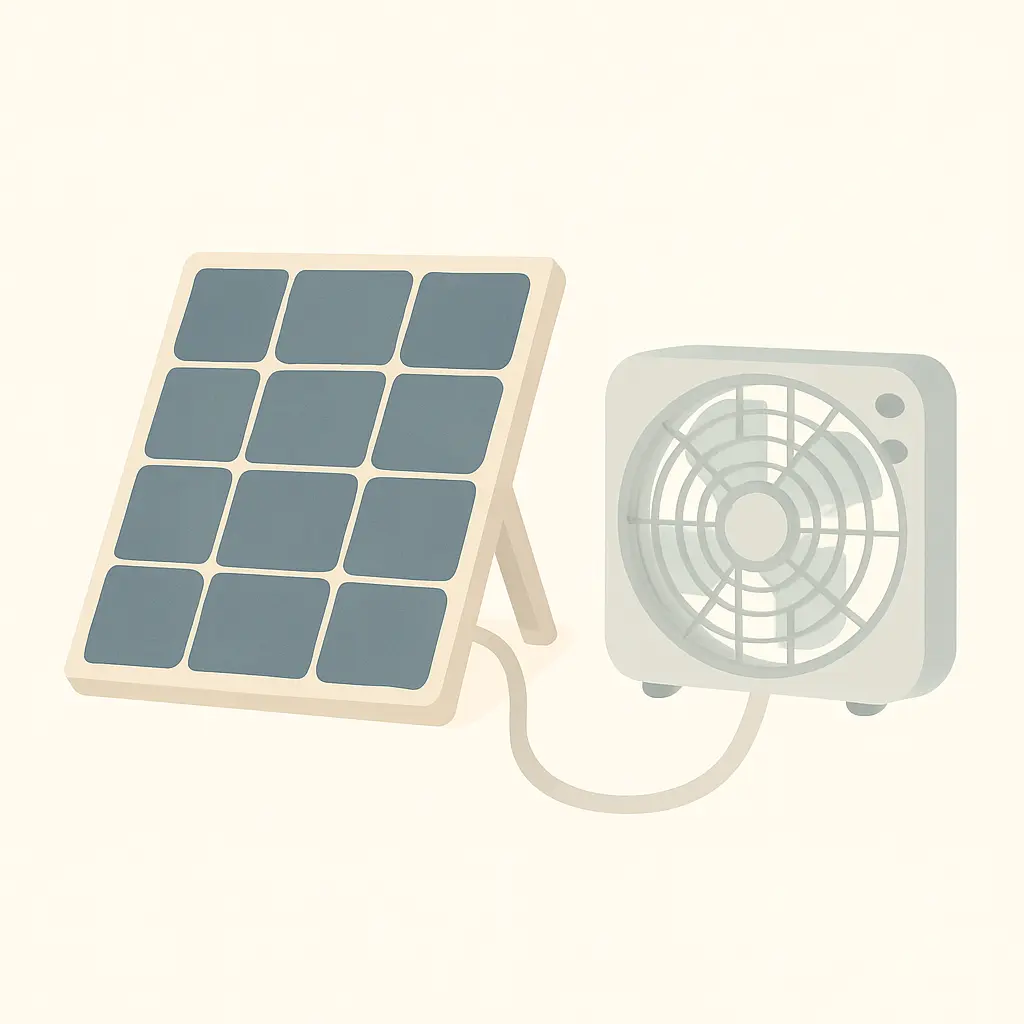
For American homeowners beginning their solar journey, the vast majority of systems installed in the United States over the last decade have been "battery-less" systems.1 This configuration is known as a "grid-tied" or "on-grid" solar system.2 As the name explicitly states, the system is physically and electrically tied to the public utility grid.4 This connection is not a one-way street; it is a bi-directional highway for electricity.
In this setup, the home can draw power from the grid, just as it always has. Simultaneously, it gains the ability to send excess, unused solar power to the grid.5 This simple, elegant design has been the default entry point for residential solar, primarily due to its compelling financial advantages.3
How It Works: A Simple 3-Step Process
A grid-tied solar system functions through a seamless, automatic interplay between the panels, an inverter, and the home's existing electrical panel.4 The entire process can be broken down into three simple steps:
- Generation: The photovoltaic (PV) solar panels, typically fixed to the roof, absorb sunlight. This sunlight is then chemically converted into Direct Current (DC) electricity.4
- Conversion: This raw DC electricity is channeled to a crucial component called a grid-tie inverter. This device's sole purpose is to convert the unusable DC power into Alternating Current (AC) electricity, which is the standard form of power used by all common household appliances, from the television to the air conditioner.6
- Distribution: The now-usable AC power flows from the inverter to the home's main electrical panel (breaker box). From there, the system automatically prioritizes power distribution:
- Priority 1 (Self-Consumption): The solar electricity is first used to power any immediate electrical needs within the home. If the sun is shining and the air conditioner kicks on, it will run on solar power first, immediately reducing the amount of power the home needs to purchase from the utility.6
- Priority 2 (Export): On bright, sunny afternoons when the panels are generating more electricity than the home is using, this surplus, unused power isn't wasted. It is automatically exported out of the house, through the utility meter, and onto the public grid for neighbors to use.3
- Priority 3 (Import): At night, or on heavy, overcast days when the panels are not generating enough (or any) power, the home automatically draws power from the grid to make up any shortfall. This entire process is seamless and requires no manual intervention.3
The Core Appeal: Why Most Homeowners Choose This Path
The enduring popularity of the grid-tied, battery-less system is not based on performance or features, but on a compelling financial and practical argument.
Benefit 1: Significantly Lower Upfront Cost
This is the primary driver. Solar batteries are one of the single most expensive components of a complete solar installation.12 Adding a battery bank can add $10,000 to $20,000 or more to the total project cost.13 In many cases, the battery alone can double the price of the installation.
By forgoing this component, the homeowner chooses the lowest possible upfront cost and the most accessible entry point into solar energy.1
A 2025 cost analysis illustrates this stark difference. A typical 6kW solar system (a common size for a US home) without a battery costs an average of $15,000 to $18,000 before incentives. After the 30% federal tax credit, the net cost drops to approximately $10,500 to $12,600.17 In contrast, a 6kW hybrid system (with a 10kWh battery) costs between $22,000 and $30,000 before incentives, with a net cost of $15,400 to $21,000.17 This $5,000 to $8,000+ difference in net cost is the main reason homeowners opt for the battery-less system.
Benefit 2: Simplicity and Low Maintenance
A grid-tied system is elegantly simple. It has fewer components to install, monitor, and maintain.3 Batteries, on the other hand, add a significant layer of complexity. They require ongoing maintenance and, more importantly, have a limited lifespan (typically 10-15 years). This means a battery will require an expensive replacement, adding a major long-term liability to the system's cost.12 A battery-less system avoids this future expense entirely.
Benefit 3: The Fastest Payback Period (With a Critical Caveat)
Because the initial investment is significantly lower, the "payback period"—the time it takes for the system to save as much money on electric bills as it cost to install—is traditionally the shortest.1 This has long been the primary financial pitch for grid-tied solar: it offers the "quickest payback".1
However, this critical benefit comes with a massive caveat that now defines the entire solar market: this fast payback is entirely dependent on living in a state with a favorable "Net Metering" policy. As this report will detail in Section 4, the erosion of this policy is the single biggest threat to the financial viability of battery-less solar.
Table 1: Grid-Tied vs. Solar-Plus-Storage: A Head-to-Head Comparison
| Feature | Grid-Tied (No Battery) | Hybrid (Solar + Battery) |
|---|---|---|
| Average 6kW System Cost (After 30% Credit) | $10,500 – $12,600 17 | $15,400 – $21,000 (with 10kWh battery) 17 |
| Provides Power During Outage? | No. System shuts down. 9 | Yes. Powers essential loads or whole home. 1 |
| Payback Period (in Net Metering State) | Fastest. (Lowest initial cost) 1 | Slower. (Higher initial cost) 13 |
| Payback Period (in Net Billing State) | Slow/Poor. (Exported power has low value) 26 | Faster. (Avoids selling power for pennies) 28 |
| Maintenance Complexity | Low. 12 | Moderate. (Batteries require eventual replacement) 12 |
| Ideal Homeowner | Cost-focused; lives in a state with strong Net Metering; has a reliable grid. 13 | Resilience-focused; lives in a state with Net Billing or high Time-of-Use rates; has an unreliable grid. 32 |
Section 2: The "Virtual Battery": How Net Metering Makes Solar-Only Worthwhile
Using the Grid as Your Personal Battery Bank
The grid-tied system, as described, has an obvious problem: it generates the most power in the middle of the day (when many people are at work) and no power at night (when home electricity consumption peaks). The solution to this timing mismatch is the mechanism that makes a battery-less system financially viable.
With this system, the homeowner does not need a physical battery because, under specific state-level regulations, the utility company is mandated to act as a giant, free, virtual battery.8
This concept is most famously illustrated by the analogy of the "meter spinning backward".11 In this system, for every kilowatt-hour (kWh) of excess electricity the solar panels export to the grid, the utility meter tracks it as a 1-kWh credit. Later that night, when the home needs to import a kWh of electricity from the grid, it "uses" that credit, and the net cost is zero.9
This process allows the homeowner to "store" the value of their excess daytime solar power and "use" that value at night, all without the expense and maintenance of a physical battery.9
The Financial Heart of Grid-Tied Solar: "Net Energy Metering" (NEM)
The specific policy that enables this "virtual battery" is called Net Energy Metering, commonly known as NEM.9 For decades, NEM has been the single most important policy for the growth of residential solar in the United States.34
The key feature of a true NEM policy is that the homeowner is credited for their excess power at the full retail rate.35 This 1-to-1 swap is the linchpin. It means if the utility charges $0.30/kWh for electricity, it must also credit the homeowner $0.30 for every kWh they export. This symmetrical pricing is what makes the investment so powerful and the payback period so short.
It is critical to understand that NEM is a policy, not a universal law of physics.38 Its availability, terms, and very existence vary dramatically by state and even by individual utility provider.39 Homeowners investigating solar must check their specific local policies using resources like the DSIRE database, which tracks these incentives across the US.38
Understanding Your Bill: The Key Compensation Models
To understand the financial risk to a battery-less system, one must first understand the different ways a utility can compensate a homeowner. As utilities and regulators move away from traditional NEM, homeowners may encounter several different billing arrangements. The difference between them is the difference between a great investment and a poor one.
Table 2: How You Get Paid: Net Metering vs. Net Billing
| Policy | How It Works | Value of Your Excess Solar (An Example) |
|---|---|---|
| Net Energy Metering (NEM) | A single, bi-directional meter spins forward when importing and backward when exporting. The homeowner is billed for the "net" difference at the end of the month. 35 | 1-to-1 Retail Rate. You buy power for $0.30/kWh. You sell (export) power for a credit of $0.30/kWh. 37 |
| Net Billing (or "Net Purchase & Sale") | A smart meter or two separate meters track all imports and all exports independently. You are billed for all imports and paid a separate credit for all exports. 37 | "Avoided Cost" / Wholesale Rate. You buy power for $0.30/kWh. You sell (export) power for a credit of $0.08/kWh. 26 |
| Buy-All, Sell-All | Similar to Net Billing, but the system is not connected to the home's loads. The homeowner sells 100% of their solar power to the grid at one rate and buys 100% of their home's power at another. 36 | Wholesale Rate. This structure formally separates the homeowner into a small-scale power producer and a regular consumer. |
The entire financial case for battery-less solar rests on the homeowner being in the first category: Net Energy Metering. The move to "Net Billing" (Column 2) destroys the "virtual battery" concept by breaking the 1-to-1 swap. Selling for $0.08 and buying back for $0.30 is not a battery; it's a bad business model. This policy shift is the subject of Section 4.
Section 3: The Critical "Gotcha" Every Homeowner Must Understand: Power Outages
The Hard Truth: Your Solar Panels Will Shut Down When the Grid Fails
Here is the single most misunderstood aspect of grid-tied solar, and it is the system's greatest vulnerability: When the power goes out, your multi-thousand-dollar solar system will shut down completely. You will be in the dark, just like your neighbors. 9
This is the critical "gotcha" that blindsides many new solar owners. Even if a blackout occurs at 2:00 PM on a perfectly sunny day, the home will lose all power. The solar panels themselves are still capable of generating electricity 23, but the homeowner cannot access it.
This is not a bug, a design flaw, or something the installer "forgot" to activate. It is a mandatory, built-in, and non-negotiable safety feature of every grid-tied system sold in America.23
The "Why": Understanding "Anti-Islanding" and Utility Worker Safety
To understand why this shutdown is necessary, one must understand the lethal risk of "islanding."
The Problem: "Islanding" (or Back-feeding)
When the utility grid goes down—for example, a tree falls on a power line—the local grid is de-energized. However, if a home's solar system were to stay on, it would continue to generate AC electricity and push it onto the grid.22 This "back-feeding" would energize the supposedly "dead" power lines around the house, creating a dangerous "island" of live electricity in a sea of blacked-out grid.
The Lethal Risk
A utility worker, sent to repair that fallen line, assumes the line is dead. If that worker, following all standard safety procedures, begins work on a line that is being secretly energized by a nearby home's solar system, they could be electrocuted. This back-feeding of power poses a grave and lethal risk to utility workers, who have no way of knowing a specific home is "islanding" and energizing the grid.9
The Solution: "Anti-Islanding Protection"
To prevent this lethal scenario, every grid-tied inverter sold in the U.S. has a mandatory safety feature called "anti-islanding protection".14
This feature can be thought of as the inverter constantly "listening" for the stable "heartbeat" of the grid—its precise voltage and frequency (60 Hz in the US).23 The instant the inverter detects that the grid's heartbeat is gone (i.e., the grid is down), it automatically and immediately shuts down the entire solar system.23
This automatic shutdown feature is the reason a grid-tied system is not just connected to the grid; it is dependent on the grid for its very ability to turn on. The grid's stability is the "on" switch for the solar inverter.
The Law: This is Not Optional
This safety feature is not an installer's choice or a premium add-on; it is a legal and regulatory requirement. This anti-islanding functionality is mandated by national safety standards, most notably IEEE 1547 (Standard for Interconnection and Interoperability of Distributed Energy Resources) and UL 1741 (Standard for Inverters, Converters, Controllers and Interconnection System Equipment).42
Any system interconnected with the public grid must comply with these standards, which require the system to "cease to energize" the grid within seconds (typically 2 seconds) of detecting an outage.47
This fact is the central challenge of a battery-less system: it provides financial benefits by reducing a utility bill, but it provides zero resilience or energy independence during an outage.
Section 4: The Financial Landscape is Changing: The End of Net Metering
The "gotcha" of power outages is the system's primary technical vulnerability. This section deals with its primary financial vulnerability: the generous "virtual battery" policy (NEM) from Section 2 is being systematically dismantled.
Why Your State's Policy Is More Important Than Your Panels
For years, utilities have argued that NEM's 1-to-1 retail rate swap forces them to "buy" power at an inflated retail price when they could generate it or buy it on the wholesale market for much less. They also argue that solar-only homeowners are not paying their fair share to maintain the grid infrastructure they rely on every night.
As a result, state regulators across the US are agreeing with utilities and unwinding these generous policies. As of late 2024, at least 12 states had already replaced traditional NEM with alternative, less favorable structures.52 States like Arizona, Hawaii, Indiana, Maine, and Nevada have been at the forefront of this transition.53
The new model replacing NEM is "Net Billing" 35—the "Net Purchase and Sale" model defined in Table 2. Under this structure, the 1-to-1 swap is broken. The homeowner buys all imported power at the high retail rate but sells all exported power at the low "avoided cost," or wholesale, rate.41
Case Study: California's NEM 3.0 (A Warning for the Nation)
There is no better example of this transition than in California, the nation's largest solar market. The state's 2023 move to a new policy, "NEM 3.0," serves as a stark warning for what is coming to the rest of the country.26
The Change: Implemented in April 2023, California's NEM 3.0 policy cut the value of exported residential solar energy by an average of 75%.26 In real-world terms, the credit homeowners received for their excess power dropped from an average of ~$0.30/kWh to ~$0.08/kWh.26
The Stated Goal: This policy change was not subtle. Regulators and utilities explicitly designed NEM 3.0 to "encourage homeowners to integrate battery storage".54
The Financial Impact: The effect was immediate and profound.
- The payback period for a solar-only system ballooned, making it a much weaker investment, with some estimates extending it beyond 10 years.26
- The new math completely inverted the old logic. A solar-plus-battery system—which allows a homeowner to avoid selling their valuable power for $0.08 and instead store it for their own use (a process called "self-consumption")—now offers a faster and better financial return than a solar-only system.28
This case study proves that utilities are winning the regulatory fight to end NEM. They are successfully changing market rules to force the adoption of batteries, which benefits the grid by storing energy locally instead of "costing" the utility by forcing them to buy at retail prices.
This creates a "pincer movement" that is squeezing the battery-less solar system into obsolescence. On one side, the "Resilience Pincer" (Section 3): an aging grid and more frequent outages 33 are making the lack of backup power (the "gotcha") more painful and undesirable. On the other side, the "Financial Pincer" (Section 4): new Net Billing policies are destroying the financial model that made solar-only a good investment.
A battery solves both problems. It provides backup power, solving the resilience problem. And it allows for "self-consumption"—storing excess solar instead of selling it for pennies—which is the only way to get a good ROI in a Net Billing state.26 The market is no longer gently pulling consumers toward batteries; it is aggressively pushing them by making the alternative non-viable.
Section 5: The Financial Incentives: The 30% Federal Tax Credit
Just as the financial case for battery-less solar is being challenged at the state level, a powerful federal incentive is simultaneously making the battery-plus-storage solution more affordable.
The Residential Clean Energy Credit: Your Biggest Discount
The single most powerful financial tool for American homeowners is the federal Residential Clean Energy Credit.56 As part of the Inflation Reduction Act of 2022, this credit was set at 30% of the total system cost and extended through 2032.1
It is crucial to understand that this is a tax credit, not a rebate.59 A rebate is cash back. A tax credit is a dollar-for-dollar reduction in the federal income taxes a homeowner owes.59 If a system costs $20,000, the 30% credit is $6,000. If the homeowner owes $10,000 in federal taxes, they will now only owe $4,000. If the credit is larger than the tax liability, it can be carried forward to reduce taxes in future years.57
This credit has no annual maximum or lifetime limit (except for fuel cell property), meaning the 30% applies to the entire cost of the project, no matter how large.57
What's Covered: The "Great Equalizer"
This is the most critical part of the federal policy as it relates to the battery decision. The 30% credit covers the entire cost of the solar installation, including:
- Solar PV panels 57
- Inverters, wiring, and mounting hardware 59
- Labor costs for onsite preparation, assembly, and original installation 57
- Permitting and inspection fees 59
Crucially, as of 2023, the credit also covers Battery Storage Technology as a standalone expense, as long as the battery has a capacity of 3 kilowatt-hours (kWh) or more.56
This equal application of the 30% credit to both solar panels and batteries is a massive incentive. It acts as a "great equalizer" in the cost calculation.
This alignment of policy is striking. State regulators (via Net Billing) are creating a punitive incentive to buy a battery. Simultaneously, the federal government (via the 30% credit) is offering a positive financial incentive for the exact same purchase. A homeowner is being pushed by their state (to avoid bad export rates) and pulled by the federal government (with a 30% discount) toward the same exact solution: adding battery storage.
Section 6: Backup Power Without a $15,000 Battery? Exploring Your Options
The analysis so far presents a stark choice: pay a low price for a system that is financially weakening and offers no resilience, or pay nearly double for a full battery system. This has left many homeowners searching for a "middle ground" that provides some protection from the "gotcha" of outages (Section 3) without the full $15,000+ cost of a battery bank.
Several of these "hybrid-lite" solutions now exist, ranging from simple generator integration to high-tech, daytime-only inverters.
Option 1: The Standby or Portable Generator
This is the traditional, low-tech solution. It is entirely possible to have both a grid-tied solar system and a gas-powered backup generator.62
However, there is one critical fact: the solar panels and the generator cannot run at the same time.62 When the grid fails and the generator's automatic transfer switch kicks on, the solar inverter must remain off.62 The inverter is designed to look for the perfect 60 Hz signal of the grid; it will see the "dirty" power from a generator as an unstable grid source and, for safety, will not turn on.
To manage this safely and legally (per NEC 702.5), the system requires a "transfer switch" or, more commonly, a "generator interlock kit".66 This simple mechanical device attaches to the main electrical panel and makes it physically impossible for the main breaker (receiving grid/solar power) and the generator breaker to be on at the same time.66 This prevents the generator from back-feeding the grid and, more importantly, from destroying the solar inverter.
Option 2: The "Daytime Backup" Inverter (Enphase Sunlight Backup)
This is a modern, high-tech, and partial solution from Enphase, one of the leading inverter manufacturers.
- Required Hardware: This feature requires a specific set of matching components: "grid-forming" Enphase IQ8-series microinverters, an Enphase IQ System Controller (the "brain" of the system), and at least one IQ Load Controller to manage power.22
- What it Does: When the grid fails and the sun is shining, the IQ System Controller automatically "islands" the home from the grid.22 It then signals the IQ8 microinverters to create their own stable micro-grid, using sunlight to power a few, pre-selected "essential" circuits (like the refrigerator, internet, and a few lights).67
- The Limitations: This is not a full battery. It does not work at night.69 It cannot power the whole home; Enphase recommends backup loads not exceed 30% of the microinverters' total rated output.69 It generally cannot run power-hungry appliances like central air conditioning.71
- The Cost: This high-tech solution is not free. The additional hardware (System Controller, Load Controller) and the complex electrical work to create a separate "essentials" panel can cost between $5,000 and $7,500.69 At this price point, it is approaching the cost of a small battery, making it a difficult value proposition for many.
Option 3: The "Emergency Outlet" Inverter (SMA Secure Power Supply)
This is a much simpler, more limited, and far cheaper feature offered on some SMA brand inverters.
- What it Does: During a daytime outage, this feature does not power any of the circuits in the house. Instead, it energizes a single, dedicated 120V outlet that is physically mounted on or near the inverter.74
- The Limitations: This single outlet is limited to 2,000 watts of power.74 Crucially, it is not automatic. The homeowner must manually go outside to the inverter and flip a switch to activate the outlet.74 If the plugged-in load exceeds 2,000 watts, the outlet simply shuts off for 20 seconds.74
- The Use Case: This is purely an emergency feature. It is designed for the homeowner to run an extension cord from the inverter to a single critical appliance, like a refrigerator, or to charge phones and laptops.74
- The Cost: This is a very low-cost add-on, often just a few hundred dollars to install the required outlet and switch, making it the cheapest "backup" solution on the market.74
Table 3: Backup Power Options: A Feature and Cost Analysis
| Solution | Avg. Installed Cost (Post-Credit) | What It Powers | Works at Night? | Works Automatically? |
|---|---|---|---|---|
| Full Battery System (10kWh) | $10,000 - $15,000+ 13 | Essential loads or whole home 13 | Yes 24 | Yes 50 |
| Enphase Sunlight Backup | $5,000 - $7,500 69 | 4-8 pre-selected essential circuits 69 | No 71 | Yes (Daytime only) 70 |
| Generator + Interlock Kit | $3,000 - $12,000+ 13 | Essential loads or whole home 62 | Yes (Requires fuel) 13 | Yes (Standby) / No (Portable) 62 |
| SMA Secure Power Supply (SPS) | < $500 74 | One 120V / 2,000W outlet 74 | No 74 | No (Manual switch) 74 |
Section 7: Final Verdict: Who Should Get a Battery-Less System in 2025?
This analysis has shown that the simple, grid-tied, battery-less solar system is caught in a "pincer movement." It is being challenged on one side by its inherent lack of resilience (the "gotcha" of outages) and on the other by a collapsing financial model (the end of NEM).
The decision to forgo a battery is no longer a simple cost calculation; it is a strategic one that depends entirely on a homeowner's location, goals, and tolerance for risk.
A "BUY" Recommendation: A Battery-Less System is Perfect For You IF...
A battery-less system remains the most cost-effective entry point into solar, but only for a specific type of homeowner. This is a "BUY" recommendation if all the following are true:
- ...You live in a state with a strong, 1-to-1 Net Metering (NEM) policy. This is the most important factor. The financial viability of the system depends on the utility crediting exported power at the full retail rate.1
- ...Your primary goal is the lowest possible upfront cost and the fastest possible ROI. A homeowner in this position is prioritizing the 30% tax credit on the smallest possible investment.1
- ...Your local grid is highly reliable. A homeowner who rarely experiences power outages will not place a high value on the backup-power feature of a battery.13
- ...You are not concerned with energy independence and have no critical electrical loads (like medical equipment) that must run during an outage.13
A "CAUTION" Recommendation: Add a Battery IF...
For a growing majority of Americans, the data now strongly suggests that adding a battery—while more expensive upfront—is the superior long-term financial and practical decision. A homeowner should add a battery if any of the following are true:
- ...You live in a "Net Billing" state (like California, Arizona, Utah, Nevada, Hawaii, etc.).26 In this environment, a battery is a financial tool, not just a backup one. It is the only way to achieve a good ROI by "self-consuming" solar power instead of selling it for pennies.
- ...Your utility uses "Time-of-Use" (TOU) rates. These plans make electricity extremely expensive during peak evening hours (e.g., 4 PM - 9 PM), precisely when solar production ends. A battery allows the homeowner to store their "free" daytime solar and use it during these expensive peak hours, maximizing savings.32
- ...You experience frequent or long power outages. If the grid is unreliable due to weather, wildfires (Public Safety Power Shutoffs), or aging infrastructure, a battery is the only way for the solar system to provide value during these events.13
- ...You rely on critical electrical equipment. For homes with essential medical devices, electric well pumps, or sump pumps, backup power is a non-negotiable matter of safety and security.13
Final Analyst Note: A Warning on Sales Tactics
The residential solar industry has expanded rapidly, but this has been accompanied by an increase in consumer complaints about unscrupulous sales tactics.78 Homeowners are advised to be skeptical of any high-pressure sale.
To protect this major investment, it is essential to get multiple quotes 79 and to specifically ask two questions of every potential installer:
- "What is my utility's exact compensation policy? Is it Net Metering or Net Billing? What is the exact credit rate I will receive for my exported power?"
- "What will happen, specifically, when the power goes out? Will my system shut down?"
Any installer who is vague on these two points, who brushes off the outage question, or who promises the system will "keep working" without a battery should not be trusted. The savvy homeowner, armed with the data in this report, will be prepared to make the right financial and practical decision for their home.
Works cited
1. How to choose the right system: Grid-tied, off-grid, or hybrid? - Enphase, accessed November 14, 2025, https://enphase.com/blog/homeowners/grid-tied-offgrid-hybrid-solar-systems
2. What Are the Differences Between On-Grid and Off-Grid Solar? - EcoFlow, accessed November 14, 2025, https://www.ecoflow.com/us/blog/differences-between-on-grid-off-grid-solar-system
3. What is a grid-tied solar system? - Hoymiles, accessed November 14, 2025, https://www.hoymiles.com/tech-pro/what-is-a-grid-tied-solar-system.html
4. accessed November 14, 2025, https://www.ecoflow.com/za/blog/what-is-grid-tied-solar-system#:~:text=A%20grid%2Dtied%20solar%20system%20functions%20through%20the%20interplay%20between,to%20a%20grid%2Dtie%20inverter.
5. What Is a Grid-Tied Solar System? - EcoFlow, accessed November 14, 2025, https://www.ecoflow.com/za/blog/what-is-grid-tied-solar-system
6. Grid-Tied Solar System: Meaning, Pros & Cons Explained, accessed November 14, 2025, https://spectrasolarpower.com/blog/what-is-grid-tied-solar-system-and-its-pros-cons.php
7. Grid-Tied vs Hybrid vs Off Grid Solar Systems - Electrician U, accessed November 14, 2025, https://electricianu.com/grid-tied-vs-hybrid-vs-off-grid-solar-system/
8. Understanding How Grid-Tied Solar Systems Work - Paradise Energy Solutions, accessed November 14, 2025, https://www.paradisesolarenergy.com/blog/how-does-a-grid-tied-solar-system-work/
9. How Grid Tie Solar Works - Fire Mountain Solar, accessed November 14, 2025, https://firemountainsolar.com/learn/grid-tie-solar/how-grid-tie-solar-works/
10. Solar Savvy: Optimize Energy Use Without Battery Storage, accessed November 14, 2025, https://www.nextenergy.ai/how-to-optimize-solar-energy-use-without-batteries
11. How does a grid-tied solar system work - Freedom Forever, accessed November 14, 2025, https://freedomforever.com/blog/how-grid-tied-solar-system/
12. Solar System Without Battery: Smart, Simple, and Cost-Effective ..., accessed November 14, 2025, https://www.aforenergy.com/solar-system-without-battery-smart-simple-and-cost-effective/
13. Should I Add a Battery to My Solar Energy System? - National, accessed November 14, 2025, https://www.checkbook.org/national/solar-contractors/articles/Should-I-Add-a-Battery-to-My-Solar-Energy-System-7614
14. Grid Tied vs. Off Grid Solar Inverter: Pros and Cons - Aforenergy, accessed November 14, 2025, https://www.aforenergy.com/grid-tied-vs-off-grid-solar-inverter-pros-and-cons/
15. Solar Systems: To battery, or not to battery? - Solar Voltaics, accessed November 14, 2025, https://www.solar-voltaics.com/blog/solar-systems-to-battery-or-not-to-battery/
16. The Pros and Cons of Off-Grid vs. Grid-Tied Solar Systems - Our World Energy, accessed November 14, 2025, https://ourworldenergy.com/the-pros-and-cons-of-off-grid-vs-grid-tied-solar-systems/
17. Home Solar System Costs: A 2025 Overview - EcoFlow, accessed November 14, 2025, https://www.ecoflow.com/us/blog/solar-system-price-guide
18. How Much Do Solar Panels Cost? (Nov 2025) - Consumer Affairs, accessed November 14, 2025, https://www.consumeraffairs.com/solar-energy/how-much-do-solar-panels-cost.html
19. How Much Does A 6kW Solar Power System Cost And How Much Electricity Does It Produce? - SolarReviews, accessed November 14, 2025, https://www.solarreviews.com/blog/how-much-does-a-6kw-solar-power-system-cost-and-how-much-electricity-does-it-produce
20. Solar Panel Cost In 2025: It May Be Lower Than You Think | EnergySage, accessed November 14, 2025, https://www.energysage.com/local-data/solar-panel-cost/
21. Choosing Between Grid-Connected and Off-Grid Solar Systems Scenarios and Costs, accessed November 14, 2025, https://www.hitekenergy.com/news/choosing-between-grid-connected-and-off-grid-solar-systems-scenarios-and-costs/
22. Staying Powered Up: The Truth About Solar Panels During Power Outages - Solar Insure, accessed November 14, 2025, https://www.solarinsure.com/staying-powered-up-the-truth-about-solar-panels-during-power-outages
23. Do Grid-Tied Solar Panel Systems Work In a Blackout? - EcoFlow, accessed November 14, 2025, https://www.ecoflow.com/us/blog/do-gridtied-solar-panel-systems-work-in-blackout
24. Homeowner reveals how he creatively powered his house after 'horrendous' storm caused multiday blackout: 'Flexibility in handling a utility outage', accessed November 14, 2025, https://www.thecooldown.com/green-tech/solar-battery-storage-idaho-blackout-grassfed-homestead/
25. Payback Period for Solar Panels - Solar Energy Calculator - Solarise Solar, accessed November 14, 2025, https://www.solarisesolar.com/how-to-figure-out-your-solar-panel-payback-period/
26. Understanding NEM 3.0 in California - GreenLancer, accessed November 14, 2025, https://www.greenlancer.com/post/nem-3-0
27. Clean Energy Alliance Explains NEM 2.0 vs NEM 3.0, accessed November 14, 2025, https://thecleanenergyalliance.org/clean-energy-alliance-explains-nem-2-0-vs-nem-3-0/
28. What Is NEM 3.0? Complete Guide To California's New Solar Policy (2025) - SolarTech, accessed November 14, 2025, https://solartechonline.com/blog/what-is-nem-3-0-california-solar-guide/
29. NEM 3.0 – Making the Financial Case by Combining Home Electrification with Energy Storage - Schneider Electric Solar, accessed November 14, 2025, https://solar.se.com/us/en/2023/08/22/nem-3-0-making-the-financial-case-by-combining-home-electrification-with-energy-storage/
30. NEM 3.0 in California: What You Need to Know - EnergySage, accessed November 14, 2025, https://www.energysage.com/blog/net-metering-3-0/
31. The ultimate guide to solar maintenance budgets and ROI - Anern Store, accessed November 14, 2025, https://www.anernstore.com/blogs/costs-incentives-policy/ultimate-guide-solar-maintenance-budgets-roi
32. Hybrid Solar Systems: Is Grid + Storage Worth It? | EnergySage, accessed November 14, 2025, https://www.energysage.com/solar/grid-tied-solar-vs-solar-battery-backup/
33. Why solar power for your home makes sense - PowerOutage.us, accessed November 14, 2025, https://poweroutage.us/solar
34. Can I Use Solar Panels Without Battery Storage? | Solar.com, accessed November 14, 2025, https://www.solar.com/learn/can-i-use-solar-panels-without-a-battery/
35. What is Solar Net Metering, and Which States Offer it? (As of 2025) | YellowLite, accessed November 14, 2025, https://www.yellowlite.com/blogs/net-metering-explained-states-that-offer-it-in-2023/
36. Energy Compensation Mechanisms for Distributed Generation ..., accessed November 14, 2025, https://www.nrel.gov/state-local-tribal/energy-compensation-mechanisms
37. Grid-Connected Renewable Energy Systems | Department of Energy, accessed November 14, 2025, https://www.energy.gov/energysaver/grid-connected-renewable-energy-systems
38. Homeowner's Guide to Solar - Department of Energy, accessed November 14, 2025, https://www.energy.gov/eere/solar/homeowners-guide-solar
39. Detailed Summary Maps - DSIRE, accessed November 14, 2025, https://www.dsireusa.org/resources/detailed-summary-maps/
40. Database of State Incentives for Renewables & Efficiency® - DSIRE, accessed November 14, 2025, https://www.dsireusa.org/
41. What You Need To Know About Arizona's Net Billing Program - SolarReviews, accessed November 14, 2025, https://www.solarreviews.com/blog/arizona-net-metering
42. What Is Anti-Islanding in Solar Inverters? - Aforenergy, accessed November 14, 2025, https://www.aforenergy.com/what-is-anti-islanding-in-solar-inverters/
43. What Is Solar Islanding? - Palmetto Solar, accessed November 14, 2025, https://palmetto.com/solar/what-is-solar-islanding-and-anti-islanding
44. Solar Anti-Islanding Protection: A Comprehensive Guide, accessed November 14, 2025, https://suntegritysolar.com/uncategorized/solar-anti-islanding-protection-a-comprehensive-guide/
45. accessed November 14, 2025, https://www.aforenergy.com/what-is-anti-islanding-in-solar-inverters/#:~:text=Anti%2Dislanding%20in%20a%20solar,an%20outage%20or%20grid%20disruption.
46. How Does Anti-Islanding Work? | Grid-Connected Inverters - Windurance Blog Library, accessed November 14, 2025, https://blog.windurance.com/how-does-anti-islanding-work
47. Anti-Islanding Protection with Grid-Tied PV Inverters - Yaskawa – Solectria Solar, accessed November 14, 2025, https://solectria.com/blog/anti-islanding-protection-with-grid-tied-pv-inverters/
48. What happens when the power goes out in a grid-tied solar energy system? - Anti-Islanding protection - Support | Enphase, accessed November 14, 2025, https://support.enphase.com/s/article/What-happens-when-the-power-goes-out-in-a-grid-tied-solar-energy-system-Anti-Islanding-protection
49. 7 Reasons Grid-Tied PV Trips Off During Outages—and What to Do - Anern Store, accessed November 14, 2025, https://www.anernstore.com/blogs/diy-solar-guides/grid-tied-pv-outages-reasons-actions
50. Why Do Solar Systems Need to Shut Down in a Power Outage (with Code References), accessed November 14, 2025, https://www.321gosolar.com/resources/why-do-solar-systems-need-to-shut-down-in-a-power-outage
51. Alternative Energy Equipment and Systems Marking and Application Guide, accessed November 14, 2025, https://www.ul.com/sites/default/files/2019-05/AlternativeEnergy_EquipmentandSystemsMarking_AG_2016.pdf
52. The Missing Correlation Between the Potential Rate Impacts of Rooftop Solar and the Timing of State Net Metering Policy Revision - NREL, accessed November 14, 2025, https://docs.nrel.gov/docs/fy25osti/93543.pdf
53. Report State Net Metering Policies, accessed November 14, 2025, https://www.ncsl.org/energy/state-net-metering-policies
54. What Are Net Metering and NEM 3.0 in California? - EcoFlow, accessed November 14, 2025, https://www.ecoflow.com/us/blog/what-are-net-metering-nem-3-in-california
55. What is NEM 3.0 and How Will it Impact California Solar Owners?, accessed November 14, 2025, https://www.solar.com/learn/nem-3-0-proposal-and-impacts-for-california-homeowners/
56. Federal Tax Credits for Energy Efficiency, accessed November 14, 2025, https://www.energystar.gov/about/federal-tax-credits
57. Residential Clean Energy Credit | Internal Revenue Service, accessed November 14, 2025, https://www.irs.gov/credits-deductions/residential-clean-energy-credit
58. Home energy tax credits | Internal Revenue Service, accessed November 14, 2025, https://www.irs.gov/credits-deductions/home-energy-tax-credits
59. Federal Solar Tax Credit: What It Is & How to Claim It - EcoWatch, accessed November 14, 2025, https://www.ecowatch.com/solar/incentives/federal-tax-credit
60. Homeowner's Guide to the Federal Tax Credit for Solar Photovoltaics - Department of Energy, accessed November 14, 2025, https://www.energy.gov/sites/prod/files/2021/02/f82/Guide%20to%20Federal%20Tax%20Credit%20for%20Residential%20Solar%20PV%20-%202021.pdf
61. Making Our Homes More Efficient: Clean Energy Tax Credits for Consumers, accessed November 14, 2025, https://www.energy.gov/policy/articles/making-our-homes-more-efficient-clean-energy-tax-credits-consumers
62. Can A Home With Solar Panels Use A Generator? - SolarReviews, accessed November 14, 2025, https://www.solarreviews.com/blog/generators-for-solar-panels
63. Adding Solar to existing home electric with whole house generator - Reddit, accessed November 14, 2025, https://www.reddit.com/r/solar/comments/13lqtcf/adding_solar_to_existing_home_electric_with_whole/
64. Grid-tied solar with backup generator | DIY Solar Power Forum, accessed November 14, 2025, https://diysolarforum.com/threads/grid-tied-solar-with-backup-generator.26419/
65. Will Solar Panels Work in a Power Outage Without Batteries?, accessed November 14, 2025, https://www.intermtnwindandsolar.com/solar-during-outage-without-battery/
66. Plugging in a Portable Generator with Solar Panels | Interlockkit, accessed November 14, 2025, https://interlockkit.com/blog/portable-generator-with-solar/
67. Sunlight Backup installation support | Enphase, accessed November 14, 2025, https://enphase.com/installers/microinverters/iq8/sunlight-backup
68. Can I power my house without batteries using Enphase IQ8M inverters and IQ Gateway? : r/solar - Reddit, accessed November 14, 2025, https://www.reddit.com/r/solar/comments/1es8oxd/can_i_power_my_house_without_batteries_using/
69. Enphase Sunlight Backup: Smart Solar Battery Solutions, accessed November 14, 2025, https://optiononesolar.com/blog/enphase-sunlight-backup
70. Understanding Sunlight Backup system for homeowners | Enphase, accessed November 14, 2025, https://enphase.com/homeowners/sunlight-backup-user-guide
71. Is Enphase Sunlight Backup Worth It Without Batteries? - YouTube, accessed November 14, 2025, https://www.youtube.com/watch?v=AFLveJabNFU
72. Enphase sunlight package - is it worth it? : r/solar - Reddit, accessed November 14, 2025, https://www.reddit.com/r/solar/comments/1ft9mqj/enphase_sunlight_package_is_it_worth_it/
73. Enphase Sunlight Backup Cost?? : r/solar - Reddit, accessed November 14, 2025, https://www.reddit.com/r/solar/comments/tx09vw/enphase_sunlight_backup_cost/
74. How to explain Secure Power Supply to homeowners - Sunny. SMA ..., accessed November 14, 2025, https://www.sma-sunny.com/us/how-to-explain-secure-power-supply-to-homeowners/
75. SMA secure power supply : r/solarenergy - Reddit, accessed November 14, 2025, https://www.reddit.com/r/solarenergy/comments/1neaexi/sma_secure_power_supply/
76. Why You Can't Have Enphase Sunlight Backup - Solar Quotes, accessed November 14, 2025, https://www.solarquotes.com.au/blog/enphase-sunlight-backup/
77. Comparing the Cost of Grid Tie vs Grid Hybrid Solar - Fire Mountain Solar, accessed November 14, 2025, https://firemountainsolar.com/comparing-the-cost-of-grid-tie-vs-grid-hybrid-solar/
78. Consumer Solar Awareness | U.S. Department of the Treasury, accessed November 14, 2025, https://home.treasury.gov/policy-issues/consumer-policy/consumer-solar-awareness
79. Is getting solar worth it and how to avoid scams - Reddit, accessed November 14, 2025, https://www.reddit.com/r/solar/comments/1k7qqol/is_getting_solar_worth_it_and_how_to_avoid_scams/