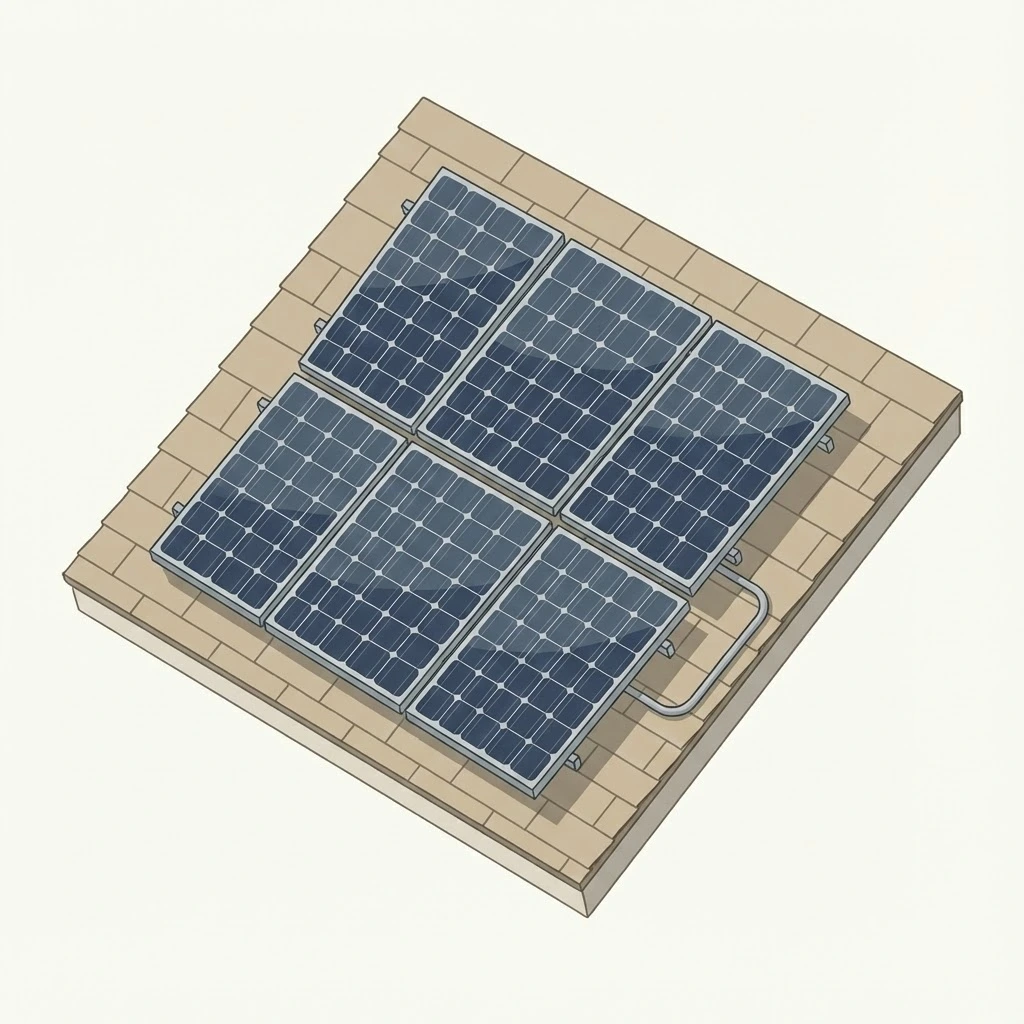
If you are looking into solar power for your home, you have likely heard the term solar array. It sounds technical, but the concept is simple. A solar array is the complete collection of solar panels wired together and mounted on your property to generate electricity.1
Consider a solar panel as an individual battery cell—a fundamental unit in a larger energy system. A solar array, by contrast, represents the complete battery pack: the integrated system formed by multiple interconnected panels, working in concert to supply electricity to a residence or facility. Whether consisting of ten panels mounted on a garage or fifty installed on a barn, these panels collectively constitute an array once they are electrically connected and securely mounted to a structural support system.3
This report reviews solar‑array components and design, covering roof‑mounted racking, wiring for efficient power transfer, and the impact of orientation and tilt on energy yield. Together, these elements form the essential "skeleton," "nervous system," and "performance geometry" of a solar array.
TL;DR: Key Takeaways
- Definition: A solar array is a group of solar panels wired together to act as a single power generator. It is the DC (Direct Current) power plant on your property.1
- One System, Many Parts: An array isn't just panels. It includes the mounting rails, the stainless steel clamps, the copper wiring, the junction boxes, and the waterproof flashings that protect your roof.5
- Wiring is Critical: Arrays are wired in series (to increase voltage) or parallel (to increase amperage). Most home systems use a mix of both to ensure efficient power flow without overheating wires.6
- Location Matters: The direction your array faces (Azimuth) and the angle it sits at (Tilt) define its output. South is usually best for total power, but West can be better for lowering evening bills.8
- It’s Modular: You can often start with a smaller array and expand it later, provided you have the roof space and compatible equipment.10
---
Part 1: Defining the Solar Array
1.1 The Concept of the Array
In the world of residential energy, precision in language helps you make better purchasing decisions. The term "array" is borrowed from computing and mathematics, referring to an ordered series or arrangement. In solar photovoltaics (PV), it specifically refers to the entire generating unit located on the property.
When a solar installer designs a system for your home, they are designing an array. This distinction is important because the performance guarantees, the physical footprint, and the electrical characteristics are all defined at the array level, not just the panel level. A single panel might be rated for 400 watts, but that number is theoretical until it is connected into an array that operates under real‑world conditions of heat, shade, and orientation.3
The array includes several distinct layers:
- The Modules (Panels): The active surface catching sunlight.
- The Racking (Mounting): The structural metal framework.
- The Interconnections (Wiring): The cables and connectors linking module to module.
- The Grounding: Safety wires ensuring the metal frame doesn't become electrically charged.
1.2 The "Brick vs. Wall" Analogy
To fully grasp the difference between a panel and an array, consider a brick wall. A single brick (the solar panel) has specific properties: a certain weight, color, and strength. However, a single brick does not make a wall. It is only when multiple bricks are laid together in a specific pattern and bound by mortar (wiring and racking) that they become a wall (the array).3
Just as a wall can be short, tall, curved, or straight depending on how the bricks are arranged, a solar array is highly customizable. It can be split into different sections—for example, one group of panels on the east roof and another on the west roof. Even though they are on different roof planes, they are typically considered part of the same overall solar array system feeding the home.4
1.3 Why the Distinction Matters for Homeowners
Understanding the array as a unified system rather than a basket of parts protects you during the buying process. Warranties, for instance, often apply to individual panels, but the "power production guarantee" usually applies to the array as a whole. If one panel fails, the array's output drops. Furthermore, the cost of solar is often quoted in "dollars per watt" based on the total size of the array. A 6‑kilowatt (kW) array might consist of fifteen 400‑watt panels. Knowing that the system is an aggregated "6 kW array" rather than just "15 panels" helps in comparing quotes from different installers who might use panels of different wattages.2
---
Part 2: The Anatomy of a Solar Array
To understand how a solar array functions, we must look at the hierarchy of its components. It is a system composed of smaller systems.
2.1 The Solar Cell: The Atomic Unit
At the most microscopic level of the array lies the photovoltaic (PV) cell. These are the small, usually square, wafers seen on the face of a solar panel. They are typically made of silicon, a semiconductor material. When sunlight (photons) hits the silicon, it knocks electrons loose, creating an electric current. This is the "photovoltaic effect." A single cell produces only a tiny amount of electricity—roughly 0.5 volts.1
2.2 The Solar Panel (Module): The Building Block
The solar panel, technically called a "module," is a collection of solar cells wired together and sandwiched between protective layers.
- Construction: The cells are encapsulated in a polymer (like EVA plastic), covered with tempered glass for durability, and backed by a polymer sheet. This "sandwich" is then framed in aluminum.
- Voltage Output: By connecting 60, 72, or more cells in series within the frame, the module boosts the 0.5 volts from the cells up to a usable level, typically between 30 and 40 volts DC (Direct Current).1
Homeowners will encounter two main types of silicon panels within an array:
- Monocrystalline: Made from a single crystal structure. These are generally darker (black or dark blue) and more efficient. They are the premium choice for modern arrays because they produce more power per square foot, which is vital for homeowners with limited roof space.11
- Polycrystalline: Made from multiple crystal fragments melted together. These have a speckled blue look and are generally less efficient, requiring more roof space to generate the same amount of power. They are often cheaper but are becoming less common in residential settings as monocrystalline prices drop.11
2.3 The Array: The Power Plant
The array is the final level of the hierarchy. It is the aggregation of these modules. An average residential array in the United States might consist of 15 to 25 panels, creating a system size of 6 to 10 kilowatts (kW).1
The array's job is to collect DC electricity. It does not produce the AC (Alternating Current) power used by wall outlets; that is the job of the inverter, which sits downstream from the array. The array is simply the DC generator. Its total power output is determined by simple math:
Total Power = Wattage of one panel × Number of panels
For example:
400 Watts × 20 panels = 8,000 Watts (or 8 kW).2
2.4 The Balance of System (BOS)
While the panels are the stars of the show, they cannot function without the supporting cast, known as the Balance of System (BOS). This includes the racking that holds the panels to the roof, the wiring that connects them, and the conduit that protects the wires. The quality of the BOS components often determines the longevity of the array. A panel might last 30 years, but if the cheap plastic zip ties holding the wires break in 5 years, the array will fail.14
---
Part 3: The Nervous System – Wiring the Array
This is arguably the most complex and critical aspect of a solar array. How the panels are wired together determines the voltage and amperage of the electricity flowing down to the house. There are two primary ways to wire an array: Series and Parallel. Most home arrays use a specific method called "stringing," which is a variation of series wiring.6
3.1 The Water Hose Analogy
To understand electrical wiring, it is helpful to visualize water flowing through a hose.
- Voltage (Volts): This is the pressure of the water. It pushes the electricity through the wire.
- Current (Amps): This is the volume of water flowing through the hose.
- Power (Watts): This is the total work the water can do, calculated as Pressure × Volume (Volts × Amps = Watts).15
The goal of wiring an array is to get the electricity from the roof to the inverter efficiently. If the voltage is too low, the "pressure" isn't high enough to push the energy down the wire without losing a lot of it along the way. If the amperage is too high, the wire (the "hose") has to be very thick to carry the volume, or it will overheat.6
3.2 Series Wiring (The "String")
In a series connection, the panels are wired in a single long chain. The positive terminal of the first panel connects to the negative terminal of the second, and so on. This is often referred to as a "string" of solar panels.15
- The Electrical Effect: In a series string, the voltage adds up, but the current (amperage) stays the same.
- Example: If you connect ten panels that each produce 40 Volts and 10 Amps:
- Total Voltage: 40V × 10 = 400 Volts
- Total Current: 10 Amps (Stays the same).7
- Example: If you connect ten panels that each produce 40 Volts and 10 Amps:
- Why do this? High voltage is excellent for moving electricity over distances. It allows the system to use thinner, less expensive copper wire because the amperage (volume) is kept low. Most central "string inverters" require high voltage (often 300‑500 Volts) to turn on and operate efficiently.6
- The "Christmas Light" Problem: The downside of series wiring is similar to old‑fashioned Christmas lights. If one bulb goes out, the whole string goes dark. In a solar array, if one panel is shaded by a chimney or covered in leaves, its electrical flow drops. Because electricity in a series circuit must flow through every panel, a blockage in one panel restricts the flow for the entire string. The output of the whole string drops to the level of the worst‑performing panel.6
3.3 Parallel Wiring
In a parallel connection, all the positive terminals are connected together, and all the negative terminals are connected together.
- The Electrical Effect: In a parallel circuit, the current (amperage) adds up, but the voltage stays the same.
- Example: Using the same ten panels (40V, 10A):
- Total Voltage: 40 Volts (Stays the same)
- Total Current: 10A × 10 = 100 Amps.7
- Example: Using the same ten panels (40V, 10A):
- Why do this? Parallel wiring is independent. If one panel is shaded, the others act like separate lanes on a highway; traffic (electricity) keeps moving in the other lanes. The shaded panel does not drag down the rest of the system. This makes parallel wiring ideal for roofs with complex shading issues.17
- The Downside: 100 Amps is a massive amount of current. It would require extremely thick, heavy, and expensive cables to transmit safely without melting. This makes pure parallel wiring impractical for large home arrays wired to a central inverter.6
3.4 The Hybrid Solution: Strings and Channels
Residential solar arrays typically use a compromise. Panels are wired in series strings to build up voltage (pressure) for efficiency. For example, an array of 20 panels might be split into two strings of 10 panels each. These two strings are then brought down to the inverter and can be treated as two parallel inputs. This keeps the wire size manageable while allowing the inverter to manage two separate sections of the roof independently.17
3.5 Junction Boxes and Connectors
How are these connections physically made? On the back of every solar panel is a small black box called the Junction Box (or J‑Box).
- Function: This box houses the electrical connection points where the solar cells inside the panel link to the wires outside. It ensures the delicate internal connections are waterproof and safe from the elements. A quality junction box is rated IP65 or higher, meaning it is dust‑tight and protected against water jets.20
- Bypass Diodes: Inside the junction box are intelligent components called "bypass diodes." These act like emergency exit doors for electricity. If a section of the panel is shaded and blocking the flow, the diode allows the current to "skip" that blocked section and continue down the wire. This mitigates the "Christmas light effect" significantly, allowing a string to continue working even if one panel is partially shaded. The diode prevents the shaded cells from overheating and becoming "hot spots" that could damage the panel.20
- MC4 Connectors: The wires sticking out of the junction box use standardized clips called MC4 connectors. They are rubber‑sealed, weather‑tight plugs that snap together with a locking mechanism. They prevent the cables from being pulled apart by wind or snow and ensure a watertight seal for the 25+ year life of the array.22
Table: Series vs. Parallel Wiring Comparison
| Feature | Series Wiring (Strings) | Parallel Wiring |
|---|---|---|
| Voltage | Increases (Adds up) | Stays the same |
| Amperage | Stays the same | Increases (Adds up) |
| Performance in Shade | Poor (One shaded panel affects all) | Excellent (Independent operation) |
| Wire Size Needed | Thinner (Cheaper) | Thicker (More expensive) |
| Best Use Case | Unshaded, large arrays, string inverters | Shaded roofs, small 12V systems, RVs |
| Common Home Setup | Yes (often combined with optimizers) | Rare (unless using microinverters) |
---
Part 4: The Skeleton – Mounting and Racking Systems
A solar array is not glued to the roof; it is mechanically bolted to the structure of the home. The mounting system, often called "racking," is the skeleton that holds the modules in place. It must be strong enough to withstand hurricane‑force winds, heavy snow loads, and decades of thermal expansion and contraction.
4.1 Roof‑Mounted Arrays
The most common residential configuration is the roof mount. This utilizes the existing structure of the home to support the array. Because the roof is the first line of defense against weather, installing an array requires careful attention to waterproofing.5
4.1.1 The Components of Roof Racking
- Flashings: These are the most critical part for leak prevention. A flashing is a sheet of metal or rubber that slides under the existing roof shingles. It creates a waterproof seal around the point where the bolt penetrates the roof. High‑quality arrays use flashings that divert water away from the hole, similar to how shingles work. They are often made of aluminum or galvanized metal to resist corrosion.5
- Mounts (Feet): A heavy‑duty bolt (lag bolt) is driven through the flashing and into the wooden rafters (trusses) of the roof. This provides the structural strength. The "foot" attaches to this bolt and sticks up above the roof surface. Installers must locate the rafters precisely to ensure the array is anchored to the structural frame of the house, not just the thin plywood decking.5
- Rails: Long aluminum tracks are bolted to the feet. These rails run horizontally across the roof. They form a level grid that the panels will sit on. Rails also provide a convenient place to tuck the wires away, keeping them off the roof surface where they could be damaged by debris or animals.5
- Clamps: The solar panels are placed on top of the rails. Aluminum clamps are used to hold them down. "Mid‑clamps" go between two panels, holding the edges of both. "End‑clamps" go on the far edges of the array row to secure the final panel. These clamps are tightened to a specific torque specification to ensuring the panels don't slide off during high winds.5
4.1.2 Rail‑less Systems
Some modern racking systems skip the long rails to save weight and improve aesthetics. Instead, they use specialized mounts that grab the edge of the panel directly. This reduces the number of components on the roof and makes shipping the equipment easier (no long rails to transport). However, rail‑less systems can be more complex to install on uneven roofs, as the rails often help to level out a wavy roof surface.5
4.1.3 Specialized Roof Types
- Tile Roofs: Installing an array on clay or concrete tile requires special care because tiles are brittle. Installers usually remove a tile, bolt a specialized hook to the roof deck, and then put a modified flashing tile back in place. The hook curves out from under the tile to hold the rail, ensuring the weight of the array rests on the building structure, not on the fragile tiles.5
- Metal Roofs: Standing seam metal roofs are excellent for solar arrays because they often require zero holes. Specialized clamps can grab onto the raised seams of the metal roof, securing the array without ever penetrating the waterproofing layer. This makes metal roofs one of the most secure and leak‑proof options for solar arrays.12
- Flat Roofs: On flat roofs (common in the Southwest or on modern homes), arrays are often "ballasted." Instead of bolting into the roof, the racking is weighed down with heavy concrete blocks. This holds the array in place via gravity and friction, preserving the integrity of the rubber roof membrane.26
4.2 Ground‑Mounted Arrays
If you have a large property or a roof that faces the wrong way (North) or is heavily shaded, a ground mount is an excellent alternative.
- Standard Ground Mount: A framework of steel pipes is driven into the ground, and aluminum rails are attached to create a tilted surface for the panels. These are easy to access for cleaning and maintenance, specifically for clearing snow in winter.27
- Pole Mounts: The entire array is mounted on a single, massive steel pole. This elevates the panels higher off the ground, which can be useful in areas with deep snow or to avoid shading from low bushes. Some pole mounts allow the owner to manually adjust the tilt of the array, steepening it in winter to shed snow and catch the low sun, and flattening it in summer.28
- Trackers: Some advanced ground arrays use "tracking" systems. These motorized mounts move the array throughout the day to follow the sun from east to west. While this increases energy production significantly (by keeping the panels perpendicular to the sun), the moving parts require more maintenance and cost more upfront. They are less common for standard residential use but popular for larger estates or farms.27
4.3 Integrated Solar (Solar Shingles)
A newer category is Building‑Integrated Photovoltaics (BIPV), such as solar shingles or the Tesla Solar Roof. In this type of array, the "panel" and the "roof" are the same thing. The solar cells are embedded inside roof tiles.
- Pros: Aesthetics are superior; it looks like a normal roof, which is a major selling point for homeowners in strict HOAs or with historic homes.
- Cons: Cost is significantly higher (often double or triple a standard array). Efficiency is generally lower per square foot than standard panels, meaning you need a larger area to generate the same power. Repairs can also be more difficult, as you cannot simply unclip a panel; you may have to rip up a section of the roof.29
---
Part 6: Positioning – The Geometry of Sunlight
A solar array is a passive generator; it sits and waits for sunlight. Therefore, its position relative to the sun is the single biggest factor in its performance. Two angles define this position: Azimuth and Tilt.
5.1 Azimuth: The Compass Direction
Azimuth refers to the compass direction the array faces.
- The Golden Rule (Northern Hemisphere): In the United States, the sun is always in the southern part of the sky. Therefore, facing the array True South (180°) usually captures the maximum total amount of sunlight over the course of a year. This is the default target for most installations.8
- Magnetic vs. True South: Compasses point to magnetic north, which drifts over time. Solar installers must correct for "magnetic declination" to find True South. Depending on where the home is in the US, magnetic south could be off by several degrees. For example, in California, magnetic north is east of true north, so installers must adjust their calculations to ensure the array is truly centered on the sun's path.30
- The Case for West: While South produces the most energy, West‑facing arrays produce energy later in the day. In the late afternoon (4 PM – 7 PM), families come home, cook dinner, and turn on the AC. This is also when utility companies often charge the highest rates (Time‑of‑Use billing). A West‑facing array produces power during this expensive peak window, potentially saving the homeowner more money even if it produces slightly less total electricity than a South‑facing array. It aligns production with consumption.8
- East: East arrays catch the morning sun. They are useful for homes with morning energy spikes or to balance out a system, but they generally produce less value than South or West options unless the home has specific morning power needs (like electric heating in winter).9
- North: In the US, North‑facing roof planes are rarely used. They receive no direct sunlight for most of the year and rely on scattered ambient light, resulting in very low production. Installing panels on the north side is usually not recommended unless the roof pitch is very flat.9
5.2 Tilt: The Vertical Angle
Tilt is the slope of the panels relative to the ground. It determines how "square" the panels are to the incoming sun rays.
- Optimal Tilt: Generally, the optimal tilt angle is equal to the latitude of the home.
- Example: A home in Phoenix, Arizona (Latitude ~33°) would ideally have panels tilted at 33 degrees.
- Example: A home in Minneapolis, Minnesota (Latitude ~45°) would need a steeper tilt of 45 degrees to catch the sun, which sits lower in the sky at northern latitudes.8
- Seasonal Variations: The sun is high in summer and low in winter.
- Summer Optimization: Tilt the panels flatter (Latitude minus 15°) to catch the high sun.
- Winter Optimization: Tilt the panels steeper (Latitude plus 15°) to face the low sun. A steeper tilt also helps snow slide off the array in winter, which is critical for northern homes.8
- Roof Constraints: For most rooftop arrays, the tilt is dictated by the roof's pitch. If a roof is a standard 20‑degree slope, the panels will likely be installed flush at 20 degrees. It is usually not cost‑effective to build complex racking just to change the tilt by a few degrees. The loss in efficiency from a slightly imperfect tilt is often negligible compared to the cost of custom racking.30
5.3 Shading: The Enemy of the Array
Shade is the kryptonite of solar arrays. Because of the series wiring discussed in Part 3, even a small amount of shade can have a disproportionate impact.
- Hard Shade: Solid objects like chimneys, vent pipes, or second‑story dormers cast distinct, dark shadows. Installers design the array layout to avoid these "keep‑out zones." Modern design software uses satellite imagery to map these shadows throughout the year.9
- Soft Shade: Trees or distant buildings cast diffuse shadows that move throughout the day. Soft shade reduces current but doesn't block it entirely like hard shade does.
- Inter‑Row Shading: On flat roofs or ground mounts where panels are arranged in rows, the front row can cast a shadow on the back row if they are placed too close together. Installers must calculate the "sun path" to ensure rows are spaced far enough apart to avoid this, especially in winter when shadows are long. If rows are too close, the winter sun will cause the array to self‑shade, drastically cutting production just when you need it most.9
Table: Optimal Tilt Angles by Region (Approximate)
| Region | Latitude | Standard Tilt | Winter Optimization Tilt |
|---|---|---|---|
| Southern US (FL, TX) | 25°‑30° | 25°‑30° | 40°‑45° |
| Central US (KS, VA) | 35°‑40° | 35°‑40° | 50°‑55° |
| Northern US (MN, ME) | 43°‑48° | 43°‑48° | 58°‑63° |
| Southern Canada | 49°+ | 49°+ | 64°+ |
---
Part 7: Connection – From Roof to Home
Once the array generates power, that electricity must travel from the roof to the home's main electrical panel. This physical path is called the "home run" or the conduit run.
6.1 Conduit Runs
The bundle of wires coming from the array is housed in a protective tube called conduit. This protects the insulation on the wires from UV sunlight, squirrels, and physical damage.
- Attic Runs: The cleanest installation method is to penetrate the roof immediately under the array and run the conduit through the attic space. This hides the silver pipe from view, maintaining the home's curb appeal. It also keeps the wires cooler, which improves efficiency, as hot wires have higher resistance. This method requires access to the attic and is often preferred by homeowners concerned with aesthetics.32
- Roof Runs: Sometimes, an attic run isn't possible (e.g., vaulted ceilings or no access). In these cases, the conduit must run across the surface of the roof and down the side of the house. While functional, this is often considered less aesthetically pleasing. It exposes the conduit to the full heat of the sun, which can degrade PVC conduit over time. Installers may paint the conduit to match the house siding to blend it in, but metal conduit (EMT) is preferred for durability.32
- Materials:
- EMT (Electrical Metallic Tubing): Metal piping. It is durable, rigid, and required for most DC circuits on the roof because it doesn't burn. It is the gold standard for roof work.
- PVC: Plastic piping. Often used for underground runs (like from a ground mount to the house). It is generally not used on roofs because it can sag in high heat and degrade in UV light, becoming brittle over time.34
6.2 The Inverter Connection
The conduit leads the DC electricity to the Inverter. This device converts the DC power (which is like a steady stream of water) into AC power (which vibrates back and forth 60 times a second). The choice of inverter changes how the array is built.
- String Inverters: The array is wired in series strings, and all the high‑voltage DC flows to a single box on the wall (often near the garage). This is cost‑effective and efficient for simple roofs with no shade. However, it is most susceptible to the "Christmas light" shading problem.16
- Microinverters: These are small boxes attached to the back of each individual panel. They convert DC to AC right at the panel. This effectively turns the array into a parallel system. If one panel is shaded, the others are unaffected. This is excellent for complex roofs with shade issues, as every panel operates independently.35
- Power Optimizers: A hybrid approach. A small device (optimizer) is on each panel to manage voltage and handle shading, but the conversion to AC still happens at a central inverter on the wall. This offers the monitoring benefits of microinverters with the cost structure of string inverters. Optimizers condition the DC power before it goes into the conduit.35
---
Part 8: Designing and Sizing the Array
Designing a solar array is a balancing act between energy needs, roof space, and budget. It is not a one‑size‑fits‑all product.
7.1 How Big Should It Be?
The size of the array is usually determined by the homeowner's electricity usage.
- Analyze the Bill: Installers look at the last 12 months of kilowatt‑hour (kWh) usage. This gives a baseline of the home's energy appetite.2
- Calculate Offset: If a home uses 10,000 kWh a year, an array might be designed to produce 100% of that (10,000 kWh) or perhaps 80% if the roof is small, or 110% if the homeowner plans to buy an Electric Vehicle or install a heat pump.2
- The "Production Ratio": Geography plays a huge role. In sunny California, a 1 kW array might produce 1,500 kWh per year. In cloudy Seattle, that same 1 kW array might only produce 1,000 kWh. This means a homeowner in Seattle needs a physically larger array (more panels) to get the same amount of energy as a homeowner in California.2
7.2 Aesthetics and Curb Appeal
A solar array becomes a permanent part of the home's architecture. Good design considers aesthetics:
- Symmetry: Lining up the edges of the array with the roof lines or windows creates a tidy look. Installers often try to maintain equal setbacks from the eaves and ridges.
- Rectangular Shapes: Keeping the array in clean rectangular blocks looks better than "tetris" layouts with jagged edges. It makes the array look like an intentional part of the design rather than an afterthought.
- All‑Black Panels: Many homeowners prefer "black‑on‑black" modules (black cells, black frame, black backsheet) because they blend in better with asphalt shingles than panels with silver frames or white backsheets. While slightly less efficient due to heat absorption, the aesthetic improvement is often worth the trade‑off.9
7.3 Future‑Proofing
A solar array is modular. It is possible to expand it later, but there are caveats.
- Inverter Capacity: If a central inverter is maxed out, adding more panels requires buying a second inverter or upgrading the main unit.
- Roof Space: Often, the best roof spots (South‑facing) are used first. Expansion might require putting new panels on less efficient North or East roofs, yielding diminishing returns.
- Technology Match: Solar panels change size and wattage every year. Five years from now, it may be impossible to find panels that match the physical dimensions or electrical look of the original array, making the expansion look mismatched. Homeowners anticipating growth should consider oversized inverters or microinverter systems (which are easier to expand) from the start.3
---
Part 9: Maintenance and Durability
Once installed, a solar array is remarkably low maintenance. It has no moving parts (unless it's a tracker), no fuel to refill, and no noise. However, it is an outdoor electrical system exposed to the elements.
8.1 Cleaning
Rain is usually sufficient to keep an array clean. However, in dry climates or areas with heavy pollen, dust, or bird droppings, the output can drop by 5‑10% over time.
- The Recommendation: A hose‑down once or twice a year is usually enough. Using harsh chemicals or abrasive brushes is discouraged as it can scratch the glass coating.
- Snow: In winter, snow will cover the array and stop production. However, because the panels are dark and absorb heat, the snow usually slides off quickly once the sun comes out. Most homeowners simply wait for it to melt rather than trying to rake it off, which risks scratching the panels.28
8.2 Durability
Solar arrays are built to be tough. They are designed to sit outside for 25 to 30 years.
- Hail: Panels are tested to withstand 1‑inch hail falling at 50 mph. While catastrophic storms can break them, they are generally tougher than the roof shingles themselves.
- Wind: Racking systems are engineered for local wind codes. In hurricane zones like Florida, arrays are bolted down with extra feet and clamps to withstand 150+ mph winds. The racking effectively ties the panels into the home's truss system.
- Lifespan: The standard warranty is 25 years. This guarantees that the panel will still produce roughly 80‑85% of its original power at year 25. In reality, many arrays will continue producing useful power for 30 or 40 years, just at a slowly degrading rate.1
---
Part 10: Conclusion
The question "What is a solar array?" has a simple answer and a complex one. Simply, it is a collection of solar panels connected to make power. But beneath that definition lies a world of engineering. It is a structural project that must keep a roof waterproof. It is an electrical project that must manage high‑voltage physics safely. It is a geometric project that must align perfectly with the movements of the sun.
For the homeowner, the array represents a shift from being a passive consumer of energy to an active producer. It is a mini‑power plant on the roof. While the individual components—the silicon cells, the aluminum rails, the copper wires—are simple on their own, the array is the intelligent synthesis of these parts into a system that can power a modern life using nothing but the sky.
Whether mounted on a roof or a rack in the yard, wired in series or parallel, the solar array is the heart of the renewable home. Understanding how it is built, how it is wired, and how it sits in the sun empowers homeowners to invest not just in hardware, but in energy independence.
Summary Table: Key Component Functions
| Component | Role in the Array | Analogy |
|---|---|---|
| Solar Cell | Generates electricity from light (0.5 V). | A single Lego brick. |
| Solar Module (Panel) | Groups cells to create usable voltage (30‑40 V). | A pre‑built Lego wall section. |
| Solar Array | The complete collection of connected modules. | The entire Lego castle. |
| Racking/Mounting | Secures the array to the roof/ground. | The foundation or skeleton. |
| Flashing | Waterproofs the roof penetrations. | The umbrella or raincoat. |
| Inverter | Converts DC (Array power) to AC (Home power). | The translator (language converter). |
| Conduit | Protects wires running to the inverter. | The protective armor for the veins. |
| Bypass Diode | Allows current to skip shaded sections. | An emergency exit / detour. |
---
Glossary of Terms
- AC (Alternating Current): The type of electricity used in homes and the grid. Electrons vibrate back and forth.
- Azimuth: The compass direction the array faces (e.g., South is 180°).
- BOS (Balance of System): Everything in the solar system that isn't the panels (wires, conduit, racking, inverters).
- DC (Direct Current): The type of electricity generated by solar panels. Electrons flow in one direction.
- Interconnection: The process of connecting the solar array to the utility grid.
- Irradiance: The amount of solar power striking a specific area (sunlight intensity).
- Kilowatt (kW): A measure of power capacity. 1,000 Watts. Arrays are sized in kW.
- Kilowatt‑hour (kWh): A measure of energy used or produced over time. This is what you pay for on your bill.
- String: A group of panels wired in series.
- Tilt: The vertical angle of the panels relative to the ground.
Works cited
- What's a Solar Array For Home? Explore Cost, Working, Benefits, and the Right Size - SolarSquare, accessed December 9, 2025, https://www.solarsquare.in/blog/solar-array-for-home/
- What Is A Solar Array And Are They Right For Your Home? - SolarReviews, accessed December 9, 2025, https://www.solarreviews.com/blog/what-is-a-solar-array
- Solar Array For Home Vs. Solar Panels: What's The Difference? - Caldor Solar, accessed December 9, 2025, https://caldorsolar.ie/caldor-solar-blog/solar-array-for-home-vs-solar-panels/
- Solar Arrays: What Are They & Why Do You Need Them? | EnergySage, accessed December 9, 2025, https://www.energysage.com/solar/installing-a-solar-array-everything-you-need-to-know/
- Solar Racking: Everything You Need to Know | EnergySage, accessed December 9, 2025, https://www.energysage.com/solar/solar-racking-overview/
- Solar Panel Series vs Parallel: Which One Works Best? - EcoFlow, accessed December 9, 2025, https://www.ecoflow.com/au/blog/solar-panel-series-vs-parallel
- How To Wire Solar Panels In Series Vs. Parallel - SolarReviews, accessed December 9, 2025, https://www.solarreviews.com/blog/do-you-wire-solar-panels-series-or-parallel
- Solar Panel Angle: Easy North America Guide - EcoFlow, accessed December 9, 2025, https://www.ecoflow.com/us/blog/solar-panel-angle-north-america
- Why Most Homeowners Get Solar Panel Direction Wrong (And How to Avoid It), accessed December 9, 2025, https://www.integratesun.com/post/why-most-homeowners-get-solar-panel-direction-wrong-and-how-to-avoid-it
- What is a Solar Array? Definition & More - SUNation Energy, accessed December 9, 2025, https://www.sunation.com/solar-glossary/solar-array/
- Solar Array vs. Solar Panel - Nevada Solar Group, accessed December 9, 2025, https://nevadasolargroup.com/solar-array-vs-solar-panel/
- Solar Array vs. Solar Panel - Texas Solar Group, accessed December 9, 2025, https://texassolargroup.com/solar-array-vs-solar-panel/
- Solar Array vs. Solar Panel | LA Solar Group, accessed December 9, 2025, https://la-solargroup.com/solar-array-vs-solar-panel/
- Photovoltaic system - Wikipedia, accessed December 9, 2025, https://en.wikipedia.org/wiki/Photovoltaic_system
- How to String Solar Panels: Series vs. Parallel Explained - Solution Control Systems, accessed December 9, 2025, https://solutioncontrols.ca/blog/what-are-the-different-ways-to-string-solar-panels/
- What is a String Solar Inverter and How Does it Work? - EGBatt, accessed December 9, 2025, https://www.egbatt.com/what-is-a-string-solar-inverter-and-how-does-it-work/
- Series Vs Parallel Solar Panels: Complete Wiring Guide 2025 - SolarTech, accessed December 9, 2025, https://solartechonline.com/blog/series-vs-parallel-solar-panels-wiring-guide/
- How to Decide: Solar Panels in Parallel or Series for Your System - HBOWA New Energy, accessed December 9, 2025, https://www.pretapower.com/how-to-decide-solar-panels-in-parallel-or-series-for-your-system/
- The Difference Between Wiring Solar Panels in Series or Parallel | Battle Born Batteries, accessed December 9, 2025, https://battlebornbatteries.com/solar-panels-in-series-or-parallel/
- Solar Panel Junction Box: Everything You Need to Know - Anker SOLIX US, accessed December 9, 2025, https://www.ankersolix.com/blogs/solar/solar-panel-junction-box
- An Overview of the Solar Panel Junction Box, accessed December 9, 2025, https://getsolarlabels.com/blog/an-overview-of-the-solar-panel-junction-box/
- What is a solar junction box? - LEADER SOLAR, accessed December 9, 2025, https://www.leader-solar.com/article/what-is-a-solar-junction-box.html
- Solar Junction Boxes: Beyond Basics to Bypass Diodes - Fenice Energy, accessed December 9, 2025, https://feniceenergy.com/a-deep-dive-into-solar-panel-junction-boxes/
- Solar Panel Wiring Basics: Complete Guide & Tips to Wire a PV System - Solar Magazine, accessed December 9, 2025, https://solarmagazine.com/solar-installation/solar-panel-wiring/
- Solar Panel Mounting and Racking: An Overview, accessed December 9, 2025, https://palmetto.com/solar/solar-panel-mounting-solar-panel-racking
- Your Guide To Solar Panel Mounts In 2025 - SolarReviews, accessed December 9, 2025, https://www.solarreviews.com/blog/solar-panel-mounts-guide
- Solar Racking Systems: A Comprehensive Guide - Zetwerk, accessed December 9, 2025, https://www.zetwerk.com/en-us/resources/knowledge-base/miscellaneous/solar-racking-systems-a-comprehensive-guide/
- Common Ground‑Mount Solar Racking Systems Explained - Nuance Energy, accessed December 9, 2025, https://nuanceenergy.com/solar-blog/common-ground-mount-solar-racking-systems-explained
- The 'solar' in these solar roofs is invisible. Are they worth the price?, accessed December 9, 2025, https://www.washingtonpost.com/…
- Solar Tilt Angle: How To Find The Best Panel Position - Sunhub, accessed December 9, 2025, https://www.sunhub.com/blog/solar-tilt-angle-guide/
- Why Your Solar Panel Angle Matters More Than You Think - Simmitri Inc., accessed December 9, 2025, https://simmitri.com/why-your-solar-panel-angle-matters/
- Solar Conduits & Roof Penetrations Explained, accessed December 9, 2025, https://solarmeusa.com/blog/solar-conduit-and-roof-penetration-guide
- Should a Solar Conduit Run Through the Attic or on the Roof, accessed December 9, 2025, https://www.solarconduits.com/should-a-solar-conduit-run-through-the-attic-or-on-the-roof
- I need guidance on some conduit rules | DIY Solar Power Forum, accessed December 9, 2025, https://diysolarforum.com/threads/i-need-guidance-on-some-conduit-rules.103021/
- What is a solar inverter and how does it work? | Essentra Components US, accessed December 9, 2025, https://www.essentracomponents.com/en-us/news/industries/renewable-energy/what-is-a-solar-inverter-and-how-does-it-work
- How the components of solar power systems work | Enphase, accessed December 9, 2025, https://enphase.com/blog/homeowners/how-solar-power-systems-works