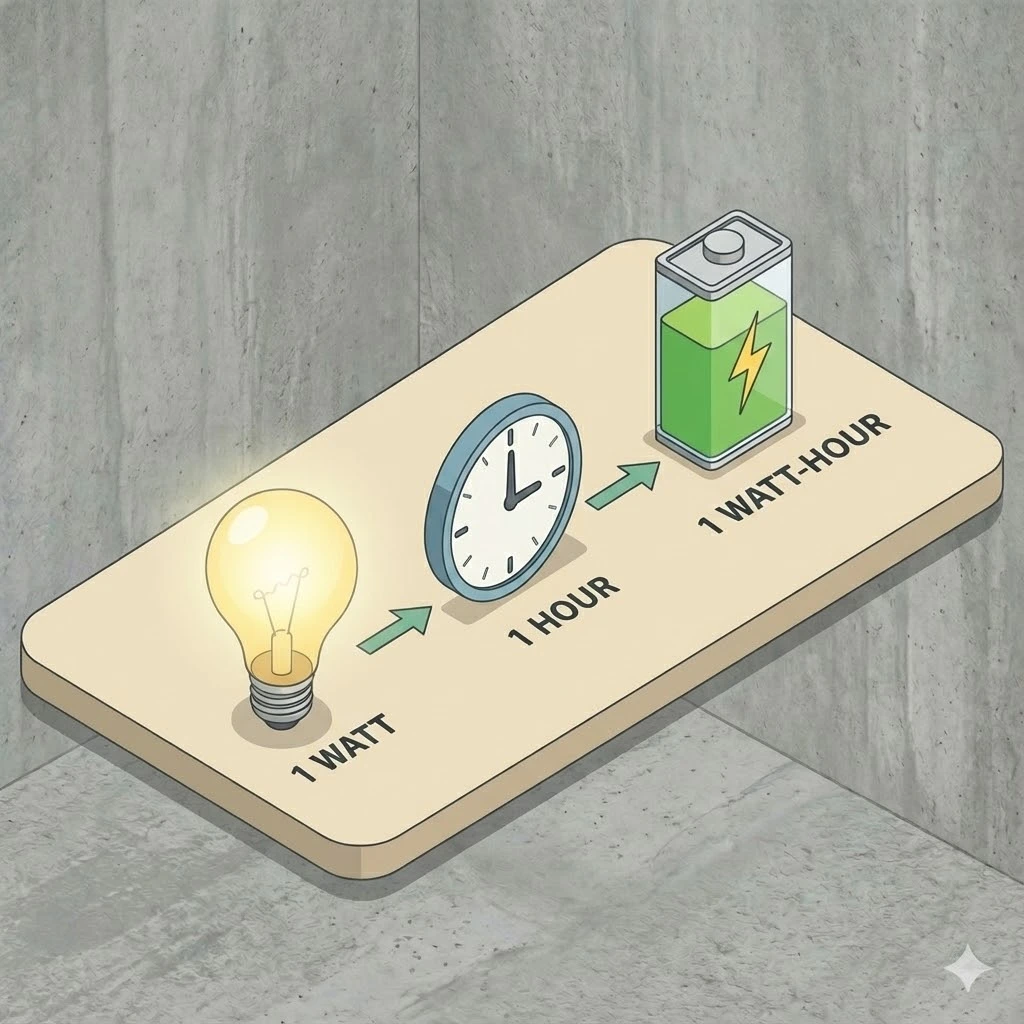
For the homeowner in a rush who just needs the basics before the contractor arrives, here is the essential summary of the entire guide.
- The Big Difference:
- Watt (W) = Speed. This measures how fast energy is being used right now. Think of it like the speedometer in a car. A 100-watt bulb runs "faster" than a 10-watt LED.1
- Watt-hour (Wh) = Distance. This measures the total amount of energy used over time. Think of it like the odometer that counts miles. If that 100-watt bulb runs for one hour, it uses 100 watt-hours.2
- The "K" Factor:
- A Kilowatt (kW) is 1,000 Watts.
- A Kilowatt-hour (kWh) is 1,000 Watt-hours.
- Your electric bill charges you for kWh (the total amount used), not kW (how fast you used it).3
- Solar vs. Batteries:
- Solar Panels are sold by the Watt or Kilowatt (kW). This tells you their maximum potential power when the sun is brightest.
- Batteries are sold by the Kilowatt-hour (kWh). This tells you how much energy they can hold—the size of the gas tank. They also have a kW rating, which tells you how many appliances they can run at once.4
- Money Talk:
- To lower your bill, you need to reduce kWh. This means either using efficient appliances (lower Watts) or turning things off sooner (less Hours).
---
Introduction: The Invisible Product
Electricity is the only product we buy that we never see. We don't see it flow through the wires, we don't pile it up in the garage like firewood, and we certainly don't weigh it on a scale like produce at the grocery store. Yet, every month, a bill arrives demanding payment for thousands of "units" of this invisible commodity. For most homeowners, the confusion starts right there. What exactly is being bought?
The confusion deepens when the conversation shifts to home improvements. A solar salesperson might talk about a "10kW system," while an appliance label warns of "1,500 Watts," and the monthly utility bill scolds the household for using "900 kWh." It often feels like everyone is speaking a different language.
Understanding these terms isn't just for engineers or electricians. It is the secret weapon for any homeowner who wants to save money, gain energy independence, or simply understand why the lights stay on. This guide breaks down the physics of home energy into simple, everyday language. It strips away the jargon and focuses on what matters: how energy works in a home, how it is measured, and how to control it. By mastering the simple concept of the "Watt-hour," a homeowner transforms from a passive payer of bills into an active manager of their own power plant.
---
Chapter 1: The Basics of Power and Energy
To understand a utility bill or a solar quote, one must first understand the difference between two very similar-sounding words: Power and Energy. In casual conversation, people use these words interchangeably. They might say, "I don't have the energy to run today," or "That car has a lot of power." But in the world of electricity, these two words mean very different things. Mixing them up is the most common reason homeowners buy the wrong size solar system or run out of battery backup during a storm.1
The Speed vs. Distance Analogy
The absolute best way to understand electricity is to compare it to driving a car. This analogy works because everyone understands that how fast you drive is different from how far you go.
1. Watts (W) = Speed
Imagine looking at the dashboard of a car. The speedometer reads 60 miles per hour. That number tells the driver exactly what the car is doing at that specific moment. It doesn't tell the driver where the car has been or how long it has been driving. It just measures the rate of travel.
In electricity, Watts (W) are the speedometer. They measure the rate at which electricity flows at a single moment in time.
- A bright incandescent light bulb might "drive" at 60 Watts.
- A powerful toaster might "drive" at 1,200 Watts.
- A massive central air conditioner might "drive" at 4,000 Watts.
This is often called "Power" or "Demand." It answers the question: How hard is the electrical system working right now?1
2. Watt-hours (Wh) = Distance
Now, look at the odometer on that same car. It reads 60 miles. This number doesn't tell the driver how fast the car was going. The car could have driven 60 mph for one hour, or 30 mph for two hours. The result is the same: a total distance of 60 miles covered.
In electricity, Watt-hours (Wh) are the odometer. They measure the total amount of electricity used over a period of time.
- If a 60-Watt bulb stays on for one hour, it has traveled "60 Watt-hours."
- If a 1,200-Watt toaster runs for one minute, it hasn't gone very far—only about 20 Watt-hours.
This is called "Energy" or "Consumption." It answers the question: How much work got done?1
The Bucket and The Hose
Another helpful way to think about this is using water. Imagine a garden hose filling up a bucket.
- The Watt (Power) is the width of the hose and the pressure of the water. A firehose has huge power; a drinking straw has very low power.
- The Watt-hour (Energy) is the amount of water inside the bucket.
A homeowner can fill a 5-gallon bucket (Energy) using a massive firehose in just one second, or they can fill it using a tiny trickle from a kitchen sink over ten minutes. In the end, they have the same amount of water (Watt-hours), but the rate (Watts) at which they got it was very different. This becomes incredibly important when talking about batteries later on. A battery is just a bucket of energy.3
The "Kilo" Short Cut
Scientists and engineers love the metric system because it makes big numbers easier to manage. In a typical house, appliances use thousands of Watts and Watt-hours. Writing out "3,500 Watts" or "1,000,000 Watt-hours" gets tiring and messy.
To fix this, the prefix "kilo-" is used. Kilo simply means "one thousand."
- 1 Kilowatt (kW) = 1,000 Watts.
- 1 Kilowatt-hour (kWh) = 1,000 Watt-hours.
So, instead of saying a heater uses 1,500 Watts, we say it uses 1.5 kW. Instead of saying a house used 30,000 Watt-hours in a day, we say it used 30 kWh.
The Kilowatt-hour (kWh) is the star of the show. This is the unit printed on every electric bill in the United States. It is the unit that costs money. When a homeowner buys electricity, they are buying blocks of 1,000 Watt-hours.2
Why The Confusion Matters
Why spend so much time on definitions? Because confusing these two concepts costs homeowners money.
Imagine a homeowner goes to a store to buy a generator for emergencies. They know they need to run their refrigerator, which consumes about 2 kWh of energy a day. They buy a small, quiet generator that has a big battery but a weak engine.
- The Problem: The refrigerator needs a surge of 1,200 Watts (Speed) to start its motor.
- The Mistake: The homeowner bought a generator with plenty of Watt-hours (Distance/Capacity) to run the fridge all day, but it only produces 500 Watts (Speed/Power).
- The Result: The generator stalls immediately. It’s like trying to tow a boat with a bicycle. The bicycle might have the energy to go 100 miles eventually, but it lacks the power to get the boat moving.7
Understanding the difference between the "Push" (Watts) and the "Pool" (Watt-hours) ensures that systems are sized correctly to actually work when needed.
---
Chapter 2: The Home Energy Audit – Where Do the Watt-Hours Go?
Now that the vocabulary is set, it is time to take a tour of the average American home. Every appliance has a personality. Some are "sprinters"—using massive power for short bursts. Others are "marathon runners"—using low power but running all day. And some are "vampires"—sucking small amounts of energy 24/7 without anyone noticing.
To calculate the cost of any appliance, a simple formula is used:
Watts × Hours Used ÷ 1,000 = kWh
Let’s walk room by room to see where the money goes.
The Kitchen: The Heat Hub
The kitchen is often the most energy‑hungry room in the house because generating heat takes a lot of energy. Turning electricity into heat is hard work.
- The Refrigerator: The Marathon Runner.
- The Stats: A modern fridge might only use 150 to 200 Watts while running. This sounds low. But unlike a toaster, a fridge never truly quits. It cycles on and off all day and night to keep food cold.
- The Math: 200 Watts × 10 hours a day = 2,000 Watt-hours, or 2 kWh per day.
- The Insight: This is why efficient fridges save so much money. Saving just 50 Watts on a device that runs 24/7 adds up to huge savings over a year.7
- The Electric Oven: The Heavy Lifter.
- The Stats: An oven element needs to get to 400 degrees Fahrenheit quickly. It draws a massive 2,000 to 4,000 Watts.
- The Math: Cooking a turkey for 4 hours? 3,000 Watts × 4 hours = 12,000 Watt-hours, or 12 kWh.
- The Insight: At an average price of 15 cents per kWh, cooking that turkey costs nearly $2.00 in electricity alone. This is why using a microwave (which uses high watts but cooks in minutes) is often much cheaper.9
- The Dishwasher: The Secret Steamer.
- The Stats: The motor that sprays the water uses very little power. The energy hog is the heating element that heats the water and dries the dishes. It can spike to 1,800 Watts.
- The Math: One load might use 1.5 kWh.
- The Trick: The "Air Dry" setting turns off that heating element, cutting energy use in half.10
The Laundry Room: The Hidden Costs
- The Clothes Dryer: The Energy Hog.
- The Stats: An electric dryer is essentially a giant toaster with a fan. It typically draws 3,000 to 5,000 Watts. It is often the second-biggest energy user in a home after the Air Conditioner.
- The Math: Drying two loads of laundry takes about 2 hours. 4,000 Watts × 2 hours = 8 kWh.
- The Insight: Just drying clothes can cost over $1.00 per day. Hanging clothes to dry is the single most effective "zero cost" way to save electricity.11
The Living Room: The Vampire's Lair
Electronics have changed the way homes consume power. Thirty years ago, when you turned off the TV, it was off. Today, "off" usually means "standby."
- The Big Screen TV:
- The Stats: A modern 65-inch LED TV is surprisingly efficient, using about 100 Watts. However, older Plasma TVs were beasts, using over 400 Watts.
- The Math: Binge‑watching for 5 hours on an LED? 100 Watts × 5 hours = 0.5 kWh. That costs pennies.
- The Warning: The cable box, game console, and sound system connected to the TV often use almost as much power as the TV itself, even when no one is watching.
- The Vampire Loads:
- A "Vampire Load" or "Phantom Load" is electricity used by devices that are plugged in but turned off. The little red light on the TV, the clock on the microwave, the "brick" on the laptop charger—all of these sip power.
- The Stats: Each one might only be 2 to 5 Watts.
- The Math: If a house has 40 such devices (which is common), that is 200 Watts of constant waste. 200 Watts × 24 hours = 4.8 kWh per day.
- The Insight: That is more electricity than the refrigerator uses! A home can spend $20 a month just powering "off" devices.1
The Basement/Garage: The Silent Spikes
- The Sump Pump / Well Pump:
- These devices sit quietly until they are needed. When they turn on, they are aggressive. A well pump might need 2,000 Watts instantly to push water up from the ground. While they don't use many kWh (because they run quickly), they require a robust electrical system to handle that initial kick.7
- The Water Heater:
- If a home has an electric tank water heater, it is a monster. It keeps 50 gallons of water hot 24/7. It cycles like a refrigerator but uses the massive power of an oven. It can account for 15‑25% of a monthly bill.9
The Climate Control: The King of Consumption
Finally, we meet the undisputed champion of the electric bill: The HVAC (Heating, Ventilation, and Air Conditioning) system.
- Central Air Conditioning:
- The Stats: A central AC unit can draw 3,500 to 5,000 Watts while running.
- The Math: On a hot summer day in the South, the AC might run for 10 hours. 4,000 Watts × 10 hours = 40 kWh.
- The Insight: In a single day, the AC uses what the refrigerator uses in three weeks. This is why "smart thermostats" are so popular—shaving just one hour off that run time saves massive amounts of Watt-hours.11
---
Chapter 3: Decoding the Electric Bill
Armed with knowledge about appliances, the monthly electric bill transforms from a mysterious demand for payment into a report card of the home's performance. However, utility companies don't make it easy. They pack bills with line items, fees, and varying rates. Let’s break down how to read it.
The Meter: The Cash Register
Every house has a meter. In the old days, these were glass globes with little spinning metal discs inside. The faster the disc spun, the more Watts (speed) the house was using. The dials on the face were the odometer, counting the Watt-hours (distance). Today, most homes have "Smart Meters." These are digital computers. They don't just count how much electricity is used; they record when it is used. They report this data back to the utility company every 15 minutes or hour.15
Supply vs. Delivery: The Two Halves of the Bill
One of the most confusing parts of a US electric bill is that the cost of electricity is often split into two separate charges.
- Supply Charge (The Product): This pays for the actual electricity—the electrons generated by burning coal, spinning wind turbines, or splitting atoms. In some states (like Texas, Pennsylvania, or Ohio), homeowners can choose which company generates their power.
- Delivery Charge (The Shipping): This pays for the poles, wires, transformers, and the trucks that come out during a storm to fix outages. This goes to the local utility company (like Duke Energy, PG&E, or ComEd). You generally cannot choose this company; it is based on where the house is located.18
Why This Matters:
A homeowner might see an advertisement for "Cheap Electricity: Only 8 cents per kWh!" They sign up, thinking their bill will drop. But that 8 cents is only for the Supply. The Delivery might cost another 6 cents. The true cost of a kilowatt‑hour is Supply + Delivery.
- Supply ($0.08) + Delivery ($0.06) = $0.14 per kWh.
When calculating savings from solar panels, the homeowner must always use this total combined rate.
Rate Structures: Not All Hours Are Created Equal
The price of a Watt‑hour can change depending on the time of day. Utilities use different "Plans" to bill customers.
- Flat Rate: The simplest plan. A kWh costs the same at 2:00 AM as it does at 2:00 PM. This is common in many parts of the Midwest and Northeast.
- Tiered Rate: The "bulk punishment" plan. The first bucket of energy is cheap. If the household uses more than a certain amount (say, 1,000 kWh), the price jumps up for every kWh after that. This punishes high users (like those with pools or old AC units).18
- Time-of-Use (TOU): The "Happy Hour" plan. Electricity is very cheap when demand is low (late at night) and very expensive when everyone is using it (late afternoon/evening).
- Example:
- Off-Peak (Midnight to 3 PM): $0.10 per kWh.
- On-Peak (4 PM to 9 PM): $0.40 per kWh.
- The Strategy: On a TOU plan, running the dishwasher at 5:00 PM costs four times as much as running it at 10:00 PM. Smart homeowners on these plans become "Load Shifters," moving their chores to cheap times to save money without actually using less energy.17
- Example:
---
Chapter 4: Solar Power – The "Sales Pitch" vs. Reality
For a homeowner considering solar panels, understanding kW and kWh is the only defense against bad deals. Solar is sold based on its Size (kW), but it pays for itself based on its Production (kWh).
The Rating: DC Kilowatts (The Engine Size)
When a solar installer says, "We recommend a 10 kW system," they are talking about the potential of the panels. A standard solar panel today is rated around 400 Watts.
- 25 panels × 400 Watts = 10,000 Watts = 10 kW.
The Reality: AC Kilowatt-Hours (The Mileage)
A 10 kW system will almost never produce 10 kW of power. Why?
- The Sun Moves: The sun is only at the perfect angle for a short time each day.
- Heat: Ironically, solar panels hate heat. As they get hotter on a summer roof, they become less efficient and produce fewer Watts.
- Conversion: Panels produce Direct Current (DC), but the house uses Alternating Current (AC). An inverter converts the electricity, losing about 3‑5% of the energy in the process.
Because of this, a homeowner shouldn't buy a system based just on the "10 kW" sticker. They need to ask: "How many kilowatt‑hours (kWh) will this produce in a year?"
Geography Matters: The Florida vs. Vermont Example
Let’s take that same 10 kW system and put it on two different houses.
- House A: Phoenix, Arizona.
- Arizona gets about 5.5 "Peak Sun Hours" per day on average.
- Math: 10 kW × 5.5 hours = 55 kWh per day.
- Annual Production: ~20,000 kWh.
- House B: Seattle, Washington.
- Seattle might average only 3.5 "Peak Sun Hours" per day due to clouds and northern latitude.
- Math: 10 kW × 3.5 hours = 35 kWh per day.
- Annual Production: ~12,700 kWh.
The homeowner in Seattle pays the same price for the equipment (the panels and wires) as the homeowner in Arizona, but they get nearly 40% less energy out of it. This makes the "price per kWh" of solar much higher in cloudy areas. A reputable installer will always provide an estimated "Annual Production" in kWh. This is the number to trust—not the system size.20
The Phenomenon of "Clipping"
New solar owners often panic when looking at their monitoring apps. They bought a 10 kW system, but at high noon on a sunny day, the chart flatlines at 7.6 kW. They think the system is broken. It usually isn't. This is called Clipping.
Installers often pair a large array of panels (10 kW) with a smaller inverter (7.6 kW).
- Why? Because the panels rarely hit their max potential anyway. A smaller inverter is cheaper and works better in the mornings and evenings when the sun is low.
- The Trade‑off: For one hour a day in the summer, the system might "throw away" that extra power above 7.6 kW. However, the system turns on earlier in the morning and stays on later in the evening, capturing more total Watt‑hours (Energy) even though it sacrifices some peak Watts (Power). It’s a smart engineering trade‑off that prioritizes total energy (distance) over top speed.
---
Chapter 5: Batteries and Resilience – Keeping the Lights On
The most critical test of a homeowner's energy knowledge comes during a blackout. When the grid goes down, the house is strictly limited by the physics of the battery backup system. This is where the difference between kW (Power) and kWh (Capacity) becomes a matter of comfort vs. crisis.
The Two Battery Ratings
When shopping for a home battery (like a Tesla Powerwall or Enphase IQ Battery), the spec sheet will list two big numbers.
- Capacity (kWh): The Gas Tank.
This is how much energy the battery holds. It determines how long the house can stay powered.- Example: A Tesla Powerwall 3 has a capacity of 13.5 kWh.23
- Real World: If a house uses 1 kWh per hour (a typical usage), this battery will last about 13.5 hours before it dies.
- Continuous Power Rating (kW): The Engine Size.
This is how much electricity the battery can push out at once. It determines what appliances can run simultaneously.
Scenario: The Blackout Dinner
It is 6:00 PM on a Tuesday. A storm knocks out the power lines. The battery system kicks in instantly. The family starts cooking dinner.
- The Electric Oven is on (3 kW).
- The Air Conditioner kicks on (4 kW).
- The Microwave is used to warm up soup (1.5 kW).
- Lights and TV are on (0.5 kW).
- Total Demand: 3 + 4 + 1.5 + 0.5 = 9 kW.
The Outcome:
- With the Tesla Powerwall 3 (11.5 kW output): The lights stay on. The dinner gets cooked. The AC runs. The battery is strong enough (high kW) to handle the load. However, draining 9 kW from a 13.5 kWh battery means the battery will be empty in about 90 minutes. The family has high performance but short duration.
- With the Enphase IQ Battery 5P (3.84 kW output): The moment the oven and AC try to run at the same time, the battery overloads. It cannot push 9 kW. The breaker trips, and the house goes dark. To make this work, the homeowner would need to install three Enphase batteries to get the power output needed, or simply choose not to run the AC and Oven during an outage.8
The "Starting Watts" Trap
The trickiest part of backup power is the "Surge." Motors, like those in a central AC or a well pump, require a massive kick of power to get moving—often 3 to 4 times their running wattage.
- A well pump might run at 1,000 Watts (1 kW) but need 4,000 Watts (4 kW) to start.
If the battery system cannot provide that split‑second 4 kW surge, the pump will simply buzz and fail to pump water, even if the battery is fully charged. Homeowners with wells or large AC units need to pay very close attention to the "Peak Power" or "LRA" rating of a battery.7
Sizing for Survival: The "Days of Autonomy"
How big of a battery does a house need? Solar installers use a calculation called "Days of Autonomy"—how many days can the house run if the sun doesn't shine (no solar recharging)?
Step 1: Calculate the "Survival Load."
In an emergency, the family won't run the dryer or the pool pump. They just need the fridge, internet, lights, and maybe the furnace fan.
- Estimated Survival Load: 10 to 15 kWh per day.
Step 2: Choose the Duration.
If the goal is to survive a 2‑day winter storm:
- 15 kWh/day × 2 days = 30 kWh required.
Step 3: Buy the Batteries.
- A single Tesla Powerwall (13.5 kWh) is not enough. It would die halfway through day 2.
- Two Powerwalls (27 kWh) would likely be just enough, provided the family is careful.
- The Lesson: Most single‑battery installations are designed to last only through the night until the sun comes up the next morning. They are not designed for multi‑day storms unless the homeowner drastically reduces their usage.27
---
Chapter 6: The Future of Home Energy
The relationship Americans have with watt‑hours is changing. Homes are becoming "electrified." Gas cars are being replaced by Electric Vehicles (EVs). Gas furnaces are being replaced by Heat Pumps. Gas stoves are being replaced by Induction Cooktops.
This means household electricity consumption (kWh) is going to skyrocket, even as the homes become more efficient.
The EV Impact
An Electric Vehicle is the biggest appliance a homeowner will ever buy.
- A standard EV battery holds roughly 60 to 100 kWh of energy.
- Charging an EV fully is mathematically equivalent to running the entire rest of the house for 2 to 3 days.
- The Math: Driving 40 miles a day uses about 10‑12 kWh. Over a month, that is roughly 350 kWh—essentially adding a second refrigerator and AC unit to the bill.
- The Opportunity: Because EVs use so much energy, charging them during "Off‑Peak" hours (like 2 AM) using a Time‑of‑Use plan is the single biggest money‑saving move a modern homeowner can make.29
The Heat Pump Revolution
Heat pumps are magical devices that move heat rather than creating it.
- An old electric baseboard heater uses 1,000 Watts of electricity to create 1,000 Watts of heat.
- A modern heat pump uses 1,000 Watts of electricity to move 3,000 Watts of heat from the outside air into the home.
- By upgrading to a heat pump, a homeowner drastically reduces the Watt‑hours needed to heat the home, effectively buying "discounted heat" through physics.10
---
Chapter 7: Practical Tips for the Savvy Homeowner
Understanding the Watt‑hour is a superpower. Here is how to use it today to save money without spending a fortune on new equipment.
- Do the "Touch Test." Walk around the house. If an electronic device feels warm to the touch (like a cable box or an old power brick), it is wasting Watt‑hours in the form of heat. Unplug it or put it on a power strip that can be switched off.
- Delay the Dishwasher. Check the utility bill. If there is a "Time of Use" plan, press the "Delay Start" button on the dishwasher so it runs at midnight. That simple button press could cut the cost of that load by 50%.
- LED Everything. It is cliché, but it works. Replacing ten 60‑Watt bulbs with ten 9‑Watt LEDs saves 510 Watts every hour they are on. Over a year, that is hundreds of kilowatt‑hours saved for an investment of $20.
- Understand the Bill. Look at the "Supply" and "Delivery" charges. Divide the total bill amount by the total kWh used. This "Effective Rate" is the real number needed to calculate if a new efficient appliance is worth the cost.
- Respect the Surge. If running a generator or battery during an outage, don't turn everything on at once. Turn on the biggest loads (like the fridge or well pump) first, let them settle, and then turn on the lights. Managing the kW (Power) prevents the system from crashing, preserving the kWh (Energy) for later.
Conclusion
The Watt‑hour is more than just a line on a bill. It is the currency of the modern home. It represents the work the house does to keep a family warm, fed, entertained, or safe. By distinguishing the speed of electricity (Watts) from the distance of electricity (Watt‑hours), homeowners can finally take the wheel. They can size solar systems that actually deliver what is promised, buy batteries that survive the storm, and manage their daily lives to keep more money in their pockets. The invisible product is finally visible.
---
Reference Tables: Cheat Sheets for Home Energy
Table 1: What Does 1 kWh Cost?
Assuming an average US rate of roughly $0.16 per kWh (Supply + Delivery).
| If you use... | It takes roughly... | To consume 1 kWh | Cost of 1 kWh |
|---|---|---|---|
| LED Light Bulb (10W) | 100 Hours | 1 kWh | $0.16 |
| Ceiling Fan (50W) | 20 Hours | 1 kWh | $0.16 |
| 55" LED TV (80W) | 12.5 Hours | 1 kWh | $0.16 |
| Desktop Computer (200W) | 5 Hours | 1 kWh | $0.16 |
| Space Heater (1,500W) | 40 Minutes | 1 kWh | $0.16 |
| Electric Oven (3,000W) | 20 Minutes | 1 kWh | $0.16 |
| Electric Shower (10,000W) | 6 Minutes | 1 kWh | $0.16 |
Table 2: The "Can My Battery Run It?" Checklist
Comparing a standard battery output (5 kW continuous) to appliance demands.
| Appliance | Running Watts (kW) | Surge Watts (kW) | Can 1 Standard Battery Run It? |
|---|---|---|---|
| Lights + WiFi + Fridge | 0.5 kW | 1.5 kW | YES (Easy) |
| Microwave | 1.5 kW | 1.5 kW | YES |
| Coffee Maker | 1.0 kW | 1.0 kW | YES |
| Sump Pump (1/2 HP) | 1.0 kW | 3.0 kW | YES (Be careful what else is on) |
| Central AC (3 Ton) | 3.5 kW | 7.0 kW+ | NO (Surge is too high; needs 2+ batteries) |
| Electric Range/Stove | 3.0 – 10.0 kW | 3.0 – 10.0 kW | NO (Requires too much continuous power) |
Works cited
- Of Watts and Watt‑Hours | Northwest Edible Life, accessed December 9, 2025, https://nwedible.com/of-watts-and-watt-hours/
- What is the difference between a watt and a watt‑hour? – Enphase Support, accessed December 9, 2025, https://support.enphase.com/s/article/What-is-the-difference-between-a-watt-and-a-watt-hour
- What's a Watt? | AltE Store, accessed December 9, 2025, https://www.altestore.com/blogs/articles/whats-a-watt
- What is the Difference between kW vs. kWh? – EcoFlow, accessed December 9, 2025, https://www.ecoflow.com/us/blog/difference-kw-kwh
- Understanding the Difference between a Watt and a Watt‑hour – FranklinWH, accessed December 9, 2025, https://www.franklinwh.com/blog/understanding-the-difference-between-a-watt-and-a-watt-hour
- Difference between kW and kWh in solar – Electrical Innovations, accessed December 9, 2025, https://elec-inn.co.uk/whats-the-difference-between-kilowatts-and-kilowatt-hours-in-a-solar-installation/
- Appliance Wattage Chart: What Size of Jackery Do I Need?, accessed December 9, 2025, https://www.jackery.com/blogs/knowledge/appliance-wattage-chart
- Those of you with home batteries, is there anything you wish you had done differently?, accessed December 9, 2025, https://www.reddit.com/r/solar/comments/1nepa7g/those_of_you_with_home_batteries_is_there/
- Typical Wattages of Appliances | Solar Energy DC Inc., accessed December 9, 2025, https://solarenergydc.com/pages/typical-wattages-of-appliances
- Appliance Energy Use Chart – Silicon Valley Power, accessed December 9, 2025, https://www.siliconvalleypower.com/residents/save-energy/appliance-energy-use-chart
- Household Appliances – Cornhusker PPD, accessed December 9, 2025, https://cornhusker-power.com/rebates/household-appliances/
- Appliance Usage Chart – Burlington Hydro, accessed December 9, 2025, https://www.burlingtonhydro.com/powertoconserve/residential/appliance-usage.html
- Reading Your Electricity Meter – Home – Duke Energy, accessed December 9, 2025, https://www.duke-energy.com/home/billing/reading-your-meter?jur=NC01
- How Much Electricity Does The US Use? 2025 Data & Trends – SolarTech, accessed December 9, 2025, https://solartechonline.com/blog/how-much-electricity-does-us-use-2025-guide/
- Electricity meter – Wikipedia, accessed December 9, 2025, https://en.wikipedia.org/wiki/Electricity_meter
- Electric Meters | Department of Energy, accessed December 9, 2025, https://www.energy.gov/energysaver/electric-meters
- How Electric Meters Work – Palmetto Solar, accessed December 9, 2025, https://palmetto.com/solar/how-does-electric-meter-work-and-what-does-electric-meter-do
- How Utility Companies Measure and Charge for kWh Usage – Energy Select, accessed December 9, 2025, https://energyselectllc.com/blog/how-utility-companies-measure-and-charge-for-kwh-usage/
- Understanding My Bill – My Account | PGE – Portland General Electric, accessed December 9, 2025, https://portlandgeneral.com/help/help-topics/understanding-my-bill
- Myth vs Reality: kW vs kWh and Why It Matters for Homes – Anern Store, accessed December 9, 2025, https://www.anernstore.com/blogs/diy-solar-guides/kw-vs-kwh-homes
- How the Size of a Solar Panel System is Measured – Good Energy Solutions, accessed December 9, 2025, https://goodenergysolutions.com/how-the-size-of-a-solar-panel-system-is-measured/
- How Much Energy Does a Solar Panel Produce?, accessed December 9, 2025, https://www.solar.com/learn/how-much-energy-does-a-solar-panel-produce/
- How Powerwall Works | Tesla Support, accessed December 9, 2025, https://www.tesla.com/support/energy/powerwall/learn/how-powerwall-works
- IQ Battery 5P – Enphase, accessed December 9, 2025, https://enphase.com/store/storage/gen3/iq-battery-5p
- Everything to Know About the Enphase IQ Battery 5P (2025 Guide) – OC Solar, accessed December 9, 2025, https://ocsolar.com/everything-to-know-about-the-enphase-iq-battery-5p-2025-guide/
- Powerwall 3 Datasheet | Energy Library, accessed December 9, 2025, https://energylibrary.tesla.com/docs/Public/EnergyStorage/Powerwall/3/Datasheet/en-us/Powerwall-3-Datasheet.pdf
- accessed December 9, 2025, https://www.ecoflow.com/us/blog/calculate-home-solar-battery-size#:~:text=Math%20is%20simple%3A%20multiply%20your,kWh%20of%20battery%20capacity%20needed.
- Solar Battery Storage: Your Ultimate Sizing Guide – EcoFlow, accessed December 9, 2025, https://www.ecoflow.com/us/blog/calculate-home-solar-battery-size
- What is a Kilowatt Hour? Understanding Your Electric Bills – Compare Power, accessed December 9, 2025, https://comparepower.com/what-is-a-kilowatt-hour/
- Usage Chart: How Many Watts Do You Need? – DonRowe.com, accessed December 9, 2025, https://www.donrowe.com/usage-chart-a/259.htm