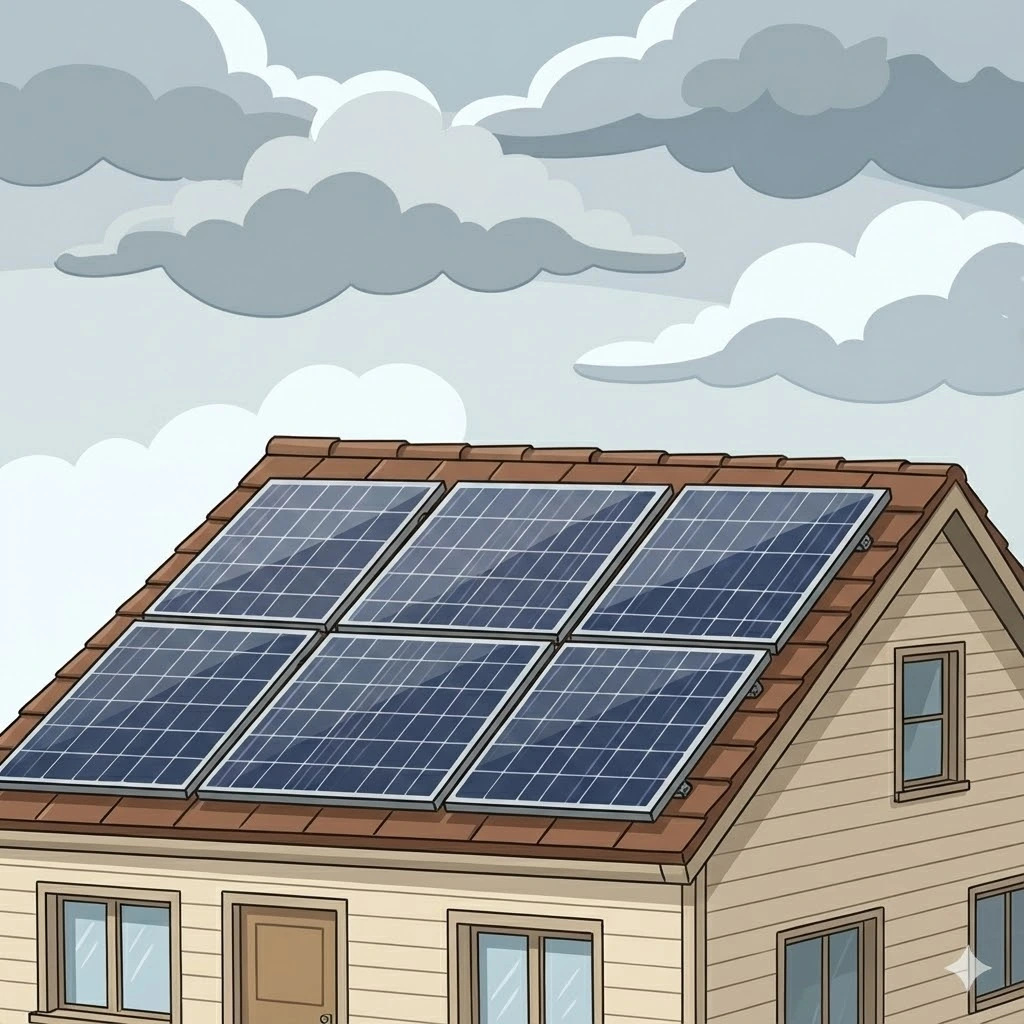
For homeowners short on time, here is the quick summary of how solar power handles cloudy days and what the current market looks like for 2025 and beyond:
- Yes, they work: Solar panels do not need direct sunlight to generate electricity. They can use "diffuse" light (sunlight scattered by clouds) to produce power. Expect about 10-25% of normal output on heavy overcast days and 50-80% on partly cloudy days. 1
- Cooler is better: Solar panels actually lose efficiency when they get hot. The cool temperatures often found on cloudy days help panels run more efficiently, which partially offsets the lower light levels. 1
- Net Metering is the secret: In cloudy states like Washington or Massachusetts, the financial math works because of "Net Metering." This policy allows homeowners to "bank" the extra energy they make in the sunny summer and use those credits to pay for electricity in the dark winter. It acts like a financial battery. 2
- The "Cloud Edge" Bonus: Sometimes, a cloudy day can produce more power than a sunny one for short bursts. When the sun peeks around the edge of a cloud, the light reflects and magnifies, creating a surge of energy called the "Cloud Edge Effect". 3
- Urgent Deadline (2025 vs. 2026): A major change in federal law (the "One Big Beautiful Bill Act" or OBBBA) means the 30% federal tax credit for buying solar panels ends on December 31, 2025. If homeowners want to own their system, they must install it in 2025. Starting in 2026, leasing will likely become the better financial option. 6
---
1. Introduction: The Myth of the "Perfectly Sunny Day"
When most people picture solar energy, they imagine the blazing sun of the Mojave Desert or the endless blue skies of Florida. It is a common assumption that solar panels are essentially useless the moment a cloud rolls in. This belief has kept many homeowners in the Pacific Northwest, the Northeast, and the Midwest from investigating a technology that could save them thousands of dollars.
The reality of photovoltaic (PV) technology—the science behind solar panels—is far more resilient than this myth suggests. Solar panels are designed to capture light, not heat. Just as a person can get a severe sunburn on a cloudy day because ultraviolet (UV) rays penetrate the cloud cover, solar panels can continue to harvest energy from the light that filters through the sky. 8
Modern engineering has advanced significantly. The solar panels available in 2025 are not the same as those from ten years ago. New materials and designs allow these systems to squeeze electricity out of the grayest winter afternoons. In fact, some of the most successful solar markets in the world are not in the desert, but in places like Germany, Seattle, and Boston. 1
This report explores exactly how solar panels function when the weather turns gloomy. It breaks down the science of "diffuse light," examines the surprising benefits of cold weather, and details the financial policies that make solar a smart investment even for homes that do not see the sun for days at a time. It also addresses the critical legislative changes occurring in 2025 that every homeowner needs to understand before signing a contract.
---
2. The Science of Solar in Low Light
To understand how a solar panel can keep the lights on when the sky is gray, it is necessary to look at how light behaves. Sunlight arrives at the Earth in two main forms: Direct Light and Diffuse Light.
2.1 Direct vs. Diffuse Sunlight
Direct Sunlight is what creates sharp shadows. It travels in a straight line from the sun to the roof. This is the most potent form of energy for a solar panel. On a clear day at noon, this light is intense and provides the maximum amount of energy the panel is rated for. 2
Diffuse Sunlight is what happens when clouds get in the way. Clouds are made of water vapor and ice crystals. When sunlight hits them, it does not just stop; it scatters. The light bounces around inside the cloud and comes out the bottom in all directions. This is why the world does not go completely dark when a cloud passes overhead. There is still ambient light, and that light contains energy. 1
Solar panels are built to convert photons (particles of light) into electrons (electricity). While direct sunlight packs the most photons, diffuse light still carries enough of them to generate a current.
- Partly Cloudy Days: When the sky is a mix of sun and clouds, panels typically operate at 50% to 80% of their maximum efficiency. 1
- Overcast Days: On days with heavy, thick cloud cover, production drops but does not stop. Panels generally produce 10% to 25% of their rated power. 1
- Rain and Fog: Even in rain, panels can produce 5% to 10% of their max output. Fog behaves similarly to clouds, scattering light but allowing "diffuse" energy to reach the cells. 8
While 10% might sound low, over the course of a long summer day in a northern city like Seattle, those kilowatt-hours (kWh) add up. Furthermore, as discussed later, state policies allow homeowners to save the surplus energy from sunny days to cover the deficits of cloudy ones.
2.2 The "Cloud Edge Effect"
There is a fascinating exception to the rule that clouds reduce power. It is called the Cloud Edge Effect (or sometimes "cloud lensing").
Imagine a partly cloudy day where puffy white cumulus clouds are drifting across the sky. As the sun moves close to the edge of a cloud, the sunlight hits the side of that cloud and reflects off the brilliant white surface. For a few moments, the solar panels on a roof receive a "double dose" of energy:
- The direct beam from the sun.
- The reflected beam from the cloud edge. 3
This acts like a magnifying glass. During these moments, the intensity of the light can actually exceed what is possible on a perfectly clear day. Solar inverters often record "spikes" in power production that go above the panel's nameplate rating. A 400-watt panel might briefly produce 450 watts or more. These spikes help boost the daily total energy production, making partly cloudy days surprisingly productive. 11
2.3 Why Cold Weather Helps
Solar panels are electronic devices, much like a smartphone or a laptop. Most electronics function better when they are cool and run slower or less efficiently when they overheat. Solar panels are no different.
Every solar panel has a specification called the Temperature Coefficient. This number tells us how much efficiency the panel loses for every degree the temperature rises above 25°C (77°F). 1
- In a hot climate like Arizona, solar panels on a roof can bake at temperatures over 150°F. This heat can cause the panels to lose 10% to 20% of their efficiency. 8
- In a cloudy climate like Washington or Maine, the air is usually cooler. If it is a cloudy day with a temperature of 60°F, the panels are operating at their peak efficiency.
This creates a balancing act. A cloudy day provides less light, but the panel is better at converting that light into electricity because it is not overheating. This "cool weather bonus" is a major reason why solar works so well in northern climates. 1
| Weather Condition | Estimated Output (% of Maximum) | Why? |
|---|---|---|
| Clear Sunny Day | 100% | Direct light maximizes photon impact. |
| Partly Cloudy | 50% - 80% | Mix of direct and scattered light. |
| Edge of Cloud | 110% - 125% | Cloud reflection magnifies sunlight briefly. |
| Heavy Overcast | 10% - 25% | Only diffuse light reaches the panel. |
| Rain / Heavy Fog | 5% - 10% | Thick moisture blocks most light. |
| 1 |
---
3. Choosing the Right Equipment for Cloudy Skies
Since a homeowner in a cloudy region is working with less intense light, the choice of equipment becomes more important than it is for someone in the desert. Certain technologies are specifically engineered to "squeeze" more energy out of diffuse light.
3.1 The Best Solar Panels: Monocrystalline vs. The Rest
Solar panels generally come in two main flavors: Monocrystalline and Polycrystalline.
Monocrystalline (Mono) Panels: These are made from a single, pure crystal of silicon. They have a smooth, black appearance.
- Cloudy Weather Performance: These are the clear winners. They are more efficient at moving electrons around, which helps them capture the weaker "diffuse" light found on cloudy days. They typically perform 15% to 20% better in low light than polycrystalline panels. 1
- Recommendation: Homeowners in cloudy areas should almost exclusively look for Monocrystalline panels (often labeled as "Mono PERC" or "N-Type").
Polycrystalline (Poly) Panels: These are made from fragments of silicon melted together. They have a speckled blue look.
- Cloudy Weather Performance: The boundaries between the crystal fragments act like roadblocks for the electrons. In low light, the energy struggles to overcome these roadblocks, leading to poor performance.
- Recommendation: These are older technology and generally should be avoided for residential roofs in cloudy states. 14
Heterojunction Technology (HJT): This is the premium option. HJT panels combine the best of both worlds. They use a high-quality crystal core (like mono panels) sandwiched between ultra-thin layers of "amorphous" silicon (the kind used in calculators).
- Why it wins: The amorphous layers are exceptionally good at soaking up the very low light found at dawn, dusk, and during storms. Brands like REC and Panasonic use this tech. It offers the best performance for gray days, though it often comes with a higher price tag. 15
3.2 Inverters: Microinverters are Essential
The inverter is the box that takes the DC electricity from the panels and turns it into the AC electricity the house uses. There are two main types: String Inverters and Microinverters.
String Inverters: These connect all the panels in a long chain, like old Christmas lights. If one panel gets shaded by a passing cloud, it can drag down the performance of the entire chain. In a variable climate with clouds moving constantly, this is not ideal. 10
Microinverters: These are small devices attached to each individual panel. Each panel works independently.
- Why they win: If a cloud covers half the roof, the panels on the other half keep cranking out maximum power. If a wet leaf sticks to one panel, the others are unaffected. For cloudy, variable weather, microinverters (from brands like Enphase) are highly recommended to maximize the "harvest" of energy. 10
3.3 Solar Batteries
Batteries, like the Tesla Powerwall, are becoming a key part of the solar conversation in cloudy regions.
- Resilience: Cloudy regions often experience storms that knock out power. A battery can keep the lights on.
- Charging in Clouds: A common myth is that you need full sun to charge a battery. This is false. Even if the solar array is only producing 20% power on a rainy day, that energy flows into the battery. It might take longer to fill up, but it will still charge, providing security for the home. 2
---
4. Real-World Success Stories: Solar in Gray Cities
It is easy to claim that solar works in theory, but the proof is in the data. Some of the places with the highest rates of solar adoption are famous for their bad weather.
4.1 Seattle, Washington: The Rainy City
Seattle has a reputation for rain and gloom, averaging 226 cloudy days a year. 10 Yet, solar is booming in the Pacific Northwest.
- The Data: A typical solar system in Seattle produces about 1,000 kilowatt-hours (kWh) of energy per year for every kilowatt (kW) of panels installed. 8
- **A standard 8kW home system creates roughly 8,000 to 10,000 kWh annually, which is enough to cover most or all of an average family's electricity needs. 17
- Comparison: While a system in Seattle produces about 35% less energy than the same system in Miami, it produces nearly the same amount as a system in Germany, the world leader in solar power. 8
- Long Summer Days: Seattle compensates for its dark winters with incredibly long summer days. In June and July, the sun is up for 16 hours. Solar panels gorge on this summer light, building up a massive surplus of energy credits. 17
4.2 Portland, Oregon: Clouds and Credits
Portland is similar to Seattle, with 222 cloudy days a year.
- The Data: Solar panels in Portland produce slightly more than Seattle—about 1,080 kWh per installed kW annually. 8
- Incentives: Oregon offers specific cash rebates (up to $5,000) for solar installations and additional rebates for batteries. This helps lower the upfront cost, making the return on investment (ROI) look much better despite the clouds. 18
4.3 Massachusetts and New York: High Rates, High Value
The Northeast (Boston, New York City) gets snow, ice, and plenty of clouds (approx. 160 cloudy days a year). 10 However, this region is a solar goldmine.
- The Secret: Electricity is expensive here. In Massachusetts, homeowners often pay 30 cents or more for a kilowatt-hour of electricity. In a sunny state like Arizona, power might only cost 15 cents. 19
- The Math: Even if a panel in Boston produces less electricity than one in Arizona, the electricity it does produce is worth twice as much money. Saving 1,000 kWh in Boston puts more money back in the homeowner's pocket than saving 1,500 kWh in Phoenix. This makes the "payback period" (the time it takes for the system to pay for itself) very attractive, often around 6-9 years. 19
| City | Cloudy Days / Year | Annual Production (per kW installed) | Local Advantage |
|---|---|---|---|
| Seattle, WA | 226 | ~1,000 kWh | Long summer days; Sales tax exemption |
| Portland, OR | 222 | ~1,080 kWh | Cash rebates; Battery incentives |
| Boston, MA | 164 | ~1,100 kWh | Very high electricity prices; Strong incentives |
| New York, NY | 152 | ~1,200 kWh | High electricity prices; Urban density |
| Miami, FL (Comparison) | ~90 | ~1,550 kWh | High sun, but lower electric rates |
| 8 |
---
5. The Financial Safety Net: Net Metering
If solar panels produce huge amounts of power in July but very little in December, how does a homeowner keep the lights on in winter without going broke? The answer is a policy called Net Energy Metering (NEM). Think of Net Metering as a bank account for electricity.
- Summer (Deposit): In July, the days are long and the sun is high. The solar panels produce far more electricity than the house can use. The excess power flows backward through the electric meter and onto the public grid, supplying neighbors with clean power. The utility company credits the homeowner's account for this extra energy. 2
- Winter (Withdrawal): In December, it is dark and rainy. The panels aren't producing enough power to run the lights and the heater. The house pulls electricity from the grid. However, instead of paying for this power with cash, the homeowner pays with the "credits" they banked back in July. 2
For homeowners in cloudy states like Washington and Massachusetts, Net Metering is the magic that makes solar viable. It allows them to average out their production over a full year, rather than worrying about the weather on any single day. 2
- Washington State Policy: Washington utilities are required to offer net metering. They usually reset the "bank" on March 31st every year. This is perfectly timed so homeowners can use up all their winter credits just as the sun starts coming back in spring. 21
- Massachusetts Update: In 2025, Massachusetts expanded its net metering rules, allowing larger residential systems (up to 25 kW) to qualify. This is great news for people wanting to power electric vehicles (EVs) and heat pumps. 22
---
6. The 2025 Market Shift: Incentives and Deadlines
This is perhaps the most critical section for any homeowner reading this report in 2025. The rules for buying solar are changing dramatically due to new federal legislation.
6.1 The End of the Purchase Tax Credit (Section 25D)
For years, the biggest reason to buy solar panels was the Federal Solar Investment Tax Credit (ITC), specifically "Section 25D." This allowed homeowners to take 30% of the total cost of their solar system and deduct it directly from their federal income taxes. If a system cost $20,000, the government effectively gave you a coupon for $6,000 off. 7
-
The Change: A new law, referred to in reports as the "One Big Beautiful Bill Act" (OBBBA), was signed in July 2025. Under this law, the 30% tax credit for homeowners who buy their systems (with cash or a loan) expires completely on December 31, 2025. 6
-
What this means: To get the 30% credit, the system must be installed and "placed in service" (turned on) by the end of 2025. If a homeowner waits until January 1, 2026, to buy solar, that 30% savings disappears entirely. 7
6.2 The Pivot to Leasing in 2026
While the credit for homeowners is ending, the credit for businesses (Section 48E) has been extended through 2027. 25
This creates a strange loophole. Starting in 2026, it will likely make more sense for homeowners to lease solar panels rather than buy them.
- How it works: If a homeowner signs a lease or a "Power Purchase Agreement" (PPA), the solar company (a business) technically owns the panels. Because a business owns them, the solar company can claim the 30% commercial tax credit. The solar company should pass those savings on to the homeowner in the form of lower monthly lease payments. 27
Summary Strategy:
- If you act in 2025: Buying (Cash or Loan) is usually the best deal because you get the tax credit yourself.
- If you wait until 2026: Leasing will likely become the smarter financial move. 27
6.3 State Specific Incentives
Even as federal laws change, states in cloudy regions offer their own perks to keep solar affordable.
- Washington: Homeowners pay 0% sales tax on solar systems (up to 100kW). This saves roughly 10% on the upfront cost immediately. This exemption lasts until 2029. 29
- Oregon: The state offers rebates up to $5,000 for solar and $2,500 for batteries. There are special higher rebates for low-and-moderate income households under the "Solar Within Reach" program. 18
- Massachusetts: The SMART program pays homeowners a small cash bonus for every kilowatt-hour of solar energy they produce, regardless of whether they use it or send it to the grid. 32
---
7. Buying Guide: Top Brands for Cloudy Weather
If a homeowner decides to move forward, asking for the right equipment is key. Here are the top brands that excel in low-light conditions based on 2024-2025 reviews.
7.1 Best Panels for Low Light
- Maxeon (formerly SunPower): These are widely considered the best panels on the market. They use high-efficiency cells that capture a broad spectrum of light. They are expensive, but they degrade very slowly and handle cloudy days better than almost anything else. 33
- REC Group (Alpha Series): REC uses the advanced "Heterojunction" (HJT) technology mentioned earlier. These panels are fantastic for cloudy, cool climates like the Pacific Northwest. They are a favorite among installers in these regions. 16
- Qcells (Q.TRON): Qcells are hugely popular because they offer a great balance of performance and price. They are often "all-black," looking great on a roof, and provide solid low-light performance for a lower cost than Maxeon or REC. 34
7.2 Best Inverters
- Enphase Energy: The leader in microinverters. They put a small computer chip on every panel. If a cloud shades the east side of the roof, the west side keeps running at 100%. This is the standard choice for variable weather. 10
---
8. Common Myths Busted
Let’s clear up a few final misconceptions that float around the neighborhood barbecue.
Myth 1: "Solar panels don't work in the winter."
- Fact: They work fine in winter, just less than in summer because the days are shorter. In fact, snow reflects light onto the panels (albedo effect), and the cold air boosts the electronics' efficiency. 3
Myth 2: "It's too expensive without sun."
- Fact: In many cloudy states, electricity from the grid is so expensive that solar saves money even with lower production. 8
Myth 3: "I need batteries to go solar."
- Fact: Not necessarily. If your state has Net Metering (like WA or MA), the grid acts as your free battery. You only strictly need a physical battery if you want backup power during a blackout. 2
Myth 4: "I missed the boat on solar."
- Fact: Not yet. If you are reading this in 2025, you are in the final rush to get the 30% ownership tax credit. If you are reading this in 2026, the boat hasn't sailed, but the ticket type has changed (to leasing). 27
---
9. Conclusion: Is It Worth It?
So, do solar panels work in cloudy weather? Absolutely.
They might not generate the massive power spikes seen in the Arizona desert, but they are steady, reliable, and surprisingly efficient workers in the gray climates of the US. Thanks to technology that captures scattered light and policies like Net Metering that smooth out the seasonal bumps, homeowners in Seattle, Portland, and Boston are seeing returns on investment that rival their sunny counterparts.
However, the clock is ticking. The legislative changes arriving at the end of 2025 create a strict deadline for those who want to own their systems and claim the federal tax break.
Recommendation:
- If you live in a cloudy state and have been thinking about solar, 2025 is the year to act. Get quotes now.
- Ask specifically for Monocrystalline or HJT panels.
- Ensure your installer uses Microinverters.
- Check if your roof needs replacing before installing the panels.
The sun is always shining, even above the clouds. Modern technology has finally given us the tools to reach it.
Works cited
- The Science Behind Solar Power in Low-Light Conditions - Solterra ..., accessed December 10, 2025, https://solar.solterra.com/the-science-behind-solar-power-in-low-light-conditions/
- Do Solar Panels Work On Cloudy Days? | Sunrun, accessed December 10, 2025, https://www.sunrun.com/go-solar-center/solar-articles/do-solar-panels-work-on-cloudy-days
- From Snow to Shine: How Solar Panels Work in All Weather Conditions - PosiGen, accessed December 10, 2025, https://www.posigen.com/blog/from-snow-to-shine-how-solar-panels-work-in-all-weather-conditions
- Net metering guide - Mass.gov, accessed December 10, 2025, https://www.mass.gov/info-details/net-metering-guide
- accessed December 10, 2025, https://www.ecoflow.com/us/blog/solar-panels-cloudy-days#:~:text=Interestingly%2C%20sometimes%20cloudy%20weather%20can,radiation%20that%20reaches%20your%20panels.
- From IRA to OBBBA: A New Era for Clean Energy Tax Credits | Advisories | Arnold & Porter, accessed December 10, 2025, https://www.arnoldporter.com/en/perspectives/advisories/2025/07/from-ira-to-obbba-a-new-era-for-clean-energy-tax-credits
- Trump and the Fate of the 30% Solar Tax Credit in 2025, accessed December 10, 2025, https://www.solar.com/learn/trump-and-the-fate-of-the-30-solar-tax-credit/
- Is Solar Worth It If You Live in a Cloudy Climate? (2025) | 8MSolar, accessed December 10, 2025, https://8msolar.com/is-solar-worth-it-if-you-live-in-a-cloudy-climate/
- How Much Power Can Solar Energy Generate on a Cloudy Day? - Sunergy Systems, accessed December 10, 2025, https://sunergysystems.com/how-much-power-can-solar-energy-generate-on-a-cloudy-day/
- Do Solar Panels Work on Cloudy Days? The Real Science Behind Solar Efficiency in Low-Light Conditions, accessed December 10, 2025, https://nrgcleanpower.com/learning-center/do-solar-panels-work-on-cloudy-days/
- Maximising Solar PV Efficiency: Understanding the Cloud Edge Effect, accessed December 10, 2025, https://www.blueelectrics.co.uk/blog/maximising-solar-pv-efficiency-understanding-the-cloud-edge-effect/
- Do Solar Panels Work on Cloudy Days? Understanding Solar Power Efficiency in Overcast Weather - Sunlux, accessed December 10, 2025, https://sunlux.com/blog/do-solar-panels-work-on-cloudy-days-understanding-solar-power-efficiency-in-overcast-weather/
- Do Solar Panels Work on Cloudy Days?, accessed December 10, 2025, https://www.solaralliance.com/how-do-clouds-affect-solar-panels/
- The Best Solar Panels For Cloudy Areas, accessed December 10, 2025, https://solorasolar.com/the-best-solar-panels-for-cloudy-days/
- Do Solar Panels Work on cloudy days (Low Light Conditions) ? - Professional Distributed PV Module Manufacturer, accessed December 10, 2025, https://www.maysunsolar.com/blog-do-solar-panels-work-on-cloudy-days-low-light-conditions/
- What is Heterojunction Technology (HJT) in the Solar Industry?, accessed December 10, 2025, https://bluebirdsolar.com/blogs/all/what-is-hjt-solar-panel-how-do-they-work
- Are Solar Panels Worth It in Seattle? A Data-Driven Guide for 2025 - Solphos, accessed December 10, 2025, https://solphos.com/2025/02/20/are-solar-panels-worth-it-in-seattle-a-data-driven-guide-for-2025/
- 2025 Oregon Solar Incentives, accessed December 10, 2025, https://sunbridgesolar.com/incentives/oregon-solar-incentives/
- Electricity Rates by State (December 2025) - Electric Choice, accessed December 10, 2025, https://www.electricchoice.com/electricity-prices-by-state/
- 2025 Electricity Rates by State | Payless Power, accessed December 10, 2025, https://paylesspower.com/blog/electric-rates-by-state/
- 2025 WA Solar Incentives: Guide Before Credits End | PS, accessed December 10, 2025, https://ps.energy/washington-state-solar-incentives/
- Massachusetts Expands Net Metering for Homeowners in 2025 - Valley Solar, accessed December 10, 2025, https://valleysolar.solar/resource-center/insights/massachusetts-expands-net-metering-for-homeowners-in-2025/
- 2025 Washington State Solar Incentives, accessed December 10, 2025, https://www.smartsolarenergyco.com/washington-residential-solar-incentives/
- Federal Solar Tax Credit Ends in Dec 31, 2025: What the Recent Law Did, accessed December 10, 2025, https://www.danielahart.com/blog/federal-solar-tax-credit-end-in-dec-31-2025-what-the-recent-law-did/
- Updates on the Solar Investment Tax Credit (ITC) for 2025, accessed December 10, 2025, https://www.solartopps.com/blog/commercial-residential-solar-tax-credit-ending-2025/
- OBBBA: How does the new legislation impact your solar tax credits? - Regenerative Shift, accessed December 10, 2025, https://regenerativeshift.com/posts/obbb-solar/
- Lease, buy, or solar PPA? How to install solar panels in 2026 - EDGE Energy, accessed December 10, 2025, https://www.edge-gogreen.com/solar/lease-buy-or-solar-ppa/
- Solar Leases And The Federal Tax Credit: What You Need To Know | EnergySage, accessed December 10, 2025, https://www.energysage.com/solar/can-you-claim-the-solar-tax-credit-with-leased-solar-panels/
- accessed December 10, 2025, https://www.thisoldhouse.com/solar-alternative-energy/solar-incentives-washington#:~:text=Washington%20offers%20a%20100%25%20sales,between%20101%20and%20500%20kW.
- Washington State Solar Sales Tax Exemptions, accessed December 10, 2025, [https://www.capstonesolar.com/resources/washington-state-solar-sales-tax-exemptions/](https://www.cap