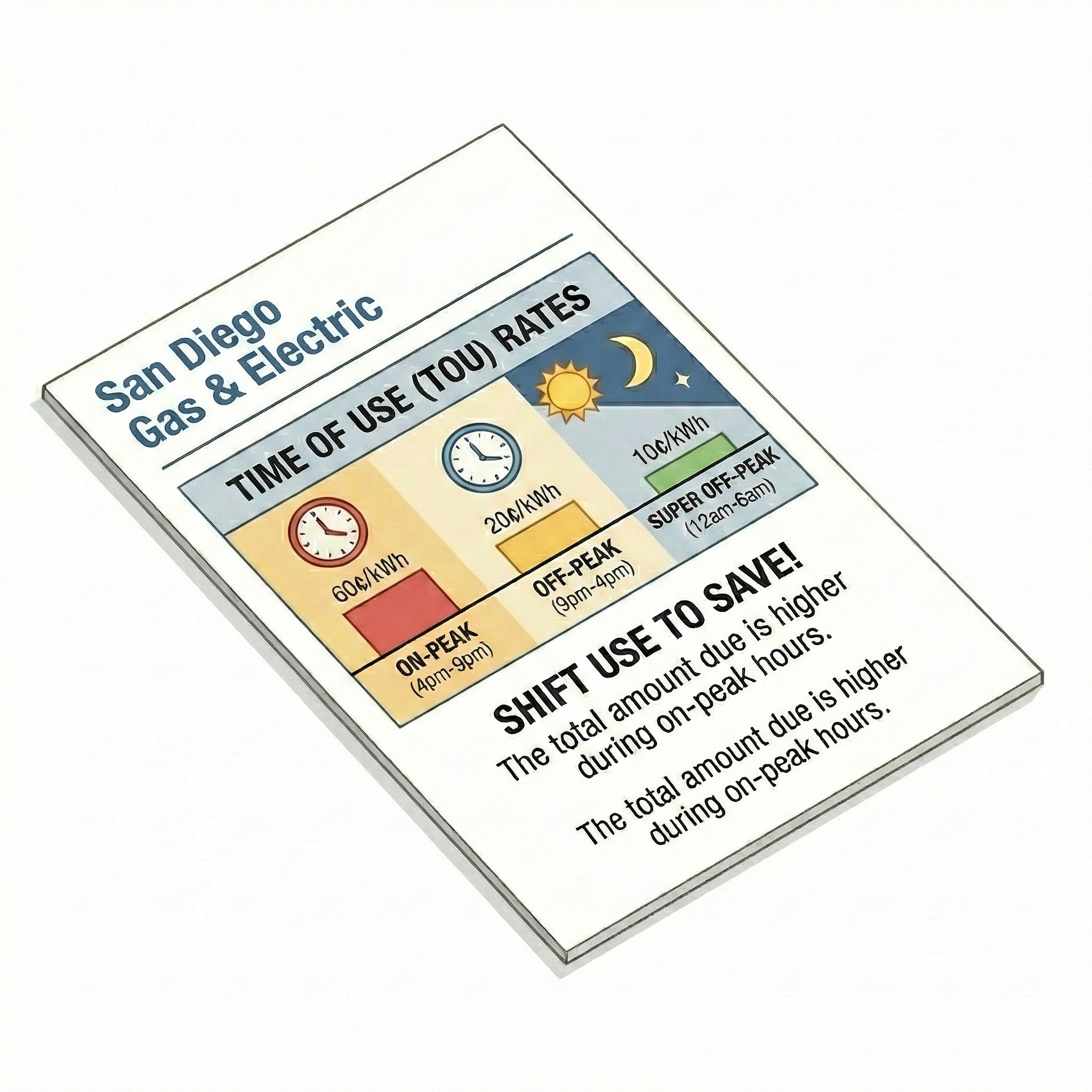
If you live in San Diego or southern Orange County, you probably have a complicated relationship with your electricity bill. You might dread opening the envelope—or the email notification—each month. You are not alone. This region has some of the highest electricity rates in the entire United States. But here is the good news: the days of staring at a confusing total and wondering how it got so high are over. By understanding the rules of the game, specifically the "Time of Use" (TOU) rules, you can take control of your costs.
This guide is written for you—the homeowner, the renter, the EV driver, and the solar enthusiast. We are going to strip away the confusing utility language and break everything down into simple, plain English. We will explore how the grid works, why prices change based on the time of day, and exactly what you can do to lower your bill without sitting in the dark. We will look at the current rates for 2024 and 2025, and we will also prepare you for the big changes coming in late 2025.
Think of this document as your owner’s manual for buying electricity. You wouldn’t buy a car without asking about the miles per gallon, right? Yet, most of us buy thousands of dollars of electricity every year without knowing the "price per gallon." That stops today. We are going to dig deep into the mechanics of your bill, using simple analogies to make the invisible forces of voltage and current visible, and provide you with actionable strategies to keep more money in your pocket.1
Chapter 1: The Building Blocks of Electricity
Before we can talk about dollars and cents, we need to understand what we are actually buying. Electricity can feel mysterious because you can’t see it. You flip a switch, and the light comes on. But to master your bill, you need to understand three key concepts: Voltage, Current, and the difference between Demand and Consumption.
The Water Analogy: Making Sense of the Invisible
The easiest way to understand electricity is to pretend it is water flowing through plumbing pipes in your house. Engineers use this analogy all the time because it works perfectly to explain how energy moves and how you get charged for it.3
1. Voltage (Volts) is Water Pressure
Imagine a large water tank sitting on top of a hill. Because the water is high up, gravity is pulling it down. This creates pressure. The higher the tank, the higher the pressure at the bottom of the pipe.
- In the electrical world, Voltage (V) is that pressure. It is the "push" that moves electrons through the wires.
- In your home, standard outlets usually provide a "pressure" of 120 volts. Your dryer or EV charger might need more "pressure," so they use special outlets with 240 volts.5
2. Current (Amps) is Water Flow
Now, imagine opening a faucet at the bottom of that hill. Water starts rushing out. The amount of water moving past a certain point every second is the flow rate.
- In electricity, this is Current, measured in Amperes (Amps). It is the actual volume of electrons flowing through your wires to power your devices.
- A small device, like a phone charger, is like a dripping faucet—it only draws a tiny trickle of current. A big device, like an electric oven or a pool pump, is like a fire hose—it pulls a massive rush of current.6
3. Resistance (Ohms) is the Pipe Width
Finally, think about the pipe itself. A wide, smooth pipe lets water flow easily. A narrow pipe, or one clogged with sand, fights the water and slows it down.
- This is Resistance, measured in Ohms.
- When electricity pushes through a material that resists it (like the filament in an old-school light bulb), that struggle creates friction, which turns into heat and light. This is literally how incandescent bulbs work—they resist the flow until they glow.5
The Most Important Concept for Your Bill: kW vs. kWh
This is where most homeowners get confused, but it is the most critical part of understanding Time of Use rates. Your bill measures electricity in two very different ways, just like a car dashboard measures your driving. 3
Demand: Kilowatts (kW) = Speed
Think of Kilowatts (kW) as the speed of your car (Miles Per Hour).
- It measures how much energy you are using right this second.
- If you turn on your Air Conditioner (3 kW), your Oven (2 kW), and your Pool Pump (1.5 kW) all at exactly 5:00 PM, your "speed" is 6.5 kW. You are putting a heavy load on the grid at that specific moment.
- Utilities care about this because they have to build wires and transformers thick enough to handle your top speed, even if you only drive that fast for ten minutes a year.8
Consumption: Kilowatt-hours (kWh) = Distance
Think of Kilowatt-hours (kWh) as the distance you drove (Miles).
- It measures the total amount of energy you used over time.
- If you run that 1 kW pool pump for one hour, you have used 1 kilowatt-hour (kWh).
- If you run a tiny 10-watt LED bulb for 100 hours, you have also used 1 kWh.
- Crucial Insight: You can use the same amount of total energy (consumption) by running a small device for a long time or a huge device for a short time. But the huge device creates more stress (demand) on the grid.3
Under Time of Use rates, the utility company charges you differently based on when you create that demand. They want you to avoid "speeding" (high usage) during rush hour (4 PM to 9 PM).
Chapter 2: The Grid and the "Duck Curve"
You might wonder, "Why does the power company care when I run my dishwasher? Electricity is electricity, right?" Actually, no. In California, the cost to generate electricity changes drastically throughout the day. To understand why your rates are so high in the evening, we have to look at the "Duck Curve."
The Solar Surge
California has done an amazing job of installing solar panels. We have rooftop solar on millions of homes, and massive solar farms in the desert.
- Morning to Early Afternoon (9 AM – 3 PM): When the sun is high, these solar panels flood the grid with clean, cheap energy. There is so much power that the price of electricity on the wholesale market sometimes drops to zero—or even goes negative! The grid is awash in energy.9
The Sunset Problem
But then, the sun goes down.
- Late Afternoon (4 PM – 9 PM): Just as solar production disappears, people come home from work. They turn on lights, cook dinner, watch TV, and crank up the air conditioning.
- The Gap: Suddenly, the grid loses its biggest source of power (solar) right when demand hits its peak. The chart of this demand looks like the silhouette of a duck—hence the name "Duck Curve."9
- The Cost: To keep the lights on, grid operators have to rapidly fire up "peaker plants." These usually burn natural gas. They are expensive to run and worse for the environment. Because this power is so costly and scarce, SDG& E charges you a premium to use it. This is why 4 PM to 9 PM is the "On-Peak" window.9
The Price Signal
Time of Use rates are a financial signal. The utility is effectively saying: "We have plenty of cheap power at 1 PM. Please use it then! We are running out of power at 6 PM. Please stop using it!"
By shifting your usage—running the dishwasher at noon or charging the car at midnight—you help balance the grid and lower your own bill.11
Chapter 3: The Players on Your Bill
Before we dissect the rates, take a close look at your bill. You are likely paying two different companies, even though you only send one check.
1. SDG&E: The Delivery Company
San Diego Gas & Electric (SDG&E) owns the poles, the wires, the transformers, and the meters. They are responsible for "Delivery."
- No matter what plan you are on, you pay SDG&E to move the electricity from the power plant to your house.
- Delivery charges cover things like maintaining lines during storms, preventing wildfires (undergrounding wires), and customer service.1
2. The CCAs: The Generation Companies
In the past, SDG&E also bought the electricity itself. But recently, most cities in the region switched to Community Choice Aggregators (CCAs). These are non-profit local agencies that buy power on behalf of residents, often with a focus on greener energy.
- San Diego Community Power (SDCP): Serves San Diego, Chula Vista, Encinitas, Imperial Beach, La Mesa, and National City.13
- Clean Energy Alliance (CEA): Serves Carlsbad, Del Mar, Escondido, Oceanside, San Marcos, Solana Beach, and Vista.14
How it works: Your CCA buys the power (Generation). SDG&E delivers it. SDG&E sends you one bill that lists both charges. They collect the money and send the "Generation" portion to the CCA.
Note: You can opt-out and stick with SDG&E for generation, but for most people, the CCA is the default. The rates we discuss in this report usually combine both Delivery (SDG&E) and Generation (CCA) to show you the "Total Rate".15
3. The PCIA: The "Exit Fee"
You might see a confusing line item called the Power Charge Indifference Adjustment (PCIA).
- Think of this as an alimony payment. When you switched to a CCA, SDG&E was left holding long-term contracts for power plants they bought for you years ago.
- The PCIA is a fee you pay to SDG&E to cover those old contracts so that the customers who didn't switch don't get stuck with the bill. It ensures "indifference"—meaning no one is hurt by your exit.14
Chapter 4: The Menu of Rate Plans (2024-2025)
Now, let’s get to the meat of the issue: the specific rate plans. SDG&E offers several different Time of Use plans. Picking the right one can save you hundreds of dollars a year. The wrong one can cost you just as much.
The Seasons
First, know that the calendar matters.
- Summer (June 1 – October 31): Rates are higher. This is when the grid is most stressed by heat waves and AC usage.
- Winter (November 1 – May 31): Rates are lower, but the peak windows still apply.12
Plan 1: TOU-DR1 (The Standard Choice)
This is the default plan for most residents. If you haven't picked a specific plan, you are probably on this one.
How it Works:
- Three Time Periods:
- On-Peak (4 PM – 9 PM): The expensive time.
- Off-Peak (6 AM – 4 PM and 9 PM – Midnight): The moderate time.
- Super Off-Peak (Midnight – 6 AM and daytime on weekends/holidays): The cheapest time.
- The Baseline Allowance: You get a specific amount of "Tier 1" energy at a lower price. If you use more than that allowance (130% of baseline), you bump up to "Tier 2" prices, which are higher.
Who is it for?
This plan is great if you can shift some usage away from the evening. The "Super Off-Peak" periods on weekends (until 2 PM) are fantastic for doing laundry or running errands.
- Summer On-Peak Rate (approx): $0.60 – $0.68 per kWh. (Very expensive!)
- Summer Super Off-Peak Rate (approx): $0.33 – $0.35 per kWh.
- Strategy: Do your laundry on Saturday morning. Run the dishwasher after midnight. Avoid the oven at 6 PM.1
Plan 2: TOU-DR2 (The Two-Period Plan)
This plan simplifies things by removing the "Super Off-Peak" period.
How it Works:
- Two Time Periods:
- On-Peak (4 PM – 9 PM): Expensive.
- Off-Peak (All other hours): Moderate.
- No "Super" Savings: You don't get the extra discount for usage after midnight. However, the "Off-Peak" rate applies all day long (outside of 4-9 PM).
Who is it for?
This is good for people who are home during the day (retirees, remote workers) and use a steady amount of power. If you run your AC at 1 PM, this plan might be cheaper than DR1 because the daytime rate is "Off-Peak" rather than a mid-tier rate. It’s for people who can't or won't shift chores to the middle of the night.1
Plan 3: TOU-DR-P (Reduce Your Use)
This plan is for the gamblers and the attentive.
How it Works:
- It looks like TOU-DR1, but with a twist.
- Event Days: On extremely hot days when the grid is about to crash, SDG&E calls a "Reduce Your Use" event.
- The Penalty: If you use electricity during peak hours (4 PM – 9 PM) on an event day, you pay a massive surcharge—roughly $1.16 per kWh. That is nearly double the normal peak rate!
- The Reward: In exchange for taking this risk, your standard rates on non-event days are slightly lower.
Who is it for?
Only choose this if you pay attention to text alerts. If you can guarantee that you will turn off your AC and go to the movies when SDG&E sends an alert, you can save money. If you ignore the alert, one bad day can wipe out a year of savings.1
Plan 4: EV-TOU-5 (The EV Owner’s Best Friend)
If you own an electric car, this is almost certainly the plan you want. It is also increasingly popular for people with home batteries.
How it Works:
- Monthly Fee: You pay a fixed "Basic Service Fee" of roughly $16 per month.
- The Trade-Off: In exchange for that $16, SDG&E gives you a deeply discounted rate for charging at night.
- Super Off-Peak Rate: From Midnight to 6 AM, the rate drops to roughly 10 to 12 cents per kWh. This is incredibly cheap compared to the standard 35-40 cents on other plans.
- On-Peak: The rate from 4 PM – 9 PM is still very high (often higher than DR1).
Who is it for?
- EV Drivers: Charging a 75 kWh battery at 10 cents costs $7.50. Charging it at 40 cents costs $30. If you charge your car just twice a month, the savings pay for the $16 fee.
- Battery Owners: If you have a Powerwall, you can charge it from the grid at 10 cents (if allowed) or just use it to cover your home usage during the expensive peak.2
Comparison Table: EV-TOU-5 vs DR1 (Winter Estimates)
| Time Period | TOU-DR1 Cost | EV-TOU-5 Cost |
|---|---|---|
| 4 PM – 9 PM (Peak) | ~$0.55 / kWh | ~$0.47 / kWh |
| Midnight – 6 AM (Super Off-Peak) | ~$0.30 / kWh | ~$0.10 / kWh |
| Monthly Fee | None | ~$16.00 |
Note how the Super Off-Peak rate on EV-TOU-5 is 3x cheaper! That is the power of this plan.17
Plan 5: TOU-ELEC (For the All-Electric Home)
This is a newer plan designed for homes that have ditched natural gas.
How it Works:
- Like EV-TOU-5, it has a ~$16 monthly fee.
- It offers discounted rates for homes with electric heat pumps (for heating or water heaters), battery storage, or EVs.
- The rates are similar to EV-TOU-5 but slightly less aggressive in the spread between peak and off-peak.
Who is it for?
If you have a heat pump water heater but don't have an electric car, this is your ticket to lower rates. It acknowledges that you are using electricity to heat water (which is good for the climate) and gives you a break on the cost.10
Chapter 5: Strategies for Mastering Your Rate Plan
Choosing a plan is Step 1. Living with it is Step 2. Here are pro-tips for maximizing your savings without disrupting your life.
The "Set It and Forget It" Strategy
You don't need to manually flip switches every day. Use automation.
- Dishwashers: Almost every dishwasher made in the last 10 years has a "Delay Start" button (often labeled "2h, 4h, 6h"). Load it after dinner at 7 PM, but press the delay button so it starts at Midnight. You just moved that energy usage from the expensive window to the cheapest one.
- EV Charging: Never, ever plug in your car and let it charge immediately at 6 PM. Set the schedule in your car's dashboard or your charger app to start at 12:05 AM. This is the single biggest money-saver for EV owners.11
The "Pre-Cooling" Trick
Air conditioning is expensive. But you can use your house as a battery.
- How to do it: If you are on a TOU plan, electricity is cheaper before 4 PM. Set your thermostat to cool the house down to 70°F or 72°F starting at 1 PM or 2 PM.
- The Peak: At 3:55 PM, turn your thermostat up to 78°F or 80°F.
- The Result: Your house will be physically cold. It will slowly warm up over the next few hours, but because you "banked" that cold air, your AC unit won't have to turn on during the expensive 4 PM – 9 PM window. You stay comfortable, but you paid "Off-Peak" prices for that comfort.20
Handling "Vampire Loads"
Take a walk around your house at night. Do you see little red or green lights glowing? TVs, game consoles, microwaves, and coffee makers all draw power even when they are "off."
- This "Vampire Load" or "Baseload" can account for 10-20% of your bill.
- The Fix: Use smart strips for your entertainment center. When you turn off the TV, the strip cuts power to the game console and soundbar too.
- Check your smart meter data on the SDG& E website. Look at your usage at 3 AM. If it is consistently high (like 500 watts), you have something running that you might not know about—maybe an old fridge in the garage or a pool pump timer that is set wrong.21
Chapter 6: The Solar Revolution – NEM 2.0 vs. NEM 3.0
Solar power is massive in San Diego. But the financial math changed completely in April 2023. You need to know which set of rules you play by.
The Old Rules: NEM 2.0 (Before April 2023)
If you installed solar before April 14, 2023, you are likely on Net Energy Metering (NEM) 2.0.
- How it works: The grid acts like a free savings account. If your panels produce excess power at noon, you send it to the grid and get a 1-for-1 credit. You can use that credit to "buy" power back at night for free.
- The Benefit: You only pay for the "Net" usage at the end of the year. Time of Use rates matter less to you because your solar credits are worth full retail price.
- Grandfathering: You get to keep this deal for 20 years from the day your system was turned on.22
The New Rules: NEM 3.0 (After April 2023)
If you are installing solar now, you fall under the Solar Billing Plan (NEM 3.0).
- How it works: The grid is no longer a free bank. It acts more like a stock market.
- Imports: When you buy power from SDG&E (at night), you pay the full retail price (e.g., 40-60 cents/kWh).
- Exports: When you sell power to SDG&E (at noon), they pay you the "Avoided Cost." This is the wholesale price of energy, which is very low during the day—often just 4 to 8 cents per kWh.
- The Problem: You are buying high and selling low. You might have to export 10 kWh of solar just to pay for 1 kWh of nighttime usage. Solar without a battery is much harder to justify under these rules.9
The Battery Strategy for NEM 3.0
The new rules are designed to force homeowners to buy batteries (like the Tesla Powerwall or FranklinWH).
- Self-Consumption: Instead of selling your excess solar to the grid for pennies, you store it in your battery. Then, at night, you use your own battery power. You avoid buying expensive grid power entirely.
- September Magic: There is one exception to the "low export" rule. In September, during the late afternoon (6 PM – 8 PM), the grid is desperate for power. The export rate can skyrocket to $3.00 per kWh or more!
- The Strategy: Smart batteries can be programmed to dump all their energy to the grid during these specific hours in September. You can earn hundreds of dollars in credits in just a few weeks, which helps offset your bill for the rest of the winter. This is called "arbitrage."26
Snapshot of NEM 3.0 Export Rates (September 2025):
| Time | Rate |
|---|---|
| 10:00 AM | ~$0.02 / kWh (Worthless to export. Store in battery!) |
| 7:00 PM | ~$3.00 / kWh (Gold mine! Export everything!) |
Chapter 7: The Big Change Coming in October 2025
Just when you think you understand the system, it is going to change again. In late 2025, a state law called Assembly Bill 205 will force all large utilities, including SDG& E, to restructure their bills.28
The Base Services Charge (Fixed Fee)
Currently, almost all the costs of the grid are baked into the "per kWh" price. If you use zero energy, you pay almost nothing. Starting around October 2025, costs for poles, wires, and maintenance will be moved to a flat monthly fee called the Base Services Charge.
The Numbers:
- Standard Customers: You will see a new flat fee of approximately $24.15 per month.
- Low-Income (CARE): The fee will be lower, approximately $6 per month.
- Moderate-Income (FERA): The fee will be approximately $12 per month.
The Lower Volumetric Rate
Because SDG& E is collecting this money upfront, they must lower the price of each kilowatt-hour you buy.
- The Drop: Expect the delivery rate to drop by 5 to 10 cents per kWh.
- The Impact:
- Low Users/Solar Owners: If you have a tiny bill (e.g., $40/month), your bill will likely go up. You are paying $24 to save a few pennies on a small amount of energy.
- High Users/EV Owners: If you have a big bill (e.g., $400/month), your bill will likely go down. You are paying $24, but you are saving 10 cents on thousands of kWh. This policy is designed to make it cheaper to charge electric cars and run heat pumps.29
Why are they doing this?
The state wants to encourage people to switch from gas cars to EVs and from gas furnaces to heat pumps. By lowering the "per unit" cost of electricity, they hope to make electrification more affordable for heavy users.30
Chapter 8: Reading Your Bill Like a Pro
Let's look at the actual bill. It’s confusing because it is split into pieces.
1. Delivery Charges (SDG&E):
This is the money SDG&E keeps. It pays for the physical grid.
- Transmission: Moving power from distant power plants on high-voltage lines.
- Distribution: Moving power down your street to your house.
- Public Purpose Programs: State-mandated fees that fund low-income assistance (CARE) and energy efficiency programs.
- Nuclear Decommissioning: You are paying a small amount to safely dismantle the San Onofre nuclear plant.16
2. Generation Charges (CCA – SDCP or CEA):
This is the money that goes to buy the energy itself.
- It will list your specific plan (e.g., "PowerOn" or "Green Impact").
- It shows the cost per kWh for the energy you used.
3. The Credits:
- California Climate Credit: This is the best part of the bill. Twice a year (usually April and October), you get a lump sum credit. In 2025, the electric credit is approximately $81.38 each time. If you have gas service, you get another credit (~$54). This money comes from the state's cap-and-trade program, where polluters pay for carbon emissions, and that money is returned to you.31
Chapter 9: Future-Proofing Your Home
Energy prices in California have risen faster than inflation for a decade. While we can hope for stability, the smart move is to protect yourself against future hikes.
1 Batteries are the New Solar
As we saw with NEM 3.0, solar panels alone are no longer the silver bullet they once were. Batteries give you independence. They allow you to ignore the On-Peak rates entirely because you are running off your own stored power.
2 Vehicle-to-Home (V2H)
The next generation of EVs (like the Ford F-150 Lightning and upcoming Tesla models) can do something amazing: they can power your house.
3 Electrification
With the Base Services Charge lowering the per-kWh rate in late 2025, replacing gas appliances with electric ones will make more financial sense.
Conclusion
Mastering your SDG& E bill doesn't require a degree in electrical engineering. It requires a shift in mindset. We are moving from a world where energy was an unlimited, flat-rate commodity to a world where time is money.
Here is your checklist for success:
- Know your plan: Check your bill. Are you on DR1, DR2, or EV-TOU-5? Does it match your lifestyle?
- Respect the Peak: Treat the 4 PM – 9 PM window like "rush hour." Avoid it whenever possible.
- Use Automation: Let your car and dishwasher do the thinking for you.
- Prepare for 2025: Understand that a fixed fee is coming, and adjust your budget accordingly.
By taking these steps, you stop being a passive payer and start being an active manager of your home's energy. You help the grid, you help the environment, and most importantly, you help your own bank account.
Reference Tables
Table 1: SDG& E Rate Plans Comparison (2024-2025 Estimates)
| Feature | TOU-DR1 | TOU-DR2 | EV-TOU-5 |
|---|---|---|---|
| Best For | Average Home | Day Users | EV / Battery Owners |
| Monthly Fee | None | None | ~$16.00 |
| Peak Hours | 4 PM – 9 PM | 4 PM – 9 PM | 4 PM – 9 PM |
| Super Off-Peak? | Yes (Midnight-6AM) | No | Yes (Midnight-6AM) |
| Super Off-Peak Rate | ~$0.33 / kWh | N/A | ~$0.10 – $0.12 / kWh |
| On-Peak Rate | ~$0.60 / kWh | ~$0.60 / kWh | ~$0.70 – $0.80 / kWh |
Table 2: Base Services Charge (Effective Oct 2025)
| Customer Type | Monthly Fixed Fee | Estimated Rate Reduction |
|---|---|---|
| Standard Residential | ~$24.15 | -5 to -10 cents/kWh |
| FERA (Moderate Income) | ~$12.00 | -5 to -10 cents/kWh |
| CARE (Low Income) | ~$6.00 | -5 to -10 cents/kWh |
Works cited
- Time of Use, TOU, Pricing Plans, TOU Pricing Plans | San Diego Gas & Electric, accessed December 8, 2025, https://www.sdge.com/residential/pricing-plans/about-our-pricing-plans/whenmatters
- 2024 SDG& E Electric Rates: How To Lower Your Electricity Costs in San Diego | Solar.com, accessed December 8, 2025, https://www.solar.com/learn/sdge-electric-rates/
- The Difference Between Electricity Demand and Electricity Consumption – Atrius, accessed December 8, 2025, https://atrius.com/the-difference-between-electricity-demand-and-electricity-consumption/
- Understanding Demand, accessed December 8, 2025, https://c03.apogee.net/mvc/home/hes/land/el?utilityname=duquesnelight&spc=UD&id=2484
- Voltage, Current, Resistance, and Ohm's Law – SparkFun Learn, accessed December 8, 2025, https://learn.sparkfun.com/tutorials/voltage-current-resistance-and-ohms-law/all
- Understanding the basics of electricity by thinking of it as water – Freeing Energy, accessed December 8, 2025, https://www.freeingenergy.com/understanding-the-basics-of-electricity-by-thinking-of-it-as-water/
- Understand Power: Volts, Amps, Watts, Watt-hours and Cost – Packet Power, accessed December 8, 2025, https://www.packetpower.com/blog/electricity-basics-for-data-centers
- Learning Calculus via Demand and Energy, accessed December 8, 2025, https://michaelsenergy.com/learning-calculus-via-demand-and-energy/
- Explaining and modeling California's Net Billing Tariff (NEM 3.0) | Aurora Solar, accessed December 8, 2025, https://aurorasolar.com/blog/explaining-and-modeling-californias-net-billing-tariff-nem-3-0/
- TOU-ELEC Pricing Plan | San Diego Gas & Electric, accessed December 8, 2025, https://www.sdge.com/residential/pricing-plans/about-our-pricing-plans/tou-elec-pricing-plan
- Pricing Plans to Fit Your Lifestyle – SDGE, accessed December 8, 2025, https://www.sdge.com/sites/default/files/pricing_plan_and_assistance_fact_sheet.pdf
- 2025 Current Residential Rates – San Diego Community Power, accessed December 8, 2025, https://sdcommunitypower.org/wp-content/uploads/2025/02/Schedule-for-WebsiteRes_2021V.pdf
- 2025 Current Residential Rates – San Diego Community Power, accessed December 8, 2025, https://sdcommunitypower.org/wp-content/uploads/2025/02/Schedule-for-WebsiteRes_2022V.pdf
- SDG& E – CEA Joint Rate Comparisons – Clean Energy Alliance, accessed December 8, 2025, https://thecleanenergyalliance.org/wp-content/uploads/2025/03/CEA_SDGE-JRC-02.01.2025_Draft.pdf
- SDG& E – CEA Joint Rate Comparisons – Clean Energy Alliance, accessed December 8, 2025, https://thecleanenergyalliance.org/wp-content/uploads/2024/11/2024.11.01-CEA-SDGE-JRC_Final.pdf
- SDCP – SDG& E, accessed December 8, 2025, https://www.sdge.com/sites/default/files/SDCP_SDGE%20JRC%2010.01.2024_Final.pdf
- Electric Vehicle Pricing Plans | San Diego Gas & Electric, accessed December 8, 2025, https://www.sdge.com/residential/pricing-plans/about-our-pricing-plans/electric-vehicle-plans
- 10-1-25 Schedule EV-TOU-5-P Total Rates Table.pdf – SDGE, accessed December 8, 2025, https://www.sdge.com/sites/default/files/regulatory/10-1-25%20Schedule%20EV-TOU-5-P%20Total%20Rates%20Table.pdf
- How Home Energy Management Systems Empower EV Owners | FranklinWH, accessed December 8, 2025, https://www.franklinwh.com/blog/how-home-energy-management-systems-empower-ev-owners
- Understanding Peak Hours – Power Calculator, accessed December 8, 2025, https://sdge.ca/peak-hours/
- Energy Billing Overview | City of San Diego Official Website, accessed December 8, 2025, https://www.sandiego.gov/planning/heart/energy-billing-overview
- What Is NEM 3.0? Complete Guide To California's New Solar Policy (2025) – SolarTech, accessed December 8, 2025, https://solartechonline.com/blog/what-is-nem-3-0-california-solar-guide/
- Solar Billing Plan | San Diego Gas & Electric, accessed December 8, 2025, https://www.sdge.com/solar/solar-billing-plan
- California Net Billing Tariff (NBT)/NEM 3.0 – FranklinWH, accessed December 8, 2025, https://www.franklinwh.com/knowledge-center/california-net-billing-tariff-nbt
- California NEM 3.0 and Peak August/Sept Export Rates (SCE, PGE,SDGE) – Reddit, accessed December 8, 2025, https://www.reddit.com/r/Powerwall/comments/1ffdftb/california_nem_30_and_peak_augustsept_export/
- Net Energy Metering (NEM) – San Diego Community Power, accessed December 8, 2025, https://sdcommunitypower.org/net-energy-metering/
- Net Surplus Compensation Rate | SCE Tariff Books, accessed December 8, 2025, https://www.sce.com/regulatory/regulatory-information/ferc-Standards-conduct/tariff-books/rates-pricing-choices/net-surplus-compensation
- Base Services Charge | San Diego Gas & Electric, accessed December 8, 2025, https://www.sdge.com/electric-billing
- What is the 'Base Service Charge' coming to your SDG& E bill? | ABC 10 San Diego – Reddit, accessed December 8, 2025, https://www.reddit.com/r/SanDiego_California/comments/1mrou5k/what_is_the_base_service_charge_coming_to_your/
- California Electric Rates Are Surging. Here's What You Need to Know – Baker Home Energy, accessed December 8, 2025, https://bakerhomeenergy.com/kc/ca-electric-rate-increases-october-2025/
- CA Climate Credit to Offset SDG& E Customers' Gas & Electric Bills in October – SDGE Today, accessed December 8, 2025, https://www.sdgetoday.com/ClimateCredit2025