Your neighbor's lights flicker for a half second and they never think about it again. Your Tesla Powerwall, meanwhile, takes your entire house off-grid for five minutes. The power never actually went out, at least not in any way visible to the people on your street without a battery system. But the Powerwall detected something in the grid's voltage or frequency that crossed a threshold, and it responded by disconnecting your home and running on stored energy until it decided the grid was stable enough to rejoin.
This behavior surprises many Powerwall owners, but it is not a malfunction. It is a deliberate, standards-mandated response that every grid-connected battery inverter in the United States is required to perform.
What Your Powerwall Is Watching
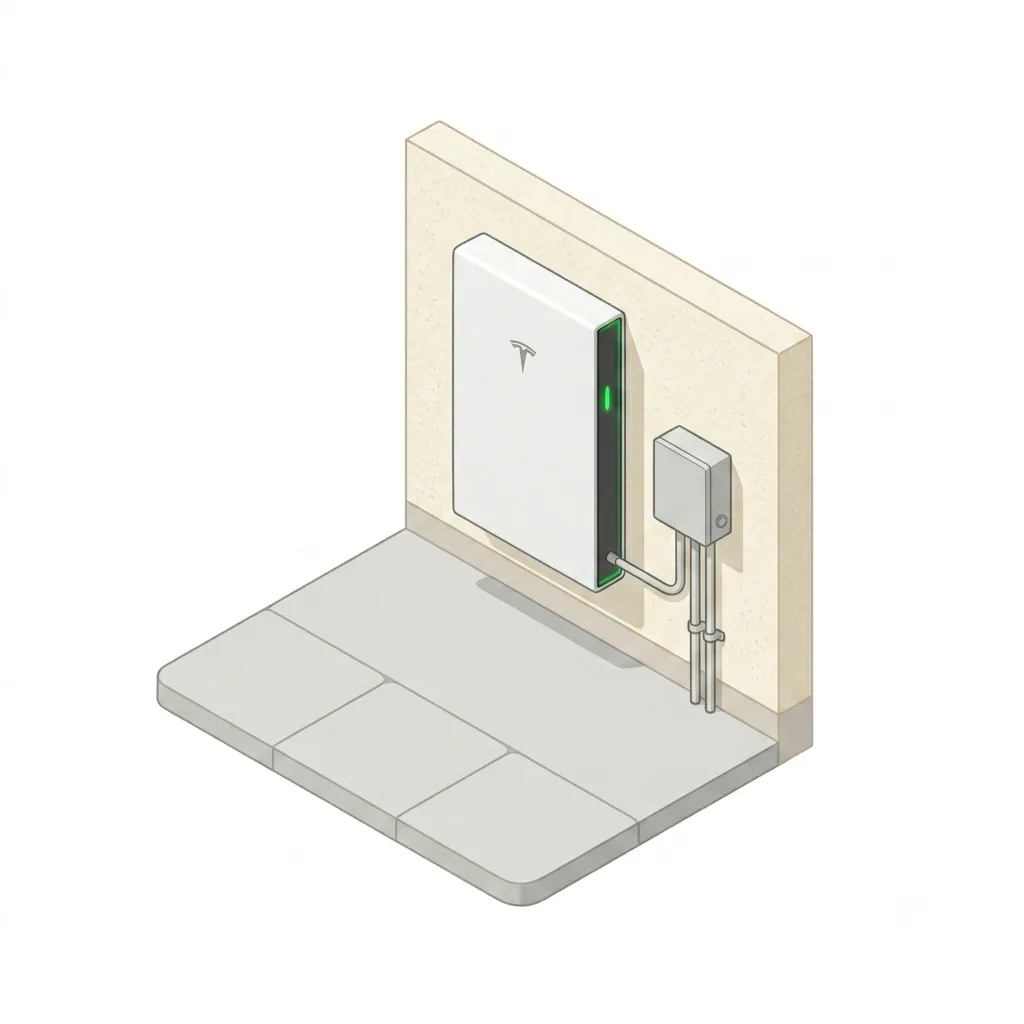
The Powerwall's Gateway, the gray box between your utility meter and your main electrical panel, continuously monitors the grid's voltage and frequency. Tesla's own installation documentation states that "on detection of abnormal condition for voltage or frequency conditions or in response to a detected unintentional island, the Tesla Powerwall system disconnects from the grid to prevent backfeed."
That phrase "abnormal condition for voltage or frequency" covers a broad range of grid disturbances that fall well short of a complete power outage. A voltage sag during a brownout, a momentary spike when a large load switches on nearby, a brief frequency deviation from utility-side equipment, any of these can trigger the Gateway to open its internal relays and island your home.
The disconnect happens quickly. Tesla's Gateway is rated for a transition time of roughly 25 milliseconds, fast enough that most electronics in the home do not register the switch. But the reconnection process is far slower by design.
Why the Five-Minute Wait
When a Powerwall disconnects from the grid due to a voltage or frequency anomaly, it does not reconnect as soon as conditions normalize. Tesla's documentation confirms that normal grid reconnection takes between 15 and 300 seconds after grid power returns to acceptable parameters, and the company recommends contacting support only if reconnection exceeds five minutes.
This delay is not a Tesla design choice. It is a requirement of IEEE 1547, the U.S. interconnection standard for distributed energy resources. The standard mandates that after a grid disturbance causes a disconnect, the inverter must verify that grid voltage and frequency have remained within acceptable bounds for a sustained period before reconnecting. The purpose is to prevent the battery system from rapidly cycling on and off the grid during an unstable event, a scenario that could damage equipment and complicate utility restoration work.
The practical result is that a grid disturbance lasting less than a second, a flicker your neighbors might not even notice, commits your Powerwall to a multi-minute off-grid episode. Owners who monitor their systems closely sometimes report dozens of these events in a single day during periods of poor grid quality, such as when a neighborhood transformer is failing or utility equipment is being serviced.
The Regulatory Stack Behind the Behavior
The Powerwall's disconnect behavior is governed by several overlapping requirements:
IEEE 1547-2018 is the primary interconnection standard. It replaced an older "trip immediately" approach with a more nuanced framework that defines voltage and frequency "ride-through" windows, ranges within which the inverter must stay connected, and trip thresholds beyond which disconnection is mandatory. The standard defines three performance categories with different ride-through capabilities. A voltage sag to roughly 80% of nominal can be tolerated for about two seconds; a deeper sag to 60% of nominal trips in about one second; and a severe sag below 45% triggers disconnection within 0.13 seconds.
UL 1741 is the safety certification standard that inverters must pass for installation. Its Supplement SA covers California Rule 21 compliance, and Supplement SB certifies IEEE 1547-2018 compliance. The Powerwall 3 datasheet confirms certification to UL 1741, UL 1741 SA, and UL 1741 SB.
NEC Section 705.40 requires that interactive power production equipment automatically disconnect from ungrounded conductors upon loss of a primary source phase and remain disconnected until all phases are restored. This is a life-safety rule to prevent backfeeding electricity to utility line workers.
FERC Order No. 828, issued in 2016, ended an exemption that had allowed small generating facilities under 20 MW, including residential battery systems, to disconnect during grid disturbances without consequence. The order required these small systems to meet the same ride-through obligations as large generators, citing the risk that mass simultaneous tripping of distributed resources could cascade into a wider grid reliability event.
These requirements mean that the specific voltage and frequency thresholds at which your Powerwall disconnects are not arbitrary. They are set by Tesla in accordance with your local utility's interconnection agreement and the applicable grid code for your region. A system in Hawaii operates under different parameters than one in California or New York.
Grid-Following vs. Grid-Forming
Most residential battery inverters today, including earlier Powerwall models, use "grid-following" technology. A grid-following inverter synchronizes its output to the grid's voltage and frequency signal. When that signal degrades, during a brownout or voltage sag, the inverter must first detect the change, measure it, and then decide whether to ride through or disconnect. This detection-and-response cycle introduces a small but meaningful lag.
Grid-forming inverters work differently. Instead of following the grid's signal, they generate their own voltage and frequency reference. As NREL researchers Benjamin Kroposki and Andy Hoke explained in IEEE Spectrum, a grid-forming inverter responds to a voltage drop "without even needing to measure the change"; it behaves like a voltage source that inherently resists disturbances rather than reacting to them after the fact.
The Department of Energy describes the distinction plainly: grid-following inverters "shut off power and wait for a signal from the rest of the grid" during disturbances, while grid-forming inverters can establish their own reference and do not need to wait. A 2020 NREL research roadmap identified fault ride-through and voltage recovery as core research gaps for grid-forming battery inverter technology, and a 2025 study in Nature Scientific Reports found that grid-forming battery systems achieved fault ride-through with voltage recovery within 300 milliseconds, while grid-following inverters under the same conditions suffered severe voltage and frequency deviations.
This distinction matters for Powerwall owners because it represents the direction the technology is moving. Grid-forming capability would allow a home battery to ride through the kind of minor voltage fluctuations that currently trigger a full disconnect-and-reconnect cycle.
What Powerwall Owners Can Do
The disconnect behavior is standards-mandated and cannot be eliminated, but there are practical steps to reduce its frequency and impact.
Check your grid quality. If your Powerwall is logging frequent short off-grid events, the grid itself may have a problem. A failing neighborhood transformer, a loose utility connection, or nearby industrial loads can cause chronic voltage fluctuations. Contact your utility and report the issue, several Powerwall owners have traced recurring disconnects to utility equipment problems that were subsequently repaired.
Ask about High Impedance Mode. Tesla's Powerwall 3 documentation describes a "High Impedance Mode" setting that can be toggled on to improve system performance on sites with high grid impedance, particularly where electrical service is 40 amps or less per Powerwall per phase. This setting is specifically designed to address the kind of voltage sensitivity that causes nuisance disconnects on weaker grid connections.
Understand the voltage thresholds. Tesla's published ride-through curves show the specific voltage and duration combinations that trigger a disconnect. The exact values depend on your region's grid code, and they are configured by Tesla, not adjustable by the homeowner. But knowing that a brief sag to 80% of nominal voltage is tolerated for about two seconds, while a deeper sag triggers faster disconnection, helps explain why some grid events cause a disconnect and others do not.
Monitor your system. The Tesla app logs every grid event, including the timestamp and duration. Patterns in these logs, events clustering at a specific time of day, or correlating with specific weather conditions, can help diagnose whether the cause is a grid-side issue, a local wiring problem, or normal behavior for your area's grid quality.
Know what Storm Watch does. Tesla's Storm Watch feature automatically charges your Powerwall to 100% ahead of severe weather events. This is useful preparation, but some owners report Storm Watch activating when they would prefer it not to. Understanding that Storm Watch is anticipating grid instability, not responding to it, can help manage expectations.
The Bigger Picture
The tension at the heart of this issue is straightforward: safety standards require battery inverters to disconnect during grid anomalies to prevent dangerous backfeed, but homeowners bought a battery system precisely to ride through grid problems. A half-second voltage dip that triggers a five-minute off-grid event feels like the system is being too cautious, and from the homeowner's perspective, it often is.
A Sandia National Laboratories study documented this exact conflict, finding that the ride-through settings meant to keep inverters connected during disturbances can interfere with the same inverter's ability to reliably detect a genuine island condition. Regulators and manufacturers are navigating a real engineering tradeoff between grid safety and customer experience.
The move toward grid-forming inverter technology promises to resolve much of this tension. But for current Powerwall owners, the disconnect-during-brownout behavior is working as designed, even when it does not feel like it.