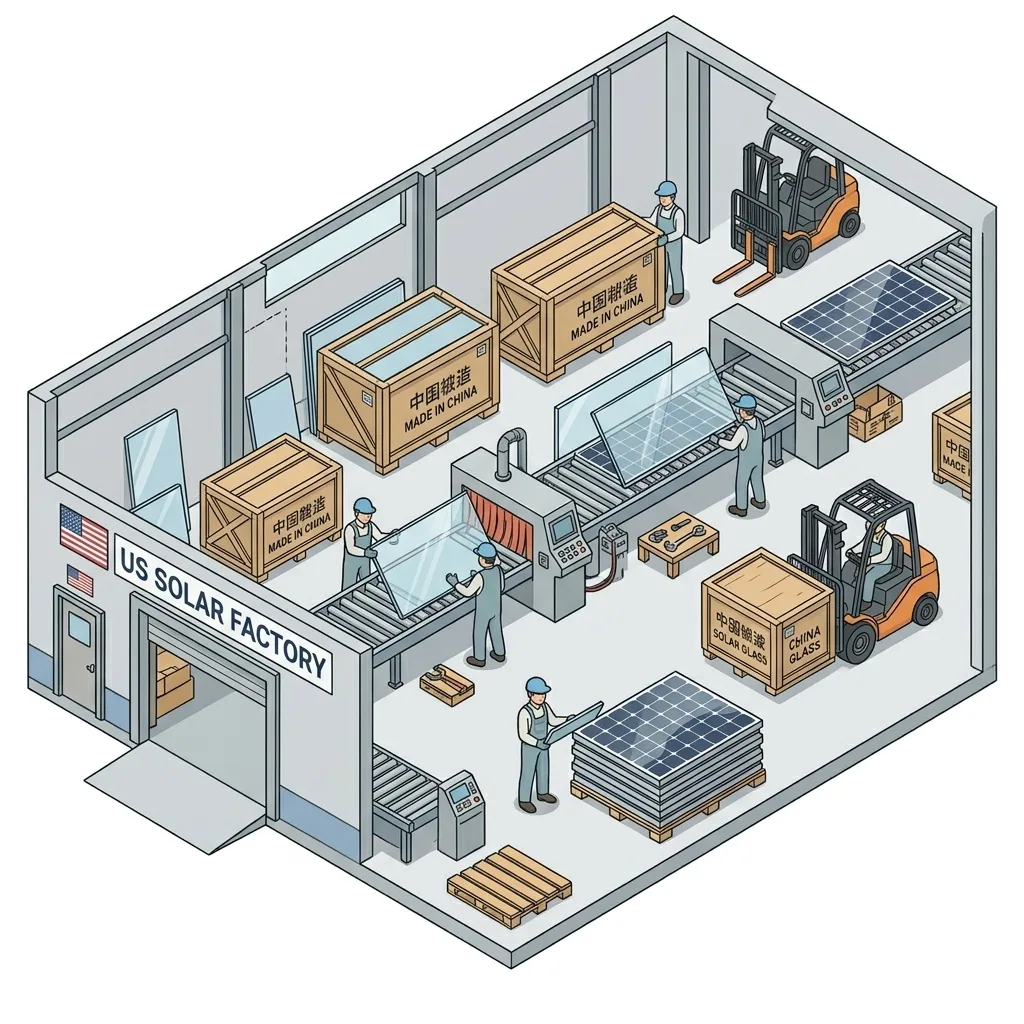
US solar panel manufacturing capacity surged more than 50 percent in a single year, reaching 65.5 gigawatts by the end of 2025. But one critical component is almost entirely absent from the domestic supply chain: the glass.
Solar panels need a specific type of glass, ultra-clear, low-iron, tempered, and patterned, that lets through more than 91 percent of incoming sunlight. Regular window glass absorbs too much light because of its iron content. The specialized glass that covers crystalline silicon solar panels is produced almost exclusively in China, which controls roughly 90 percent of global solar glass manufacturing capacity.
That means the fastest-growing segment of US clean energy manufacturing depends on a single country for one of its most basic raw materials.
The scale of the mismatch
According to the Solar Energy Industries Association, US module manufacturing capacity grew from 42.5 gigawatts at the end of 2024 to 65.5 gigawatts the following year, a jump driven largely by Inflation Reduction Act tax credits that made domestic panel assembly economically viable.
But module assembly is only the final step. Upstream, the picture is far less encouraging. Domestic cell manufacturing capacity stands at roughly 10 gigawatts, with actual production around 5.2 gigawatts. Wafer capacity is just 5 gigawatts. And for rolled patterned glass, the type used on crystalline silicon panels, there is essentially no established domestic production at commercial scale.
"Except for the glass, everything we have in the module could be domestic, should the client choose that," Martin Pochtaruk, CEO of Canadian-based module manufacturer Heliene, told Canary Media.
Why China dominates solar glass
The global solar glass market is dominated by a small number of predominantly Chinese companies. The top three manufacturers, Xinyi Solar Holdings, Flat Glass Group, and IRICO Group, together hold roughly 71 percent of global market share. A second tier of Chinese producers, including CSG Holding and Jin Jing Group, fills most of the remaining capacity.
Non-Chinese solar glass producers exist, but they are small by comparison. Japan's AGC Inc. and France's Saint-Gobain appear in some market rankings, along with NSG Group and Interfloat. None approaches the production volumes of the Chinese leaders.
China's advantage is structural. Chinese glass plants benefit from lower energy costs, cheaper raw materials, lower labor costs, and, critically, proximity to the world's largest concentration of downstream module factories. A single Chinese glass furnace complex operates at roughly ten times the scale of anything being planned in the United States.
Xinyi Solar alone operated at a daily melting capacity of 23,200 tonnes in 2024, down from 27,000 tonnes after the company idled some lines due to global oversupply. For context, the largest US solar glass facility currently in operation produces 150 tonnes per day.
Why domestic production is so difficult
Setting up solar glass production in the US faces compounding challenges that go beyond cost.
A single furnace capable of producing 5–6 gigawatts of solar glass annually requires an estimated $550–600 million in capital investment. The furnace itself is only part of the expense, grid connection alone can take 12 to 18 months because of the enormous electricity demand. Glass furnaces run continuously; once ignited, they cannot be powered down for maintenance or market downturns without a multi-year decommissioning process.
There is also a knowledge gap. The US has limited recent experience with rolled patterned glass manufacturing for solar applications. The expertise exists predominantly in China, where the industry has scaled over the past two decades.
And the policy framework has not addressed the gap. The Inflation Reduction Act's Section 45X advanced manufacturing production tax credits drove the boom in module assembly, but those credits do not directly subsidize solar glass production. Meanwhile, the Department of Commerce's recent countervailing duty investigations on float glass from China and Malaysia, filed by Vitro Flat Glass, the largest US float glass producer, explicitly carve out solar glass products from their scope. Coated solar glass and clear back solar glass are exempted, leaving PV glass in a regulatory gap where it benefits from neither direct production incentives nor import protections.
Who is trying to close the gap
Despite the obstacles, several companies are attempting to build US solar glass capacity.
Stewart Glass operates what is currently the only dedicated solar glass production line in the United States, housed in a former GE Lighting facility in Logan, Ohio. The company produces 150 tonnes per day of 3.2mm ultra-clear, fully tempered solar glass. It is expanding with a second production line that will add 250 tonnes per day of capacity, expected to come online in June 2027.
Solarcycle is building a $344 million facility in Cedartown, Georgia, that would be the first in the US to manufacture solar glass from recycled materials extracted from retired solar panels. The company claims its proprietary process recovers 95 percent of the value from end-of-life panels. The plant targets 5–6 gigawatts of annual glass capacity and has secured a five-year, 15-gigawatt supply agreement with Illuminate USA as its anchor customer. Production is expected to begin in early 2028.
Vitro Architectural Glass received a $67.6 million tax credit to support patterned solar glass production at its Wichita Falls, Texas facility. And in Virginia, MSolar Manufacturing is investing $23.7 million in a vertically integrated facility that will produce solar glass, silicon cells, and assembled modules under one roof.
In Canada, Canadian Premium Sand had proposed an $880 million CAD integrated solar glass facility in Manitoba targeting 6 gigawatts of annual capacity, but paused the project due to policy uncertainty.
The First Solar exception
First Solar, the largest US-headquartered solar manufacturer, sidesteps the glass supply chain problem entirely. Its cadmium telluride thin-film panels use standard float glass rather than the rolled patterned glass required for crystalline silicon modules. First Solar sources its glass domestically from Vitro Architectural Glass and NSG Group.
But First Solar is the exception. The overwhelming majority of the world's solar panels, and nearly all panels assembled by the wave of new US module factories, use crystalline silicon technology that requires specialized solar glass.
What this means going forward
Even as "Made in America" solar panels become more common, the glass in those panels will likely be imported for years. Stewart Glass's current output represents a fraction of what the industry needs. Solarcycle's larger facility will not produce glass until 2028. And a single US furnace at 5–6 gigawatts would still operate at roughly one-tenth the scale of a major Chinese glass complex.
The Department of Energy has identified glass as part of the critical "balance of module" gap in the domestic PV supply chain. An NREL analysis notes that while more than 250 gigawatts of manufacturing capacity has been announced since the IRA's passage, representing over $14 billion in investments, the announcements are concentrated in module assembly, trackers, and inverters. Upstream components, including glass, largely remain missing links.
For homeowners buying solar today, this means supply chain origin is more nuanced than labels suggest. A panel assembled in the United States may contain glass from China, cells from Southeast Asia, and polysilicon that was refined domestically, shipped abroad for wafering, and reimported. Full supply chain traceability, as PV Tech reports, will remain challenging to guarantee for several more years.
The glass gap is not an existential threat to US solar deployment, panels will continue to be assembled regardless of where the glass originates. But it is a reminder that building a supply chain is not the same as building a factory. The hardest parts are upstream, capital-intensive, and slow. A glass furnace is not a panel assembly line. It costs ten times more, takes years to build, and cannot be idled when markets shift.
Two US companies are attempting it. Whether the policy framework catches up to support them may determine whether "Made in America" solar eventually means the whole panel.