When shopping for a ductless mini-split, most buyers focus on the maximum BTU rating: how much heating or cooling the system can deliver at peak demand. But there is a less obvious specification that may matter more for day-to-day comfort: how low the system can go.
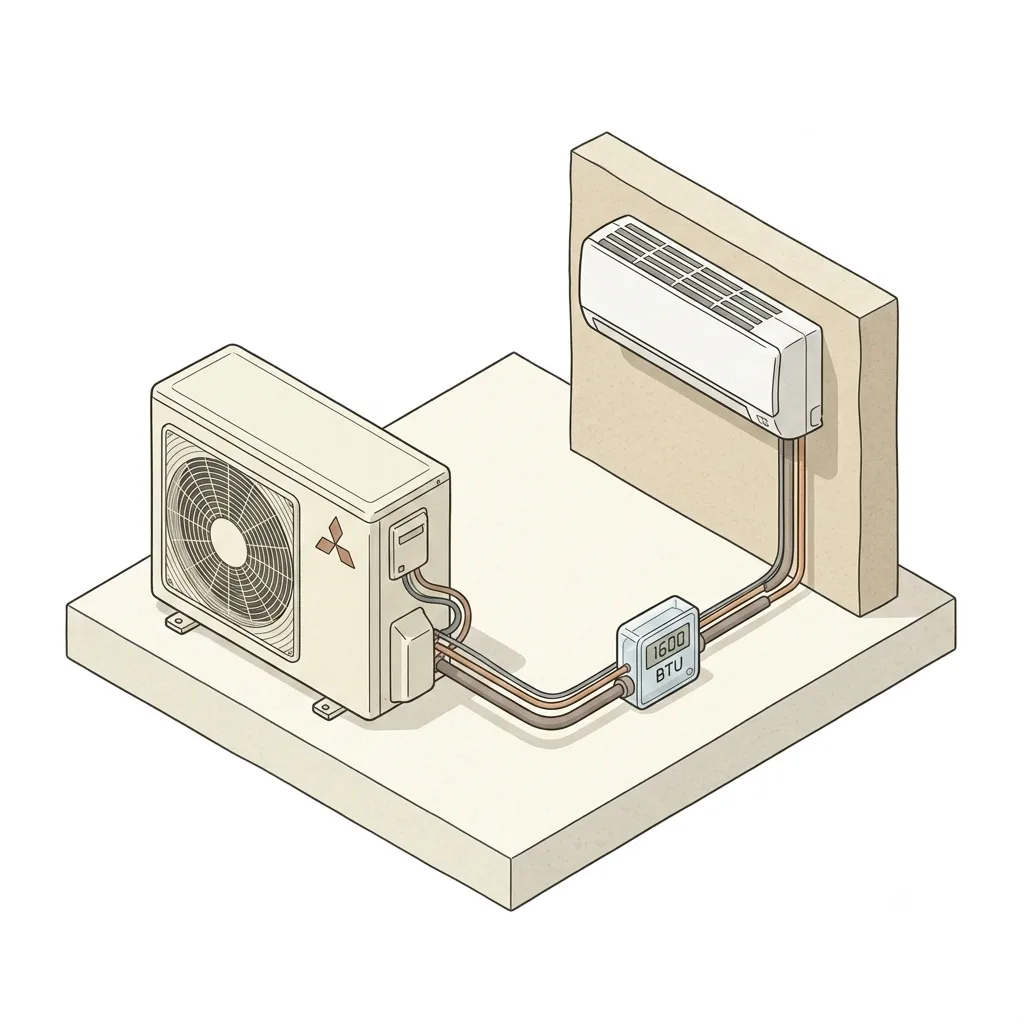
Certain Mitsubishi heat pump systems feature upgraded indoor units capable of modulating down to 1,600 BTU per hour without the compressor shutting down. That is roughly the heat output of a hair dryer on low, delivered continuously and quietly. No other major manufacturer matches this combination of low minimum output and high efficiency at that output.
This capability is called the turndown ratio, the range between a heat pump's maximum and minimum output. A system with a wide turndown ratio can cruise at low speed during mild weather rather than cycling on and off. That distinction affects comfort, efficiency, and humidity control in ways that are difficult to appreciate until you have lived with both approaches.
What turndown ratio means in practice
A traditional single-speed heat pump has two modes: full output and off. When the thermostat is satisfied, the compressor shuts down. When the temperature drifts, it restarts at 100 percent capacity. Each startup wastes energy; compressors typically need 8–10 minutes to reach peak efficiency; and creates temperature swings of 2–4 degrees between cycles.
An inverter-driven mini-split works differently. Its compressor adjusts speed continuously, ramping up when more conditioning is needed and throttling down as the space approaches setpoint. A properly sized system runs nearly continuously at low speed, maintaining temperature within a fraction of a degree.
The critical question is how low that throttle goes. If a 12,000 BTU system only modulates down to 6,000 BTU and your room needs 3,000 BTU on a mild afternoon, the system still produces twice what the space requires. It will cycle on and off like a single-speed unit, forfeiting the comfort and efficiency advantages of variable-speed operation.
Where Mitsubishi's lineup stands
Mitsubishi's wall-mounted mini-splits come in distinct tiers, and modulation capabilities vary significantly between them.
The FH and FS series, what contractors informally call the "upgraded heads", are the premium line. They include the i-see 3D sensor for directed airflow, triple-stage filtration, and Hyper-Heating INVERTER (H2i) technology for cold-climate performance down to −13°F. The 6,000 and 9,000 BTU models in these series achieve a minimum output of 1,600 BTU per hour in heating and 1,700 BTU per hour in cooling.
The GL series is the standard-efficiency option. Despite being the budget line, the GL12 achieves an impressive 1,500 BTU minimum in cooling mode, an 8:1 turndown ratio. However, its heating minimum is higher at approximately 5,500 BTU, and it lacks cold-climate capability.
| Model | Rated Capacity | Min Heating (47°F) | Min Cooling |
|---|---|---|---|
| MSZ-FH06NA (6K) | 6,000 BTU/h | 1,600 BTU/h | 1,700 BTU/h |
| MSZ-FH09NA (9K) | 9,000 BTU/h | 1,600 BTU/h | 1,700 BTU/h |
| MSZ-FS12NA (12K) | 12,000 BTU/h | 3,700 BTU/h | 2,500 BTU/h |
| MSZ-GL12NA (12K) | 12,000 BTU/h | ~5,500 BTU/h | 1,500 BTU/h |
| MSZ-FH15NA (15K) | 15,000 BTU/h | 5,140 BTU/h | 2,500 BTU/h |
The FH09NA achieves a turndown ratio of up to 11:1 when measured as maximum output at 5°F divided by minimum output at 47°F. It can deliver as little as 9 percent of its peak capacity, essentially idling through mild weather.
The multi-zone caveat
If you are considering a multi-head system, one outdoor compressor connected to two or more indoor units, the modulation picture changes substantially.
Multi-zone outdoor units (Mitsubishi's MXZ series) have their own minimum compressor output, typically 6,000–7,200 BTU per hour in heating mode. When multiple heads operate simultaneously, the system minimum is the sum of all active heads' minimums. A Mitsubishi MXZ-2C20 outdoor unit has a minimum output of 5,400 BTU with one head running and 7,800 BTU with both heads active, well above the 1,600 BTU minimum the same indoor unit achieves when paired with its own single-zone outdoor unit.
Single-zone configurations also deliver significantly higher efficiency: approximately 30–33 SEER compared to roughly 20 SEER for the same indoor units in multi-zone setups. That gap translates to about 35 percent more energy consumption at part-load conditions.
Mitsubishi's recent R-454B refrigerant model refresh directly addresses this weakness. The updated three-ton multi-zone unit reduced its minimum heating output from 22,500 BTU to 12,600 BTU, a 44 percent improvement. The new models also extend cold-climate operation from −13°F to −22°F and include built-in Wi-Fi.
Why minimum output matters for comfort and efficiency
Three problems emerge when a heat pump's minimum output exceeds the actual load.
Temperature swings. The system overshoots setpoint, shuts down, allows the temperature to drift, and restarts. Each cycle creates noticeable 2–4 degree fluctuations.
Poor humidity control. During cooling, moisture condenses on the evaporator coil. When the compressor cycles off, that condensate re-evaporates back into the room before draining. A continuously running system maintains the coil below the dew point, allowing moisture to condense and drain. Even at very low compressor speeds, coil temperatures can rise above 52°F and reduce dehumidification, but continuous operation still outperforms cycling for moisture removal.
Wasted energy. A 20 percent reduction in compressor speed produces approximately a 50 percent reduction in energy consumption. A system running continuously at low speed uses less electricity than one cycling between high output and off. Compressors also need 8–10 minutes after each startup to reach peak efficiency, so frequent cycling means the system rarely operates at its best.
Sizing guidelines from ACCA Manual S recommend that a variable-capacity system's minimum output should not exceed 80 percent of the design heating load. A typical well-insulated bedroom needs roughly 2,500 BTU per hour. A system with a 6,000 BTU minimum will cycle in that room. A system with a 1,600 BTU minimum will modulate smoothly.
How Mitsubishi compares to other brands
| Brand / Model | Min Heating Output | Efficiency at Min |
|---|---|---|
| Mitsubishi MSZ-FH09NA (9K) | 1,600 BTU/h | COP 4.6 |
| LG LA090HYV3 (9K) | ~1,023 BTU/h | COP ~1.5 |
| Fujitsu 9RLFCD (9K ducted) | 3,100 BTU/h | Not published |
| Daikin (multi-zone outdoor) | ~6,600 BTU/h | Not published |
LG reaches a lower absolute minimum, but at a COP of approximately 1.5, roughly equivalent to electric resistance heating and a fraction of Mitsubishi's efficiency at minimum output. The older LG LSU090HSV4 modulated down to 500 BTU but has been discontinued.
Daikin's multi-zone outdoor units achieve better turndown than Mitsubishi's comparable multi-zone units, making them worth considering when multi-head installations require low minimum output. Fujitsu's minimum output is roughly double Mitsubishi's for comparable single-zone wall-mounted models, though Fujitsu's XLTH+ cold-climate line operates down to −22°F.
What to look for when choosing a system
The NEEP Cold Climate Heat Pump Product List at ashp.neep.org is the best independent database for comparing minimum capacity across brands and models. It includes turndown ratio as a searchable data field alongside efficiency ratings at multiple outdoor temperatures.
Practical guidance from building science experts:
Size conservatively. Do not exceed 120–150 percent of calculated heating load at the 99 percent design temperature. Oversizing beyond that range eliminates the modulation benefit.
Consider single-zone where possible. For rooms with moderate to small loads, a dedicated single-zone system achieves dramatically lower minimum output and higher efficiency than the same indoor unit on a multi-zone compressor.
Use auto fan mode. Setting fan speed to high prevents the compressor from modulating down because the unit maintains a minimum supply air temperature. Auto mode allows the fan and compressor to coordinate for the lowest possible output.
Avoid temperature setbacks. Mini-splits run at maximum capacity, their least efficient operating point, during recovery from setbacks. Steady setpoints take advantage of continuous low-speed operation.
Cost and incentives
A two-zone Mitsubishi system with FS or FH series indoor units typically runs $6,500–$11,500 installed. Single-zone installations range from $3,800–$8,000. Hyper-Heating models carry a $300–$1,500 premium per unit over standard models. Prices vary by region, with Northeast and West Coast urban markets running 10–30 percent above Midwest averages.
The federal Section 25C tax credit for heat pumps expired December 31, 2025 under the One Big Beautiful Bill Act. IRA-funded HEEHRA rebates remain available through state-administered programs, offering up to $8,000 for qualifying heat pump installations for households at or below 80 percent of area median income and up to $4,000 for moderate-income households. ENERGY STAR Cold Climate certification, which Mitsubishi's H2i models carry, is generally required for rebate eligibility.