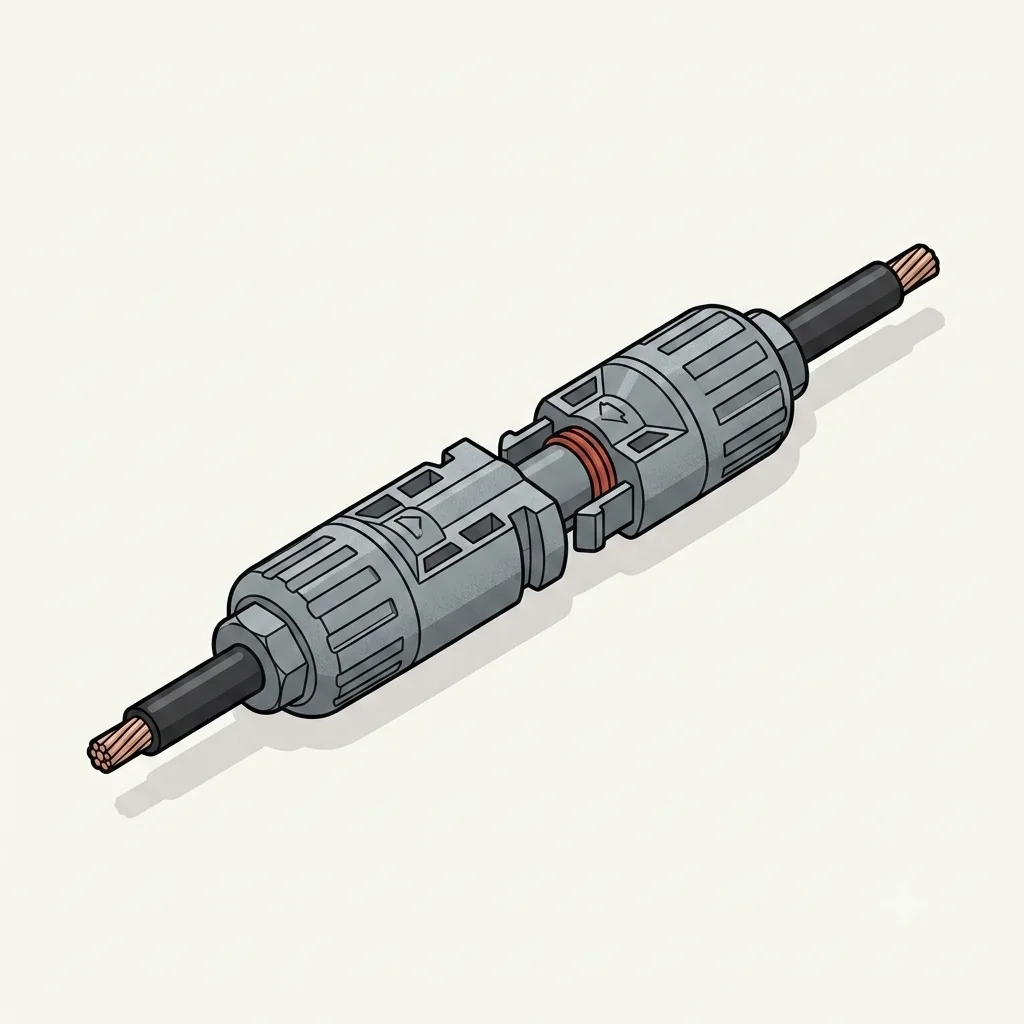
Every MC4 solar connector looks roughly the same: a cylindrical housing, a 4 mm contact pin, a locking clip. Dozens of manufacturers produce them. Online retailers sell them interchangeably. It is natural to assume they are all compatible.
They are not. Mixing MC4 connectors from different manufacturers can create compatibility and safety problems that range from increased electrical resistance to connector fires, and it violates the National Electrical Code.
What MC4 actually is
"MC4" stands for Multi-Contact 4 mm. The connector was introduced in 2004 by Multi-Contact, a Swiss company acquired by Stäubli in 2002. As of 2022, Stäubli holds roughly 50 percent of the global PV connector market.
The name describes a specific product line, not an open standard. There is no MC4 specification that other manufacturers can license or build to. When a company sells "MC4-compatible" connectors, it is claiming dimensional similarity to the Stäubli design: nothing more. That label carries no certification, no tested interoperability, and no code compliance.
Stäubli has stated explicitly that it has not recognized any third-party product as compatible with MC4 connectors and does not intend to.
Why cross-brand connectors fail
Two MC4-style connectors from different manufacturers may slide together and click. That does not mean they form a reliable electrical connection. The failure mechanisms are well documented.
Tolerance differences. Each manufacturer designs to its own internal specifications. Contact pin diameter, socket spring tension, and housing dimensions vary by fractions of a millimeter, enough to reduce the contact surface area and increase electrical resistance. A Stäubli analysis of generic connectors found terminals that physically inserted into MC4 housings but failed to lock, allowing them to be pulled free by hand.
Material incompatibility. Different manufacturers use different metal alloys and plating materials for contact pins. When dissimilar metals are pressed together in the presence of moisture, galvanic corrosion develops at the contact interface. This corrosion increases resistance progressively in a self-reinforcing cycle: higher resistance produces more heat, which accelerates corrosion, which raises resistance further.
Thermal expansion mismatch. Connectors in a PV system cycle through wide temperature swings daily. If the housing and contact materials expand at different rates, as they will when sourced from different manufacturers, the connection loosens over time. Each thermal cycle widens the gap slightly, compounding the resistance problem.
Seal degradation. MC4 connectors are rated IP67 when properly mated, meaning they withstand temporary submersion. That rating is achieved through precise tolerances between the housing O-rings and mating surfaces. Cross-brand pairs frequently fail to achieve a full seal, allowing moisture ingress that accelerates corrosion and creates paths for tracking currents.
What the electrical code requires
The National Electrical Code addressed connector mixing directly in the 2020 edition. NEC Section 690.33(C) requires that PV connectors be "listed and identified as being of the same type and from the same manufacturer, or listed and identified for intermatability."
That second clause, intermatability, is where confusion arises. To be listed as intermatable, two connector brands must be tested together by a nationally recognized testing laboratory (such as UL) and receive a formal listing. As of this writing, no cross-brand MC4 combination has achieved intermatability certification.
The international standards tell the same story. UL 6703 and IEC 62852 evaluate connectors from a single manufacturer. Both standards were recently updated to explicitly prohibit evaluating cross-brand pairs. IEC 62548 requires connectors "of the same origin." An NREL presentation at the 2024 Photovoltaic Reliability Workshop described the routine cross-mating of connectors from different manufacturers as "rampant violation of electrical codes worldwide."
A one-off test report from a private lab showing that two brands "work together" does not constitute certification. Design-type certification requires an accredited body, standardized test protocols, and recurring production audits; none of which apply to cross-brand connector test reports.
What the field data shows
The consequences of connector mismatch are not theoretical. Field inspection data from multiple organizations paints a consistent picture.
HelioVolta's 2025 inspection findings, reported in Solar Builder, found that 83 percent of inspected PV projects had at least one connector issue. Of the sites with major or critical problems, 40 percent involved intermated connectors from different manufacturers, a direct NEC 2023 violation.
Sandia National Laboratories' PV Connectors Research Program has conducted thermal imaging of field connectors across the United States. Normal operating temperature for a properly mated connector is 25–27°C. Sandia found connectors running at 95°C, a temperature that degrades housing materials and is a precursor to fire.
The financial consequences are significant. One case study documented a connector fire on a 1 MW commercial rooftop system that caused $558,450 in losses, 58 percent of the system's annual revenue.
A broader analysis by Mayfield Renewables cited PVEL data showing approximately 3.5 billion PV connections exist globally. BOS components, including connectors, represent roughly 10 percent of system cost but account for up to 70 percent of system failures. Over 40 percent of PV fire cases are attributed to DC arc faults, and connectors are a primary source of the high-resistance connections that trigger them.
In Brazil, a Stäubli forensic analysis of generic connectors found that their terminals were physically incompatible with genuine MC4 housings; the terminals inserted but did not lock, making the connection mechanically unreliable. A 100 MW project in Germany experienced 47 connector failures within six months of commissioning.
What "MC4 compatible" actually means
The phrase "MC4 compatible" appears on thousands of connector listings online. It suggests interchangeability. In practice, it means the connector has a 4 mm contact pin and a housing that physically mates with an MC4 connector.
It does not mean the connector has been tested with MC4 connectors by a recognized lab. It does not mean it meets the same material specifications. It does not mean it achieves the same contact resistance, IP rating, or mating force. And it does not satisfy NEC 690.33(C), which requires formal listing, not physical fit.
TÜV Rheinland, the largest PV certification body, conducted a Failure Modes and Effects Analysis that ranked dissimilar connector mating as the single greatest risk to PV system performance and safety. The analysis cited contact corrosion from differing metal alloys, thermal expansion mismatches, and dimensional tolerance differences as the primary failure mechanisms.
Genuine Stäubli MC4 connector pairs typically cost $3–8 each. The price difference between genuine connectors and generic alternatives is small relative to the cost of a solar installation, and negligible compared to the cost of a connector-related fire or a failed inspection.
How to protect your system
Use one brand throughout. The simplest path to code compliance is to use connectors from a single manufacturer across the entire system. If your solar panels ship with Stäubli connectors, use Stäubli for all field-made connections.
Verify UL listing. Check that connectors carry a UL 6703 listing verifiable in the UL Product iQ database under the PVSM category. A UL mark on the packaging is not sufficient; listings can be verified online.
Inspect crimps. A proper crimp produces a gas-tight connection between the wire strands and the contact terminal. Use the manufacturer's specified crimping tool and die set. A $30 ratcheting crimper from a reputable tool manufacturer will produce reliable crimps, but only with the correct die for your connector brand and wire gauge.
Never disconnect under load. MC4 connectors are not rated for load-break operation. Disconnecting them while the system is producing power creates an arc that damages the contact surfaces, increasing resistance for all future connections. Always shut down the system or wait for dark before disconnecting.
Check sealing rings. Different brands use different-sized cable sealing glands. If the gland does not grip the cable tightly, moisture will enter the connector body over time. A connector that is hand-tight but not sealed to its cable is a failure waiting to happen.
Inspect periodically. Thermal imaging during peak production can identify high-resistance connections before they fail. A connector running more than 10°C above ambient or above adjacent connectors in the same string warrants investigation.
The industry is working on a fix
The current situation, where the most widely used PV connector in the world cannot be legally mixed across brands, is recognized as a problem. NREL has initiated work through IEC Technical Committee 82, Working Group 2, to develop a universal PV connector standard that addresses geometric and material compatibility across manufacturers.
Until that standard exists, the safest and most code-compliant approach is straightforward: pick one connector brand and use it everywhere.