If you live in a two-story house and the upstairs is always warmer than the downstairs, or the basement is noticeably colder than the main floor, you have probably seen the advice to set your thermostat fan to "on" or "circulate" mode. The idea is simple: keep air moving through your ductwork even when the system is not actively heating or cooling, and the temperatures between floors will even out.
The advice is broadly correct, but it comes with conditions that determine whether the strategy saves you money or wastes it.
Why floors end up at different temperatures
The underlying cause is usually the stack effect. Warm air is less dense than cold air, so it rises. In a multi-story home, this creates a natural pressure gradient: warm air moves upward through stairwells, mechanical chases, and any unsealed gaps in the structure, while cooler air settles to lower levels. The stack effect generates roughly 4 pascals of pressure per story in winter and about 1.5 pascals per story in summer.
In winter, heated air rises to the upper floors and exits through gaps in the ceiling, attic access points, and recessed light fixtures. Cold outdoor air infiltrates at the lower levels to replace it. In summer, the pattern partly reverses, but the upper floor still tends to be warmer because the roof absorbs solar heat and radiates it downward.
The result is a temperature difference between floors that typically runs 6–10°F in a two-story home with a single HVAC system. In extreme cases, especially between a basement and a second floor, the gap can reach 15–20°F.
How fan circulation helps
When the thermostat is set to AUTO, the blower motor only runs during active heating or cooling cycles. Between cycles, air sits still in the ducts, and the temperature in each room drifts based on local conditions: heat gain from windows, heat loss through exterior walls, and the stack effect pulling warm air upward.
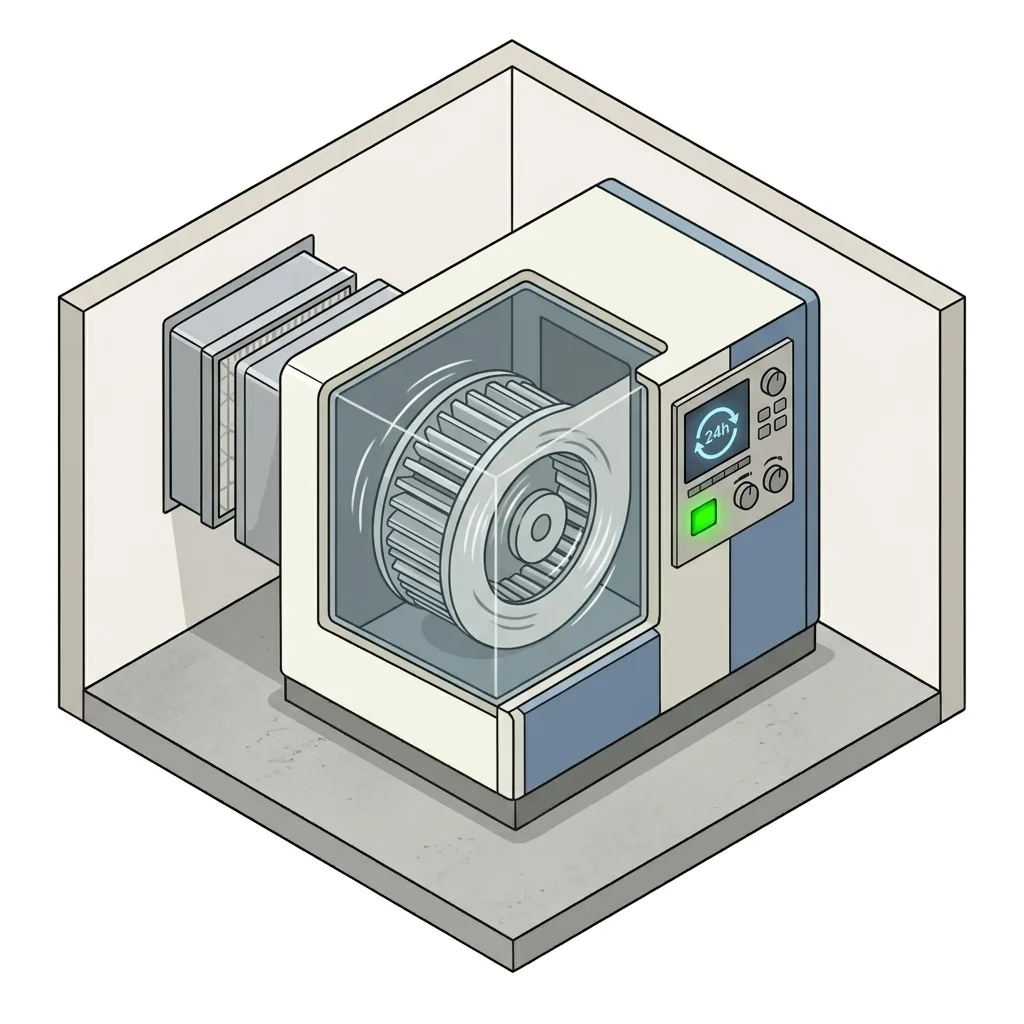
Setting the fan to ON or using a circulate mode keeps the blower running between cycles. Air is pulled through return vents, mixed in the air handler, and pushed back out through supply registers on every floor. If you have return vents on all floors, the system pulls warmer air from upstairs and cooler air from downstairs, blends them, and redistributes the mix. One documented case found that a 6–7°F floor-to-floor gap dropped to 2–3°F with continuous fan operation.
The circulate mode on most modern thermostats is a timed version of this approach. Honeywell's circulate mode runs the fan about 20 minutes per hour, roughly 33% of the time. Lennox iComfort defaults to about 21 minutes per hour. Ecobee allows anywhere from 0 to 55 minutes per hour. The 80% duty cycle that some homeowners recommend is unusually aggressive; most manufacturer defaults sit at 20–35%.
The motor type determines whether this makes economic sense
This is the single most important factor, and it is often left out of the advice.
PSC (permanent split capacitor) motors are single-speed. When they run, they draw 400–800 watts regardless of whether the system is heating, cooling, or just circulating air. Running a PSC motor continuously adds roughly $28–56 per month to your electric bill at typical rates. Over a year, that is $336–672 in extra electricity for temperature mixing alone.
ECM (electronically commutated motors) are variable-speed. In fan-only circulation mode, they drop to low speed and draw approximately 80 watts, about the same as an incandescent light bulb. Running an ECM motor continuously adds roughly $4–8 per month. The annual cost is modest enough that the comfort benefit often justifies it.
ENERGY STAR certified air handlers and heat pumps, including Bosch's IDS 2.0 series, use ECM motors. If your system was installed after 2015 and meets current efficiency standards, it likely has one. Older systems with a single-speed, always-loud blower almost certainly have a PSC motor.
When continuous fan does not help, or makes things worse
Leaky ductwork
Running the fan continuously pushes air through your ducts for more hours per day. If your ducts have leaks, especially in unconditioned spaces like attics, crawlspaces, or garage ceilings, every hour of extra fan runtime loses more conditioned air to those spaces and pulls in unconditioned air. Research from ASHRAE and building performance organizations suggests that duct leakage can increase fan energy consumption by 4% at best to over 100% at worst, depending on leakage severity.
Before switching to continuous fan, it is worth having a professional check your duct system for leaks. The improvement from sealing ducts often exceeds the improvement from running the fan more.
No return vents upstairs
The fan can only equalize temperatures if it can pull air from every floor. If your return vents are only on the main floor, a common builder shortcut in older construction, the fan just recirculates main-floor air while the upstairs remains a dead zone.
If you lack upstairs returns, adding them is often the single highest-impact upgrade for multi-story comfort. Transfer grilles or jump ducts between rooms and hallways can also help balance pressure. A general guideline is one return per 600–900 square feet.
Humid climates
In humid climates, the air conditioning coil collects moisture during cooling cycles. When the compressor shuts off but the fan keeps running, it blows across the wet coil and re-evaporates that moisture back into your home. The result is higher indoor humidity, which makes the house feel warmer and can promote mold growth.
In dry climates, including Denver and much of the Mountain West, this is not a concern. In the Southeast, Gulf Coast, or other humid regions, continuous fan operation during cooling season is generally a bad idea unless the system has a dedicated dehumidification mode.
Cool drafts between heating cycles
When the furnace or heat pump is not actively heating, the air in the ductwork cools toward room temperature. Running the fan during these pauses pushes air across your skin at 65–68°F, below body temperature, which can feel like a cool draft even though the air is not actually cold. Some homeowners find this uncomfortable enough to switch the fan back to AUTO in winter.
Alternatives and complements
Fan circulation addresses a symptom. The stack effect itself is driven by air leakage through the building envelope. Sealing attic bypasses, basement rim joists, and gaps around pipes and wires reduces the pressure gradient that causes temperature stratification in the first place. The Department of Energy estimates that air sealing combined with insulation improvements can reduce heating and cooling costs by up to 50%.
Other approaches that address the root cause or target specific floors:
- Damper adjustment: partially closing supply registers on the first floor redirects more conditioned air upstairs. A free, if imprecise, first step.
- Adding or enlarging upper-floor return vents: directly improves upper-floor air exchange with the system.
- HVAC zoning with motorized dampers: independent temperature control per floor, but requires compatible equipment and professional installation.
- Ductless mini-splits: targeted heating and cooling for a chronically hot or cold floor without modifying the central system.
- Ceiling fans: reduce perceived temperature by 3–4°F through air movement, at very low energy cost.
- Attic insulation: reduces solar heat gain on the top floor in summer, often the largest single contributor to an overheated second floor.
The bottom line
Running your HVAC fan on circulate mode is a legitimate strategy for reducing temperature differences between floors, if the conditions are right. The conditions: an ECM blower motor, reasonably sealed ductwork, return vents on all floors, and a dry or moderate climate.
If you have an older system with a single-speed PSC motor, the energy cost of continuous operation is hard to justify. And if your ducts leak into unconditioned spaces, running the fan more just amplifies the problem.
The fan trick works best as one element of a balanced system, combined with proper return ductwork, reasonable air sealing, and adequate insulation, not as a standalone fix for a 10°F floor-to-floor gap.