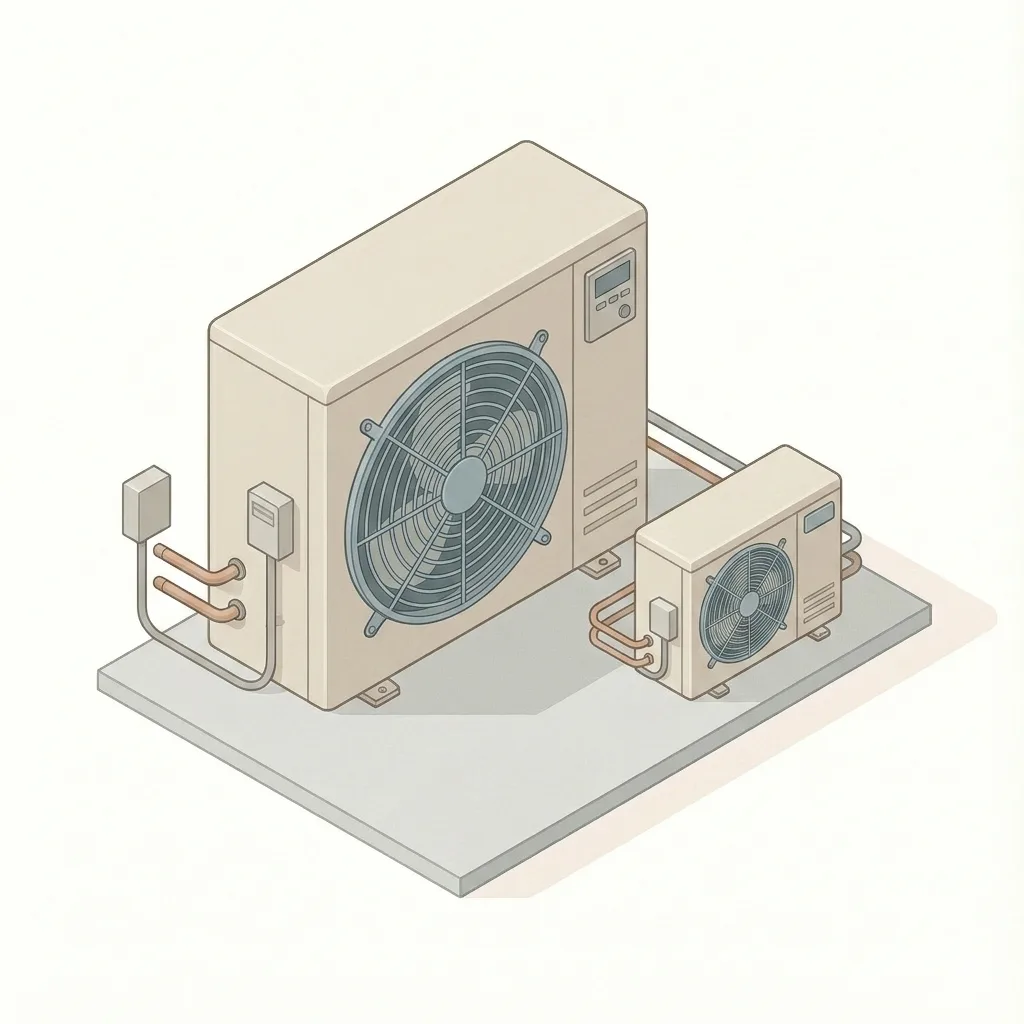
When it comes time to replace a heating and cooling system, the instinct is natural: go a little bigger, just to be safe. With traditional furnaces and air conditioners, oversizing was sometimes tolerated. Heat pumps are different. Oversizing modern, high-efficiency heat pumps can cause more problems than it solves: from clammy rooms to higher energy bills to premature equipment failure.
Here is what happens when a heat pump is too large for the space it serves, and what you can do to avoid the problem.
What Short Cycling Is and Why It Matters
Heat pumps perform best when they run longer, steadier cycles. A properly sized system runs for extended periods, maintaining even temperatures and giving the indoor coil enough time to do its full job.
An oversized heat pump satisfies thermostat calls for heating or cooling too quickly and shuts off, a behavior known as short cycling. Trane's engineering guidance defines cycles shorter than about seven minutes total, three minutes on, five minutes off, as short cycling and identifies it as a durability concern. The pattern creates a cascade of problems.
Poor Humidity Control
In cooling mode, removing humidity is a major part of what a heat pump does. The evaporator coil needs sustained airflow to condense moisture out of the air. Short cycling prevents heat pumps from running long enough to effectively remove humidity during cooling mode, resulting in clammy indoor air, even when the thermostat reads the right temperature.
Modern high-efficiency equipment actually makes this worse, not better. According to HVAC Know It All, newer high-efficiency coils have roughly 26% less dehumidification capacity than older equipment. That means correct sizing is more important for today's heat pumps, not less.
Uneven Temperatures and Faster Wear
Short cycling causes uneven temperatures because the air does not mix thoroughly throughout the home. The system satisfies the thermostat near its location, but rooms farther away may still be too warm or too cold.
Short cycling increases wear and tear on components such as the compressor, potentially shortening the system's lifespan. Starting and stopping is harder on mechanical components than steady operation. The initial power surge to start a heat pump compressor uses significant energy, and multiple short cycles can consume more power than single, steady cycles covering the same heating or cooling output. Mitsubishi Electric's technical documentation notes that fixed-speed compressors draw three to four times more power at startup than inverter-driven units.
Variable-Speed Heat Pumps Help, but Do Not Solve Everything
Modern inverter-driven heat pumps can ramp output up or down rather than running at full blast or shutting off entirely. This is a genuine advantage that buys more sizing headroom. The industry-standard Manual S allows oversizing of up to 130% of the calculated cooling load for variable-speed systems, compared with 115% for single-stage equipment.
But variable-speed technology does not eliminate the oversizing problem. Every compressor has a minimum output floor, a speed below which it cannot modulate. If the home's load drops below that floor, the system cycles on and off just like a single-stage unit. As the Northeast Energy Efficiency Partnerships (NEEP) documented, even variable-speed heat pumps show excessive cycling, low efficiency, and ineffective summer dehumidification when oversized beyond their modulation range.
There is also a subtlety in how capacity reduction works. When a variable-speed compressor throttles down, it reduces both temperature-cooling capacity and moisture-removal capacity in equal proportion. An oversized inverter unit running at partial load still under-dehumidifies relative to a right-sized unit running closer to full capacity.
How to Get Sizing Right
Proper heat pump sizing is determined by a load calculation known as Manual J, published by the Air Conditioning Contractors of America (ACCA). This is not a rough estimate. It is the ANSI-accredited national standard referenced by the International Residential Code and adopted into law by most states.
Manual J calculations consider specific home factors including orientation, window types and sizes, insulation levels, air leakage, regional climate data, and internal heat gains from people and appliances. A companion standard, Manual S, then matches the calculated load to specific equipment at actual operating conditions.
This is a far cry from the rules of thumb some contractors still use. Rewiring America's analysis found that common sizing shortcuts like "one ton per 500 square feet" oversized systems by an average of 31,000 BTU, and left 32% of homes undersized under an alternative rule. Neither outcome is acceptable.
What to Ask Your Contractor
A few questions can separate a careful installer from one who is guessing:
- "How will you size the system?" If the answer is square footage alone, that is a red flag. A quality contractor will reference a Manual J calculation.
- "Can I see the load calculation?" Consumer Reports recommends asking for printouts of the contractor's calculations and assumptions.
- "Why this particular unit size?" EnergySage notes that quotes for the same home can range from 4 tons to 8 tons depending on the contractor's methodology, so understanding the reasoning matters.
Be cautious about proposals that seem large relative to your existing system. A home that needed a 100,000 BTU/hr furnace might need only a 36,000 BTU/hr heat pump; the technologies deliver heat differently, and a one-to-one replacement is usually wrong.
The Bottom Line
Right-sizing a heat pump takes more effort than guessing, but the payoff is real: better comfort, lower bills, and longer equipment life. The answer is not to buy the biggest system available. It is to work with a contractor who will calculate what your home actually needs.